

Sales Attrition: What It Really Costs and How to Fix It
Your best AE just put in two weeks' notice. She's got $400K in pipeline that nobody else knows how to close, and her replacement - assuming you find one within 60 days - won't be fully productive for another three to six months. Meanwhile, the remaining reps absorb her accounts, her manager burns hours redistributing deals instead of coaching, and morale on the floor takes a visible hit. The math on that single departure? Roughly $115K fully loaded, plus whatever revenue evaporates from orphaned deals.
That's sales attrition in action. Now multiply it by the three other reps eyeing the door.
The Short Version
Rep turnover in sales averages 35% annually - nearly three times the 13% average across all industries. Each departure costs roughly $115K when you factor in recruiting, vacancy, ramp, and lost pipeline. The number-one controllable driver isn't compensation - it's toxic culture, which MIT Sloan found is 10x more predictive of attrition than pay. To calculate your own rate: departures / average headcount x 100. The 90-day playbook in Section 8 gives you the step-by-step fix.
What Is Sales Attrition?
Sales attrition means different things depending on who's asking. For most sales leaders - and the primary focus of this article - it's employee turnover: the rate at which reps leave your sales org, voluntarily or involuntarily, over a given period. That includes resignations, terminations, and internal transfers out of the sales function.
Technically, turnover means the role gets refilled; attrition means the headcount disappears. In practice, sales leaders use the terms interchangeably, and we will too.
There's a secondary meaning that trips people up. Some teams use the phrase to describe customer churn - the rate at which accounts stop buying. The two concepts share a word but require completely different playbooks. We'll cover the customer-side definition briefly near the end for anyone who landed here looking for that. Everything between here and there is about keeping your reps from walking out.
Losing a customer is a revenue problem. Losing a rep is a compounding operational crisis - it hits revenue, morale, pipeline coverage, and manager bandwidth all at once.
Rep Turnover by the Numbers
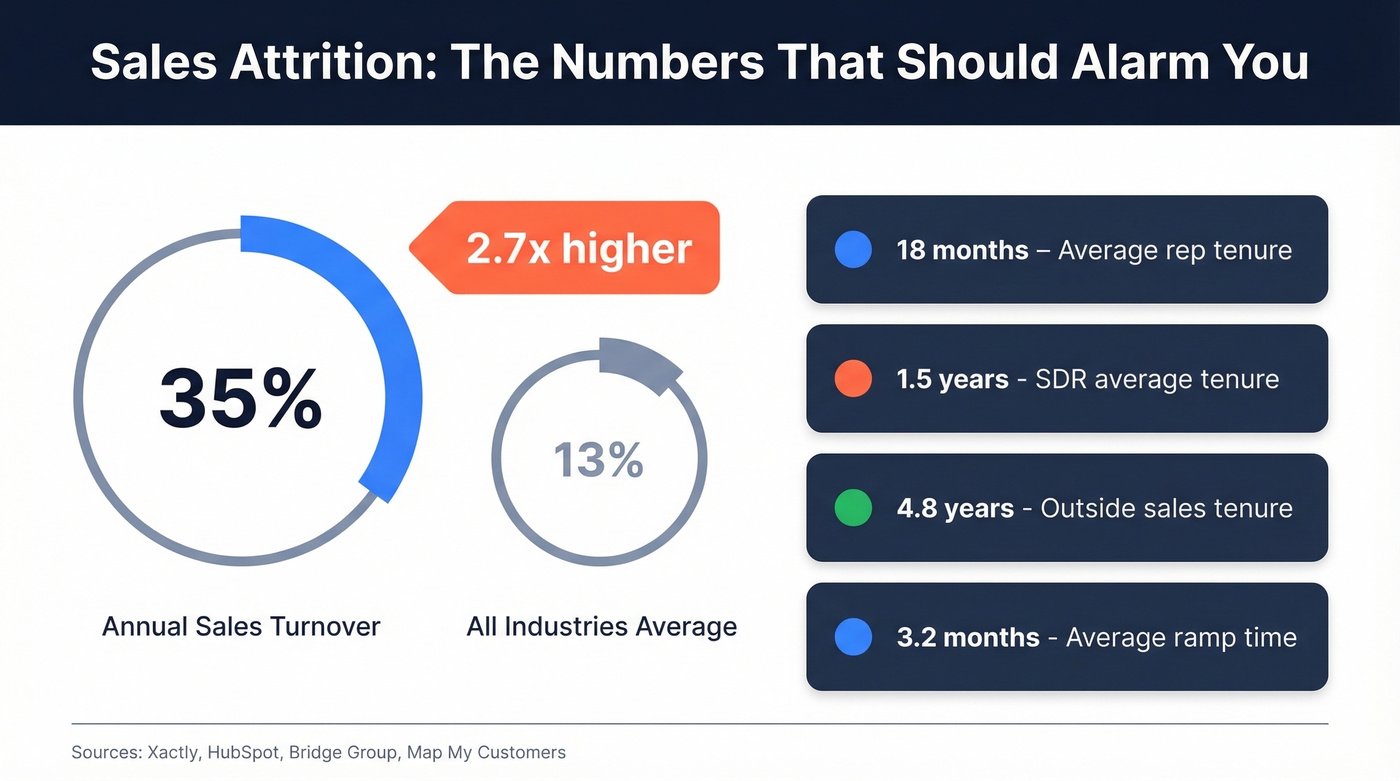
Most leaders don't know whether their attrition is normal or catastrophic because they've never seen the benchmarks side by side.
| Metric | Sales Orgs | All Industries | Source |
|---|---|---|---|
| Annual turnover | ~35% | ~13% | Xactly / HubSpot |
| B2B orgs with >30% turnover | 45% | - | SiriusDecisions |
| Avg rep tenure | 18 months | - | HubSpot |
| SDR avg tenure | 1.5 years | - | Bridge Group |
| Outside sales tenure | 4.8 years | - | Map My Customers |
| Avg ramp time | 3.2 months | - | Xactly |
| Time to fill a role | ~60 days | - | SellingPower survey |
The SDR-to-outside-sales tenure gap is staggering: 1.5 years versus 4.8 years. That's not just a difference in role maturity - it reflects how differently orgs invest in those populations. SDRs get the worst onboarding, the least career visibility, and the highest activity quotas. No wonder they leave first.
Stop benchmarking against 35% and calling it normal. That number includes companies that treat sales seats as disposable. Your target should be under 20%. The best-run teams we've seen operate closer to 12-15%.
How to Calculate Your Attrition Rate
The employee attrition formula is straightforward:
Attrition Rate = (Departures / Average Headcount) x 100
Worked example: you started Q1 with 40 reps and ended with 36. Four left. Average headcount is (40 + 36) / 2 = 38. Attrition rate = 4 / 38 x 100 = 10.5% for the quarter, or roughly 42% annualized. That's a problem.
Run this quarterly, not just annually. Annual numbers hide seasonal spikes - like the post-Q4-bonus exodus that hits every January.
For readers tracking customer attrition instead: N-Day Attrition Rate = Customers who became dormant in N days / Active customers at start. Pair that with revenue churn (MRR lost / starting MRR) to get the full picture. Gross churn tells you what you're losing; net churn tells you whether expansion revenue is covering the gap.

Lost pipeline from rep departures is the silent killer. When a new hire finally starts, don't make them waste months building a contact list from scratch. Prospeo gives incoming reps instant access to 300M+ profiles with 98% email accuracy - so they hit quota faster and your vacancy gap shrinks.
Cut rep ramp time in half with data that's verified every 7 days.
The Real Cost of Losing a Rep
Harvard Business Review estimates the fully loaded cost of replacing a single sales rep at $115K. Here's what that includes:
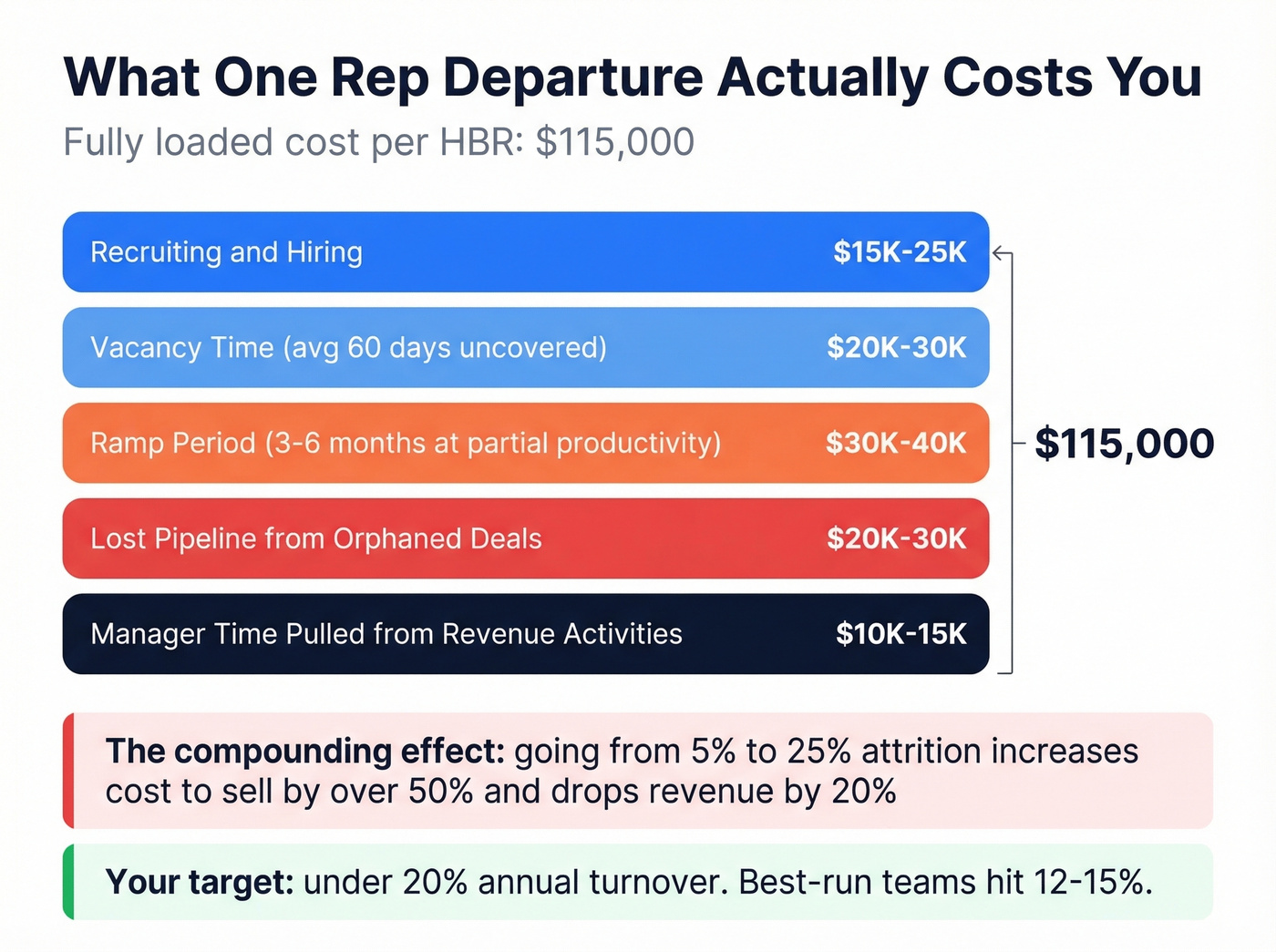
- Recruiting and hiring - internal or external agency costs
- Vacancy time while territory and pipeline sit uncovered
- Ramp time (3-6 months) at partial productivity
- Lost pipeline from orphaned opportunities
- Manager time pulled into interviewing, onboarding, and coaching instead of revenue-generating activities
For broader context: US firms already spend $15B per year training salespeople and $800B on incentives. Turnover burns through both investments every time a trained, incentivized rep walks out the door.
The compounding effect is what kills you. Xactly's modeling shows that moving from 5% to 25% attrition increases your cost to sell by over 50% and drops revenue by 20%. CSO Insights found that teams operating below 80% capacity hit only 82% of revenue targets. That's not linear - it's a death spiral where each departure accelerates the next one.
We've seen this play out on r/sales repeatedly: a team of eight SDRs loses three, the remaining five absorb the extra territory, activity targets stay the same or increase, burnout accelerates, and two more quit within 90 days. By the time leadership reacts, the team is at half capacity and the pipeline is cratered.
Here's the thing: if your annualized turnover is above 30%, you don't have a hiring problem. You have a retention emergency masquerading as a recruiting one. Pouring money into sourcing while ignoring why reps leave is like filling a bathtub with the drain open.
Why Sales Reps Leave
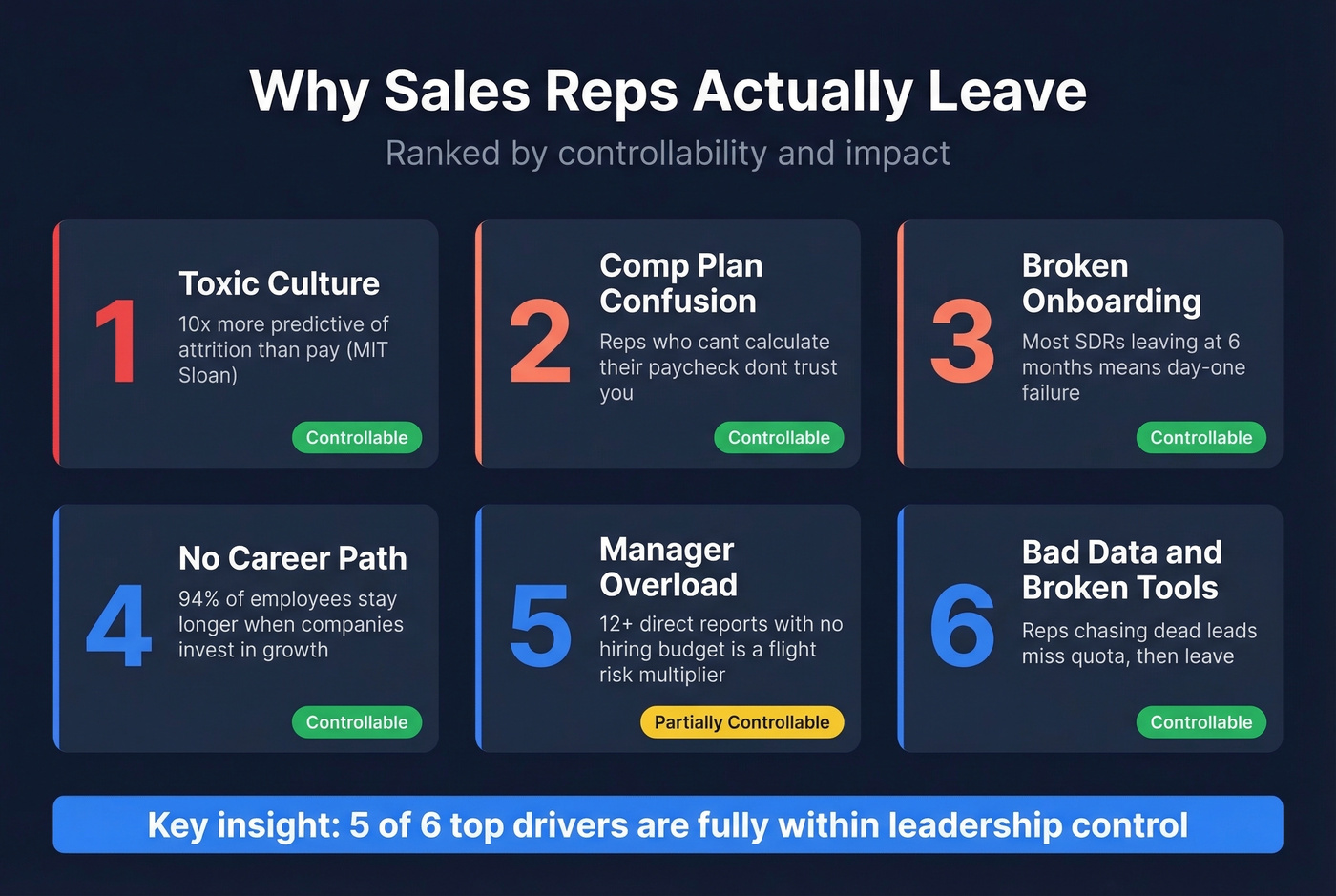
Not all causes are equally fixable. Let's separate what you can control from what you can't.
Toxic Culture Beats Bad Pay
MIT Sloan's research found that toxic culture is 10x more predictive of attrition than compensation. Reps will take a pay cut to escape a toxic manager or a backstabbing floor. If your exit interviews keep surfacing "culture" or "leadership" themes, that's not a comp problem - it's a management problem.
Comp Plan Confusion
A repeated theme in r/sales threads is brutal: reps who can't calculate their own paycheck don't trust the company. Mid-cycle quota changes, unclear accelerator thresholds, and suspected payroll errors erode trust faster than a bad quarter. We've audited comp plans where even the VP of Sales couldn't explain the SPIFs - and then leadership wondered why reps were disengaged.
Broken Onboarding
Bridge Group data shows average SDR tenure at 1.5 years. If most of those SDRs are leaving at the six-month mark, onboarding failed on day one. Structured 30/60/90-day programs with mentor pairing and early performance reviews aren't optional anymore. They're retention infrastructure. If you need a template, start with a proven 30/60/90-day program.
No Career Path
LinkedIn's Workforce Learning Survey found that 94% of employees would stay longer if their company invested in their careers. For SDRs, the blocked SDR-to-AE promotion path is the single biggest frustration. When reps can't see a future, they build one somewhere else.
Manager Overload
When reps leave and don't get backfilled, surviving reps absorb the territory. Managers respond by adding call targets instead of providing support. The remaining reps burn out. More quit. If your frontline managers have 12+ direct reports and no hiring budget, you don't have an attrition problem - you have a leadership math problem. This is where stronger sales leadership systems matter more than another hiring sprint.
Bad Data and Broken Tools
Reps lose significant time to non-selling activities, and a huge chunk of that waste comes from bad prospect data - bounced emails, disconnected phone numbers, outdated titles. When reps can't reach anyone, they miss quota. When they miss quota repeatedly, they leave.
This is the fastest, cheapest retention lever most leaders overlook. In our experience, cleaning up data quality has a more immediate impact on rep morale than almost any other intervention. Prospeo covers 300M+ professional profiles with 98% email accuracy and a 30% mobile pickup rate, refreshed every seven days - which is why GreyScout cut new rep ramp time from 8-10 weeks to 4 weeks after switching, and Snyk's 50-person AE team saw bounce rates drop from 35-40% to under 5% while AE-sourced pipeline jumped 180%. If you're evaluating vendors, compare data enrichment services and set a hard standard for email bounce rate.

When your data is clean, reps spend time selling instead of chasing dead leads. That directly impacts quota attainment, confidence, and retention.
Comp Structures That Retain or Repel
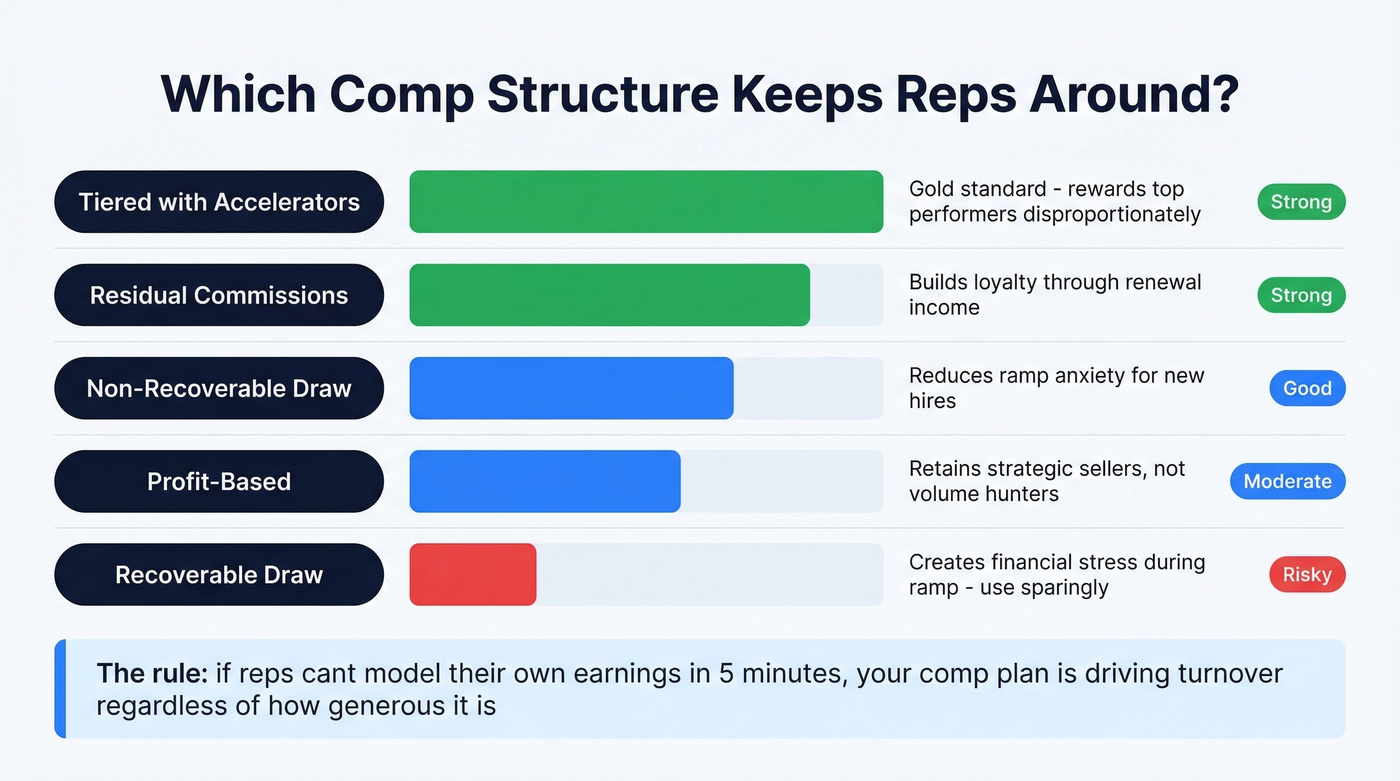
If reps can't model their own earnings in five minutes, your comp plan is driving turnover - regardless of how generous it is. Clarity beats complexity every time.
| Structure | How It Works | Retention Impact | Best For |
|---|---|---|---|
| Tiered / accelerators | Higher rates above quota | Strong - rewards top performers | Growth-stage orgs |
| Residual | Commission on renewals | Strong - builds loyalty | Account management |
| Non-recoverable draw | Guaranteed floor, no clawback | Good during ramp | New hire onboarding |
| Recoverable draw | Advance repaid from commissions | Risky - adds financial stress | Use sparingly |
| Profit-based | Commission on margin, not revenue | Moderate - retains strategic sellers | Margin-conscious orgs |
Tiered structures with accelerators are the gold standard for retention. They reward your best reps disproportionately, which is exactly what keeps them from taking recruiter calls. Recoverable draws, on the other hand, create financial anxiety during ramp - the exact period when new hires are most likely to quit. Skip recoverable draws unless you have no other option for managing cash flow during onboarding. If you want to pressure-test whether your plan is actually driving the right behaviors, tie it back to sales performance management metrics.
90-Day Playbook to Cut Attrition
Month 1 - Diagnose
- Calculate your current attrition rate, both quarterly and annualized
- Audit the last 12 months of exit interviews for pattern themes
- Run a comp plan clarity check: ask five reps to calculate their next paycheck - if they can't, you've found a problem
- Survey managers on span of control; anyone above 10 direct reports is a flight risk multiplier. Use a simple sales operations metrics dashboard so this doesn't become a one-off exercise.
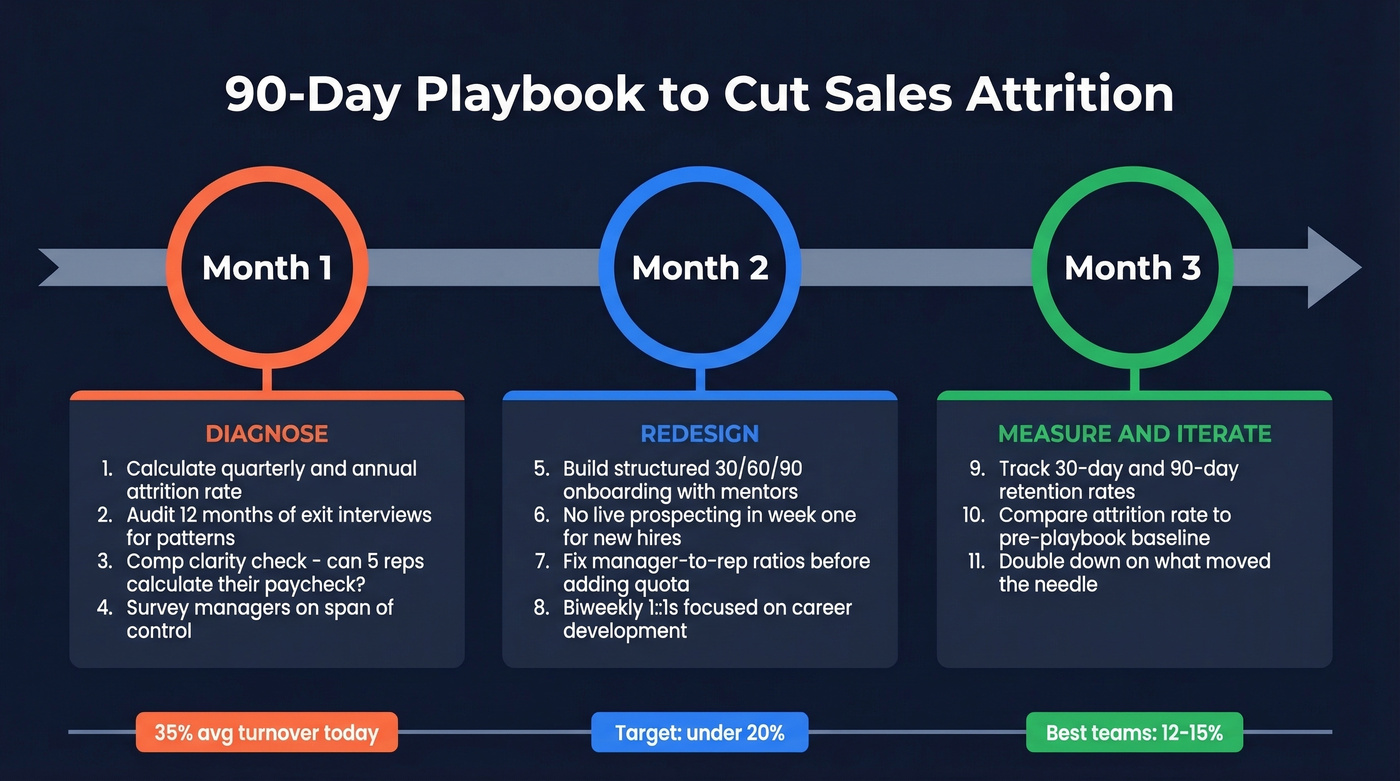
Month 2 - Redesign
- Rebuild onboarding with structured 30/60/90-day milestones and mentor pairing
- Eliminate live prospecting in week one - let new hires learn the product and ICP first (your ideal customer profile should be explicit, not tribal knowledge)
- Review manager-to-rep ratios and backfill open seats before adding quota to survivors
- Schedule biweekly 1:1s focused on career development, not just pipeline reviews
Month 3 - Optimize
- Audit your prospect data quality: if email bounce rates exceed 5%, your data provider is costing you reps - verified data platforms like Prospeo can keep bounce rates under 4% with weekly-refreshed contacts
- Document career paths from SDR to AE to management with clear criteria and timelines
- Run a culture pulse survey - anonymous, five questions max
- Implement consistent recognition; employees who feel appreciated are 63% less likely to leave. Keep the operating cadence tight with a lightweight pipeline health review so coaching doesn't get swallowed by firefighting.
Snyk armed 50 AEs with Prospeo and grew AE-sourced pipeline 180% - because reps who connect with real buyers don't burn out chasing dead data. Bad contact info drives the frustration spiral that accelerates attrition. Verified emails at 98% accuracy and 125M+ direct dials mean your team spends time selling, not scrubbing lists.
Stop losing reps to tools that waste their time. Give them data that works.
Customer-Side Sales Attrition
For readers who searched "sales attrition" meaning customer loss: attrition and churn aren't the same thing. Customer attrition is the measurable decline in engagement before a customer formally exits - it's a leading indicator. Churn is the exit event itself: cancellation, non-renewal, lapse. Track both. If you need a deeper framework, use a structured churn analysis approach.
N-day attrition rate = customers who became dormant / starting active customers. Revenue churn = MRR lost / starting MRR. Always track gross and net churn separately - net churn hides problems when expansion revenue masks losses.
FAQ
What's a good sales attrition rate?
Under 20% annually for a well-managed org. The industry average sits around 35%, but that includes companies treating sales seats as disposable. Top-performing teams consistently run under 15%. If you're above 25%, treat it as an operational emergency, not a cost of doing business.
How much does it cost to replace a sales rep?
Harvard Business Review pegs the fully loaded cost at roughly $115K per departure - covering recruiting, vacancy, ramp time at partial productivity, lost pipeline, and manager time. For senior AEs carrying large books of business, the true cost can exceed $500K when you account for orphaned deals and relationship damage.
What's the fastest way to reduce rep turnover?
Audit your comp plan for clarity - can reps calculate their own paycheck? Fix onboarding with structured 30/60/90-day milestones and mentor pairing. Then check your prospect data quality: if bounce rates exceed 5%, that drag on quota attainment is pushing reps toward the door. Those three moves address the top controllable drivers within 90 days.
Is sales attrition the same as customer churn?
No. Sales attrition typically refers to employee turnover - reps leaving the org. Customer attrition measures the rate at which accounts stop buying or go dormant. The two share a word but require completely different playbooks: one is an HR and leadership problem, the other is a customer success and product problem.