

The Sales Breakup Email Template That Doesn't Make Your Prospect Hate You
Most breakup email templates online are cringe. They read like a passive-aggressive text from someone you went on two dates with - "I guess you don't want an amazing partner who'll change your life forever..." One buyer on r/sales called them "completely disrespectful, borderline insulting" and killed the deal over it. Another thread compared them to guilt-trip dating messages. If you need a sales breakup email template that actually closes the loop without torching the relationship, you're in the right place.
What You Need (Quick Version)
- Use the Magic Email. Subject line: "Closing the Loop." Two sentences. No guilt.
- Send it at touch 7-8, around Day 10-12. That's a solid placement in a tight outbound cadence (and it fits cleanly into a B2B cold email sequence).
- Verify the email address first. If your emails are bouncing, no template will save you (here’s a deeper guide on email bounce rate and what it means).
Why Breakup Emails Work
Kahneman and Tversky's Prospect Theory showed people feel losses roughly twice as strongly as equivalent gains. Signal you're walking away, and the prospect feels the option slipping - not being pushed.
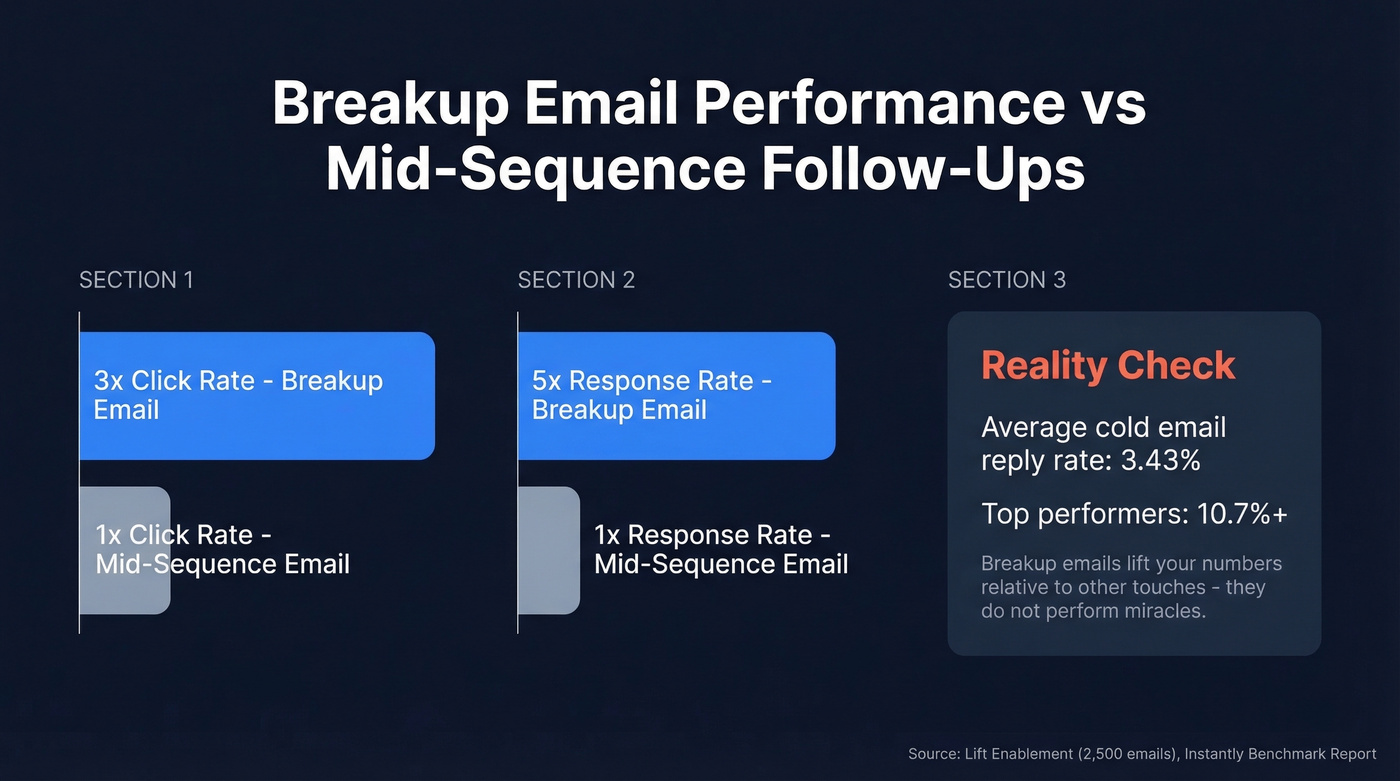
A Lift Enablement analysis of 2,500 emails found breakup emails generated 3x the click rate and 5x the response rate compared to mid-sequence follow-ups. But let's kill the fantasy numbers. You'll see articles claiming 76% reply rates. Benchmarks across billions of cold emails put the average reply rate at 3.43%, with top performers hitting 10.7%+. Breakup emails lift your numbers relative to your other touches - they don't perform miracles. We've rarely seen a breakup email clear the mid-teens on a truly cold list, and anyone claiming otherwise is selling something.
9 Templates by Scenario
1. The Magic Email (Closing the Loop)
Attributed to Blair Enns of Win Without Pitching, this is the most widely copied closing-the-loop format in outbound. One reader reported going "8 for 8, 100% response rate." Enns explicitly warns against automating it - this works because it feels human.
Subject: Closing the Loop
Body:
I haven't heard back from you on [project/opportunity] so I'm going to assume you've gone in a different direction or your priorities have changed.
Let me know if we can be of assistance in the future.
No guilt. No "I've tried reaching you 7 times." Just a clean exit that paradoxically makes people respond. We've tested this one more than any other template on this list, and it consistently outperforms the clever alternatives.
2. The Redirect (Routing Request)
This is the "help me route this" breakup - use it when you suspect you've been talking to the wrong person (a quick refresher on lead status helps here).
Subject: Quick question
Body:
Hi [Name], I haven't been able to connect with you on [topic]. Totally understand if this isn't your area - could you point me to the right person on your team to discuss [specific outcome]? Appreciate it either way.
3. The Post-Demo Ghost
They showed up, engaged, asked questions - then vanished. You've earned more directness here (use this alongside a tight product demo checklist).
Subject: Following up on our [date] call
Body:
Hi [Name], we covered [specific feature/outcome] in our demo on [date] and you mentioned [their stated pain point]. I want to make sure this doesn't fall through the cracks. Should I close this out, or is there a better time to revisit?
4. The Post-Proposal Ghost
They asked for pricing. You sent it. Silence.
Subject: Your [proposal/quote] from [date]
Body:
Hi [Name], I sent over the [proposal type] on [date] covering [scope]. Haven't heard back - happy to adjust if the pricing or scope doesn't fit. Otherwise, I'll close this out. Either way, no hard feelings.
5. The Value-Add Exit
Share something useful on your way out. Best when you have a relevant case study or resource that genuinely helps them, regardless of whether they buy from you (more ideas in these sales follow-up templates).
Subject: One last thing before I go
Body:
Hi [Name], I'm going to stop following up on [topic]. Before I do - [link to relevant resource] covers exactly the [challenge] you mentioned. Might be useful regardless. Best of luck.
6. The Casual / Humor Breakup
SMB and startups only. Skip this for enterprise buyers - it'll land wrong (if you sell upmarket, see enterprise B2B sales).
Subject: Not to be dramatic, but...
Body:
Hi [Name], I've reached out a few times about [topic] and I'm getting the hint. No worries at all - if timing changes, you know where to find me. Wishing you and the team a great [quarter/year].
7. The CEO Escalation
Use this carefully. You're signaling you'll reach out to their boss - it works when you have a legitimate reason, not as a threat.
Subject: Should I loop in [CEO/VP name]?
Body:
Hi [Name], I haven't been able to connect on [topic]. Given the [specific business impact], I was planning to reach out to [executive name] to see if this is still a priority. Wanted to give you a heads-up first.
8. The Nurture Transition
Instead of a hard close, move them to a lower-touch channel. This preserves the relationship and it's one of the most underused breakup email formats reps have at their disposal (this is basically sequence management done right).
Subject: Switching gears
Body:
Hi [Name], I'll stop reaching out about [specific opportunity]. I'd love to keep you in the loop on [relevant content] - no sales pitch, just useful stuff. If not, reply "stop" and I'll remove you.
9. The One-Liner
Ultra-short. A staple in sales communities - "Should I close your file?" consistently gets mentioned as a last-resort winner. We've used it when everything else failed, and it works more often than it should.
Subject: Should I close your file?
Body: Hi [Name] - yes or no?

A perfect breakup email bouncing off an invalid address is just wasted craft. Prospeo verifies emails at 98% accuracy with a 5-step process that catches spam traps, honeypots, and catch-all domains - so your closing-the-loop message actually reaches the inbox.
Stop breaking up with inboxes that never heard from you.
Where the Breakup Fits in Your Sequence
Don't send a breakup email on touch 3. You haven't earned it yet. Here's a cadence based on Highspot's Day 10 breakup placement and Sybill's 8-touch framework:
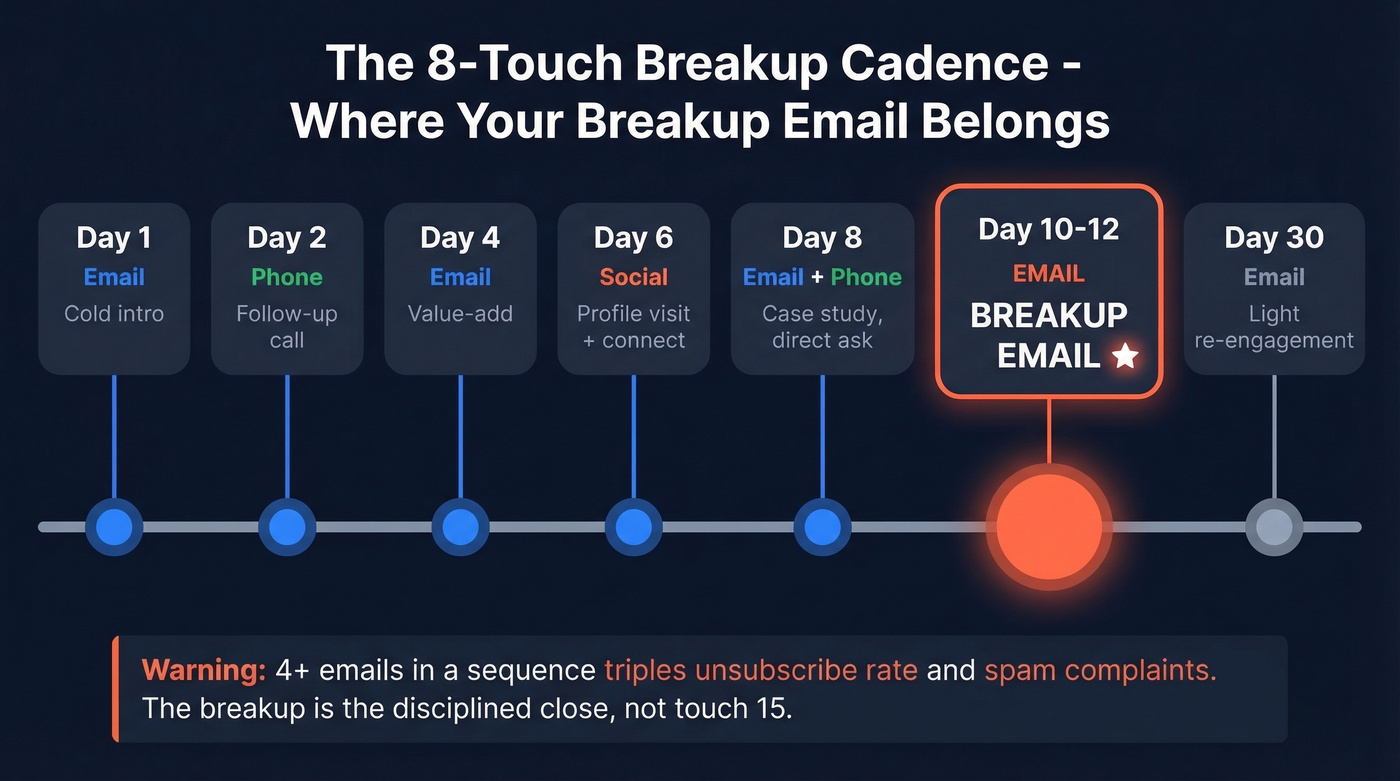
| Day | Touch | Channel | Purpose |
|---|---|---|---|
| 1 | 1 | Cold intro | |
| 2 | 2 | Phone | Follow-up call |
| 4 | 3 | Value-add | |
| 6 | 4 | Social | Profile visit + connect |
| 8 | 5-6 | Email + phone | Case study / direct ask |
| 10-12 | 7-8 | Breakup email | |
| 30 | 9 | Light re-engagement |
The 4-7 touch sweet spot aligns here. An analysis of 16.5 million cold emails found that sending 4+ emails in a sequence triples unsubscribe rate and more than triples spam complaint risk. The breakup email isn't touch 15 - it's the disciplined close to a tight sequence (more on timing in when should you follow up on an email).
Pre-Send Checklist
Here's the thing: the best breakup email in the world doesn't matter if it never reaches the inbox.
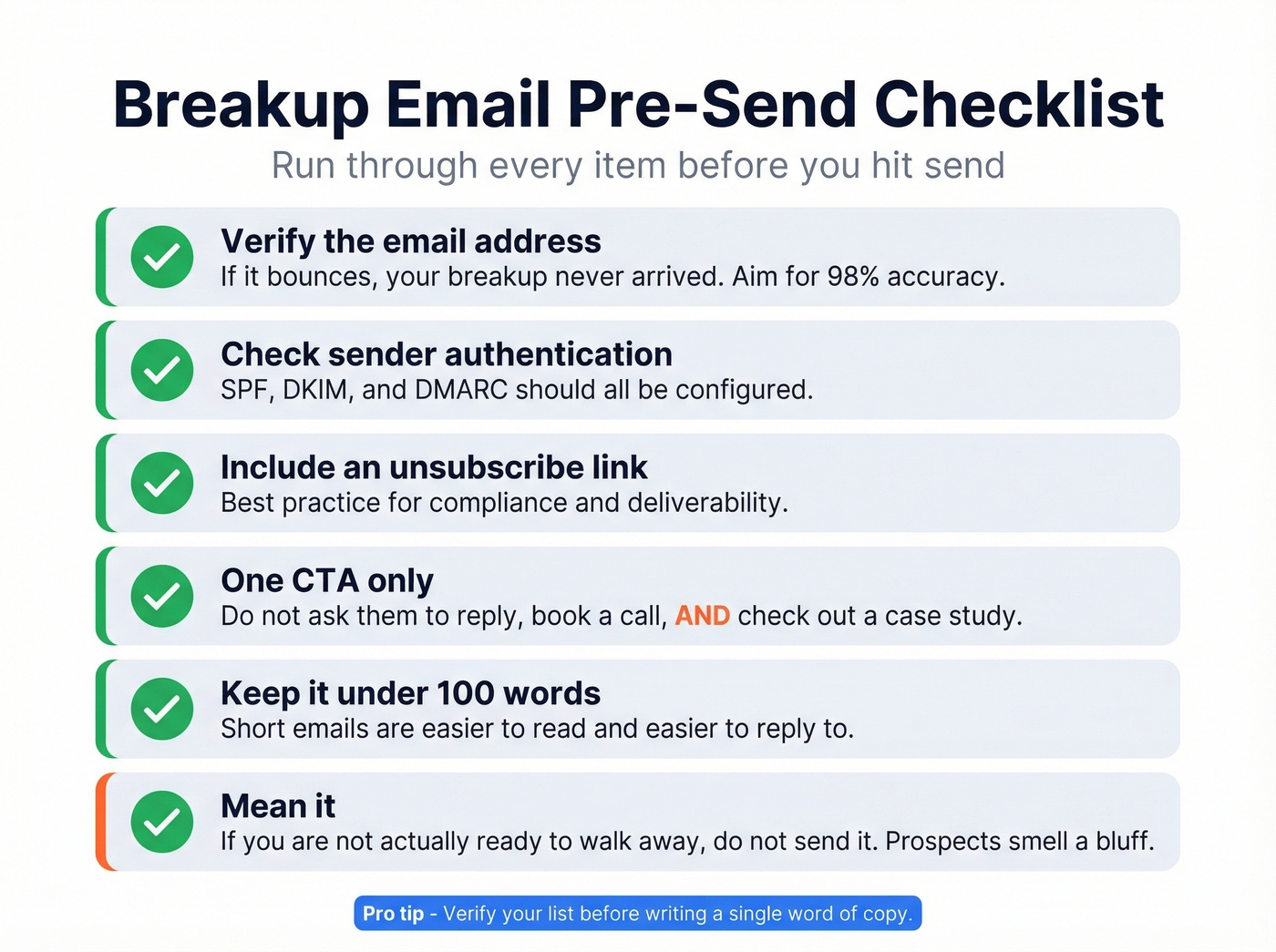
- Verify the email address. If it's bouncing, you're breaking up with an inbox that never heard from you. Prospeo verifies emails in real time with 98% accuracy - the free tier covers 75 verifications/month, enough to clean your active pipeline before you send (see the full email deliverability guide).
- Check sender authentication. SPF, DKIM, and DMARC should all be configured (start with DMARC alignment).
- Include an unsubscribe link. It's a best practice for compliance and deliverability.
- One CTA only. Don't ask them to reply, book a call, AND check out a case study (rules + examples in email call to action).
- Keep it under ~100 words. Short emails are easier to read and easier to reply to.
- Mean it. If you're not actually ready to walk away, don't send a breakup email. Prospects smell a bluff.
Half the time prospects ghost, you're emailing the wrong person. Prospeo's 300M+ profile database with 30+ filters - job title, department, seniority - lets you find the real decision-maker before you ever need a breakup email.
Find the right contact so you never have to send touch 8.
What to Do After the Breakup
If they don't respond, respect it. Remove them from your active sequence and add them to a long-term nurture list. That Day 30 re-engagement touch? Keep it genuinely light - a relevant article, a quick "hope things are going well," nothing more.
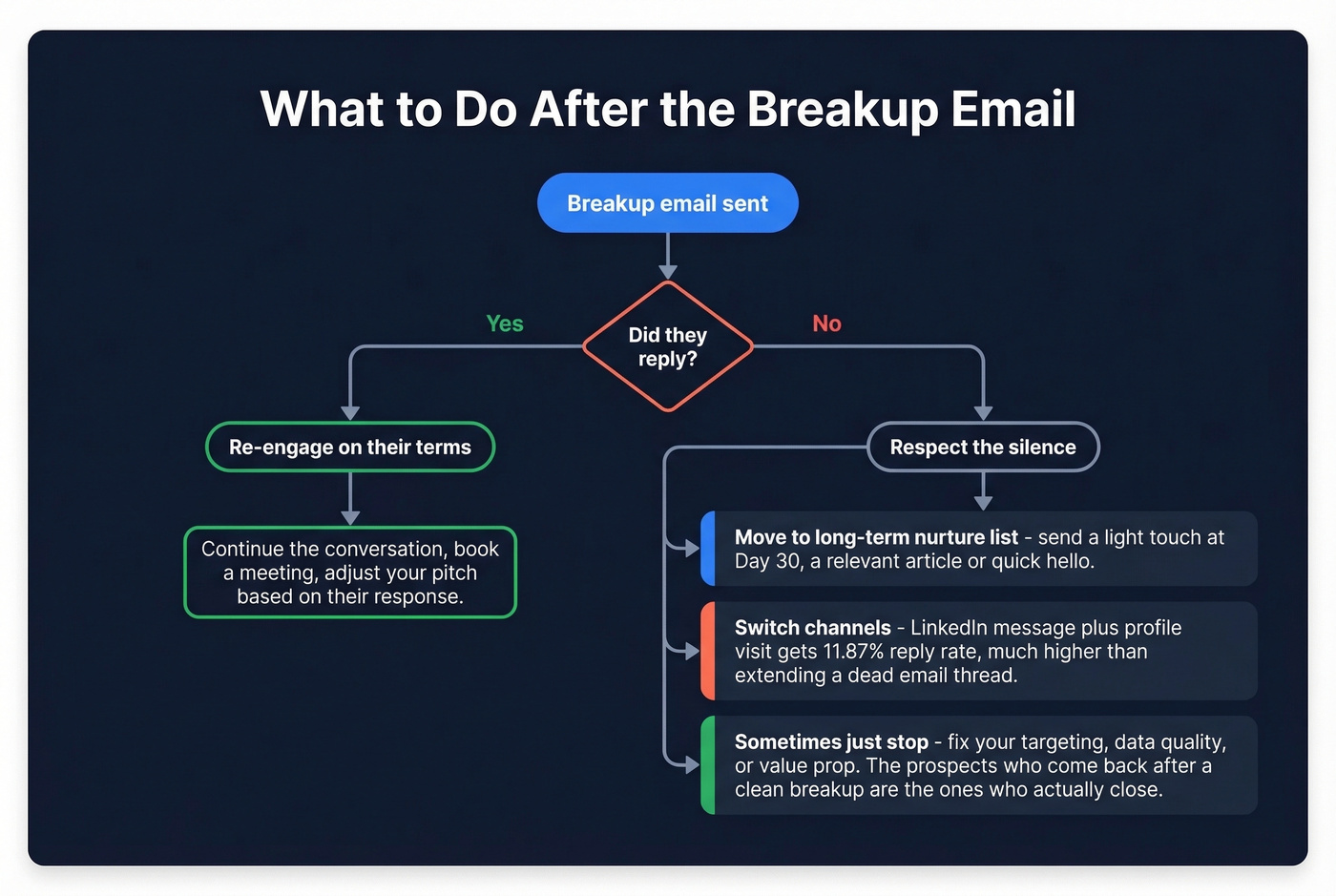
Consider switching channels entirely. A LinkedIn message plus profile visit combo hits an 11.87% reply rate - significantly higher than extending a dead email thread.
Sometimes the best breakup is silence. Just stop emailing. If they want you, they'll come back. I've watched reps agonize over the perfect last follow-up email when the real problem was their targeting, their data quality, or their value prop. The prospects who come back after a clean breakup are the ones who actually close. Fix the fundamentals first (start with sales prospecting techniques that improve targeting).
FAQ
Do breakup emails actually work?
They outperform mid-sequence follow-ups - one dataset showed 3x click rates and 5x response rates versus earlier touches. But average cold email reply rates sit at 3-8%, with top performers hitting 10%+. Expect a relative lift, not a miracle.
How many follow-ups before a breakup email?
Send 6-8 touches over 10-14 days, placing the breakup at touch 7-8. Each touch needs to earn the next - an analysis of 16.5M emails found 4+ emails in a sequence triples unsubscribe rate and spam complaints.
Should I verify emails before sending?
Always. If the email is invalid, your breakup never arrived and you've wasted a sequence slot. Run your list through a verification tool first - 98% accuracy is the bar you should hold any provider to.
What's the best format for a sales breakup email?
The Magic Email - "Closing the Loop" - consistently outperforms every other format. It's two sentences, zero guilt, and gives the prospect a clean exit. Pair it with any of the scenario-specific templates above depending on where the deal stalled.