

Sales Contests That Actually Motivate Your Whole Team
Your VP just pinged you: "We need a sales contest this quarter. Something fun. No budget." So now you're scrolling through listicles at 9 PM, staring at 47 ideas you'll never use. You don't need 47 ideas. You need a system - about four sales contests, rotated quarterly, designed so your entire team has a real shot at winning. The gamification market hit $43B in 2024 and is racing toward $172B by 2030 - because structured competition works when it's built right.
The Quick Version
- Pick one contest format per category (activity, gamified, team, recognition) and rotate quarterly. Four formats, not thirty.
- Use activity-based metrics - calls, meetings, personalized emails - so your whole team can compete, not just the top three closers. (If you need a menu of options, start with these sales activities.)
- Budget $100-$300 per winner for weekly SPIFFs. Experience prizes beat cash under $500.
- Verify your prospect data before launching. Reps competing to dial disconnected numbers breeds cynicism, not motivation. (A quick data enrichment pass helps before you lock rules.)
Why Sales Contests Work
Every contest should answer one question: what behavior do you want reps to start, stop, or keep doing? A "Call Blitz" gets reps to start making more outbound dials. A "Conversion Rate Challenge" gets them to stop spraying low-quality pitches. A "Customer Feedback Champion" contest reinforces the habit of asking for reviews they're already doing sporadically.
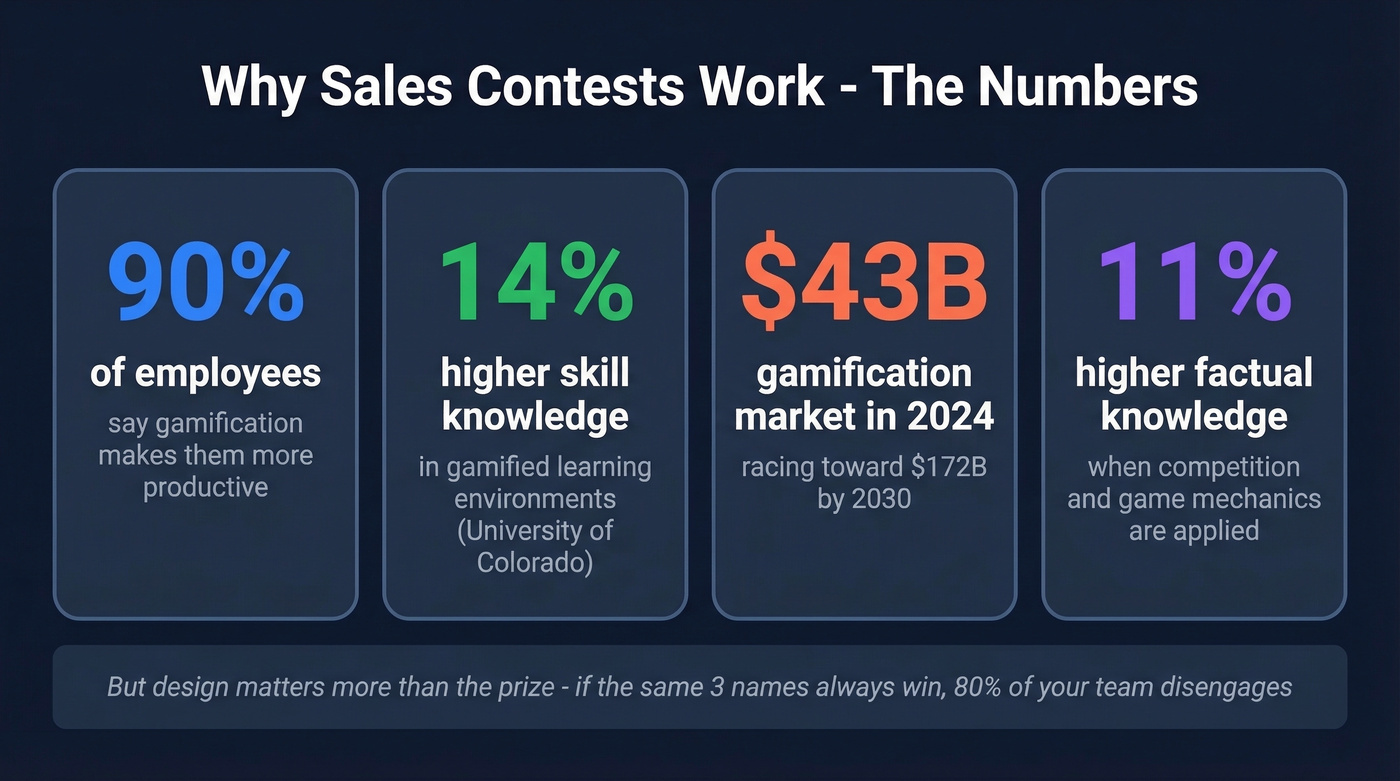
The data backs this up. 90% of employees say gamification makes them more productive, and a University of Colorado study found gamified environments produced 14% higher skill-based knowledge and 11% higher factual knowledge. Those aren't trivial lifts. The best team competitions don't just spike activity for a week - they build "winning plans" where reps internalize the behaviors that made them successful and carry them forward.
But here's the psychology most contest designers miss: for competitive top performers, the fear of losing is often a stronger motivator than winning. And when mid-tier reps look at a leaderboard and see the same three names at the top every time, they don't try harder - they disengage. "If I don't play, I can't lose." That's the silent killer of sales team competitions, and it's why design matters more than the prize.
Designing Contests That Don't Demotivate 80% of Your Team
Revenue-only contests are lazy management. If your contest metric is "most revenue closed this month," you've just handed the trophy to whoever has the biggest pipeline going in. Everyone else checks out by day three. (If you want to pressure-test what’s actually moving revenue, use pipeline health metrics alongside contest metrics.)
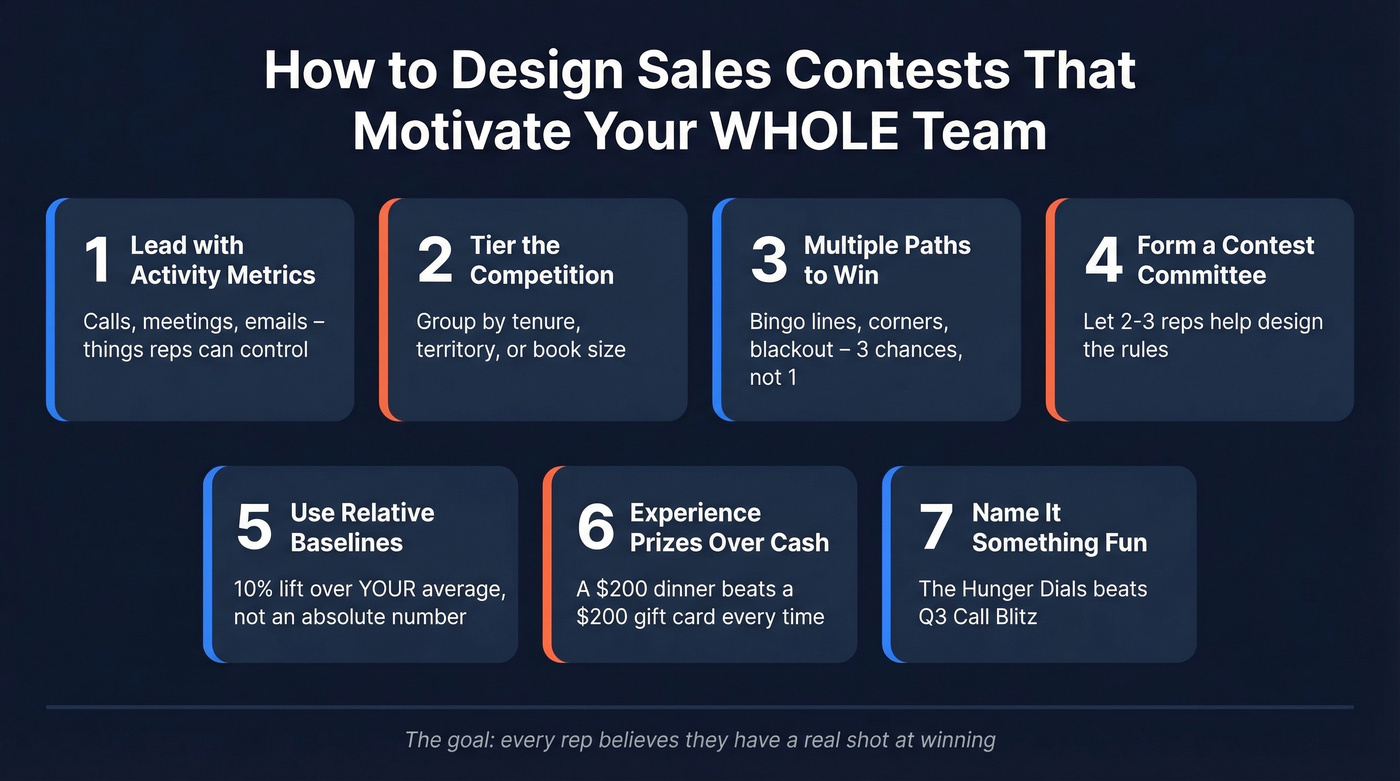
Here's the thing: we've seen this pattern play out dozens of times across teams we work with. The fix isn't complicated, but it requires intentional design.
Lead with activity metrics. Calls made, meetings booked, personalized emails sent, proposals delivered. These are controllable. Revenue isn't. (Need a refresher on what “good” looks like? Start with sales prospecting techniques.)
Tier the competition. Group reps by tenure, territory size, or book of business. A rep in month two shouldn't compete head-to-head against someone with a $2M book.
Create multiple paths to win. Sales Bingo does this naturally - line, corners, and blackout are three separate prizes. Bracket tournaments create consolation rounds.
Form a contest committee. Let two or three reps help design the rules. Buy-in skyrockets when the team feels ownership over the format. You still set the metrics, but reps who helped build the contest will promote it for you.
Set thresholds relative to each rep's baseline. A 10% lift over their weekly average is harder to game than an absolute number, and it keeps the playing field honest.
Favor experience prizes over cash. A $200 dinner-for-two feels more special than a $200 Visa gift card. Experiential prizes are valued more than their monetary equivalent.
Name your contest something memorable. "Q3 Call Blitz" is forgettable. "The Hunger Dials" gets talked about.
20+ Sales Contest Ideas by Type
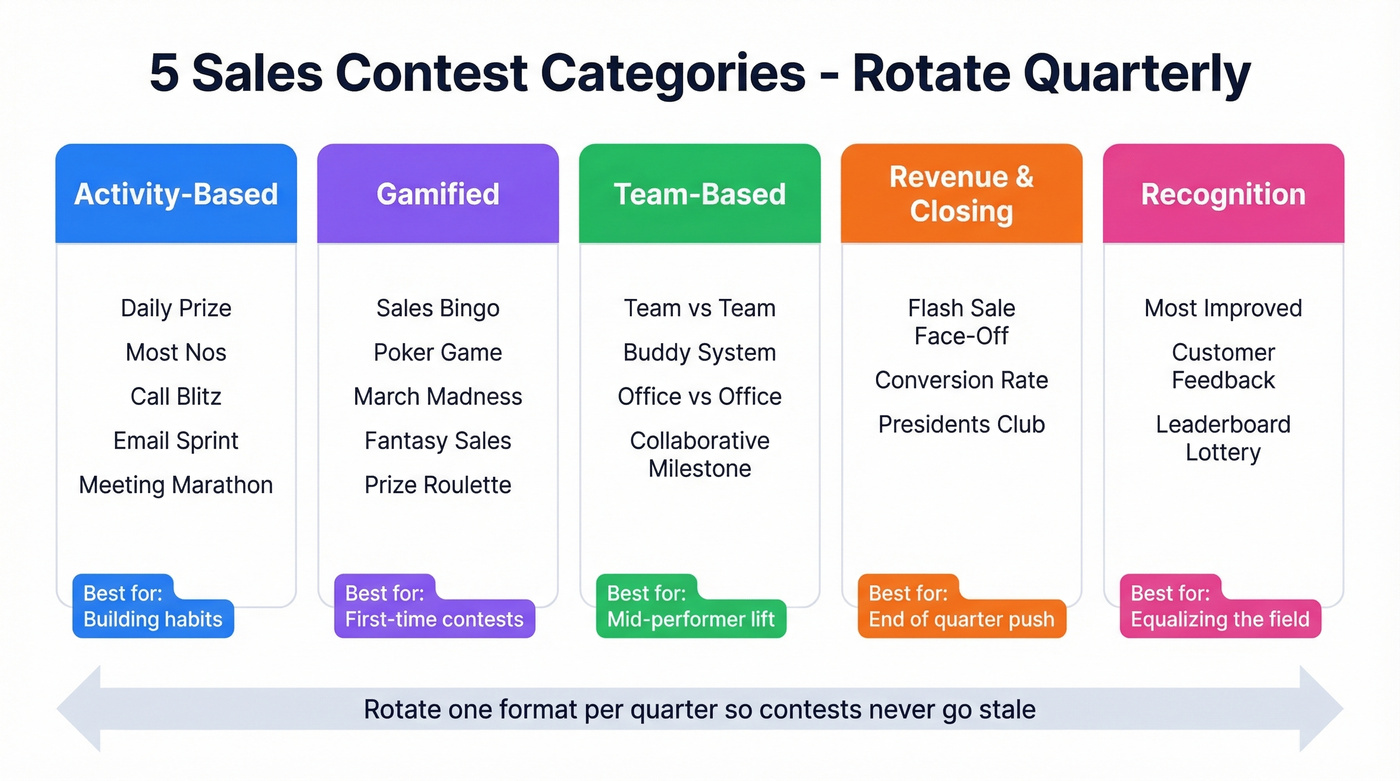
Understanding the different formats helps you pick the right one for your team's maturity, size, and goals. Below are five categories - rotate through them quarterly so the format never goes stale.
Activity-Based Contests
Daily Prize - Reset the leaderboard every 24 hours on a single metric (dials, emails, meetings set). Award a $50-$100 gift card to the daily winner. Best for remote teams with Slack alerts.
Most Nos - Reward the rep who collects the most rejections. Crushes call reluctance. Run it for 5-7 days max. Best for teams battling phone anxiety. (If this is a recurring issue, build it into your onboarding and 30-60-90 day plan.)
Call Blitz / Power Hour - One hour, maximum dials, everyone goes at once. Prize can be as small as a $25 coffee card. The energy is the real reward. (Pair it with a tighter cold calling system so reps don’t waste the hour.)
Email Sprint - Most personalized emails sent in a set window, weighted by reply rate. This prevents the "blast 500 templates" loophole. Run for 2-3 days. (If you need copy fast, pull from proven sales follow-up templates.)
Meeting Marathon - Most qualified meetings booked in a week. Define "qualified" clearly upfront, otherwise you'll get calendar stuffing. For field teams, swap dials for door knocks or GPS-verified check-ins - the same daily-reset format works.
Gamified Contests
Sales Bingo - Create bingo cards with activities in each square: cold call a C-suite exec, book a demo from an inbound lead, get a referral. Tiered prizes at $50 for a line, $100 for four corners, $250 for blackout. Best for teams running their first contest.
Poker Game - Reps earn playing cards from weekly metrics. Most calls gets a card, highest close rate gets a card, most new contacts gets a card. Monthly showdown with the best hand winning. One Reddit user described running this with zero budget - operational rewards like lead choice and "manager takes a deal" were enough.
March Madness Bracket - Head-to-head elimination over 4-5 weeks using composite activity scores. Works best with 16+ reps.
Fantasy Sales Team - Draft-style, quarter-long. Reps draft "players" (other reps or accounts) and score based on their performance. Clayton Homes ran this format, and Ambition later cited it alongside an HBR feature on sales gamification. High setup effort, but engagement lasts months.
Prize Roulette - Spin a wheel after hitting a milestone. The randomness adds excitement even when the prizes are small, and it keeps mid-tier reps engaged because every milestone feels like a fresh shot.
Team-Based Contests
Team vs. Team - Split the floor into two or three teams. Track a composite score across calls, meetings, and pipeline created. A team-based competition pushes mid-performers harder than individual formats because nobody wants to be the one dragging their squad down.
Buddy System - Pair a top performer with a newer rep. Their combined score competes against other pairs. This doubles as coaching without calling it coaching. (If you want to formalize it, borrow from sales training tips.)
Office vs. Office - MuleSoft ran team-based fantasy competitions across four offices on three continents. The manager-vs-manager framing taps into leadership pride - nobody wants their team to lose publicly.
Collaborative Milestone - Set a team-wide goal. Social Tables would take the whole team out for shots at a local bar for every 20 deals closed, pushing toward 100. The shared celebration matters more than individual glory.
Revenue & Closing Contests
Flash Sale Face-Off - 24-hour closing sprint. Only works if your sales cycle allows same-day closes or you're targeting late-stage pipeline.
Conversion Rate Challenge - Highest win rate over a two-week window. Rewards efficiency and prevents the "throw everything at the wall" approach. (To benchmark what “good” is, use sales conversion rate targets.)
President's Club - The big one. Quarterly or annual, $2,500+ prize or an all-expenses-paid trip. Reddit threads mention prizes ranging from iPhones and weekend trips to paid Paris weekends in five-star hotels. Reserve this for your marquee competition.
Recognition & Improvement Contests
Most Improved - Measure percentage lift, not absolute numbers. A rep who goes from 10 to 15 meetings (50% lift) beats someone who goes from 30 to 40 (33% lift). The great equalizer.
Customer Feedback Champion - Most positive reviews or NPS mentions collected. Reinforces post-sale behavior that most contests ignore.
Leaderboard Lottery - Every completed activity earns a raffle ticket. Random drawing at the end. Luck-based, which means anyone can win - perfect for teams where the same names always dominate.

Activity-based contests only work when reps reach real people. Prospeo's 125M+ verified mobile numbers have a 30% pickup rate - that's 3x the industry average. Stop your team from burning contest energy on disconnected numbers and bad emails.
Fuel your next sales contest with data that actually connects.
Prize Budget Guide
| Contest Type | Duration | Prize Range | Example |
|---|---|---|---|
| Daily Prize | 24 hours | $50-$100 gift card | Most dials today |
| Weekly SPIFF | 5-7 days | $100-$300 | Most Nos / Call Blitz |
| Sales Bingo | 1-2 weeks | $50 / $100 / $250 tiered | Line / Corners / Blackout |
| Monthly Gamified | 4 weeks | Operational rewards | Poker game + lead choice |
| Quarterly Championship | 8-12 weeks | $2,500+ or trip | Fantasy Team / President's Club |
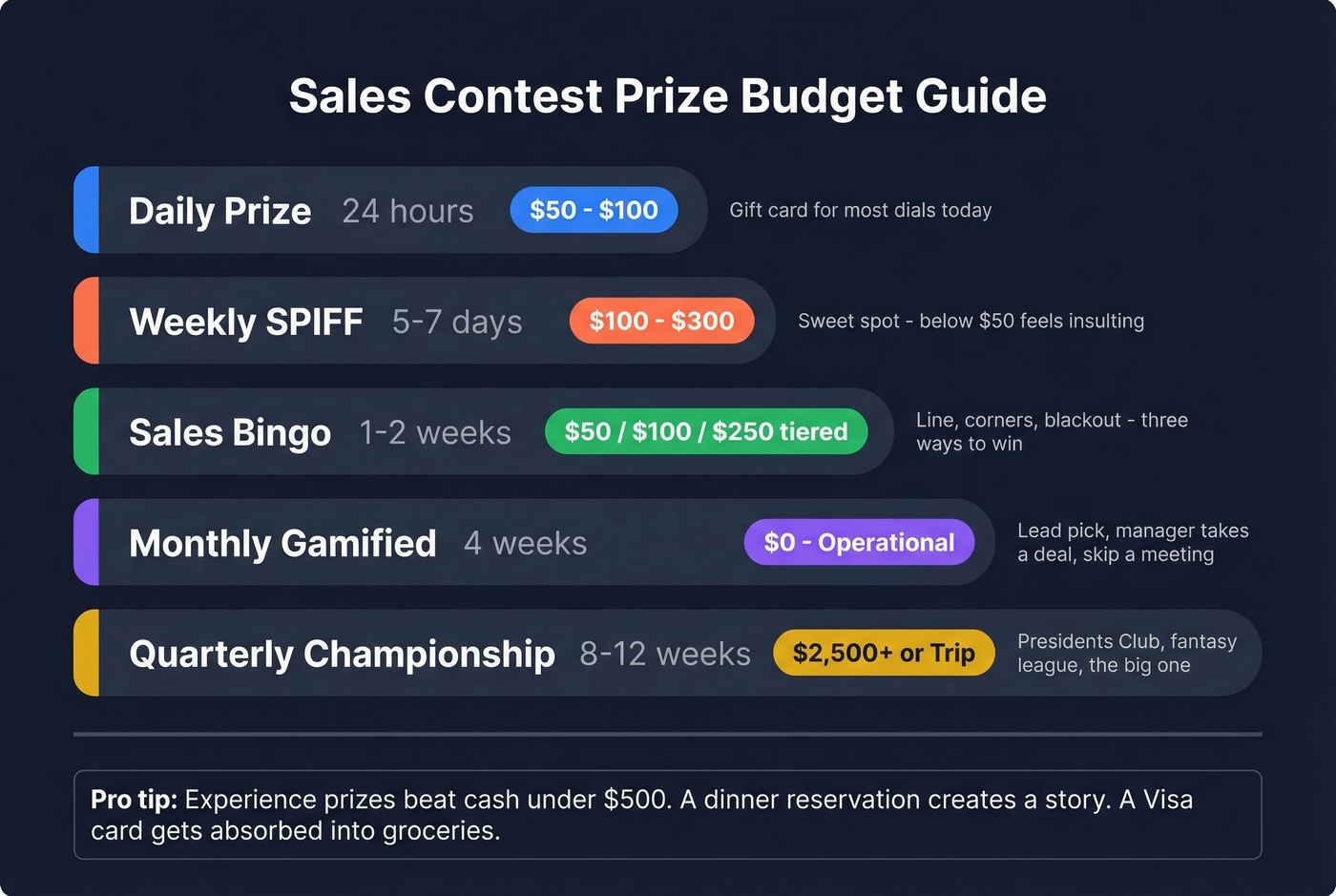
The sweet spot for weekly SPIFFs is $100-$300 per winner. Below $50, it feels insulting. Above $500 weekly, you're burning budget that should go toward quarterly prizes.
When leadership won't fund prizes - and this happens more than anyone admits - operational rewards work surprisingly well. First pick of inbound leads on Monday. Sales manager handles one of your deals. Hand off a problem client for a week. Choice of the site vehicle next month. These cost nothing and reps genuinely value them because they make daily work easier.
Experience prizes beat cash under $500. A $200 dinner reservation creates a memory. A $200 Visa card gets absorbed into groceries. Concert tickets, a weekend trip, even a cooking class - these create stories reps tell for months.
Running Contests for Remote Teams
Visibility is the number-one challenge for distributed competitions. A whiteboard in the office means nothing to a rep in Denver working from their kitchen.
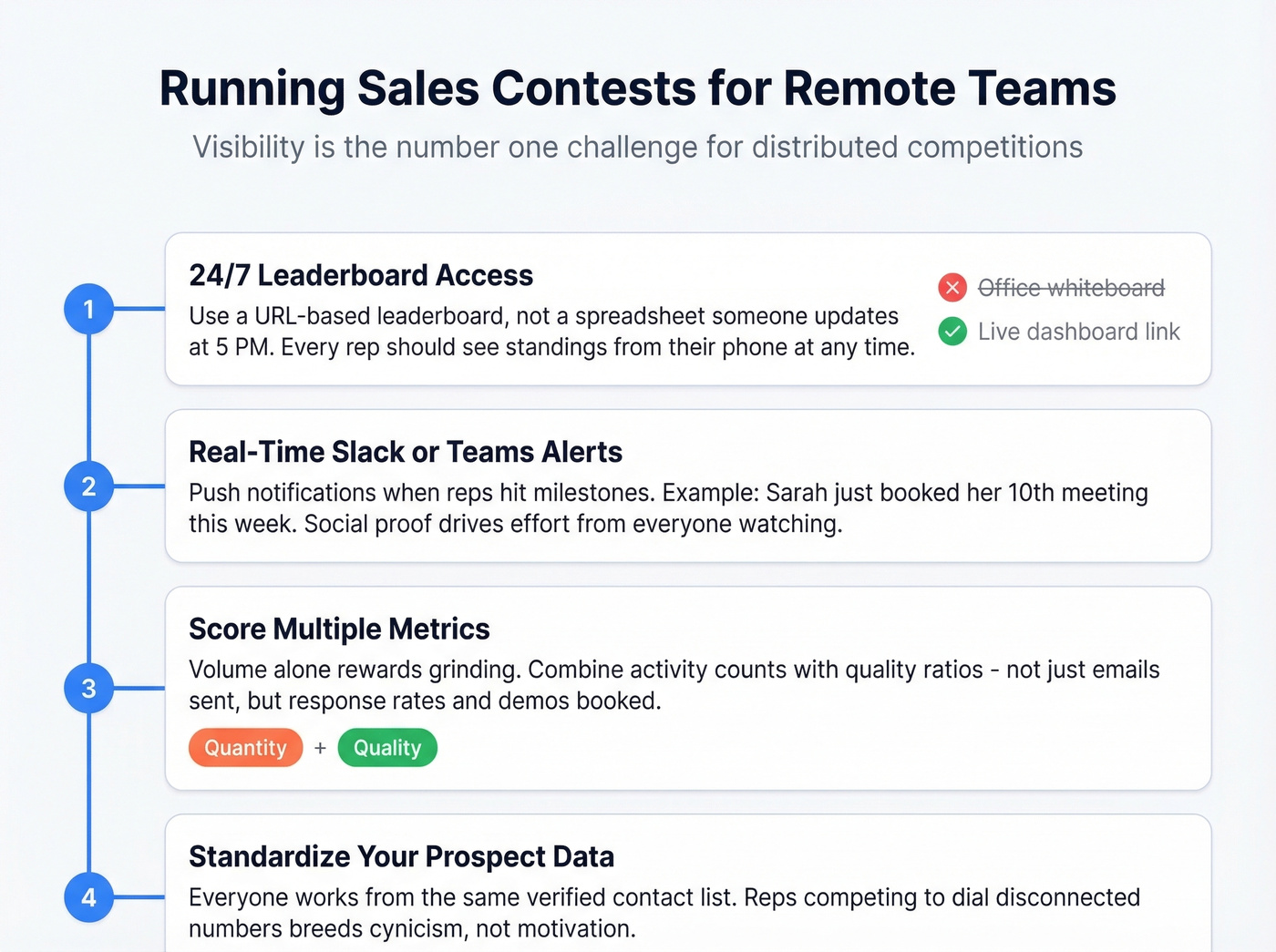
Make standings accessible 24/7. Use a URL-based leaderboard, not a spreadsheet someone updates at 5 PM.
Push Slack or Teams alerts when reps hit milestones. "Sarah just booked her 10th meeting this week" creates real-time social proof that drives effort from everyone watching.
Score on multiple metrics. Volume alone rewards grinding. Combine activity counts with quality ratios - not just InMails sent, but response rates and demos booked.
Standardize your prospect data. When you've got reps across multiple offices and time zones, everyone needs to work from the same verified contact list. Prospeo's database lets distributed teams pull from 300M+ profiles with a 7-day refresh cycle, so a rep in London and a rep in Austin are working equally clean data. (If you’re evaluating your stack, compare options in best contact management software.)
A good remote contest should hit at least three goals: drive daily activity, improve CRM data quality, and create visibility across time zones. MuleSoft ran competitions across Atlanta, Los Angeles, London, and Sydney simultaneously - the key was a single scoring system visible to everyone, everywhere.
Mistakes That Kill Sales Contests
Same winners every time. If your top three closers win every contest, everyone else stops trying. Fix it with activity-based metrics and tier by tenure or territory size. Multiple paths to win means multiple people stay engaged.
Broken prize promises. Nothing kills trust faster than announcing a $500 prize and then downgrading it to a $100 gift card because "budget got tight." Get budget approval before you announce anything. If you can't fund it, run a zero-budget contest with operational rewards instead.
Gaming the metrics. If reps can log fake calls or send mass templates to inflate email counts, they will. If you can't measure it in your CRM with a clear audit trail, don't contest it.
Bad data undermining activity contests. You launch a Call Blitz, reps are fired up, and half the phone numbers are disconnected. The contest rewards wasted effort, and your team comes out more cynical than motivated. We've heard this story from teams who switched to verified data mid-contest and saw engagement jump overnight. Skip this problem entirely - audit your contact list before you announce anything. Tools like Prospeo verify emails at 98% accuracy and refresh every seven days, and the free tier covers 75 email checks per month, enough to spot-check a contest list. (If you’re building a repeatable process, see data-driven selling.)
Sales Contest Software
Most teams under 15 reps don't need dedicated software - a shared spreadsheet and a Slack channel work fine. Once you're running competitions across multiple teams or offices, though, purpose-built tools pay for themselves in admin time saved. (If you’re also standardizing outreach, consider a broader SDR tool stack review.)
| Tool | Starting Price | Best For | CRM Integration |
|---|---|---|---|
| SalesScreen | $20/user/mo | Real-time TV displays | Major CRMs |
| Spinify | $16/user/mo | Leaderboards + recognition | Major CRMs |
| Plecto | $200/mo | Dashboard-heavy teams | Major CRMs |
| Pointagram | $5/user/mo | Budget-conscious teams | Major CRMs |
| Ambition | ~$2,000-$5,000/mo | Enterprise performance mgmt | Major CRMs |
Plecto deserves a closer look. Insurance Surgery implemented their dashboards and saw a 50% increase in calls made by their lead gen team, with sales advisors logging the equivalent of eight extra hours of calls per month. That's a real lift from visibility alone.
AMX Logistics provides the long-game case study - they scaled from $200K to $25M in annual revenue using Ambition's gamification platform. That growth reflects many factors beyond contests, but it shows what sustained competitive culture can compound into over time.
Skip dedicated software if you're under 10 reps. The integration matters because your contest metrics need to pull automatically - manual tracking defeats the purpose and creates arguments about accuracy.
How to Measure Contest ROI
The formula is straightforward:
ROI = (Incremental Sales Profit - Contest Costs) / Contest Costs x 100%
Contest costs include prizes, admin time, and software. Incremental sales profit is the revenue lift during the contest period minus what you'd have expected without it. Compare activity levels during the contest to the two weeks before it. Track conversion rate changes, pipeline generated, and meetings booked. (If you want a cleaner baseline, align on sales operations metrics first.)
Aim for a 3-10x return. Below 3x, the contest probably isn't worth the disruption. Above 10x, you've found a format worth repeating quarterly.
Clayton Homes provides the benchmark: their fantasy-style contest drove an 18% spike in outbound calls, 2x appointment rates, and 8x transferred calls. That's the kind of lift that makes $250 in Bingo prizes look like a rounding error.
The hardest part is isolating the contest's impact from other variables - seasonality, new marketing campaigns, territory changes. The simplest approach works best: compare the contest week to the same week last month, control for obvious outliers, and don't overthink it. Directional accuracy beats false precision every time.
Let's be honest about one thing: if your deal sizes are under $10K, you don't need elaborate quarter-long fantasy leagues. A weekly $100 SPIFF on meetings booked will outperform a complex gamified system every single time. Save the big productions for teams where one extra deal pays for the entire contest ten times over.
A Call Blitz with bad data isn't a contest - it's punishment. Prospeo refreshes 300M+ profiles every 7 days and delivers 98% email accuracy, so every dial and every send counts toward the leaderboard.
Give your reps a fair fight with data refreshed weekly, not monthly.
FAQ
How long should a sales contest last?
Most contests perform best at 1-7 days. Daily resets keep energy highest because everyone starts fresh each morning. Longer formats like brackets or fantasy teams can run 4-12 weeks but need weekly milestones and mini-prizes to sustain engagement. Without those checkpoints, interest dies by week three.
What's the best contest for a team that's never run one?
Sales Bingo. It's simple to explain, creates multiple winners through tiered prizes, and tracks diverse activities rather than a single metric. Low risk, high engagement, and it teaches your team how competitions work before you try something more complex.
How do you run a sales contest with no budget?
Use operational rewards: first pick of inbound leads, manager handles one of your deals, hand off a problem client, or choice of site vehicle. A monthly poker game where reps earn cards from weekly metrics costs nothing and drives consistent effort across the whole team.
Do activity-based contests actually increase revenue?
Yes - when the underlying data is clean. Clayton Homes saw 2x appointment rates from an activity-focused competition. Verify your contact list before launching so every dial and email counts.
What sales contest software is cheapest?
Pointagram starts at $5/user/month - the most affordable dedicated option. For teams under 10 reps, a shared spreadsheet or Slack channel with manual updates works fine. The ROI on dedicated tools kicks in around 15+ reps or multi-office setups.