

Sales Development Manager: Role, Salary, KPIs & How to Get Hired
It's Thursday afternoon. Two SDRs are at 40% of quota. One is ramping. One is checked out. You've got 1:1s in an hour and a VP who wants pipeline numbers by Monday. That's the sales development manager job - not the LinkedIn title, not the job description, but the actual daily reality of owning top-of-funnel pipeline through people.
What Is a Sales Development Manager?
A Sales Development Manager (SDM) owns the engine that feeds your sales pipeline. They don't close deals. They don't run marketing campaigns. They manage the SDR team - the reps making dials, sending sequences, and booking meetings that eventually become revenue.
In most B2B orgs, the SDM sits between the SDR team and the VP of Sales or Director of Sales Development. They're the translation layer: converting leadership's pipeline targets into daily activity plans, coaching reps through slumps, and making sure the meetings SDRs book are actually qualified enough for AEs to work.
The role is part coach, part operator, part data analyst. On any given day, an SDM reviews call recordings, redesigns territory assignments, interviews SDR candidates, and troubleshoots a broken Salesforce report. It's a management role, but it's deeply operational - you're in the weeds on metrics, tooling, and process in a way that a typical "sales manager" title doesn't capture.
This is one of the most impactful positions in a sales org, and one of the least understood. Most companies don't even agree on what to call it - SDR Manager, BDR Manager, Sales Development Manager - same job, different business cards. The role itself varies too: some SDMs run purely outbound teams, others manage inbound qualification, and a growing number operate account-based motions where SDRs are aligned to specific target accounts rather than territories. Same title, very different daily work.
Quick-Reference Summary (2026)
If you're short on time, here's the snapshot:
- Compensation: $105k base / $155k OTE in SaaS (RepVue, March 2026). Broad market averages are lower - $72k base per PayScale. The gap is real and mostly explained by industry mix.
- What "good" looks like: 21 meetings/month per SDR, 3.2-month ramp time, 8.1 SDRs per manager. Only 63% of SDMs attain quota.
- The hardest part: 52% of companies report SDR tenure under a year. Retention isn't a side project - it's the job.
- What you need to get hired: A 30-60-90 day plan, KPI fluency, and a clear point of view on your tech stack. Walk in with numbers, not platitudes.
SDM vs BDM vs Sales Manager
These three titles get used interchangeably in job postings, but they're different roles with different mandates.
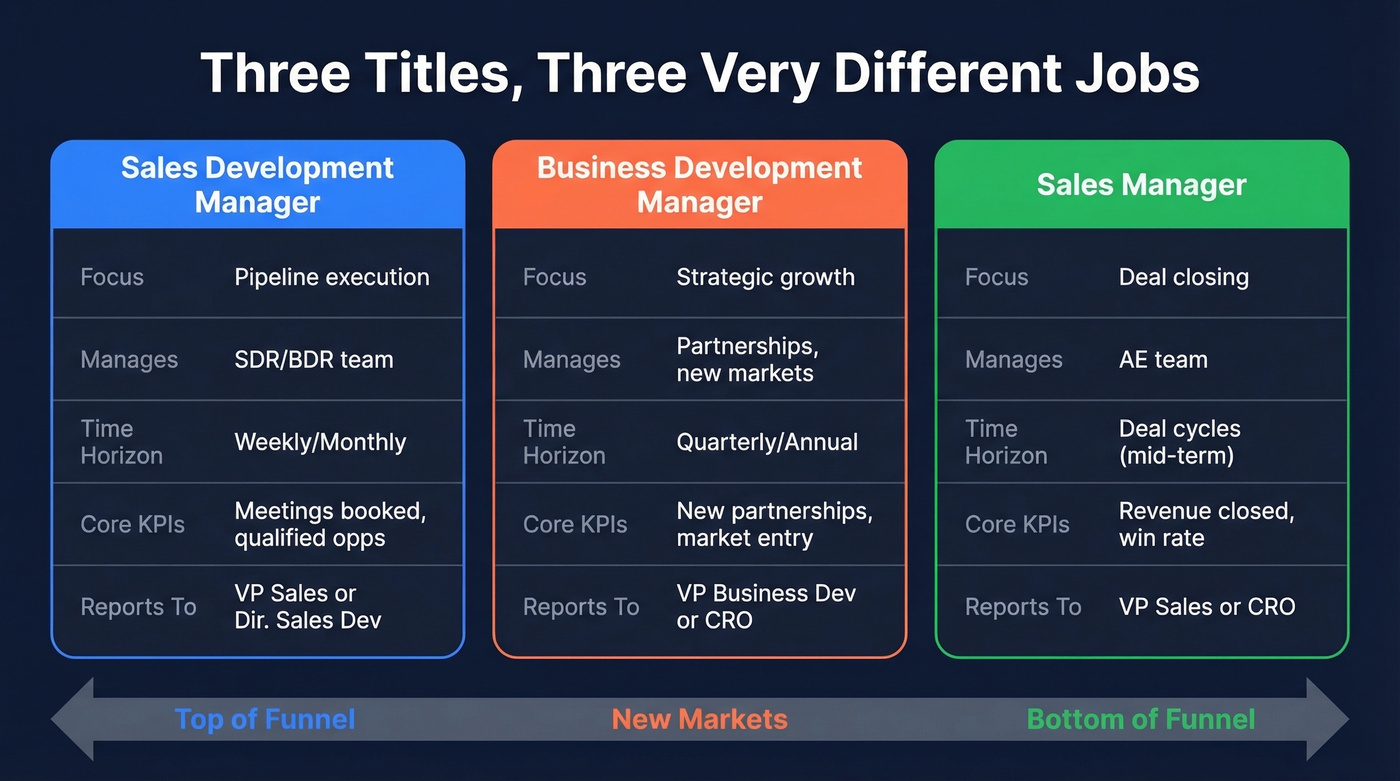
| Sales Development Manager | Business Development Manager | Sales Manager | |
|---|---|---|---|
| Focus | Pipeline execution | Strategic growth | Deal closing |
| Manages | SDR/BDR team | Partnerships, new markets | AE team |
| Time horizon | Short-term (weekly/monthly) | Long-term (quarterly/annual) | Mid-term (deal cycles) |
| Core KPIs | Meetings booked, qualified opps | New partnerships, market entry | Revenue closed, win rate |
| Reports to | VP Sales / Dir. of Sales Dev | VP Business Dev / CRO | VP Sales / CRO |
The SDM is a pipeline operator. They optimize lead qualification, monitor SDR metrics like conversion rates and response times, and run A/B tests on outbound campaigns. Tactical, data-heavy work with a short feedback loop.
The BDM plays a longer game - identifying new markets, structuring partnership deals, and exploring business models that don't exist yet. Less management, more strategy.
The Sales Manager owns AEs and closing. Different KPIs, different skill set, different daily rhythm. If the SDM fills the top of the funnel, the Sales Manager empties the bottom.
Core Responsibilities
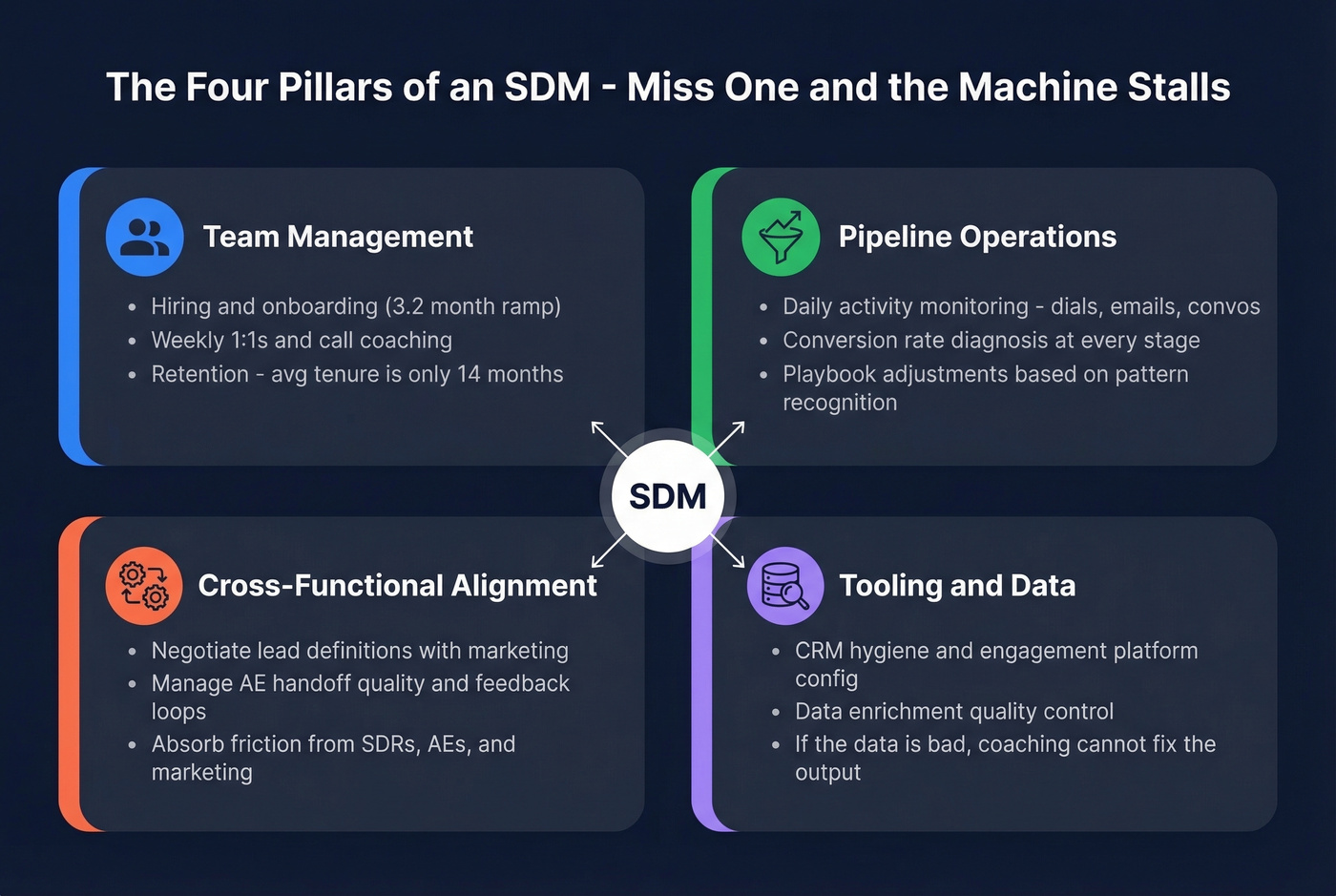
An SDM's job breaks into four categories. Miss any one and the whole machine stalls.
Team Management
This is where most of your time goes. Hiring SDRs, onboarding them (average ramp is 3.2 months), running 1:1s, coaching through call reviews, and - critically - retaining them. With average SDR tenure sitting at just 14 months, you're constantly balancing development against attrition. Every rep who leaves costs you three-plus months of ramp time on their replacement, plus the recruiting overhead, the knowledge loss, and the morale hit on the rest of the team. Your ability to develop junior reps into consistent performers is the single biggest lever you have on pipeline.
Pipeline Operations
You own the numbers. Meetings booked, qualified opportunities generated, conversion rates at every stage. You're monitoring daily activity - dials, emails, conversations - diagnosing where reps are falling off, and adjusting playbooks accordingly. This isn't "check the dashboard once a week" work. It's daily pattern recognition.
Cross-Functional Alignment
SDMs sit at the intersection of SDRs, AEs, and marketing - and absorb friction from all three. When marketing sends garbage leads, you hear about it first. When AEs reject meetings as unqualified, that's your problem to solve. You're constantly negotiating lead definitions, handoff processes, and feedback loops across teams.
Tooling & Data
You own the SDR tech stack - CRM hygiene, engagement platform configuration, data enrichment quality. If your reps are working with stale contacts and bouncing emails, no amount of coaching fixes the output. The tools are your responsibility, and the data flowing through them determines whether your team's effort converts to pipeline or just noise.
KPIs and Benchmarks Every SDM Should Know
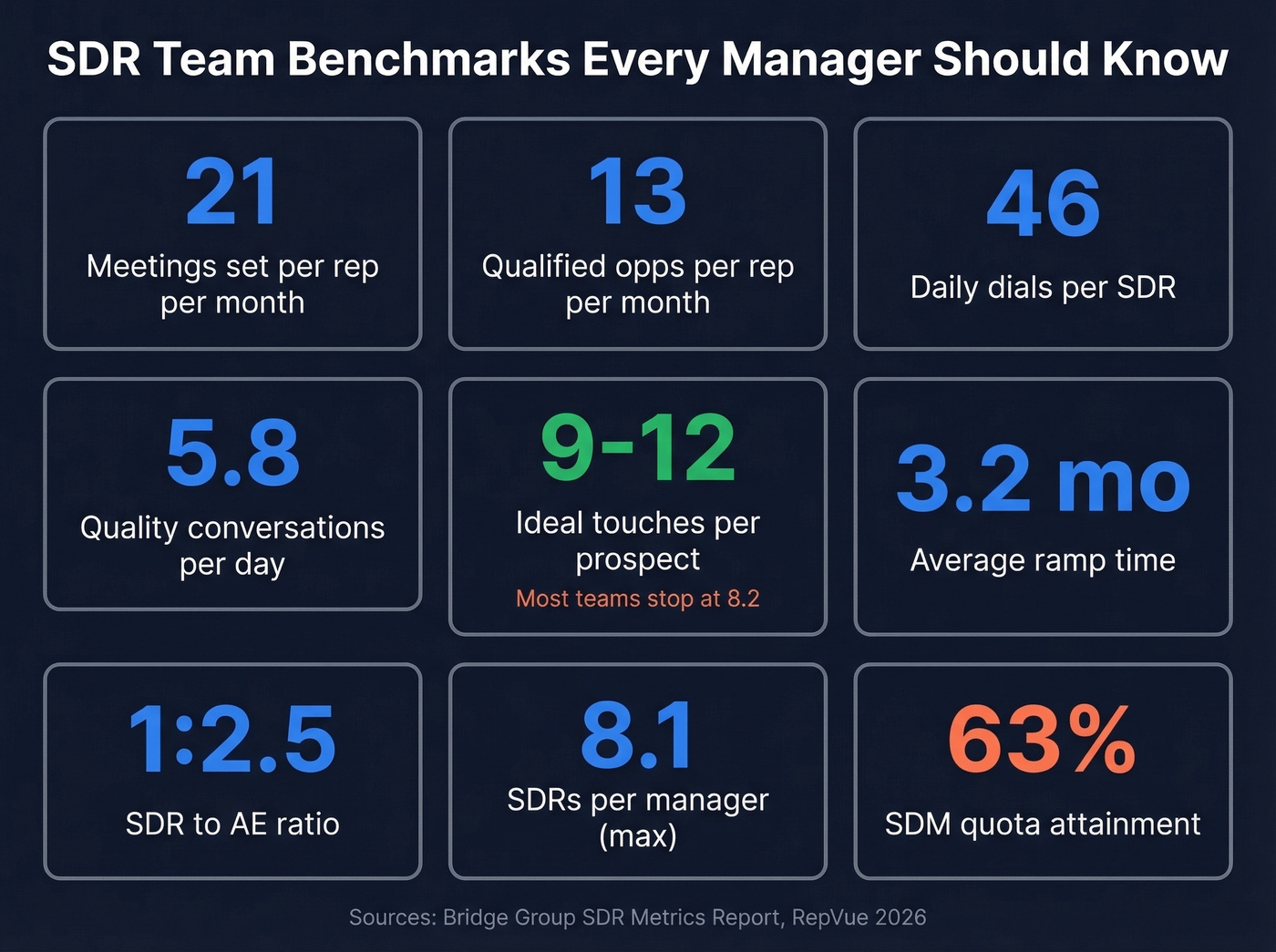
This is the section most SDM content gets wrong - vague advice about "tracking the right metrics" without any actual numbers. Crunchbase's summary of The Bridge Group's SDR Metrics Report, published here, is one of the closest things to an industry standard, and every SDM should know these benchmarks cold.
| Metric | Benchmark | Notes |
|---|---|---|
| Monthly meetings set | 21/rep | Quota standard |
| Qualified opps/month | 13/rep | Higher bar than meetings |
| Daily dials | 46 | Varies by market/segment |
| Quality conversations/day | 5.8 | The metric that matters most |
| Attempts per prospect | 8.2 avg (9-12 sweet spot) | Most teams give up too early |
| SDR-to-AE ratio | 1:2.5 | Design your org around this |
| Ramp time | 3.2 months | Plan hiring accordingly |
| Average tenure | 1.4 years | Budget for turnover |
| Manager span | 8.1 SDRs | Above 10, coaching suffers |
| SDR quota attainment | 68% | Across all SDRs |
| SDM quota attainment | 63% | Last 12 months (RepVue) |
A few things jump out from this data.
First, the attempts-per-prospect number: most teams average 8.2 touches, but the sweet spot is 9-12. The average team is giving up too early on every single prospect. An SDM who pushes their team from 8 to 11 touches per prospect can move pipeline numbers without adding a single rep.
Second, dialing technology makes a measurable difference - teams using parallel dialers or power dialers see 28% more dials and 30% more quality conversations per day. That's not a marginal improvement. It's the difference between hitting quota and missing it. (If you're evaluating calling tools, start with a clear cold calling system and then compare vendors.)
Third, only 63% of SDMs attain quota. That's a sobering number, and it means the role is genuinely hard. The margin between success and failure is thin. The managers who make it are the ones obsessing over these benchmarks, not the ones running on gut feel.

Bad data is the silent killer of SDR productivity. When reps burn dials on wrong numbers and bounce emails off stale contacts, no amount of coaching fixes the output. Prospeo delivers 98% email accuracy, 125M+ verified mobiles, and a 7-day data refresh - so your team's 46 daily dials actually connect.
Stop coaching effort. Start coaching conversations.
SDM Salary in 2026
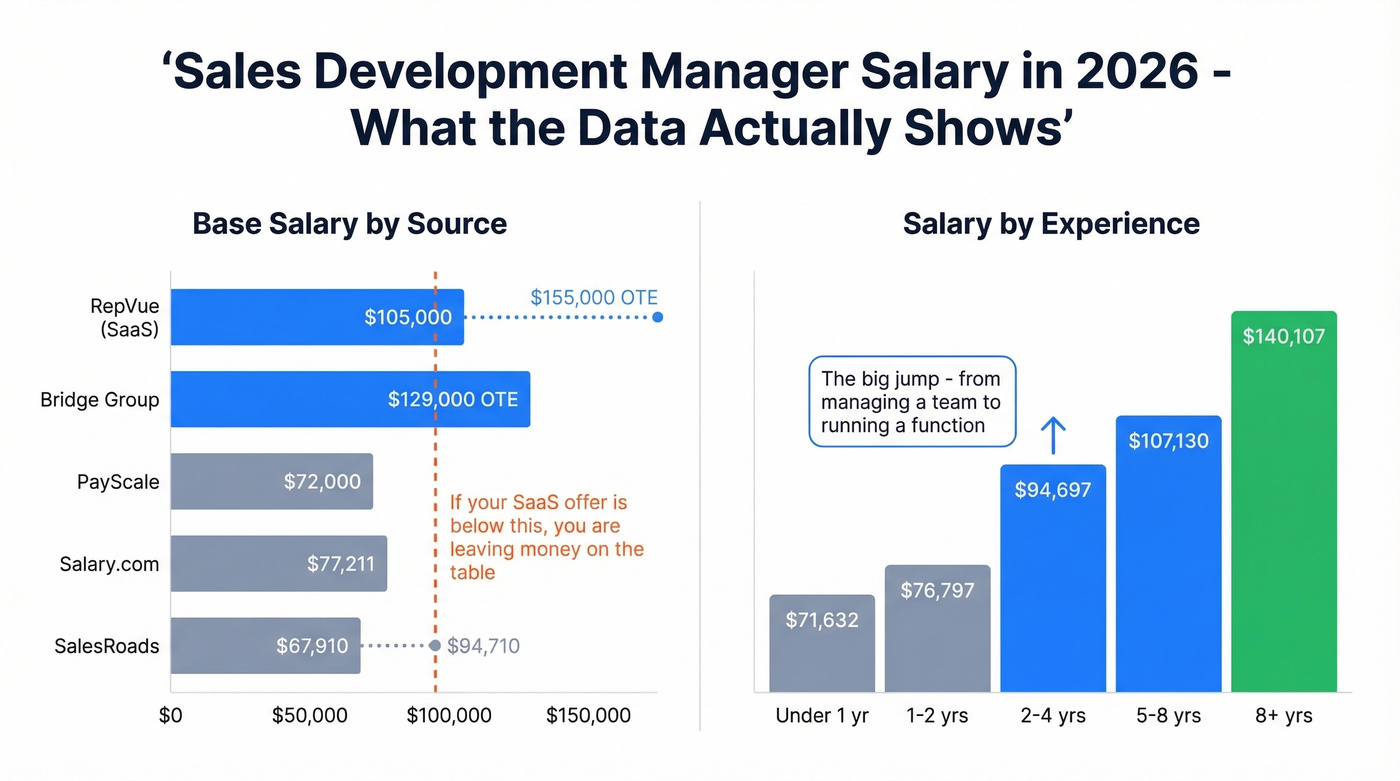
SDM compensation data is all over the map, and the reason matters.
Cross-Source Comparison
| Source | Base Salary | OTE / Total | Sample |
|---|---|---|---|
| RepVue | $105,000 | $155,000 | SaaS-heavy |
| Bridge Group (via Crunchbase) | - | $129,000 | SDR managers specifically |
| PayScale | $72,000 | $50k-$138k range | 118 profiles, broad |
| Salary.com | $77,211 | N/A | Modeled, all industries |
| SalesRoads (Glassdoor-derived) | $67,910 | ~$94,710 total value | Broad market |
The $30k+ gap between RepVue and PayScale isn't an error - it's a sample composition story. RepVue skews heavily toward SaaS and tech companies, where SDM comp is significantly higher. PayScale and Salary.com capture the full market, including non-tech industries where the role pays less. The Bridge Group figure lands right in the middle, which makes sense: it's SDR-manager-specific but not SaaS-exclusive.
If you're in SaaS, RepVue is your benchmark. If you're in manufacturing or services, Salary.com is more realistic. (For comp conversations, it also helps to understand OTE in sales and how variable pay is structured.)
Salary by Experience Level
| Experience | Average Salary |
|---|---|
| Entry (<1 year) | $71,632 |
| Early (1-2 years) | $76,797 |
| Mid (2-4 years) | $94,697 |
| Senior (5-8 years) | $107,130 |
| Expert (8+ years) | $140,107 |
The jump from early career to mid-level is where the real money kicks in. That $18k leap between years two and four reflects the transition from "managing a team" to "running a function" - the point where you're owning process design, not just executing someone else's playbook.
Top-Paying Cities
| City | Average Salary |
|---|---|
| San Jose | $97,386 |
| San Francisco | $96,428 |
| New York | $89,479 |
Top SaaS Employers by OTE
Illumio leads at $230k OTE, followed by Shopify at $220k, and Salesforce and Workday both at $200k. These are outliers, but they show the ceiling for the role in enterprise SaaS.
Most SDM comp structures run a 70/30 or 75/25 base-to-variable split. If you're interviewing in SaaS and the offer is below $95k base, you're leaving money on the table. The BLS reports median sales manager pay at $138k (2024 data) - and that's across all sales management roles, not just the higher-paying SaaS segment. Use that as leverage in negotiations.

Management Best Practices
Let's talk about what separates SDMs who build motions like Chili Piper's (118% of goal) from those who churn out of the role in 18 months.
Chili Piper published a detailed breakdown of their outbound SDR motion that's worth studying. Their reps were sending 200+ emails per day and working 600-700 accounts per month - and still missing targets. The instinct is to push harder: more dials, more emails, more activity. The Chili Piper team diagnosed it as an operational efficiency problem, not a motivation problem.
Their interventions were structural. They redesigned account distribution to enforce pipeline equality - making sure no rep got stuck with a disproportionately bad territory. They restructured 1:1s to diagnose performance problems earlier. They shifted from an email-heavy approach to a hybrid model incorporating more phone outreach. The result: 118% of their closed-won goal by year-end, with the outbound SDR motion driving nearly 20% of net new business.
The lesson is systems over hustle. Volume without efficiency is just expensive noise.
We've seen this pattern repeatedly - teams that add 20% more activity get maybe 5% more pipeline, while teams that fix their targeting, data quality, and process design see 30-40% improvements without adding a single dial. The SDMs who survive aren't the ones who accept bad inputs and try to coach around them. They're the ones who fight upstream for better data, better lead routing, and better marketing alignment. (If you're trying to diagnose where the funnel is leaking, use a pipeline health checklist.)
Here's the thing about SDM burnout: it almost always comes from being accountable for pipeline numbers while having limited control over lead quality. That frustration is valid. And it's exactly why the cross-functional alignment piece matters so much.
Data quality is one of the most overlooked levers. If 15-20% of your team's emails bounce, you need 15-20% more activity just to break even. That's a tax on every rep, every day. Fixing the data layer - through real-time verification and regular record refreshes - is a straightforward change that compounds across your entire team. When your data is clean, the same effort produces more conversations, more meetings, and less burnout. (If you need a deeper playbook, start with email bounce rate and email deliverability.)
The best SDMs we've worked with spend more time on process and tooling than on motivational speeches. Coaching matters, but coaching on top of broken systems is like teaching someone to swim in an empty pool.
The SDM Tech Stack
Every SDM needs five categories covered. Miss any and your team is flying blind.
| Category | Tools | What It Does | Typical Cost |
|---|---|---|---|
| CRM | Salesforce, HubSpot | Source of truth for pipeline | ~$25-$300/user/mo |
| Sales Engagement | Outreach, Salesloft | Sequence execution, task management | ~$100-150/user/mo |
| Data & Enrichment | Prospeo, Hunter.io, Lusha | Verified contacts, enrichment | Free-$150/user/mo |
| Call Intelligence | Gong | Call recording, coaching insights | ~$100-150/user/mo |
| Enablement | Gong + internal wikis | Onboarding content, talk tracks | Included with Gong or free |
The CRM is non-negotiable - it's your single source of truth. Salesforce dominates enterprise; HubSpot's free CRM works for earlier-stage teams, with Sales Hub paid plans starting around $20-$100/user/month depending on tier. (If you're standardizing tooling, it helps to review examples of a CRM and what each is best at.)
For sales engagement, Outreach and Salesloft are the two serious options. Both run $100-150/user/month. The choice usually comes down to which one your AE team already uses - consistency across the org matters more than marginal feature differences. (Implementation details matter more than most teams think; see implementing a sales engagement platform.)
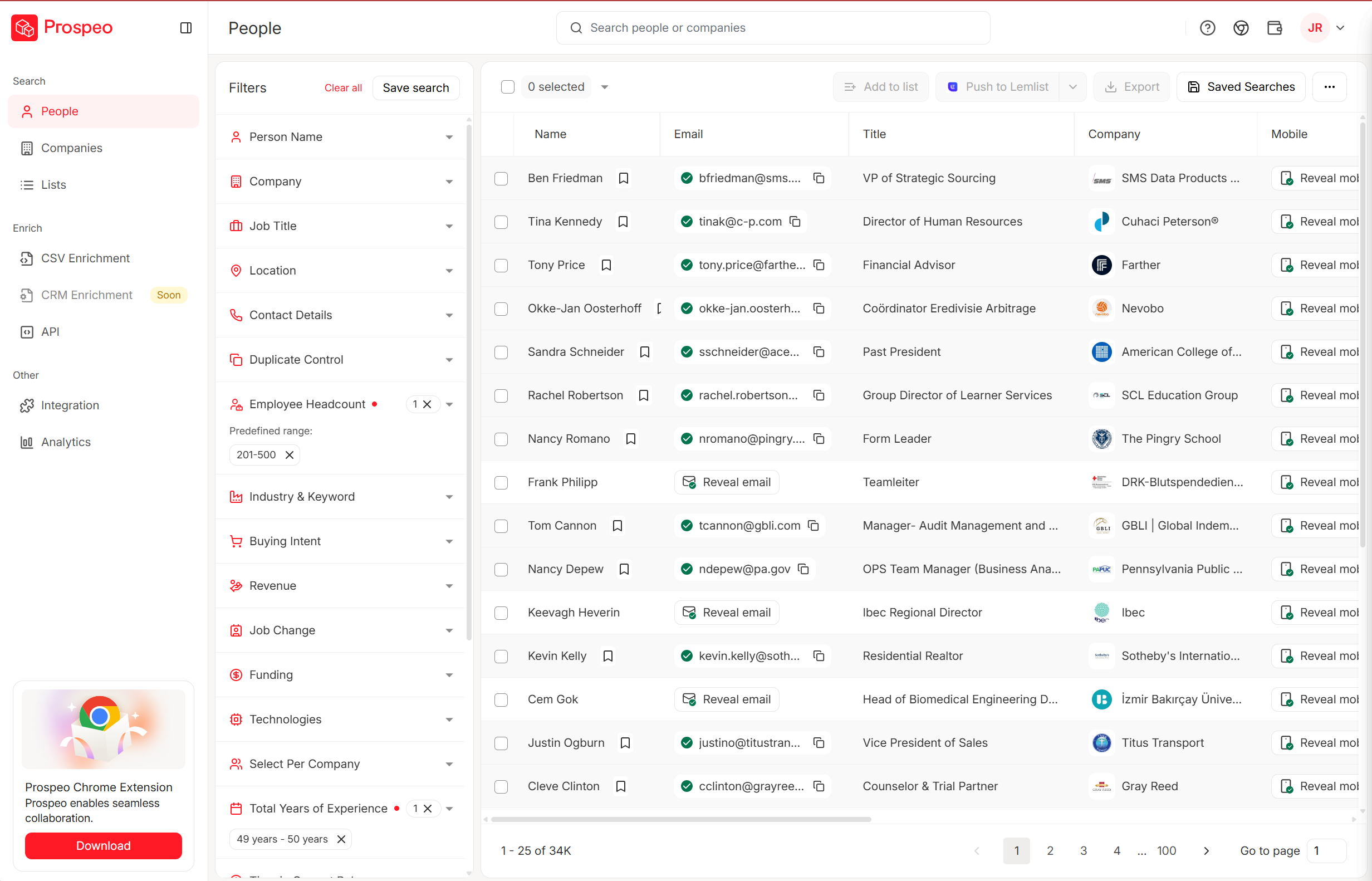
The data and enrichment layer is where most teams underinvest and pay the highest hidden cost. Prospeo covers 300M+ professional profiles with 98% email accuracy and 125M+ verified mobile numbers. The 7-day data refresh cycle is the real differentiator - most competitors refresh every 4-6 weeks, which means your reps are working stale data for most of the month. GreyScout cut rep ramp time from 8-10 weeks to 4 weeks after switching their data layer, a direct SDM metric improvement. (If you're comparing vendors, start with data enrichment services and a short list of SDR tools.)
Gong pulls double duty as both call intelligence and enablement. At ~$100-150/user/month it's not cheap, but the ability to review calls, identify coaching moments, and track talk patterns across the team makes it worth the investment for most SDM-led orgs. Pair it with an internal wiki for onboarding playbooks and talk tracks, and you've got a full enablement stack without adding another vendor.
I'll be blunt about the SDM tech stack: most teams overspend on engagement platforms and underspend on data quality. A $150/user/month sequencing tool sending emails to bad addresses is just an expensive way to destroy your domain reputation. If your budget is tight, invest in clean data first and run sequences from HubSpot until you can afford a dedicated engagement platform. The data layer has a higher ROI than any other category in the stack.
SDR Retention - The Hardest Part
Here's the stat that should keep every SDR team leader up at night: 52% of companies report average SDR tenure under one year. The broader average sits around 14 months. Either way, you're looking at a revolving door unless you actively build against it.
The math on turnover is brutal. Each departing SDR costs you 3+ months of ramp time on their replacement, plus the recruiting and onboarding overhead. If you manage 8 SDRs and lose 4 per year, you're spending nearly half your time just getting people up to speed. That's not a management job - it's a treadmill.
The fix isn't ping-pong tables or pizza Fridays. It's career paths.
SDRs need to see a clear progression: SDR to Senior SDR to SDM or AE or Customer Success. When the path is visible and achievable, retention improves because reps are working toward something, not just grinding through a stepping-stone role. The consensus on r/sales backs this up - the threads about SDR burnout almost always circle back to "I don't see where this goes."
Pipeline equality matters here too. Nothing burns out an SDR faster than watching a peer crush quota on a better territory while they're stuck cold-calling companies that'll never buy. Enforcing fair account distribution isn't just an efficiency play - it's a retention play. Reps who feel the system is fair stick around longer.
Build career paths or build a revolving door. There's no third option.
How to Become an SDM
The typical progression: SDR to Senior SDR to Sales Development Manager to Senior SDM to Director of Sales Development to VP of Sales.
Each jump requires something different. Going from SDR to SDM usually takes 1-2 years as a top performer, plus a demonstrated coaching instinct. The reps who get promoted aren't just the ones who hit quota - they're the ones who help other reps hit quota. If you're an SDR eyeing management, start documenting what you're teaching teammates and what process improvements you've driven. That paper trail matters when the promotion conversation happens.
The SDM-to-Director jump is harder. It typically takes 2-3 years of managing and requires cross-functional credibility - you need marketing, RevOps, and AE leadership to vouch for you. At this level, you're not just running a team; you're designing the sales development function and influencing hiring plans, tech stack decisions, and go-to-market strategy.
Skip the management track if you get your energy from carrying an individual number. Many strong SDRs move laterally into AE roles to close deals, or Customer Success for relationship-oriented work. The SDM path specifically appeals to people who enjoy building systems and developing people. If that doesn't sound like you, there's no shame in choosing a different lane.
How to Get Hired
Every SDM interview includes "walk me through your 30-60-90 day plan." Here's what they're actually testing: can you listen before you act, diagnose before you prescribe, and show results before you ask for more headcount?
What Interviewers Ask
Expect questions across four areas. Behavioral questions probe how you've handled underperformers, conflict, and missed targets. Strategic and operational questions test whether you can design an SDR org from scratch. Team-building questions explore your hiring criteria and onboarding approach. Industry and product knowledge questions reveal whether you understand the buyer, the market, and the competitive landscape.
What to Prepare
Know your KPIs cold - conversion rates, deal size, sales cycle length, CAC. Have a clear point of view on CRM and tooling. Bring a 30-60-90 day plan, even if they don't ask for it. (If you want a template, adapt a 30-60-90 day plan to the SDM role.)
The 30-60-90 Framework
Days 1-30 are about listening. Audit the current pipeline, shadow every rep, understand the tech stack, map the handoff process to AEs. Don't change anything yet. Your job is to learn what's actually happening versus what leadership thinks is happening.
Days 31-60 are about targeted action. Identify 2-3 process changes based on your audit. Implement one. Maybe it's restructuring 1:1s, fixing account distribution, or cleaning up the data layer. Pick the highest-leverage change and execute it well.
Days 61-90 are about proving impact. Pipeline velocity, meeting quality, ramp time, rep satisfaction - pick the metrics that matter most to your VP and demonstrate movement. This is where you earn the trust to make bigger changes.
The candidates who get hired aren't the ones with the flashiest decks. They're the ones who show they can diagnose a problem, build a system to fix it, and measure the result. That's the sales development manager role in a nutshell - and it's exactly what separates pipeline machines from pipeline messes.
You're managing 8 SDRs, each needing 21 meetings a month. That's 168 meetings from data you didn't choose. Prospeo gives your team verified contacts at $0.01/email with 30% mobile pickup rates - so the 9-12 touches per prospect actually reach real buyers, not dead inboxes.
Give your reps pipeline-grade data for less than your coffee budget.
FAQ
What does a sales development manager do day-to-day?
An SDM spends most of their time coaching SDRs through 1:1s and call reviews, monitoring pipeline metrics, and troubleshooting process bottlenecks. Expect roughly 40% people management, 30% pipeline operations, 20% cross-functional alignment with marketing and AEs, and 10% on tooling and data hygiene.
Is an SDM the same as an SDR Manager?
Yes - they're identical roles with different titles. "Sales Development Manager" appears on formal job postings and org charts, while "SDR Manager" is the shorthand used internally. Compensation, reporting structure, and responsibilities are the same regardless of which title the offer letter uses.
How much does an SDM earn in SaaS?
In SaaS, expect $105k base / $155k OTE based on RepVue's 2026 data. Enterprise SaaS outliers like Illumio ($230k OTE) and Shopify ($220k OTE) push the ceiling higher. Non-tech industries average $72k-$77k base.
What tools should an SDM prioritize first?
Start with a CRM (Salesforce or HubSpot) and a data enrichment platform for verified contacts. Clean data eliminates the 15-20% bounce-rate tax that silently kills SDR productivity before any coaching or sequencing tool can help.
How many SDRs should one manager oversee?
The benchmark is 8.1 SDRs per manager. Above 10, coaching quality drops noticeably - you can't run meaningful 1:1s and call reviews with that many direct reports. Below 5, you're likely overstaffed on management relative to team size.