

Sales Email Best Practices: Start With the Inbox, Not the Subject Line
Picture this: an SDR sends 500 cold emails. Three replies. Open rate looks fine at 35%, but Apple Mail Privacy Protection is inflating that number. Subject lines are decent. The real problem? 47 emails bounced, and Gmail just decided the domain sends junk.
Most sales email best practices guides would tell that SDR to rewrite their subject lines. That's the wrong fix. The problem is almost never copy - it's infrastructure.
Here's everything that actually moves the needle, organized into three tiers that separate high-performing teams from everyone else.
Deliverability and Data Quality Come First
84% of B2B sending domains have zero DMARC protection. If yours is one of them, your emails are fighting uphill before a human ever sees them.
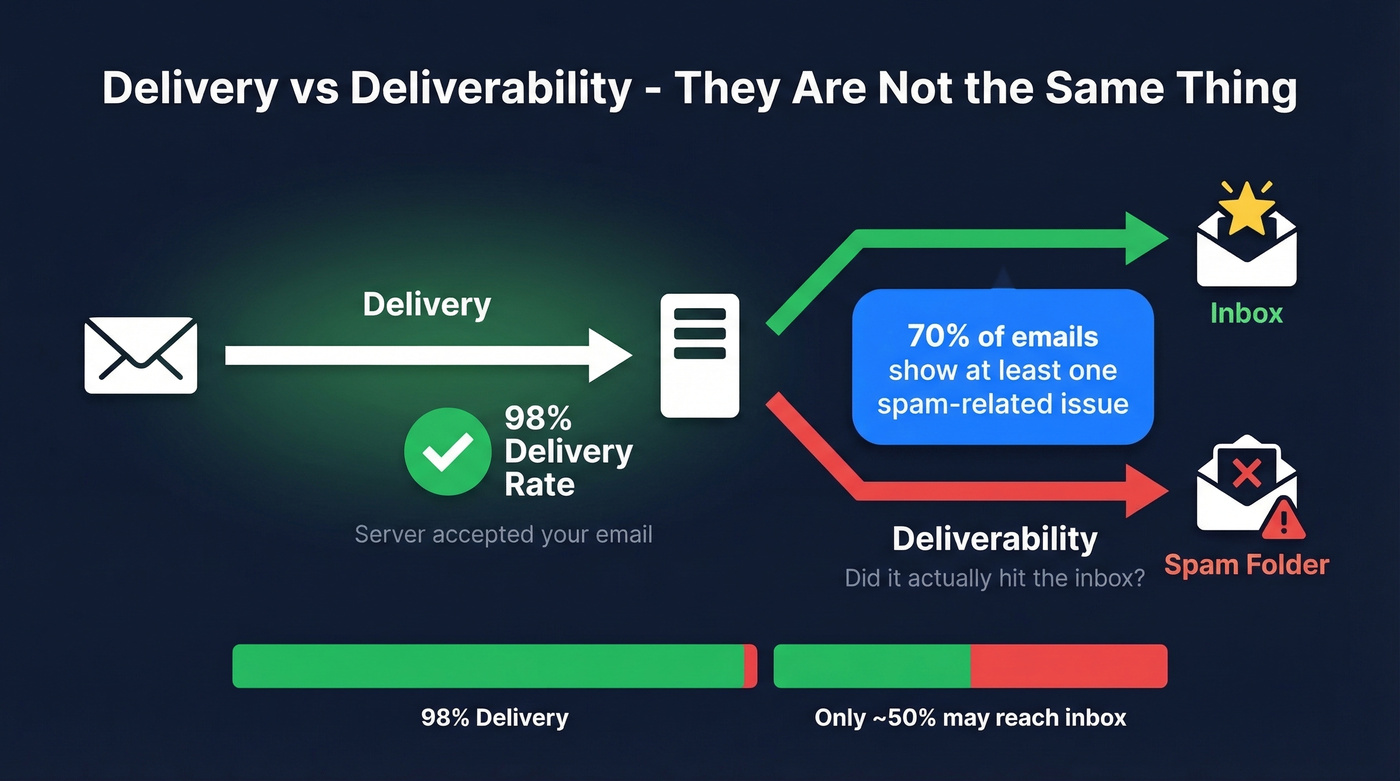
Quick distinction worth internalizing: delivery means the server accepted your email. Deliverability means it hit the inbox, not spam. 70% of emails show at least one spam-related issue, so you can have 98% delivery and still lose half your messages to spam folders. Those are very different problems with very different fixes. If you want the deeper technical breakdown, start with an email deliverability audit.
Your pre-send checklist:
- SPF, DKIM, DMARC - all three configured and aligned (and double-check DMARC alignment)
- Spam complaint rate under 0.3%
- Warm up new mailboxes 2-4 weeks, starting at 20-40 sends/day (use safe email velocity limits)
- Verify your contact list before every campaign with an AI email checker

That last point is where we've seen the most damage done. A 5% bounce rate sounds minor until Gmail starts throttling your domain. We run every list through Prospeo's 5-step verification - spam-trap removal, honeypot filtering, catch-all handling - which delivers 98% email accuracy. Stack Optimize built their agency to $1M ARR on that data, holding 94%+ client deliverability and under 3% bounce rates across every campaign (see email bounce rate benchmarks and fixes).
Clean data isn't a nice-to-have. It's the engine.

You just read it: a 5% bounce rate is enough for Gmail to throttle your domain. Prospeo's 5-step verification - spam-trap removal, honeypot filtering, catch-all handling - delivers 98% email accuracy on 143M+ verified addresses. Stack Optimize held under 3% bounce rates across every client campaign and scaled to $1M ARR on that data.
Stop rewriting subject lines. Fix your data first.
Copy That Earns Replies
Subject Lines
A Belkins study of 5.5 million emails found personalized subject lines hit 46% open rates versus 35% without. Reply rates doubled. The sweet spot is 2-4 words, and performance drops noticeably past seven. Numbers in subject lines actually performed slightly worse, so skip the "3 ways to..." format. If you need inspiration, pull from these email subject line examples (and compare against prospecting email subject lines).
| Device/Client | Visible Characters |
|---|---|
| iPhone | 33-41 |
| Android | 35-50 |
| Gmail (desktop) | ~70 |
| Outlook | 50-70 |
| Yahoo | ~46 |
Body Copy
The best-performing campaigns in Instantly's 2026 dataset share a few traits. Here are the email selling tips that hold up in the data, numbered so you can audit your templates against them:
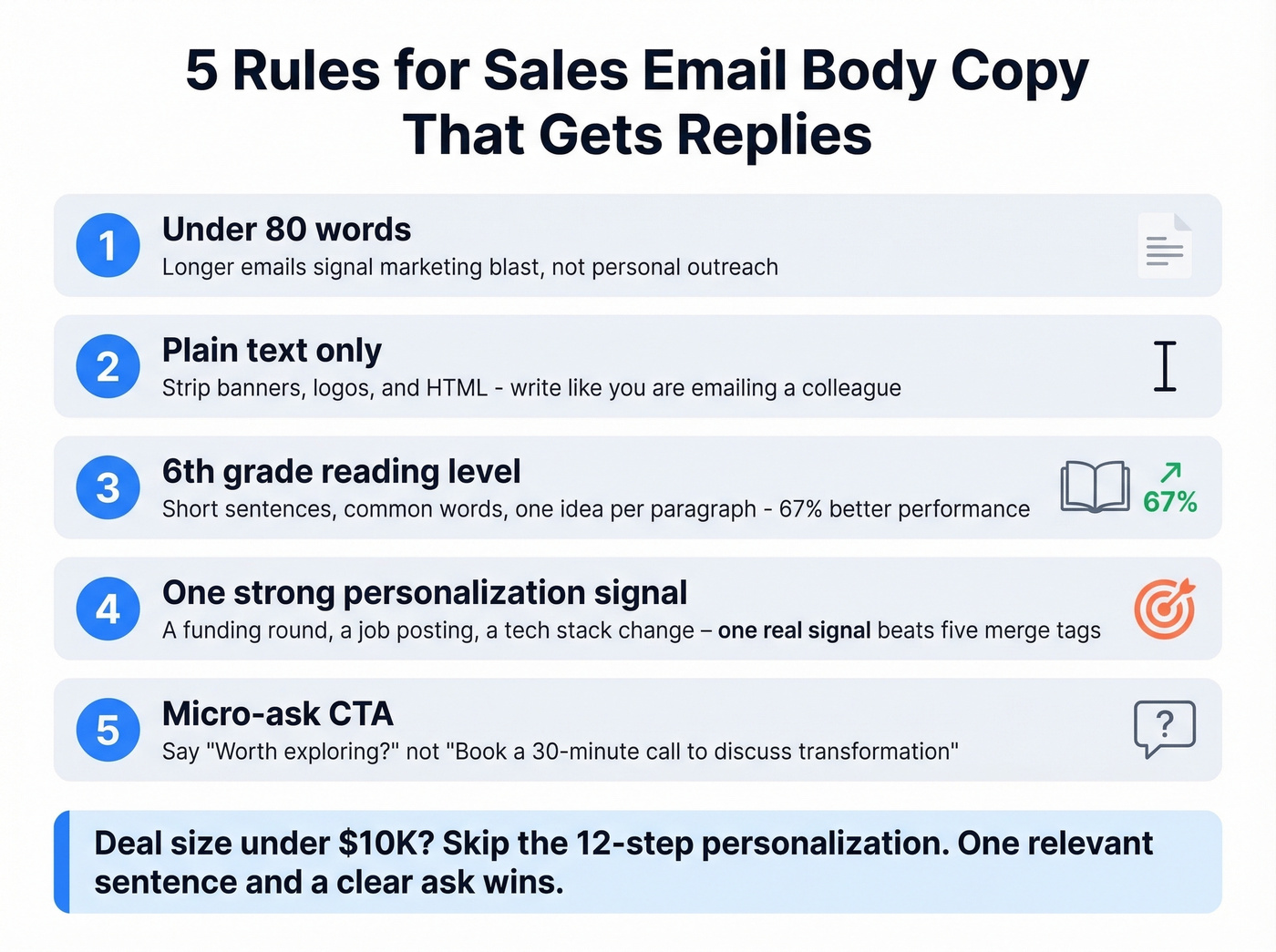
- Keep first-touch emails under 80 words. Longer emails don't signal thoroughness - they signal marketing blast.
- Use plain text. Strip banners, logos, and HTML formatting. Write like you're emailing a colleague (more email copywriting rules here).
- Write at a sixth-grade reading level. A widely shared r/SaaS playbook claims roughly 67% better performance with simpler language. Short sentences, common words, one idea per paragraph.
- Personalize with one strong signal. A recent funding round, a job posting, a tech stack change. One real signal beats five generic merge tags every time (see personalized outreach).
- End with a micro-ask CTA. "Worth exploring?" works. "Book a 30-minute call to discuss how we can transform your pipeline" doesn't. You're asking for a reply, not a commitment (more email call to action examples).
Here's the thing: if your deal size sits below $10K, you probably don't need a 12-step personalization workflow. One relevant sentence and a clear ask will outperform a hyper-researched novel that nobody reads.
Follow-Up Sequences
58% of replies come from the first email, which means 42% come from follow-ups. That's not a rounding error.
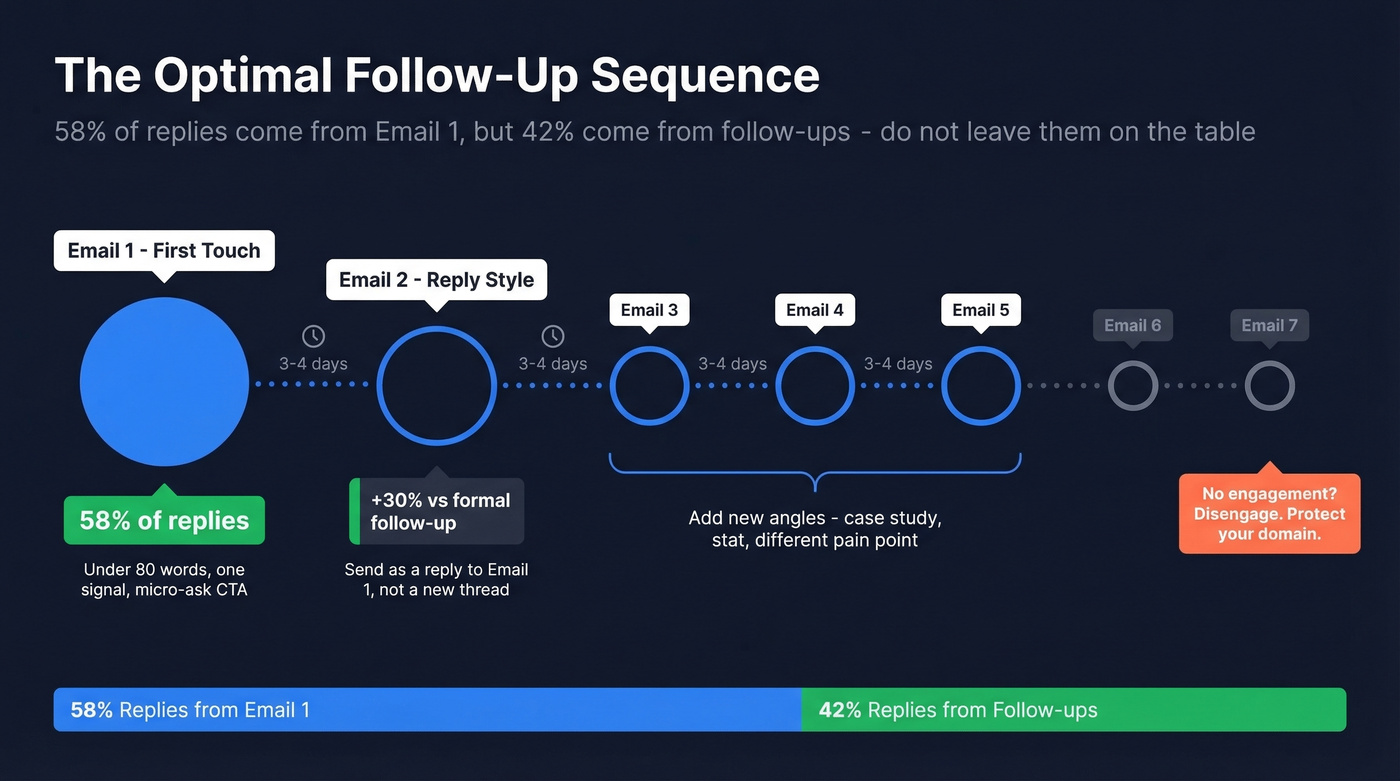
We've tested this extensively: 4-7 emails spaced 3-4 days apart is the sweet spot. Make your second email feel like a reply to the first, not a new pitch - this "Step 2 as reply" approach outperforms formal follow-ups by roughly 30%. After a couple of weeks of zero engagement, disengage. Your domain reputation matters more than any single prospect, and burning it for one deal you'll probably never close anyway is a bad trade. If you want plug-and-play sequences, use these sales follow-up templates.
Measurement and Compliance
Stop Tracking Opens
Let's be honest about open tracking: it's doing more harm than good. An analysis of 44 million emails found that turning off open tracking more than doubled reply rates - 2.36% versus 1.08%. The tracking pixel itself triggers spam filters. Apple Mail Privacy Protection inflates open numbers anyway, as Klaviyo's analysis of 183,000+ brands confirms.
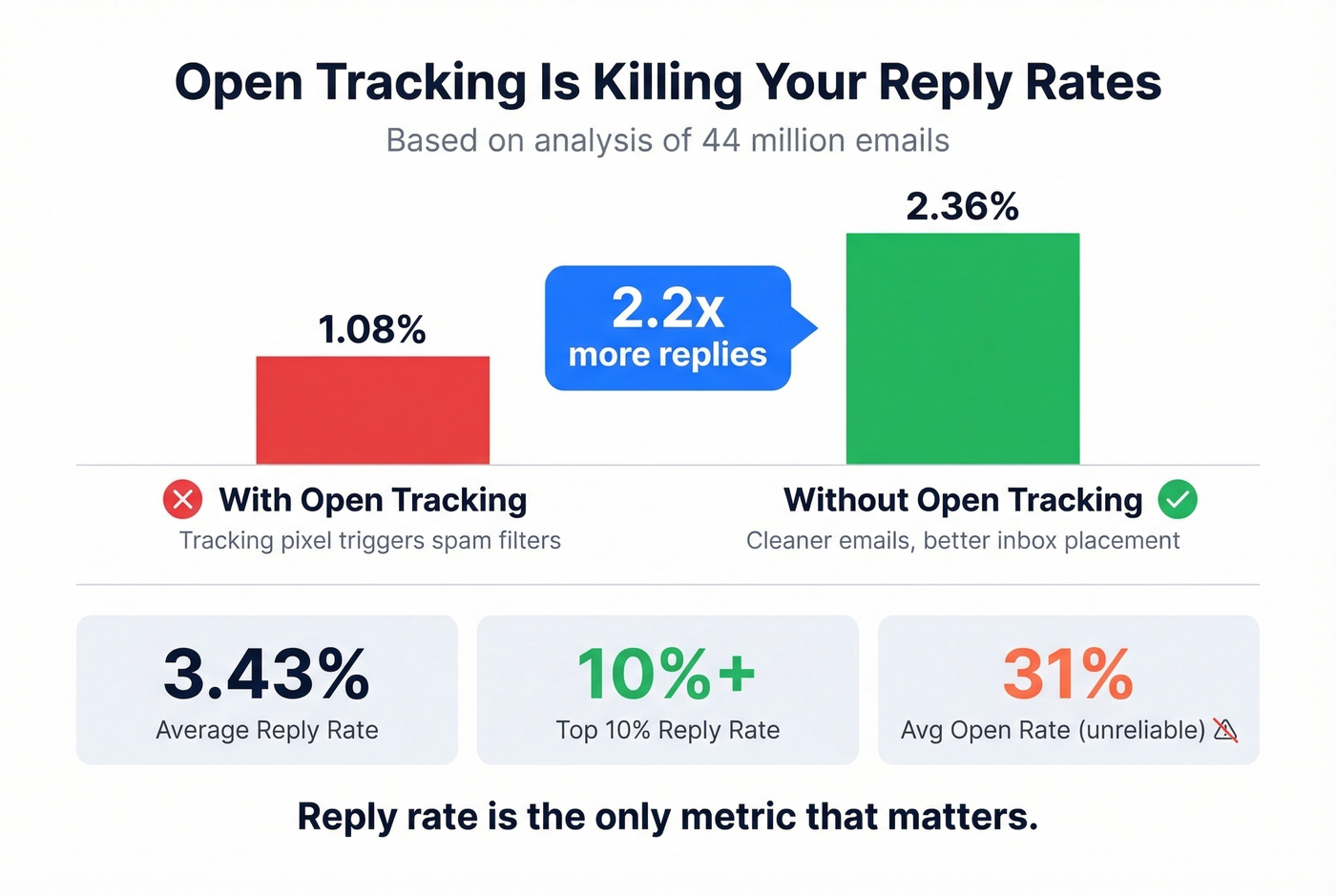
Reply rate is the only metric that matters.
| Metric | Average | Top 10% |
|---|---|---|
| Reply rate | 3.43% | 10%+ |
| Campaign open rate | 31% | 45.1% |
| Click rate | 1.69% | 3.38% |
Regulatory Compliance
CAN-SPAM penalties run up to $53,088 per violating email. Per email. That number tends to focus the mind.
| Regulation | Key Requirement | Max Penalty |
|---|---|---|
| CAN-SPAM (US) | Address + opt-out (10 days) | $53,088/email |
| GDPR (EU/UK) | Consent / legit interest | EUR 20M or 4% revenue |
| CASL (Canada) | Express or implied consent | $10M/violation |
Build compliance into your templates from day one - physical address, clear opt-out, honest headers - and you'll never think about it again. Following sales email best practices means nothing if a single regulatory violation wipes out your sending reputation overnight.
Every best practice in this guide - plain text, micro-ask CTAs, 4-7 email sequences - falls apart when 47 emails bounce and your domain gets flagged. Prospeo refreshes all 300M+ profiles every 7 days, not the 6-week industry average, so your lists stay clean between campaigns. At $0.01 per email, protecting your sender reputation costs less than a single spam complaint.
Fresh data every 7 days. Your domain reputation depends on it.