

Sales Email Tone: What the Data Actually Says About Getting Replies
You just sent 500 cold emails and got 17 replies. That's not a bad week - that's the average. Instantly's 2026 benchmark report puts the overall cold email reply rate at 3.43%. Top performers hit 10%+. The gap between those two numbers isn't your offer, your product, or your list. It's your sales email tone - the highest-leverage variable most reps never deliberately adjust.
The Short Version
If you're between meetings and need the takeaways now, here they are.
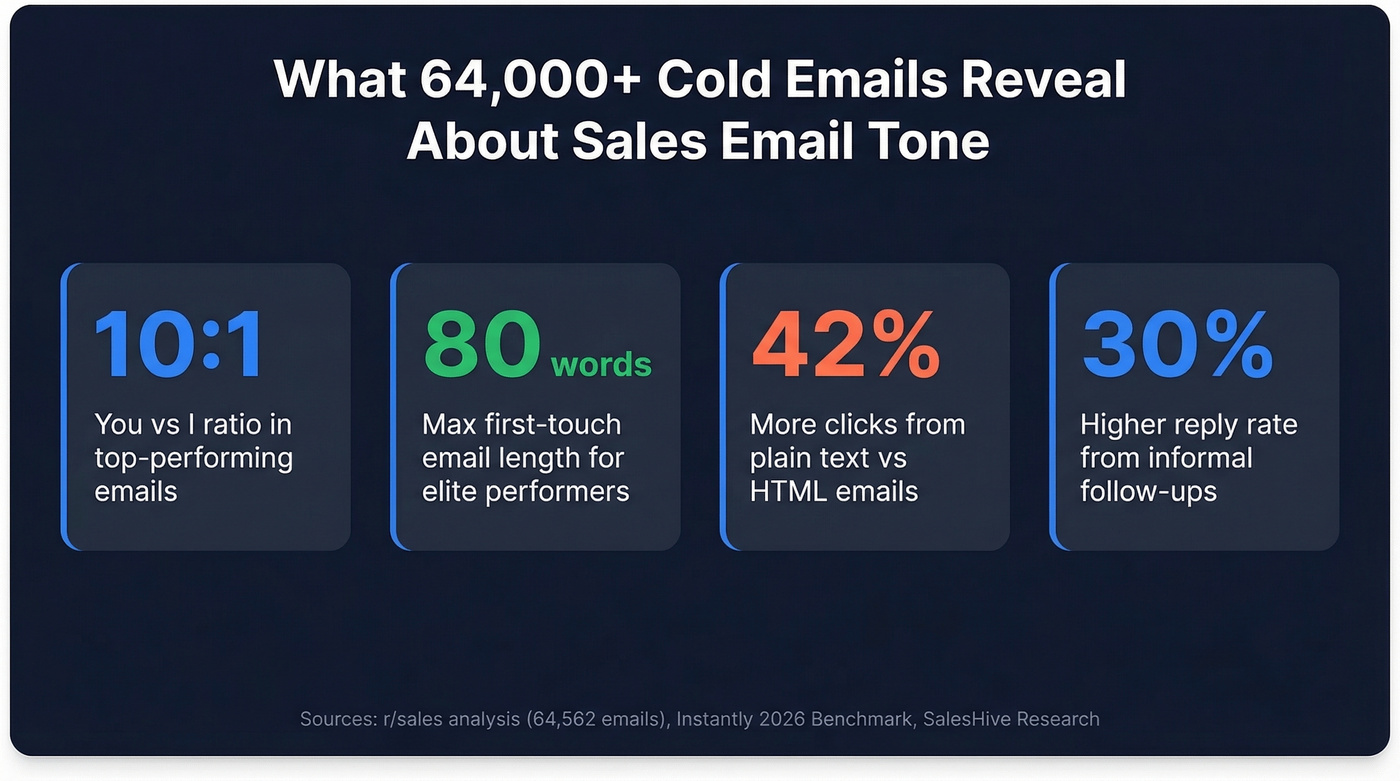
- Use "you" 10x more than "I." An analysis of 64,562 cold emails found buyer-centric language is the single strongest tone signal.
- Keep first-touch emails under 80 words. Elite performers in Instantly's 2026 data stay under this threshold consistently.
- Lead with an observation, not your credentials. Nobody cares that you're the "leading provider of" anything. Open with something you noticed about them.
- Use interest-based CTAs, not calendar links. "Is this relevant to your team?" outperforms "Book 15 minutes here" before you've earned any interest.
- Write casual subject lines. Personalized, lowercase subject lines outperform polished marketing-style headers in cold outbound.
The rest of this piece is the evidence and the examples.
What Tone Actually Means in Sales Emails
Tone isn't voice. Your voice is your brand's personality - it stays consistent whether you're writing a blog post, a cold email, or a Slack message. Tone shifts by context. The tone of a first-touch cold email should feel different from a third follow-up, which should feel different from a closing email.
This distinction matters because most "email tone" advice comes from the email marketing world. Mailchimp-style guidance about brand voice and newsletter personality doesn't apply here. Cold outbound is a different animal entirely. You're interrupting a stranger's day, and the tone rules that govern a welcome sequence to opted-in subscribers will actively hurt you in cold email, where conversational brevity is what works.
What 64,000+ Emails Reveal
A practitioner on r/sales analyzed 64,562 cold emails sent over two years, tracking which templates (used 400+ times each) actually booked meetings, with results tied back to CRM outcomes. The patterns all point to the same conclusion: sound like a helpful peer, not a salesperson.
The You:I Ratio
Top-performing emails use "you" roughly 10 times for every "I." In our experience, this is the single fastest fix for underperforming sequences. Most reps do the opposite - they open with "I'm reaching out because..." and spend three sentences explaining what their company does. The prospect doesn't care about your company. They care about their problem.
Why Short Emails Win
The data converges from multiple directions. The 64,562-email analysis recommends 5 sentences max and 70 words or fewer. SalesHive's research puts the sweet spot at 50-125 words, with short emails in that range driving up to 50% higher reply rates. Instantly's elite performers stay under 80 words on first touch.
Here's the thing: brevity is tone. Keeping an email under 80 words isn't a formatting trick - it communicates respect for the reader's time. That's a tone choice, and it's the most important one you'll make.
Plain Text Beats HTML
Plain-text cold emails generate ~42% more clicks than HTML-heavy versions. With 41.6% of emails opened on mobile, heavy formatting signals "marketing blast" instead of "person writing to you." Personalized subject lines boost open rates by ~26%, and multi-point personalization can more than double response rates versus generic templates.
We've tested this across dozens of client campaigns and the pattern holds every time. Stop trying to "add personality." Every guide tells you to inject humor, use GIFs, show your brand's quirky side. The data says the opposite. The best-performing cold emails aren't charming - they're useful. They lead with an observation, offer something valuable, and ask a low-friction question. Personality is what you default to when you don't have anything relevant to say.
| Element | What Works | What Doesn't |
|---|---|---|
| Length | 50-80 words | 150+ words |
| Pronouns | "You" 10:1 over "I" | "I" / "We" dominant |
| Format | Plain text | HTML, banners, logos |
| CTA | Interest-based question | Calendar link |
| Subject | Personalized, short | Generic, gimmicky |
Before and After: Tone in Action
Your manager forwarded you a "winning template" from 2019. We've rewritten hundreds of these - the pattern is always the same.
Opening Line
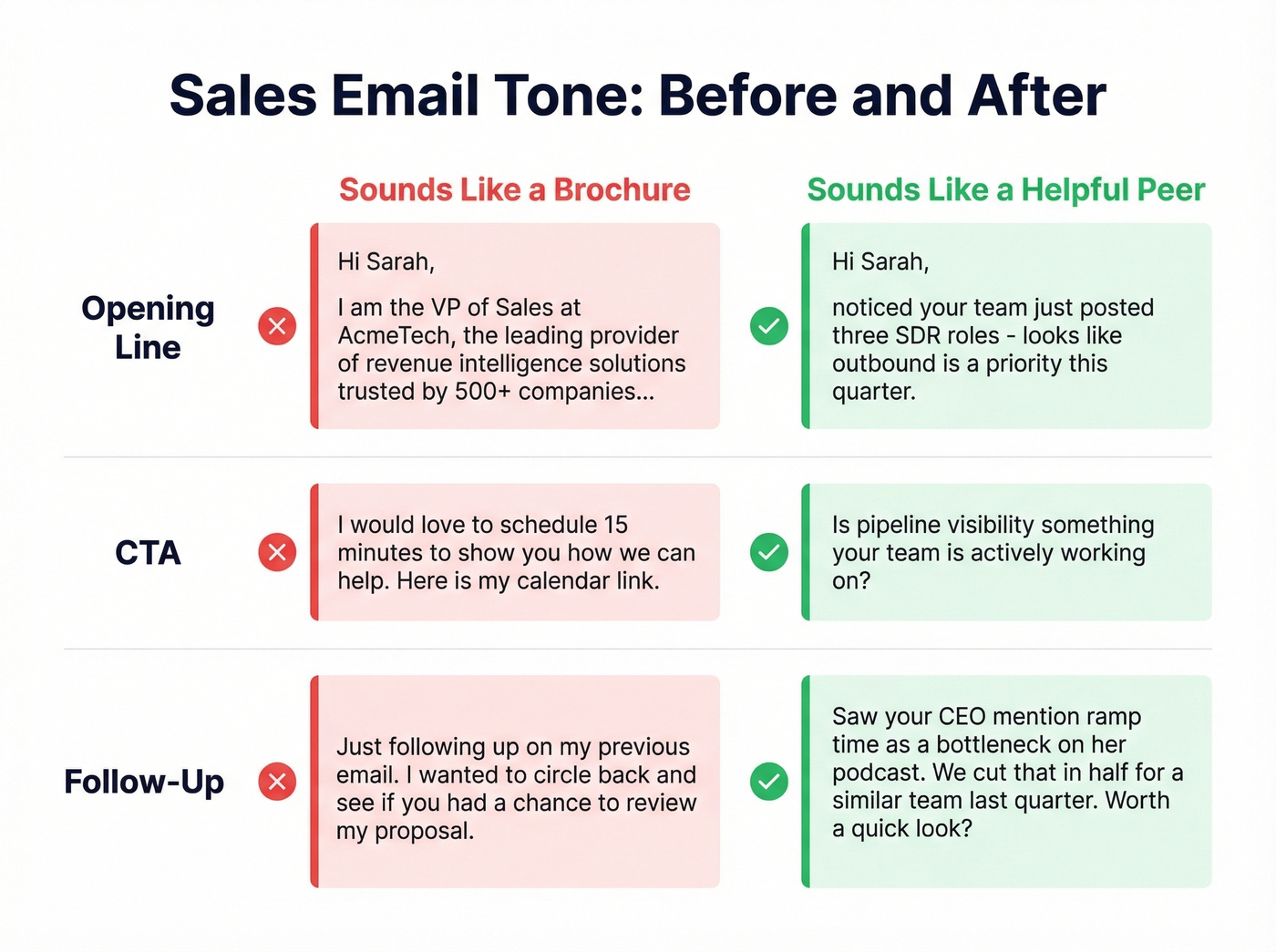
❌ Before: "Hi {{first_name}}, I'm the VP of Sales at AcmeTech, the leading provider of revenue intelligence solutions trusted by 500+ companies..."
✅ After: "Hi {{first_name}}, noticed your team just posted three SDR roles - looks like outbound is a priority this quarter."
The first version is a brochure. The second is a casual email introduction - an observation that proves you did 30 seconds of homework. That's the entire tone shift in one sentence. No charm required, just relevance.
CTA
❌ Before: "I'd love to schedule 15 minutes to show you how we can help. Here's my calendar link: [calendly.com/...]"
✅ After: "Is pipeline visibility something your team is actively working on?"
Calendar links before interest is established are the cold email equivalent of proposing on a first date. Interest-based CTAs lower the commitment threshold and let the prospect engage on their terms. (If you want more examples, see our email call to action guide.)
Follow-Up
❌ Before: "Just following up on my previous email. I wanted to circle back and see if you had a chance to review my proposal."
✅ After: "Saw your CEO's podcast on scaling outbound - she mentioned ramp time as a bottleneck. We cut that in half for a similar team last quarter. Worth a quick look?"
Informal follow-ups that read like replies outperform formal reminders by ~30%. Add new value each time. Never guilt-trip.
Adjusting Tone by Buyer Role
The average B2B buying committee includes 11-13 stakeholders. You can't use the same tone for all of them. (This is also why account-based selling tends to outperform one-size-fits-all blasts.)
C-Suite: Strategic and Brief
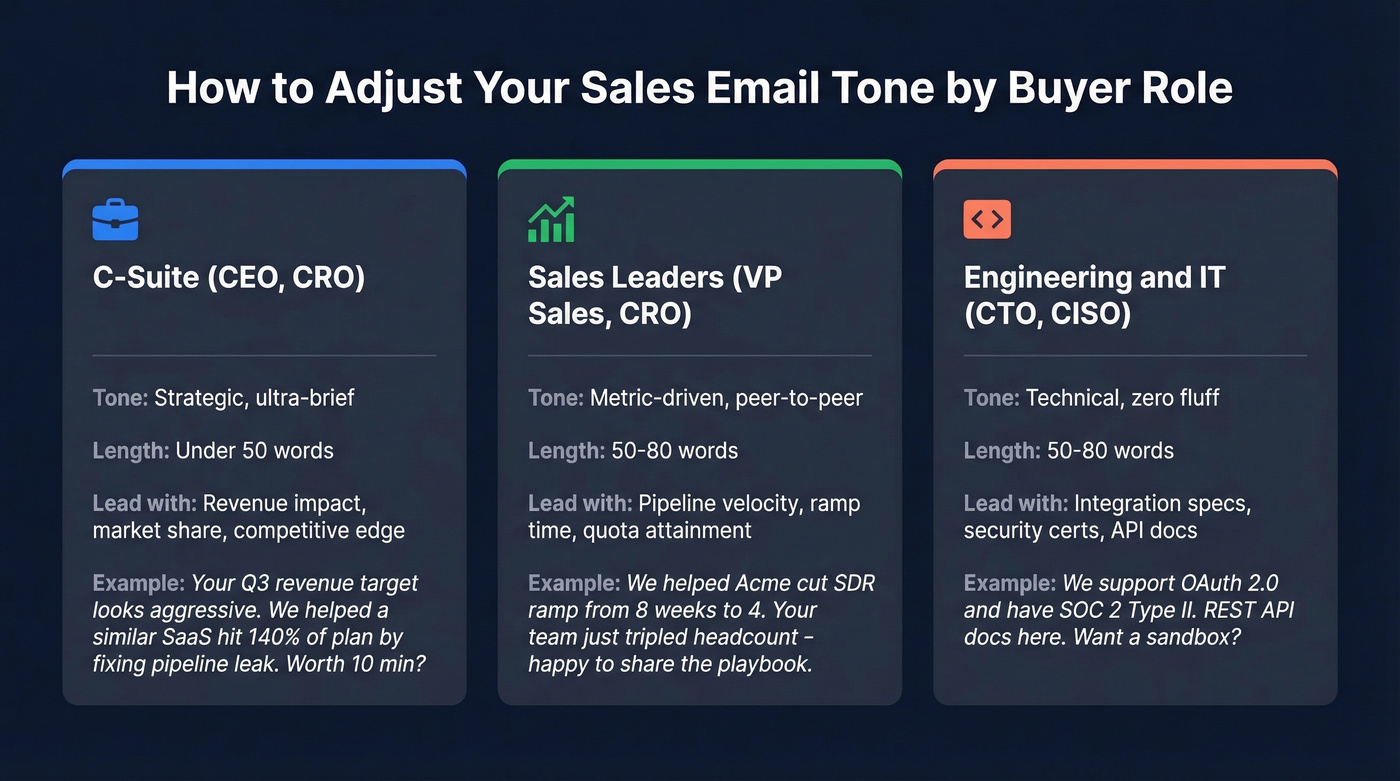
Executives have the least time and the most context. So how formal should an email to a CEO be? More formal than a note to a marketing manager, but still concise and direct - skip the pleasantries and lead with strategic outcomes like revenue impact, competitive positioning, and market share. Keep it under 50 words. Skip the feature list entirely. 57% of C-level buyers prefer phone over email, so your email's job is often just earning the right to call.
Sales Leaders: Lead With Metrics
Pipeline velocity, ramp time, rep productivity, quota attainment. Sales leaders think in numbers. "We helped [similar company] cut SDR ramp from 8 weeks to 4" lands harder than any paragraph about your platform's capabilities.
Engineering and IT: Skip the Buzzwords
These buyers are allergic to marketing speak. Lead with technical specifics - integration architecture, security certifications, API documentation. "We support OAuth 2.0 and have SOC 2 Type II" beats "our enterprise-grade solution seamlessly integrates" every single time.

Nailing your sales email tone is half the battle. The other half is reaching the right person at a real address. Prospeo's 98% email accuracy means your carefully crafted 80-word emails don't bounce - they land. At $0.01 per email, bad data stops being the reason your reply rates stay at 3.43%.
Perfect tone + verified emails = the 10% reply rate club.
Follow-Up Tone Across Your Sequence
Your follow-up tone matters more than your first email's tone. 58% of replies come from step 1 of a sequence, which means 42% come from follow-ups - and the tone shift from professional outreach to casual reply is where most reps fail. (If you need copy you can adapt, start with these sales follow-up templates.)
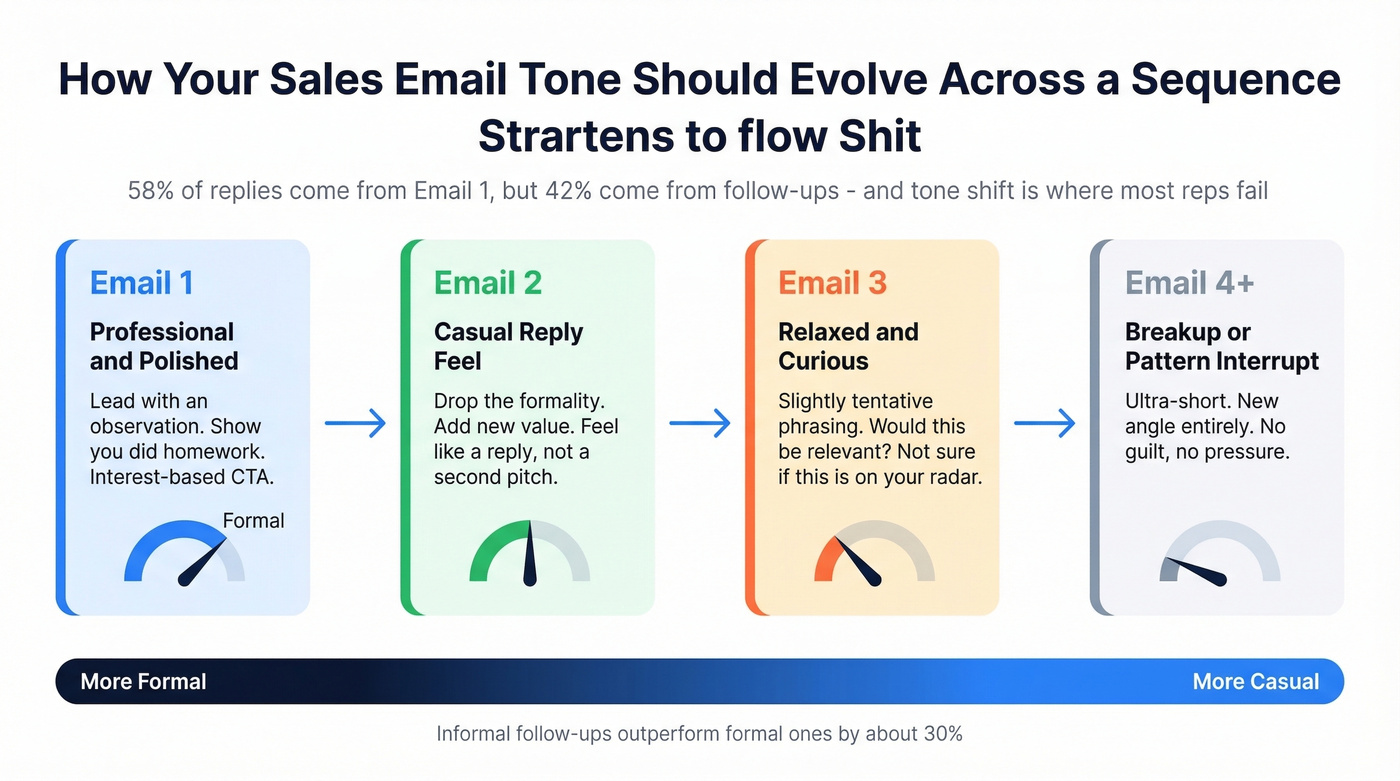
The biggest mistake is keeping the same formal register across every touchpoint. Your first email can be polished and professional. Your second should feel like a conversational email - a casual reply rather than a second pitch. Your third can be even more relaxed. Instantly's data shows informal follow-ups outperform formal ones by ~30%, and slightly tentative phrasing like "Would this be relevant?" instead of "I know this will transform your pipeline" lifts reply rates by 10-25%.
Let's be honest: confident tone is overrated. The Reddit consensus in r/sales backs this up - chest-thumping language triggers sales defenses. A slightly uncertain, genuinely curious tone disarms people. "Not sure if this is on your radar" works better than "I'm confident we can help." One user asked for a tone check because their follow-up felt "too fearmongery" - and that's the line you don't want to cross. If you're using fear or guilt to drive replies, you've already lost.
The Psychology Behind Tone
Every tone choice maps to a psychological trigger. Understanding why certain phrases work helps you adapt rather than just copy templates.
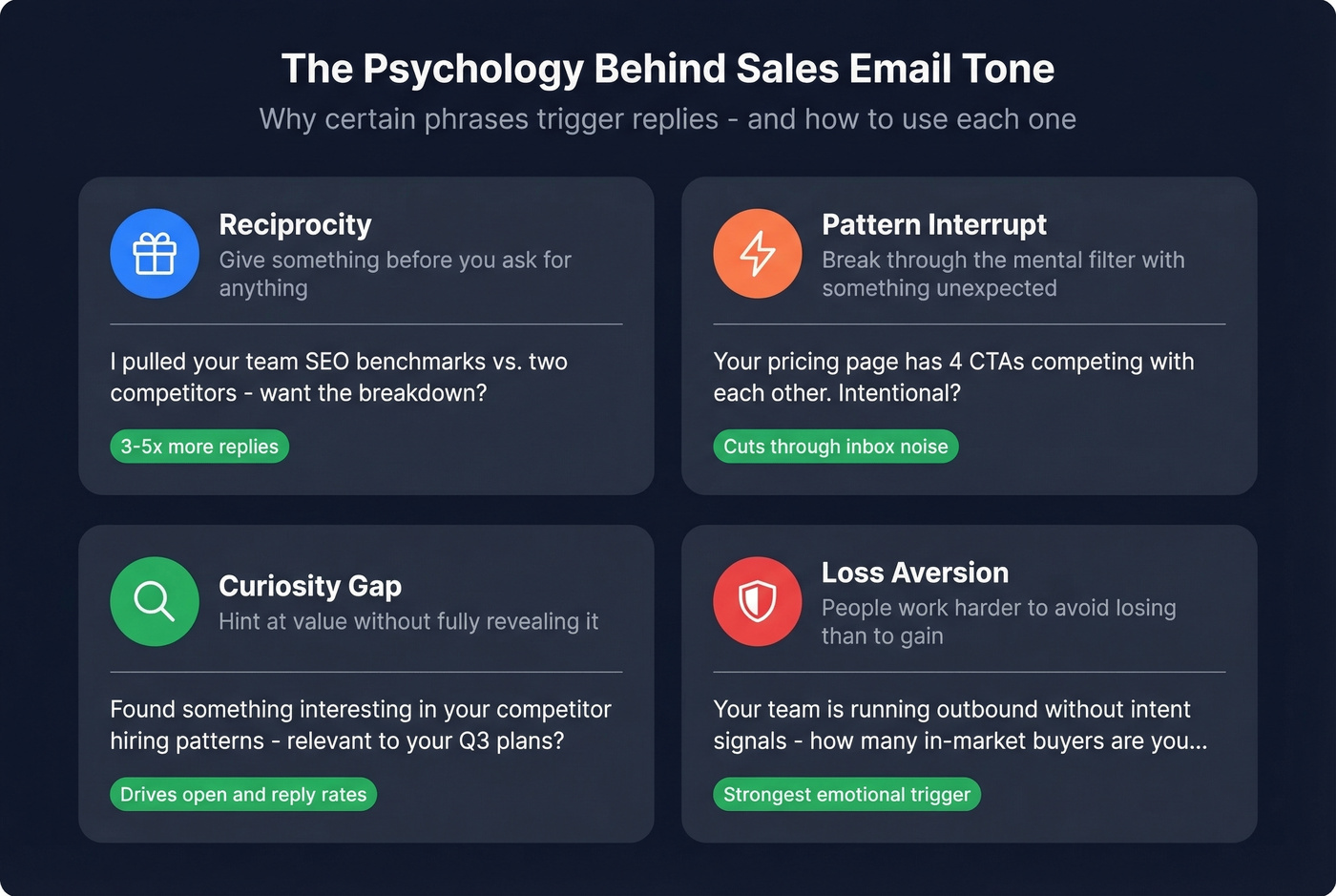
Reciprocity. Give something before asking - a relevant benchmark, a quick audit, a useful framework. Give-first emails generate 3-5x more replies than ask-first approaches. "I pulled your team's SEO benchmarks vs. two competitors - want the breakdown?" (More on this approach: how to add value in sales.)
Pattern interruption. The brain filters out anything that looks like every other email. An unexpected opening line breaks the pattern. "Your pricing page has 4 CTAs competing with each other. Intentional?" This is usefulness, not personality - and it's why the "stop trying to be charming" principle holds. The observation itself is the hook.
Curiosity gap. Hint at something valuable without fully revealing it. "Found something interesting in your competitor's hiring patterns - relevant to your Q3 plans?"
Loss aversion. People work harder to avoid losing something than to gain something equivalent. "Your team's running outbound without intent signals - how many in-market buyers are you missing?"
Tone Mistakes That Kill Replies
Prospects can smell robotic, templated campaigns instantly. Here are the patterns that trigger that reaction.
Writing like a brochure. If your email could be a paragraph from your website's homepage, rewrite it. Cold emails are conversations, not marketing collateral. (For a deeper framework, see email copywriting.)
Over-formatting. Banners, logos, multiple hyperlinks, colored text - all of it screams "mass email." One link max. Plain text always.
Fear-based follow-ups. "Your competitors are already doing this" triggers defensiveness, not curiosity. Offer value instead of anxiety.
Being too casual for the audience. A GIF works for a marketing manager. It won't work for a CISO at a bank. Match the buyer's world, not yours.
Confusing personalization tokens with personalization. Inserting {{first_name}} and {{company}} doesn't make an email feel personal. Tone does. Observation does. A merge tag is plumbing - it's not the message. (If you're building this at scale, personalized outreach is the playbook.)
And the biggest tone mistake of all isn't word choice - it's sending a perfectly crafted email to an address that bounces. Prospeo verifies emails in real time on a 7-day refresh cycle, so your outreach actually reaches humans instead of disappearing into the void. (Related: email bounce rate.)
Industry Benchmarks for Reply Rates
"Good" reply rates vary wildly by vertical. Before you panic about your numbers, check where your industry actually sits. These ranges come from Mailpool's aggregated platform data:
| Industry | Typical Reply Rate |
|---|---|
| Recruiting / HR | 8-13% |
| SaaS / Tech | 8-12% |
| Marketing / Agencies | 7-10% |
| Financial Services | 5-8% |
| Healthcare | 4-7% |
| Manufacturing | 4-7% |
If you're in healthcare hitting 6%, you're outperforming your vertical. Context matters more than absolute numbers.
Tools That Help You Nail Tone
Lavender
Selling into a new vertical and not sure if your tone lands? Lavender scores your email in real time and suggests rewrites as you type. I've seen reps improve reply rates within a week just by following its pronoun and length nudges. Free tier available; paid plans run ~$30-$60/user/mo.
Grammarly Business
Grammarly won't teach you sales-specific tone, but it catches the "committee copy" that makes emails sound corporate - passive voice, jargon clusters, sentences that run 40 words long. Think of it as a safety net, not a coach. ~$15-25/user/mo.
Crystal
Selling into diverse buyer personas? Crystal analyzes prospect personality profiles and recommends tone adjustments per recipient. The free version gives you a taste; paid plans run ~$50-$100/user/mo. Skip this if you're only selling to one persona type - the ROI won't be there.
You just learned that buyer-centric language and role-specific tone drive replies. But personalizing by role requires knowing who's actually on the buying committee. Prospeo gives you 30+ filters - job title, department headcount, buyer intent - so you can segment your list and match your tone to every stakeholder.
Stop sending one-size-fits-all emails to 11-person buying committees.
FAQ
What's the best tone for cold sales emails?
Conversational and buyer-centric. Data from 64,000+ emails shows top performers use "you" 10x more than "I," keep messages under 80 words, and use interest-based CTAs instead of calendar links. A slightly curious, peer-level tone beats aggressive confidence every time.
How long should a sales email be?
First-touch emails should be 50-80 words, five sentences max. Elite performers in Instantly's 2026 benchmark report stay under 80 words consistently. Brevity signals respect for the reader's time - which is itself a critical tone choice.
How do I write an informal email introduction that doesn't feel sloppy?
Lead with a specific observation about the prospect - a recent hire, a product launch, a public post. An informal introduction works when it's grounded in research rather than forced casualness. "Saw your team just expanded into EMEA - curious how you're handling outbound there" is casual but credible.
How do I follow up without sounding desperate?
Write follow-ups that read like replies, not reminders. Drop the "just checking in" opener. Add new value each time - a relevant stat, a competitor insight, a fresh observation. And verify addresses before the sequence launches; a bounced follow-up is worse than no follow-up at all.