

Sales Enablement Consulting: What It Costs, What Works, and How to Choose
Your pipeline looks healthy on paper. Close rates are sliding. Ramp time for new hires keeps stretching. The CRO wants answers, and someone suggests hiring a sales enablement consulting firm - before you write that check, you need to know what you're actually buying. Only 10% of large-scale B2B orgs rate themselves as "very effective" at driving GTM initiatives that deliver business results, per Highspot's survey of 350 global GTM professionals. The other 90% are spending money on enablement and not getting the return.
The Short Version
- Define a specific project and measurable outcome before talking to any firm. "Improve enablement" isn't a scope - "reduce new-hire ramp from 90 to 60 days" is. (If you need a structure, start with a 30-60-90 day plan.)
- Budget $15K-$60K for a one-off project or $8K-$25K/month for a retainer. Enterprise transformations run $150K-$500K+.
- Screen for real selling experience. If the consultant hasn't carried a quota, your reps will tune them out. The consensus on r/sales is blunt - enablement people who've never closed an enterprise deal get dismissed as "zero value."
- Fix your data before you fix your process. Bad contact data undermines every enablement investment. If ~30% of your emails bounce, no playbook will save you. (Use email bounce rate benchmarks to sanity-check your baseline.)
What Is Sales Enablement Consulting?
It means bringing in an external expert to diagnose and fix the gaps between your sales strategy and your reps' ability to execute it. The work spans four pillars: content, coaching, training, and technology.
Gartner's enablement advisory framework breaks it into six domains: Talent Enablement, Message Enablement, Pipeline Enablement, Operational Enablement, Platform Enablement, and Partner Enablement. Most consulting engagements touch two or three of these. Very few tackle all six - and the ones that try usually stall.
The global sales enablement platform market reached $6.91B in 2026, with content management and delivery accounting for roughly 35% of that spend. AI adoption is the primary driver - 92% of business leaders cite AI advancements as the reason behind increased enablement investment, per Seismic's Generation Enablement Report. But platforms alone don't solve the problem. That's where dedicated sales enablement services come in, whether from an agency or an independent consultant.
When to Hire a Consultant
Not every sales problem requires outside help. But certain signals suggest your internal team can't fix it alone:
- Win rates are declining and nobody agrees on why (start by auditing your sales conversion rate)
- New-hire ramp exceeds 90 days with no clear onboarding path
- You're entering a new market and your existing playbook doesn't translate
- Post-M&A integration - two sales teams, two processes, one quota
- CRM adoption is stalling - reps aren't logging activity, forecasts are fiction (often a sales process optimization issue, not a training issue)
- Coaching is inconsistent or nonexistent - managers run deals, not development
That last one is more common than most leaders admit. 55% of organizations struggle with sales training or coaching.
Here's the thing: sometimes you don't need a consultant at all. You need clean data in your CRM and a manager who runs a weekly coaching cadence. We've seen teams spend $50K on an engagement when the real problem was that reps couldn't reach anyone because half their contact data was stale. Fix the foundation first.
What Does It Cost?
Most enablement consulting firms don't publish pricing. You're expected to "book a call" before you can even budget. Here are real cost ranges based on what we've seen and publicly available consulting benchmarks.
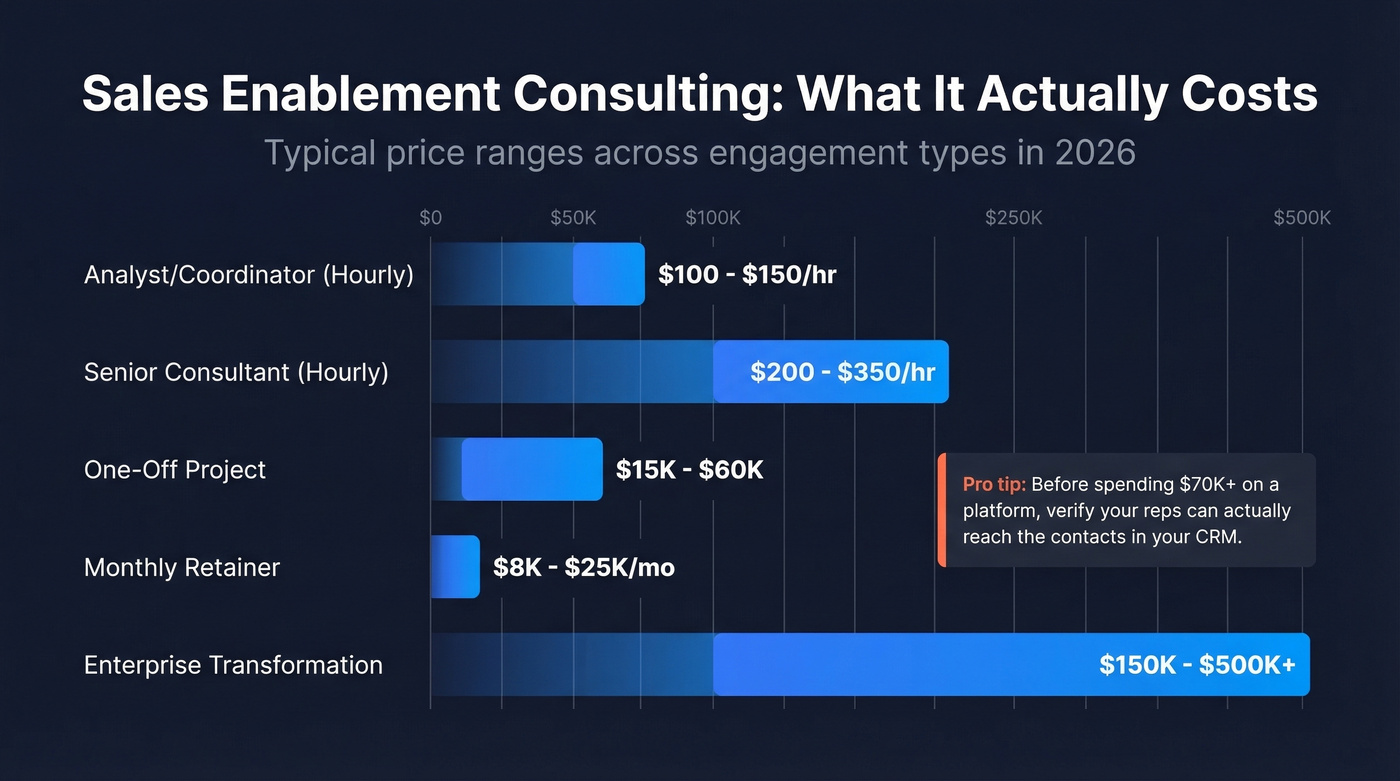
Consulting Fees
| Engagement Type | Typical Range |
|---|---|
| One-off project | $15,000-$60,000 |
| Monthly retainer | $8,000-$25,000/mo |
| Enterprise transformation | $150,000-$500,000+ |
| Senior consultant (hourly) | $200-$350/hr |
| Analyst/coordinator (hourly) | $100-$150/hr |
These ranges align with broader Salesforce/CRM consulting benchmarks for implementation-heavy work. A mid-sized implementation - the kind that often sits inside enablement when you're rebuilding process, tooling, and reporting - typically lands in the $30,000-$60,000 range. B2B sales consultants at boutique firms tend to charge toward the lower end; large agencies with enterprise clients push toward the top.
Platform Costs (On Top of Consulting)
Most consultants will recommend a platform. Here's what those run:
| Platform | Annual Contract | Implementation |
|---|---|---|
| Seismic / Highspot | $70,000-$180,000+/yr | $15,000-$50,000+, 3-4 months |
| Showpad | $42,000-$108,000/yr | ~$2,000+, 2-4 months |
| Dock | $4,200-$70,000+/yr | None, live in days |
The Seismic-Highspot merger announced in February 2026 is consolidating two of the biggest enterprise platforms in this market. Showpad merged with Bigtincan in October 2025. If you're evaluating platforms now, use the merger uncertainty as negotiation leverage - vendors are competing harder for new logos during transitions.
Before you spend $70,000 on a platform, verify your reps can actually reach the people in your CRM. Prospeo returns verified emails at ~$0.01/lead with 98% accuracy - a fraction of a platform license. In our experience, most teams would get more pipeline lift from clean data than from a content management system their reps won't use. (If you're comparing vendors, see data enrichment services.)

Most enablement engagements fail because reps can't reach anyone - not because they lack a playbook. Prospeo gives your team 98% accurate emails at $0.01/lead, refreshed every 7 days. That's the foundation no consultant can build for you.
Clean data is the enablement investment that pays for itself on day one.
How to Choose the Right Consultant
The Gartner Peer Community's number-one piece of advice: define a specific project and outcome before you talk to anyone. "Sales enablement" is a broad bucket. If you can't articulate what success looks like in one sentence, you aren't ready to hire.
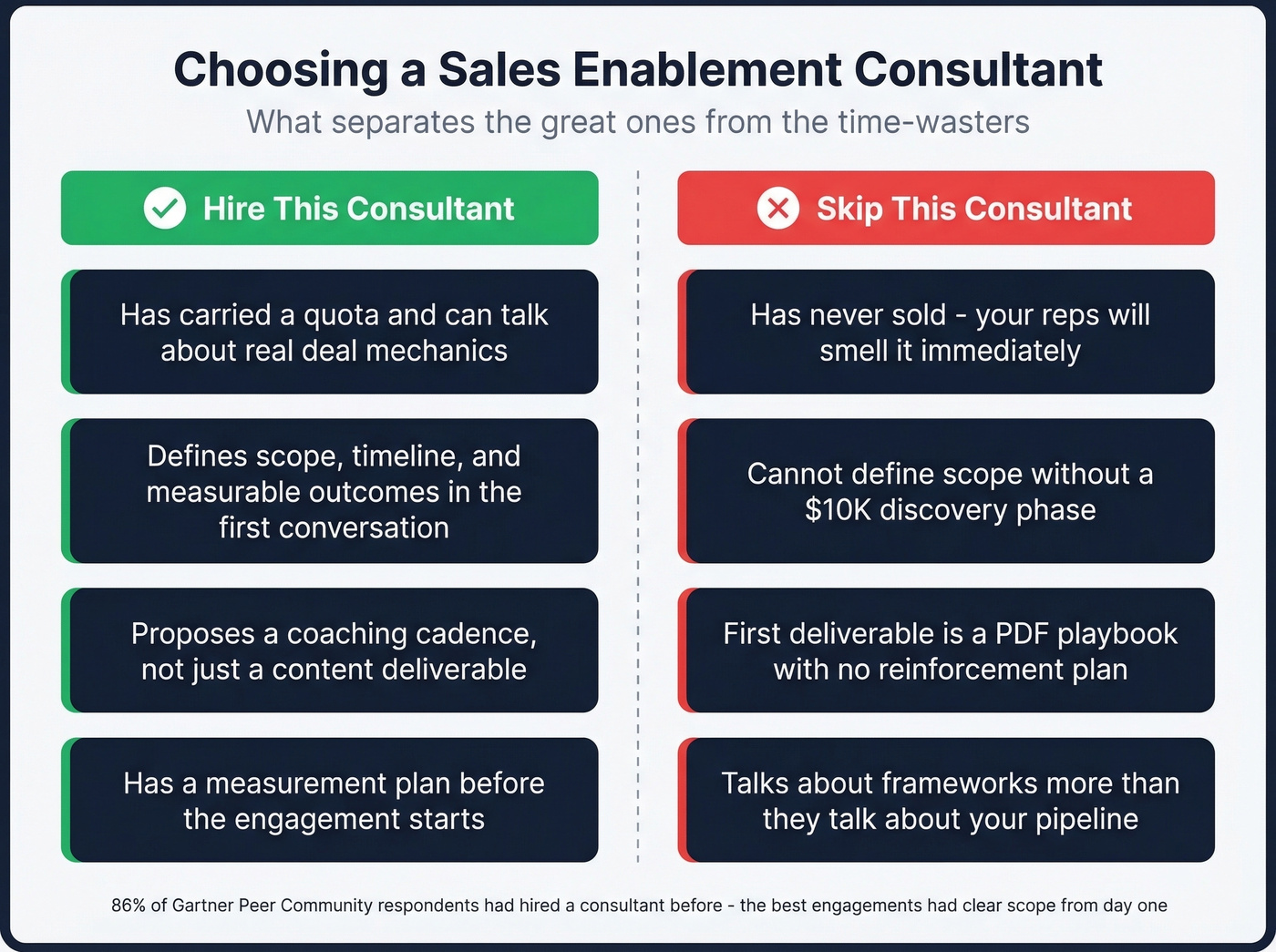
In that same community, 86% of respondents had hired a consultant before. The most successful engagements shared common traits: native industry knowledge sourced through vendor networks and peer referrals, structured cadences with weekly group sessions plus individual breakouts, and long time horizons. One buyer described an 18-month program that worked precisely because it wasn't a one-and-done workshop.
Watch for the "order taker" trap. The Sales Enablement Collective warns that without a strategy framework, enablement becomes a service desk - consultants take requests from stakeholders who each describe a different slice of the problem, and you end up with disconnected deliverables that don't move a single metric. This is where sales execution differs from generic training. A good strategist aligns enablement work to revenue outcomes, not stakeholder wish lists.
Use this consultant if:
- They've carried a quota and can speak credibly about deal mechanics
- They define scope, timeline, and measurable outcomes in the first conversation
- They propose a coaching cadence, not just a content deliverable
- They have a measurement plan before the engagement starts
Skip this consultant if:
- They've never sold - your reps will smell it immediately
- Their first deliverable is a PDF playbook with no reinforcement plan
- They can't define scope without a "discovery phase" that costs $10,000
- They talk about frameworks more than they talk about your pipeline
What Good Engagements Actually Deliver
Enablement consulting splits into two camps. The first is content-first: build the playbook, create the battle cards, load the content management system. The second is behavior-first: design coaching programs, run role-plays, build muscle memory.
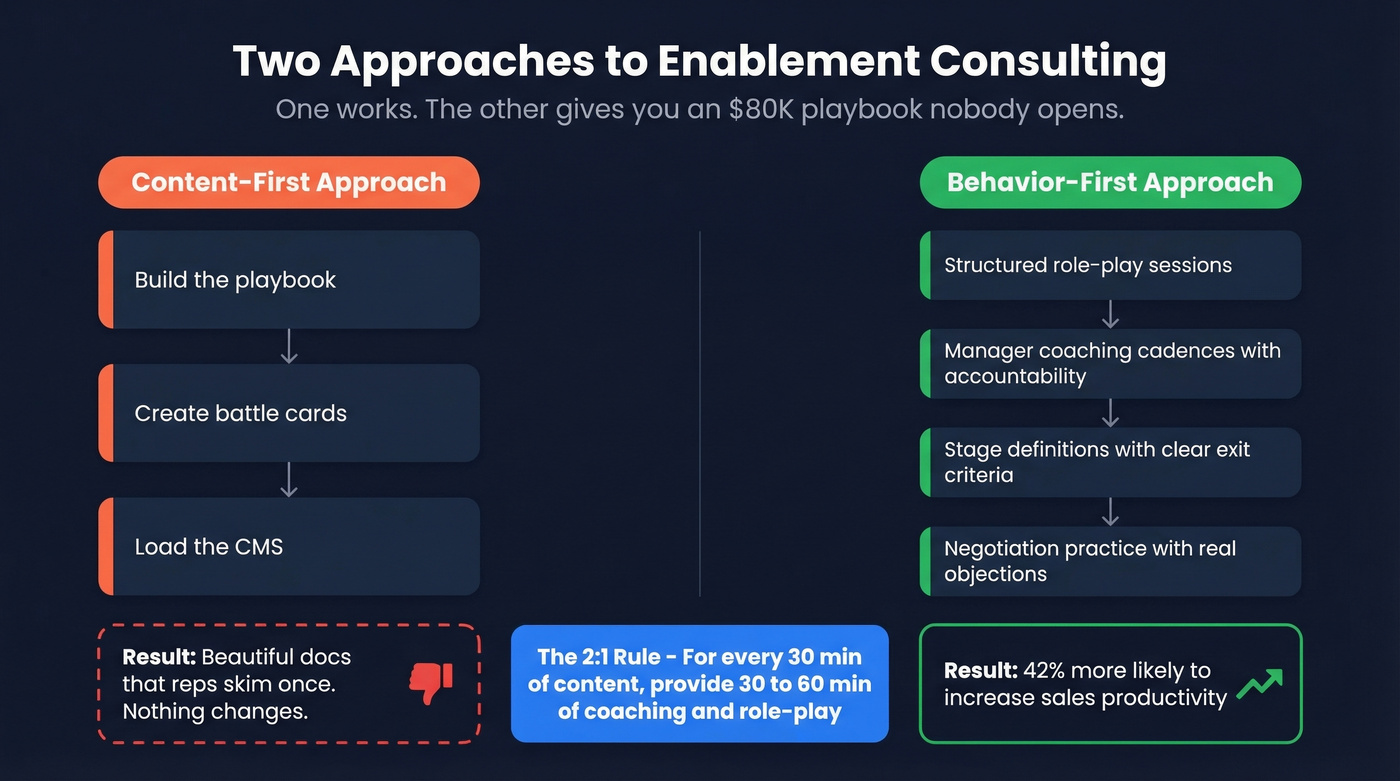
The behavior-first approach wins. Every time.
Harris Consulting uses a "2:1 rule" - for every 30 minutes of content, provide 30-60 minutes of coaching and role-play. That ratio matters because decks don't change behavior. We've seen the $80,000 playbook that nobody opened. It's depressingly common.
The deliverables that actually move revenue are programs, not documents: structured role-play sessions, manager coaching cadences with accountability, stage definitions with clear exit criteria so your forecast stops being fiction, and negotiation practice with real objections pulled from your deal history. Companies with well-integrated enablement tech stacks are 42% more likely to increase sales productivity - but the tech only works when the behavior change comes first. (If you need a starting point for content, build sales battle cards before you buy another platform.)
Mistakes That Kill Engagements
No defined scope. Write a one-page brief with the problem, the metric you're moving, and the timeline. If the consultant can't work within that, they're the wrong fit.
Content-only delivery with no coaching reinforcement. You get a beautiful playbook. Reps skim it once. Nothing changes. Require a coaching cadence - if the proposal doesn't include role-play sessions, push back hard.
Consultant without selling experience. Ask for deal stories - not case studies, actual stories about deals they've personally worked and lost. If they can't give you one in 60 seconds, that tells you everything.
No measurement framework from day one. Agree on 3-5 leading indicators and 2-3 lagging indicators before signing. If you can't define success upfront, you won't know if it worked.
Ignoring data quality. Your consultant builds a perfect outbound playbook. ~30% of the emails bounce. The fix: verify your contact data first. Meritt saw their bounce rate drop from 35% to under 4% after cleaning up their data - pipeline tripled from $100K to $300K per week. (If you're troubleshooting, use an email deliverability guide before you rewrite sequences.)
How to Measure Enablement ROI
The biggest mistake in measuring enablement is expecting revenue impact in 30 days. Leading indicators shift in 30-90 days. Lagging indicators take 6-12 months. Let's break down what to track:
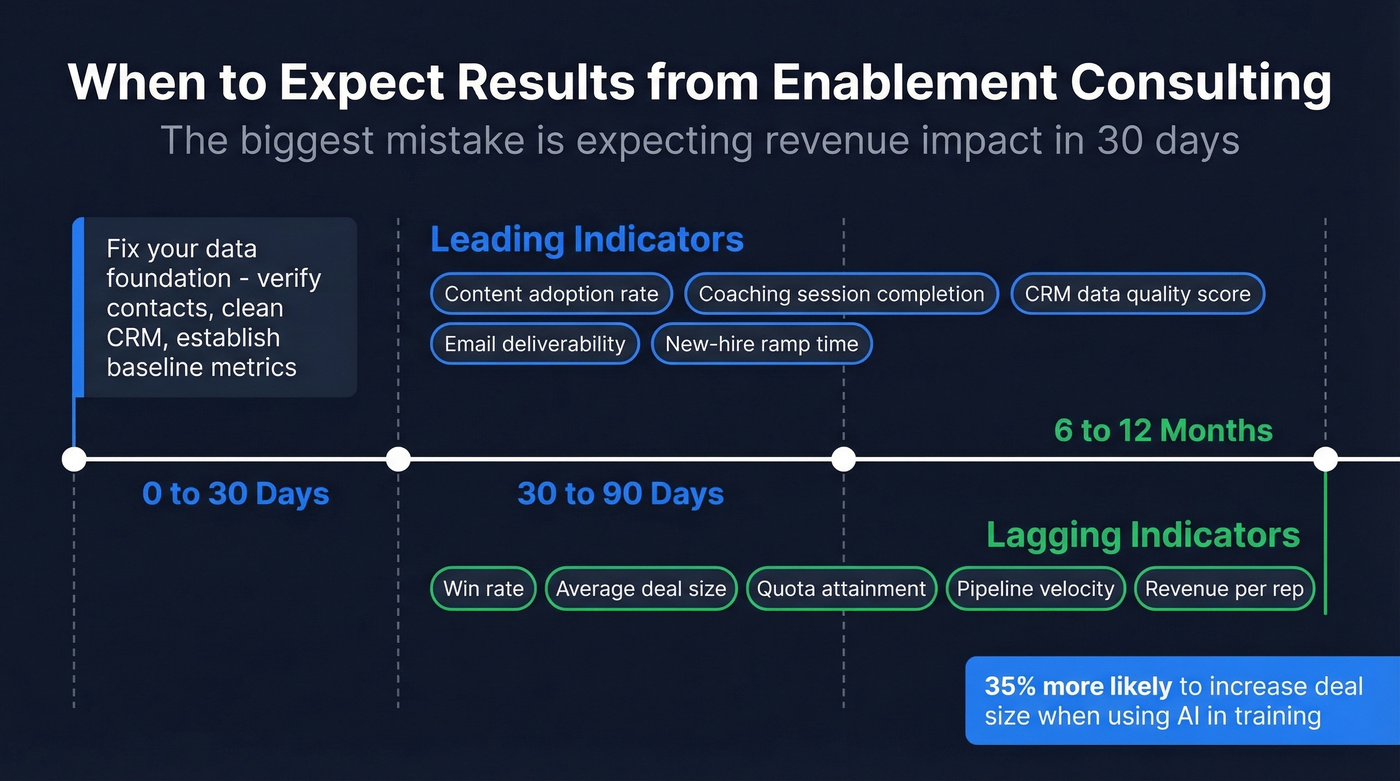
| Leading Indicators (30-90 days) | Lagging Indicators (6-12 months) |
|---|---|
| Content adoption rate | Win rate |
| Coaching session completion | Average deal size |
| CRM data quality score | Quota attainment |
| Email deliverability / bounce rate | Pipeline velocity |
| New-hire ramp time | Revenue per rep |
Teams using AI in training are 35% more likely to increase average deal size. But that stat only matters if you're tracking deal size before and after. The measurement framework isn't optional - it's the only way to justify the spend and decide whether to renew. (To connect enablement to outcomes, track pipeline health alongside rep activity.)
If your CRM data quality is poor, start there. Every other metric downstream is compromised by bad data. No amount of sales enablement consulting will overcome a foundation of unreliable contact information, and we've watched too many teams learn that the expensive way.
You're budgeting $150K+ for an enterprise enablement transformation. Meanwhile, 30% of your CRM contacts bounce. Prospeo enriches your entire CRM with 50+ data points per contact at a 92% match rate - for less than a single month of consulting fees.
Enrich your CRM before you overhaul your process.
FAQ
How long does an enablement engagement typically last?
Most engagements run 3-12 months depending on scope. One buyer in the Gartner Peer Community described an 18-month program with weekly group sessions and individual breakouts. A playbook audit takes weeks; a full organizational transformation takes a year or more. Shorter isn't always better - behavior change requires repetition.
Can we build enablement in-house instead?
Yes, if you have someone with real selling experience and executive sponsorship. Start with a weekly coaching cadence and clean CRM data. Hire a consultant when you need a proven framework, external accountability, or specialized expertise - like entering a new market or integrating post-acquisition.
What should you fix before hiring a consultant?
Your data. If reps can't reach prospects because emails bounce and phone numbers are disconnected, no playbook or platform will help. Fix deliverability first, then invest in process.
How do enablement services differ from strategy consulting?
Sales enablement services equip reps with content, training, and tools to close deals - onboarding programs, battle cards, coaching cadences. Sales strategy consulting addresses go-to-market positioning, territory design, pricing, and ICP definition. The best engagements clearly separate strategic recommendations from tactical execution so you can measure each independently.