

How to Build Sales Enablement Content That Doesn't Collect Dust
A VP of Sales tells you reps aren't using the competitive battle cards you spent three weeks building. They're winging it on calls with whatever they remember from the last all-hands. The problem isn't that your sales enablement content marketing strategy needs more assets - it's that 70% of what you already have never gets touched, costing enterprises roughly $2.3M per year in missed opportunities from underused content.
That number should make you angry. It made us rethink how we approach enablement entirely.
Why Most B2B Enablement Content Fails
One practitioner on r/SaaS summed it up perfectly: the team built product overview decks, vertical decks, competitive decks, case study decks, and an ROI calculator - organized everything neatly in Notion. Sales "uses the product overview deck. Sometimes. Everything else collects dust." Another on r/B2BSaaS described being "constantly buried" in docs, decks, and must-read updates that nobody reads.
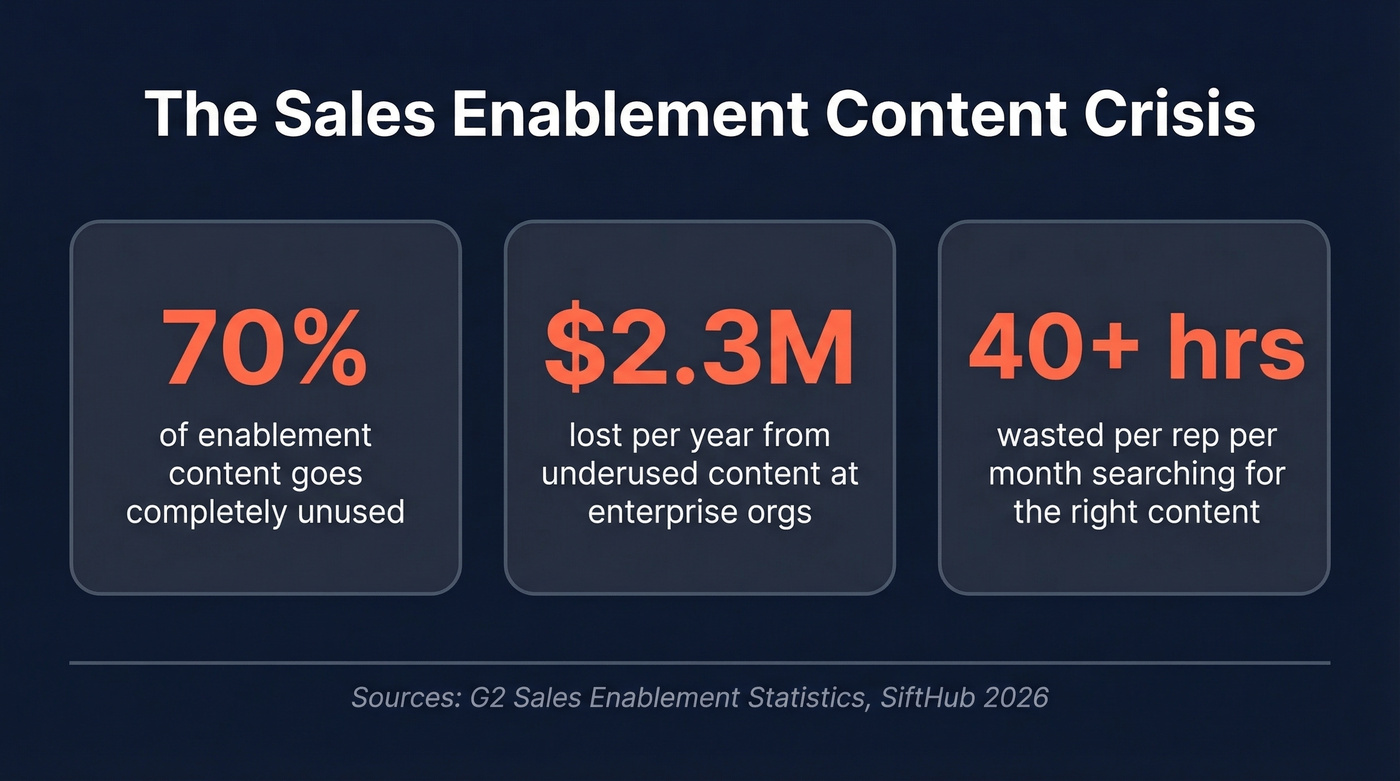
The pattern is always the same. Marketing produces content measured by volume. Sales ignores most of it. Reps waste 40+ hours per month searching across Drive, SharePoint, Slack, and whatever enablement tool the team adopted last quarter.
Here's the thing: enablement teams get measured on content production volume instead of content influence on revenue. That's backwards, and it's the root cause of almost every enablement failure we've seen.
What You Need (TL;DR)
- Audit ruthlessly - kill half your content library. If nobody's used it in 90 days, it's dead weight.
- Organize what's left by buyer challenge, not your org chart or product line.
- Verify the prospect data underneath it all - content can't close deals if it never reaches the buyer.
Internal vs. External Content Types
Sales enablement content splits into two buckets, and most teams conflate them. Internal content helps reps sell better. External content helps buyers buy.
| Internal (rep-facing) | External (buyer-facing) |
|---|---|
| Battle cards | Case studies |
| Playbooks & objection scripts | Pitch decks & product demos |
| Training modules | Thought leadership |
| Recorded demo walkthroughs | ROI calculators & comparison guides |
Buyers are already more than halfway through their evaluation before they speak to sales, which means your external content is doing the selling before reps even get a chance, and your internal content determines whether they can close what marketing warmed up.

You just mapped content to deal stages. Now ask: are those emails even valid? 35%+ bounce rates kill enablement ROI before your battle cards get a chance. Prospeo's 98% email accuracy and 7-day refresh cycle mean your content reaches real buyers, not dead inboxes.
Stop building content for inboxes that don't exist.
A 5-Step Framework Reps Actually Use
Teams with a unified enablement platform are 42% more likely to improve sales productivity, per Highspot's 2026 survey of 350 GTM professionals. Yet 29% still rely on disconnected tools. This framework works regardless of your tech stack.
If you're building this function from scratch, it helps to understand what a Sales Enablement Manager actually owns (and what they shouldn't).
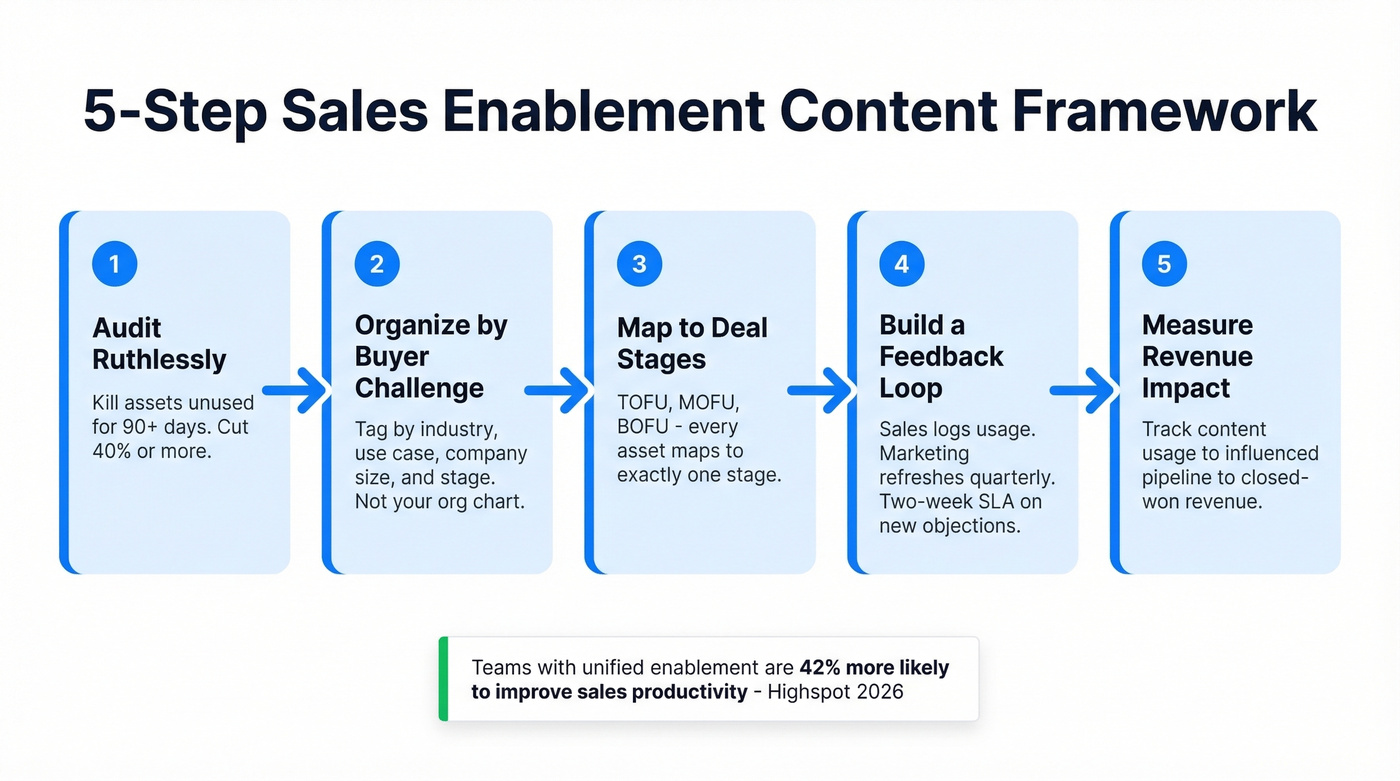
1. Audit Ruthlessly
Build a spreadsheet with these columns: asset name, URL, owner, persona, stage, format, last used by sales, confidence/accuracy rating, influenced pipeline, and a retire/refresh decision. If you can't fill the "last used by sales" column, retire the asset. One of the most common mistakes is what Decision Foundry calls "content management chaos" - dozens of outdated versions floating across folders with no single source of truth. The audit kills that problem at the root.
We've run this exercise with our own content library. Painful? Yes. But we cut 40% of our assets and saw usage rates on the survivors jump almost immediately.
2. Organize by Buyer Challenge
If your enablement library is organized by product line, you've already lost. Sellers think in buyer challenges, not your internal org chart. Tag every asset across multiple dimensions - industry, use case, company size, sales stage - and centralize it in one hub.
A rep on a live call needs to find the right case study in under 10 seconds. That's the bar.
3. Map Content to Deal Stages
| Stage | Asset types |
|---|---|
| TOFU (awareness) | Blog posts, industry reports, thought leadership |
| MOFU (evaluation) | Case studies, ROI calculators, comparison guides |
| BOFU (decision) | Battle cards, pricing decks, implementation plans |
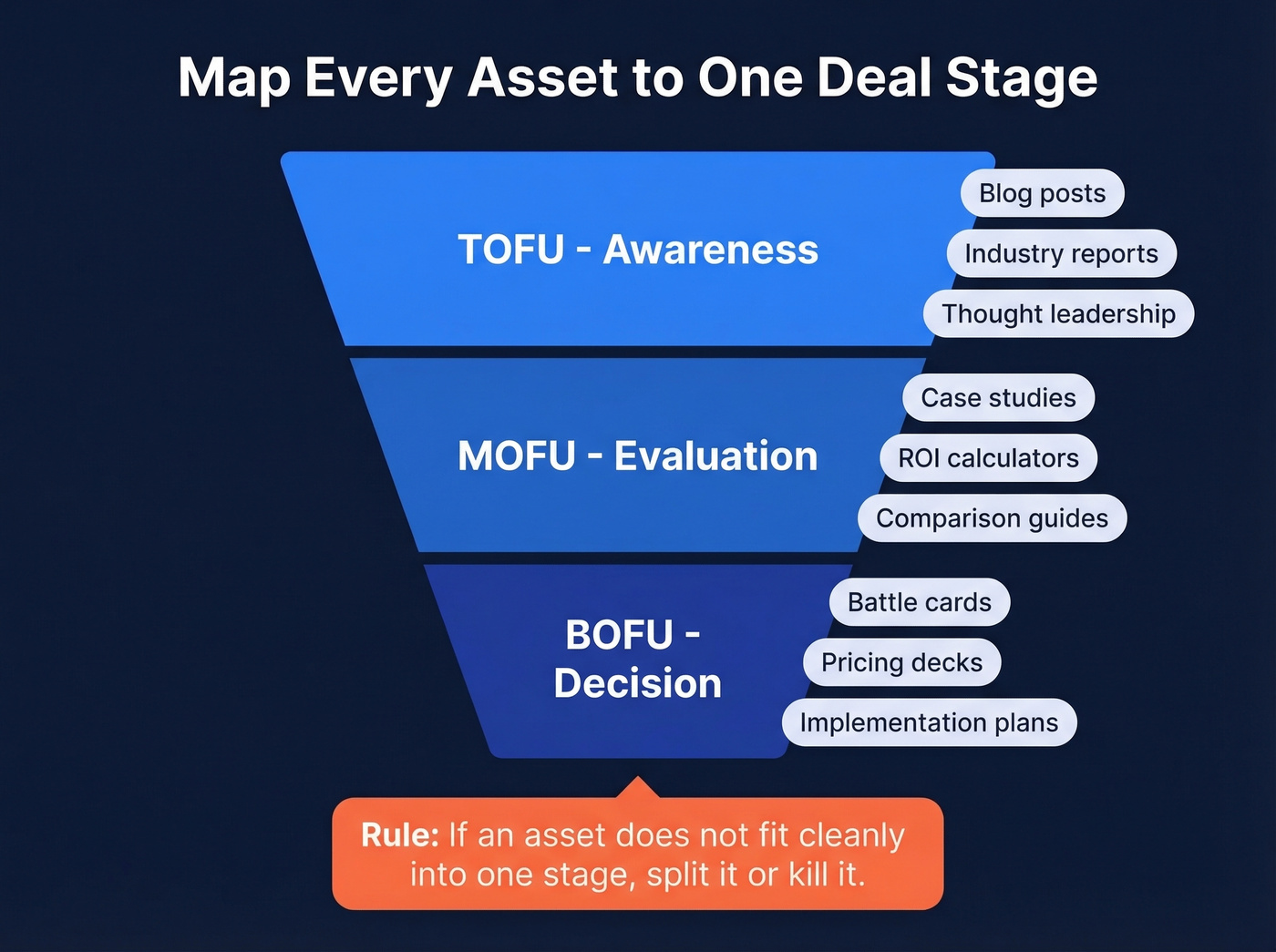
Every asset should map to exactly one stage. If it doesn't fit cleanly, it's trying to do too much - split it or kill it.
If you want a tighter definition of each stage (and what to measure), align this with your AIDA Sales Funnel and your funnel metrics.
4. Build a Feedback Loop
Set an SLA between sales and marketing. Marketing commits to refreshing battle cards quarterly. Sales commits to logging which assets they use in deals. The best enablement programs treat this as bidirectional: reps surface objections they can't handle, and content creation addresses them within two weeks.
Sales-marketing misalignment costs organizations an estimated $1 trillion annually. The feedback loop isn't a nice-to-have. It's structural.
This is also where sales operations metrics and pipeline health keep the conversation grounded in reality.
5. Measure What Moves Revenue
Most enablement teams are order-takers. As one enablement leader at Sigma Computing put it, teams fall into that trap when they don't use data and sales math to surface problems and decide if solving them is impactful. Track the full chain: content usage → influenced pipeline → closed-won revenue. 42% of sales leaders say ARR is their most important success metric. Your enablement content should tie back to that number, not to "decks produced this quarter."
If you're struggling to connect content to outcomes, start with data-driven selling and a clean set of sales pipeline benchmarks.
The Data Layer Most Guides Skip
Every enablement guide covers what to create. Almost none cover whether your content actually reaches the buyer's inbox.
Skip this step if your bounce rates are already under 3%. For everyone else, it's the highest-leverage fix you're not making.
If you need a baseline and a remediation plan, use these email bounce rate benchmarks and this email deliverability guide.
Your enablement framework is only as strong as the prospect data underneath it. Teams using Prospeo cut bounce rates from 35% to under 4% and tripled pipeline. 143M+ verified emails at $0.01 each - no contracts, 75 free emails to start.
Great content can't close deals it never reaches.
2026 Benchmarks Worth Knowing
The Highspot 2026 State of Sales Enablement found 90% of organizations are using AI for GTM or plan to start. Teams with AI-powered training are 35% more likely to report increased average deal size.
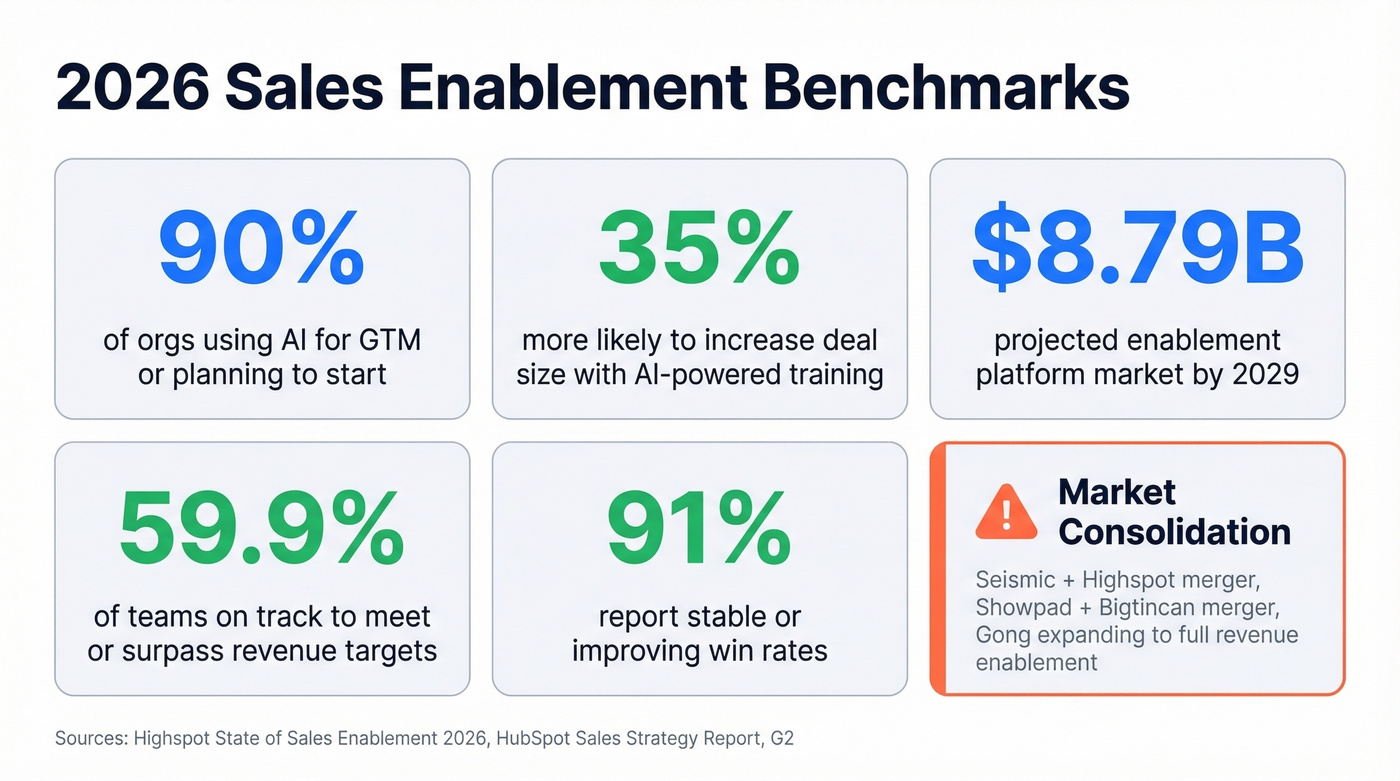
The enablement platform market is consolidating fast. Seismic and Highspot announced a definitive merger in February 2026, Showpad completed its merger with Bigtincan in late 2025, and Gong expanded into full revenue enablement in early 2026. The platform market overall is projected to hit $8.79B by 2029.
On the revenue side, HubSpot's 2026 survey of 1,000 sales pros found 59.9% of teams are on track to meet or surpass revenue targets, with 91% reporting stable or improving win rates.
Hot take: If your average deal size is under $10K, you probably don't need a $50K/year enablement platform. A clean Notion workspace, a shared content calendar, and verified prospect data will outperform a bloated tech stack that nobody logs into.
FAQ
What's the most important enablement asset to build first?
Battle cards and case studies. They're specific, actionable, and usable mid-conversation. Start there before investing in decks that take weeks to produce - reps consistently rank these two formats as the highest-impact content in deal cycles.
How do you measure if enablement content is working?
Tie content usage to influenced pipeline and closed-won revenue. Track which assets reps attach to won deals versus lost deals. Production volume is a vanity metric - the only number that matters is revenue influenced per asset.
How does prospect data quality affect content performance?
Even the best battle card fails if reps email bounced addresses. Verifying contact data before outreach ensures your sales enablement content marketing investment actually reaches buyers instead of dead inboxes. Tools like Prospeo handle this with 98% email accuracy and a 7-day refresh cycle.
What's the ideal cadence for refreshing enablement content?
Refresh battle cards and competitive assets quarterly at minimum. Case studies and ROI calculators should be updated every six months. Any asset untouched by sales for 90 days should be retired or reworked - stale content erodes rep trust in the entire library.