

The Sales Enablement Project Plan Nobody Else Will Give You
Your VP just told you to "get enablement figured out" by next quarter. You opened every guide you could find, and they all say "align stakeholders" and "set KPIs" without telling you what week that happens in, who owns it, or what the deliverable looks like. That's not a plan - it's a wish list.
Reps spend only 30% of their time actually selling. The other 70%? Searching for content, recreating decks that already exist, wrestling with outdated collateral. A real sales enablement project plan fixes this - not by adding more tools, but by assigning owners, setting deadlines, and defining what "done" looks like at every phase.
Below you'll find a copy-ready RACI matrix, a risk register, and a 30/60/90-day timeline alongside the full six-phase framework. Let's get into it.
The 6-Phase Enablement Framework
This framework draws on the Demand Metric 6-stage model - which lists 47 tools and templates across its stages - with realistic week ranges we've seen work across mid-market teams. We've distilled the essential deliverables into the table below.
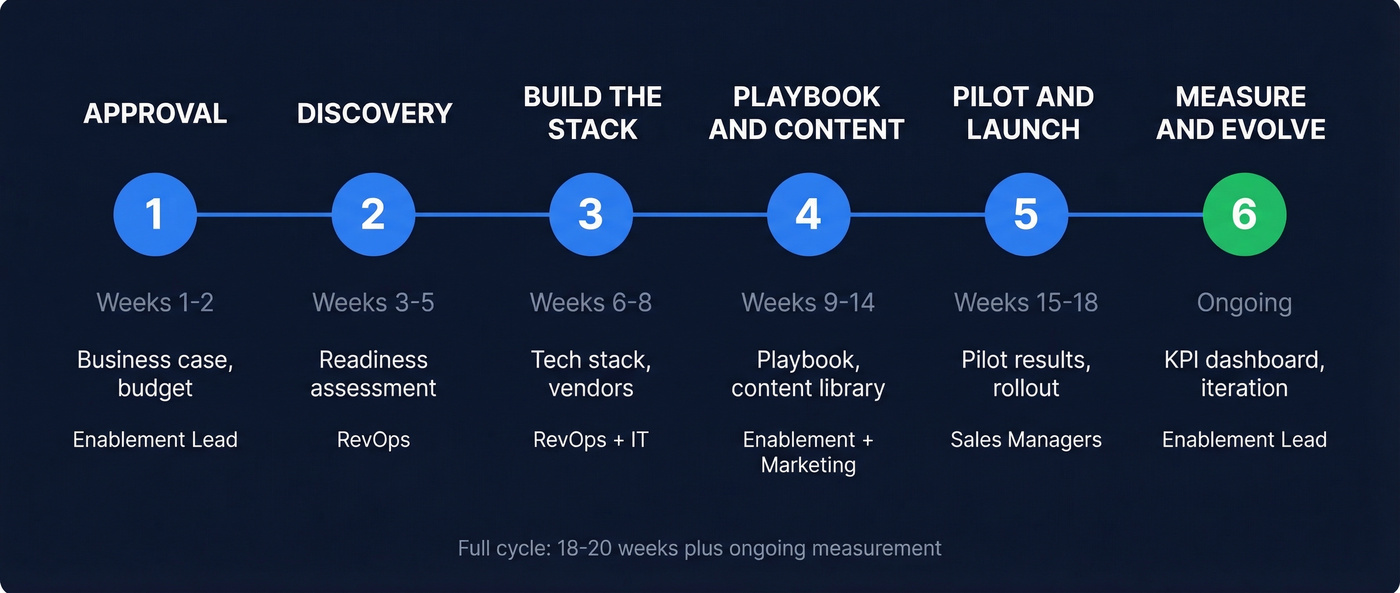
| Phase | Timeline | Key Deliverables | Owner |
|---|---|---|---|
| 1. Approval | Weeks 1-2 | Business case, budget | Enablement Lead |
| 2. Discovery | Weeks 3-5 | Readiness assessment | RevOps |
| 3. Solutions | Weeks 6-8 | Tech stack, vendors | RevOps + IT |
| 4. Playbook | Weeks 9-14 | Playbook, content | Enablement + Mktg |
| 5. Pilot & Launch | Weeks 15-18 | Pilot results, rollout | Sales Managers |
| 6. Measure & Evolve | Ongoing | KPI dashboard, iteration | Enablement Lead |
76% of organizations now have a dedicated enablement function. Most still lack a formal project plan. If you need an enablement plan template you can adapt immediately, copy the six phases above and customize the owners and week ranges to your org.
Phase 1: Business Case (Weeks 1-2)
Don't skip this. Your one-page business case needs three numbers:
- Current win rate and target improvement - even a rough baseline gives leadership something to measure against (see win rate benchmarks)
- Average ramp time for new hires - structured enablement cuts onboarding by 40-50%
- Revenue impact - best-in-class programs achieve 38% higher quota attainment and 49% more wins on forecasted deals
That's your ammunition for budget approval. If leadership won't fund it after seeing those numbers, you have a sponsorship problem, not a data problem.
Phase 2: Discovery (Weeks 3-5)
Audit everything. What content exists? What do reps actually use? Where are the gaps in onboarding, competitive intel, and objection handling?
Interview five reps and three managers. You'll learn more in those conversations than in any vendor demo. One question we always ask: "When you lost a deal last quarter, what piece of content or training would have changed the outcome?" The answers tend to cluster around two or three gaps, and those become your Phase 4 priorities.
This phase is also where you map existing content, tools, and training to each stage of the buyer journey so you can spot redundancies before building anything new.
Phase 3: Build the Stack (Weeks 6-8)
Here's where teams go wrong: they buy a $50K/year enablement platform before they've fixed their content or training. Process first, tools second. Always.
Your enablement stack needs verified contact data underneath it - every playbook and outreach sequence falls apart if reps are emailing dead addresses. Prospeo runs a 7-day data refresh cycle with 98% email accuracy, so reps stop wasting outreach on bounced contacts. Layer that with your CRM and a PM tool, and you've got a foundation that actually works.
If outbound is a core motion, align the stack to your sales prospecting techniques so enablement assets map cleanly to what reps do daily.
Phase 4: Playbook & Content (Weeks 9-14)
This is the longest phase for a reason. Only 30% of marketing-created content gets used by sales teams. The rest rots in a shared drive somewhere.
| Do | Don't |
|---|---|
| Build a centralized library with version control | Dump 200 PDFs into a shared drive |
| Tag everything by buyer persona and deal stage | Organize by internal team or creation date |
| Create battlecards reps can pull up mid-call | Write 15-page competitive analyses nobody reads |
Here's the thing: reps recreate content 40% of the time because they can't find what exists or don't trust it's current. That's a content governance problem, not a content volume problem. A quarterly audit cadence and clear ownership per asset type fixes this without adding headcount.
Phase 5: Pilot & Launch (Weeks 15-18)
Pick one team. Run the full playbook for three weeks. Measure adoption, gather feedback, fix what's broken. Then roll out with the pilot team as internal champions.
Trying to launch to everyone simultaneously is how enablement programs die quietly. We've watched it happen twice at companies we've worked with - big fanfare, zero follow-through, and six months later the VP asks why nobody uses the playbook. Start small. Prove it works. Scale from proof, not from hope.
Phase 6: Measure & Evolve (Ongoing)
Track content adoption weekly, everything else monthly. That's it. We cover the specific KPIs in the governance section below.
RACI Matrix for Enablement
Every task needs one Responsible person. No more than one Accountable per task - multiple approvers create decision paralysis. A well-built RACI matrix prevents the "I thought you were handling that" conversations that derail programs in weeks 6-10.
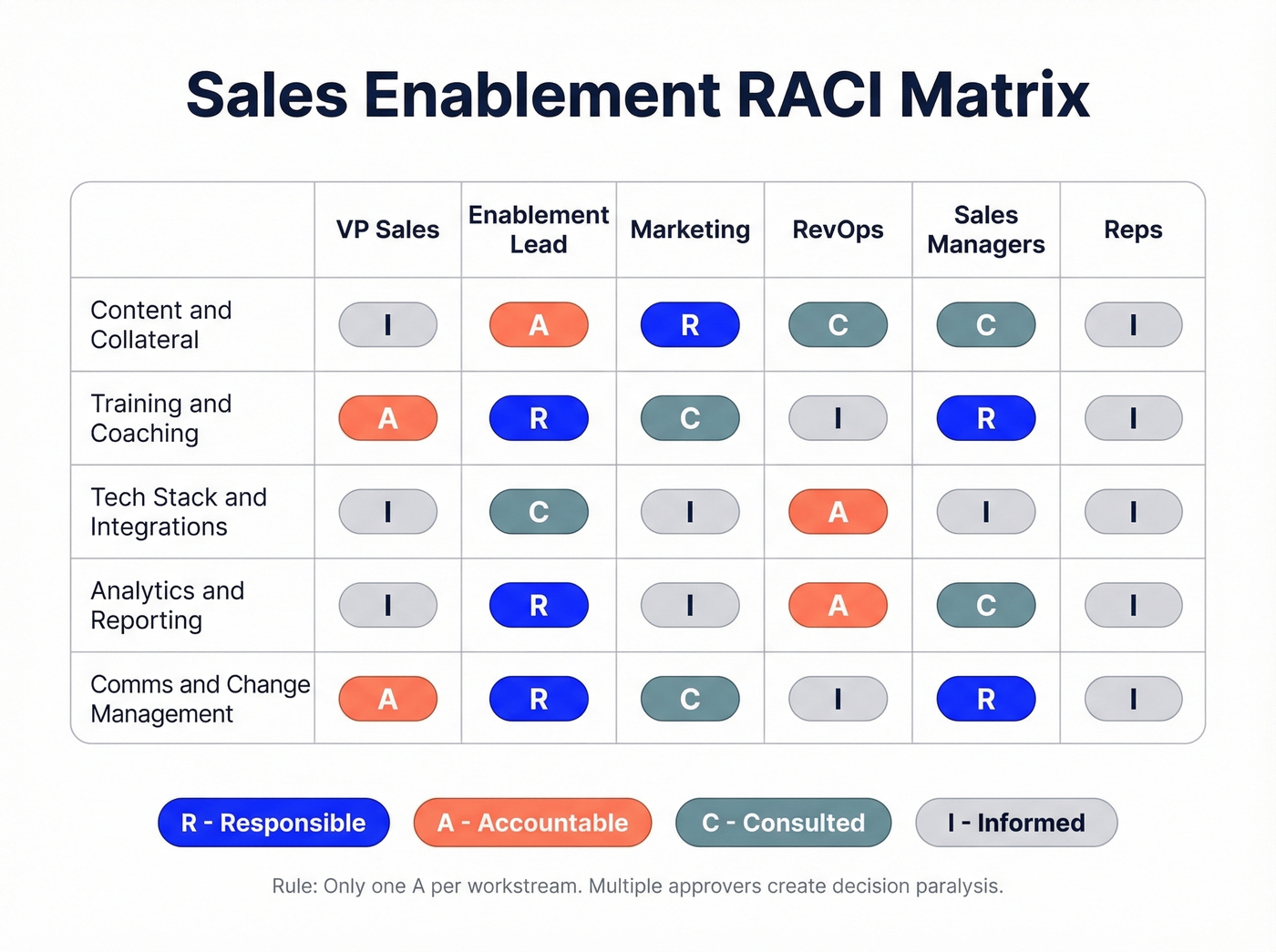
Leadership & Strategy:
| Workstream | VP Sales | Enablement Lead | Marketing |
|---|---|---|---|
| Content & Collateral | I | A | R |
| Training & Coaching | A | R | C |
| Tech Stack & Integrations | I | C | I |
| Analytics & Reporting | I | R | I |
| Comms & Change Mgmt | A | R | C |
Execution:
| Workstream | RevOps | Sales Mgrs | Reps |
|---|---|---|---|
| Content & Collateral | C | C | I |
| Training & Coaching | I | R | I |
| Tech Stack & Integrations | A | I | I |
| Analytics & Reporting | A | C | I |
| Comms & Change Mgmt | I | R | I |
Two rules that save projects: don't overload one person with too many R assignments, and if you have more than three Consulted parties on a task, set up a Slack channel or weekly digest so consultation doesn't become a bottleneck.
If you're formalizing ownership, it helps to define what a RevOps Manager (or Sales Ops) is accountable for vs enablement.

Phase 3 of your enablement plan needs a data foundation that doesn't rot. Prospeo refreshes every record every 7 days - not the 6-week industry average - so the contact data underneath your playbooks stays accurate. 98% email accuracy means reps execute sequences instead of chasing bounces.
Fix your data layer before you build anything on top of it.
30/60/90-Day Launch Timeline
The three deliverables that matter most in the first 30 days: a stakeholder map, a content audit, and a competitive battlecard. This mirrors what practitioners on r/ProductMarketing consistently recommend for first-90-day enablement work.
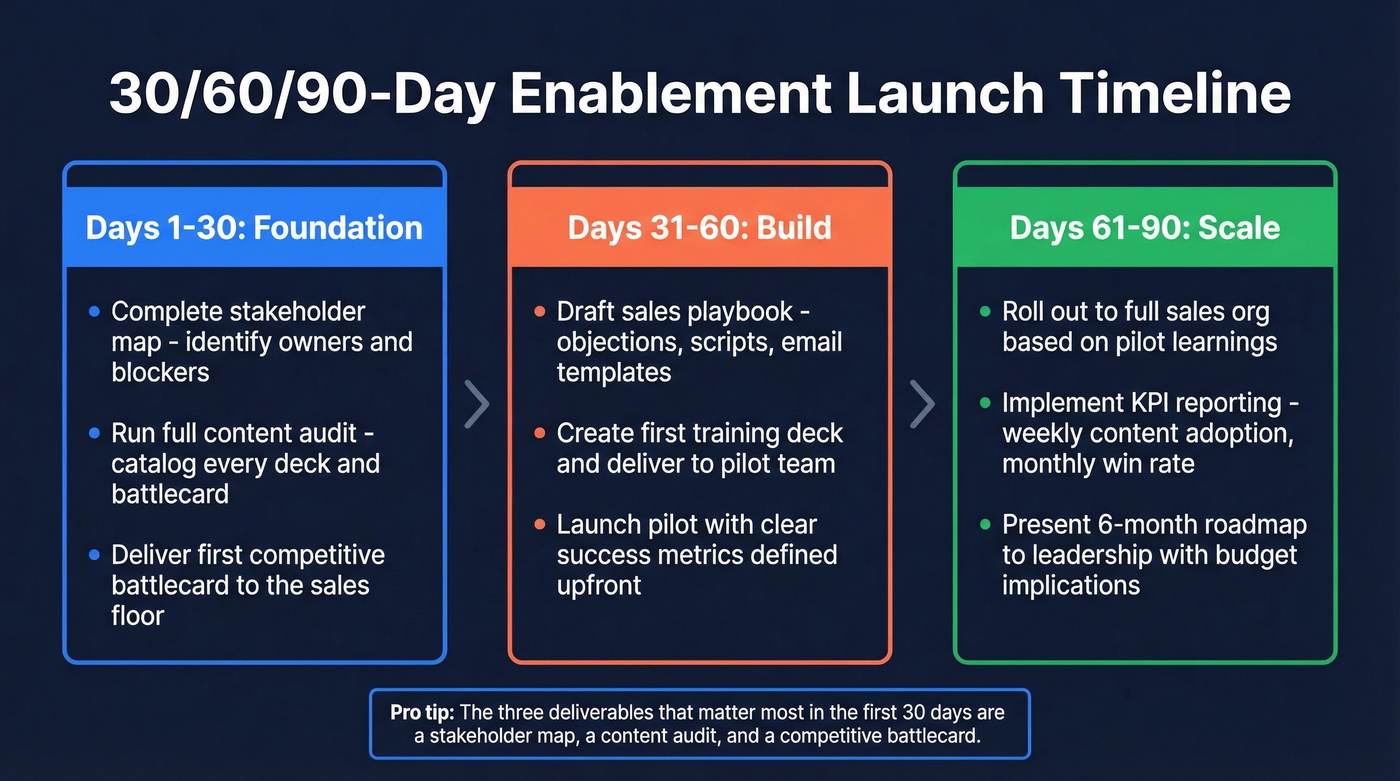
Days 1-30: Foundation
- Complete stakeholder map identifying owners and blockers
- Run a full content audit - catalog every deck, one-pager, and battlecard
- Deliver your first competitive battlecard to the sales floor (use a lightweight competitive intelligence strategy)
Days 31-60: Build
- Draft the sales playbook covering objection handling, call scripts, and email templates
- Create the first training deck and deliver it to one pilot team
- Launch the pilot with clear success metrics defined upfront
Days 61-90: Scale
- Roll out to the full sales org based on pilot learnings
- Implement KPI reporting: weekly content adoption, monthly win rate
- Present a 6-month roadmap to leadership with budget implications
If you want a rep-level version of this rollout, adapt it into a 30-60-90 day plan for sales reps.
Risk Register: 6 Failure Modes
| Risk | Impact | Mitigation |
|---|---|---|
| No defined strategy | Unclear goals, poor alignment | Formal charter + exec sponsor |
| Content chaos | Outdated decks, version conflicts | Centralized hub + quarterly audit |
| Inadequate training | Low adoption, wasted content | Structured onboarding + coaching |
| No assigned ownership | Tasks fall through cracks | RACI matrix, single Accountable |
| Tech over-reliance | Tools without process = shelfware | Process first, tools second |
| Measuring wrong metrics | False confidence, missed problems | Lead with adoption, not revenue |
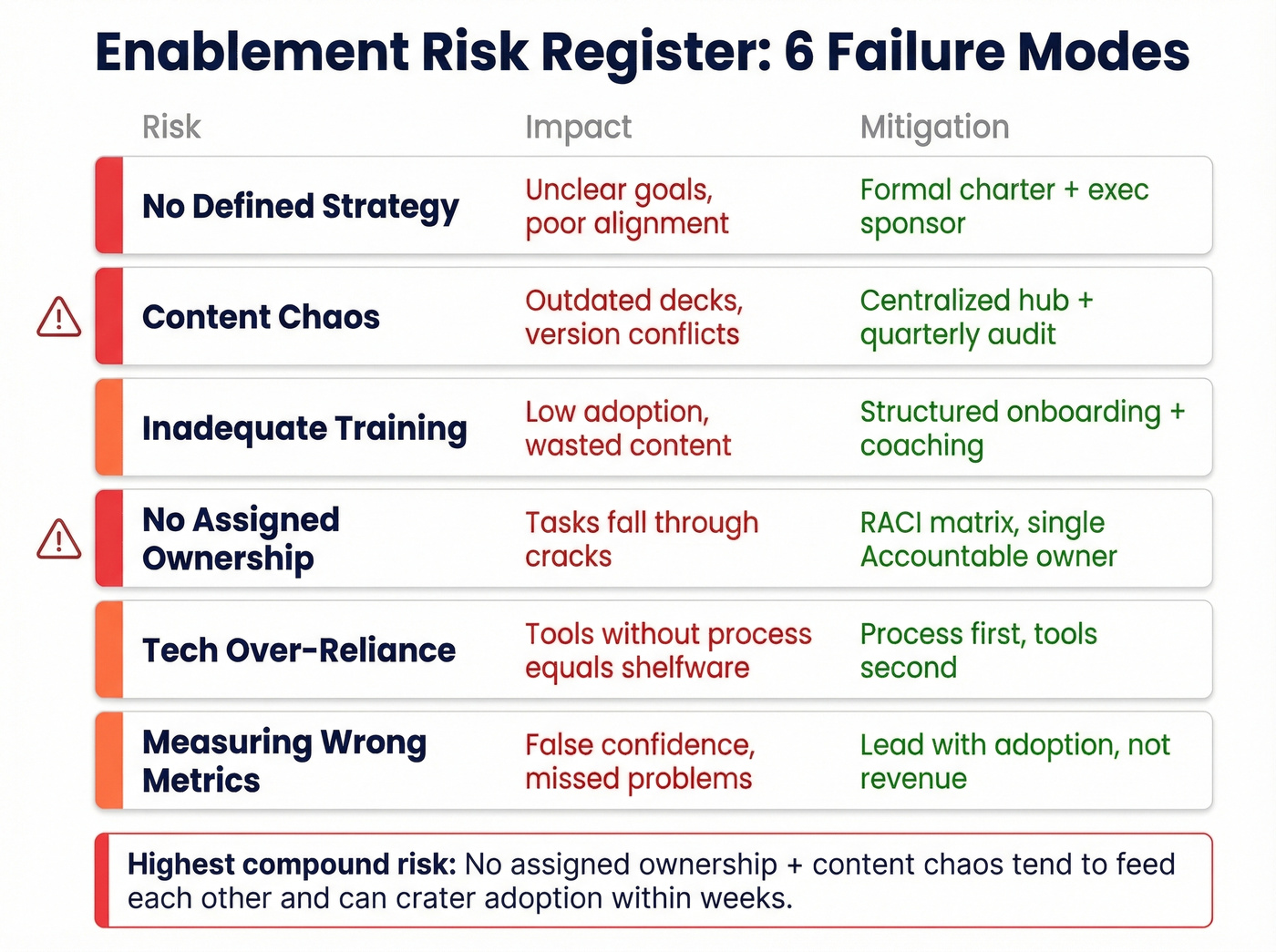
Skip the risk register at your own peril. In our experience, the two risks that kill programs fastest are "no assigned ownership" and "content chaos" - and they tend to compound each other. When nobody owns the content library, reps stop trusting it, and adoption craters within weeks.
A strong opinion: you don't need an enablement platform to run a great enablement program. A Google Drive folder with good governance beats a $50K/year platform with no project plan behind it. Fix the plan first. Buy the platform later - if you even need one.
Governance & KPIs
Enablement's reporting line varies widely: RevOps owns it in 39.4% of organizations, Sales in 25.4%, and the C-Suite in 16.6%. Where it reports matters less than having a single executive sponsor with budget authority and the willingness to protect the program when quarterly pressure hits.
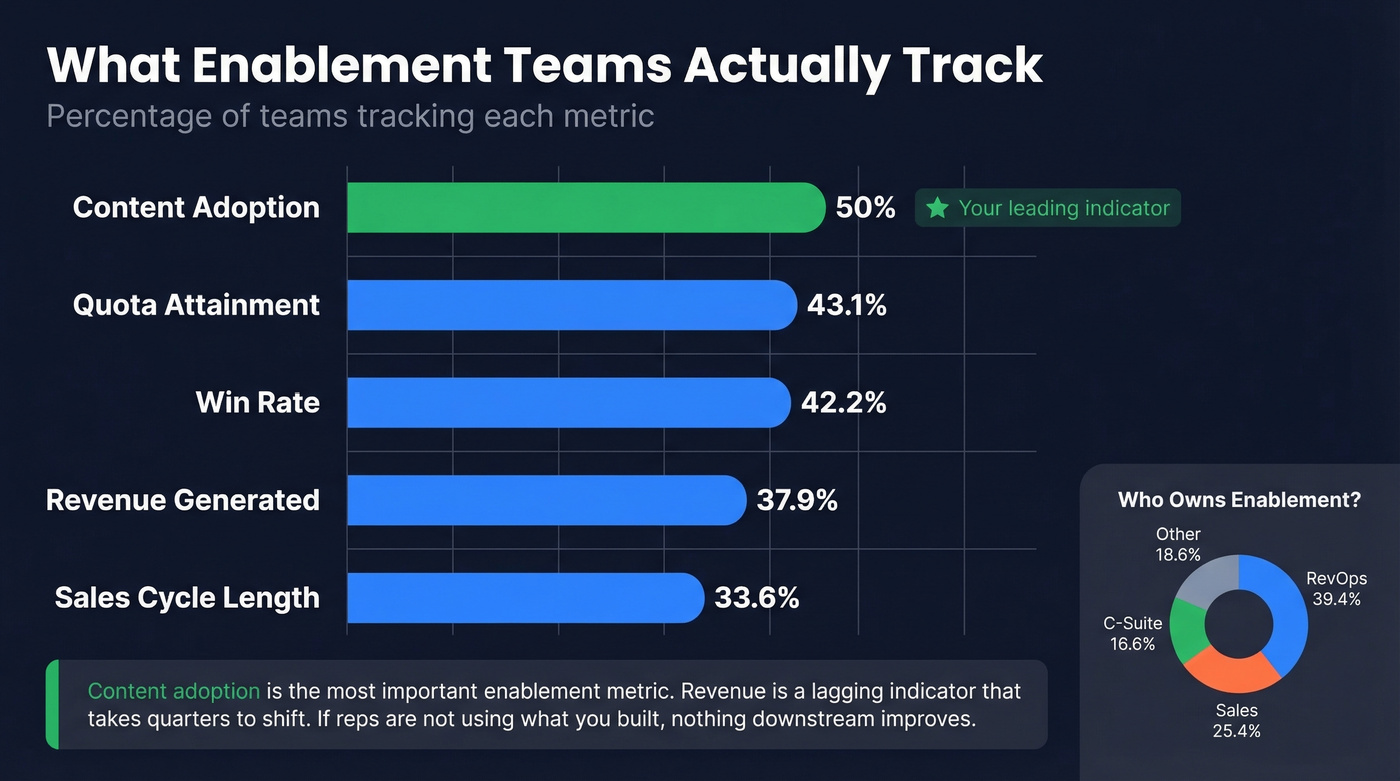
The metrics teams actually track tell you what matters:
- Content adoption - 50% of teams track this, and it should be your leading indicator
- Quota attainment - 43.1%
- Win rate - 42.2%
- Revenue generated - 37.9%
- Sales cycle length - 33.6% (see pipeline health metrics)
Content adoption is the most important enablement metric. Not revenue. Revenue is a lagging indicator that takes quarters to shift. If reps aren't using the content and playbooks you built, nothing downstream will improve - and you won't know why revenue isn't moving until it's too late to course-correct.
If your enablement motion depends on outbound, keep an eye on email bounce rate as an operational KPI alongside adoption.
Reps spend 70% of their time not selling. Don't let bad contact data make it worse. Prospeo gives your team 300M+ verified profiles with 30+ filters - buyer intent, job changes, technographics - so every playbook and battlecard connects to a real, reachable buyer. At $0.01 per email, it costs less than the time reps waste on dead addresses.
Give your enablement stack the verified data it actually needs.
FAQ
How long does it take to implement?
A full sales enablement project plan takes 18-20 weeks across six phases. The first 90 days cover discovery, stack decisions, and playbook build, with pilot and rollout starting shortly after. Measurement is ongoing - enablement is a program, not a project with a finish line.
Who should own enablement?
RevOps owns it in 39.4% of organizations, Sales in 25.4%. The reporting line matters less than having one executive sponsor with budget authority who'll defend the program when quarterly pressure hits.
What tools do I need?
Start with a CRM, a PM tool like Asana or Trello, and a verified contact data source for outbound accuracy. Add a dedicated enablement platform like Highspot or Seismic only after your process is solid - not before.
Is there a free template I can use?
The six-phase table and RACI matrix above work as a standalone enablement plan template. Copy them into a spreadsheet, assign owners from your org, and adjust the week ranges to fit your team size and budget cycle.