

Sales Enablement Training: How to Build a Program Reps Won't Hate
Your enablement team shipped three video trainings last week. Each one ran two hours. Reps sat through them with cameras on, half-listening while working deals in another tab. In one brutally honest r/sales thread, a rep summed up the pain: internal meetings and trainings eat 20-25% of every week, and the camera-on policing feels like high school attendance checks.
There's a better way to run sales enablement training. It starts with respecting your reps' time.
What You Need (Quick Version)
Building a program? Start with a charter and cap mandatory training at two hours per week. Taking a course? HubSpot Academy is free and solid - start there. Reps trained but still bouncing emails and hitting dead numbers? Fix the data layer first. No curriculum compensates for bad contact data.
What Is Sales Enablement?
Sales training teaches skills - objection handling, closing, discovery frameworks. Enablement training is the broader operating system: content, tools, data, processes, and cross-functional alignment that lets reps actually apply those skills in live deals.
The distinction matters because B2B selling has gotten harder. Gartner puts the average buying committee at 11 stakeholders. Reps spend roughly [28-30% of their time](https://www.salesforce.com/news/stories/sales-research-2023/) actually selling - the rest goes to admin, internal meetings, and hunting for content. 76% of organizations now have a dedicated enablement function, up from 32% five years ago. The discipline has arrived. The execution still lags.
The Business Case for Enablement Programs
Numbers, because "enablement matters" isn't a budget justification.
| Metric | Benchmark |
|---|---|
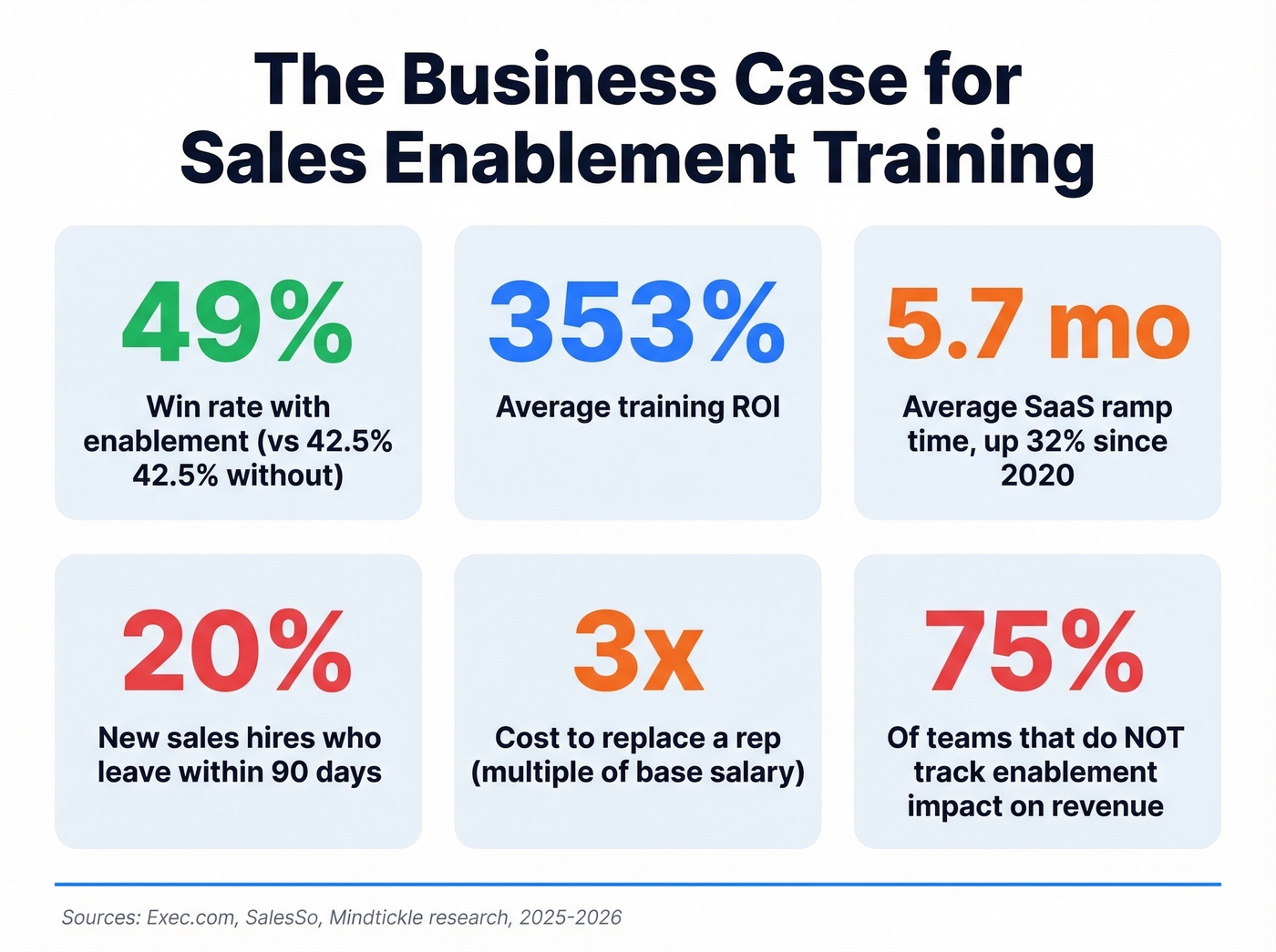
| Win rate (with enablement) | 49% vs 42.5% |
| Training ROI | 353% |
| New sales hires leaving in 90 days | 20% |
| Cost to ramp a new rep | ~3x base salary |
Here's the stat that should alarm every enablement leader: only 25% of organizations actually track enablement's impact on revenue. Three out of four teams are flying blind - spending budget on programs they can't prove work.
Ramp time is where the real money hides. SaaS companies average 5.7 months to full productivity, up 32% from 4.3 months in 2020. Enterprise B2B ramp pushes that to 9-12 months. When 20% of new sales hires leave within 90 days and each replacement costs three times base salary, cutting ramp time by even a few weeks pays for itself immediately.
How to Build a Training Plan That Works
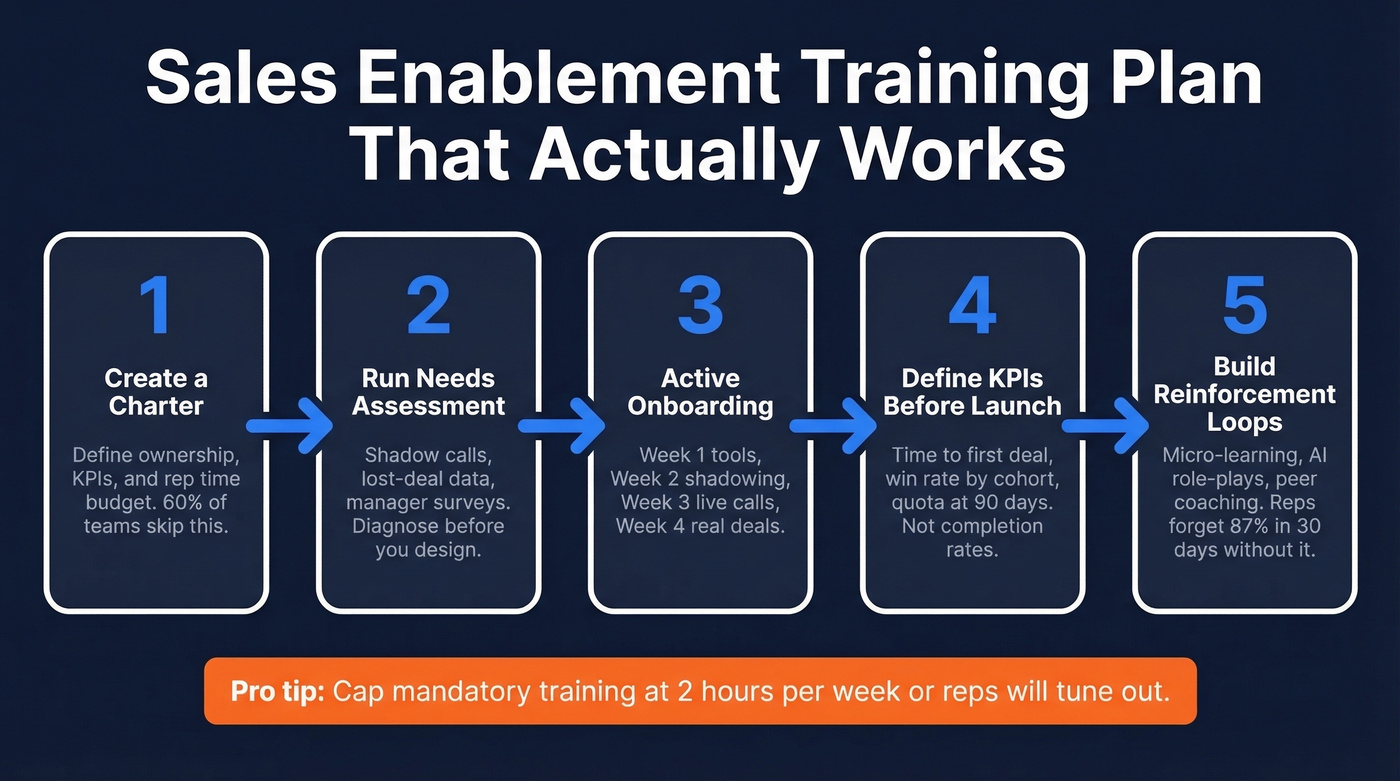
1. Create a Charter
Over 60% of enablement functions lack a formal charter. That's why so many programs drift into "let's create another training video" territory. Your charter defines who owns what, which KPIs matter, and how much rep time you're allowed to consume. We've seen teams skip this step and spend six months building content nobody asked for. Write the charter first.
2. Run a Needs Assessment
Don't guess where reps struggle - measure it. Shadow calls, review lost-deal data, survey managers. If discovery calls are where deals stall, that's where training hours go first. If multi-threading into buying committees is the bottleneck, build content around stakeholder mapping and executive messaging.
Many teams find the ADDIE model useful here. Its Analysis phase gives you a structured framework for diagnosing skill gaps before you design a single module.
3. Use Active Onboarding
The old model - two weeks of classroom training, then "go sell" - doesn't work. Companies using Active Onboarding reduce ramp time by 50%. The structure looks like this: Week 1 covers tools and value prop. Week 2 puts reps on calls with training wheels. Week 3 moves to live discovery with coaching support. By week 4, reps are running deals with a safety net, not sitting in a classroom watching slides.
If you're building a structured ramp plan, a 30-60-90 day plan helps keep onboarding measurable.
4. Define KPIs Before Launch
If you're in the 75% of teams not tracking impact, fix that now. Tie training to pipeline metrics: time-to-first-deal, win rate by cohort, quota attainment at 90 days. The Kirkpatrick model gives you a proven four-level framework for measuring training effectiveness, from initial reaction all the way through business results. Vanity metrics like "course completion rate" tell you nothing about revenue.
To keep measurement consistent, align enablement KPIs with your broader sales operations metrics.
5. Build Reinforcement Loops
Reps forget 87% of training content within 30 days if they don't use it. One-and-done SKO sessions are expensive entertainment.
Reinforcement means micro-learning modules, AI-driven role-plays (tools like Second Nature and Mindtickle now simulate buyer objections convincingly), peer coaching, and certification checkpoints that test fluency - not just completion.
If your reinforcement includes outbound practice, keep a set of sales follow-up templates handy so reps can apply the skill immediately.

You just read that reps spend 28-30% of their time selling - the rest is admin and hunting. Bad data makes it worse. When bounce rates hit 35-40%, every outbound workflow you train on breaks. Prospeo's 98% email accuracy and 7-day data refresh mean reps apply what they learn on day one, not waste cycles chasing dead contacts.
Cut ramp time by fixing the data layer your enablement program runs on.
Mistakes That Kill Enablement Programs
Meeting overload. Cap at two hours per week. If your enablement calendar looks like a college course schedule, you've already lost. Reps will tune out, multitask, or resent the program entirely. A hard cap creates discipline about what deserves synchronous time.
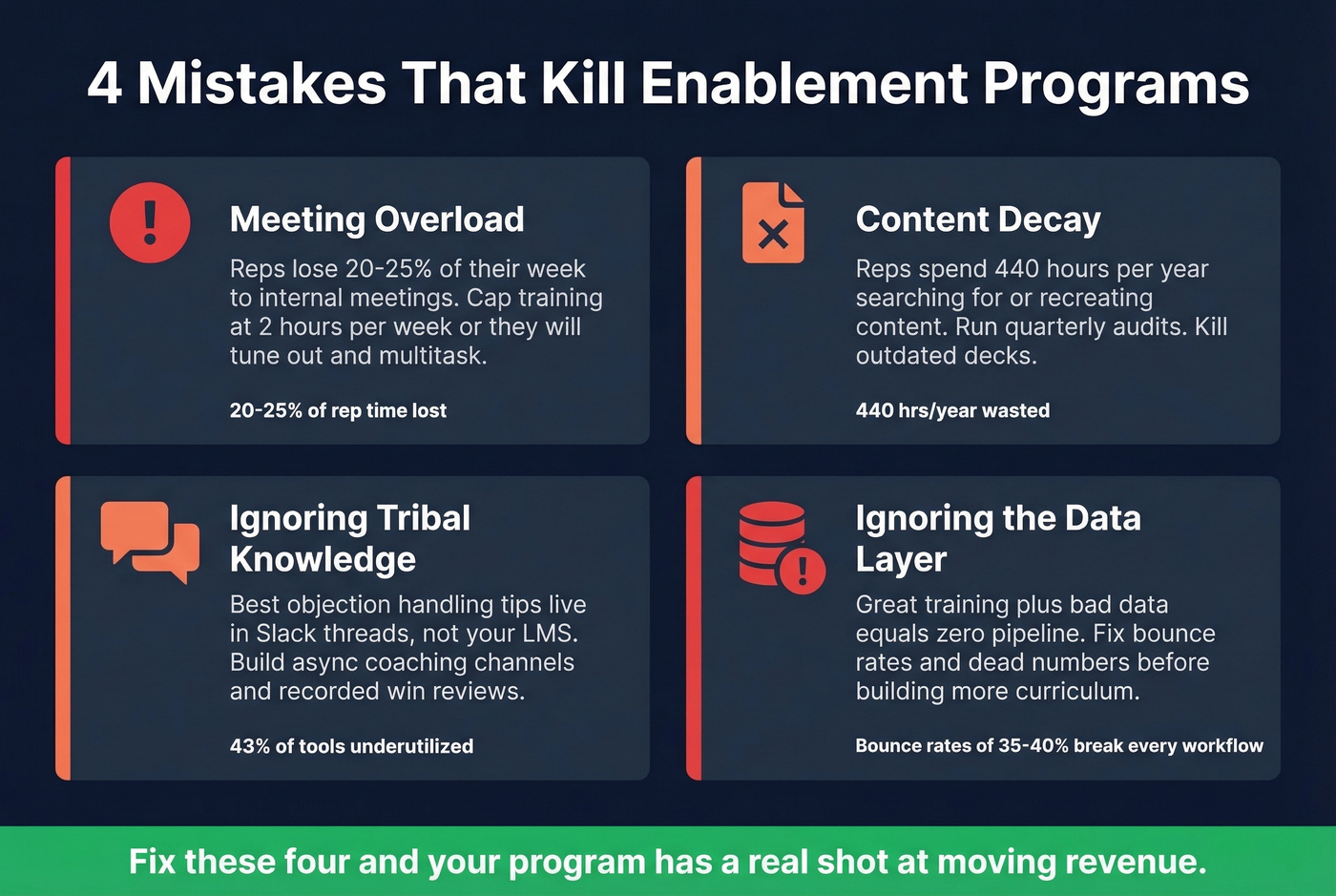
Content decay. Reps spend 440 hours per year searching for or creating content - much of it recreating materials that already exist because they can't find current versions. Run quarterly audits. Kill outdated decks. If 43% of your enablement tools are underutilized, you have a discovery problem, not a content problem.
If content is decaying because nobody can find the right record, consider tightening your contact management software standards.
Ignoring tribal knowledge. The best objection-handling tips live in Slack threads and post-call debriefs, not in your LMS. Build systems to capture peer learning: async coaching channels, recorded win reviews, mentorship pairings.
If you need a repeatable way to standardize messaging, ship lightweight talk track examples alongside training.
Ignoring the data layer. This is the invisible failure mode nobody talks about at SKO. You can run the best enablement program in the world, but if reps are dialing dead numbers and bouncing emails, training never gets applied. GreyScout cut rep ramp time from 8-10 weeks to 4 weeks, and a big piece of that was fixing the data foundation so reps could actually reach the people they were trained to sell to. When bounce rates drop from 35-40% to under 5%, every outbound workflow you train on becomes usable.
If you're seeing deliverability issues, start by tracking and fixing your email bounce rate.

GreyScout halved rep ramp time from 8-10 weeks to 4 weeks after fixing their data foundation. Snyk's 50 AEs dropped bounce rates from 35-40% to under 5% and added 200+ new opportunities per month. The pattern is clear: enablement training only works when reps can reach real buyers. At ~$0.01/email with no contracts, the ROI math is instant.
Stop training reps to call numbers that don't pick up.
Best Courses and Certifications in 2026
| Course | Provider / Price | Duration | Best For |
|---|---|---|---|
| Sales Enablement Cert | HubSpot Academy - Free | 27 hrs | Career entry |
| SEC Core | Sales Enablement Collective - ~$1,299 | 15 hrs | Practitioners |
| Sales Enablement (edX) | Queen's University - $189 | 5 months | Academic depth |
| Enablement Fundamentals | Udemy - $59.99 | 2 hrs | Quick overview |
| SE Certified | Product Marketing Alliance - $500 | 4 hrs | PMM crossover |
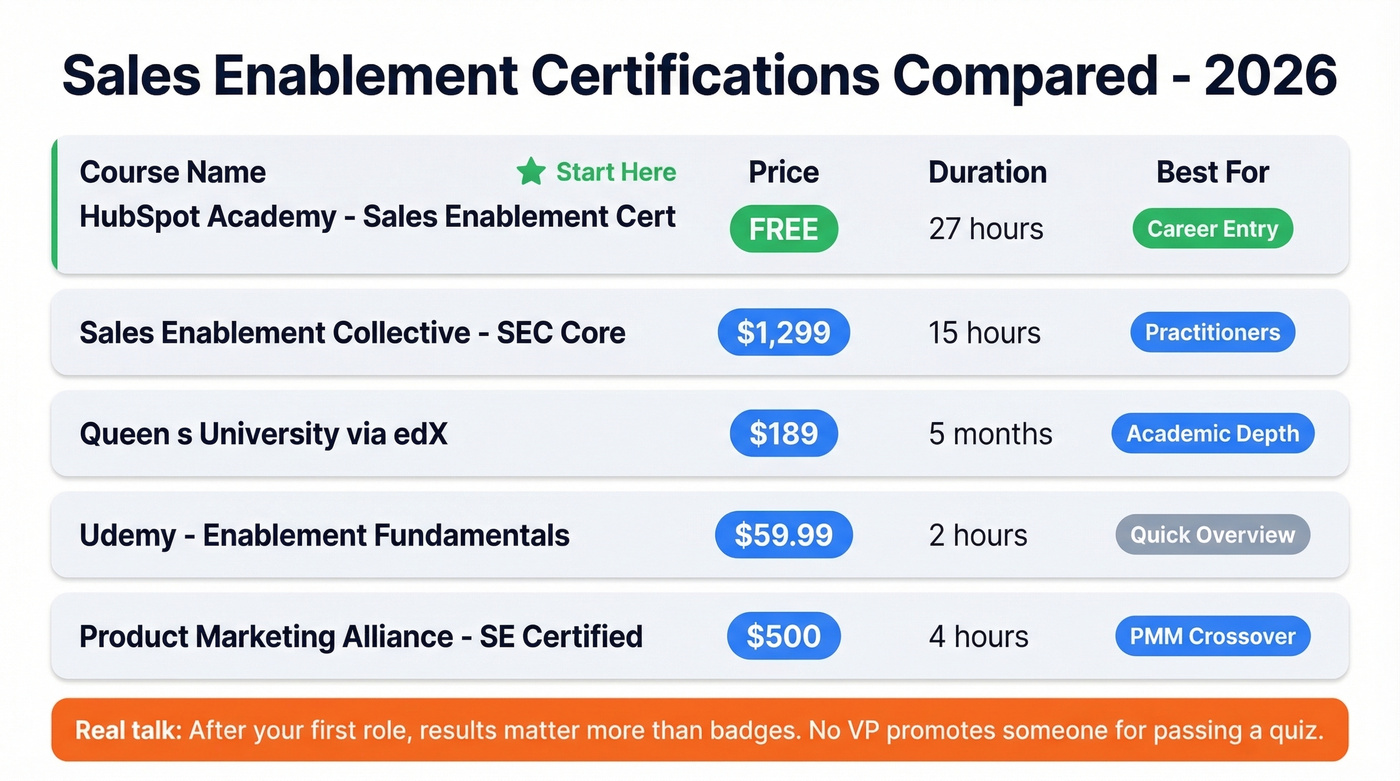
Start with HubSpot Academy - it's free, recognized enough to get past resume screens, and includes a certification exam. SalesHood is also free and self-paced. When you're ready to invest, the Sales Enablement Collective's Core program is one of the most respected practitioner certifications in the field.
After your first role, results matter more than badges. No VP promotes someone for passing a quiz.
Let's be honest about something most enablement content won't say: practitioners over-invest in certifications and under-invest in learning their company's data stack. Understanding how CRM enrichment, intent signals, and verification workflows function will make you more effective than any course. The best enablement leaders we've worked with can troubleshoot a broken outbound sequence as fluently as they can design a training curriculum.
If you're evaluating vendors for that layer, start with a shortlist of data enrichment services.
Tools and Platforms Worth Knowing
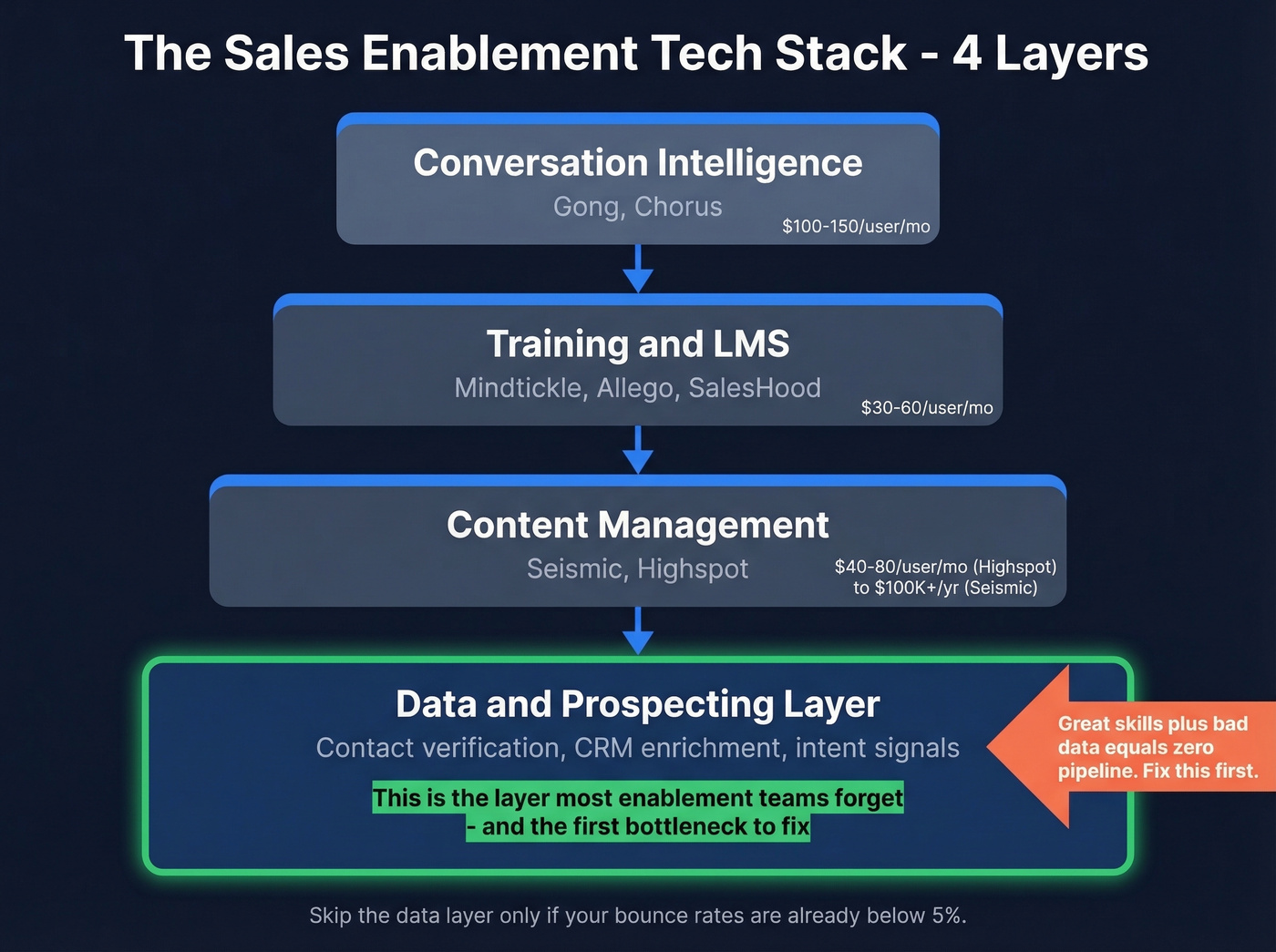
Enablement platforms fall into four categories:
| Category | Key Tools | Typical Pricing |
|---|---|---|
| Content management | Seismic, Highspot | $40-80/user/mo (Highspot); $100K+/yr (Seismic enterprise) |
| Training & LMS | Mindtickle, Allego, SalesHood | $30-60/user/mo |
| Conversation intelligence | Gong, Chorus | $100-150/user/mo |
The data and prospecting layer is the piece most enablement teams forget. In our experience, fixing contact quality moves pipeline numbers faster than any new training module. A rep with great skills and bad data produces nothing. A rep with decent skills and verified contacts produces pipeline.
If you’re building that motion, these sales prospecting techniques pair well with enablement training.
Skip the data category if your CRM hygiene is already strong and bounce rates sit below 5%. For everyone else, this is the first bottleneck to fix.
Structuring Recurring Sessions
A common question is how often to hold live training. Weekly sessions work best when they're short, focused, and tied to a single skill or deal scenario.
Keep them under 30 minutes. Rotate facilitators between enablement, product marketing, and top-performing reps. Always end with a clear takeaway reps can apply that same day - not a vague "key learning." Monthly deep-dives can supplement weekly sessions for topics like competitive positioning or new product launches, but those should be opt-in, not mandatory.
To keep sessions tied to revenue outcomes, review pipeline health metrics by cohort.
FAQ
Is a sales enablement certification worth it?
Yes for career entry. HubSpot's free certification is the baseline - it signals you understand the discipline and costs nothing. After your first role, hiring managers care about programs you've built and metrics you've moved, not certificates on your wall.
How long does it take to build an enablement program?
Four to eight weeks for a basic launch. Charter and needs assessment in weeks one and two, curriculum build in three through five, pilot in six through eight. No program is ever truly done - plan for quarterly iteration cycles.
What's the difference between sales training and sales enablement training?
Sales training teaches selling skills like objection handling and closing. Enablement training is broader: content, tools, data, processes, and cross-functional alignment so reps can apply those skills. Training is one input; enablement is the operating system.
How do I fix enablement if my reps' contact data is bad?
Start with the data layer before adding more training. Verify emails and phone numbers before reps dial. Tools like Prospeo deliver 98% email accuracy and refresh data every 7 days - customers like Snyk cut bounce rates from 35-40% to under 5% and grew AE-sourced pipeline 180%.
What frameworks help measure training effectiveness?
The Kirkpatrick model measures impact across four levels: reaction, learning, behavior change, and business results. The ADDIE model focuses on the design side - Analysis, Design, Development, Implementation, and Evaluation. Most mature teams use elements of both to build and refine programs over time.