

The 10 Best Sales Engagement Software Platforms for 2026
A RevOps lead we know ran a 3-tool sales engagement software bake-off last quarter. The "best" platform created 4,000 duplicate contacts in Salesforce within five days. The cheapest one had better phone connect rates. The tool that won wasn't the one with the most features - it was the one that played nicest with their existing data layer.
Sales reps spend 60% of their time on non-selling tasks. Engagement platforms exist to claw back that time - automating sequences, managing multichannel touches, and logging everything back to your CRM so reps can focus on actual conversations. But the category is shifting fast. Gartner already reframed it as "Revenue Action Orchestration," signaling that pure sequencing is table stakes. The platforms that matter in 2026 combine engagement, intelligence, and data quality into a single workflow.
Here are the 10 platforms worth your time, ranked by what they're actually best at.
Our Top Picks
| Tool | Best For | Starting Price | Key Strength |
|---|---|---|---|
| Prospeo | Data accuracy | Free; ~$0.01/lead | 98% email accuracy, 125M+ mobiles |
| Apollo.io | All-in-one SMB | Free; $49/user/mo | Data + sequencing in one tool |
| Salesloft | Enterprise balance | ~$125/user/mo | Power without the complexity |
| Outreach | Customization | ~$100/user/mo + fees | Most configurable SEP available |
Short on time? Prospeo handles the data layer every other tool on this list depends on. Apollo is the fastest way to get an SMB team running outbound. Salesloft and Outreach are the enterprise heavyweights - pick based on whether you value ease of use or configurability.
What Is Sales Engagement Software?
Gartner defines sales engagement applications as platforms combining multichannel engagement, outbound workflow execution, and AI-driven automation into a single interface - guiding reps on who to engage, when, and with what messaging.
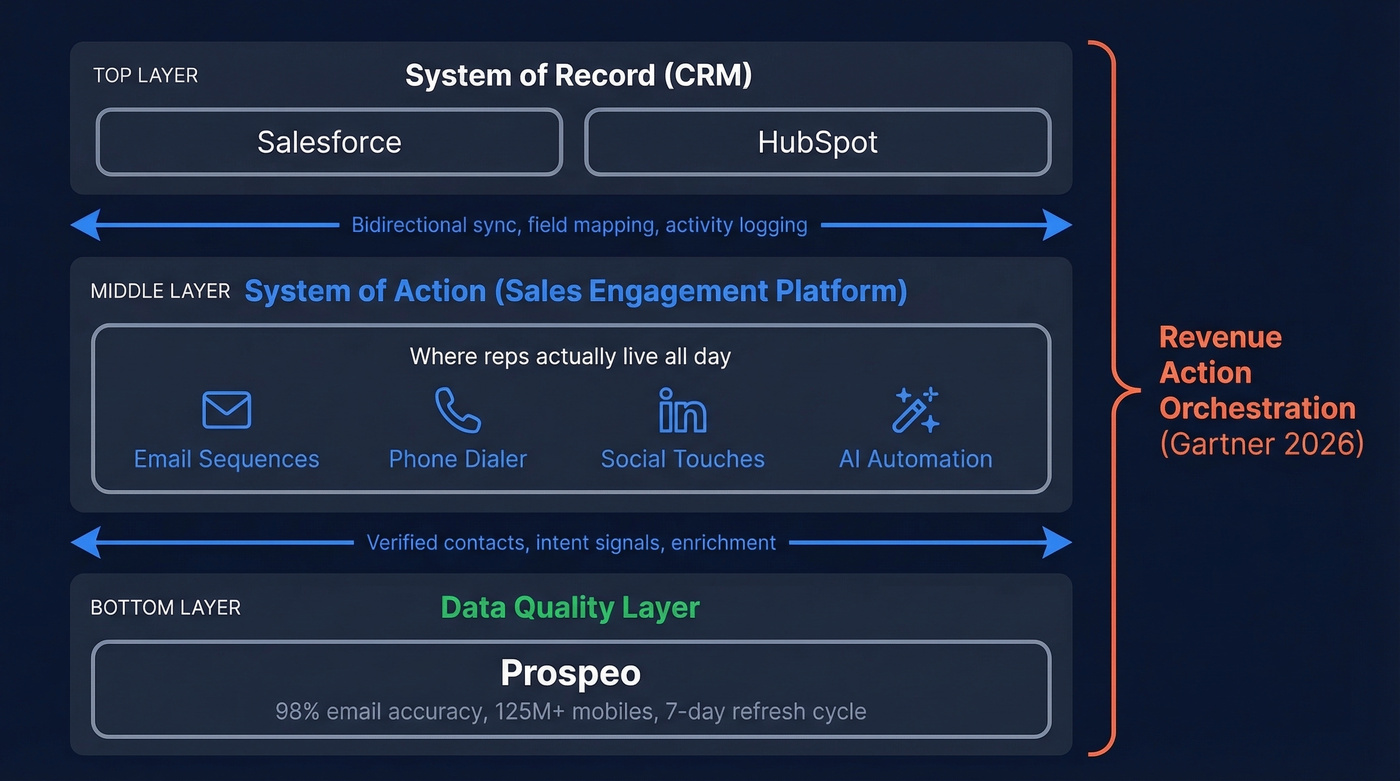
In practice, a sales engagement platform is the operating system your reps live in all day. It's where sequences get built, calls get logged, and follow-ups happen automatically instead of falling through the cracks.
Your CRM (Salesforce, HubSpot) is the system of record. Your SEP is the system of action. They're complementary, not interchangeable. HubSpot blurs this line with Sales Hub, but for most teams running serious outbound, a dedicated engagement layer outperforms CRM-native sequencing.
The bigger shift is convergence. Gong was named a Leader in the inaugural Gartner Magic Quadrant for Revenue Action Orchestration, a new category merging engagement with revenue intelligence and deal management. Clari landed as a co-Leader, and Salesloft earned a Visionary spot. 88% of reps with AI agents say it increases their odds of hitting targets, and high performers are 1.7x more likely to use prospecting agents. The message is clear: standalone sequencing tools are evolving into full revenue platforms, and your buying decision should account for where the category is heading.
Here's the thing most teams get wrong: they over-index on sequencing features and under-index on data quality. The fanciest branching logic in the world doesn't matter if 20% of your emails bounce. Fix the data layer first, then pick your sequencing tool.
How We Evaluated
We assessed each platform across seven criteria that matter in production - the features that separate real tools from demo-ware:
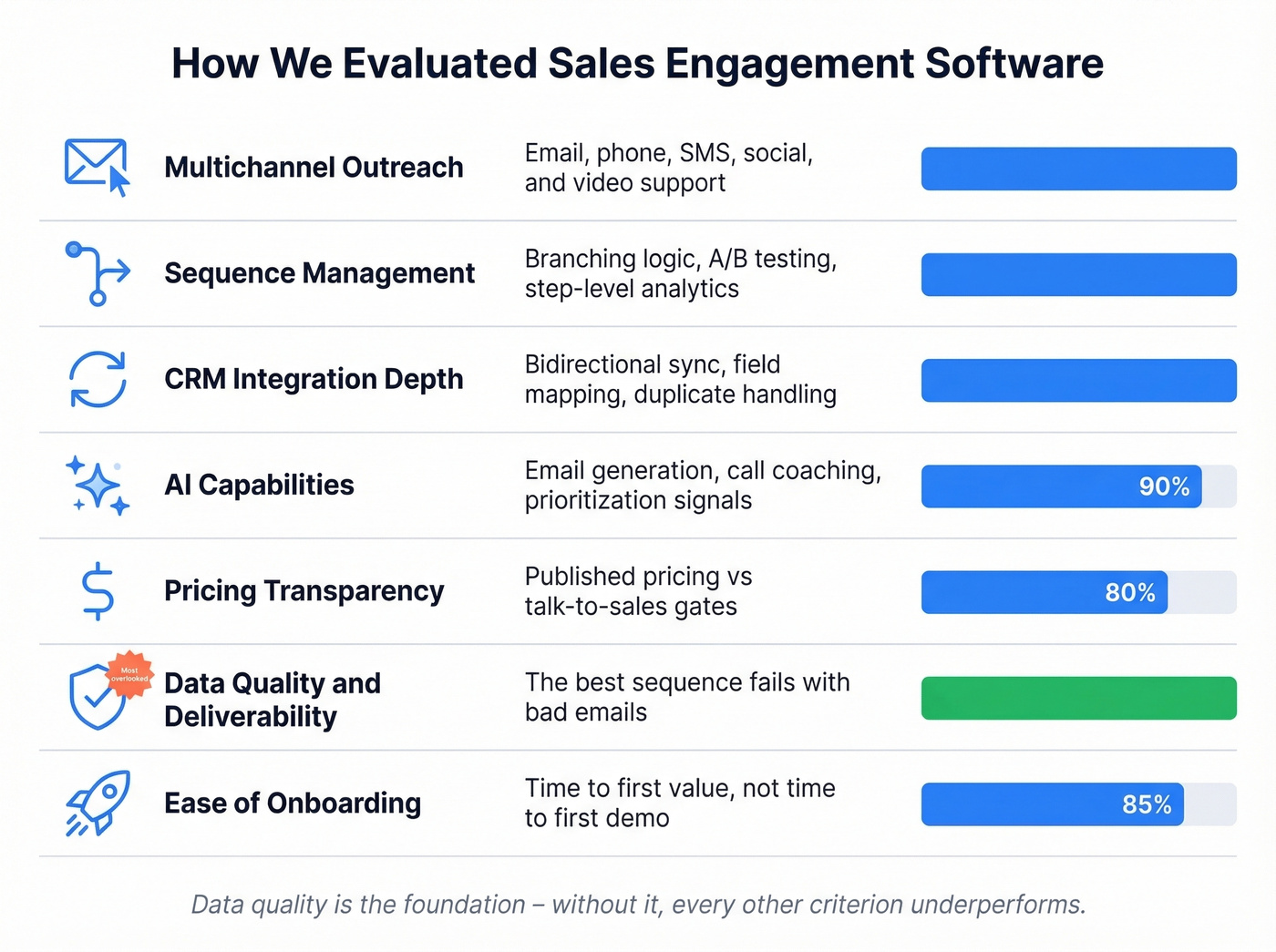
- Multichannel outreach - email, phone, SMS, social, and video support
- Sequence management - branching logic, A/B testing, step-level analytics
- CRM integration depth - bidirectional sync, field mapping, duplicate handling
- AI capabilities - email generation, call coaching, prioritization signals
- Pricing transparency - published pricing vs. "talk to sales" gates
- Data quality and deliverability - the best sequence fails with bad emails
- Ease of onboarding - time to first value, not time to first demo

Every sales engagement platform on this list depends on clean contact data to perform. Prospeo delivers 98% email accuracy and 125M+ verified mobiles on a 7-day refresh cycle - so your sequences actually reach real buyers instead of bouncing into the void.
Fix the data layer first. Everything else gets easier.
The 10 Best Engagement Platforms Ranked
Prospeo - Best for Data Accuracy
No engagement platform works if your contact data is garbage. Prospeo sits underneath every other tool on this list as the data quality layer that makes sequences actually land.
If you're comparing providers, it's worth also looking at the broader landscape of data enrichment services and sales prospecting databases.
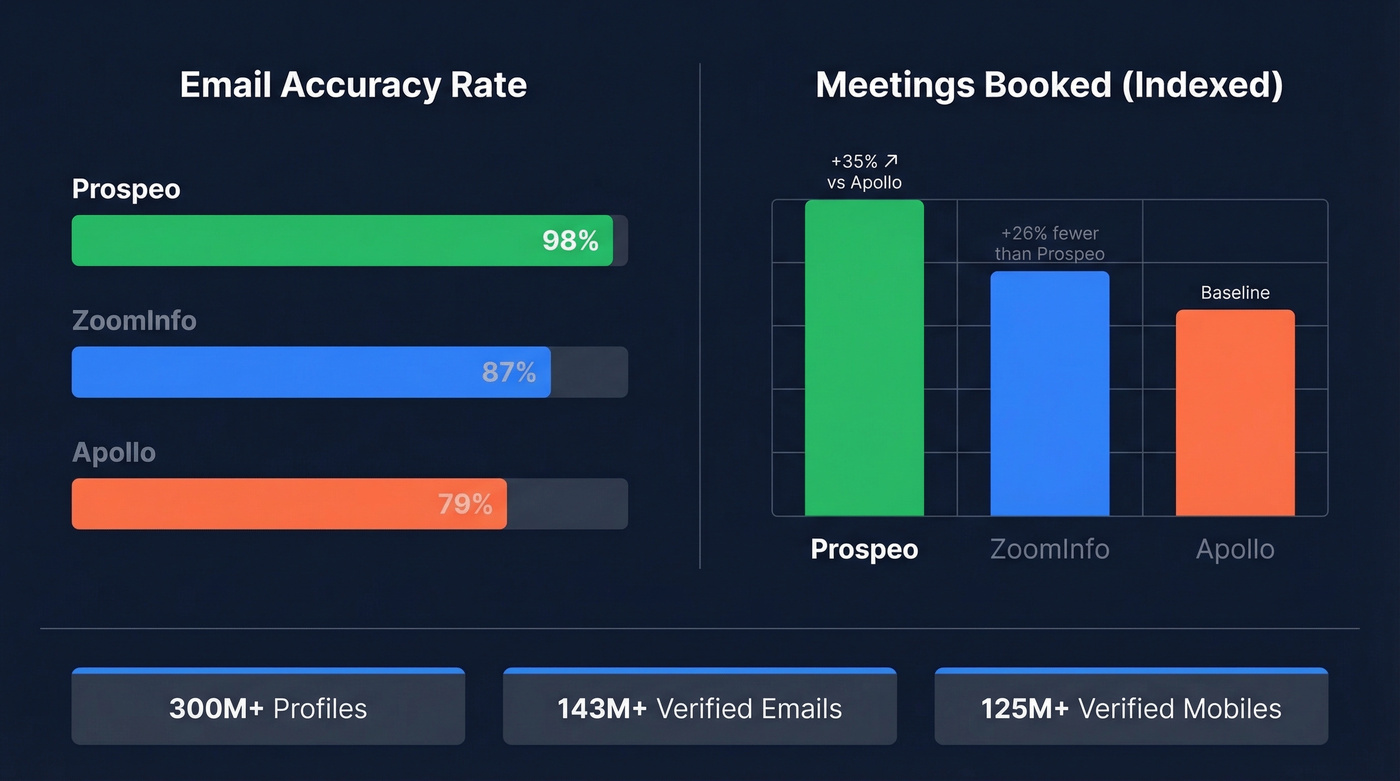
The database covers 300M+ professional profiles, 143M+ verified emails, and 125M+ verified mobile numbers. Email accuracy runs at 98%, compared to 87% for ZoomInfo and 79% for Apollo. The mobile numbers carry a 30% pickup rate - roughly 2.5x what ZoomInfo delivers. Every record refreshes on a 7-day cycle, where the industry average is six weeks. Teams using Prospeo book 26% more meetings than ZoomInfo users and 35% more than Apollo users. A Chrome extension with 40,000+ users lets you prospect from any website in one click, and intent data tracking 15,000 topics via Bombora surfaces in-market buyers before they hit your competitors' radar.

The proof point that matters: Snyk's 50-person AE team was running 35-40% bounce rates before switching. After layering in Prospeo, bounces dropped under 5%, AE-sourced pipeline jumped 180%, and they now generate 200+ new opportunities per month. That's not a marginal improvement - it's a different business.
Prospeo integrates natively with Salesforce, HubSpot, Smartlead, Instantly, Lemlist, Salesloft, Outreach, Clay, Zapier, n8n, Make, and more - so it slots into whatever engagement stack you're already running.
Use it if you want the cleanest contact data in the market at ~$0.01/lead with a free tier to test. No contracts, self-serve onboarding.
Skip it if you need a full sequencing engine built in - pair Prospeo with any SEP on this list for the complete workflow.
Outreach - Best for Customization
The consensus on r/sales is consistent: Outreach wins on customization. One practitioner put it bluntly - there's a "clear advantage to Outreach for the level of customizability" over everything else in the category. If your sales process has complex branching logic, multiple personas, and nuanced trigger-based workflows, Outreach handles it. Gartner Peer Insights users rate it 4.5/5 across 185 reviews.

The AI story is strong too. Outreach's Kaia feature shaves 11 days off sales cycles and boosts win rates by up to 10 percentage points on deals over $50K, and 45% of teams now run a hybrid AI-SDR model through the platform.
If you're rolling this out across a team, follow a structured implementing a sales engagement platform plan to avoid messy adoption.
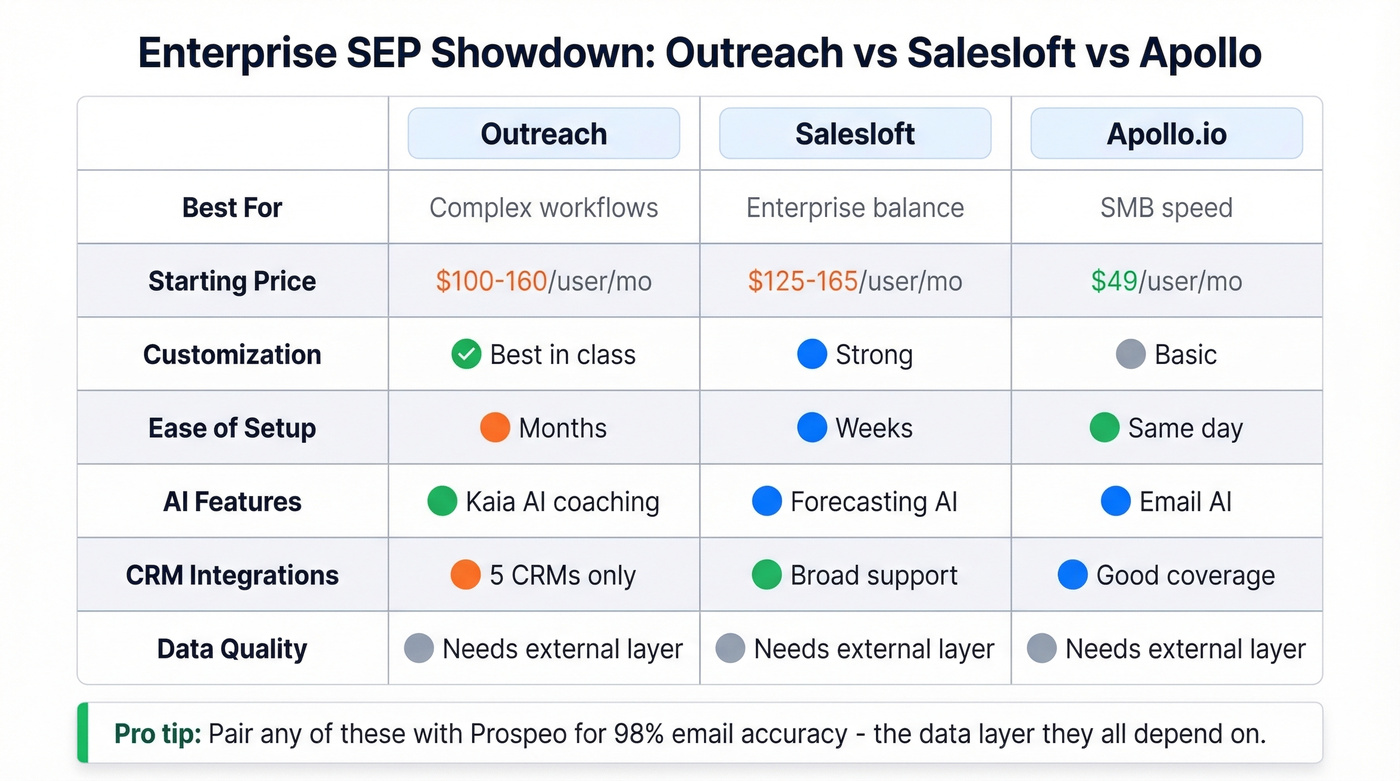
The tradeoffs are real, though. Outreach only integrates with five CRMs. Gmail sync issues are a recurring complaint - users report sent emails that can't be viewed, and the "Snooze" button sitting right next to "Schedule" has cost people drafted emails. Frustrating stuff when you're moving fast.
Pricing reflects enterprise expectations: $100-160/user/mo on annual contracts, plus $1,000-$8,000 in implementation fees. Onboarding takes months, not days. The fact that Outreach still won't publish pricing in 2026 tells you everything about their sales motion.
Use it if you have 20+ reps, complex workflows, and the budget and patience for a proper implementation.
Skip it if you're a small team that needs to be running sequences by Friday.
SalesLoft - Best Enterprise Balance
Salesloft occupies the sweet spot between Outreach's power-user complexity and the simplicity of lighter tools. Practitioners consistently describe it as "much better than just using HubSpot sequencing or Apollo" for enterprise outbound, while being easier to adopt than Outreach. Gartner Peer Insights users rate it 4.4/5 across 284 reviews.

Gartner named Salesloft a Visionary in the inaugural RAO Magic Quadrant, which tracks with where the product is heading - the Premier plan adds forecasting and revenue management on top of core engagement. Typical annual contracts land between $20,000 and $120,000/year depending on team size, with per-seat pricing in the ~$125-165/user/mo range.
Here's a negotiation tip worth knowing: Vendr data shows 35-60% discounts off list price are common with upfront annual payment. A 50-seat Advanced plan might list at $108,000 but close at $50-70K. Watch out for add-ons, though - unlimited calling and messaging for 25 users runs an extra $7,500/year.
Use it if you want enterprise-grade cadence management without Outreach's implementation overhead.
Skip it if you're running a lean team under 10 reps - the annual minimums won't make sense.
Apollo.io - Easiest to Implement
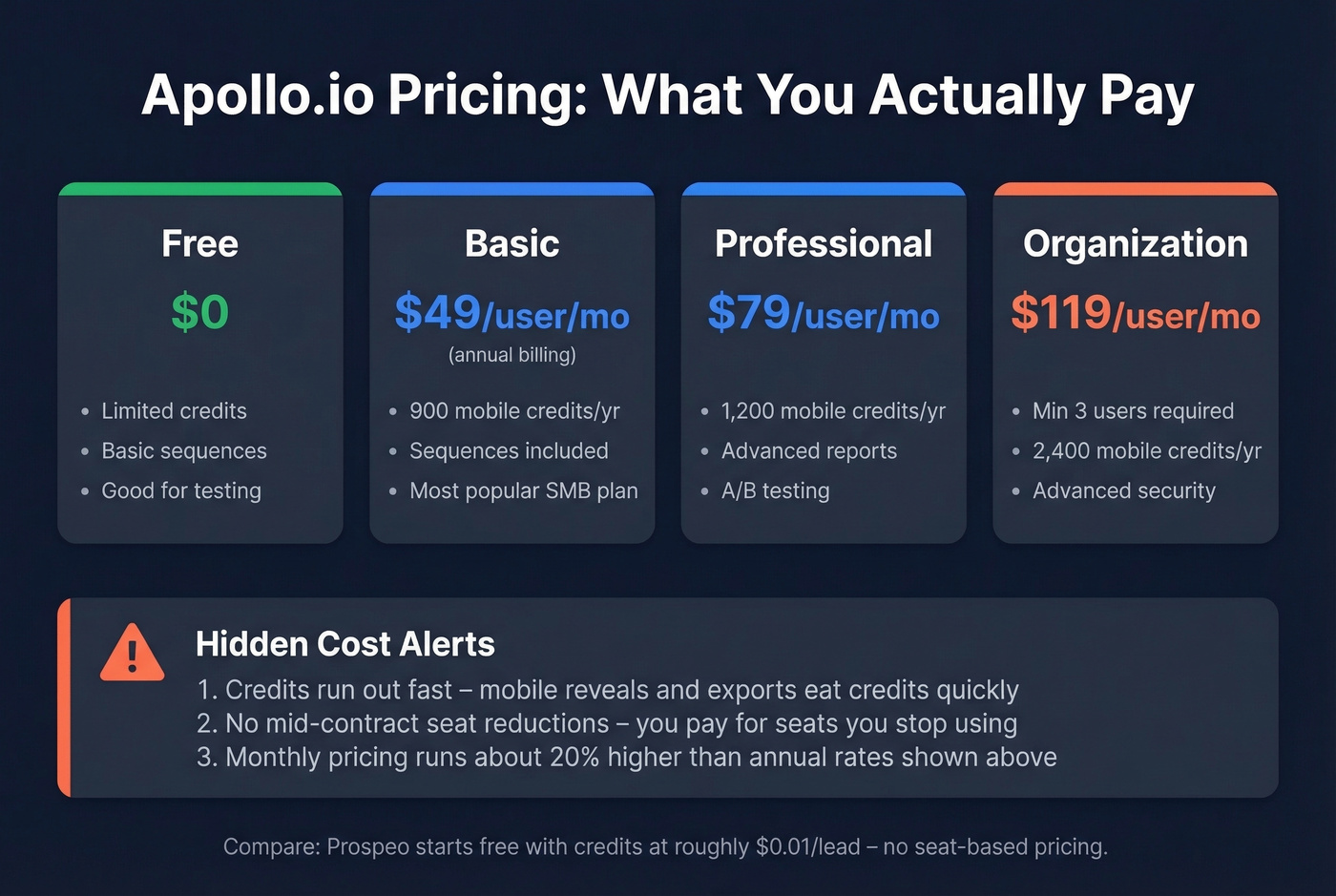
Apollo is the obvious starting point for most SMB teams. Data plus sequencing in one platform, a genuinely useful free tier, and paid plans from $49/user/mo on Basic through $79 on Professional to $119 on Organization with annual billing. Monthly pricing runs about 20% higher.
If you're building an outbound stack from scratch, compare it alongside other SDR tools and outbound lead generation tools.
The appeal is speed to value. You can go from zero to running outbound sequences in an afternoon, with Apollo's built-in database feeding your cadences directly. For a 3-5 person sales team that doesn't want to manage multiple tools, it's hard to beat.
The tradeoffs are real, though. Practitioners consistently rate Apollo's sequencing as weaker than Outreach or Salesloft - functional, but not enterprise-grade. The credit system drives your actual cost higher than the sticker price suggests, since mobile reveals and exports consume credits fast. You can't reduce seats mid-contract, and the Organization plan requires a minimum of three users.
The data quality gap is the bigger concern. We've tested Apollo's email accuracy against dedicated data providers, and it runs closer to 79% versus 98% from a dedicated verification layer. For teams scaling past 5-10 reps, pairing Apollo's sequencing with a verified data source is a common upgrade path.
Use it if you're an SMB that wants data and engagement in one tool, today.
Skip it if you need enterprise-grade sequencing or your bounce rates are already a problem.
HubSpot Sales Hub - Best for HubSpot Shops
If your CRM is HubSpot, adding Sales Hub is the path of least resistance. Professional runs $100/user/mo, Enterprise $150/user/mo, and there's a free tier with basic tools. The sequencing is functional - you can build email cadences, track opens, and manage tasks without leaving the ecosystem you already know.
HubSpot's sequencing doesn't compete with Outreach or Salesloft on depth. Branching logic is limited, reporting is surface-level, and multichannel orchestration feels bolted on rather than native. But if you're a 5-15 person team already paying for HubSpot Marketing and CRM, adding another engagement platform creates complexity you don't need. Use what you have, and invest the savings in better contact data.
Instantly - Best for Cold Email Volume
Instantly is purpose-built for scaling cold email. Starting at $30/1,000 contacts per month, it's a strong option for agencies and teams that need to send high volumes without torching their domain reputation. The platform handles inbox rotation, spreading sends across multiple mailboxes to stay under provider radar.
The deliverability-first approach matters. A common ramp rule is roughly 30 emails per inbox per day during warmup, and you scale by adding inboxes rather than spiking volume from a single account. Instantly isn't trying to be an enterprise SEP. It's trying to be the best cold email machine, and it succeeds at that narrow mission.
If you're going deeper on deliverability, see our email deliverability guide and email reputation tools.
Gong - Best for Revenue Intelligence
Gong represents where the entire engagement category is heading. Named a Leader in the inaugural Gartner RAO Magic Quadrant - placed highest on Ability to Execute and furthest on Completeness of Vision - Gong combines conversation intelligence, deal management, and outbound orchestration into a single platform. Clari also earned a Leader position, focusing more on pipeline management and forecasting, with Clari citing 2x higher win rates for adopters. Custom pricing for Gong typically runs $100-150/user/mo on annual contracts.
If you're evaluating tools in 2026, Gong is the platform to watch. It's not the cheapest or simplest option, but the convergence of engagement and intelligence into one workflow is the direction every vendor is chasing. For teams that can afford it, it eliminates the gap between "what happened on the call" and "what should happen next."
Salesforce Sales Engagement
Baked into Salesforce at $50/user/mo on annual billing, this requires Sales Cloud as a foundation. If your entire org lives in Salesforce and you need basic cadence functionality without adding another vendor, it's the lowest-friction option - but it won't replace a dedicated SEP for serious outbound teams.
Reply.io
Starting at $49/user/mo, Reply.io delivers solid multichannel automation with AI-powered sequence generation. It's a capable mid-market option for teams that want more sophistication than Instantly but don't need Outreach-level complexity.
Klenty
Klenty starts at $50/user/mo on annual billing and offers straightforward sequencing without enterprise overhead. It's a clean, no-nonsense alternative for mid-market teams that find Outreach and Salesloft overkill for their workflow.
Pricing Comparison
Here's what these tools actually cost. Outreach and Salesloft still won't publish pricing in 2026, which tells you something. Everything below is based on published tiers, procurement data, and community-reported contracts.
| Tool | Starting Price | Contract | Setup Fee | Free Tier? | Peer Rating |
|---|---|---|---|---|---|
| Prospeo | ~$0.01/lead | None | $0 | Yes, 75 emails/mo | - |
| Apollo.io | $49/user/mo | Annual | $0 | Yes | 4.3/5 |
| Instantly | $30/1K contacts/mo | Monthly avail. | $0 | No | - |
| Reply.io | $49/user/mo | Monthly avail. | $0 | No | - |
| Klenty | $50/user/mo | Annual | $0 | No | - |
| HubSpot Sales Hub | $100/user/mo | Annual | $0 | Yes | - |
| Outreach | ~$100-160/user/mo | Annual | $1K-$8K | No | 4.5/5 |
| Salesloft | ~$125-165/user/mo | Annual | Varies | No | 4.4/5 |
| Gong | ~$100-150/user/mo | Annual | Varies | No | - |
| SF Engagement | $50/user/mo | Annual | $0 | No | - |
That Salesloft negotiation benchmark is worth remembering: 35-60% off list price is achievable with upfront annual payment and bundled add-ons. A $108,000 list-price contract can often close at $50-70K.
The Data Problem Most Guides Skip
Let's be honest about something most sales engagement guides gloss over entirely.
Picture this: you've spent three months evaluating engagement platforms, negotiated a solid Salesloft contract, built 40 sequences, and trained your team. Week one of launch, 1 in 5 emails bounce. That's not a sequencing problem. That's a data problem.
Bad contact data leads to bounces. Bounces damage your sender reputation. Damaged reputation means your emails start landing in spam - even the ones sent to valid addresses. This is the deliverability death spiral, and no amount of A/B testing or subject line optimization can fix it once it starts. The ramp rule exists for a reason: cap at roughly 30 emails per inbox per day during warmup, and scale by adding inboxes, not volume.
If you're seeing this in the wild, start with email bounce rate benchmarks and fixes, then work on how to improve sender reputation.
81% of sales teams are using AI in some form, but AI can't fix a bad phone number or a bounced email address. The data layer is the foundation everything else sits on. Snyk's team proved this in production - after switching to a dedicated verification layer, bounce rates dropped from 35-40% to under 5% while generating 200+ new opportunities monthly. Compare that to the 79-87% accuracy range from major databases, and the math on deliverability protection becomes obvious.
Snyk's 50 AEs cut bounce rates from 35% to under 5% and grew pipeline 180% by layering Prospeo under their engagement stack. At ~$0.01/lead with native Salesloft, Outreach, and Instantly integrations, it slots into whatever SEP you choose from this list.
Stop sequencing bad data. Start with 300M+ verified profiles.
Implementation by Team Size
Not every team needs the same stack. Here's what actually works at each stage, based on what we've seen across hundreds of outbound setups.
1-5 reps, roughly $3,000-$8,000/year
Start with Apollo.io on the Free or Basic tier at $49/user/mo for sequencing and built-in data. Layer in a dedicated email verification tool before any contact enters a sequence - this alone will save you from the deliverability spiral described above. Total investment is lean, fast to deploy, and carries zero implementation overhead.
5-25 reps, roughly $25,000-$80,000/year
Move to Salesloft or Outreach as your primary engagement engine. Add a dedicated data verification and enrichment layer feeding clean contacts into every cadence, plus a warmup tool like Instantly's warmup feature to protect domain reputation. At this tier, budget for multiple sending domains and enforce the 30-emails-per-inbox-per-day ramp rule during the first 2-3 weeks on any new domain. Invest in proper training for your team - the biggest ROI killer at this stage isn't the tool, it's reps who only use 20% of its capabilities.
If you need a tighter outbound motion, these sales prospecting techniques help teams avoid spray-and-pray.
25+ reps, roughly $80,000-$250,000+/year
Enterprise SEPs like Outreach, Salesloft, or Gong for the full RAO play form the core. API-level enrichment running in the background ensures every new lead gets verified before it hits a sequence. Dedicated deliverability infrastructure with multiple sending domains and inbox rotation rounds out the stack.
The pattern across all three tiers is the same: your engagement platform handles the workflow, and a dedicated data layer handles verification. We've seen teams skip this step to save money, then spend twice as much recovering from deliverability damage three months later.
FAQ
What is sales engagement software?
It's the platform that automates and manages daily outreach - email sequences, phone cadences, social touches, and follow-ups - while logging every activity back to your CRM. Think of it as the system of action sitting on top of your system of record, replacing manual task tracking with consistent, multichannel execution.
What's the difference between a CRM and an engagement platform?
A CRM stores contact data and manages relationships over time. An engagement platform automates the outreach itself - sequences, calls, social touches - and logs activities back to the CRM. You need both: the CRM is your record layer, the SEP is your action layer.
Is there free sales engagement software?
Apollo.io and HubSpot both offer free tiers with basic sequencing. Prospeo offers a free tier for email verification at 75 emails per month. For serious outbound at scale, expect to pay $49-100+/user/month for a dedicated platform.
Which features matter most?
Multichannel sequencing, bidirectional CRM sync, AI-driven prioritization, and deliverability management separate great tools from mediocre ones. Many teams fixate on flashy AI while overlooking data quality - which ultimately determines whether outreach actually reaches inboxes.
Do I need a separate data provider if my SEP includes a database?
Usually, yes. Built-in databases like Apollo's are convenient but less accurate than dedicated providers. A 98% email accuracy rate with a 7-day refresh cycle significantly outperforms bundled databases - and bad data kills deliverability regardless of how good your sequencing is.