

Sales Follow Up Emails: What 16.5 Million Emails Say Actually Works
You had the perfect demo. The prospect was nodding, asking smart questions, even pulled in their VP halfway through. Then silence. Three days. A week. Your sales follow up email sits unopened - or worse, it bounced.
The problem isn't your copy. It's everything around it.
Most follow-up advice stops at templates. That's like giving someone a recipe without checking if the oven works. The data from 16.5 million cold emails tells a different story about what actually moves the needle - and it starts well before you hit send.
The Short Version
- 2-3 follow-ups is the sweet spot, not 5+. Sending 4+ emails in a sequence more than triples unsubscribe and spam complaint rates.
- Short emails win. Under 56 words outperforms 141-word emails consistently.
- Fix your data and deliverability first. One practitioner doubled their reply rate from 3% to 6% - not by rewriting copy, but by cleaning their list and fixing infrastructure.
- Open tracking is probably hurting you. Campaigns with it turned off see 2x+ reply rates.
Below: the templates, cadence, subject lines, and the deliverability checklist most guides skip entirely.
What 16.5 Million Emails Reveal
Belkins analyzed 16.5 million cold emails across 93 business domains from January through December 2024. The headline finding contradicts most sales advice: the highest reply rate - 8.4% - comes from just one email. Every additional follow-up after that sees declining returns.
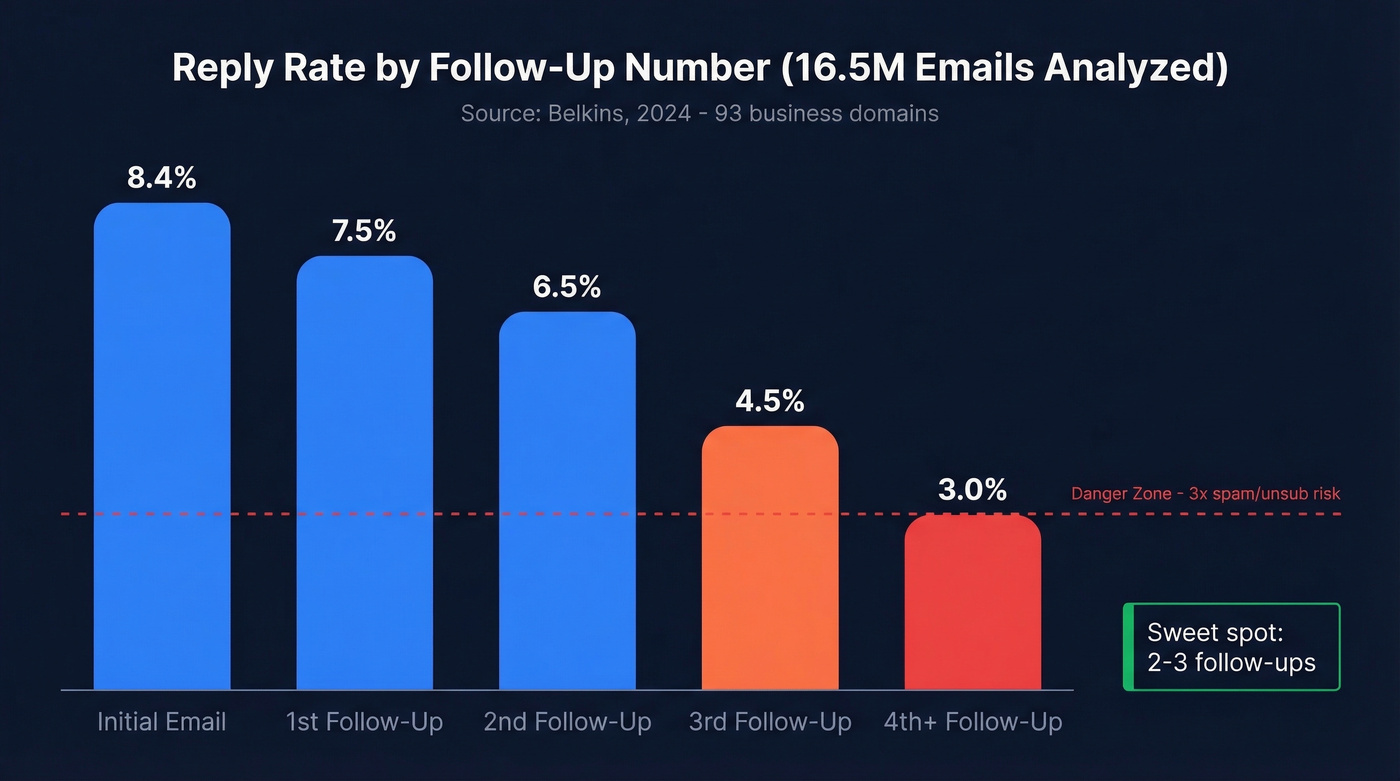
That doesn't mean you should never follow up. Woodpecker's data shows the average reply rate jumps from 9% to 13% with at least one follow-up. For experienced teams, that lift is even more dramatic - 16% without follow-ups versus 27% with them. The first follow-up does the heavy lifting. In our experience, it accounts for roughly 80% of the incremental value, and everything after the second or third adds only a fraction.
Here's the thing: sending 4+ messages in a sequence more than triples unsubscribe and spam complaint rates. That "always be following up" advice? It's actively dangerous in 2026.
Results vary by company size and industry. Small companies (2-50 employees) tolerate persistence better, starting at 9.2% and holding around 8% through the first follow-up. Enterprise contacts (1,000+ employees) are allergic to persistence.
Founders follow a specific curve: 6.64% initial, 6.66% on the first follow-up, a slight bump to 6.94% on the second, then a cliff to 5.75% and 3.01% on the third and fourth. Manufacturing, Solar, and Transportation consistently outperform at 6.5-6.8%, while e-learning, crypto, healthcare, cloud, and security struggle to crack 5%. Use this to calibrate expectations for your vertical.
| Follow-Up # | Avg. Reply Rate | Spam/Unsub Risk | Verdict |
|---|---|---|---|
| Initial email | ~8.4% | Baseline | Always send |
| 1st follow-up | ~7-8% | Low | High ROI - send it |
| 2nd follow-up | ~6-7% | Moderate | Worth it for warm leads |
| 3rd follow-up | ~4-5% | Elevated | Only with new value |
| 4th+ follow-up | ~3% or less | 3x+ higher unsub/spam | Stop here for cold |
Let's be blunt: the "5+ follow-ups" advice isn't just outdated - it's the fastest way to get your domain flagged. Two to three is the sweet spot. If your deal size is under five figures, you probably don't need more than two.
How to Write a Sales Follow Up Email
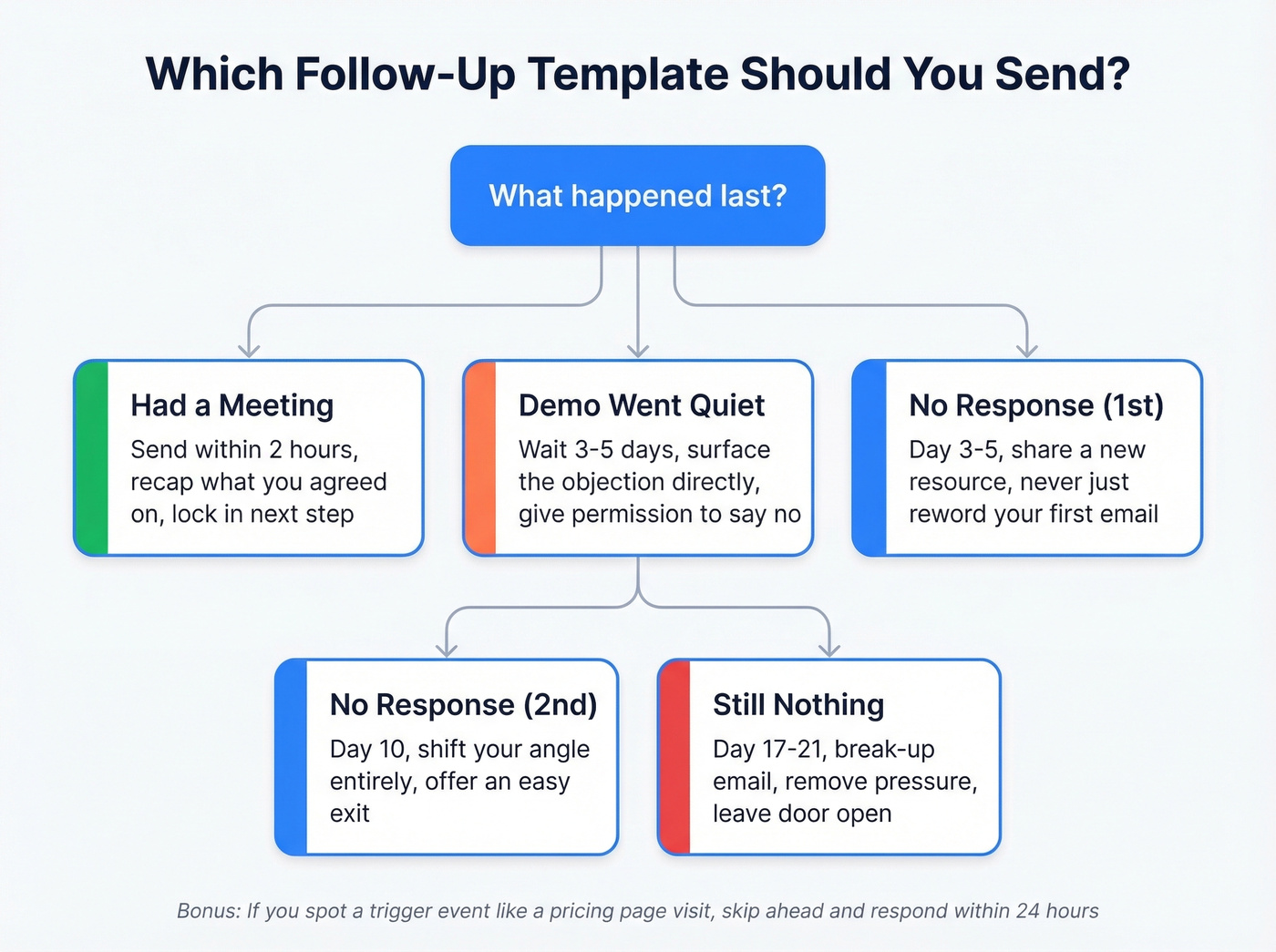
Every template below follows one principle: add new value or change the angle. A follow-up that just says "bumping this" is spam with a friendly face. If you want more plug-and-play options, start with these sales follow-up templates.
Post-Meeting Follow-Up
Subject: Next steps from our call Timing: Within 2 hours of the meeting
Hi [Name],
Great talking through [specific topic discussed]. Recap: [one-sentence summary of what you agreed on]. I'll have [deliverable] over to you by [date].
Does [proposed next step/date] still work on your end?
This works because it proves you were listening and locks in momentum while the conversation is fresh. Two hours, not two days. (More on this in our sales meeting follow-up email guide.)
Post-Demo / Stalled Deal
Most reps send "just checking in" when a prospect goes quiet after a demo. That tells the prospect nothing new. Surfacing the objection directly - and giving them permission to be honest - is how you unstall deals.
Subject: One question before your internal review Timing: 3-5 days after the demo goes quiet
Hi [Name],
As you're discussing internally, what's the biggest concern or question that's coming up? I'd rather address it head-on now than have it stall things later.
Happy to jump on a 10-minute call or send over whatever context helps.
No Response - First Follow-Up
Subject: [Relevant resource] for [their company] Timing: Day 3-5 after initial email
Hi [Name],
Wanted to share [specific resource - case study, benchmark, article] that's relevant to [their situation/industry]. [One sentence on why it matters to them.]
Worth a quick look?
Never send a first follow-up that's just a reworded version of your original email. Add something new. The prospect ignored email #1 for a reason - repeating it won't change their mind. If you're building a full sequence, use this B2B cold email sequence framework.
No Response - Second Follow-Up
Subject: Different angle on [problem you solve] Timing: Day 10 after initial email
Hi [Name],
I came at this from [original angle] last time. But talking with other [their role] at [similar companies], the bigger pain is usually [different angle/problem].
Is that closer to what you're dealing with? If not, no worries - happy to stop cluttering your inbox.
Shifting the angle signals you're not just running an automated sequence. It also tests whether your original positioning missed the mark entirely.
Trigger-Event Follow-Up
Behavioral triggers - pricing page visits, content downloads, webinar signups - are the highest-intent signals you'll get. When you spot one, speed matters more than polish.
Subject: Saw [specific trigger] - quick thought Timing: Within 24 hours of the trigger event
Hi [Name],
Noticed [you visited our pricing page / downloaded the ROI guide]. Figured the timing might be right to pick this back up.
[One sentence connecting the trigger to their problem.] Want to grab 15 minutes this week?
Skip this template if you don't have reliable behavioral tracking set up. Guessing at triggers and getting it wrong is worse than not mentioning them at all. If you want a system for this, see how to track sales triggers.
Break-Up Email
The break-up email works because it removes pressure. The "finalizing my schedule" framing gives the prospect a low-stakes reason to respond. Use it as your final touch in any outbound sequence.
Subject: Should I close your file? Timing: Day 17-21 (final touch)
Hi [Name],
I'm finalizing my schedule for next week and want to make sure I'm not leaving you hanging. If the timing isn't right, totally understand - just let me know and I'll circle back in a few months.
If there's still interest, I've got [specific date/time] open.
Leave the door open, but make it clear this is the last touch for now.

The data is clear: 2-3 follow-ups is the sweet spot. But even the perfect cadence fails when 35% of your emails bounce. Prospeo's 98% email accuracy and 7-day data refresh mean your follow-ups actually land in real inboxes - not spam traps or dead addresses.
Stop perfecting templates for emails that never arrive.
Subject Lines That Get Opened
Subject lines follow a simple hierarchy: personal beats clever, short beats long, and anything that sounds like marketing gets ignored. For more ideas, pull from these email subject line examples.
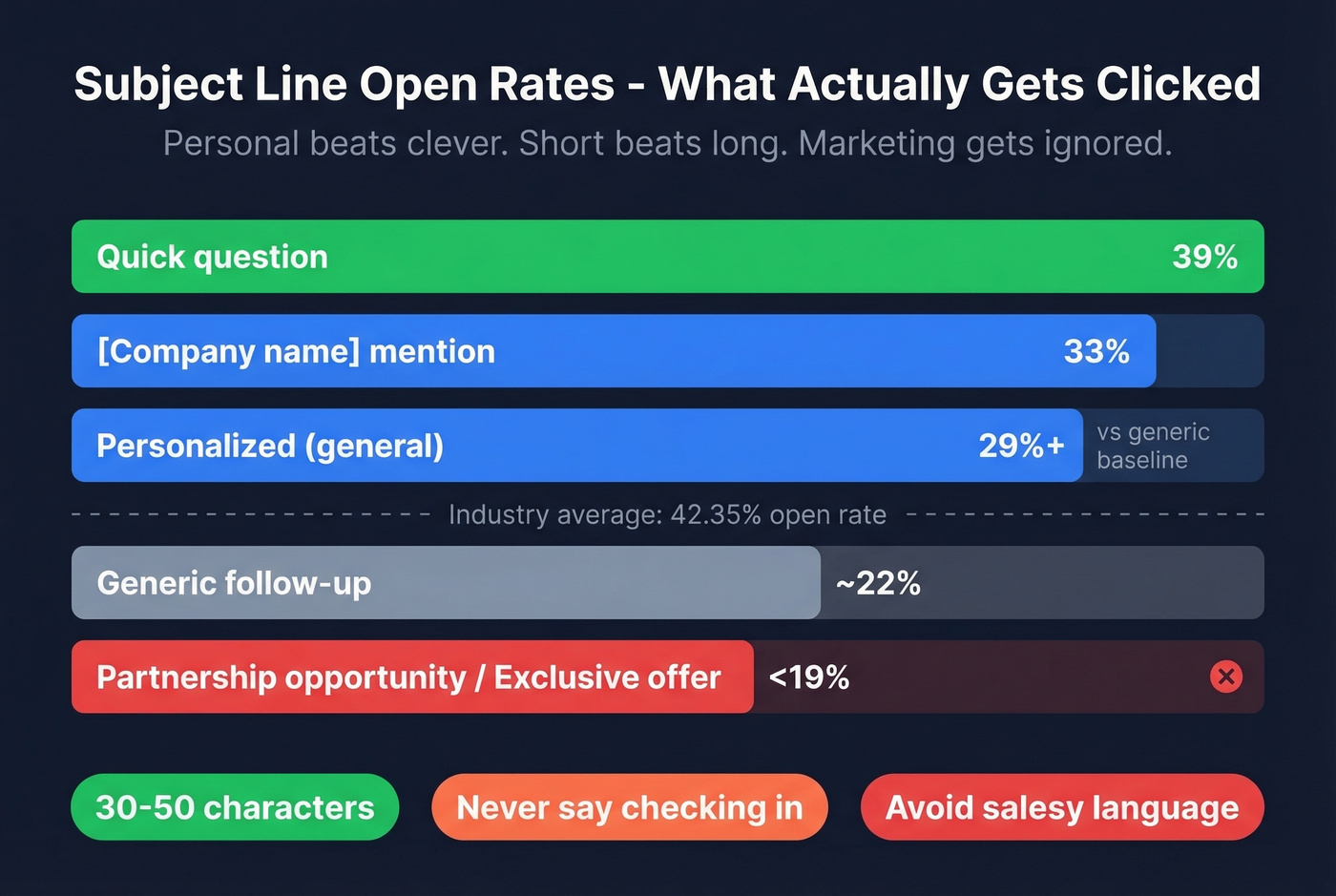
One practitioner tested this directly: "Quick question" pulled 39% opens. Subject lines with the prospect's company name hit 33%. Anything salesy - "Partnership opportunity," "Exclusive offer" - dropped below 19%. Personalized subject lines lift open rates by 29% or more compared to generic ones. For context, the average email open rate across industries sits at about 42.35%, so a well-crafted subject line can push you well above the median.
Keep them between 30-50 characters. Never use the word "follow-up" or "checking in" in a subject line - both signal you have nothing new to say.
| Scenario | Subject Line Example |
|---|---|
| Post-meeting | Next steps from our call |
| Post-demo (stalled) | One question before your review |
| No response #1 | [Resource] for [Company] |
| No response #2 | Different take on [problem] |
| Trigger (pricing page) | Saw you looking - happy to walk through |
| Break-up | Should I close your file? |
| Referral angle | [Mutual connection] suggested I reach out |
| Quick question | Quick question about [specific thing] |
| Social proof | How [similar company] solved [problem] |
| Time-sensitive | [Date] still work? |
| Curiosity gap | Noticed something about [their company] |
The Ideal Follow-Up Cadence
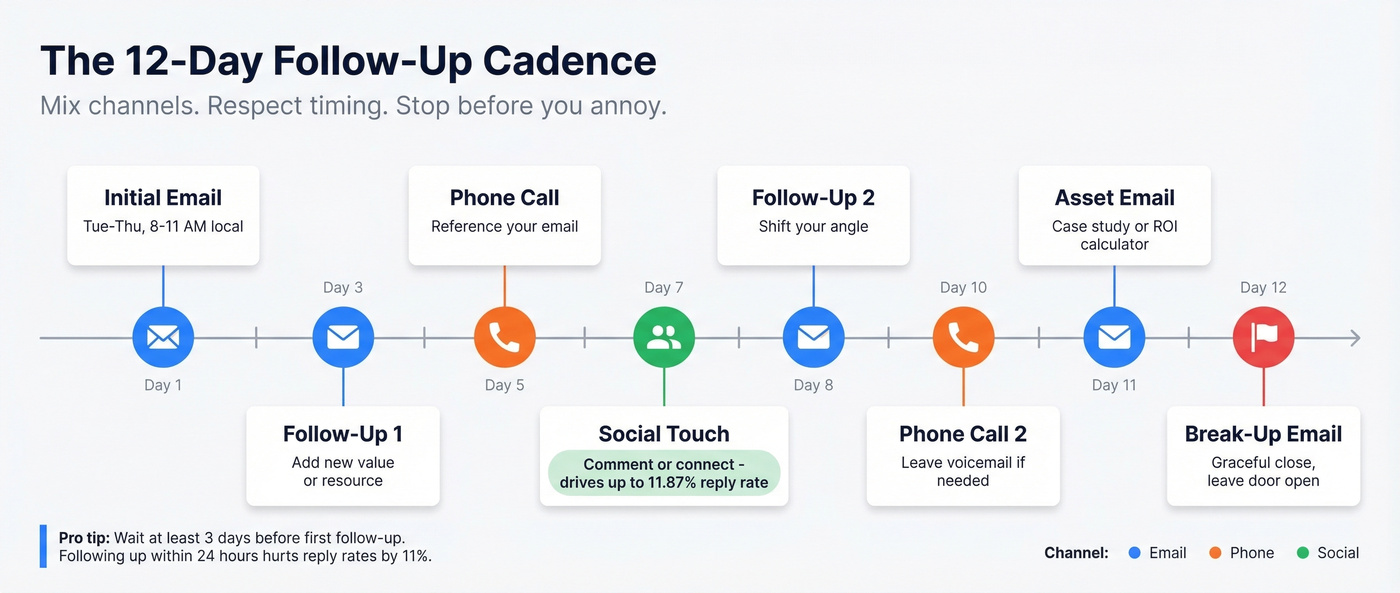
The "how many" question matters less than the "when and how" question. Mixing channels and respecting the data on timing is what separates good sequences from inbox clutter. If you want a deeper dive, see when should you follow up on an email.
| Day | Action | Channel | Notes |
|---|---|---|---|
| 1 | Initial email | Tue-Thu, 8-11 AM local | |
| 3 | Follow-up #1 (new value) | Add resource or insight | |
| 5 | Phone call | Phone | Reference the email |
| 7 | Social touch | Social | Comment or connect |
| 8 | Follow-up #2 (new angle) | Shift positioning | |
| 10 | Phone call #2 | Phone | Voicemail if needed |
| 11 | Asset email | Case study or ROI calc | |
| 12 | Break-up email | Graceful close |
That social touch on Day 7 isn't filler. Belkins found that a message plus profile visit combo on social drives reply rates up to 11.87%. It's the highest-performing non-email touchpoint in the dataset.
For warm leads or hand-raisers, compress this to 4-7 touches within a week. They've already shown interest - speed matters more than spacing. For teams that want something simpler, the 3-7-7 framework works well as a default: follow up on Day 3, Day 10, and Day 17. Following up within 24 hours of the initial email actually hurts reply rates by ~11%. Waiting 3 days yields roughly a 31% increase in replies. Patience pays.
Real talk: the best cadence is the one your team will actually execute consistently. A perfect 12-day plan that reps abandon after Day 5 loses to a simple 3-touch sequence they run every time.
Why Your Follow-Ups Aren't Landing
Your SDR sent 200 follow-ups last week. Open rates look decent. Replies? Crickets. The problem probably isn't the copy - it's the infrastructure underneath it. Before you draft another message, run through this deliverability checklist (or go deeper with our email deliverability guide):
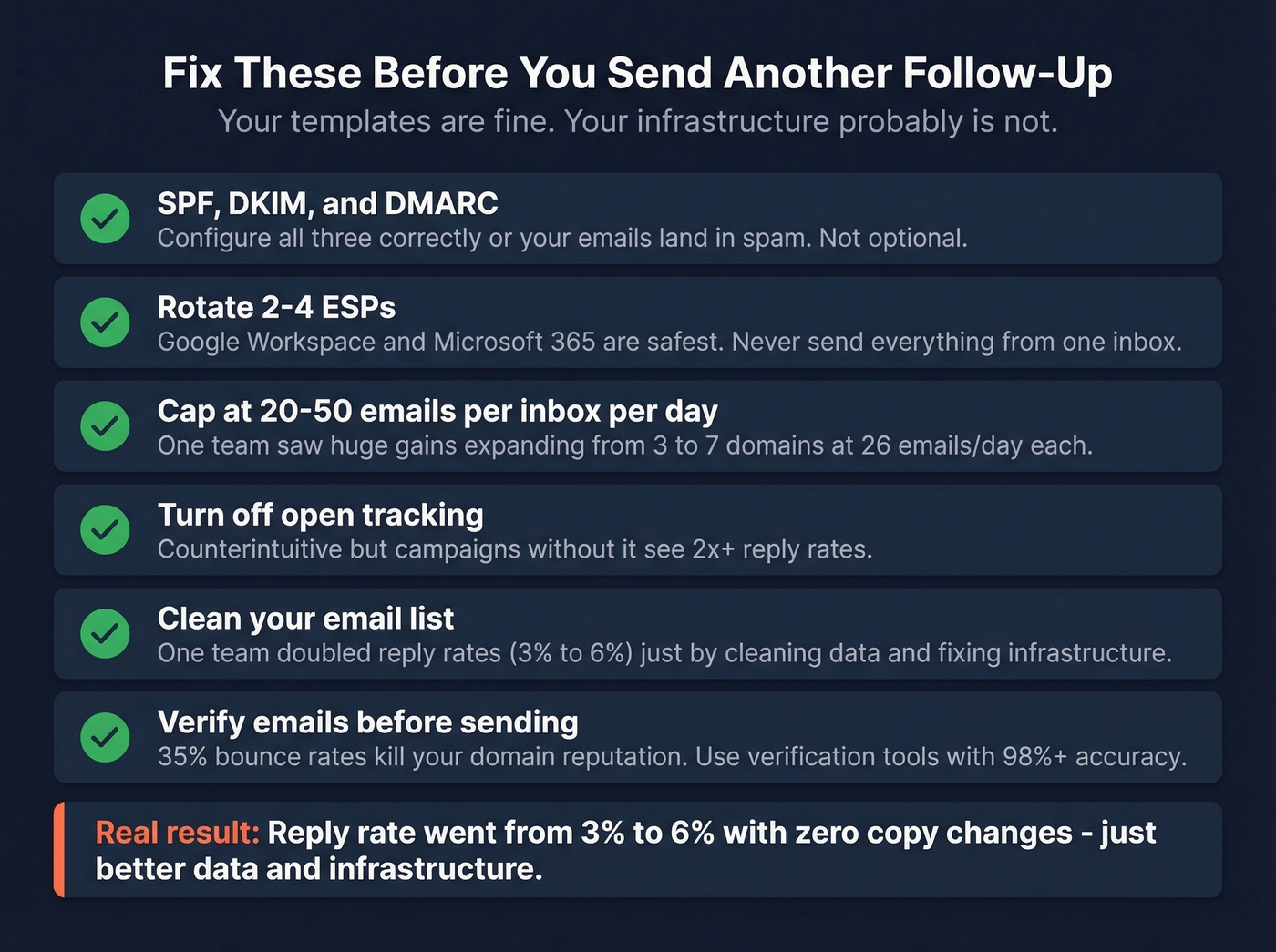
- SPF, DKIM, and DMARC must be configured correctly. If you don't know what these are, your emails are probably landing in spam. (Start with DMARC alignment.)
- Rotate across 2-4 ESPs - Google Workspace and Microsoft 365 are the safest bets. Don't send everything from one inbox.
- Cap volume at 20-50 emails per day per inbox. One practitioner saw dramatic improvement just by expanding from 3 to 7 domains at 26 emails/day each. (More on safe sending limits in email velocity.)
- Turn off open tracking. Counterintuitive, but campaigns with open tracking disabled see more than double the reply rates. Tracking pixels trigger spam filters.
- Keep spam complaints below 0.1%. Gmail's threshold is strict - exceed it and you're flagged.
Open rates are a vanity metric. And open tracking is often the thing killing your reply rates.
But the single biggest deliverability lever? List quality. One Reddit practitioner dropped their bounce rate from 11% to under 2% and watched reply rates double from 3% to 6%. We've seen similar results across dozens of teams we work with: bad data is the silent killer of follow-up sequences. Every bounced email chips away at your domain reputation, which makes your next 100 emails less likely to land. It compounds fast - a list with 10% invalid addresses doesn't just waste 10% of your sends, it poisons deliverability for the other 90%. If you’re troubleshooting, start with email bounce rate benchmarks and fixes.
This is where verification matters before you send a single follow-up. Prospeo runs every email through a 5-step verification process that catches invalid addresses, spam traps, and honeypots - with a 7-day data refresh cycle that keeps contacts current. The free tier gives you 75 emails per month to test with, no contract required.
That practitioner who doubled reply rates from 3% to 6%? They didn't rewrite copy - they cleaned their list. Prospeo's 5-step verification with catch-all handling, spam-trap removal, and honeypot filtering does that automatically across 300M+ profiles at $0.01 per email.
Clean data is the deliverability fix most follow-up guides skip entirely.
Mistakes That Kill Reply Rates
Every follow-up that doesn't add new value is spam. Whether you're reaching out after a demo or a cold first touch, these are the patterns that tank replies - and what to do instead.
"Just checking in" / "Touching base" / "Circling back" - These phrases tell the prospect you have nothing new to say. They're the email equivalent of an empty handshake. Replace them with a specific reason for reaching out. If you need alternatives, see how to say just checking in professionally.
Bumping with no new information - Here's what this looks like in practice:
❌ Bad: "Just bumping this to the top of your inbox."
✅ Better: "Saw [relevant trigger] - thought this might be useful now: [new resource]."
Forwarding your original email with "bumping this" is lazy and obvious. Every follow-up needs a new angle, resource, or question. GMass's analysis puts this as the #1 follow-up mistake.
Writing too much - Keep follow-ups between 50 and 125 words. For cold outreach, under 56 words outperforms everything else. If your follow-up requires scrolling, it's too long.
Ignoring objections - There are really only five reasons a prospect doesn't respond: no need, value not worth the cost, no urgency, they don't want it, or they don't trust you. Your follow-up should address one of these head-on, not pretend the silence doesn't exist.
Sending to unverified emails - If 11% of your list bounces, your domain reputation degrades with every send. Verify before you follow up. Bad data compounds.
Sending from a burned domain - If your primary domain's reputation is already damaged, no template will save you. Set up dedicated sending domains and warm them properly before running sequences.
FAQ
How many follow-up emails should I send?
Two to three is the data-backed sweet spot. Belkins' 16.5-million-email study shows that 4+ messages more than triples unsubscribe and spam complaint rates. The biggest lift comes from the first follow-up - after that, returns diminish fast.
How long should I wait between follow-ups?
Wait at least 2-3 days before your next touch. Following up within 24 hours hurts reply rates by roughly 11%. The 3-7-7 framework - Day 3, Day 10, Day 17 - is a reliable default that gives prospects breathing room without losing momentum.
What's a good reply rate for outbound follow-ups?
Average reply rates with follow-ups run 9-13% according to Woodpecker's benchmarks. Experienced teams hit 16-27%. If you're below 5%, the issue is almost certainly deliverability or data quality, not your copy.
Should I reply in the same thread or start a new one?
Same thread for follow-ups 1 and 2 - it preserves context and looks natural. Start a new thread for follow-up 3 or later, especially if you're shifting the angle significantly.
How do I verify emails before sending follow-ups?
Use a dedicated verification tool before loading contacts into your sequence. Prospeo's free tier (75 emails/month) runs a 5-step check that catches invalid addresses, spam traps, and honeypots at 98% accuracy. NeverBounce and ZeroBounce are alternatives worth comparing.