

How to Plan a Sales Kick Off That Actually Changes Behavior
You've sat through the sales kick off where the CEO talks for 90 minutes, the VP of Product demos a feature nobody asked about, and by Thursday the "big bet" is a faded memory buried under 400 unread Slack messages. Ask any rep what they remember from last year's SKO and you'll get the same answer: the dinner. Not the keynote, not the product demo - the dinner.
Only 38% of sales leaders say their SKO measurably improved performance the following quarter. The event cost somewhere between $2,500 and $5,500 per attendee - and likely around 20% higher in 2026 after years of hotel and airfare inflation. That's real money for an outcome that fuzzy.
Here's the thing: the event itself is the least important part of your SKO. What happens in the two weeks before and the 90 days after determines whether you moved pipeline or just moved budget.
Quick version: Build the 90-day reinforcement plan before you book the venue. Filter every session through the Monday test - if reps can't use it Monday morning, cut it. And refresh your CRM data before reps build territory plans, because stale contacts undermine everything you're about to invest in.
What Is a Sales Kick Off?
A sales kick off is a company-wide event held at the start of a fiscal year or major planning cycle. It typically runs 2-3 days and brings together reps, managers, leadership, and people from Marketing, Product, and CS to align on what's changing, what's staying, and how the team will hit the number.
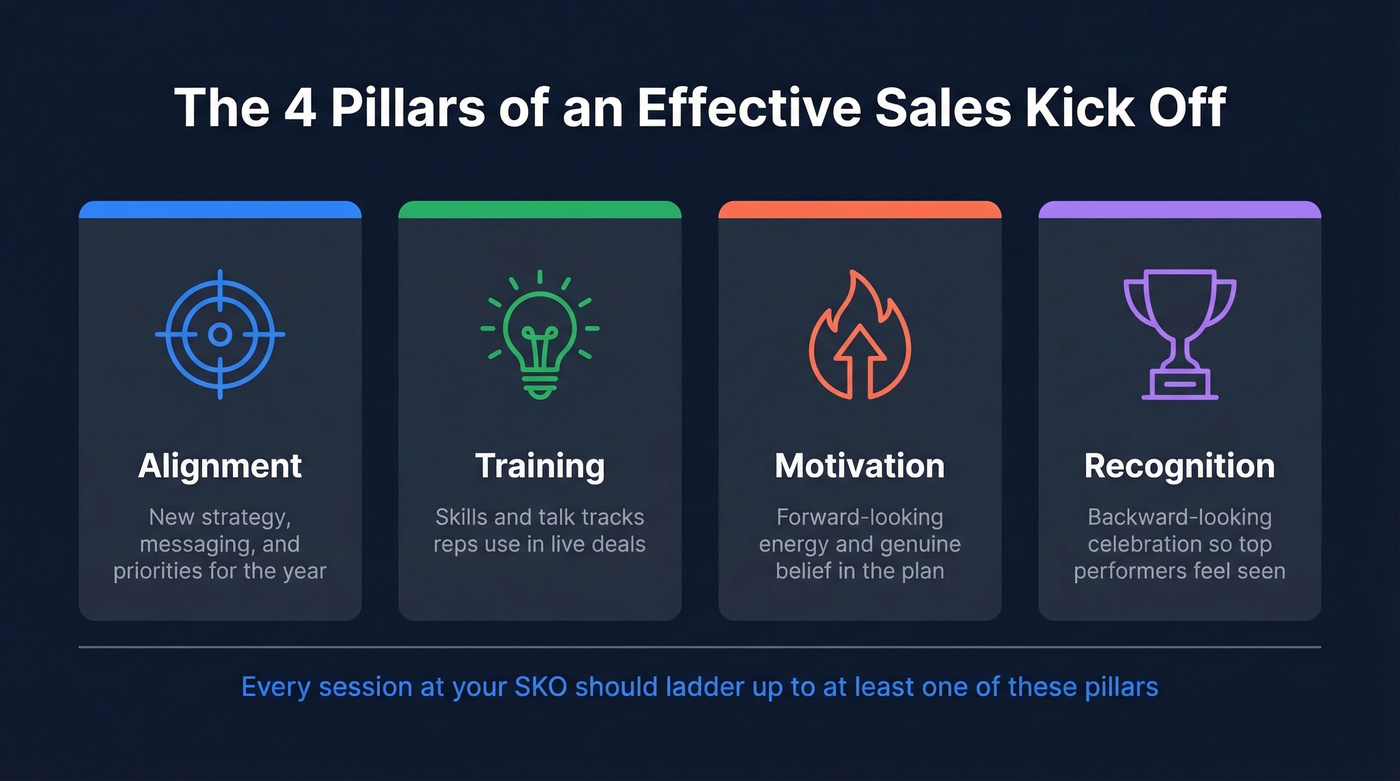
Every effective SKO covers four pillars:
- Alignment - new strategy, messaging, and priorities for the year
- Training - skills and talk tracks reps will use in live deals
- Motivation - forward-looking energy and genuine belief in the plan
- Recognition - backward-looking celebration of wins so top performers feel seen
The format varies - in-person, virtual, hybrid - but the purpose doesn't. An SKO compresses months of enablement into a few high-intensity days, then sets the conditions for that learning to stick.
Why SKOs Matter When Done Right
The skeptic's question is fair: why fly 100 people to a hotel when you could just send a deck? Because alignment isn't a PDF. It's a shared experience that changes how people sell.
Gallup's engagement research shows that companies with highly engaged teams report 20% higher sales and 23% greater profitability A well-run SKO is one of the few moments where you can move the engagement needle for an entire sales org simultaneously. If your SKO sharpens messaging on even one key segment, the revenue it generates dwarfs the hotel bill. That's where effectiveness becomes measurable - not in post-event surveys, but in the pipeline impact over the following quarter.
How to Plan Your SKO Step by Step
It's November. Your CRO just told you to own SKO. You have 8 weeks and a six-figure budget. This planning sequence works.
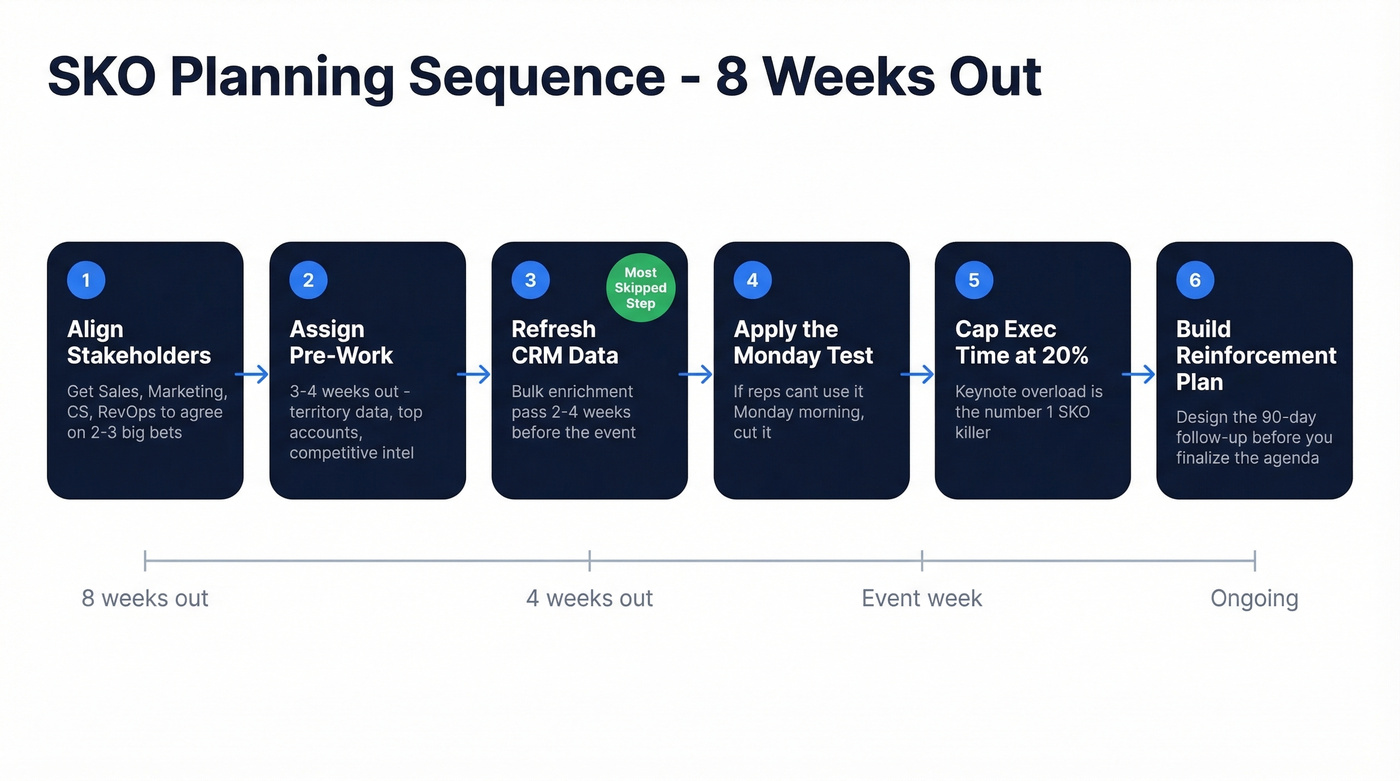
1. Align stakeholders early. Get Sales, Marketing, CS, and RevOps in a room to agree on the 2-3 big bets for the year. Every session at SKO should ladder up to those bets. If it doesn't connect, it doesn't make the agenda.
2. Assign pre-work. Reps should arrive having reviewed their territory data, top accounts, and competitive intel. Pre-work transforms passive attendees into active participants. Send assignments 3-4 weeks out with clear deadlines.
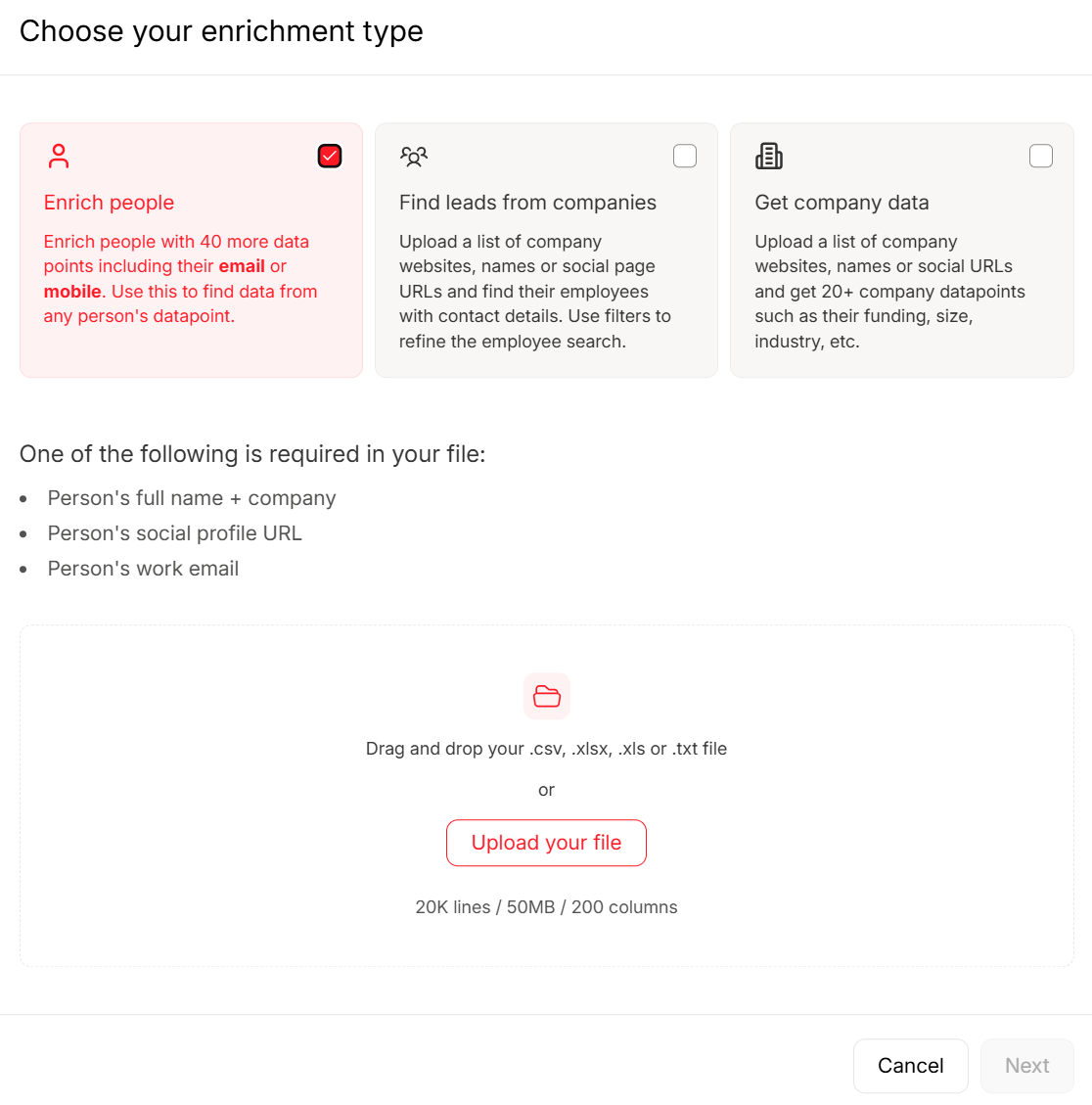
3. Refresh your CRM data. This is the step most teams skip - and it quietly sabotages everything else. Reps building territory plans on contacts that bounced six months ago waste every minute of SKO prep. Run a bulk enrichment pass 2-4 weeks before the event. We've seen teams use Prospeo for this: upload your CRM list and get 98% verified email accuracy back, with a 7-day refresh cycle and an 83% enrichment match rate. Reps walk in with real data, not guesswork. (If you're comparing vendors, start with data enrichment services and a practical lead enrichment workflow.)
4. Apply the Monday test to every session. This comes from ZoomInfo's enablement team, and it's the best filter we've found: if a rep can't use what they learned on Monday morning, the session failed. Cut anything that's purely inspirational without a tactical takeaway.
5. Cap executive presentations at 20% of agenda time. Leadership alignment matters, but keynote overload is the #1 SKO killer. Too much "talking at" the team crowds out the interactive work that actually changes behavior.
6. Build the reinforcement plan now. Don't wait until the event is over. Design the 90-day follow-up cadence before you finalize the agenda. If you can't reinforce a session post-SKO, question whether it belongs in the lineup.
Sample 2-Day Agenda Template
The best agendas follow a simple rhythm: 45-minute session blocks with 15-minute breaks. Herrmann's research backs this - attention drops hard after 45 minutes, and no amount of coffee fixes it.
Day 1: Align and Equip
| Time | Session | Format |
|---|---|---|
| 8:30-9:15 | CRO keynote: the year ahead | Presentation (45 min max) |
| 9:30-10:15 | New messaging workshop | Breakout by segment |
| 10:30-11:15 | Competitive battlecards | Interactive drill |
| 11:30-12:15 | Customer panel | Live Q&A |
| 12:15-1:15 | Lunch | - |
| 1:15-2:00 | Territory planning session | Hands-on workshop |
| 2:15-3:00 | Product roadmap: what closes deals | Presentation + Q&A |
| 3:15-4:00 | Role-play: new discovery framework | Paired practice |
| 4:15-5:00 | Team-building activity | See below |
| 6:30 | Team dinner | - |
Day 2: Practice and Celebrate
| Time | Session | Format |
|---|---|---|
| 8:30-9:15 | Marketing + Sales alignment | Joint workshop |
| 9:30-10:15 | Objection handling drill | Live simulation |
| 10:30-11:15 | Manager coaching playbook | Breakout by team |
| 11:30-12:15 | "Deals we won" lightning talks | 3 reps, 10 min each |
| 12:15-1:15 | Lunch | - |
| 1:15-2:00 | 90-day action planning | Individual + manager |
| 2:15-3:00 | Recognition ceremony + awards | Full group |
| 3:00-3:30 | CRO close: the Monday commitment | Presentation |
Notice what's missing: there's no 90-minute product demo. No "state of the market" lecture from an outside analyst. Every block passes the Monday test.

Every SKO territory planning session is built on CRM data - and stale contacts silently destroy the ROI of your entire event. Prospeo's bulk enrichment returns verified contacts for 83% of your list with 98% email accuracy, refreshed every 7 days. Run it before kickoff so reps walk in with real buyers, not bounced emails.
Don't let bad data waste your $5,000-per-head SKO investment.
SKO Themes That Work
A good theme gives the event a narrative spine without becoming cheesy. Five that translate into actual session design:
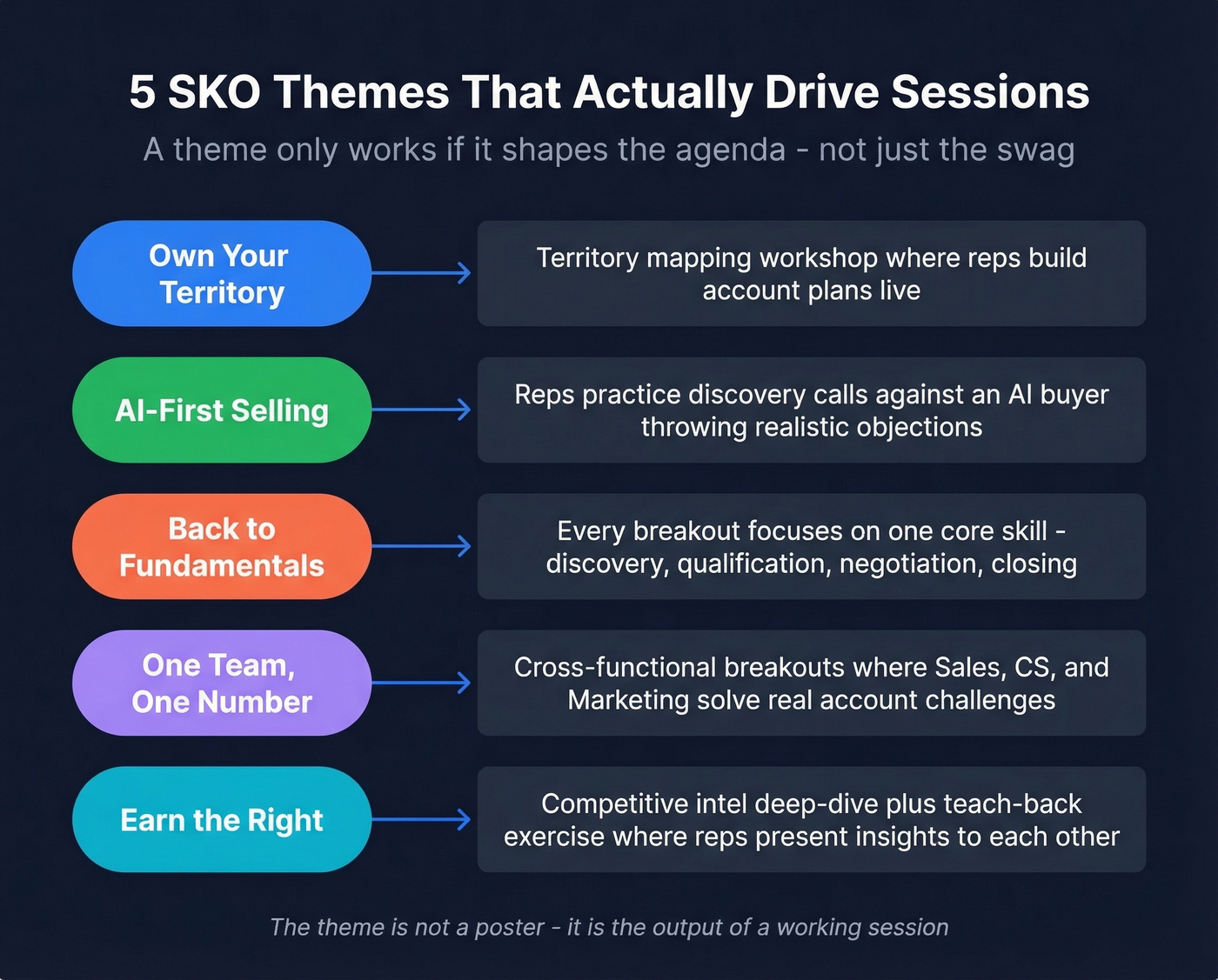
Own Your Territory. Pair this with a territory mapping workshop where reps build account plans live. The theme isn't a poster - it's the output of a working session.
AI-First Selling. Picture this: your reps practice discovery calls against an AI buyer that throws realistic objections in real time. Tools like Yoodli or Second Nature make this possible today. This theme works especially well if you're rolling out new AI tools post-SKO - it gives reps hands-on experience before they're expected to use them in live deals, and the practice sessions generate coaching data managers can reference for months afterward.
Back to Fundamentals. Best for teams that've drifted from core methodology. Structure every breakout around one fundamental skill: discovery, qualification, negotiation, closing. (If you need a refresher, use a tight set of sales prospecting techniques and updated talk tracks.)
One Team, One Number. Design cross-functional breakouts where mixed teams from Sales, CS, and Marketing solve real account challenges together. The theme only works if the sessions force genuine collaboration, not just proximity.
Earn the Right. A challenger-style theme focused on earning buyer trust through insight. Pair with a competitive intelligence deep-dive and a "teach-back" exercise where reps present insights to each other. (If you want a framework, build a repeatable competitive intelligence strategy.)
Team-Building That Doesn't Make People Cringe
Let's be honest - most team-building activities fail because they feel forced. These three work because they're competitive, fast, and genuinely funny, drawn from Salesforce's SKO research.
Rock Paper Scissors Extreme. Everyone pairs up. Losers become the winner's hype team, cheering them on in the next round. By the finals, two people are competing with 50-person hype squads behind them. Takes 10 minutes. The energy is electric.
Shark Tank Fail. Teams pitch the worst business ideas they can imagine. Judges award points for creativity and commitment to the bit. It loosens people up before serious sessions.
Flip the Tarp. A group stands on a tarp and has to flip it over without anyone stepping off. Forces communication, quick problem-solving, and a lot of laughing. Works best with teams of 8-12.
Running a Virtual or Hybrid SKO
With 12.7% of full-time employees fully remote and 28.2% hybrid - 40.9% total, per Gallup data cited by Herrmann - designing for remote parity isn't optional. It's the baseline. And the stakes are real: 60% of hybrid workers report feeling disconnected from company culture.
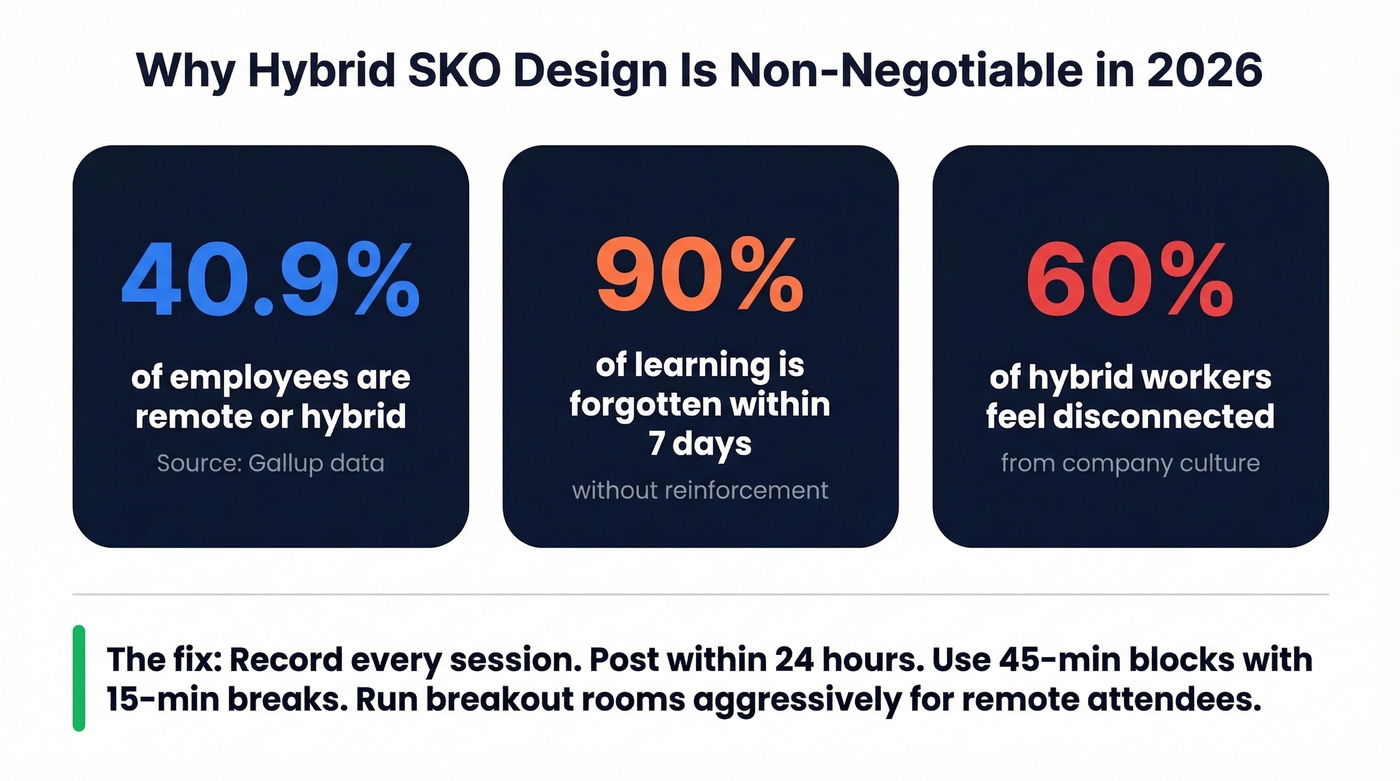
The biggest advantage of virtual components? Recording. Learners forget around 90% within 7 days. Recorded sessions become an on-demand library reps revisit during deal prep - not during a keynote.
For hybrid execution, keep these non-negotiables:
- Use breakout rooms aggressively. Don't let remote attendees sit in spectator mode.
- Digital whiteboards for collaboration. Miro and FigJam keep remote participants as active as the people in the room.
- Manage time zones. If your team spans more than 6 hours, run regional breakouts and keep full-group sessions in the overlap window.
- Consider "all join virtually." Even if half the team is co-located, having everyone join from a laptop levels the playing field.
Record everything and post sessions within 24 hours. The 45-minute blocks with 15-minute breaks aren't just a nice-to-have for virtual - they're non-negotiable for remote attention spans.
What Your SKO Actually Costs
SBI's benchmarks put the cost at $2,500-$5,500 per attendee based on 2021 data - expect around 20% higher in 2026 after inflation. For a mid-sized org, that looks like:
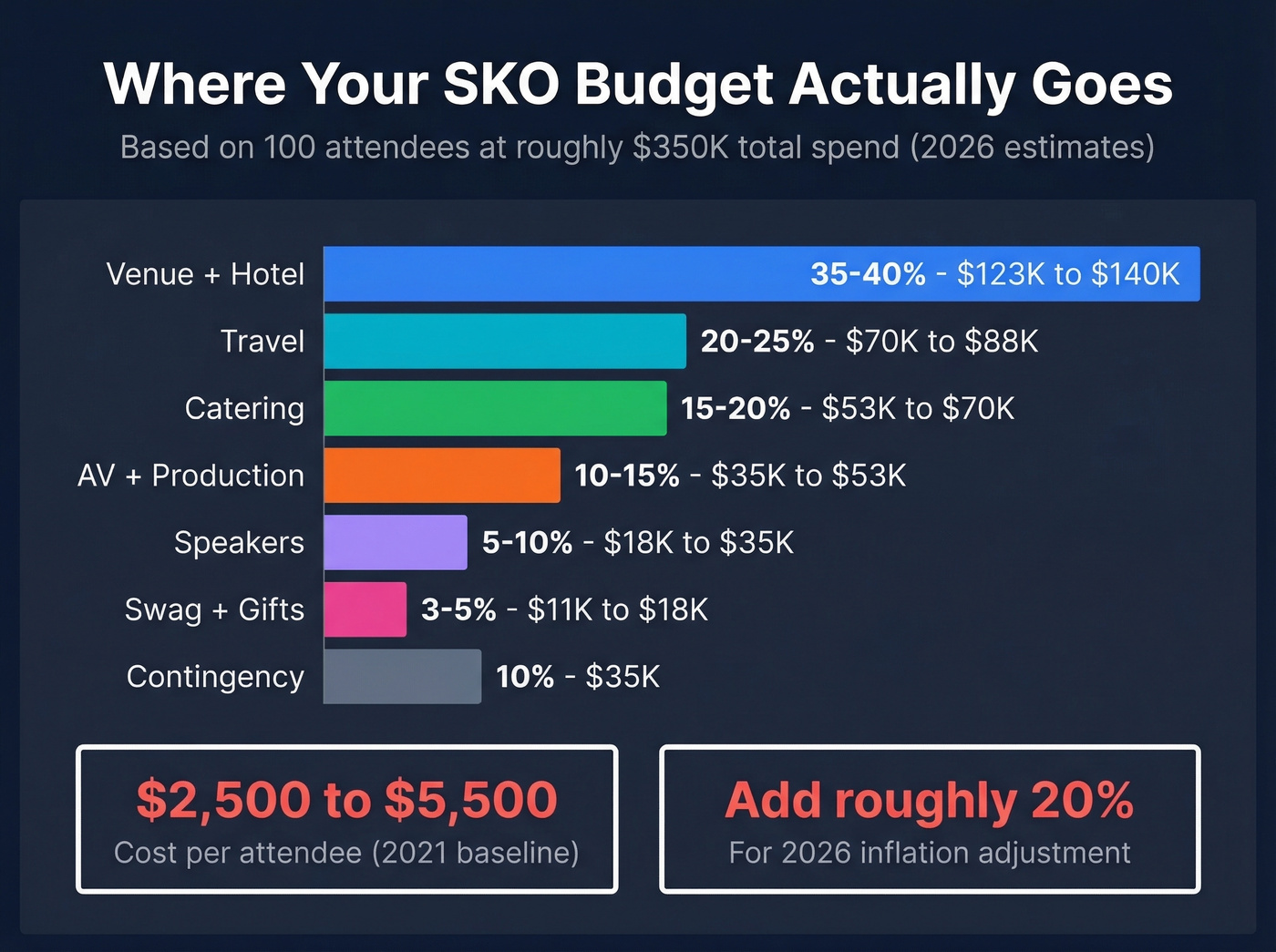
- 50 attendees: roughly $125K-$275K
- 100 attendees: roughly $270K-$640K
BoomPop's event data suggests adding a 10% contingency buffer.
| Category | % of Budget | For 100 attendees (~$350K) |
|---|---|---|
| Venue + hotel | 35-40% | $123K-$140K |
| Travel | 20-25% | $70K-$88K |
| Catering | 15-20% | $53K-$70K |
| AV + production | 10-15% | $35K-$53K |
| Speakers | 5-10% | $18K-$35K |
| Swag + gifts | 3-5% | $11K-$18K |
| Contingency | 10% | $35K |
Venue and travel are where budgets balloon. Virtual or hybrid formats cut those by around 30-50%, which is why more teams run a 1-day in-person event bookended by virtual sessions rather than a full 3-day offsite.
Skip the full in-person SKO if your average deal size is under $25K. Run a tight 1-day hybrid event, invest the savings in better post-SKO coaching, and you'll see more pipeline impact per dollar. I've watched teams blow $400K on an offsite and then have zero budget left for the reinforcement work that actually moves numbers.
The 90-Day Reinforcement Plan
It's February. SKO was three weeks ago. You pull up the CRM and nothing has changed. The new messaging framework is collecting dust. Every sales subreddit has the same post-SKO thread: "Great dinner, forgot everything else by Wednesday."
This is where most events die. Without structured reinforcement, your six-figure investment evaporates before Q1 pipeline reviews start.
Days 0-14: Inspiration to Clarity
Translate SKO messaging into specific, observable behaviors. "Use the new value prop" isn't a behavior. "Open every discovery call with the industry-specific pain statement" is.
Launch immediate AI roleplay practice on the 2-3 moments that matter - discovery, competitive differentiation, pricing objections. Managers hold 1:1s to review each rep's 90-day action plan from SKO. (If you want a clean structure, borrow from a 30-60-90 day plan for sales reps.)
Days 15-45: Build the Habit
Weekly practice scenarios tied to SKO themes - 15 minutes, async if needed. Manager coaching cadence: one observed call per rep per week with feedback tied to SKO frameworks.
Share wins publicly. When a rep uses the new messaging and it works, broadcast it. Nothing reinforces behavior like peer proof. Apply the Monday test retroactively at Day 45: if reps aren't using a framework in live deals, diagnose whether it's a skill gap or a relevance gap.
Days 46-90: Measure What Changed
Move beyond attendance and satisfaction scores. Track lead indicators like confidence and engagement, middle indicators like message fluency and empathy in observed calls, and lag indicators like conversion rate, deal velocity, and win rate. If adoption is low on a specific framework, fix it - don't just report it. This is where you prove the SKO's value to leadership with data, not anecdotes. (To make this measurable, align on pipeline health and a few core funnel metrics.)
Keep your data fresh post-SKO too. Territory plans built on verified contacts in January are only useful if those contacts stay current through Q1. Automate your enrichment cadence so reps aren't manually updating records when they should be selling.
The SKO is the least important part of your sales kick off. The 90 days after it are everything.
Your reps just spent two days building account plans and sharpening talk tracks. None of it matters if they can't reach the right people Monday morning. Prospeo gives them 300M+ verified profiles, 125M+ direct dials, and 30+ filters to find exactly who they need - at $0.01 per email.
Make Monday morning the moment your SKO actually pays off.
FAQ
How long should an SKO be?
Two to three days is the sweet spot. Anything shorter feels rushed; anything longer causes fatigue. A tight 2-day format with pre-work assigned 3-4 weeks beforehand maximizes in-person time and keeps energy high through the final session.
What's the average cost per attendee?
$2,500-$5,500 for in-person events, roughly 20% higher in 2026 after inflation. For 100 attendees, budget $270K-$640K all-in. Hybrid formats cut venue and travel costs by 30-50%.
How do you measure SKO success?
Track three tiers: lead indicators like rep confidence scores post-event, middle indicators like talk-track adoption in observed calls at Day 30, and lag indicators like conversion rate and win rate over the following quarter. If win rate doesn't move by Day 90, the reinforcement plan needs fixing.
Should our event be in-person or virtual?
A 1-day in-person core with virtual pre- and post-sessions gives the best ROI for most mid-market teams. Design for remote parity regardless - breakout rooms, digital whiteboards, and recorded sessions keep distributed reps fully engaged.
How do you prepare CRM data before the event?
Run a bulk enrichment pass 2-4 weeks out. With 98% email accuracy and an 83% enrichment match rate, reps build territory plans on contacts they can actually reach - not bounced addresses from six months ago.