

10 Sales Leadership Qualities That Actually Drive Revenue
You just got promoted. Yesterday you were the top closer on the floor, and today you're responsible for making sure eight other people hit their numbers. Nobody gave you a playbook for this.
Here's the uncomfortable truth: in Steve W. Martin's landmark HBR study, 69% of salespeople who exceeded quota rated their sales manager as excellent or above average. Even more striking, salespeople who rated their organization as excellent also rated their manager as excellent 56% of the time. Among those who rated their organization as merely average? That number dropped to 3%. Your sales leadership qualities aren't a nice-to-have. They're the single biggest variable in whether your team makes the number.
Meanwhile, 77% of organizations say they lack sufficient leadership depth, and trust in managers dropped from 46% to 29% between 2022 and 2024. According to Korn Ferry, only about 30% of leadership capability is innate - the other 70% is built through deliberate, challenging experience. Your best rep is rarely your best leader. So what actually separates leaders from closers? Let's get into it.
The 3 That Matter Most
If you're short on time, here's the thesis. The three qualities with the highest leverage are:
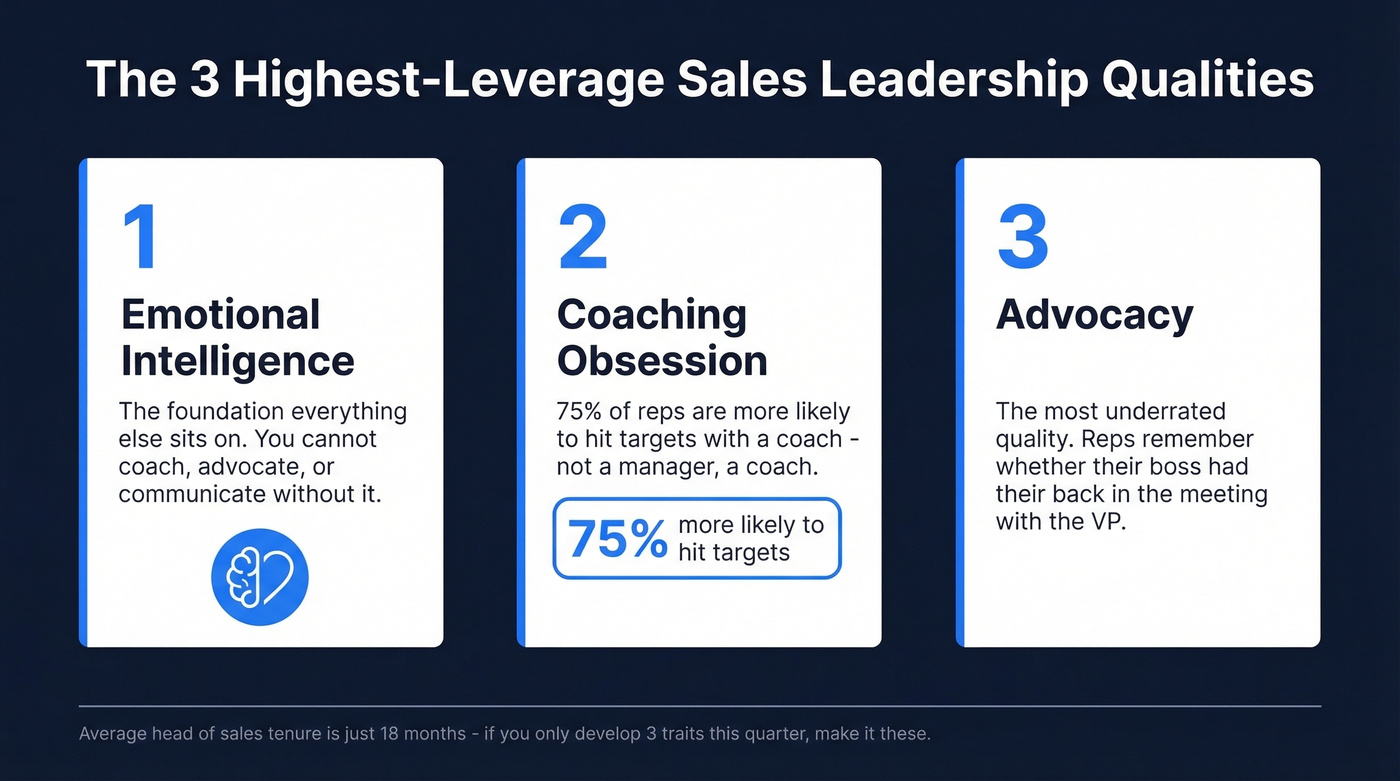
- Emotional intelligence - you can't coach, advocate, or communicate without it. It's the foundation everything else sits on.
- Coaching obsession - 75% of reps say they're more likely to hit targets when they have a coach or mentor. Not a manager. A coach.
- Advocacy - the most underrated quality on this list. Reps on Reddit don't talk about their leader's strategic vision. They talk about whether their boss had their back in a meeting with the VP.
The average tenure of a head of sales is roughly 18 months. That's barely enough time to build a culture, let alone transform one. If you only develop three traits this quarter, make it these.
Sales Leadership vs. Sales Management
Most companies use these terms interchangeably. They shouldn't.
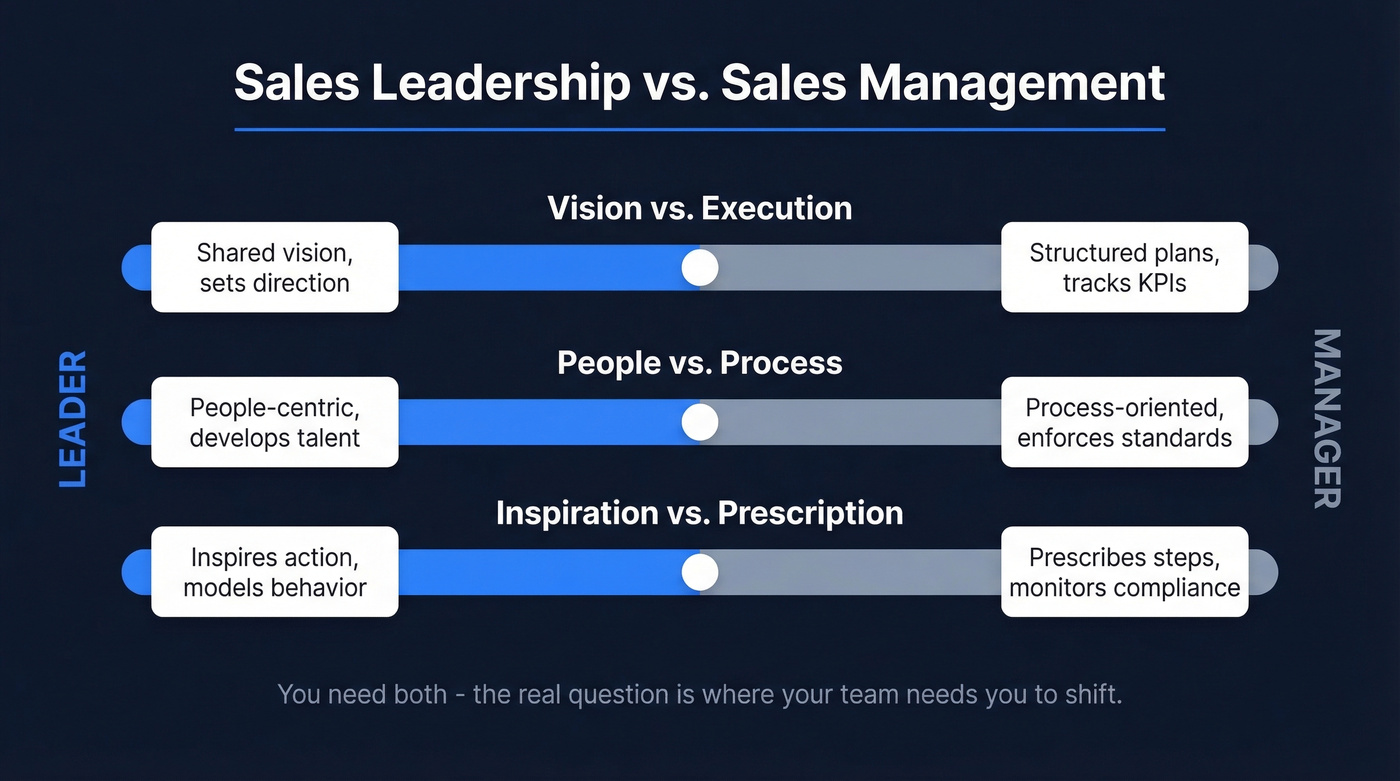
The distinction isn't semantic - it's operational, and confusing the two costs real revenue. That erosion isn't random. It's what happens when organizations promote top closers into leadership roles without developing them first.
Simon Hazeldine frames it well: "Management is about doing things right; leadership is about doing the right things." A manager ensures CRM hygiene, forecast accuracy, and process compliance. A leader sets the direction that makes those processes worth following. Federico Presicci's framework breaks this into three spectrums that work as a self-diagnostic:
| Spectrum | Leader Behavior | Manager Behavior |
|---|---|---|
| Vision vs. Execution | Shared vision, direction | Structured plans, KPIs |
| People vs. Process | People-centric, develops talent | Process-oriented, enforces standards |
| Inspiration vs. Prescription | Inspires action, models behavior | Prescribes steps, monitors compliance |
Neither side is wrong. You need both. But when organizations confuse the two - rewarding operational efficiency over visionary impact - three things happen. Short-termism takes over. Risk-avoidance becomes the culture. And your best people leave, because top performers don't tolerate micromanagement for long.
The real question isn't "am I a leader or a manager?" It's "where do I fall on each spectrum, and where does my team need me to shift?"
10 Qualities of a Great Sales Leader
1. Emotional Intelligence
Every other quality on this list depends on this one. Self-awareness, empathy, the ability to read a room - these aren't soft skills. They're the operating system.
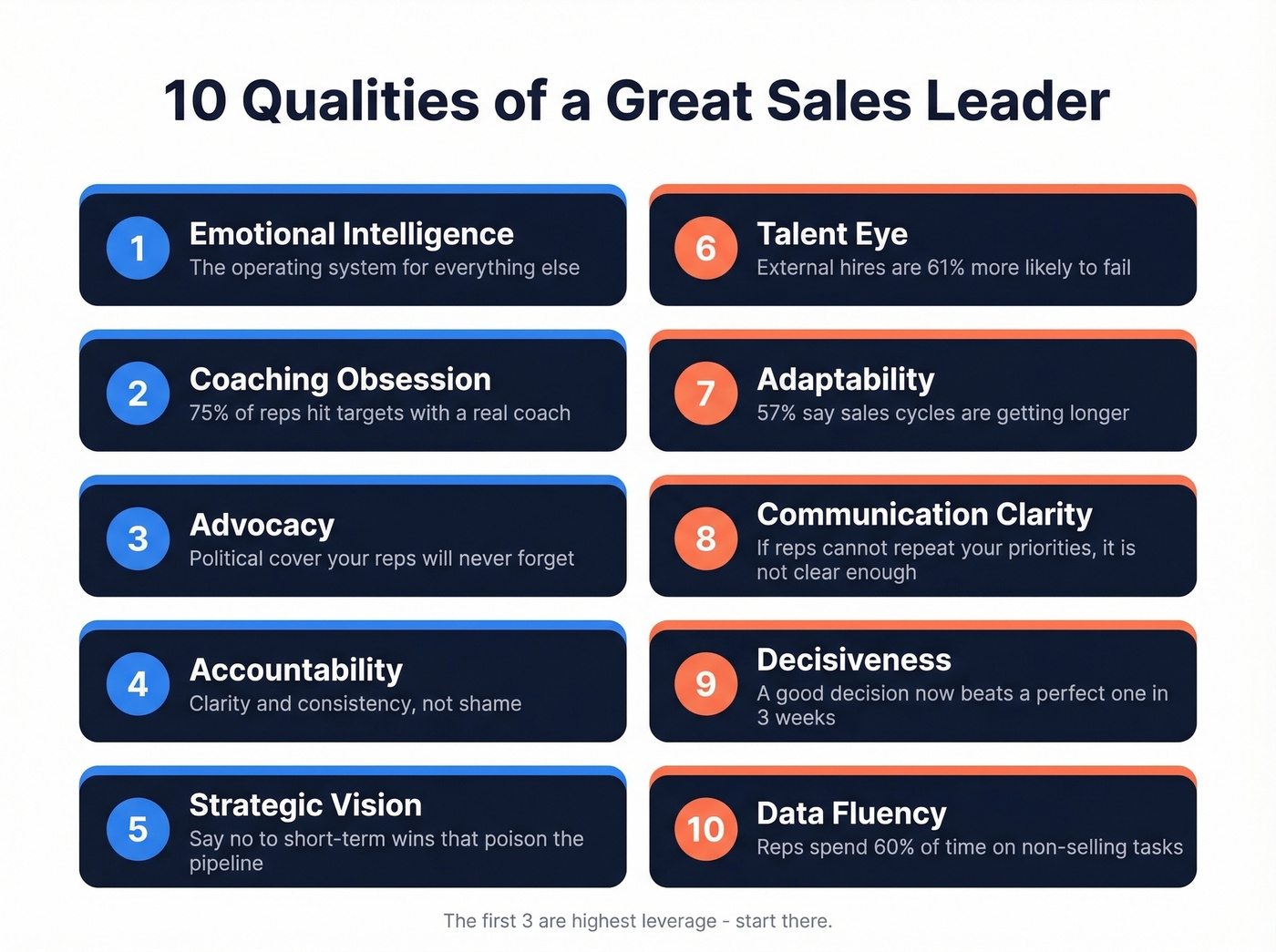
Reps on r/sales consistently describe their best managers as people who "feel what I'm about to dive into" before assigning work. That's empathy before delegation. Korn Ferry lists self-awareness as a core leadership characteristic for good reason: you can't coach someone through a slump if you don't recognize your own biases first. We've watched leaders with sky-high IQs and zero EQ burn through entire teams in a single quarter because they couldn't tell the difference between a rep who needed encouragement and one who needed space.
2. Coaching Obsession
There's a difference between ad-hoc feedback and structured coaching. The first is reactive - you notice a blown demo and offer a tip. The second is systematic: weekly 1:1s with call reviews, skill development plans, and deliberate practice.
75% of reps say coaching makes them more likely to hit targets. Yet most leaders spend their coaching time buried in forecasting spreadsheets instead. Coaching is the single highest-leverage activity available to a sales leader, and it's the one most consistently neglected. The best coaches don't just teach. They learn alongside their reps, adjusting their approach based on what each person actually needs rather than running the same playbook for everyone.
3. Advocacy
When reps describe their best boss, they don't talk about strategy decks. They talk about political cover.
"Have my back politically" is one of the most common phrases in r/sales threads about great managers. Advocacy means protecting your team from internal distractions, shielding them from unqualified "advice" from other departments, and fighting for resources in leadership meetings. It's the most underrated quality on this list, and the one reps remember longest. Skip this if you think leadership is about looking good to the C-suite - it's about making your team look good to everyone else.
4. Accountability
Clear goals. Consistent follow-up. No shifting expectations mid-quarter.
Accountability isn't about being harsh - it's about being predictable. When a leader changes the goalposts or goes soft on follow-through, the entire team recalibrates downward. Some consultants advocate public performance rankings as "radical transparency." Let's be honest: that's not transparency. It's humiliation. Accountability works through clarity and consistency, not shame. The real anti-pattern is rewarding activity over outcomes - a leader who celebrates 200 dials but ignores a 2% connect rate is optimizing the wrong metric.
5. Strategic Vision
The pressure to think quarter-to-quarter is intense, and it's exactly the wrong instinct. Strategic vision means knowing which deals, segments, and motions will compound over 12 months, even when this quarter's number is screaming at you.
High-performing leaders build durable revenue engines because they're willing to sacrifice a short-term win for a long-term position. In our experience, the leaders who consistently hit annual targets are the ones who said no to a few deals in Q1 that would've juiced the short-term number but poisoned the pipeline for Q3 and Q4.
6. Talent Eye
Here's a stat that should terrify every hiring manager: external hires are 61% more likely to fail within 18 months than internal promotions.
Assessment scores can mislead. We've seen leaders hire based on personality profiles and structured interview rubrics, only to miss the candidate who'd actually thrive in their specific selling environment. Great leaders develop probing questions that reveal coachability and resilience - not just polished interview performance. Hiring is the one decision that multiplies or divides everything else you do, and most leaders still treat it like a checkbox exercise instead of the highest-stakes bet they'll make all year.
7. Adaptability
57% of sales professionals say their sales cycle is getting longer. Territories get redrawn overnight. Products pivot mid-quarter.
Leaders who need certainty before acting will always be a step behind. The best ones treat uncertainty as the default operating condition and build teams that can flex without breaking. I once watched a VP restructure territories three times in six months - the teams that survived weren't the ones with the best reps, but the ones whose leader framed each change as an opportunity rather than a crisis.
8. Communication Clarity
Reps want their leader to "sell me on the tasks" - give context, purpose, and a clear scope with a time limit. Not just orders.
Communication clarity means defining what done looks like, why it matters, and when it's due. It also means asking for feedback without losing confidence. That balance is harder than it sounds, and it's one of the most overlooked skills to develop. If your team can't explain your priorities back to you in one sentence, your communication isn't clear enough.
9. Decisiveness
Waiting until end-of-quarter to make calls. Letting deal slippage surprise you. Avoiding hard conversations until they become crises. This is what reactive leadership looks like, and it's one of the most common failure modes in sales organizations.
Decisive leaders make calls with incomplete data because they understand that a good decision now beats a perfect decision in three weeks. The cost of indecision is measured in lost pipeline and eroded trust.
10. Data Fluency
Sales reps spend 60% of their time on non-selling tasks. A data-fluent leader decides whether the tech stack helps or hurts.
Pipeline hygiene, CRM accuracy, lead quality - these are leadership responsibilities, not rep problems. A leader who gives their team unverified contact lists is setting them up to fail. Tools like Prospeo verify emails in real time with 98% accuracy and refresh data every 7 days, so reps spend time selling instead of cleaning spreadsheets. Data fluency isn't about being a Salesforce admin. It's about building systems that keep the numbers clean so your team can focus on what they were hired to do.


You can't coach reps through a slump when they're burning hours on bad contact data. Prospeo gives your team 300M+ verified profiles, 98% email accuracy, and 125M+ direct dials - so your reps spend time selling, not list-building.
Leaders who invest in data quality see 26% more meetings booked.
What Reps Actually Want
Most sales leadership advice reads like a motivational poster. Reps don't think in frameworks. They think in moments - the moment their manager threw them under the bus in a forecast call, or the moment their leader stepped in and said "that's on me, we'll fix it."
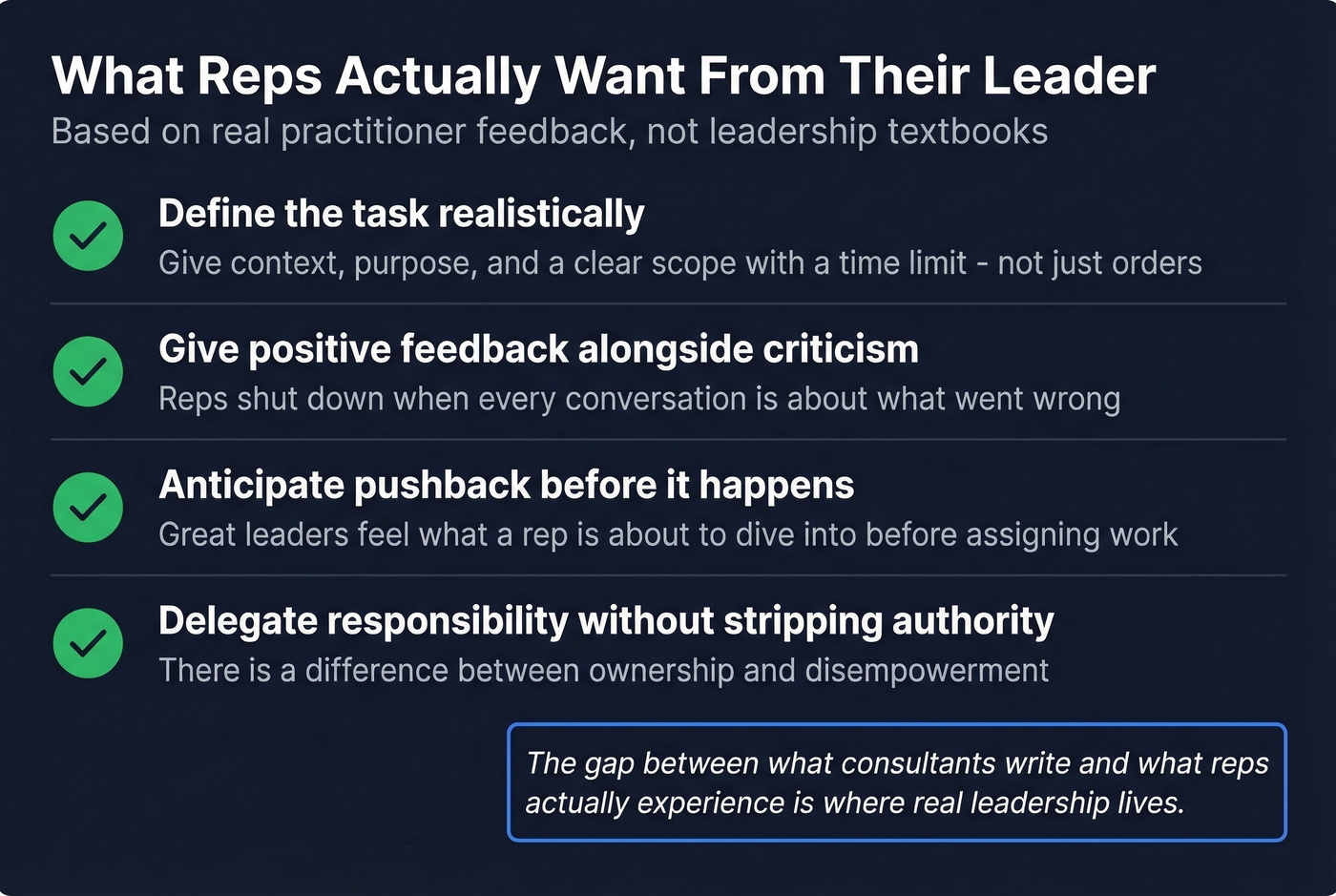
The r/sales consensus is remarkably consistent. Reps want someone who defines the task realistically, gives positive feedback alongside criticism, anticipates pushback before it happens, and delegates responsibility without stripping authority. That last one - "delegate responsibility but not authority" - is a direct quote from a practitioner thread, and it captures something leadership books almost never address: the difference between ownership and disempowerment.
The gap between what consultants write about leadership and what reps actually experience is enormous. Reps don't care about your "shared vision" if you can't protect them from a product team that keeps changing the demo environment. They don't care about your "strategic focus" if you can't tell them honestly whether a deal is worth pursuing. The 10 qualities above matter, but only when they show up in daily behavior, not quarterly offsites.
Habits That Prevent Common Mistakes
Assuming Everyone Sells Like You
The promotion bias is real. You got promoted because you were great at selling, and now you assume everyone should sell the way you did. They shouldn't. Different reps have different strengths, different communication styles, different motivational triggers. This mistake violates both emotional intelligence and coaching - you can't develop someone if you're measuring them against a mirror.
Weak Pipeline Discipline
Stale deals sitting in stage 3 for 90 days. No documented next steps. Forecasting on hope instead of evidence.
This is the most common operational failure we see in sales orgs, and it's a leadership problem, not a rep problem. Proactive leaders set up verified data pipelines from day one - enrichment APIs, real-time verification tools, whatever keeps the list clean. They also enforce deal hygiene weekly, not quarterly.
If you want a tighter operating rhythm, start with pipeline discipline and a consistent sales process.
No Political Cover
Failing to protect your team from internal distractions - non-sales projects, unqualified advice from marketing, executive drive-bys that derail a rep's week - is a leadership failure. Reps notice immediately when their manager won't advocate for them. And they start updating their resume shortly after.
Reactive Leadership
End-of-quarter desperation. Forecast surprises. Suddenly caring about coaching when the number's at risk.
Reactive leadership is the opposite of strategic vision and decisiveness. It means you don't have a coaching rhythm, you don't have a pipeline review cadence, and you're managing by crisis instead of by system. If this sounds familiar, the fix isn't complicated - it's just uncomfortable. Block the time. Run the cadences. Do it when things are going well, not just when they're falling apart.
Managing From Behind a Computer
Insufficient field time, no live coaching, no ride-alongs, no joint calls. If you're spending your days in dashboards and Slack threads instead of alongside your sellers, you're managing - not leading. The best leaders time-block coaching and rep shadowing the way they time-block forecast reviews.
Proof It Works
A Fortune 500 communications division was ranked 9th out of its peer group. After an intervention focused entirely on leadership clarity, team communication, and leader behavior - no changes to the sales playbook, product, territory, or people - the division moved to 1st. They reported a $1.6M year-over-year revenue increase in 8 months. The only variable that changed was how the leader showed up.
At ECC, a company with solid 10-12% annual sales growth was leaking margin. After implementing a documented sales process, a coaching system, and margin discipline standards - all leadership-driven changes - margins on sold work increased by nearly 5%. They're now tracking 102% of gross profit quota.
Here's the thing: most sales teams don't have a talent problem or a product problem. They have a leadership system problem. Fix the leader, and the numbers follow.
How to Build These Qualities This Quarter
You don't need a $50k executive coaching engagement to start. Here's a week-one action plan.
Set your cadences. Weekly 1:1s with every rep, 30 minutes, non-negotiable. Weekly pipeline reviews with documented next steps. Monthly coaching blocks where you shadow calls and give structured feedback. These aren't optional - they're the operating system.
If you want a simple structure for the first month, borrow a 30-60-90 day plan and adapt it for managers.
Run the self-diagnostic. Where do you fall on each of the three spectrums - vision vs. execution, people vs. process, inspiration vs. prescription? Be honest. Ask your team where they'd place you. The gap between your self-assessment and theirs is where the development opportunity lives.
Audit your team's data stack. What's your bounce rate on outbound sequences? When was the last time your contact data was refreshed? If you don't know, that's the first problem to solve. Organizations that invest in leadership development see 25% better business outcomes, and the fastest win is often giving your team clean, verified data so they can actually sell instead of scrubbing spreadsheets.
To go deeper, use an email bounce rate benchmark and a practical email deliverability checklist, then evaluate data enrichment services if your lists are thin.
70% of leadership capability is developed, not born. The sales leadership qualities on this list aren't personality traits you either have or don't. They're behaviors you can practice, measure, and improve - starting this week. Pick one quality, build one new habit around it, and watch what happens to your team's number in 90 days.
If you want to systematize the day-to-day, standardize your sales activities and tighten your sales communication.
Accountability starts with giving reps every advantage. Teams using Prospeo cut bounce rates from 35% to under 4% and tripled pipeline - because leadership means removing obstacles, not adding them.
Stop asking reps to hit quota with broken data. Start leading.
FAQ
What's the difference between a sales leader and a sales manager?
Leadership focuses on vision, people development, and inspiration; management focuses on execution, process compliance, and operational rigor. The Presicci framework maps three spectrums: vision vs. execution, people vs. process, and inspiration vs. prescription. Effective leaders operate across both sides depending on what their team needs in the moment.
Can sales leadership qualities be learned?
Yes. Korn Ferry's research shows roughly 30% of leadership capability is innate and 70% is developed through challenging experiences and deliberate practice. Structured development like coaching rhythms, self-assessment, and real-time feedback consistently outperforms relying on natural talent alone.
What's the most important quality in a sales leader?
Emotional intelligence. Every other quality - coaching, advocacy, communication, adaptability - depends on your ability to read people and manage your own reactions. Without EQ, coaching becomes lecturing, advocacy becomes politics, and communication becomes orders.
How do you give a sales team clean data without adding rep workload?
Audit your data stack quarterly and measure bounce rate as a leadership KPI - anything above 5% is a red flag. Tools like Prospeo verify emails at 98% accuracy on a 7-day refresh cycle, so reps sell instead of scrubbing spreadsheets. Clean data is a leadership decision, not a rep responsibility.