

The Sales Manager Coaching Playbook: Frameworks, Templates, and Tools for 2026
Sales manager coaching is the highest-leverage activity most revenue orgs neglect. Companies spend $10B+ a year on sales training and somehow skip the people delivering it - 57% of sales managers receive no formal management training before they're expected to develop a team. Quota attainment has cratered from 53% in 2012 to just 16% by 2024. Seller turnover sits around 35%, and replacing a single rep costs roughly $195K when you factor in recruiting, ramp, and lost pipeline.
Something's broken, and it isn't the reps.
Here's the hot take: most sales managers don't need more tools or dashboards. They need 30 protected minutes per rep per week and a framework that doesn't suck. Organizations with structured coaching programs see 91% higher quota attainment. The ROI is there. The execution isn't.
The Three Things That Actually Matter
If you only take three things from this article:
- Use the PAUSE framework for coaching conversations - not just "ask open-ended questions." It gives you a repeatable structure that ends with behavior change, not a nice chat.
- Replace pipeline interrogation 1:1s with the 10/10/10 template - 10 minutes metrics, 10 minutes skill development, 10 minutes human. Your reps will stop dreading Mondays.
- Diagnose root causes before prescribing fixes. Not every missed number is a skills gap. Sometimes it's calendar management. Sometimes it's emotional regulation. Slow down and ask before you coach.
From Manager to Coach
Here's the distinction that trips up every new manager: managers run operations, coaches develop sellers. You need to be both, but most people default to the first one because it feels productive. Checking pipeline, reviewing forecasts, running team meetings - that's management. Sitting with a rep and helping them figure out why they keep discounting too early - that's coaching. SBI draws this line clearly: the manager role optimizes current performance, the coach role builds future capability.
65% of organizations don't even evaluate coaching skills when hiring sales managers. They promote the best closer and hope for the best.
Investing in manager enablement - giving frontline leaders the training, frameworks, and practice they need - closes this gap before it becomes a retention problem. If you're a newly promoted manager, here are the behavioral shifts that matter:
- Ask, don't tell. Your instinct is to solve the problem. Resist it. Ask the rep what they'd do differently first.
- Listen at an 80/20 ratio. You should be talking 20% of the time, max. If you're doing more, you're managing, not coaching.
- Carve non-negotiable coaching time. Gartner found managers spend less than 10% of their time actively coaching. Block it on your calendar like a customer meeting.
- Separate coaching from inspection. Your forecast review isn't a coaching session. Stop pretending it is.
The State of Sales Coaching 2025 survey found that 43% of leaders are unaware their reps want more coaching. Meanwhile, 94% of reps say coaching improves their performance. The demand is there. You just have to show up differently.
Two Frameworks That Actually Work
The PAUSE Framework for Weekly Coaching
This is the one we recommend for sales-specific coaching. It comes from Challenger, and it's better than GROW for one reason: it starts with preparation and ends with behavior embedding. GROW ends with "will" - basically, "so are you gonna do it?" PAUSE builds the accountability loop into the structure.
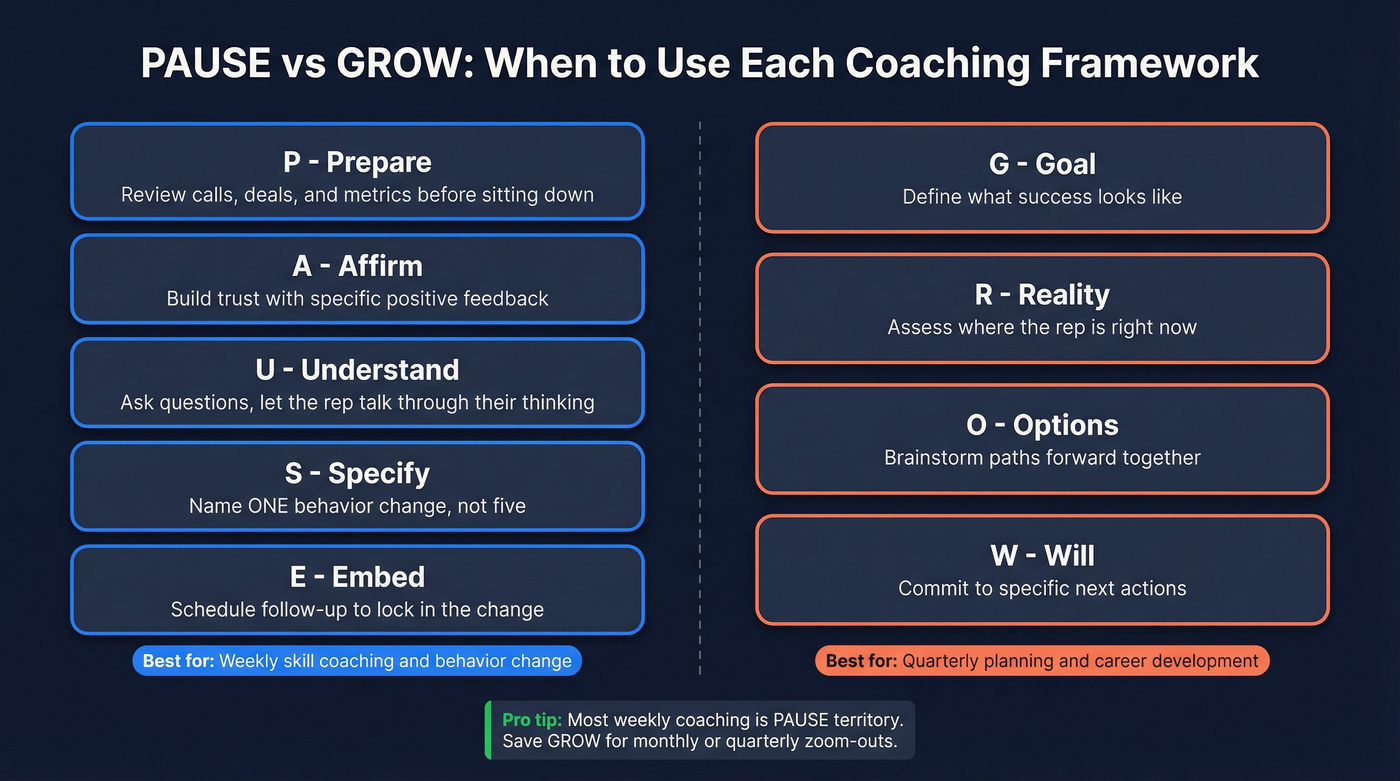
While it's technically five steps, adding a pre-step of scheduling dedicated coaching time gives you a complete six-step process any frontline leader can follow consistently.
Prepare: Review the rep's recent calls, deals, or metrics before the conversation. Walking in cold is a waste of everyone's time. Know what you're coaching on before you sit down - pull up the specific call recording, the deal that stalled, the email that got no reply.
Affirm: Build trust first. "Your discovery questions on that Acme call were sharp - you got the budget conversation in the first 10 minutes." This isn't flattery. It's creating psychological safety so the rep can hear the hard stuff.
For the Understand step, flip the script - lead with curiosity instead of your interpretation. "Walk me through your thinking when you offered the discount at minute 22." Let them talk. You'll learn more about their decision-making in two minutes of silence than in ten minutes of lecturing.
Specify: Name the behavior change clearly. One thing, not five. "Next call, I want you to hold pricing until the prospect brings it up. Let's practice that." Overloading kills retention.
Embed: This is where most coaching falls apart. Tie the change to a longer-term goal and schedule a follow-up. "We'll review your next three calls together next Thursday." Without this step, the coaching evaporates by Friday. The embed step is what separates a conversation from a development program.
The GROW Model
GROW (Goal, Reality, Options, Will) is the classic. It works best for goal-setting conversations - quarterly planning, career development, "where do you want to be in 12 months" discussions. Define the goal, assess current reality, brainstorm options, commit to action.
Use GROW when the conversation is about direction. Use PAUSE when it's about changing a specific behavior. Most weekly coaching falls into the PAUSE bucket. GROW is better for monthly or quarterly sit-downs where you're zooming out.
The 10/10/10 Weekly 1:1 Template
The most common failure mode for sales 1:1s? They become pipeline interrogation. Manager opens CRM, scrolls through deals, asks "what's happening with Acme?" for 30 minutes. Rep leaves feeling audited, not developed. Both people dread it.
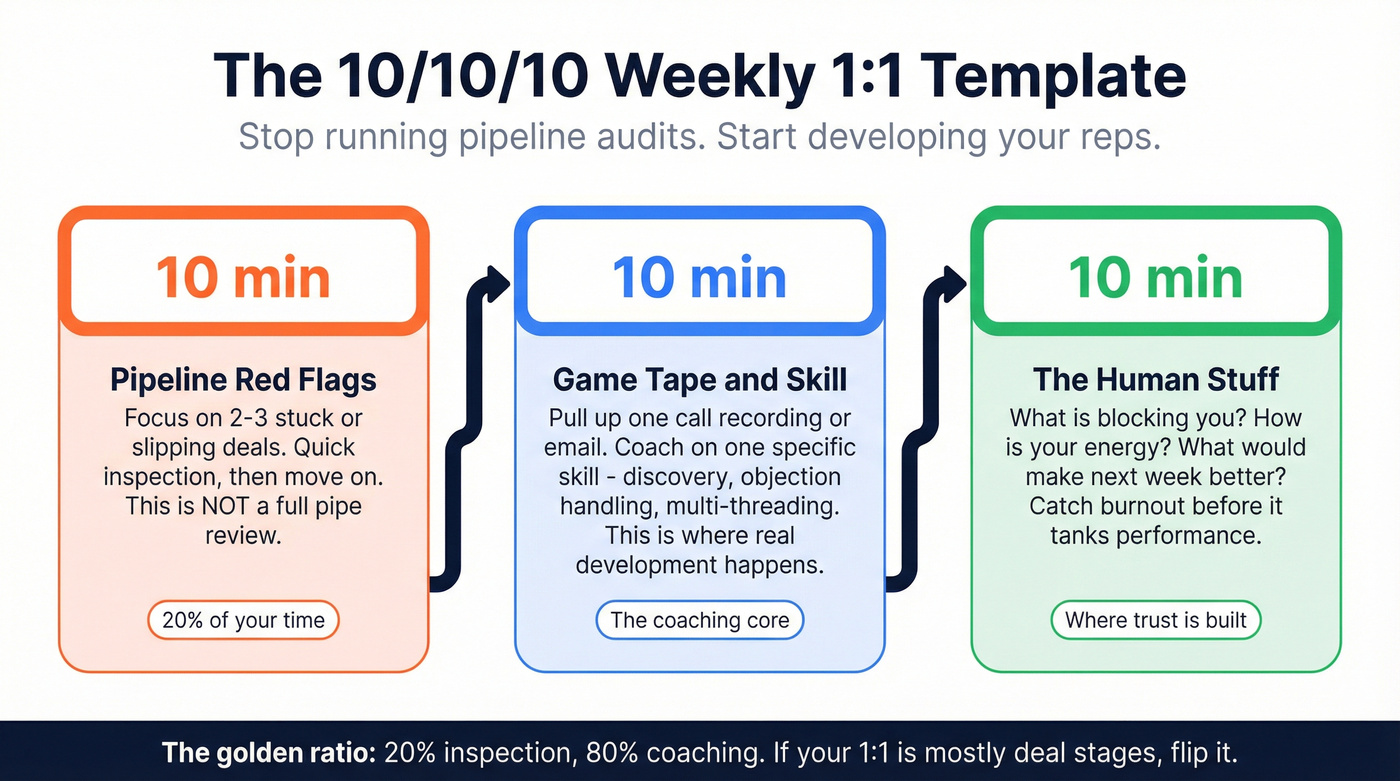
The fix is the 10/10/10 template. Thirty minutes, three blocks:
First 10 minutes - Pipeline red flags. Not a full pipe review. Focus on the 2-3 deals that are stuck, slipping, or missing key stakeholders. Quick inspection, then move on. (If you want a tighter way to track this, borrow a few ideas from pipeline health scorecards.)
Middle 10 minutes - Game tape and skill. Pull up one call recording or email thread. Coach on one specific skill - discovery depth, objection handling, multi-threading, whatever the rep needs most right now. This is where the real development happens, and it's where structured coaching pays off most visibly. If your reps struggle here, keep a short library of discovery questions and prompts to practice.
Last 10 minutes - The human stuff. What's blocking you? What do you need from me? How's your energy? This is where you catch burnout, frustration, or personal issues before they tank performance. One r/sales practitioner noted that simply asking "what would make next week better than this one?" consistently surfaced issues reps wouldn't volunteer otherwise. (This also ties directly to resilience in sales when the quarter gets ugly.)
The rule of thumb: 20% inspection, 80% coaching. If your 1:1 is mostly you asking about deal stages, flip the ratio.
Five questions worth keeping in your back pocket:
- What's your biggest forecast risk this week?
- Which deal is missing a decision-maker you haven't reached?
- If you could replay one conversation from this week, which one?
- What's the one thing slowing you down that I could remove?
- Where did you surprise yourself this week?
You might also ask what skill they want to sharpen this month, or what they'd do differently on their last call if they ran it again. The goal is getting reps to self-diagnose - not feeding them answers.

Coaching reps on multi-threading and stakeholder access only works if they can actually reach decision-makers. Prospeo gives your team 300M+ verified contacts with 98% email accuracy and 125M+ direct dials - so the skills you coach on translate to booked meetings, not bounced emails.
Stop coaching reps on deals they can't reach. Fix the data first.
Common Coaching Mistakes
Coaching the Symptom, Not the Cause
A rep discounts too early. The instinct is to coach negotiation tactics. But the root cause might be emotional - they can't handle the tension of a strong negotiator pushing back, so they cave. The fix isn't a negotiation playbook. It's emotion management coaching. (If you want a clean way to teach this, the concept of an anchor in negotiation is a useful starting point.)
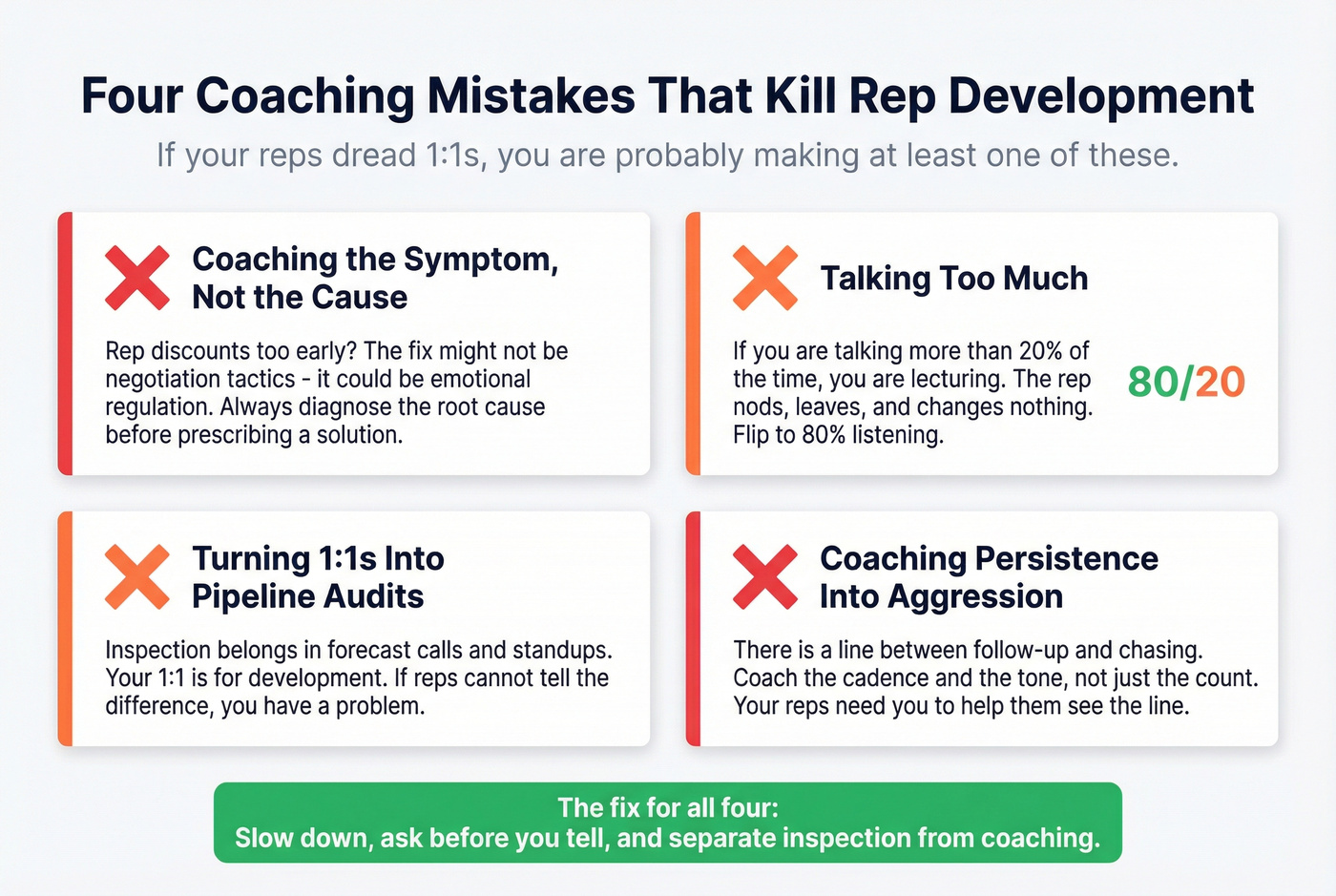
Another example: a rep misses activity targets. You assume motivation. But their calendar is a disaster - back-to-back internal meetings, no protected call blocks. The fix is time management, not a pep talk. Diagnose before you prescribe. (This is also where better sales activities examples can help you define what “good” looks like.)
Talking Too Much
Every new manager struggles with this. One manager on r/sales described it perfectly: they felt like they were "doing the thinking for them" instead of guiding reps to self-diagnose. If you're talking more than 20% of the time in a coaching conversation, you're lecturing. The rep nods, leaves, and changes nothing.
Turning 1:1s Into Pipeline Audits
Inspection has its place - in your forecast call, in your Monday standup. Your 1:1 is for development. If a rep can't tell the difference between their coaching session and their pipeline review, you've got a problem. If your team is constantly stuck here, it’s usually a sign of bigger sales pipeline challenges.
Coaching Persistence Into Aggression
A Reddit thread captured this well: a rep followed their manager's instruction to "salvage" a lost deal and called the prospect multiple times in one day. The prospect said they felt "chased." There's a line between persistence and aggression, and your reps need you to help them see it. Coach the follow-up cadence, not just the follow-up count. Keeping a few sales follow-up templates on hand makes this easier to standardize.
Coaching Different Rep Profiles
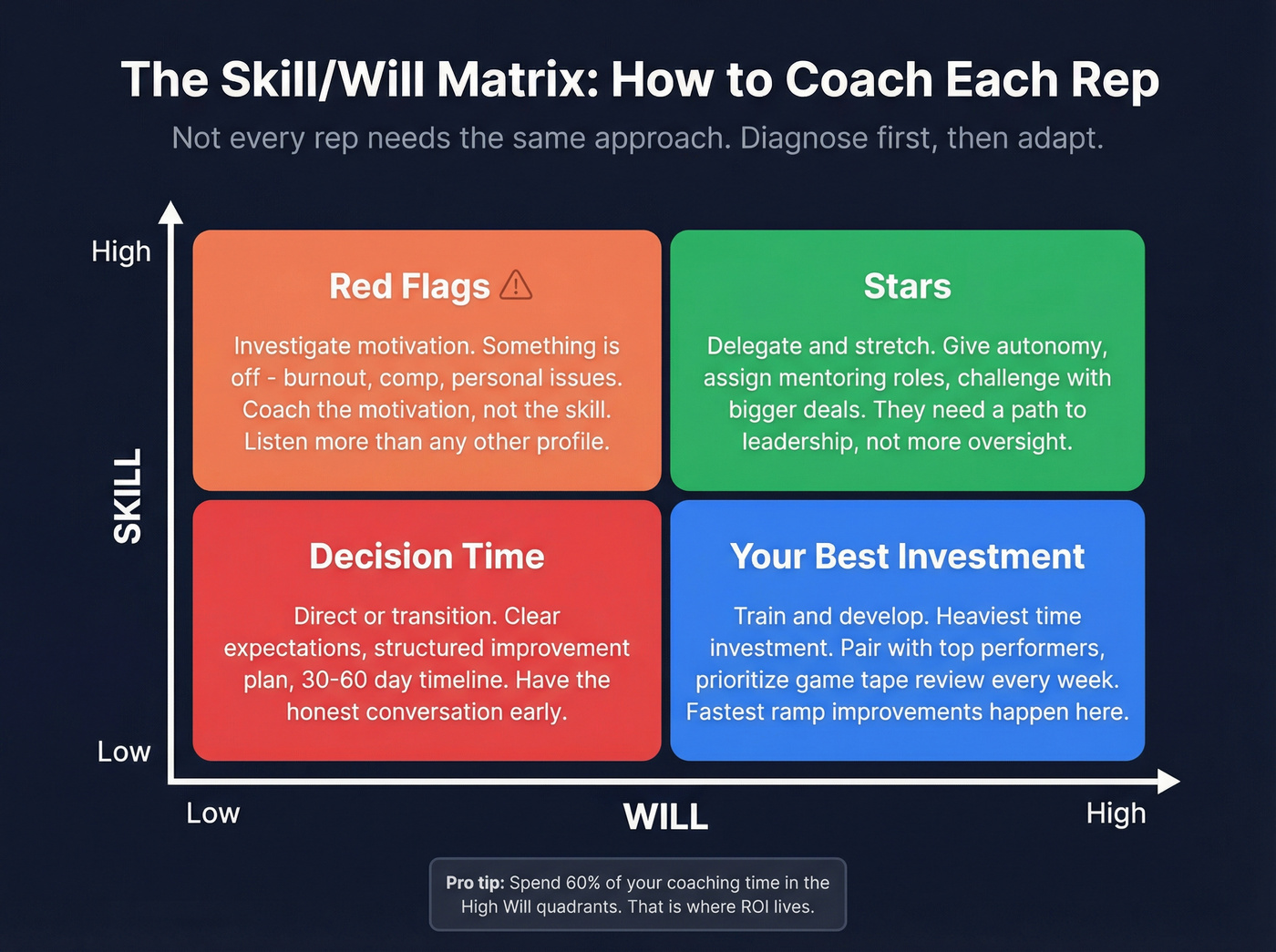
Not every rep needs the same coaching. The skill/will matrix gives you a quick diagnostic, and adapting your approach to each quadrant is one of the most important management techniques to master:
| High Will | Low Will | |
|---|---|---|
| High Skill | Delegate & stretch | Investigate motivation |
| Low Skill | Train & develop | Direct or transition |
High skill, high will reps don't need weekly call reviews. Give them autonomy, assign mentoring roles, challenge them with bigger deals. They need a path to leadership, not more oversight. (This is where broader sales leadership habits matter more than tactics.)
High skill, low will is your red flag quadrant. Something's off - burnout, comp frustration, personal issues. Coach the motivation, not the skill. These conversations require more listening than any other profile.
Low skill, high will reps deserve your heaviest time investment. They want it and they'll absorb it. Pair them with your top performers for ride-alongs and prioritize game tape review in every 1:1. We've seen this quadrant produce the fastest ramp improvements when managers commit to consistent weekly sessions with the PAUSE framework. If you’re onboarding new hires, align coaching to a simple 30-60-90 day plan for sales reps.
For low skill, low will reps, you need directness. Clear expectations, a structured improvement plan, and a defined timeline. If no progress materializes after 30-60 days, it's probably not a fit. Skip the extended hand-holding and have the honest conversation early.
AI Tools for Sales Coaching in 2026
AI coaching tools have matured fast. Teams that implement them well see 20-25% improvement in rep proficiency and 15% faster ramp, with win rates improving by up to 32%. Coaching within 24 hours of a call makes reps 2.5x more likely to improve - and AI tools make that timeline realistic even when you're managing 8-10 reps. HubSpot estimates AI tools save sales pros up to 2 hours per day, time you can reinvest in actual coaching.
| Tool | Best For | Starting Price |
|---|---|---|
| Gong | Enterprise conversation intel | ~$1,200-$1,600/user/yr |
| Chorus (ZoomInfo) | Post-call analysis | ~$100-$150/user/mo |
| Highspot | Enablement + coaching | ~$50-$80/user/mo |
| Salesloft | Teams already on Salesloft | ~$100-$150/user/mo |
| Outreach | Teams already on Outreach | ~$100-$150/user/mo |
| Cirrus Insight | Budget, Salesforce-centric | ~$14-$21/user/mo |
| Hyperbound | AI roleplay & skill dev | From ~$40/user/mo |
Our take: Gong is the gold standard if you're enterprise and can stomach the platform fee. Highspot is the best single-platform play if you need enablement and coaching in one place. If you're already paying for Salesloft or Outreach, use their built-in conversation intelligence before adding another tool - one Salesloft case study showed teams targeting 25% improvement actually hit 31%.
For smaller teams, Hyperbound's AI roleplay is genuinely good for skill development without needing a library of real call recordings. And for teams focused on outbound call volume, dialer-centric platforms like Nooks and Orum now include monitoring and coaching workflows worth evaluating if your reps spend most of their day on the phone. (If you’re rebuilding your stack, start with a shortlist of SDR tools so coaching and workflow match.)
Let's be honest about something most coaching playbooks miss: frameworks only work when reps have enough live conversations to coach on. If your contact data is stale, 1:1s become therapy sessions about pipeline frustration instead of skill development. In our experience, the teams that get the most from coaching invest in data quality first - Prospeo verifies emails at 98% accuracy on a 7-day refresh cycle, so reps walk into call blocks with contacts that actually connect. (If you’re evaluating vendors, compare data enrichment services and workflows before you buy.)
Measuring Coaching Effectiveness
You can't improve what you don't measure, but most managers only track the obvious stuff. Sales training delivers $4.53 for every $1 spent - a 353% ROI - but only if you're measuring the right things.
Performance metrics tell you coaching worked after the fact: quota attainment, win rate, average deal size, ramp time for new hires. These are lagging indicators.
Observational metrics are your leading indicators. Are your coaching questions getting sharper? Can reps self-diagnose problems without you pointing them out? Are they bringing specific call moments to 1:1s instead of generic "it went well" updates? When reps start coaching themselves, you're winning.
Culture metrics reveal the compounding effect: eNPS scores, rep attrition rate, percentage of reps hitting target vs. team average. Companies with effective coaching see 19% higher sales toward goal. If your team's spread between top and bottom performers is narrowing, your coaching is working. And remember the cost of failure - at 35% annual turnover and $195K per replacement, every rep you retain through better development drops straight to the bottom line.
One underrated metric: contact rate. If reps aren't connecting with prospects, you're coaching on hypothetical conversations. Tools like Prospeo surface verified direct dials and emails so you're measuring real conversations, not voicemails.
That 10/10/10 middle block - game tape and skill coaching - falls apart when reps spend hours hunting for contact data instead of selling. Prospeo's Chrome extension lets reps find verified emails and mobiles in one click, cutting list-building from 15 hours to under 3 per week.
Give your reps selling time back so your coaching actually compounds.
FAQ
How often should managers coach each rep?
Weekly 30-minute 1:1s plus async call review is the baseline. Add monthly skill sessions and quarterly process training. Consistency beats duration - 30 reliable minutes weekly outperforms occasional deep dives that get canceled when forecasting heats up.
What's the difference between coaching and training?
Training teaches new skills in group settings. Coaching applies those skills to individual reps' real deals through 1:1 feedback and guided self-diagnosis. You need both, but coaching is where behavior actually changes - it's personalized, ongoing, and tied to live pipeline.
How do you coach a rep who resists feedback?
Start with the Affirm step from PAUSE - build trust before prescribing change. Ask what they'd do differently before offering your view. Resistant reps usually had bad coaching experiences before you. Pushing harder makes it worse; earning trust first makes everything else easier.
What's the biggest mistake new managers make?
Talking too much. New managers solve problems for reps instead of asking questions that help reps self-diagnose. Aim for 80% listening, 20% talking. If you catch yourself monologuing past the two-minute mark, stop and ask a question.
How do you make sure reps have enough conversations to coach on?
Verify your contact data before blaming rep activity. Bounced emails and disconnected numbers kill call blocks and leave reps with nothing to show in 1:1s. Clean data means more live conversations, which means more material for coaching - and faster improvement cycles.