

The Best Sales Manager Software for Every Team Size
Sales reps spend 60% of their time on non-selling tasks - updating records, logging activities, chasing down contact info, building reports nobody reads. Meanwhile, 45% of sales professionals feel overwhelmed by the sheer number of tools in their stack. The irony is brutal: the sales manager software meant to make your team faster is often the thing slowing them down.
The fix isn't adding more tools. It's picking the right platform for your team and making sure the pieces actually talk to each other. Automation alone increases sales team efficiency by 10-15%, but only when the tools are set up correctly and fed clean data. We've tested, implemented, and ripped out enough CRMs and sales management platforms to know what works at different team sizes - and where the real money gets wasted.
Our Picks (TL;DR)
| Pick | Tool | One-Liner |
|---|---|---|
| Best pipeline CRM (SMBs) | Pipedrive | Visual pipeline, $14/seat/mo (annual) |
| Best contact data accuracy | Prospeo | 98% email accuracy, free tier |
| Best free option | Freshsales | Full CRM free for 3 users |
| Best for enterprise | Salesforce | The default at scale |
| Best all-in-one ecosystem | HubSpot Sales Hub | CRM + marketing + service |
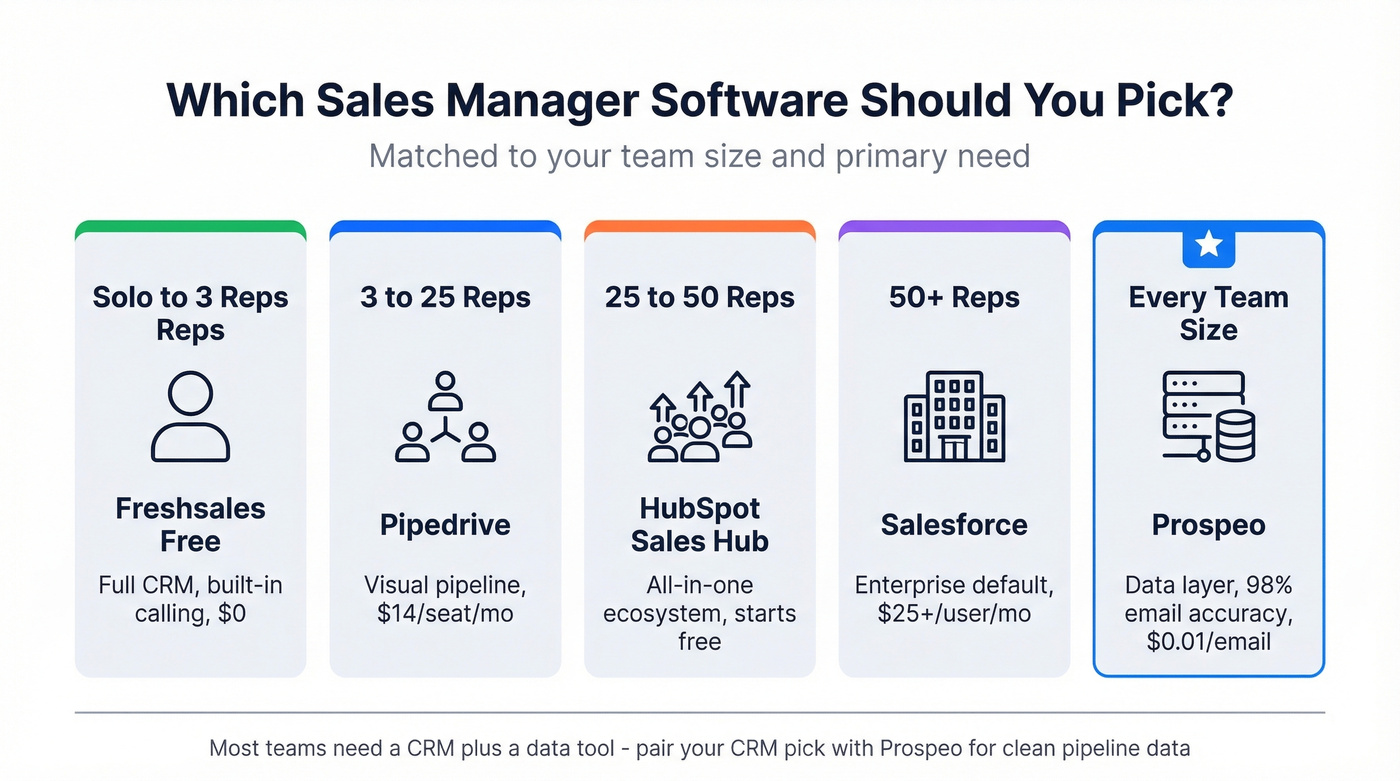
Your actual best pick depends on team size, budget, and whether you need a CRM, a data platform, or both. Most teams need both - they just don't realize it until their sequences start bouncing. If you're evaluating the data side specifically, start with data enrichment options before you commit.
What Is Sales Management Software?
The term gets thrown around loosely. The category actually spans three distinct layers:
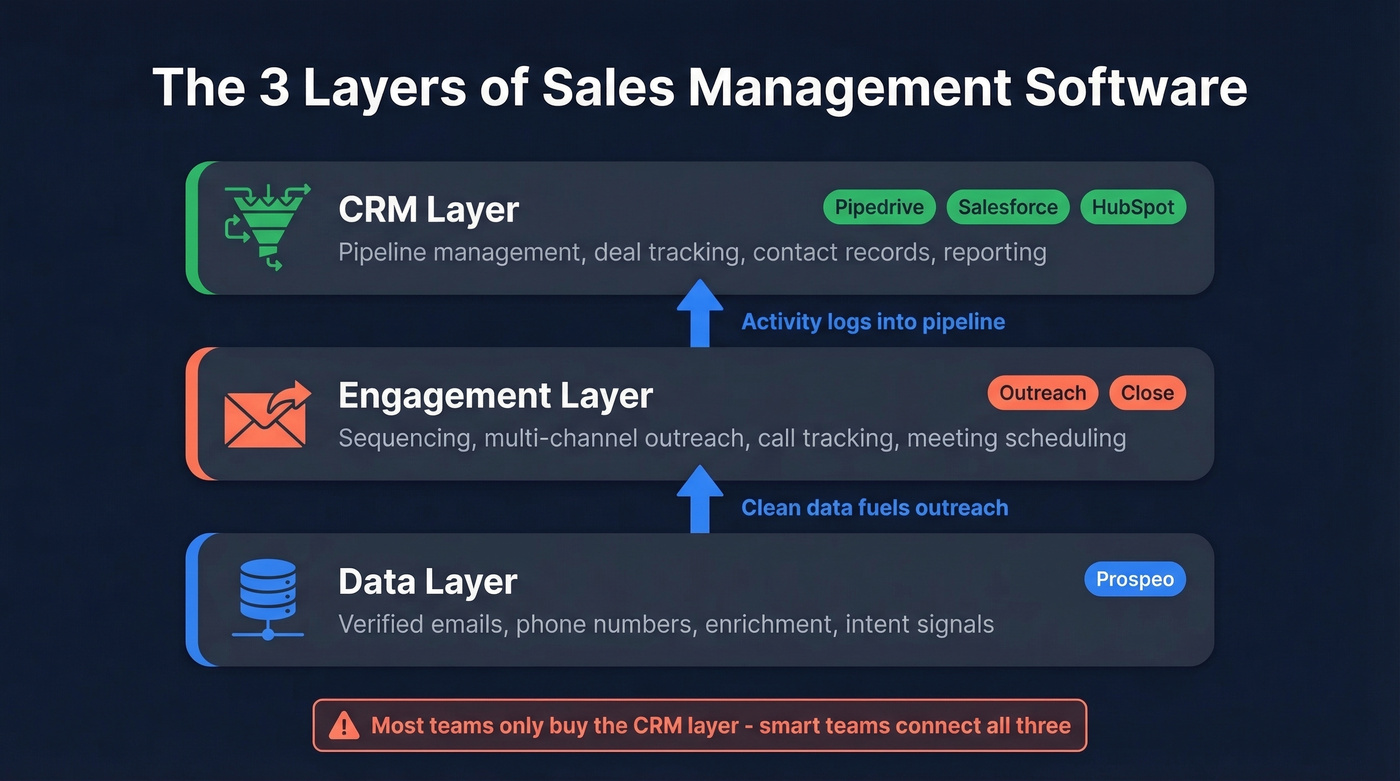
CRM layer - pipeline management, deal tracking, contact records, reporting. This is where 87% of companies already live. Pipedrive, Salesforce, HubSpot, and Freshsales all sit here. (If you want more examples, see these examples of a CRM.)
Engagement layer - sequencing, multi-channel outreach, call tracking, meeting scheduling. Tools like Outreach and Close live here, sometimes overlapping with CRM. The best engagement tools eliminate tab-switching entirely so reps call, email, and log without leaving one screen. If you're rolling this out, follow a proven approach to implementing a sales engagement platform.
Data layer - verified emails, phone numbers, enrichment, intent signals. This is the upstream fuel. Without clean data, your CRM is a beautifully organized graveyard of bad contact info. For a deeper breakdown, see our guide to lead enrichment.
Most sales managers buy a CRM and call it done. The smart ones build a stack where all three layers feed each other - that's what separates a basic CRM from a true sales management platform.
Side-by-Side Comparison
Here's how all 12 tools stack up on the metrics that actually differentiate them:
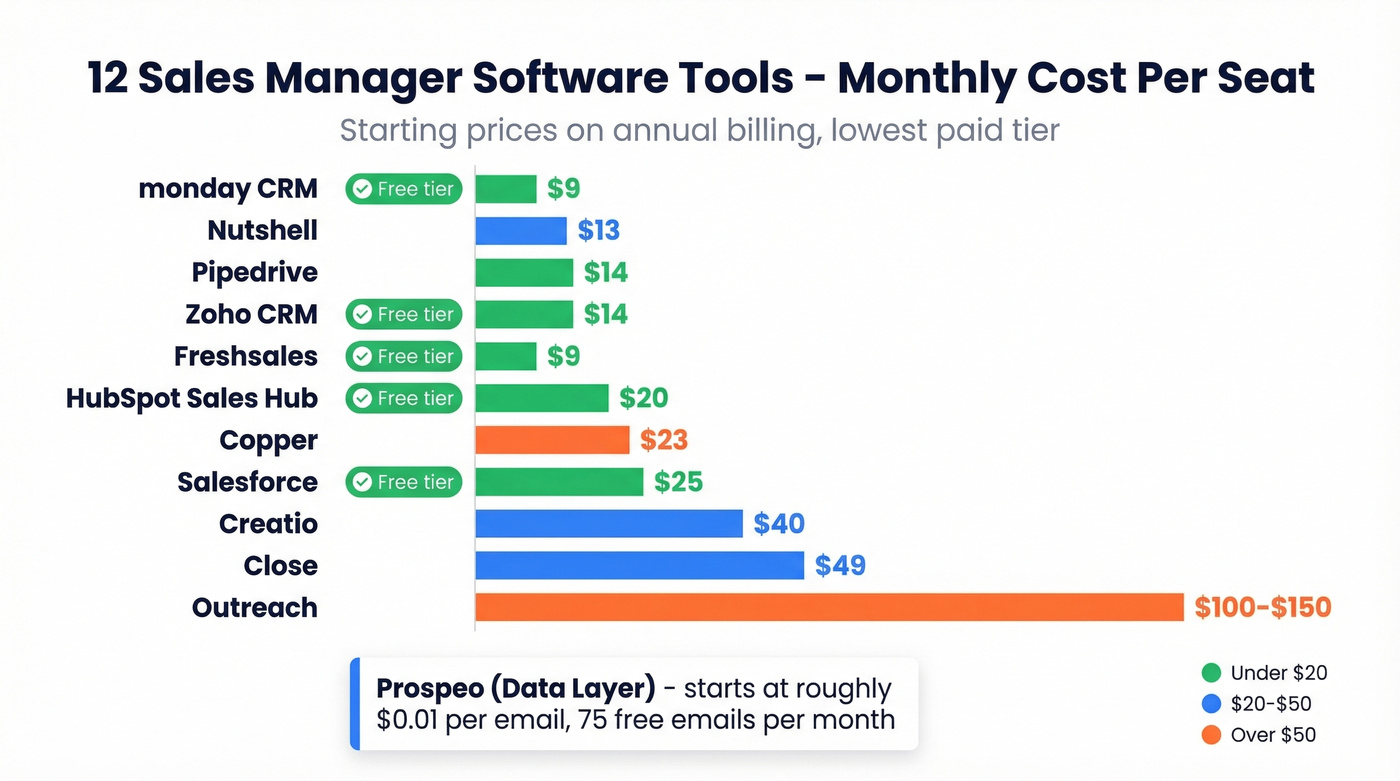
| Tool | Best For | Starting Price | Free Tier | AI Features |
|---|---|---|---|---|
| Pipedrive | Visual pipeline | $14/seat/mo (annual) | 14-day trial | AI assistant |
| Prospeo | Contact data | ~$0.01/email | 75 emails/mo | Intent data (15,000 topics) |
| HubSpot Sales Hub | All-in-one | Free -> $20/seat/mo (annual) | Yes | Breeze AI |
| Salesforce | Enterprise | $25/user/mo | Free Suite (2 users) | Einstein AI |
| Freshsales | Free CRM | Free (3 users) | Yes (+ 21-day trial) | Freddy AI |
| monday CRM | Cross-functional | $9/seat/mo | Free (up to 2 seats) | AI automations |
| Zoho CRM | Customization | $14/user/mo | Free (up to 3 users) | Zia AI |
| Close | Outbound teams | ~$49/user/mo | 14-day trial | AI call assist |
| Outreach | Engagement at scale | ~$100-$150/user/mo | No | AI sequences |
| Nutshell | Simple SMB CRM | $13/user/mo (annual) | 14-day trial | Basic AI |
| Copper | Google Workspace | $23-$99/user/mo | 14-day trial | Limited |
| Creatio | Enterprise workflow | $40/user/mo | Trial only | No-code AI |

Every sales manager software on this list runs on contact data - and bad data kills pipeline. Prospeo feeds your CRM 98% accurate emails and verified mobiles with a 30% pickup rate, refreshed every 7 days. One team cut their bounce rate from 35% to under 4% and tripled weekly pipeline to $300K.
Stop managing a CRM full of dead contacts. Fix the data layer first.
Best Sales Manager Software in 2026
Pipedrive - Best Visual Pipeline CRM
Use this if you're a team of 3-25 reps who need a CRM that reps will actually open every morning. Pipedrive's drag-and-drop pipeline is the cleanest in the category - the consensus on r/sales is that it offers "very clean pipeline management" - and the learning curve is measured in hours, not weeks. Pricing starts at $14/seat/month on the Lite plan, scaling to $79/seat/month for Ultimate. Implementation is free on plans over $400/year.
Skip this if you need deep marketing automation or enterprise reporting out of the box. Pipedrive's automation is limited unless you upgrade to Growth or higher, and the add-ons add up fast. LeadBooster runs $32.50/month, Web Visitors $41/month. A 10-seat team on Growth with LeadBooster is looking at ~$422.50/month before you've added any data tools. Still far cheaper than HubSpot Pro or Salesforce, but don't assume the sticker price is the full cost.

Prospeo - Best for Contact Data Accuracy
Your CRM is only as useful as the data inside it. Prospeo isn't a CRM - it's the data layer that makes every CRM on this list actually work. The platform covers 300M+ professional profiles with 98% email accuracy and 125M+ verified mobile numbers that deliver a 30% pickup rate across all regions. We've seen teams triple their connect rates just by switching from generic database numbers to Prospeo's verified dials. Meritt, for example, went from a 35% bounce rate to under 4% and tripled their pipeline from $100K to $300K per week.

What separates Prospeo from other data providers is the 7-day refresh cycle - the industry average is six weeks. Native integrations with Salesforce and HubSpot mean enriched contacts flow directly into your pipeline without CSV gymnastics. Credit-based pricing starts at roughly $0.01 per email, with a free tier offering 75 emails per month plus 100 Chrome extension credits. No contracts, no sales calls required. If you're comparing providers, this roundup of sales prospecting databases can help.
HubSpot Sales Hub - Best All-in-One Platform
The free CRM is genuinely useful - unlimited users, contact management, basic reporting. Breeze AI handles email drafting, call summaries, and forecasting. Marketing Hub, Service Hub, and CMS all live under one roof, so data flows naturally across teams. Starter tier at ~$20/seat/mo (annual) billed annually is reasonable for small teams that want more than free.
The catch? The jump from Starter to Professional (~$100/seat/month billed annually) is steep, and that's where the real automation lives. Enterprise runs ~$150/seat/month with seat minimums that lock you into larger commitments. Onboarding fees at Pro and Enterprise tiers can run $1,500-$5,000+. Reddit sentiment is consistent: "gets expensive fast" and can feel "heavy for smaller teams."
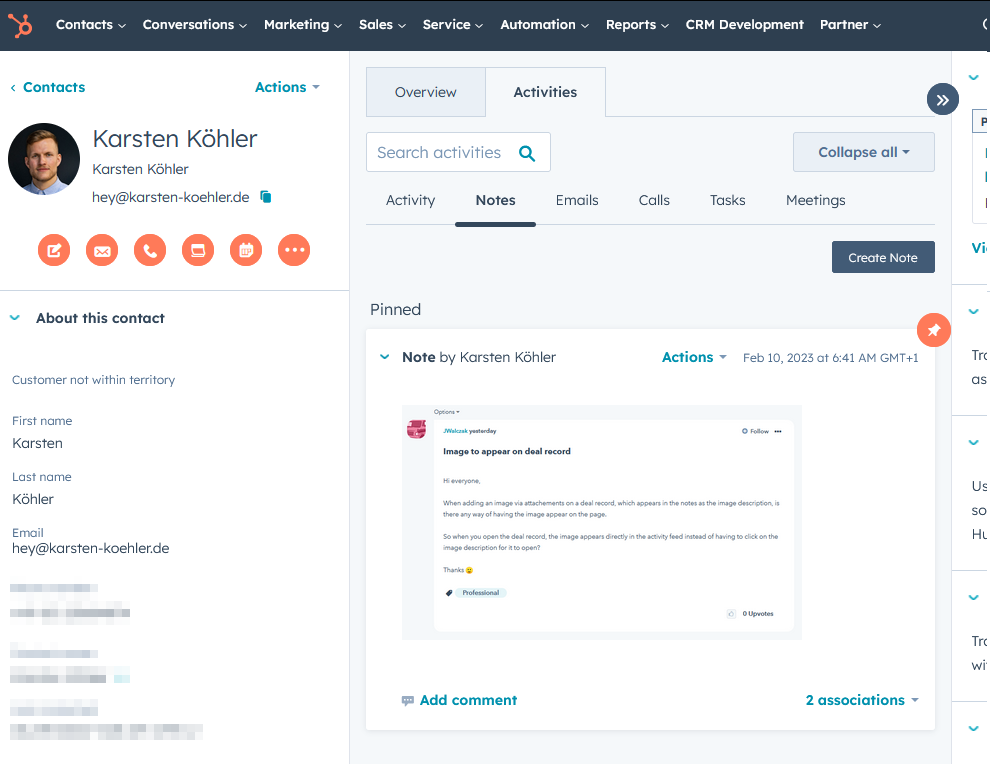
HubSpot is the right call if you want one platform for sales, marketing, and service - and you're willing to pay for it. For teams that only need CRM and pipeline management, it's overkill.
Salesforce Sales Cloud - Best for Enterprise
Salesforce is the enterprise default. Not the best CRM - the default. There's a difference. At 50+ reps with complex territories, approval workflows, and CPQ needs, nothing else has the ecosystem depth. Einstein AI handles forecasting, lead scoring, and opportunity insights. The AppExchange has an integration for basically everything. If forecasting is the core pain, compare dedicated sales forecasting solutions before you commit.
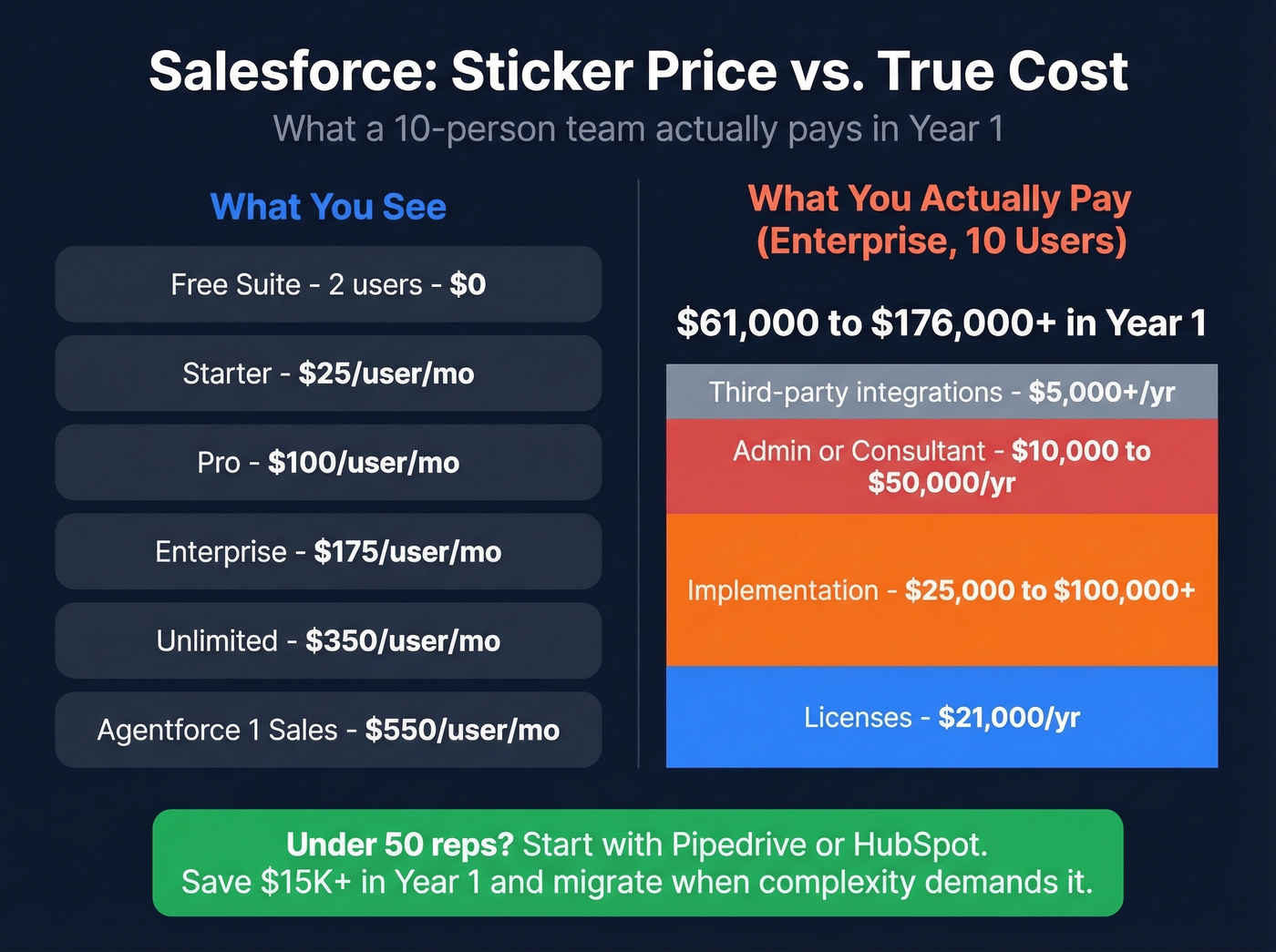
The pricing ladder starts deceptively low: a Free Suite for 2 users, Starter at $25/user/month, Pro at $100, Enterprise at $175, Unlimited at $350/user/month, and Agentforce 1 Sales at $550/user/month for AI-first teams. But the sticker price is never the real cost. Implementation for a mid-market team starts around $25K and can easily hit six figures. You'll need a Salesforce admin or consultant on retainer. A 10-person team on Enterprise is paying $21,000/year in licenses alone - before implementation, training, or any third-party integrations.
Here's the thing: if you're under 50 reps, Salesforce is more platform than you need. Start with Pipedrive or HubSpot and migrate when complexity demands it. You'll save $15K+ in the first year and actually get reps using the system.
Freshsales - Best Free Option
Freshsales is the fastest path from spreadsheets to a real pipeline view without budget approval. The free plan supports up to 3 users permanently - not a trial. Built-in calling is included, which is rare at this price point. Reddit users praise the "built-in calling and decent automation," and there's a 21-day free trial for paid tiers, giving you a full week more than Pipedrive's 14-day window to test advanced features.
The tradeoff is depth. The free and Growth ($9/user/month) tiers are intentionally limited. Freddy AI contact scoring doesn't kick in until Pro at $39/user/month, and advanced automation isn't as deep as competitors like HubSpot or Pipedrive at equivalent price points. For a 5-person team that's outgrowing spreadsheets, though, Freshsales is the right starting point.
monday CRM - Cross-Functional Teams
monday CRM makes sense when your sales team isn't just a sales team. If deals involve project handoffs, client onboarding, or cross-department collaboration, monday's board-based UI handles all of it without forcing you into a second tool. Pricing is accessible - free for up to 2 seats, then $9 (Basic), $12 (Standard), or $19/seat/month (Pro). Note: Basic typically has a 3-seat minimum. The CRM functionality is solid but not as deep as Pipedrive or HubSpot on pure sales workflows. Think of it as the right pick when your team also needs project management, not the best CRM for pure sales orgs.
Zoho CRM - Best for Customization
Zoho offers staggering customization - custom modules, workflows, layouts, and automation rules at every tier. Zia AI handles lead scoring, anomaly detection, and conversation intelligence. Free for up to 3 users, with paid plans from $14 to $52/user/month. The learning curve Reddit users mention is real, and the UI feels dated compared to newer competitors. But Zoho is the right pick for teams that want to build exactly the CRM they need, not adapt to someone else's opinion of what a CRM should look like.
Close - Best for Outbound-Heavy Teams
Close was built for SDR teams that live on the phone. Built-in calling, SMS, and email sequencing are native - not bolted-on integrations. The power dialer and call coaching features are where Close separates from general-purpose CRMs. If calling is central, you may also want a dedicated cold calling system to standardize workflows.
Here's how to think about it: if your team's primary motion is high-volume outbound calling and your reps make 50+ dials a day, Close eliminates the need for a separate dialer and saves you $30-$50/rep/month on standalone tools. Pricing runs approximately $49 to $149/user/month depending on tier. If your motion is inbound or ABM, skip it - you'd be paying for phone infrastructure you won't use.
Outreach - Engagement at Scale
Outreach is a sales engagement platform, not a CRM - and that distinction matters. It handles multi-channel sequencing with AI-driven optimization for send times, messaging, and rep coaching. Pricing runs ~$100-$150/user/month, and it's designed to sit on top of Salesforce or HubSpot, not replace them. For teams running complex, multi-touch sequences at scale, Outreach is the engagement layer that makes your CRM data actionable. For teams under 15 reps, it's more platform than you need. If you're building sequences, tighten your sequence management first.
Nutshell - Simple SMB CRM
Nutshell doesn't try to be everything. Pricing runs $13 to $79/user/month on annual tiers, and it's a solid choice for small teams that want pipeline management and email sequences without the complexity of Salesforce or HubSpot. If you've looked at Pipedrive and found even that to be more than you need, Nutshell is one step simpler.
Copper - Google Workspace Native
Copper lives inside Google Workspace - Gmail, Calendar, Drive. If your team already runs on Google and wants a CRM that feels native rather than bolted on, Copper ($23-$99/user/month) is the path of least resistance. Don't bother if you're a Microsoft shop.
Creatio - Enterprise Workflow Automation
Creatio targets mid-market and enterprise teams that need no-code workflow automation beyond standard CRM. Starting at $40/user/month, it's built for organizations with complex sales processes that want to design custom workflows without developer resources. Think insurance, financial services, and manufacturing - industries where the sales process has 15 steps and three approval layers.
How to Choose by Team Size
Picking the right tool comes down to matching complexity to headcount. Overshoot and you'll pay for features nobody uses; undershoot and you'll outgrow the platform in six months.
| Team Size | Recommended CRM | Data Layer | Monthly Cost Estimate |
|---|---|---|---|
| Solo / 1-3 reps | Freshsales (free) or Pipedrive Lite | Prospeo free tier | $0-$50/mo |
| 5-15 reps | Pipedrive Growth or HubSpot Starter | Dedicated data plan | $250-$500/mo |
| 15-50 reps | HubSpot Pro or Salesforce Pro | Data platform + intent | $1,500-$5,000/mo |
| 50+ reps | Salesforce Enterprise | API enrichment | $9,000+/mo |
A 10-person team on Pipedrive Growth with a data enrichment layer runs roughly $400/month total - and gets clean pipeline management with verified contact data. That same team on Salesforce Enterprise is paying $1,750/month in licenses alone, before implementation. Any sales management software decision should start with this cost-to-value math.
The ROI math is simple: a well-adopted CRM with clean data typically returns 3-5x in pipeline value within the first year. If your team closes just 10% more deals because reps aren't wasting time on bad contacts and stale records, that's tens of thousands in recovered revenue for a mid-market team. The cost of the software is almost never the problem - the cost of bad adoption and dirty data is.
CRM Mistakes That Kill Adoption
We've watched enough CRM rollouts fail to spot the patterns. These are the five that kill adoption fastest:
Recreating your spreadsheets inside the CRM. The whole point is to work differently. If your CRM looks like a glorified Google Sheet with the same columns and manual entry, reps will treat it like one - which means they'll ignore it.
Overcomplicating the setup. Twenty pipeline stages, forty custom fields, and twelve required dropdowns on day one. Start with the minimum viable pipeline of 3-5 stages and add complexity only when you have data showing you need it.
Skipping user training. "It's intuitive, they'll figure it out" is the most expensive sentence in sales operations. Budget two hours of structured training per rep, minimum. Record it so new hires can self-serve. If you're building onboarding, a structured 30-60-90 day plan for sales reps helps.
Importing dirty data. Run your contact list through a verification tool before importing. A CRM full of bounced emails and dead phone numbers is worse than no CRM at all - it actively erodes rep trust in the system. Use these email bounce rate benchmarks to sanity-check your list quality.
Inconsistent usage across the team. If three reps log calls and seven don't, your forecasting data is fiction. Make CRM logging a non-negotiable part of the workflow, not a suggestion. Tie it to comp if you have to.
Why Data Quality Decides CRM Success
Let's be honest about a pattern we see constantly: a sales manager buys a great CRM, imports a purchased list of 10,000 contacts, launches sequences, and watches 35% of emails bounce. Reps lose confidence. Deliverability tanks. The CRM gets blamed for what's actually a data quality problem.
73% of B2B buyers actively avoid sellers who send irrelevant outreach. Irrelevant starts with wrong - wrong email, wrong title, wrong company. Contact data decays fast. People change jobs, get promoted, switch companies. A database that refreshes every six weeks is already stale by the time your reps hit send. No sales management platform can compensate for fundamentally broken data. If you're fixing deliverability, start with an email deliverability guide before you scale volume.
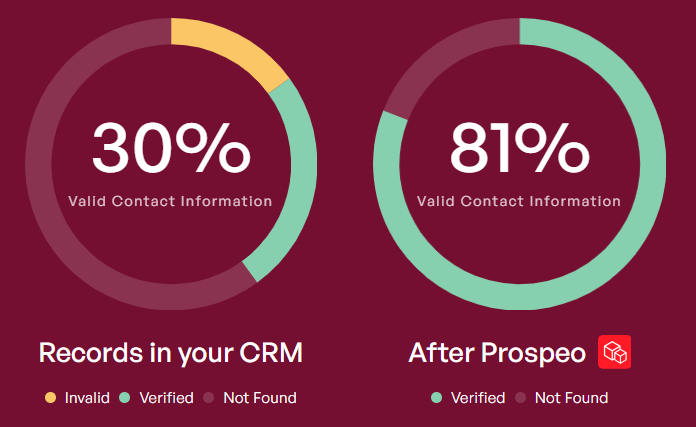
This is where your data layer earns its keep. Pairing your CRM with a platform that delivers 98% email accuracy, an 83% enrichment match rate returning 50+ data points per contact, and a weekly refresh cycle solves the upstream problem that makes every downstream tool work better. Native CRM integrations mean enrichment happens automatically - no manual CSV uploads, no weekly data hygiene sprints. Your CRM stays clean because the data feeding it is clean.
You don't need another CRM - you need the data layer that makes your current one work. Prospeo enriches Salesforce and HubSpot natively with 300M+ profiles, 125M+ verified mobiles, and intent signals across 15,000 topics. At ~$0.01 per email, it's 90% cheaper than ZoomInfo.
Give your sales manager software the fuel it actually needs.
FAQ
What is sales manager software?
Sales manager software helps managers track pipeline health, forecast revenue, monitor rep performance, and automate administrative work. Most platforms in this category are CRMs with reporting, automation, and coaching layers built on top. The best ones reduce the 60% of time reps spend on non-selling tasks.
How much does sales management software cost?
Free tiers exist - Freshsales for 3 users, monday CRM for up to 2 seats, and Salesforce Free Suite for 2 users. Paid plans range from $9/user/month (Freshsales Growth) to $350+/user/month (Salesforce Unlimited). Budget for add-ons and implementation - the sticker price is rarely the full cost.
Do I need a separate tool for prospecting data?
Yes. CRMs manage relationships but don't generate leads. A dedicated data platform provides verified emails and phone numbers that feed your CRM - without one, you're relying on manual research or purchased lists with 30%+ bounce rates. Think of it as the fuel line to your CRM engine.
Can small teams use enterprise sales platforms?
Technically yes, but you'll overpay and under-adopt. A 5-person team on Salesforce Enterprise spends $10,500/year on software designed for 500-person orgs. Start with Pipedrive or Freshsales and upgrade when you genuinely outgrow them - that's the move that saves both money and sanity.
What features matter most for sales managers?
Pipeline visualization, workflow automation, reporting dashboards, native integrations with your email and data tools, and AI-powered insights like lead scoring and deal risk alerts. Mobile access matters too - managers who review pipeline health from a phone coach reps faster and catch stalled deals earlier.