

Sales Methodologies for SaaS: Which Framework Actually Fits Your Team?
A thread on r/sales put it bluntly: all sales methodologies "boil down to need, budget, stakeholders, timeline." The poster isn't wrong - and that's exactly why most sales methodologies for SaaS teams fail on implementation, not on theory. Leaders pick a framework, jam it into onboarding, and wonder why reps treat it like a compliance exercise instead of a competitive edge.
The real question isn't which methodology has the best acronym. It's which one gives your team a shared language and a repeatable system that matches how your buyers actually buy. That distinction - shared language, not new fundamentals - is what separates methodology adoption from methodology theater. Your reps already know how to ask questions and handle objections. A methodology doesn't teach them to sell. It gives everyone a common vocabulary for diagnosing why deals stall, what's missing from a pipeline, and when to walk away.
We've watched teams spend six figures on methodology rollouts only to abandon them within two quarters because they picked a framework that didn't match their deal complexity, their ACV, or their buyers' expectations. This guide exists to prevent that.
30-Second Version
If you don't read another word, here's where to start:
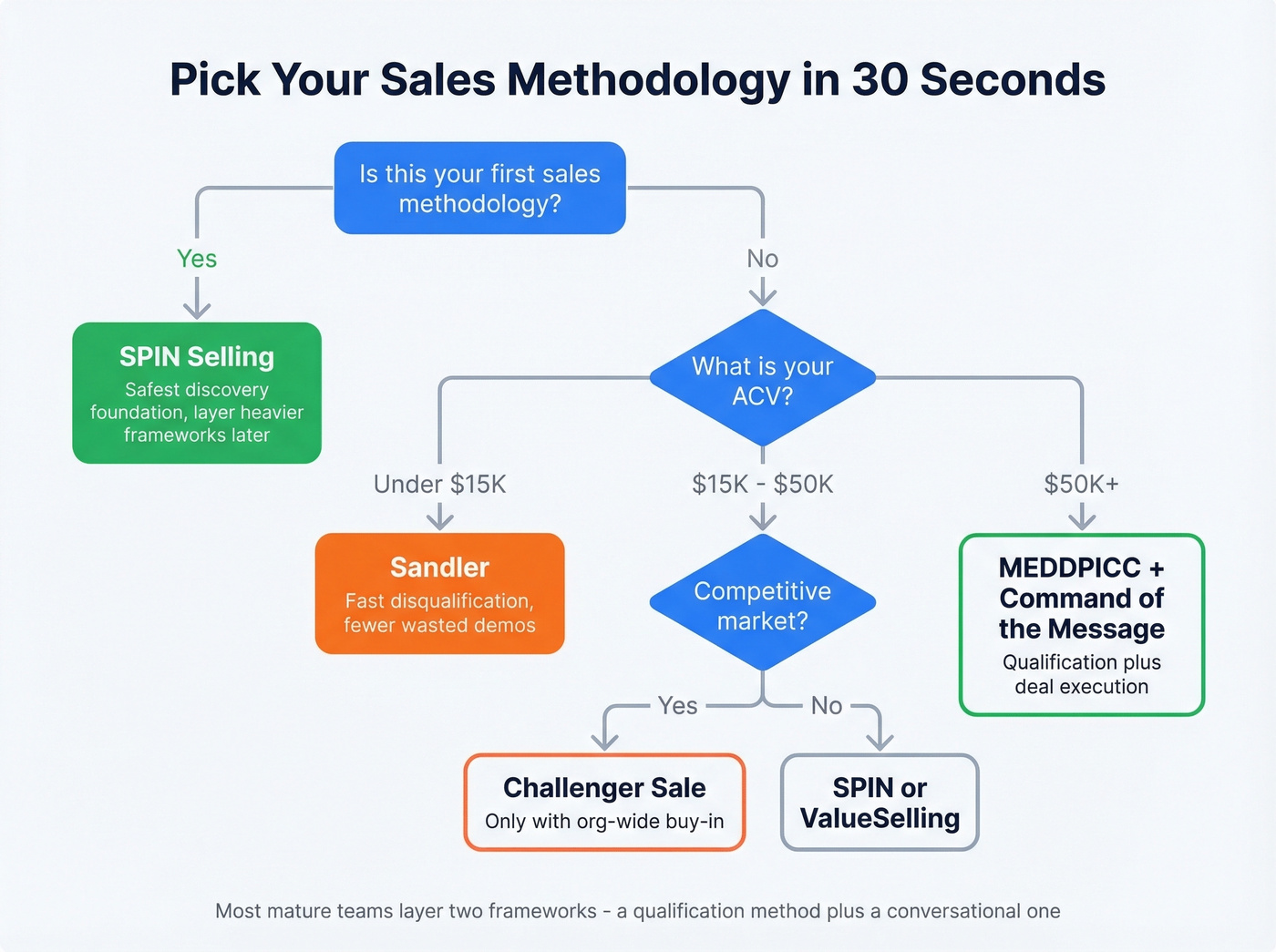
- First methodology ever? SPIN Selling. Safest discovery foundation before you layer on heavier qualification.
- Enterprise, $50K+ ACV? MEDDPICC for qualification + Command of the Message for deal execution.
- Founder-led or SMB/mid-market? Sandler. Fewer wasted demos, faster disqualification.
- Competitive outbound, mid-market? Challenger Sale - but only if you've got the organizational buy-in to support it.
These picks assume you're choosing one primary framework. Most mature teams layer two - a qualification framework plus a conversational one. That combination is where the real results live.
Why SaaS Deals Demand a Framework
SaaS deals are getting harder to close. The average B2B SaaS sales cycle now runs 134 days, up from 107 in the prior period. That's nearly a full month of extra pipeline drag. Meanwhile, 64.4% of sales leaders report that the number of stakeholders per deal is increasing, with 44% saying four or more people are involved in every decision.
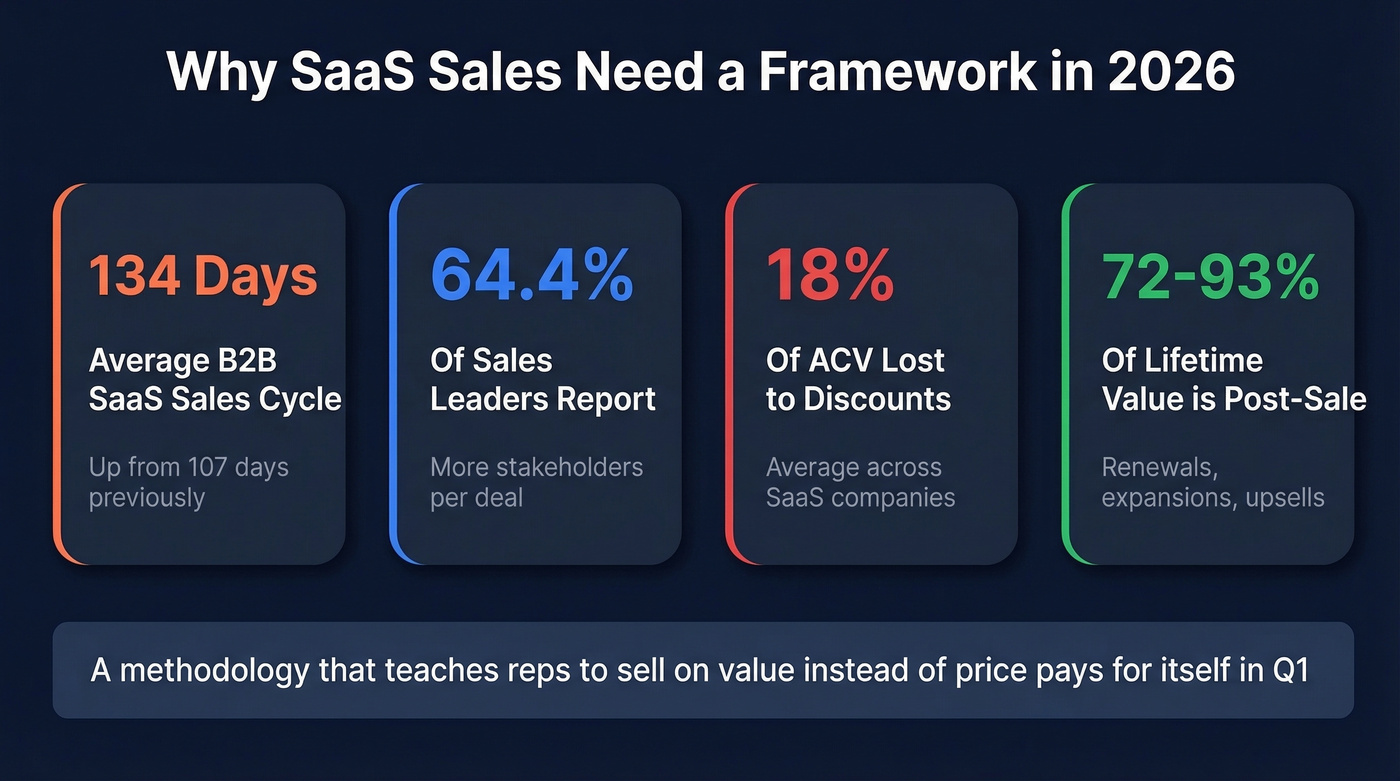
The complexity doesn't end at close. Winning by Design's Recurring Revenue Bowtie model argues that 72-93% of customer lifetime value happens post-sale through renewals, expansions, and upsells. If your methodology only covers the pre-close funnel, you're optimizing for a fraction of the revenue. Reps who internalize that revenue is earned continuously - not just at the point of sale - naturally adopt habits that prioritize long-term customer value over one-time closes.
Here's a useful distinction: a sales process defines the stages a deal moves through (discovery, demo, proposal, close). A methodology defines how reps engage at each stage - the questions they ask, how they qualify, how they advance. Process is the map. Methodology is the driving style. You need both, but most teams only formalize the map and leave the driving to individual talent.
One more number worth internalizing: the average SaaS company loses 18% of ACV to discounts. A methodology that teaches reps to sell on value instead of price pays for itself in the first quarter.
The Decision Matrix
Before we get into each framework, here's how they map across the dimensions that actually matter for SaaS teams.
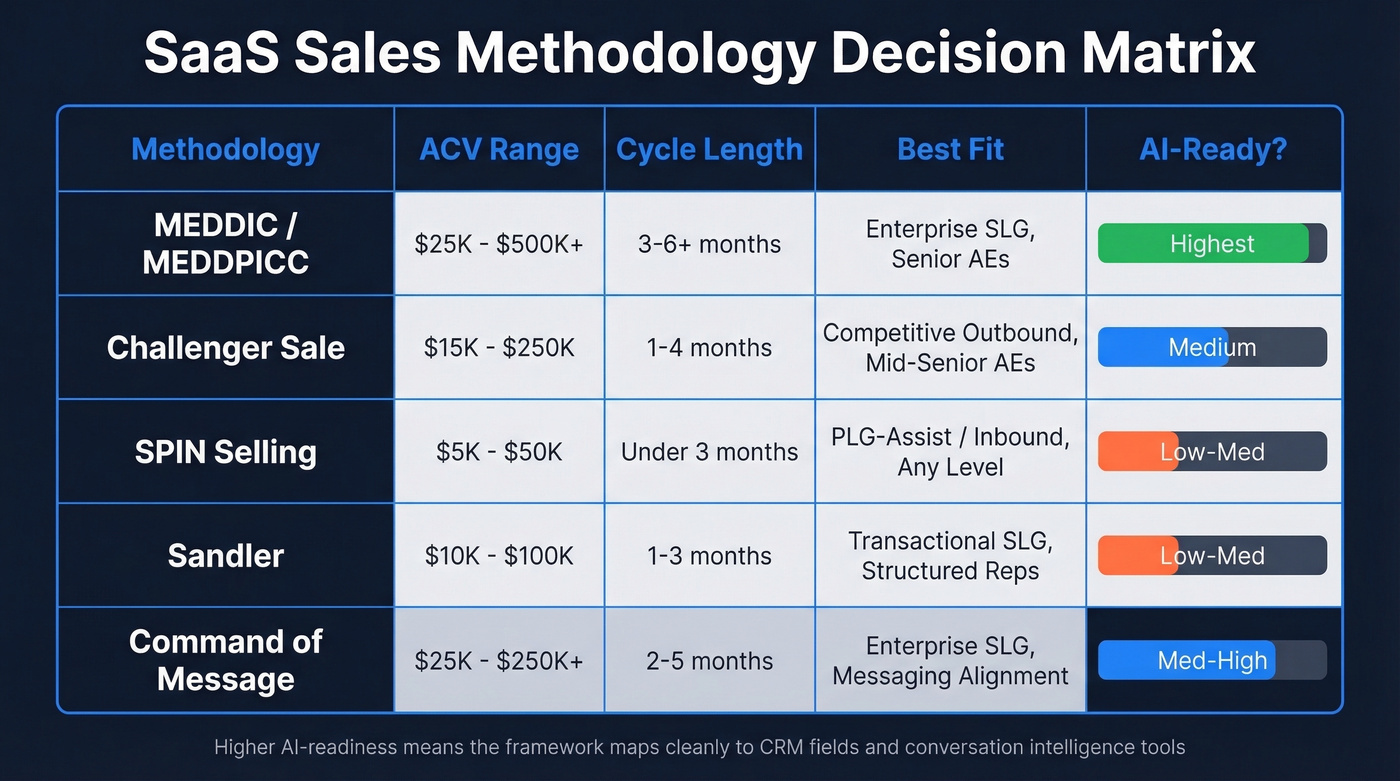
| Methodology | ACV Range | Cycle Length | Best Fit | AI-Ready? |
|---|---|---|---|---|
| MEDDIC/MEDDPICC | $25K-$500K+ | 3-6+ mo | Enterprise SLG, senior AEs | Highest |
| Challenger | $15K-$250K | 1-4 mo | Competitive outbound, mid-senior AEs | Medium |
| SPIN | $5K-$50K | <3 mo | PLG-assist / inbound, any level | Low-med |
| Sandler | $10K-$100K | 1-3 mo | Transactional SLG, structured reps | Low-med |
| Command of Message | $25K-$250K+ | 2-5 mo | Enterprise SLG, messaging alignment | Med-high |
Tier 2-3 frameworks covered in shorter form below: Gap Selling ($10K-$100K, mid-market outbound), ValueSelling ($10K-$150K, technical PLG), NEAT ($5K-$50K, fast-cycle SDR teams), SPiCED ($10K-$100K, RevOps-aligned mid-market), Solution Selling ($5K-$50K, inbound/channel generalists).
10 Frameworks Compared
MEDDIC / MEDDPICC
Use this if: You're selling $25K+ ACV deals with 3+ stakeholders, long cycles, and a forecast that's more fiction than fact.
Skip this if: Your average deal closes in under 30 days or your reps are still learning basic discovery. MEDDIC on top of weak fundamentals is just bureaucracy.
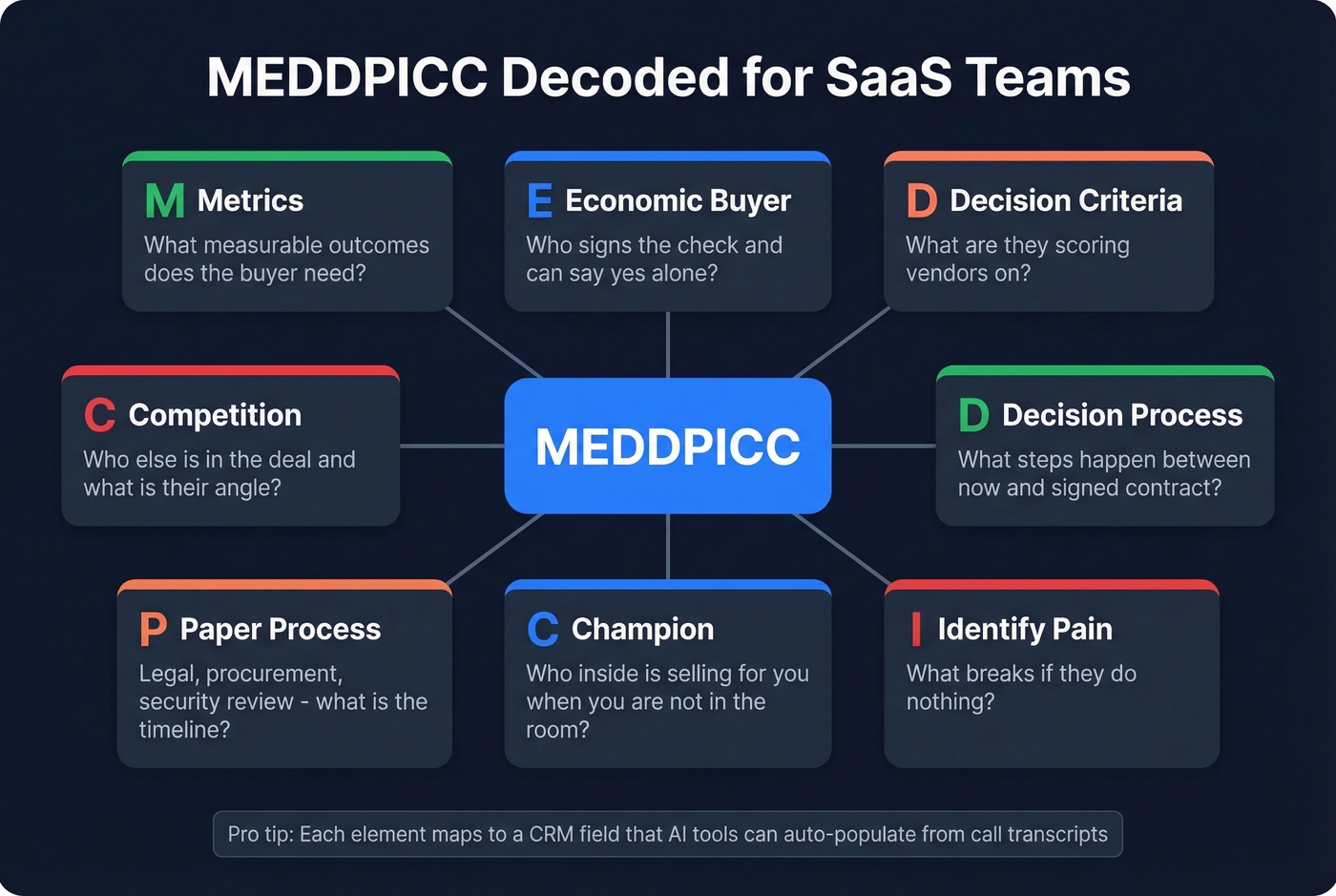
The acronym maps to Metrics, Economic Buyer, Decision Criteria, Decision Process, Identify Pain, Champion - add Paper Process and Competition for MEDDPICC. Each element forces a specific qualification question that most reps skip.
Consider a $72K ARR partner-led deal that was slipping quarter after quarter. A MEDDIC review exposed the gaps: no identified economic buyer, no quantified metrics, unclear decision process, no internal champion. The deal wasn't stalled. It was never properly qualified. MEDDIC didn't close that deal - it saved the team from wasting another quarter on it.
With 64.4% of sales leaders reporting increasing stakeholders, you need a framework that forces reps to map the buying committee. MEDDIC does that better than anything else. A common refrain on r/sales: "MEDDIC is great until your CRM becomes a data entry nightmare." That's a real risk - but it's also one of the most AI-compatible methodologies. Each element maps to a distinct CRM field that modern conversation intelligence tools can populate from call transcripts, which eliminates most of the manual entry complaint. If you want a deeper set of qualification prompts, use these MEDDIC discovery questions in pipeline reviews.
Challenger Sale
Picture a $350K ARR opportunity with a 6-month cycle. The prospect had a homegrown system they were comfortable with. The Challenger approach reframed "works fine" into "you're leaving $2M in operational efficiency on the table." The rep taught the buyer something they didn't know about their own business. Closed.
That deal illustrates Challenger at its best: competitive markets where buyers think their current solution is good enough and your reps need to reframe the conversation entirely. The teach-tailor-take control framework is powerful when it works.
Here's the thing: Challenger is the most overrated methodology for teams that aren't ready. It requires company-wide buy-in - marketing enablement has to create the teaching content, enablement has to build the tailoring playbooks, and reps need a specific profile: assertive, commercially oriented. We've seen teams adopt Challenger and watch their bottom-performing reps get worse because they confuse "challenging" with "confrontational." If you don't have the organizational infrastructure to support it, you'll get aggressive selling with a book recommendation. Start with SPIN instead.
SPIN Selling
Use this if: You're building a sales team from scratch, your reps struggle with discovery, or you need a universal foundation before layering on something heavier.
Skip this if: Your deals are $100K+ with 6-month cycles - SPIN alone won't give you the qualification rigor you need at that level.
Neil Rackham built SPIN from 35,000 observed sales calls. The four question types - Situation, Problem, Implication, Need-payoff - are designed to make the buyer articulate their own pain and the cost of inaction. It's deceptively simple, which is why it works.
A $20K ARR deal where the buyer knew they had a problem but couldn't justify the budget. SPIN's implication questions - "What happens to your pipeline if this data quality issue persists for another two quarters?" - got the buyer to quantify the cost themselves. They signed without a discount. That's the power of SPIN: it teaches the one skill that separates good reps from order-takers, the ability to ask questions that change how the buyer thinks about their problem. It's the safest first methodology for most teams, and it pairs beautifully with stricter qualification frameworks when deal size grows. If you need a ready-to-run set, pull from this discovery questions library.
Sandler Selling System
| Sandler Pros | Sandler Cons |
|---|---|
| Fastest disqualification of any framework | "Upfront contract" can feel transactional to enterprise buyers |
| Strong fit for founder-led and SMB/mid-market motions | Less effective in procurement-heavy processes |
| Cuts wasted demos dramatically | Requires discipline most early reps lack initially |
| Respects the founder's scarcest resource: time | Doesn't scale to complex multi-stakeholder deals |
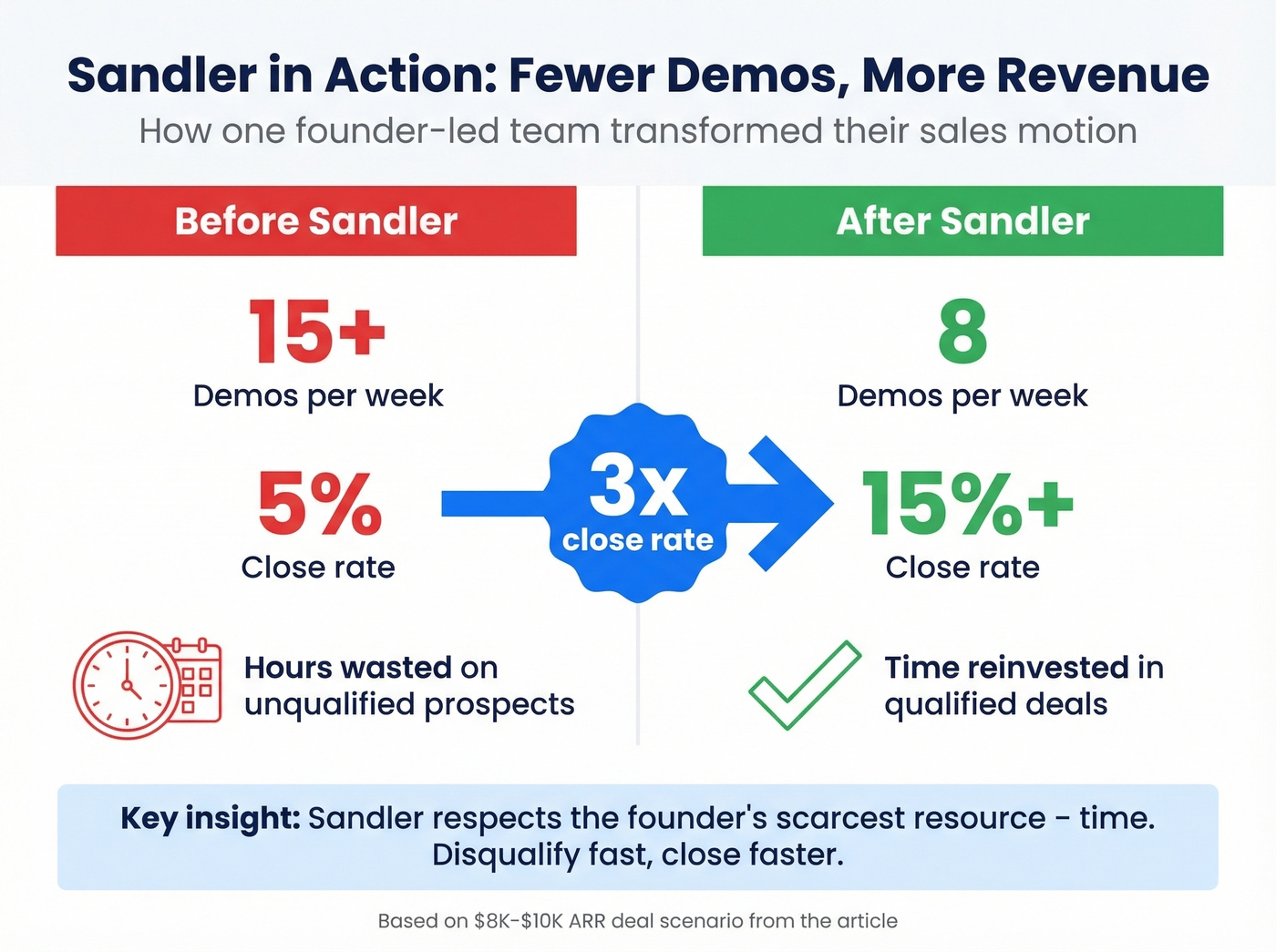
Sandler's core innovation is the upfront contract - setting mutual expectations at the start of every conversation about what happens next. Combined with pain-focused qualification and early budget/authority checks, it's ruthlessly efficient at disqualifying bad deals fast.
A founder selling $8K-$10K ARR deals in a crowded market was running 15+ demos a week with a 5% close rate. Sandler's qualification framework cut demos to 8 per week and pushed close rates above 15%. Fewer demos, faster decisions, more revenue per hour of selling time. For founder-led and early-stage teams, Sandler is the methodology that respects the fact that your time is your scarcest resource. If you're a solo founder doing sales and you only read one section of this article, make it this one.
Command of the Message
The cost question first: A Force Management engagement runs $100K-$150K initially, with Year 1 totals reaching $230K-$475K including reinforcement and refreshers. That's real money. For teams selling $100K+ ACV deals, the math works - one additional closed deal pays for the entire program. For a 15-person startup selling $20K deals, the investment is absurd.
Force Management's framework shifts reps from product pitching to value-focused discovery through a 5-part structure: Before Scenarios, Negative Consequences, After Scenarios, Positive Business Outcomes, Required Capabilities. Companies like Databricks, MongoDB, and Snowflake use it to align messaging across large sales organizations.
Use this if: You're a $100K+ ACV team that needs every rep delivering a consistent, value-focused narrative across complex buying committees. Skip this if: You're a 15-person startup. See the price tag above. If your team struggles to keep demos tight, use a product demo checklist to reinforce the narrative consistently.
Gap Selling
Gap Selling, developed by Keenan, focuses on the distance between a buyer's current state and their desired future state. The larger the gap, the more urgency to buy. The framework breaks the current state into five elements: physical environment, problem, impact, root cause, and emotions.
It's strongest in mid-market deals where a prospect says "we know we have a problem but can't justify the spend." Where MEDDIC asks "who's the economic buyer?", Gap Selling asks "what's the emotional and financial weight of staying where you are?" The two pair well together - Gap for discovery, MEDDIC for qualification. If your reps are good at building rapport but struggle to create urgency, Gap Selling fills that hole better than any other framework on this list.
ValueSelling
Where Challenger teaches, ValueSelling listens. It positions every conversation around business outcomes rather than features, built for technical or skeptical buyers who resist traditional sales approaches - the kind of prospects who've already done their research and don't want to be "sold to."
The sweet spot is $10K-$150K ACV deals with technical decision-makers. It works particularly well in PLG-adjacent motions where the buyer has already used the product and needs a business case to justify an enterprise contract. Think of it as the methodology for selling to engineers who've already read your docs.
NEAT Selling
NEAT - Need, Economic impact, Access to authority, Timeline - is a modernized, streamlined BANT. Each element is discrete and automatable, making it the easiest framework to build into fast-cycle workflows where SDRs need to qualify high volumes quickly. For teams running sub-$50K ACV deals with cycles under 60 days, NEAT provides enough structure without the overhead of MEDDIC. Not every deal needs a 7-element qualification checklist.
SPiCED
SPiCED (Situation, Pain, Impact, Critical Event, Decision) is a modern alternative to MEDDIC designed for mid-market teams that want qualification rigor without the enterprise weight. It maps cleanly to CRM fields and pipeline stages, making it a strong fit for RevOps-aligned organizations. If your RevOps team is already driving your sales process, SPiCED will feel like it was built for them.
Solution Selling
Solution Selling emerged in the 1980s from Mike Bosworth's work and pioneered the buyer-problem-first approach that every modern methodology now takes for granted. It's table stakes at this point - useful as a foundation, but less differentiated than newer frameworks that build on its principles with more specific structures for SaaS buying dynamics. If you're already doing any of the above, you're already doing Solution Selling whether you know it or not.

No methodology survives bad data. When 134-day cycles depend on reaching the right economic buyer and champion, you need verified contacts - not bounced emails. Prospeo delivers 98% email accuracy and 125M+ verified mobile numbers so your MEDDPICC-qualified deals actually connect.
Stop qualifying deals you can't even reach. Start with real data.
PLG and the AI Era
When Buyers Avoid Sales Reps
53% of buyers prefer to purchase without any sales interaction. That stat reshapes which methodologies work. In a PLG-assist motion, the rep isn't running a full discovery cycle - they're entering a conversation the buyer started with the product. SPIN and Sandler adapt best here because they're question-driven rather than pitch-driven. The rep's job becomes understanding what the buyer already knows and filling the gaps, not running a scripted qualification.
If you're building a repeatable outbound engine alongside PLG, these sales prospecting techniques help keep pipeline consistent without bloating your process.
Which Frameworks Survive AI
Reps spend just 28% of their week actually selling - the rest goes to admin, data entry, and internal meetings. AI tools are compressing that admin time, but they favor methodologies with structured, field-mappable elements. MEDDIC wins here because each letter maps to a CRM field that AI can populate from call transcripts. NEAT is similarly automatable. SPIN and Sandler, which rely on conversational nuance and emotional intelligence, are harder to automate - but that's also what makes them harder to replace with AI.
Let's be honest: if your deal size is under $25K and your cycle is under 60 days, you probably don't need a heavyweight methodology at all. NEAT or SPiCED plus a good conversation intelligence tool will outperform a poorly implemented MEDDIC every single time. The best methodology is the one your reps actually use, and complexity is the enemy of adoption.
Adherence technology is changing the equation. With conversation intelligence in the workflow, methodology adherence can stay at 90%+ instead of decaying to the 40-50% range six months after training without reinforcement.
Matching Framework to Sales Motion
The methodology you pick is only half the equation - it has to align with your software sales model. A PLG motion where users self-serve into paid plans demands a different framework than a high-touch enterprise B2B sales motion where reps run multi-threaded deals over six months. Teams that try to force an enterprise methodology onto a transactional motion end up with bloated qualification steps that slow down deals that should close in a week. Match the framework to the motion, not the other way around.
Making It Stick
Here's the narrative every sales leader recognizes: your VP just announced MEDDPICC. Half the reps are excited because they've been asking for structure. The other half are updating their resumes because they think it means more CRM busywork. Six months later, adherence has dropped from 70-80% to 40-50%, and the VP is wondering whether to double down or quietly abandon the initiative.
The difference between adoption and theater comes down to operationalization. That means scorecards tied to each methodology element, pipeline reviews that use the framework's language, CRM fields that map to qualification criteria, and coaching cadences that reinforce the right behaviors weekly - not quarterly. If you need a rollout template, start with a 30-60-90 day plan for sales reps.

There's an execution layer most teams overlook entirely: data quality. Every methodology requires reaching the right people. MEDDIC needs the economic buyer. Challenger needs the executive you're going to teach. Command of the Message needs the full buying committee mapped. If your contact data bounces or connects to wrong numbers, no framework helps. Prospeo's 98% email accuracy on a 7-day refresh cycle - versus the 6-week industry average - means reps can actually reach the people their methodology tells them to target, instead of burning non-selling time on contact hunting. If you're diagnosing deliverability, use these email bounce rate benchmarks and fixes.
Your methodology teaches reps how to sell. Prospeo tells them who to sell to. Layer buyer intent data across 15,000 topics with 30+ filters - job changes, headcount growth, technographics - so every Challenger insight and SPIN question lands on an in-market buyer.
Map your buying committee with data refreshed every 7 days, not 6 weeks.
How to Measure Results
You can't evaluate a methodology change without baselines. The average B2B win rate sits around 21% - if you're above that, your current approach has something worth preserving. Here are the numbers that matter:
| Metric | Benchmark | What It Tells You |
|---|---|---|
| Win rate (qualified opps) | ~29% | Qualification quality |
| Win rate (full pipeline) | 15-25% | Overall pipeline health |
| Deals closing <50 days | 47% win rate | Velocity advantage |
| Deals closing >50 days | ≤20% win rate | Stall risk |
| Discount rate | 18% of ACV | Value selling effectiveness |
| Connect rate (email) | >95% delivery | Email data quality |
| Connect rate (cold call) | >10% pickup | Phone data quality |
The deal velocity benchmark is the most actionable: opportunities that close within 50 days win at 47% vs ≤20% for longer deals. That's a 2.35x differential. If your methodology change isn't compressing cycle times within two quarters, something's broken in the implementation.
Real talk: if your email bounce rate is above 5% or cold call connect rate is below 10%, fix the data before you blame the methodology. We've seen teams agonize over framework selection when the real problem was that 30% of their emails were bouncing. Get the data right first, then isolate whether the framework itself is moving the needle. If you want a clean KPI set for leadership, track pipeline health alongside win rate and cycle length.
Track these metrics monthly for the first two quarters after any methodology rollout. Win rate and cycle length are lagging indicators - connect rate and qualification adherence are leading ones.
FAQ
What's the difference between a sales methodology and a sales process?
A process defines deal stages (discovery, demo, close). A methodology defines how reps engage at each stage - the questions they ask, how they qualify, how they advance. You need both. Formalizing only the process and leaving execution to individual talent is the most common mistake SaaS teams make.
Which methodology works best for enterprise SaaS?
MEDDPICC is the strongest choice above $25K ACV because it forces qualification rigor across the exact complexity points - economic buyer, decision process, champion - that kill enterprise deals. Pair it with Command of the Message for $100K+ ACV teams needing consistent value narratives across large buying committees.
Can you combine multiple frameworks?
Yes, and most high-performing teams do. The most common pairing: MEDDPICC for qualification plus Challenger or SPIN for discovery conversations. They serve different purposes - one structures the deal, the other structures the conversation - and they complement each other naturally.
How long does methodology adoption take?
Initial training takes 1-3 days. Real adoption requires 3-6 months of reinforcement through scorecards, call reviews, and weekly coaching cadences. Budget for the reinforcement, not just the kickoff - that's where 80% of failed rollouts break down.
How does contact data quality affect methodology execution?
Every methodology requires reaching the right stakeholders - MEDDIC needs the economic buyer, Challenger needs the executive to teach. If emails bounce or dials hit dead numbers, no framework helps. Tools like Prospeo, with 98% email accuracy and a 7-day refresh cycle, give reps the data foundation that makes any methodology actually executable.