

Sales Personality Types: What the Research Says (and What Actually Matters)
There's a persistent myth in sales that you need to be a wolf - aggressive, relentless, willing to say anything to close. A thread on r/sales captured it perfectly: a rep wondering if they needed to "rewire" their compassionate personality to match the top performers who seemed to bulldoze through every objection. Meanwhile, 72% of sales pitches go unanswered regardless of how aggressive the sender is. The problem isn't your personality. It's whether you can adapt it to the person on the other end.
Understanding sales personality types doesn't predict success. How you adapt does.
The Short Version
Self-efficacy - confidence in your own selling ability - predicts sales performance more than any personality type, per Baylor University's Keller Center research. DISC is the most practical framework for adapting to buyers in real time. MBTI is interesting for self-awareness but less actionable mid-call. Take a free sales personality assessment (Truffle or Dealmayker - links below) to identify your style, then use the scripts in this article to adapt your pitch to each buyer type.
The 4 Sales Personality Types Explained
Most frameworks converge on the same four buyer archetypes, whether you're using DISC, Merrill-Reid Social Styles, or Keirsey temperaments. One important caveat: most buyers are hybrids, not pure types. In our experience, the dominant style reveals itself within the first 10 to 15 minutes of a discovery call.
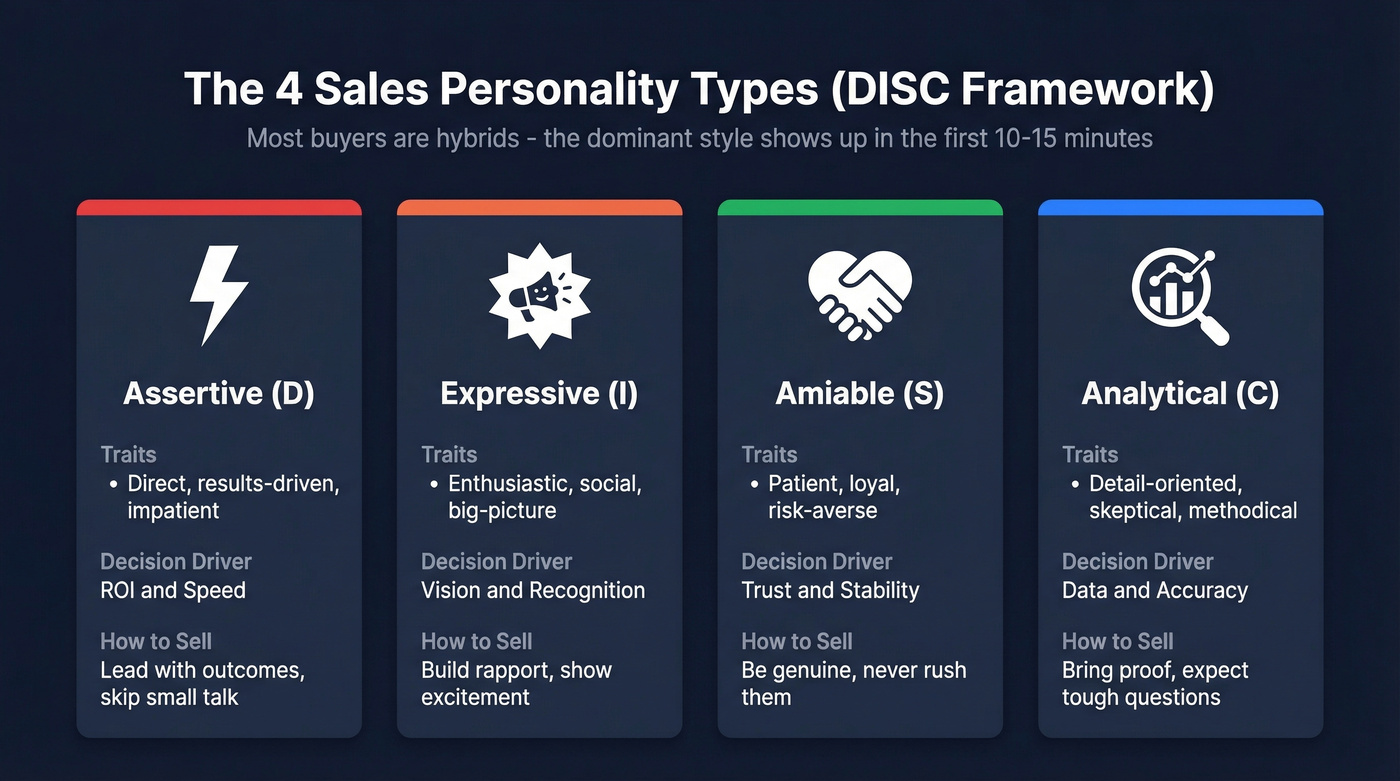
| Type | DISC Map | Traits | Decision Driver | How to Sell to Them |
|---|---|---|---|---|
| Assertive | D (Dominance) | Direct, results-driven, impatient | ROI and speed | Lead with outcomes, no small talk |
| Expressive | I (Influence) | Enthusiastic, social, big-picture | Vision and recognition | Build rapport, show excitement |
| Amiable | S (Steadiness) | Patient, loyal, risk-averse | Trust and stability | Be genuine, don't rush |
| Analytical | C (Compliance) | Detail-oriented, skeptical, methodical | Data and accuracy | Bring proof, expect questions |
The temptation is to label a prospect and stop thinking. Don't. These are communication lenses, not boxes. Some teams now use AI call analysis to auto-tag buyer types from transcripts, which helps - but even then, try asking a simple question mid-call: "Would you like more detail here, or should we move forward?" The answer tells you everything.
How to Sell to Each Buyer Type (With Scripts)
Adapting your pitch is the actionable takeaway - not labeling people. Here's what that looks like in practice, drawing from Crystal Knows' DISC-based scripts.
D-type (Assertive) email pitch:
"Hi [Name], I'll keep this short. [Company] helps teams like yours cut prospecting time by 40%. Want 15 minutes this week to see if it fits?"
Short. No fluff. That's what a D-type respects.
I-type (Expressive) email pitch:
"Hey [Name]! I've been following what your team's doing at [Company] - really impressive growth. We help teams like yours keep that momentum going. Would love to chat and share some ideas - coffee call Thursday?"
S-type (Amiable) email pitch:
"Hi [Name], I know your time is valuable, so no pressure here. We've been helping teams like yours build more consistent pipelines without the chaos. If you're open to it, I'd love to share how - whenever works for you."
C-type (Analytical) email pitch:
"Hi [Name], quick question: are you open to a short comparison on accuracy and deliverability? I can share a one-page breakdown with assumptions, methodology, and expected impact. If it looks relevant, we can do a 20-minute walkthrough this week."
We've tested variations of these across hundreds of outbound campaigns, and the pattern holds: matching tone to buyer type consistently lifts reply rates by 15-30% compared to a one-size-fits-all template. (If you want more plug-and-play options, start with these sales follow-up templates.)
Which Framework Should You Use?
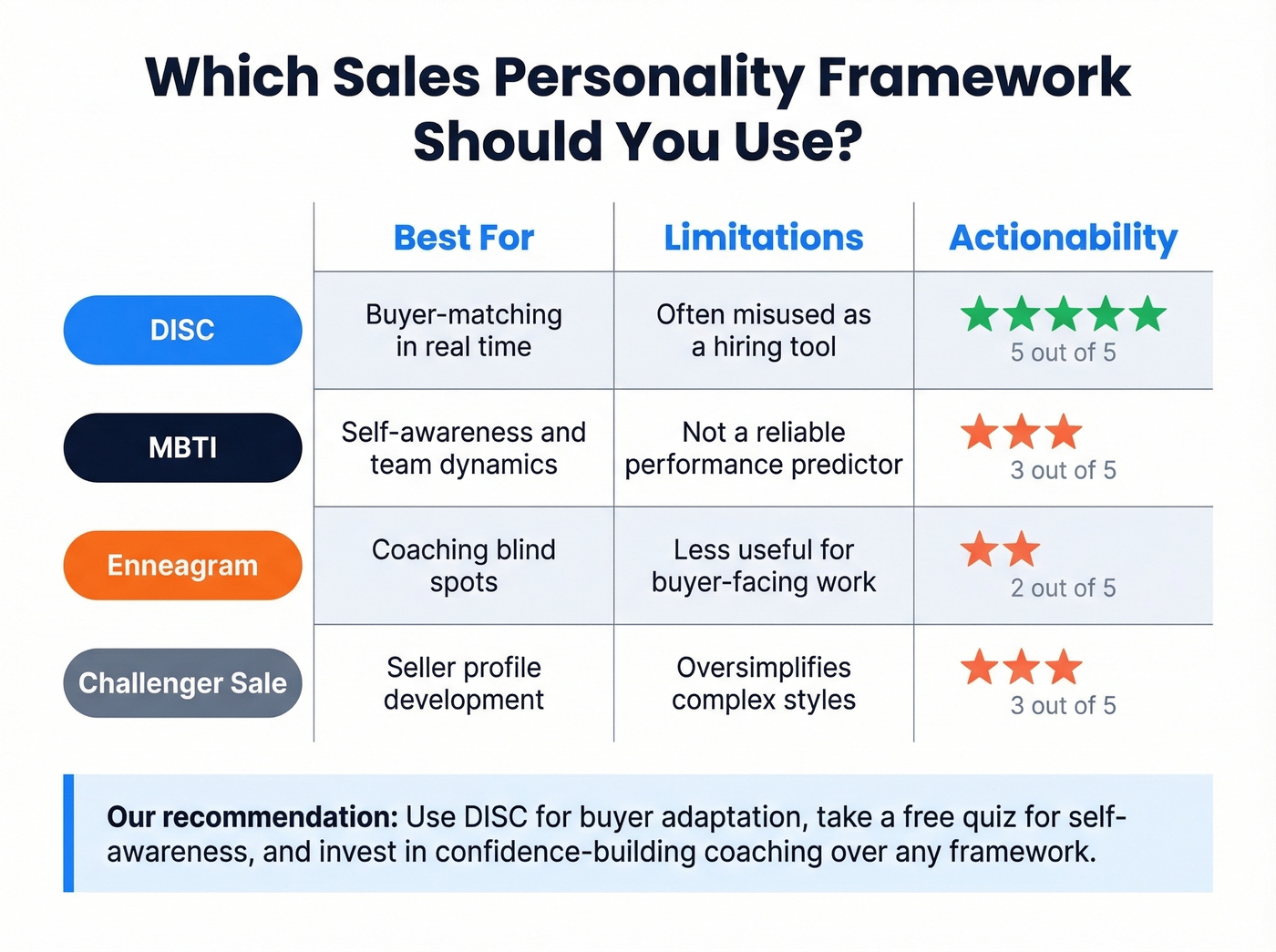
| Framework | Best For | Limitations | Cost |
|---|---|---|---|
| DISC | Buyer-matching in real time | Often misused as a hiring tool | Free-$100/assessment |
| MBTI | Self-awareness, team dynamics | Not a reliable sales performance predictor | Free-$60 |
| Enneagram | Coaching blind spots | Less actionable for buyer-facing work | Free-$30 |
| Challenger Sale | Seller-profile development | Oversimplifies complex selling styles | ~$20-$30 (book) |
HubSpot identifies seven MBTI types that succeed in sales: ESFJ, ESTP, ENTJ, INTJ, ISTP, INFJ, and ESTJ. That's a wide range - including two introverted types - which tells you MBTI is better for understanding yourself than for predicting who'll hit quota. On r/sales, reps regularly try to correlate MBTI with comp; one ENTJ AE posted $188K CAD earnings alongside their type. The impulse is understandable, but a sample of one isn't a study.
The Enneagram is underrated for coaching. Blindspots in Sales maps each type to a specific sales blind spot: Type 3s prioritize success over authenticity, Type 8s can intimidate clients, and Type 9s avoid the conflict that closing sometimes requires. Useful for self-awareness, less useful for reading a buyer on a first call.
The Challenger Sale framework ranks five seller profiles from least to most likely to be a top performer. Relationship Builders come in last. Challengers come in first. That finding still surprises people. Here's the thing - most reps who say "relationships matter" actually mean trust, value, and collaboration, not the passive harmony the Challenger model defines. (If you're tightening your process end-to-end, map this to the steps to close a sale.)

You just crafted the perfect D-type email - short, direct, ROI-focused. Now who do you send it to? Prospeo gives you 300M+ profiles with 30+ filters so you can target assertive decision-makers, analytical CFOs, or any buyer type with 98% verified emails.
Personality-matched outreach means nothing if the email bounces.
What Research Says About Personality and Sales
Most companies use DISC wrong. Even DISC's own publishers say it isn't a hiring tool. The data supports that caution.
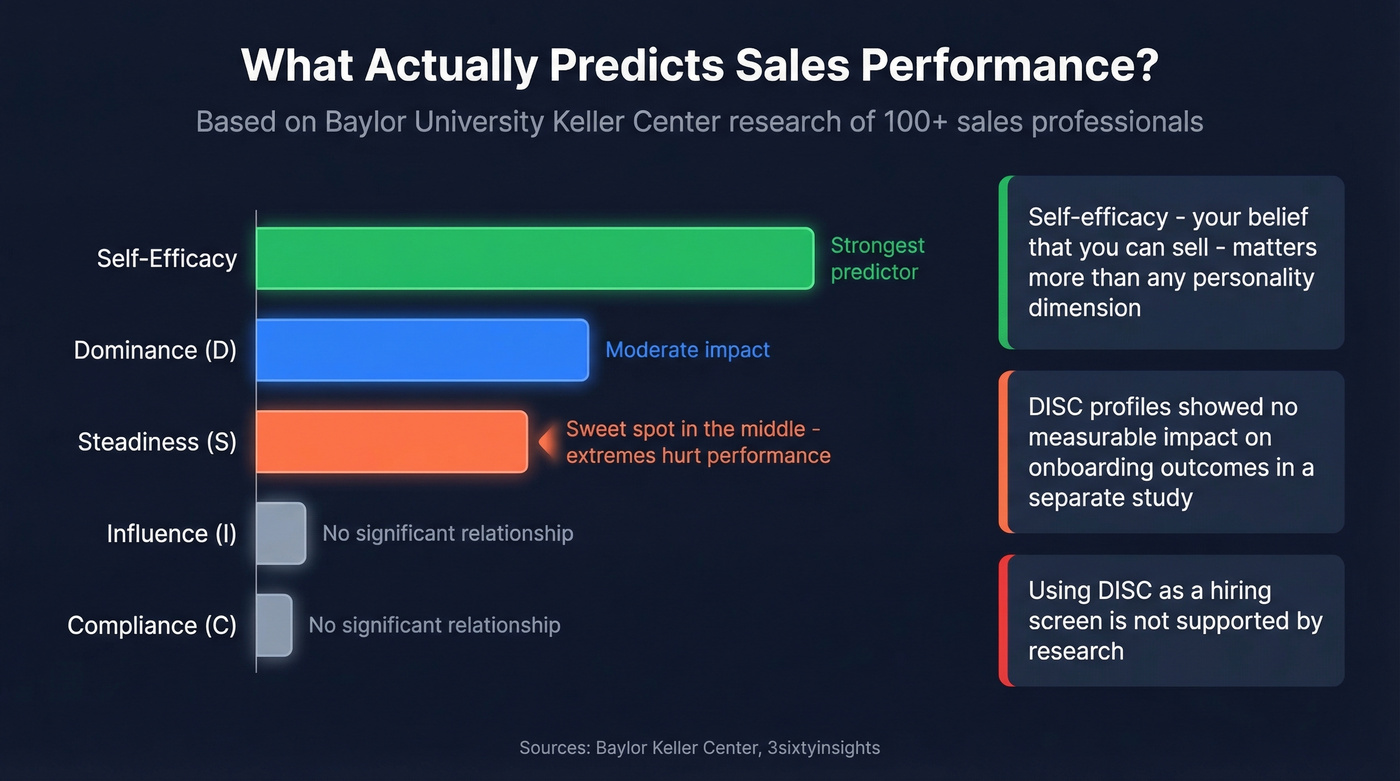
Baylor's Keller Center studied over 100 sales professionals and found that the strongest determinant of sales performance was self-efficacy - not any DISC dimension. High-D individuals did outperform low-D individuals, but Influence and Compliance showed no significant relationship with performance at all. Steadiness was the most interesting finding: moderate-S reps performed well, but those at the extreme high end performed very poorly.
A separate analysis from 3sixtyinsights examined two sales onboarding programs and found DISC profiles had no measurable impact on knowledge or performance outcomes. Every self-report assessment also carries impression management bias - Truffle's own documentation acknowledges this and recommends validating results against observable behavior like call recordings and pipeline data. Research on gender differences in sales has found no consistent evidence that men or women are inherently better suited to selling; performance gaps tend to trace back to opportunity, coaching quality, and territory assignment rather than innate traits.
Let's be honest: if you're investing in personality assessments instead of confidence-building coaching, you're optimizing the wrong variable. Self-efficacy beat every DISC dimension. We've seen teams waste entire quarters on DISC-based hiring screens when the research flat-out doesn't support it. Train your reps to believe they can sell, then give them the communication tools to adapt. That's the order of operations. (For a systems view, see factors affecting sales performance.)
Traits That Actually Predict Quota Attainment
Beyond frameworks and labels, certain traits show up consistently in high performers:
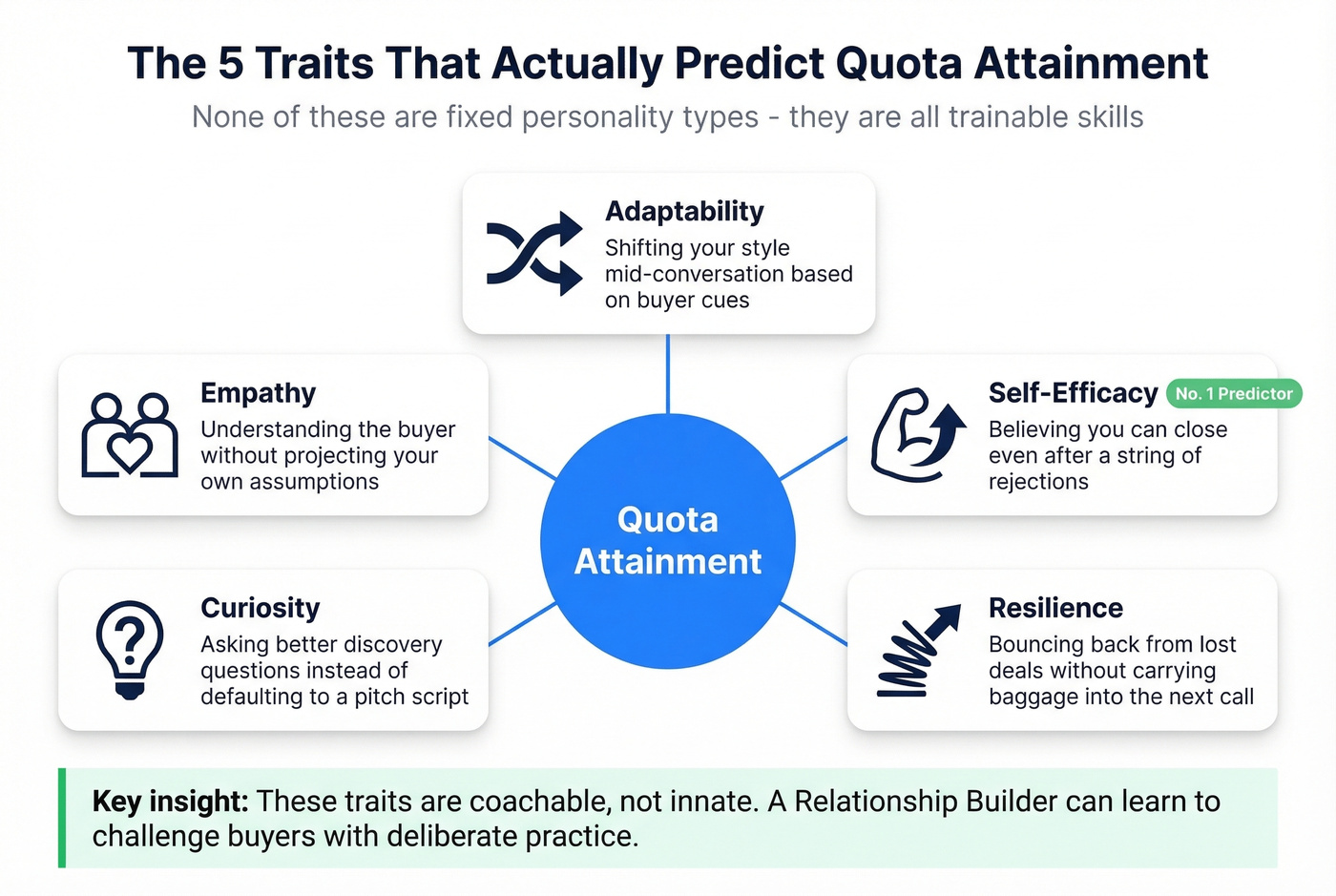
- Adaptability - shifting communication style mid-conversation based on buyer cues.
- Self-efficacy - believing you can close, even after a string of rejections.
- Resilience - bouncing back from lost deals without carrying emotional baggage into the next call.
- Curiosity - asking better discovery questions instead of defaulting to a pitch script.
- Empathy - understanding the buyer's situation without projecting your own assumptions.
None of these are fixed personality types. They're trainable skills. That's the most important takeaway from the research: the traits that predict quota attainment are coachable, not innate. A rep who scores as a "Relationship Builder" on the Challenger framework can absolutely learn to teach and challenge buyers - it just takes deliberate practice and a manager who coaches to behavior, not to labels. (If you're building that muscle, start with sales training tips and a tighter sales communication cadence.)
Take a Free Sales Personality Quiz
Three options worth your time:
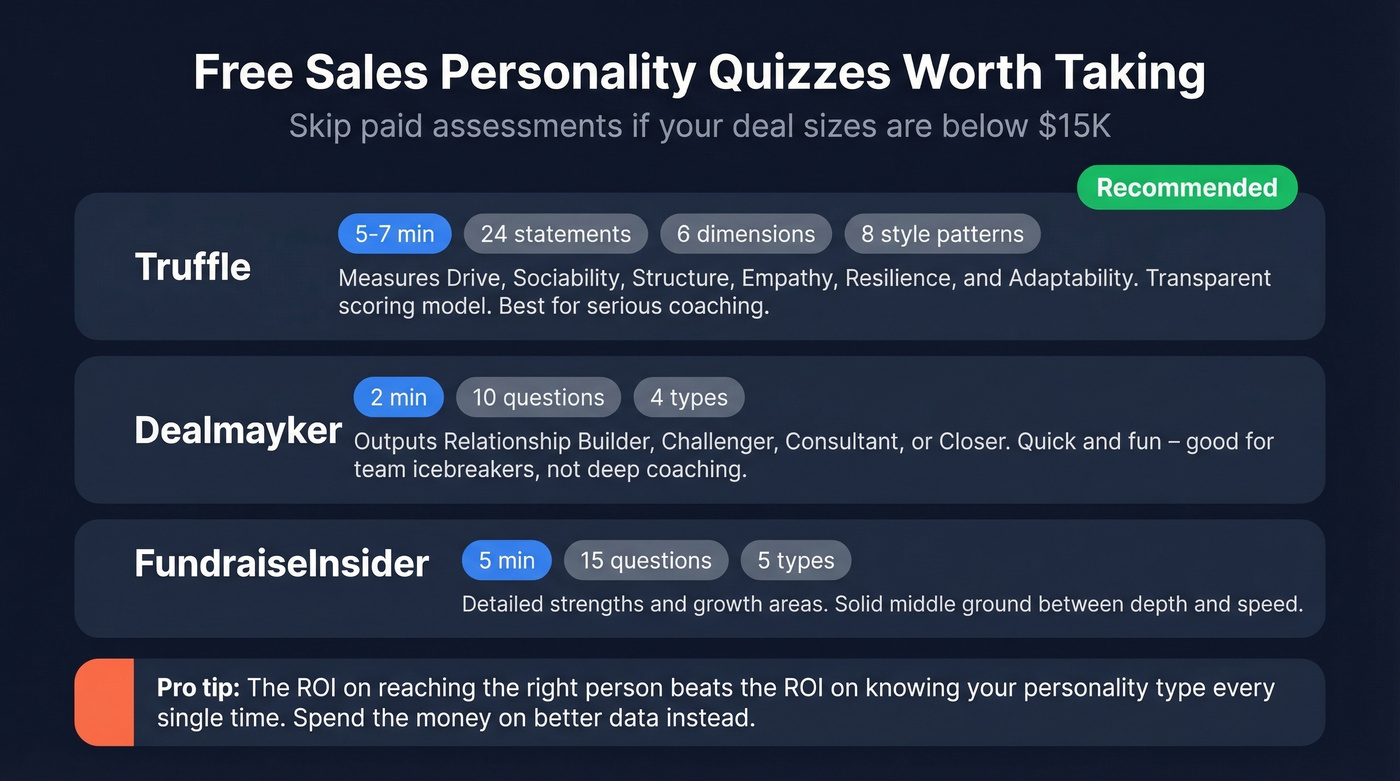
Truffle - 5-7 minutes, 24 statements, measures 6 dimensions (Drive, Sociability, Structure, Empathy, Resilience, Adaptability), and maps to 8 sales-style patterns. Transparent scoring model. This is our recommended pick.
Dealmayker - 2 minutes, 10 questions, outputs one of 4 types (Relationship Builder, Challenger, Consultant, Closer). Quick and dirty - good for a team meeting icebreaker, not for serious coaching.
FundraiseInsider - 5 minutes, 15 questions, 5 types with detailed strengths and growth areas.
For a paid option, CliftonStrengths (Top 5 runs ~$25-$30) is excellent for team coaching but less useful for buyer-matching.
Skip the paid assessments entirely if your deal sizes sit below $15K. Use a free quiz, internalize the four buyer archetypes above, and spend the money on better data instead. The ROI on reaching the right person beats the ROI on knowing you're an ENTJ every single time. (If you're rebuilding your outbound engine, use these sales prospecting techniques and a cleaner lead generation workflow.)
Put It Into Practice
You've identified your style, studied the frameworks, and adapted your pitch to different buyer types. None of it matters if the email bounces. A huge chunk of outbound fails because the message never reaches the right inbox in the first place - bad addresses, outdated contacts, and deliverability issues will crush reply rates no matter how well you tailor your tone.
Prospeo solves that last-mile problem with 98% email accuracy and a 7-day data refresh cycle, so your personality-adapted pitch actually lands. The free tier gives you 75 emails per month - enough to test whether better data changes your reply rates before you commit. (To go deeper on the mechanics, read our email deliverability guide and email bounce rate benchmarks.)
Research says self-efficacy beats personality type every time. Nothing builds confidence like knowing your emails actually land. Prospeo's 5-step verification delivers 98% accuracy at $0.01/email - so your tailored scripts reach real buyers, not dead inboxes.
Stop optimizing personality frameworks. Start optimizing deliverability.
FAQ
What's the best personality type for sales?
No single type is "best." Baylor University research found self-efficacy - confidence in your own selling ability - is the strongest predictor of sales performance, not personality type. High-Dominance individuals showed a slight edge, but adaptability matters more than any fixed trait.
Is DISC or MBTI better for sales teams?
DISC is more practical for day-to-day selling because it maps directly to buyer communication styles. MBTI is useful for self-awareness and team dynamics but isn't a reliable sales performance predictor. Use DISC for buyer-matching and CliftonStrengths for team coaching.
Can introverts succeed in sales?
Yes. HubSpot identifies INTJ and ISTP - both introverted types - among MBTI profiles that thrive in sales. The Challenger Sale data shows that relationship-building extroverts are actually the least likely to be top performers. Listening, teaching, and challenging buyers matters more than being outgoing.
How do I make sure my adapted pitch reaches the right person?
Use a verified-data platform like Prospeo to find accurate emails for your target buyers. With 98% email accuracy and a 7-day refresh cycle, your personality-adapted outreach actually reaches the intended inbox instead of bouncing.