

7 Sales Persuasion Tactics That Close Deals in 2026
Your SDR team memorized Cialdini's six principles. Reply rates haven't moved. You don't need more sales persuasion tactics - you need seven you'll actually run, with scripts and a system behind them. A practitioner on r/sales nailed it: when they stopped trying to convince and started guiding, prospects opened up. That's the shift this article is built around - understanding how to use psychology to sell without making the prospect feel sold to.
If you implement nothing else: Fix your talk-to-listen ratio to 40/60. Use tactical empathy in every discovery call. Follow up six times across multiple channels.
What Buyer Psychology Actually Shows
[57% of the buying journey](https://www.linkedin.com/business/sales/blog/b2b-sales/how-sales-can-win-before-57 - of-the-buyers-journey-is-over) is complete before a prospect talks to a rep. They've read the case studies, compared pricing pages, and asked their network. By the time you get on a call, you're not introducing - you're defending.
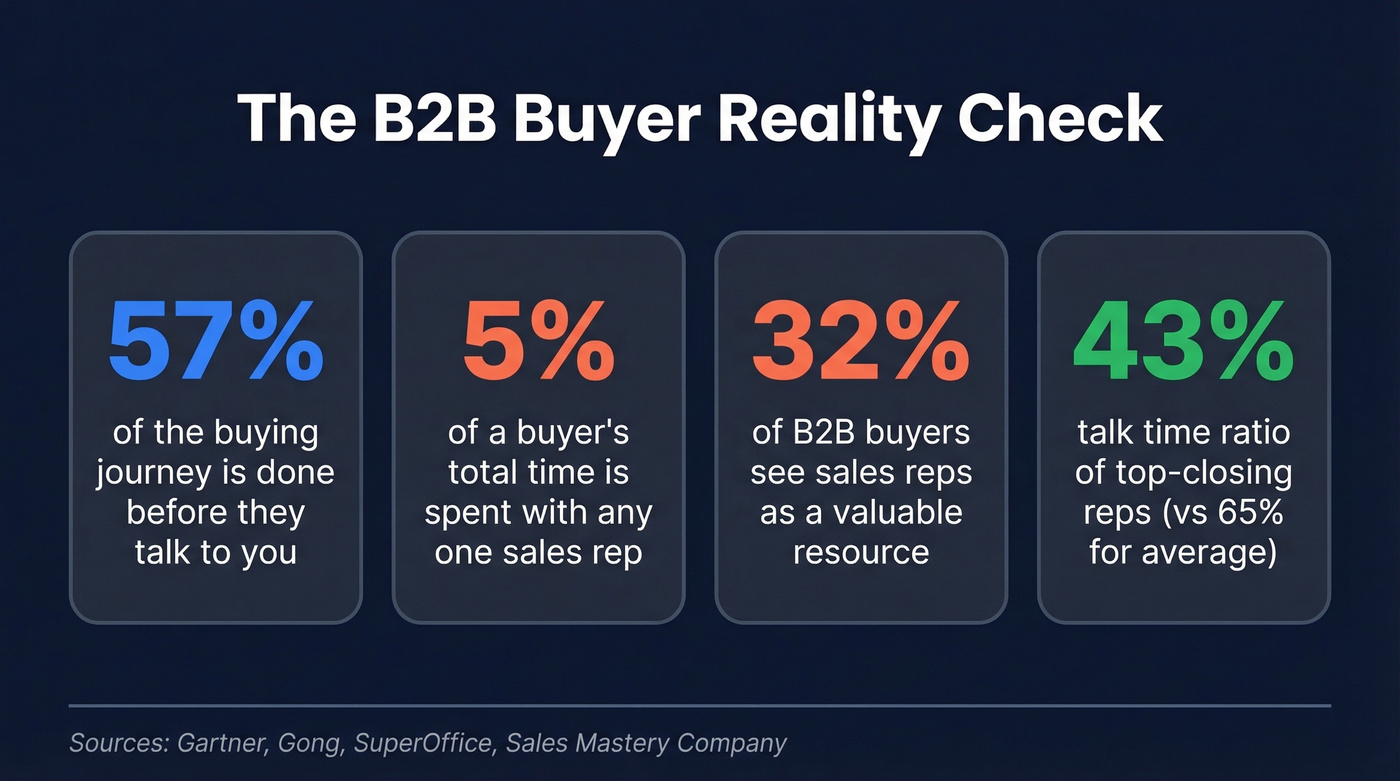
It gets worse: only 32% of B2B buyers consider sales reps a valuable resource. The average deal involves 6-10 stakeholders, and 80% of those buyers prioritize avoiding a bad decision over getting the best deal. Gartner found that reps get roughly 5% of a customer's total buying time. Five percent. Every second of that window has to count.
That last stat matters most. Your prospects aren't optimizing - they're protecting themselves. Gong's data shows top-closing reps speak 43% of the time. Average performers? 65%. The reps who close more talk less. They listen, diagnose, and guide. They don't "persuade" - and that's exactly why persuasion works best when it doesn't feel like persuasion at all.
Persuasion Starts Before the Call
The word "persuasion" is the problem. The moment you frame a conversation as "I need to convince this person," the prospect feels it. Real influence is structural - what some call "ambient authority." It's the accumulated signals across every interaction before the sale: your website, your proposal formatting, the accuracy of the prospect's name in your opener. One mismatch - a bounced email, a wrong title, a misspelled name - and trust evaporates before you've said a word.
Bad data is the silent killer here. If your first email bounces or addresses someone by the wrong title, you've burned credibility before you've spoken. Building that ambient authority means getting the basics right: verified contact info, relevant content, and a first touch that proves you did your homework.
If you want a broader system for filling pipeline (not just persuading on calls), start with these sales prospecting techniques.
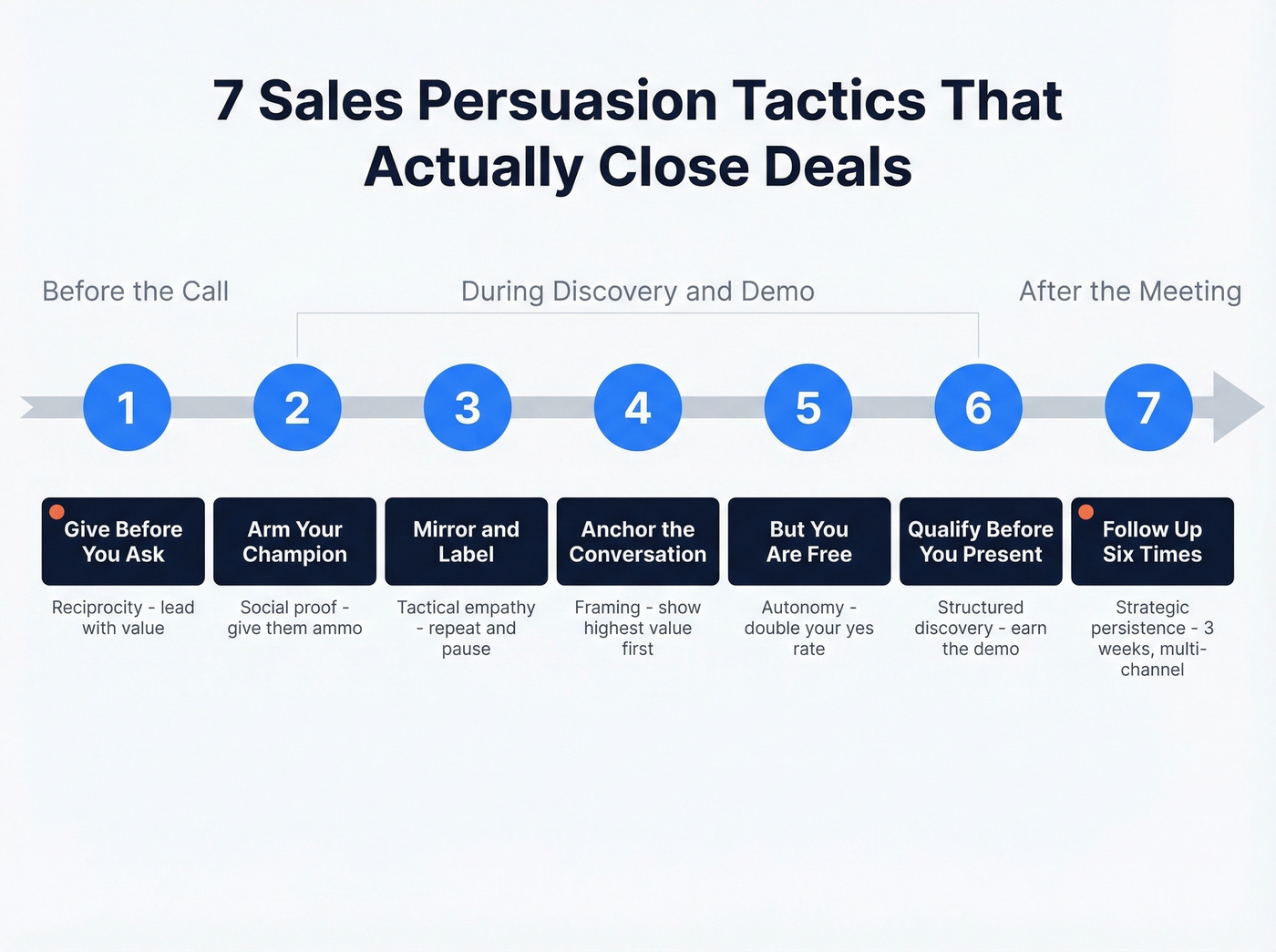
7 Tactics That Actually Close
1. Give Before You Ask (Reciprocity)
Lead with a relevant insight, benchmark, or resource before you pitch anything. "I noticed your team's hiring three SDRs - here's a comp framework we put together for similar-stage companies." Reciprocity isn't about gifts. It's about demonstrating you've done the work. Lead with the value the prospect cares about, not the features you're proud of.
This is easiest to operationalize when your team has a repeatable way to add value in sales.
Think of every value-first interaction as a deposit into an emotional bank account. Each helpful touchpoint builds goodwill you can draw on when it's time to ask for the meeting, the demo, or the signature. Use this in your first email or the opening two minutes of discovery.
2. Arm Your Champion (Social Proof)
B2B deals aren't won in the demo. They're won in the internal meeting you're not invited to.
Give your champion specific language, ROI numbers, and a one-page summary they can forward. "Here's exactly what to tell your CFO" beats any slide deck. Concrete metrics - "35% reduction in bounce rates" or "3x connect rate improvement" - give your champion ammunition that survives the internal game of telephone. Use this after a strong demo, before the deal goes to committee.
If you're selling into larger buying committees, this is a core enterprise B2B sales skill.
3. Mirror and Label (Tactical Empathy)
Ever watched a prospect shut down mid-objection? Chris Voss's mirroring technique prevents that. Repeat the last 2-3 words the prospect said, then pause. "The implementation timeline concerns us." You respond: "The timeline concerns you?" Then wait. If they give a yes/no, follow with "tell me more about that."
If you want a tighter question map for this, use a structured set of discovery questions.
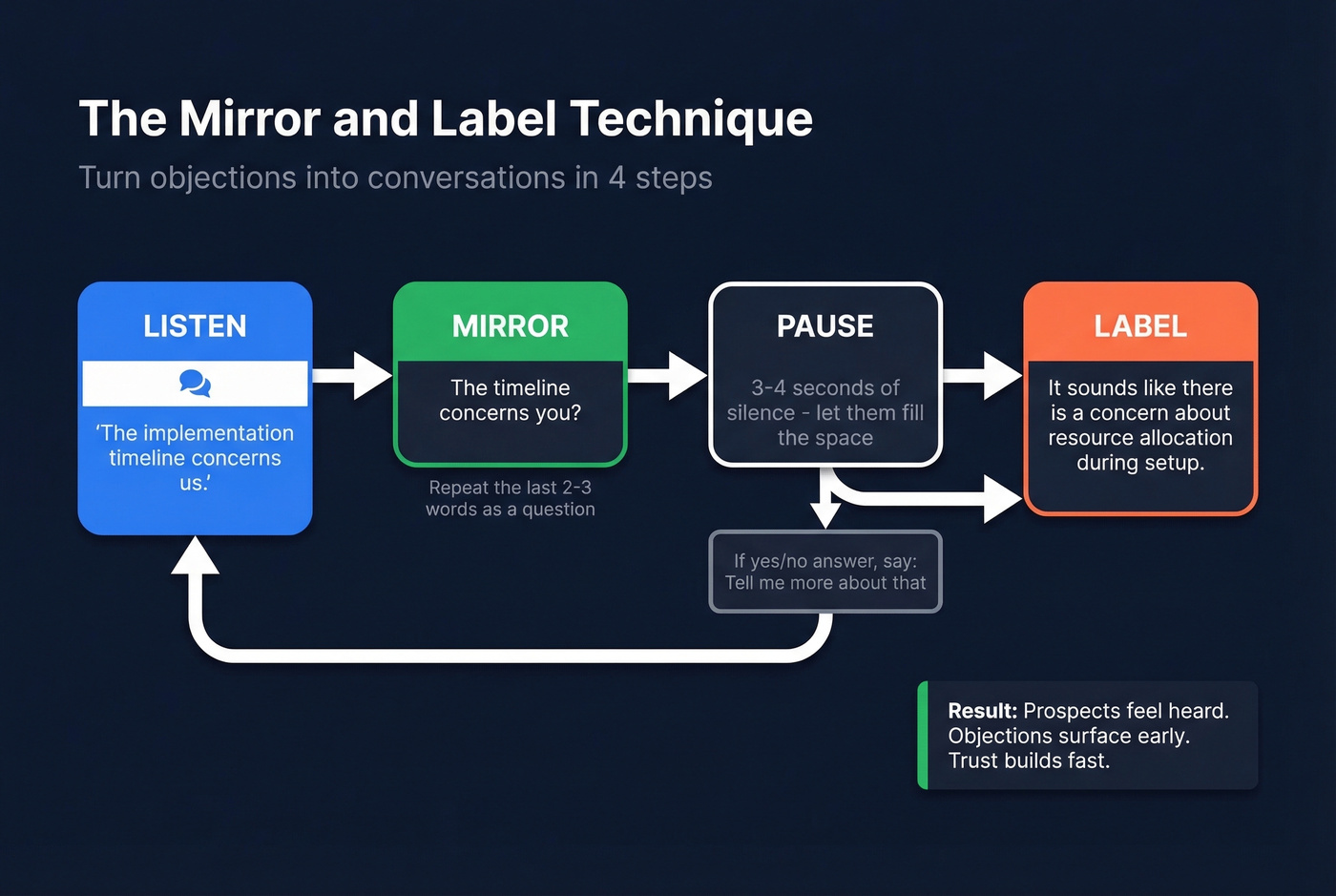
We've seen this single technique transform discovery calls from interrogations into conversations - it's the fastest way to build trust without saying anything about yourself. In our experience, reps who practice mirroring for even a week start hearing objections they never knew existed, because prospects finally feel safe enough to voice them.
4. Anchor the Conversation (Framing)
Present your highest-value package first. When the prospect sees the $80k option before the $35k option, the $35k feels reasonable. This isn't manipulation - it's context-setting.
Anchoring works in proposals, pricing conversations, and even discovery: "Most companies in your space spend $X on this problem." A well-designed comparison table or ROI calculator makes the anchor tangible and memorable. Skip this tactic if you're selling a single-SKU product with public pricing - anchoring only works when there's a range to frame.
For deeper pricing context-setting, see anchor in negotiation.
5. "But You Are Free" (Autonomy)
A meta-analysis of over 22,000 people found that affirming someone's freedom to choose - "totally your call," "no pressure either way" - can double the chances of a person saying "yes." Drop this phrase naturally at the end of a pitch or follow-up. It's the easiest tactic on this list and one of the most effective.
This is the opposite of manufactured scarcity. Autonomy-based language respects the buyer and outperforms pressure every time.
6. Qualify Before You Present (Structured Discovery)
Here's the thing: most reps earn the right to demo way too early. The Straight Line concept maps questions from surface-level to intrusive as trust builds, creating a conversation map that guides the call naturally instead of forcing it. You can lose the sale in the first four seconds if your greeting isn't dialed in - and jumping straight to features wastes that window entirely.
If you can't articulate the prospect's pain better than they can, you haven't earned the presentation yet. Pay attention to your vocabulary too; dropping industry jargon the prospect doesn't use creates distance instead of connection.
If you need a repeatable flow, start with a discovery call script.
7. Follow Up Six Times (Strategic Persistence)
Research suggests six follow-ups over roughly three weeks is the sweet spot. Most reps stop after a couple of touches. That's leaving money on the table.
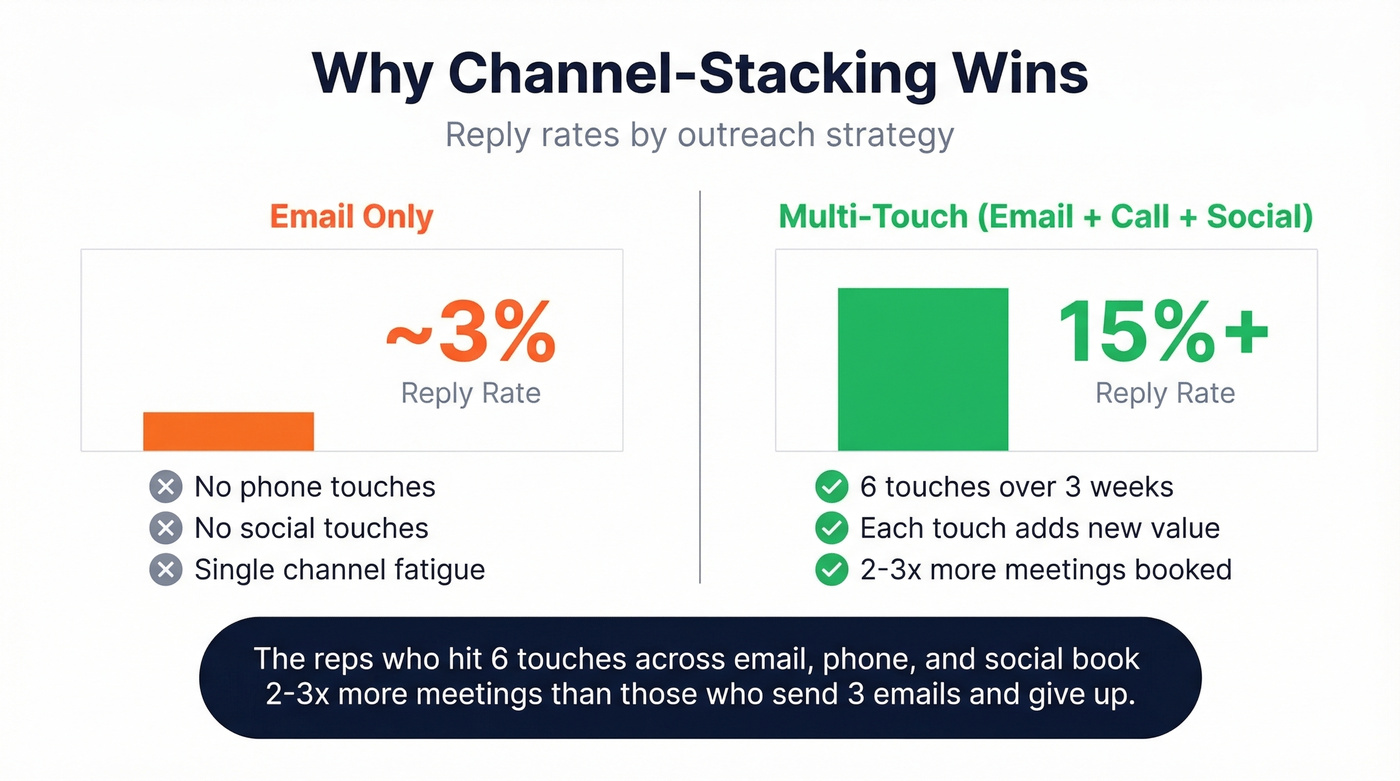
Persistence isn't pushy if each touch adds value - a relevant case study, a benchmark, a useful article. Not "just checking in." Each follow-up is a chance to show the prospect exactly how much time or money they'd save, giving them a new reason to respond. When we've audited outbound sequences for sales teams, the pattern is always the same: reps who hit six touches across email, phone, and social book 2-3x more meetings than those who send three emails and give up.
To make this easier to execute, keep a swipe file of sales follow-up templates.

You just read that a wrong title or bounced email kills trust before you speak. Prospeo's 5-step verification delivers 98% email accuracy so your first touch actually lands - giving reciprocity, anchoring, and every other tactic a chance to work.
Stop perfecting your pitch only to send it to a dead inbox.
Scripts That Work
Channel-stacking matters: email-only campaigns average around 3% reply rates, while multi-touch sequences (email + call + social) can climb to 15%+. Here are templates that layer the tactics above.
If you're building full sequences, use a proven B2B cold email sequence.
Cold call opener (autonomy + reciprocity):
"Hey [Name], I'll be brief - I know I'm catching you cold. In two minutes, I can share how we helped [similar company] cut [specific problem] by [specific metric]. Does that sound fair, or should I call back at a better time?"
Cold email (PAS framework + social proof):
Subject: [Company]'s [specific metric] vs. industry average
Hi [Name],
[Company] is scaling the sales team - congrats. Teams that scale outbound fast often see bounce rates spike when contact data isn't verified.
We helped Meritt cut bounce rates from 35% to under 4% and 3x their connect rate to 20-25%. Worth a 15-minute look? Totally your call.
Let's be honest about these templates: they're starting points. The specific metric, the company reference, the problem you lead with - those have to be real and researched. A perfect template with lazy personalization still lands in the trash.
What Kills Persuasion
These mistakes undo everything above:
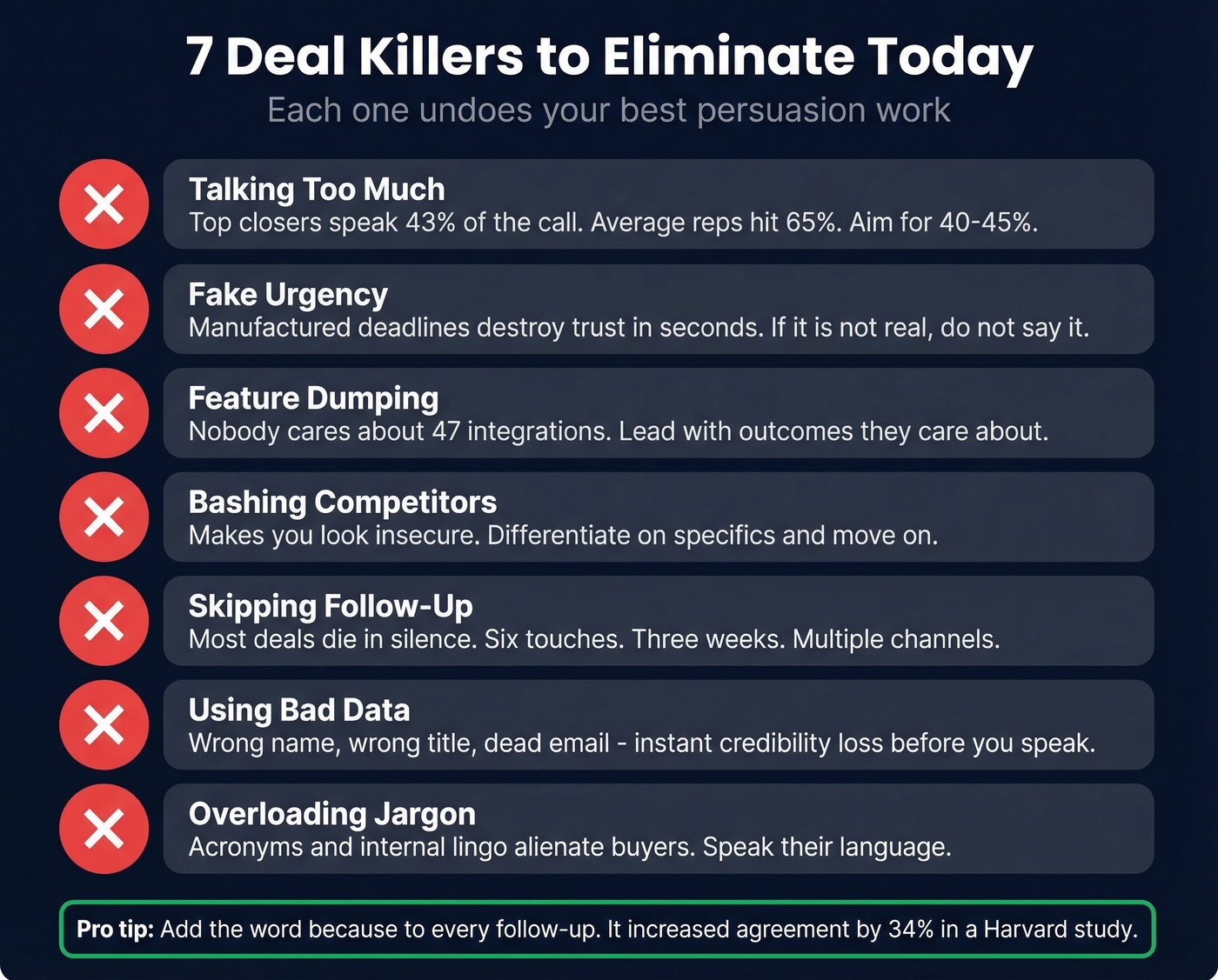
- Talking too much. 43% vs 65%. Aim to speak around 40-45% of the call.
- Fake urgency. "This offer expires Friday" when it doesn't. Manufactured deadlines erode trust. Building trust takes weeks; a single dishonest deadline can destroy it in seconds.
- Feature-dumping. Nobody cares about your 47 integrations. Lead with outcomes.
- Bashing competitors. It makes you look insecure. Differentiate on specifics and move on.
- Skipping follow-up. Most deals die in silence. Six touches. Three weeks. Multiple channels.
- Using bad data. Wrong name, wrong title, dead email - instant credibility loss before you speak. Tools like Prospeo with 98% email accuracy and a 7-day data refresh cycle exist specifically to prevent this.
- Overloading jargon. Acronyms and internal lingo alienate buyers. Speak their language, not yours.
If you're seeing bounces, start by fixing your email bounce rate and tightening your email deliverability.
A Harvard study found that adding the word because increased agreement by 34%. Every follow-up, every email, every voicemail - give a reason. "Because I found a benchmark relevant to your Q3 goals" beats "just circling back" every time. And a well-placed moment of self-deprecating humor - acknowledging a clunky transition or a too-long voicemail - can disarm tension and make you more relatable.
Six follow-ups across email, phone, and social only work when you have the right contact data. Prospeo gives you verified emails and 125M+ direct dials refreshed every 7 days - so your persistence reaches real buyers, not outdated records.
Arm your reps with data accurate enough to deserve six touches.
Persuasion vs. Manipulation
The line is simpler than people make it. Persuasion serves the prospect's interest. Manipulation serves yours at their expense.
The Zendesk framework nails the test: if the prospect would thank you for the conversation even if they don't buy, you're on the right side. Cialdini's principles - reciprocity, commitment and consistency, social proof, authority, liking, and scarcity - are tools. Like any tool, the ethics depend on intent. The liking principle works because genuine rapport creates better outcomes for both sides, not because you're gaming the relationship. Commitment and consistency means helping buyers follow through on goals they already stated - not trapping them in escalating agreements.
If you want to formalize this line for your team, use a clear ethics in sales standard.
The similarity attraction effect is another ethical lever: when prospects see you understand their world - their industry, their challenges, their language - they naturally trust you more. Positioning yourself as a subject matter expert through thought leadership and relevant content earns that trust honestly.
FAQ
What's the most effective persuasion technique in sales?
Tactical empathy. Gong data shows top closers speak 43% of the time and listen 57%. Master the 40/60 talk-to-listen ratio before layering on any other technique - it's the foundation that makes every other tactic work.
How do you persuade without being pushy?
Affirm the prospect's autonomy ("totally your call"), ask discovery questions before pitching, and follow up with value. The "But You Are Free" technique doubled compliance in a meta-analysis of 22,000+ participants. Persistence with value isn't pushy - persistence without it is.
How does data quality affect sales outcomes?
Wrong names, dead emails, and outdated titles signal zero research effort - killing trust before you speak. Verified contact data means your first touch is credible and your tactics reach the right person.
Do sales persuasion tactics work in B2B with long cycles?
Yes, but they compound rather than convert instantly. In deals with 6-10 stakeholders and 3-6 month cycles, tactics like arming your champion with proof points and following up six times across channels are what move deals through committee. Single-touch persuasion rarely closes enterprise deals.