

Sales Pitch Definition: What It Is & How to Nail It in 2026
You've read ten articles that say "start with a hook" and "tell a story." None of them explain why your pitch still sounds like every other rep's pitch. The problem isn't your delivery - it's that most advice skips the structural thinking that separates a pitch that books meetings from one that gets a polite "send me some info."
What Is a Sales Pitch?
A sales pitch is a concise, persuasive message designed to convince a prospect to take a specific next step - booking a meeting, starting a trial, or signing a deal. It's not a monologue. It's not a landing page, a marketing tagline, or a product demo. It's the shortest path between your prospect's problem and your solution, delivered in whatever format the moment demands: a 30-second phone opener, a 90-word cold email, or a 10-minute boardroom presentation.
Every effective pitch needs three things: a hook rooted in the prospect's problem, a value proposition framed as an outcome, and a single clear CTA. Top closers talk only 43% of the time versus 65% for average performers. Your pitch should create space for dialogue, not fill every second with your voice.
Where the Term Comes From
"Pitch" as inflated sales talk dates to 1876, likely borrowed from the baseball sense. The compound "sales pitch" in its modern advertising meaning first appeared in 1943, concentrated in The Billboard magazine. One early usage: "The sales pitch... is now an integrated part of the show" - describing how sponsored entertainment had merged with selling.
That origin reveals something useful about the sales pitch meaning we use today. It started as entertainment-adjacent persuasion, not a product spec sheet. The best pitches in 2026 still work that way - they're performances built around a prospect's world, not recitations of your feature list.
Why Your Pitch Matters More Than Ever
The window for pitching has never been smaller. Nearly 70% of the buyer's journey is complete before a prospect talks to a rep. An average of 7.4 decision-makers are involved in a typical B2B purchase. And 61% of B2B buyers say they'd prefer a completely rep-free experience.
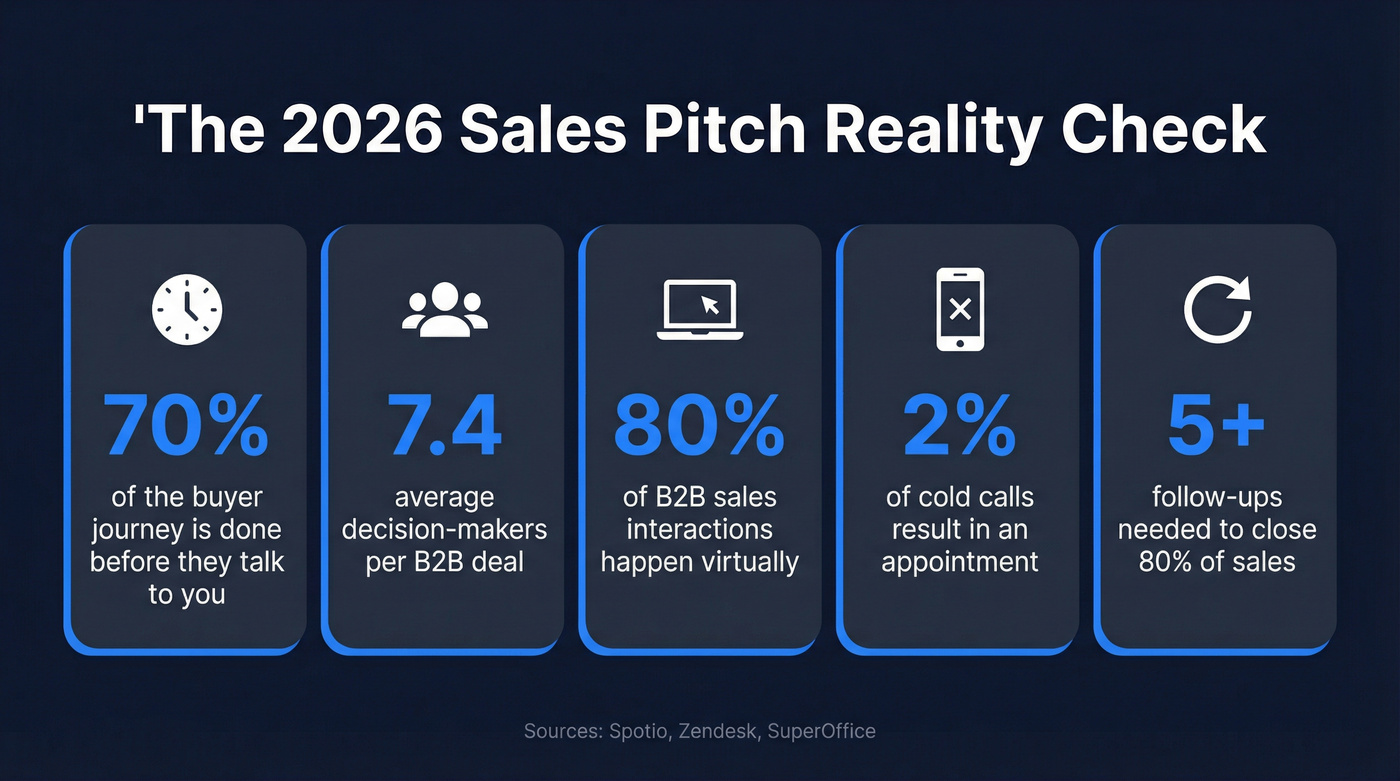
So when you do get someone's attention, your pitch has to land immediately. You're not educating from scratch - you're competing against whatever the buyer already believes. 80% of B2B sales interactions now happen virtually, which strips away the body language and rapport-building that used to carry mediocre pitches. Only about 2-2.3% of cold calls result in an appointment, so your message has to be exceptional just to beat the baseline.
Here's the thing: the elevator pitch is overrated. It's a useful exercise for clarity, but 80% of sales require five or more follow-ups, and 92% of reps quit after four attempts. Your first pitch rarely closes anything. What it does is earn the right to a second conversation. Build for that.
Sales Pitch vs. Elevator Pitch vs. Pitch Deck
These terms get used interchangeably, and they shouldn't.
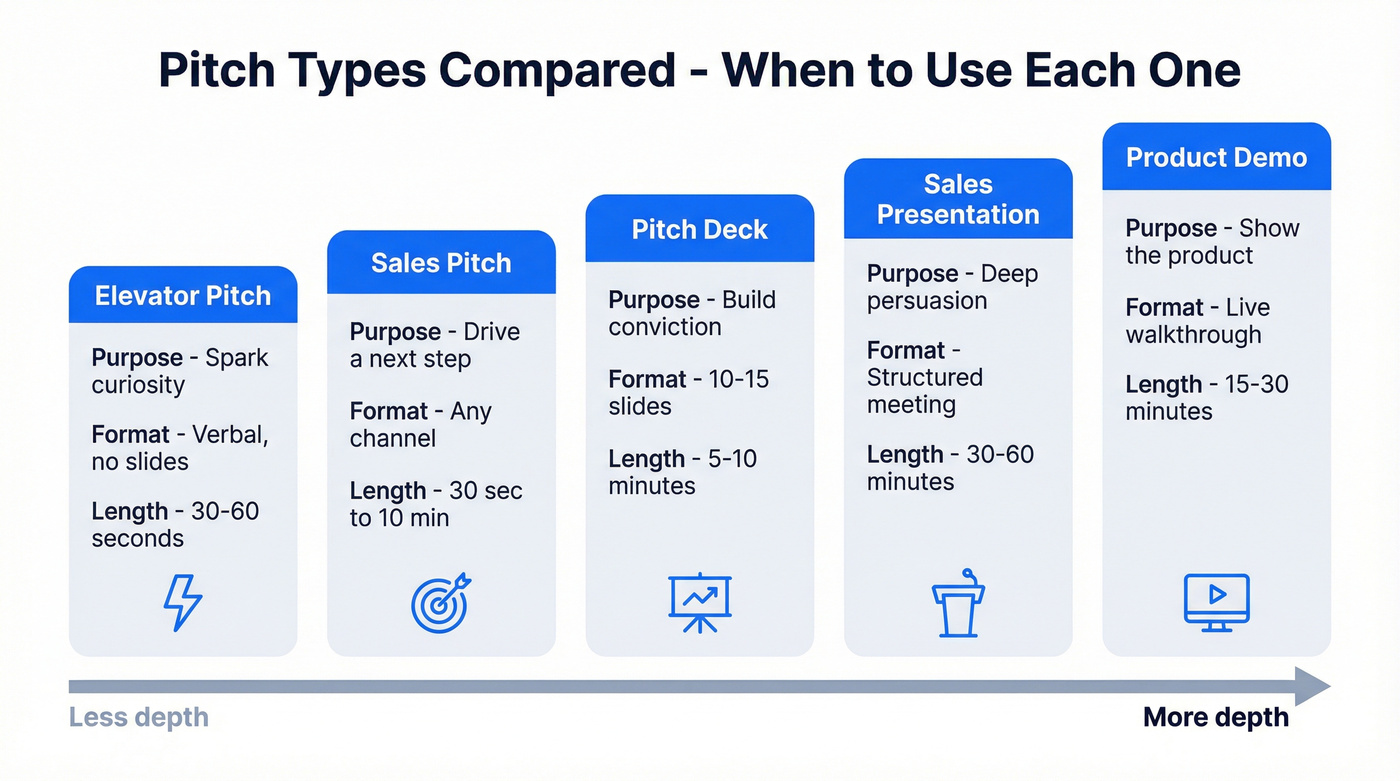
| Type | Purpose | Format | Length | Depth |
|---|---|---|---|---|
| Elevator pitch | Spark curiosity | Verbal, no slides | 30-60 seconds | Problem + who + why listen |
| Sales pitch | Drive a next step | Any channel | 30 sec - 10 min | Problem + value + proof + CTA |
| Pitch deck | Build conviction | 10-15 slides | 5-10 minutes | Model, traction, market, ask |
| Sales presentation | Deep persuasion | Structured meeting | 30-60 minutes | Full narrative + Q&A |
| Product demo | Show the product | Live walkthrough | 15-30 minutes | Features in context |
The elevator pitch gets you in the door. The pitch deck keeps you in the room. The sales pitch is the core argument that adapts to whatever format the moment requires - it connects every touchpoint in the buyer's journey.
If you want ready-to-use scripts, start with these elevator pitch examples and customize from there.

Your sales pitch doesn't fail at delivery - it fails before you hit send. Bounced emails and wrong numbers kill momentum before your prospect ever hears your hook. Prospeo gives you 98% verified emails and 125M+ direct dials so every pitch lands in front of a real decision-maker.
Stop perfecting pitches that bounce. Start reaching buyers who answer.
Frameworks That Actually Work
Most reps pitch intuitively, which means they default to whatever feels natural. That's usually a feature dump. Frameworks give you structure so you can focus on delivery instead of figuring out what to say next.
SPIN Selling
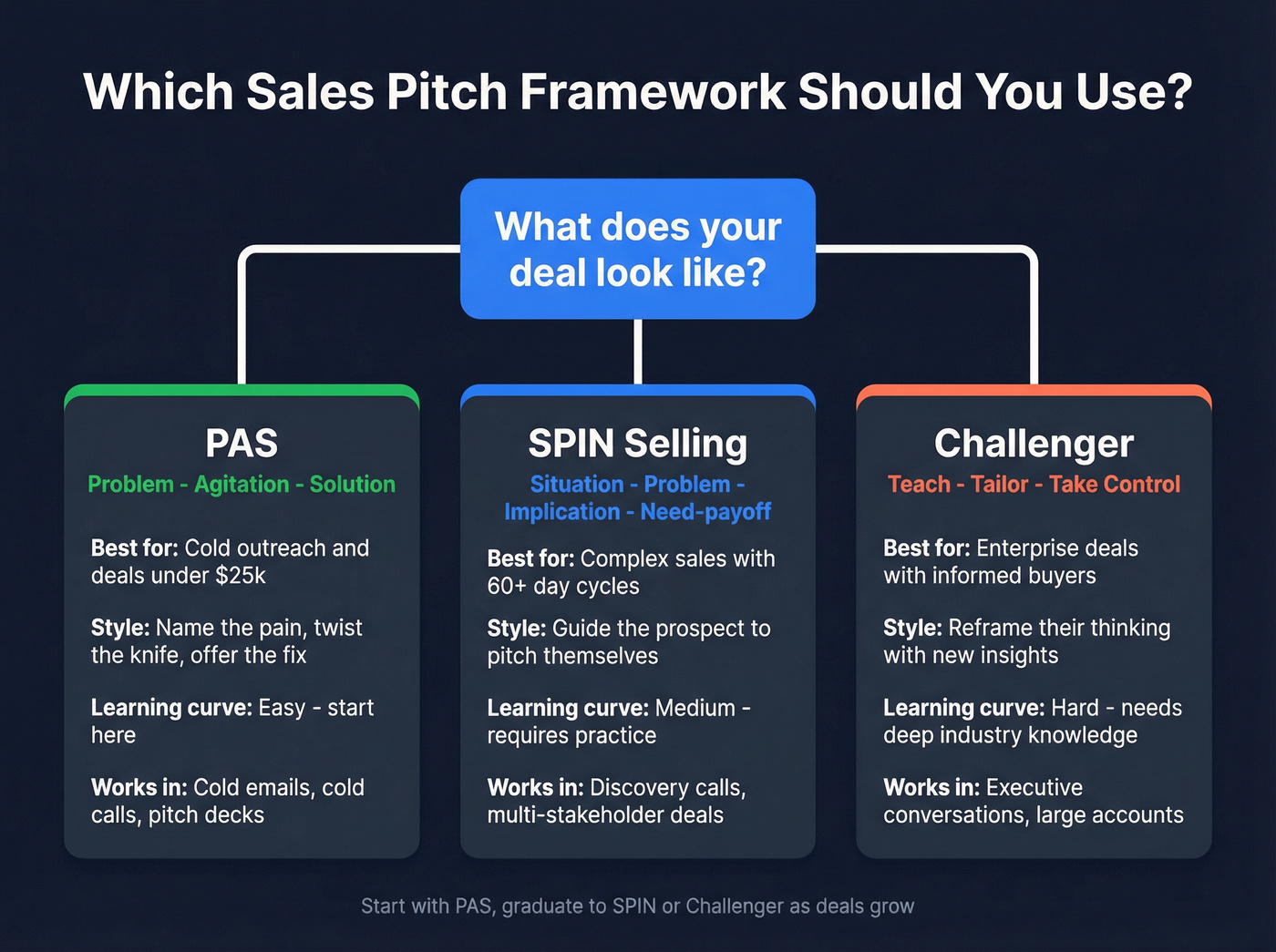
Neil Rackham built SPIN from studying 35,000 sales calls and found that a structured questioning strategy can improve closure rates by 20%. The acronym maps to four question types: Situation questions gather context, Problem questions surface pain, Implication questions expand the cost of inaction, and Need-payoff questions let the prospect articulate the value of solving it themselves.
SPIN works best for complex, discovery-heavy sales where the prospect doesn't fully understand their own problem yet. It's less a pitch framework and more a conversation architecture - you're guiding the prospect to pitch themselves. We've seen it work especially well for deals with 60+ day sales cycles where multiple stakeholders need convincing.
If you want to go deeper on discovery, use these discovery questions to structure your first call.
The Challenger Approach
This is the framework for enterprise deals where prospects think they already know the answer. You're not asking questions - you're reframing their thinking.
Dixon and Adamson's research identified five seller profiles and found the "Challenger" consistently outperformed. The core behavior is teach-tailor-take control: lead with an insight the prospect hasn't considered, tailor it to their specific situation, then confidently guide the conversation toward a decision. It requires deep industry knowledge and genuine confidence, which is why it's harder to learn than SPIN - but it's the single best approach when your buyer persona is a senior executive who's already done their homework.
This approach pairs well with account-based selling when you’re targeting a tight list of high-value accounts.
Problem-Agitation-Solution (PAS)
Imagine you're writing a cold email to a VP of Sales. You could open with your product's features. Or you could open with the fact that their team's outbound reply rate dropped 30% last quarter.
PAS starts there - name the problem, twist the knife by showing what happens if they don't fix it, then present your solution as the way out. It's the workhorse for cold outreach, the fastest framework to learn, and the most versatile. It works in cold emails, cold calls, and even pitch decks. If your deal size is under $25k, start here and graduate to SPIN or Challenger as your deals get bigger.
For multi-touch outreach, a B2B cold email sequence will usually outperform one-off pitches.
How to Write a Sales Pitch
Research Your Prospect First
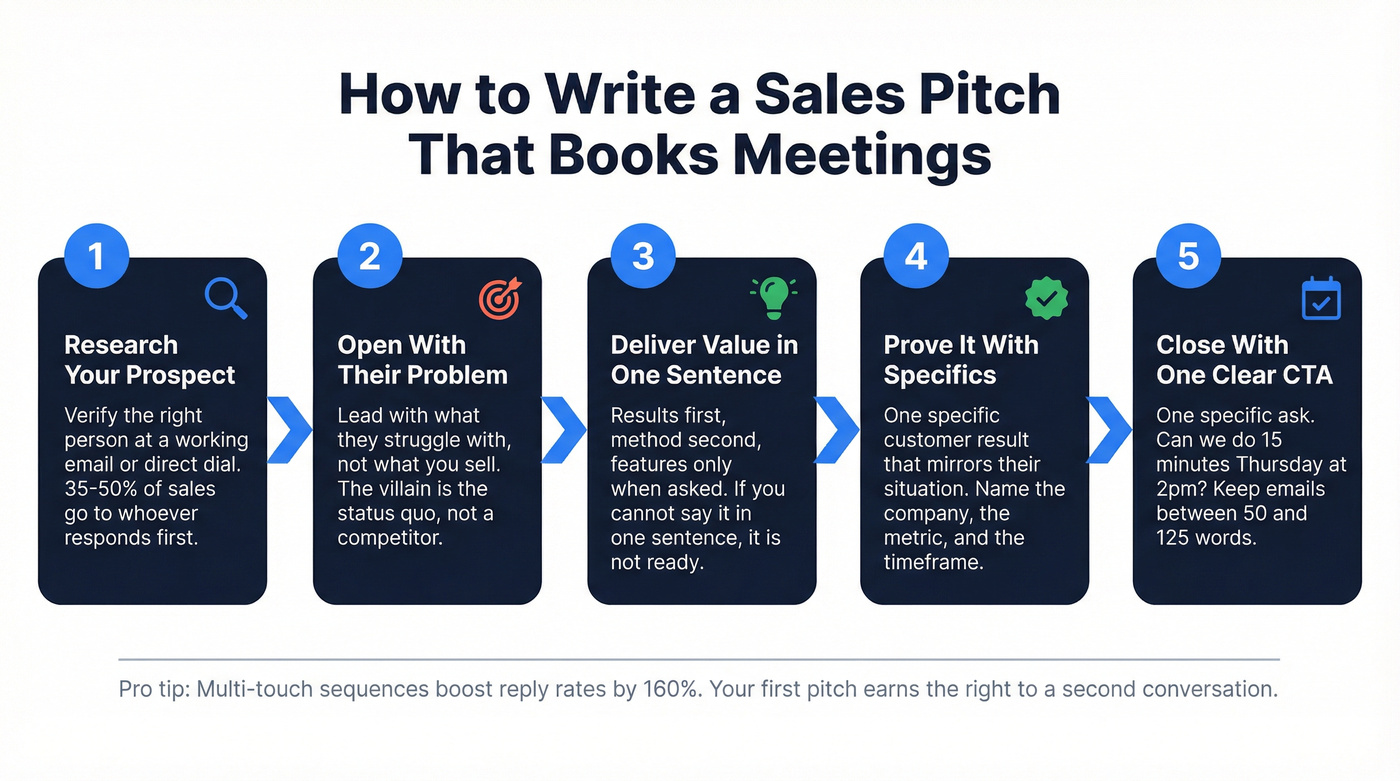
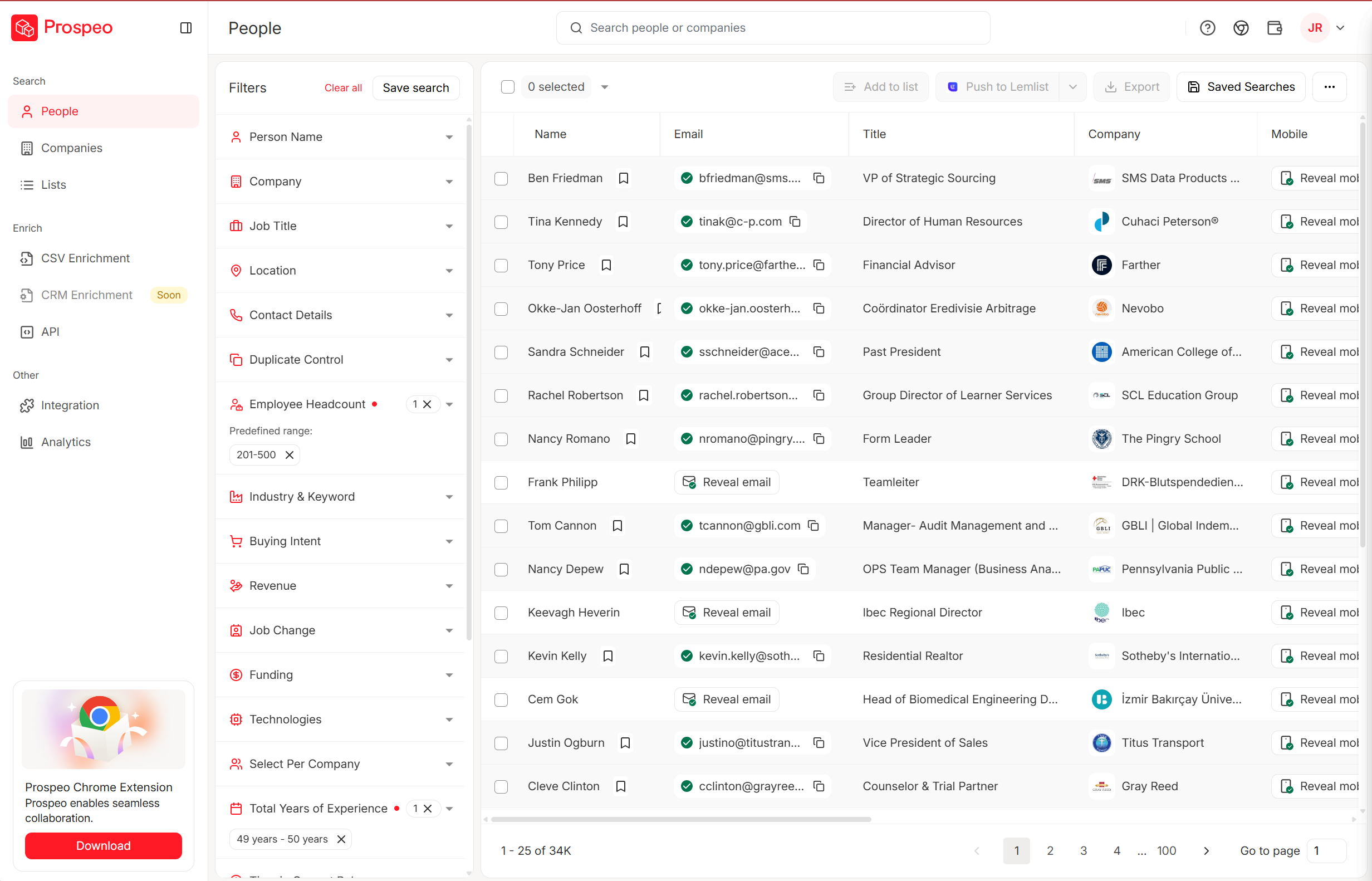
Before you write a single word, verify you're reaching the right person at a working email or direct dial. This sounds obvious, but 35-50% of sales go to the vendor that responds first. You can't respond first if your email bounces or your phone number connects to a general line.
Prospeo makes this step fast - search by role, company, and 30+ filters, then export verified emails and direct mobile numbers with 98% email accuracy on a 7-day data refresh cycle.
If you're building lists at scale, data enrichment can help you fill missing fields before you pitch.
Open With Their Problem
The single biggest mistake in sales pitching is leading with what you sell instead of what they're struggling with. That 43% talk-time stat isn't just trivia - it's the clearest predictor of whether a pitch converts. The gap isn't about being quiet. It's about asking better questions and framing the prospect's pain before presenting your solution.
Use what Pipedrive calls the "villain" framing: the enemy isn't a competitor, it's the status quo. Legacy systems, manual processes, the way things have always been done - that's your villain. Position your pitch as the escape from that villain, not as a product with features.
If you’re still getting stonewalled, these cold call rejection fixes can help you diagnose what’s actually happening.
Deliver Your Value Prop in One Sentence
If you can't explain what changes for the prospect in one sentence, your pitch isn't ready. "We help mid-market IT teams cut incident response time by 40% without adding headcount" is a value proposition. "We offer a cybersecurity platform with AI-powered threat detection" is a feature list wearing a trench coat.
Results first. Method second. Features only when asked.
If you want a tighter structure for persuasion, the AIDA model is a useful sanity check.
Prove It With Specifics
Generic credibility kills pitches. "We serve thousands of customers across dozens of countries" tells the prospect nothing. Instead, use a specific customer result that mirrors their situation: "We helped [similar company] reduce [specific metric] by [specific number] in [timeframe]." Specificity builds trust. Vagueness destroys it.
Close With a Clear CTA
One next step. Not "let me know if you'd like to learn more." One specific ask: "Can we do 15 minutes Thursday at 2pm?"
For email pitches, keep the entire message between 50 and 125 words - that's the sweet spot for response rates. For cold calls, ask for 15 minutes, not an open-ended conversation. Time your calls for Wednesdays and Thursdays between 11am-12pm or 4pm-5pm - those are consistently top-performing windows. And remember that contacting the same prospect multiple times yields 2x more responses; multi-touch sequences can boost reply rates by 160%.
To make follow-ups easier, keep a set of sales follow-up templates ready to go.
The article says 35-50% of sales go to the vendor that responds first. You can't respond first if you're guessing at email addresses. Prospeo's 30+ search filters and 7-day data refresh mean you're pitching the right person with accurate contact data - not chasing dead leads while competitors book the meeting.
Research prospects in minutes, not hours, at $0.01 per verified email.
Sales Pitch Examples
A Cold-Call Pitch That Works
Here's a PAS-structured cold call for a SaaS company selling to IT leaders:
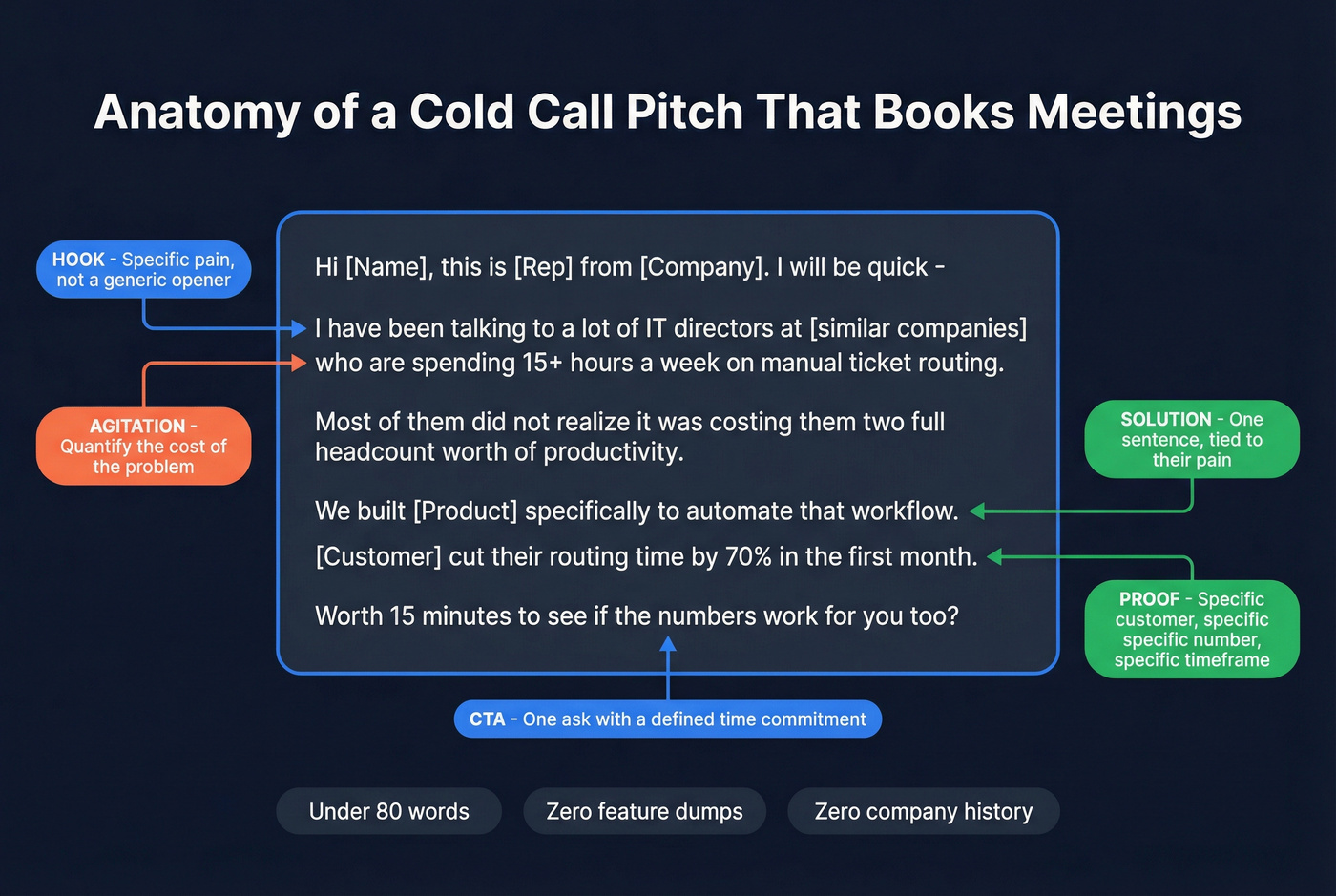
"Hi [Name], this is [Rep] from [Company]. I'll be quick - I've been talking to a lot of IT directors at [similar companies] who are spending 15+ hours a week on manual ticket routing. Most of them didn't realize it was costing them two full headcount worth of productivity. We built [Product] specifically to automate that workflow. [Customer] cut their routing time by 70% in the first month. Worth 15 minutes to see if the numbers work for you too?"
Under 80 words. It names a specific pain, quantifies the cost, drops one proof point, and asks for a specific time commitment. No company history. No feature list. No "is this a bad time?"
If you’re building a repeatable outbound motion, a cold calling system helps you turn good pitches into consistent meetings.
A Bad Pitch, Rewritten
A cybersecurity SDR shared their script on r/sales, frustrated that it wasn't landing. The structure: polite opener ("Is it a terrible time?"), company credibility ("We serve XXXX customers in XXX countries"), generic problem ("Too many alerts, too noisy"), scary stat ("Ransomware attacks being up by 800% in 2020"), and a soft CTA ("Would you be open to going into more detail?").
The rep's own diagnosis: the only "interesting part" was the customer count. That's the problem - the pitch over-indexes on generic credibility and a stat that has nothing to do with the prospect's specific situation. In our experience, this before/after exercise is where most reps have their breakthrough moment.
The rewrite, using PAS:
"Hi [Name], quick question - how many hours is your team spending triaging false-positive alerts each week? The security directors I talk to at [similar-size companies] are averaging 20+ hours, and most of that is wasted on noise. We built [Product] to filter that noise automatically - [Customer] cut their triage time by 60% in 30 days. Can I show you how in 15 minutes?"
Same product. Completely different pitch. The difference is leading with their problem instead of your resume.
Common Mistakes to Avoid
Talking too much. The 43% vs. 65% talk ratio isn't just a fun stat - it's the clearest predictor of pitch effectiveness. If you're doing most of the talking, you're not pitching. You're presenting. And presentations don't close.
Leading with features instead of problems. Features are proof. Problems are hooks. Get the order right.
No follow-up plan. 80% of sales require five or more follow-ups, but 92% of reps quit after four. Your pitch isn't a one-shot event - it's the opening move in a sequence. Plan the next four touches before you make the first one.
If you need a system for timing and touchpoints, see when you should follow up on an email.
Pitching the wrong person or using bad contact data. The most polished pitch in the world doesn't matter if it lands in a bounced inbox or reaches someone who left the company six months ago. Stale data is the silent killer of outbound campaigns.
If deliverability is the issue, start with email bounce rate benchmarks and fixes.
Overpromising. Only 5% of B2B buyers say salespeople exceed their expectations. That's a damning number, and it's largely because reps promise outcomes they can't deliver. Underpromise on timelines, overpromise on support.
Let's be honest: if your deal size is under $10k, you don't need a 45-minute discovery call or a 15-slide pitch deck. Skip all that. A tight PAS email and a 10-minute demo will outperform the enterprise playbook every time. Match your pitch complexity to your deal size.
A sales pitch isn't a script - it's a structure. Now that you understand the definition at a structural level - hook, value prop, proof, CTA - the words take care of themselves. Get the structure right, and every conversation becomes a chance to earn the next one.
FAQ
What is a sales pitch in simple terms?
A sales pitch is a short, persuasive message designed to convince a prospect to take one specific next step - booking a meeting, starting a trial, or making a purchase. It can be verbal, written, or presented on slides. The key is brevity and direct relevance to the prospect's problem, not a feature rundown.
How long should a sales pitch be?
Elevator pitches run 30-60 seconds; cold-call pitches stay under two minutes. Email pitches perform best at 50-125 words. Formal presentations typically run 5-10 minutes. Match length to channel warmth - colder prospects need shorter, sharper messages.
What's the difference between a pitch and a presentation?
A pitch is a concise persuasion moment on any channel - a phone call, an email, a hallway conversation. A presentation is a longer, structured meeting with slides, a detailed narrative, and Q&A. Think of the pitch as earning the right to deliver the presentation.
What tools help you prepare a sales pitch?
CRM platforms for account context, call intelligence tools like Gong for talk-ratio coaching, and contact verification tools like Prospeo to ensure your pitch reaches the right decision-maker at a verified email or direct dial. Bad data wastes even the best-crafted message.