

Sales Pitch Email Examples That Actually Get Replies in 2026
The average cold email reply rate in 2026 is 3.43%. For every 100 emails you send, 97 people ignore you.
Back in 2023-early 2024, decent targeting could pull 15-25% reply rates. Now 8-10% feels like a win, and most teams aren't close. The sales pitch email examples below are built for this reality - short, trigger-timed, and backed by data from billions of tracked sends.
The 2026 Reality Check
Instantly's 2026 benchmark report analyzed billions of cold email interactions: 3.43% average reply rate, 5.5% for top-quartile performers, 10.7%+ for the elite top 10%. Those numbers are brutal if you're used to the old days.
Over on r/coldemail, practitioners have been tracking the decline in real time. One poster charted their numbers from 2023 through early 2026 - what used to be 15-25% with solid targeting now hovers at 8-10% for enterprise prospects. Microsoft 365 spam filtering has gotten sharper, and warmup that used to take about three weeks now takes 6-8 weeks before you can trust any volume. Infrastructure quality matters more than perfecting your opening line.
What Separates 3% From 10%
Most teams obsess over email copy when the real difference-maker is elsewhere. A Reddit practitioner sent 908 cold emails, booked 112 meetings, and attributed the results primarily to trigger-event timing. The same email pitch without a trigger? "Garbage results."
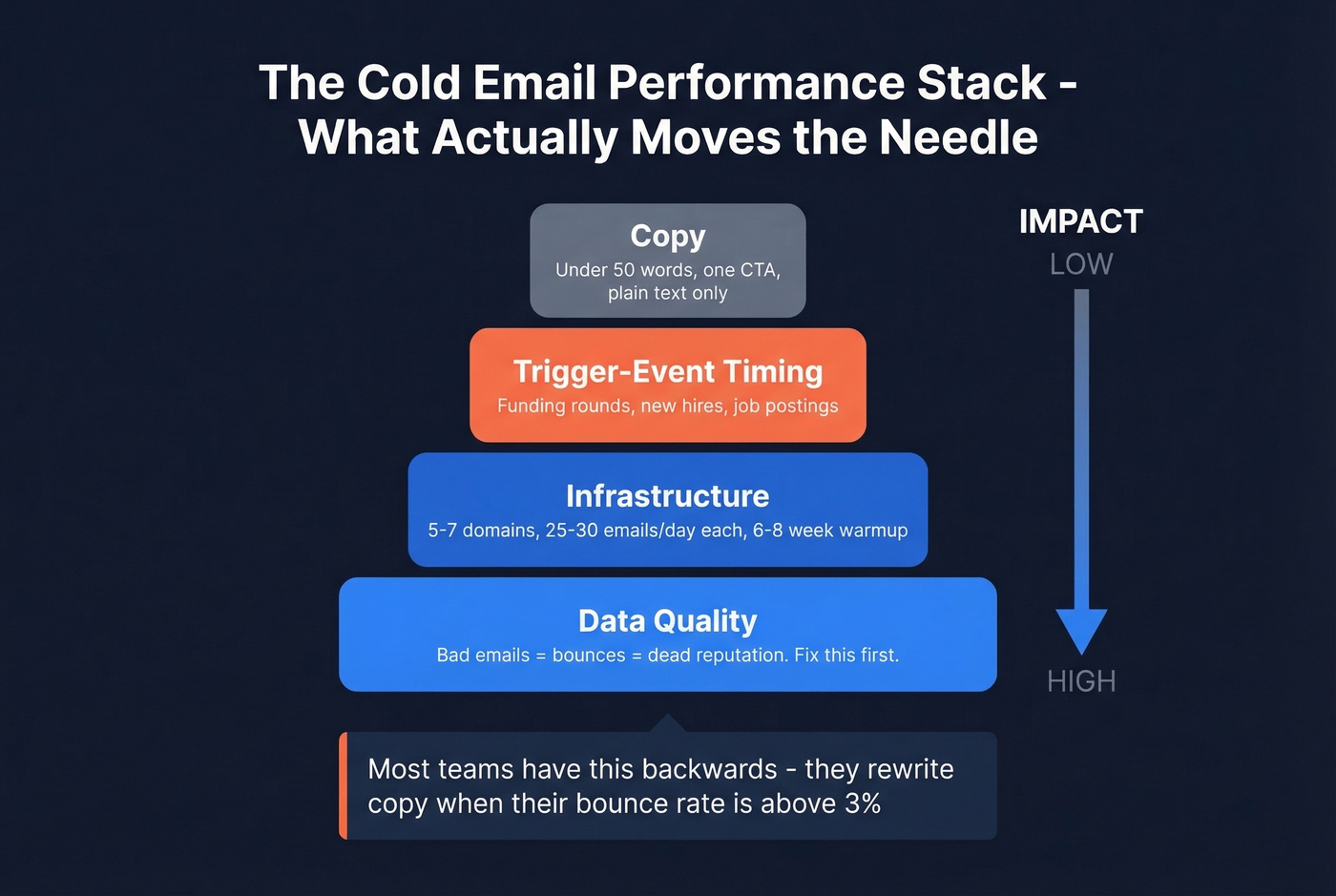
The performance stack, in order of impact:
- Data quality - bad emails mean bounces, bounces kill sender reputation, and dead reputation means inbox zero for you
- Infrastructure - one team went from 3 domains to 7, capped at 26 emails/day each, and dropped bounce rates from 11% to under 2% (see email velocity best practices)
- Trigger-event timing - funding rounds, new hires, job postings (more on how to track sales triggers)
- Copy - under 50 words beats long emails; one clear CTA beats multi-option CTAs (rules + examples in email call to action)
Copy is the last layer. Most teams have it backwards.
Here's the thing: if your bounce rate is above 3%, stop rewriting your emails. Fix your data first. We've seen teams double reply rates without changing a single word of copy - just by cleaning their lists and adding sending domains (start with an email deliverability guide).
7 Email Pitch Templates That Work
Every template below is under 60 words. Emails over 400 words see reply rates below 5%. Keep it tight.
The Trigger-Event Email
Trigger events create urgency the prospect already feels - you're not manufacturing interest, you're arriving at the right moment.
Hi {{firstName}} - saw {{company}} just closed your Series B, congrats. When teams scale that fast, {{pain point}} usually breaks within 90 days. We helped {{similar company}} fix it before it slowed them down. Worth 15 minutes Thursday?
Use it after funding rounds, acquisitions, or product launches.
The New Hire Email
Hi {{firstName}} - noticed you just joined {{company}} as {{role}}. New roles usually mean fixing what's broken fast. If {{specific problem}} is on your list, we helped {{similar company}} cut the timeline in half. Open to a quick chat?
New hires are actively looking for wins and aren't loyal to incumbent vendors yet. That's your window - and it closes fast, usually within the first 60 days.
The Pain-Point Email
Hi {{firstName}} - most {{role}}s at {{company size}} companies tell me {{specific pain}} eats 5-10 hours/week. We built a way to cut that to under 1. Want to see how in 10 minutes?
This one works when you know the ICP's top frustration cold. Naming the pain proves you understand their world, and it immediately separates you from every "just checking in" email cluttering their inbox (alternatives in how to say just checking in professionally).
The Mutual Connection Email
Hi {{firstName}} - {{mutual connection}} mentioned you're working on {{problem}}. We helped them {{specific result}} and I can share what we did. Would Tuesday work for a quick call?
Social proof plus a named referral cuts through noise instantly. Use it for warm intros, shared investors, or conference connections.
The Social Proof Email
Hi {{firstName}} - we helped {{peer company}} {{specific metric}}. Your team at {{company}} looks like a similar situation. Worth 10 minutes to see if we can replicate it?
Peer results in the same vertical outperform generic case studies by a wide margin. "We helped a SaaS company" is weak. "We helped {{their direct competitor}}" gets replies. That specificity is what earns the click.
The Direct Value Email
Hi {{firstName}} - I pulled a quick analysis on {{company}} ({{public metric}}). Found 2-3 things that could save your team time. Want me to send it over?
Leading with value flips the dynamic - you're giving, not asking. This template takes more prep work, but it earns trust before the first call. In our experience, it pulls the highest quality replies because prospects who respond are already engaged with your thinking (see data-driven selling).
The Breakup Email
Hi {{firstName}} - I've reached out a few times and haven't heard back. If {{problem}} isn't a priority, no worries. If it is, this is my last note. Want to revisit later?
Breakup emails consistently pull replies from prospects who ignored everything else. Scarcity and low pressure work. Use this as touch 4-7 in your sequence.
What Kills a Cold Pitch Email
Skip the templates entirely if you're making these mistakes - they tank reply rates faster than bad targeting:
- "I hope this finds you well" - every prospect has read this 500 times. Open with relevance, not filler.
- Multiple CTAs - "Book a call, check our site, or reply with questions" confuses the next step. One CTA only.
- Attachments or images - PDFs and embedded images trigger spam filters. Plain text wins.
- Over 100 words - if your email needs scrolling on mobile, it's too long.

You read it above: data quality matters more than copy. If your bounce rate is above 3%, no template will save you. Prospeo's 5-step email verification delivers 98% accuracy - teams using it drop bounce rates from 35% to under 4%.
Stop rewriting emails. Start fixing your contact data.
Subject Lines That Open Emails
A study of 5.5M cold emails by Belkins gives us the clearest picture of what works. Short, personalized, and conversational wins. Everything else loses (more cold email subject line examples).
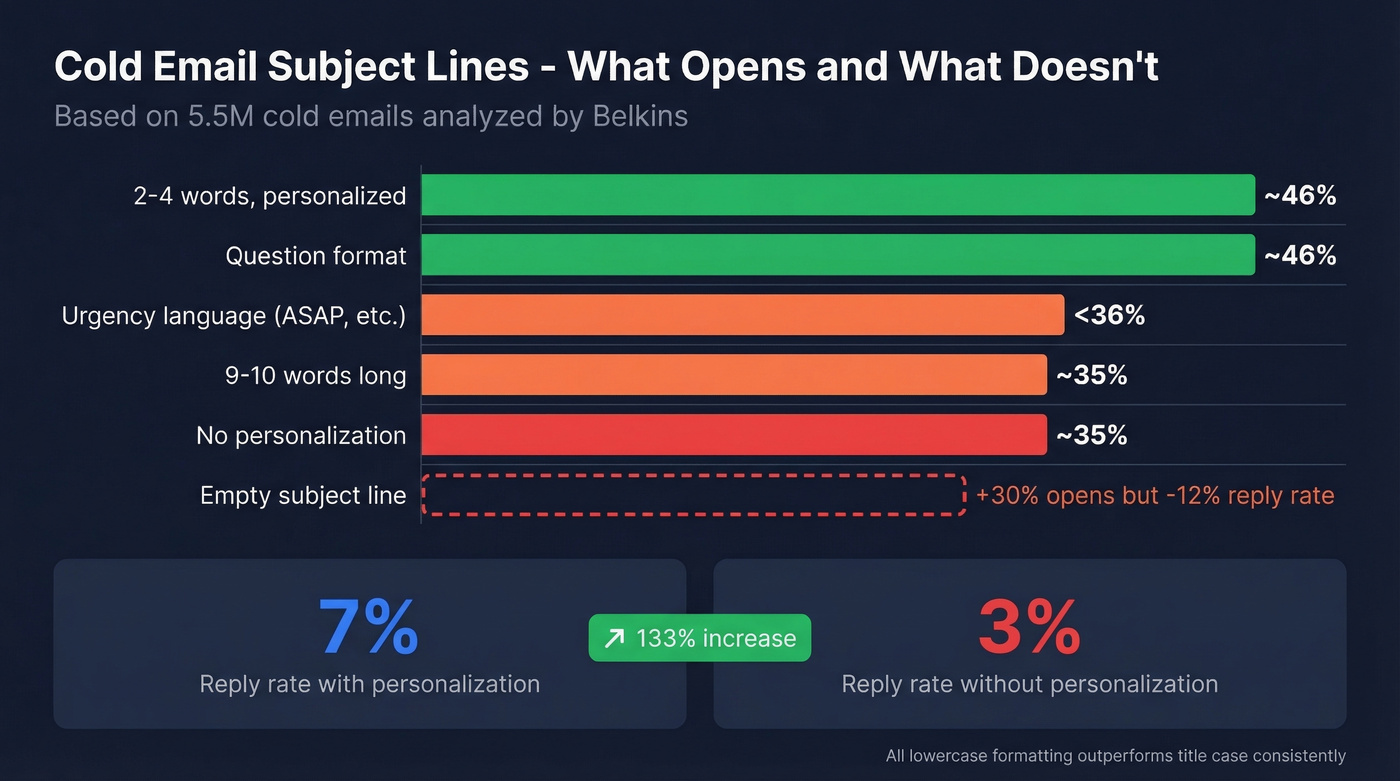
| Subject Line Style | Open Rate |
|---|---|
| 2-4 words, personalized | ~46% |
| Question format | ~46% |
| No personalization | ~35% |
| 9-10 words | ~34-35% |
| Urgency language ("ASAP") | <36% |
| All lowercase | Highest across large datasets |
Personalized subject lines pull a 7% reply rate vs 3% without - a 133% increase from a two-second personalization effort. The ideal range is 2-4 words. "Quick question about {{company}}" and "{{Mutual connection}} mentioned you" both outperform anything clever or salesy.
One practitioner's results tracked similarly: "Quick question" pulled 39% opens, company name alone hit 33%, and "Partnership opportunity" cratered below 19%. All lowercase formatting consistently outperforms title case.
One trap worth knowing: empty subject lines boost opens by 30% but tank reply rates by 12%. Curiosity opens don't convert.
A/B test one variable per week - subject line, CTA, or send time - and let the data pick the winner.
The Follow-Up Sequence
58% of replies come from the first email. That means 42% come from follow-ups, and most teams give up too early. Aim for 4-7 touchpoints over 2-3 weeks, spaced 2-4 days apart (use these sales follow-up templates).
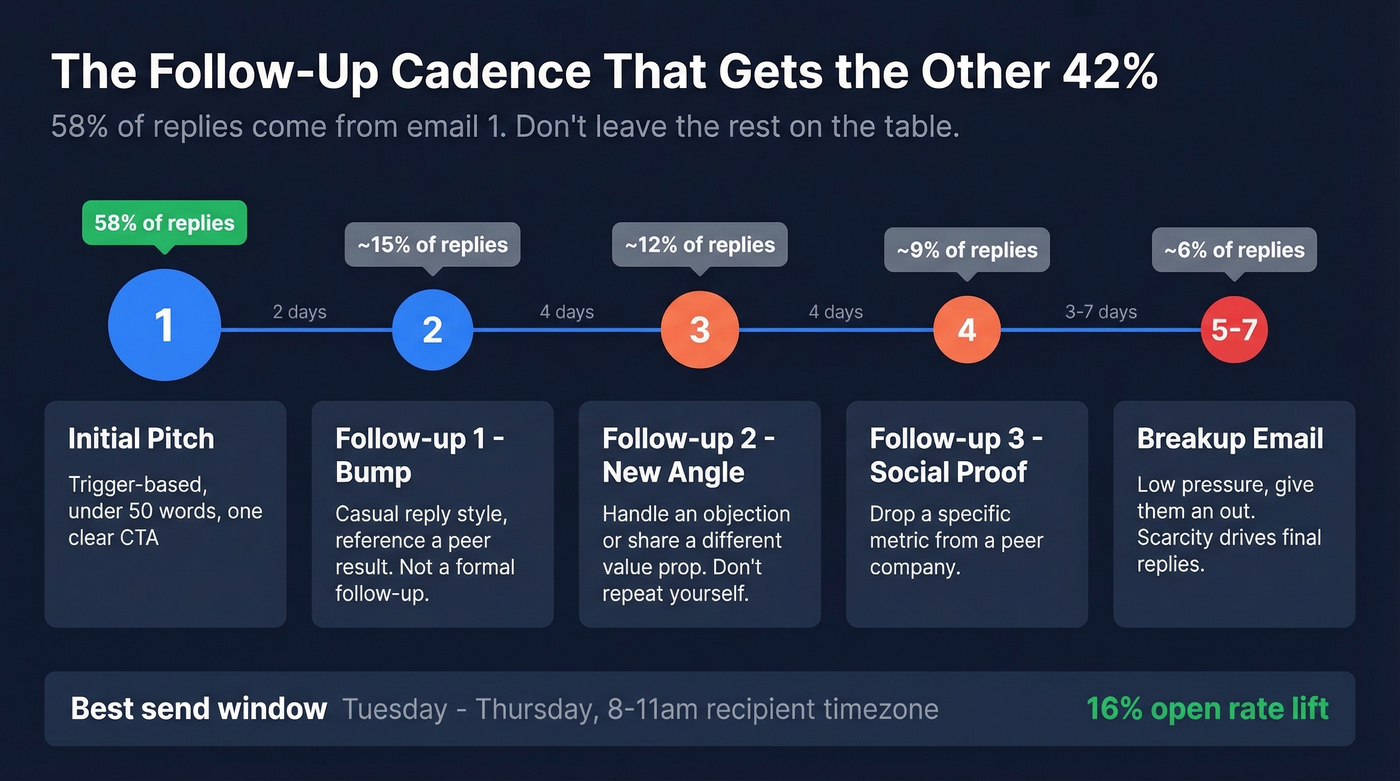
One team sending Tuesday through Thursday, 8-11am in the recipient's timezone, saw a 16% open-rate lift. Instantly also found that Step 2 should feel like a casual reply, not a formal follow-up - this style outperforms structured follow-ups by about 30%.
Each subsequent touch should use a different angle. Don't repeat the same pitch. If your sending tool tracks opens, adjust your approach: a prospect who opened twice but didn't reply needs a different nudge than one who never opened at all.
Follow-up #1 - Day 3:
Hey {{firstName}} - bumping this up. The {{specific result}} we got for {{peer company}} is relevant to what you're building. Worth a quick look?
Follow-up #2 - Day 7, different angle:
{{firstName}}, one thing I didn't mention - {{objection handling}}. Happy to walk through it.
Verify Before You Send
None of the templates above matter if your emails bounce. Bounce rates above 3% damage sender reputation, and once that's gone, even perfect copy lands in spam. One team rebuilt their infrastructure over 62 days - including cutting bounce from 11% to under 2% - and doubled their reply rate from 3% to 6%.
If you want the deeper breakdown of bounce codes and benchmarks, start with email bounce rate.
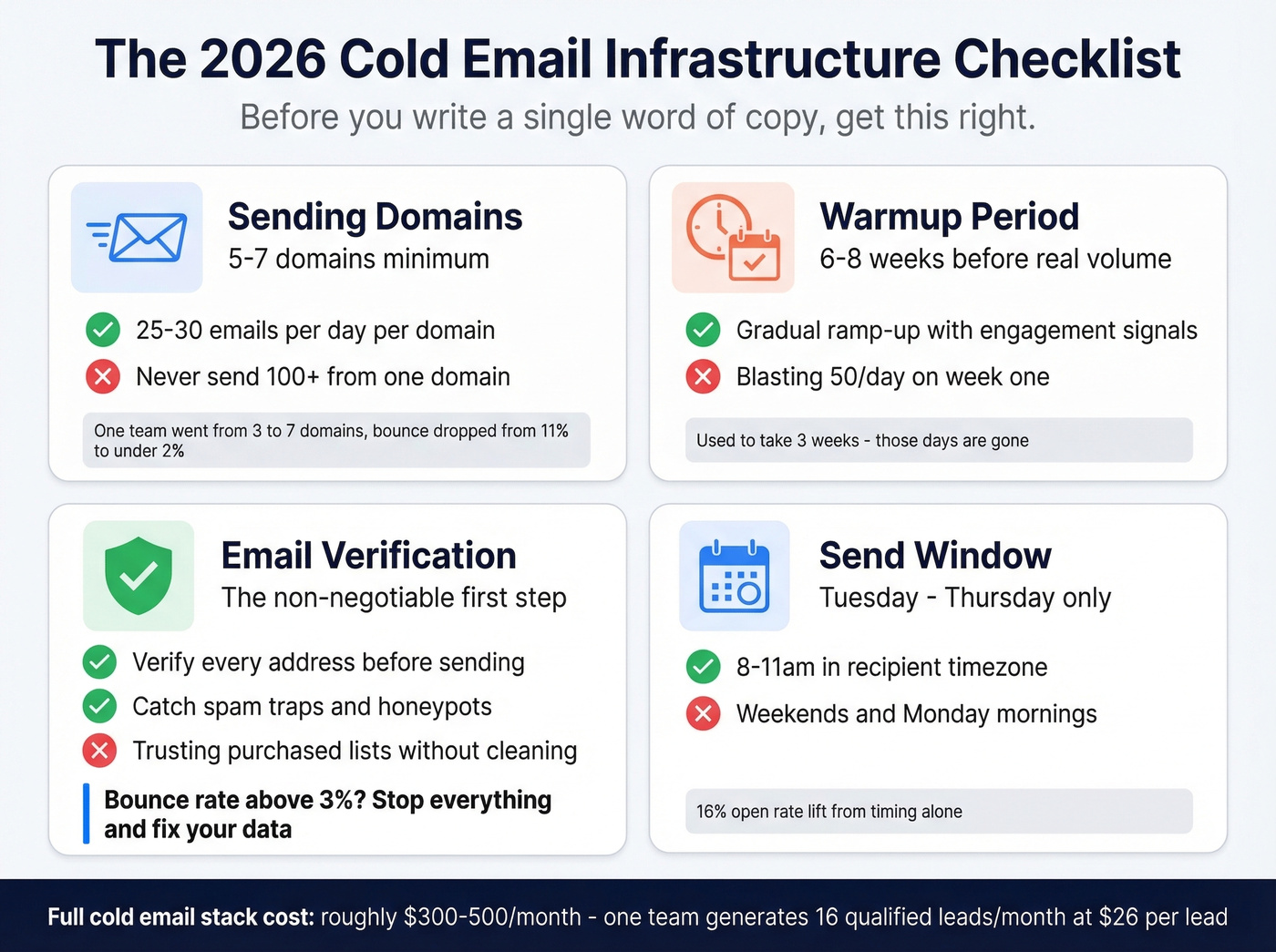
The infrastructure checklist:
- Multiple sending domains - 5-7 minimum, each capped at 25-30 emails/day
- Warmup period - 6-8 weeks before trusting any real volume (tooling options in best unlimited email warmup tools)
- Send window - Tuesday through Thursday, 8-11am recipient timezone
- Email verification - the non-negotiable first step
Let's be honest: we've watched too many teams burn through domains because they skipped verification. Before you send a single outreach email, verify your list. Prospeo's 5-step verification catches spam traps, honeypots, and catch-all domains with 98% accuracy across 143M+ verified emails on a 7-day data refresh cycle. The free tier gives you 75 verified emails per month plus 100 Chrome extension credits.
A full cold email stack runs about $300-500/month. One team's $420/month setup generates 16 qualified leads per month - roughly $26 per lead before any deal closes. That's the cost of doing outbound properly in 2026.
Trigger-event emails only work when you reach the right person at the right time. Prospeo tracks job changes, funding rounds, and hiring signals across 300M+ profiles - refreshed every 7 days, not 6 weeks.
Send your best pitch to a verified inbox, not a bounce.
CAN-SPAM in 30 Seconds
CAN-SPAM applies to B2B email - no exceptions. Penalties run up to $53,088 per violating email. You need accurate "From" and "Reply-To" information, non-deceptive subject lines, a valid physical postal address, a working opt-out mechanism, and opt-outs honored within 10 business days.
Outside the US, CASL carries penalties up to $10M for businesses. GDPR fines reach up to EUR 10M, and pre-ticked consent boxes don't count. For teams sending internationally, know the rules for each jurisdiction before you hit send.
The templates are the easy part. Fix your data, fix your infrastructure, and the replies follow. These sales pitch email examples give you the copy - now pair them with verified contacts and proper deliverability to actually land in inboxes (see cold email marketing for benchmarks and setup).
FAQ
How long should a sales pitch email be?
Under 50-60 words. Emails over 400 words see reply rates below 5%. One practitioner cut from 141 words to under 56 and doubled their reply rate. Mobile readability matters - if it scrolls, it's too long.
What's a good reply rate for cold emails in 2026?
The average is 3.43%. Top quartile hits 5.5%+, and elite performers reach 10.7%+. Consistently above 5% means you're outperforming most outbound teams.
How do I verify emails before sending a pitch?
Use a dedicated verification tool before every campaign. Keeping bounce rates under 3% protects your sender reputation, and it's the single fastest way to improve reply rates without touching your copy.
How is a cold email pitch different from warm outreach?
A cold email targets prospects with no prior relationship, so it must earn attention in the first line. Warm outreach leans on existing rapport. Cold emails need a trigger event or specific pain point to justify the interruption - generic intros get deleted.
What subject lines get the highest open rates?
Personalized, 2-4 word subject lines hit about 46% open rates. All-lowercase formatting outperforms title case. Avoid urgency words like "ASAP" - they drop open rates below 36% and trigger spam filters.