

Sales Presentation Tips: A Modern Playbook for Closing More Deals
Reps spend roughly 30% of their time actually selling. The rest vanishes into admin, CRM updates, and internal meetings. So when you finally get 30 minutes in front of a buyer, the deck you bring and the way you run that conversation carry enormous weight.
Only 43.5% of sales professionals hit quota - and a big chunk of the gap comes down to two moments: the wrong stakeholder is in the room, or the deal goes dark 48 hours after a promising call. Both are fixable.
What You Need (Quick Version)
- Tight agenda + clear outcome statement before you open a single slide.
- 10-15 slides max (fewer for execs), with 30-40% of meeting time reserved for dialogue.
- A 24-hour follow-up plan with a mutual action plan - not "I'll circle back."
Research Before the Meeting
The presentation doesn't start when you share your screen. It starts with research. Pull CRM history on similar accounts, scan the company's recent news and annual report, and map the decision-making unit - economic buyer, champion, technical evaluator. Ignoring the DMU is how deals stall: you pitch the champion, they love it, and then finance kills it because nobody looped them in. (If you want a tighter framework for stakeholder roles, see technical evaluator.)
Here's the thing: your buyer is roughly 57% through their decision before they ever talk to a vendor. They've already read your website, compared you to two competitors, and formed an opinion. Your job isn't to introduce yourself. It's to prove you understand their specific situation better than anyone else on their shortlist.
The context has shifted permanently, too. 80% of B2B interactions now happen at least partly through digital channels, which means your pre-meeting research, your invite list, and your follow-up sequence all matter as much as the slides themselves. (More on running these calls well: virtual selling.)
The 10-Slide Structure
A 50-slide canned presentation is a self-inflicted loss. If you need 50 slides, you don't have a message.
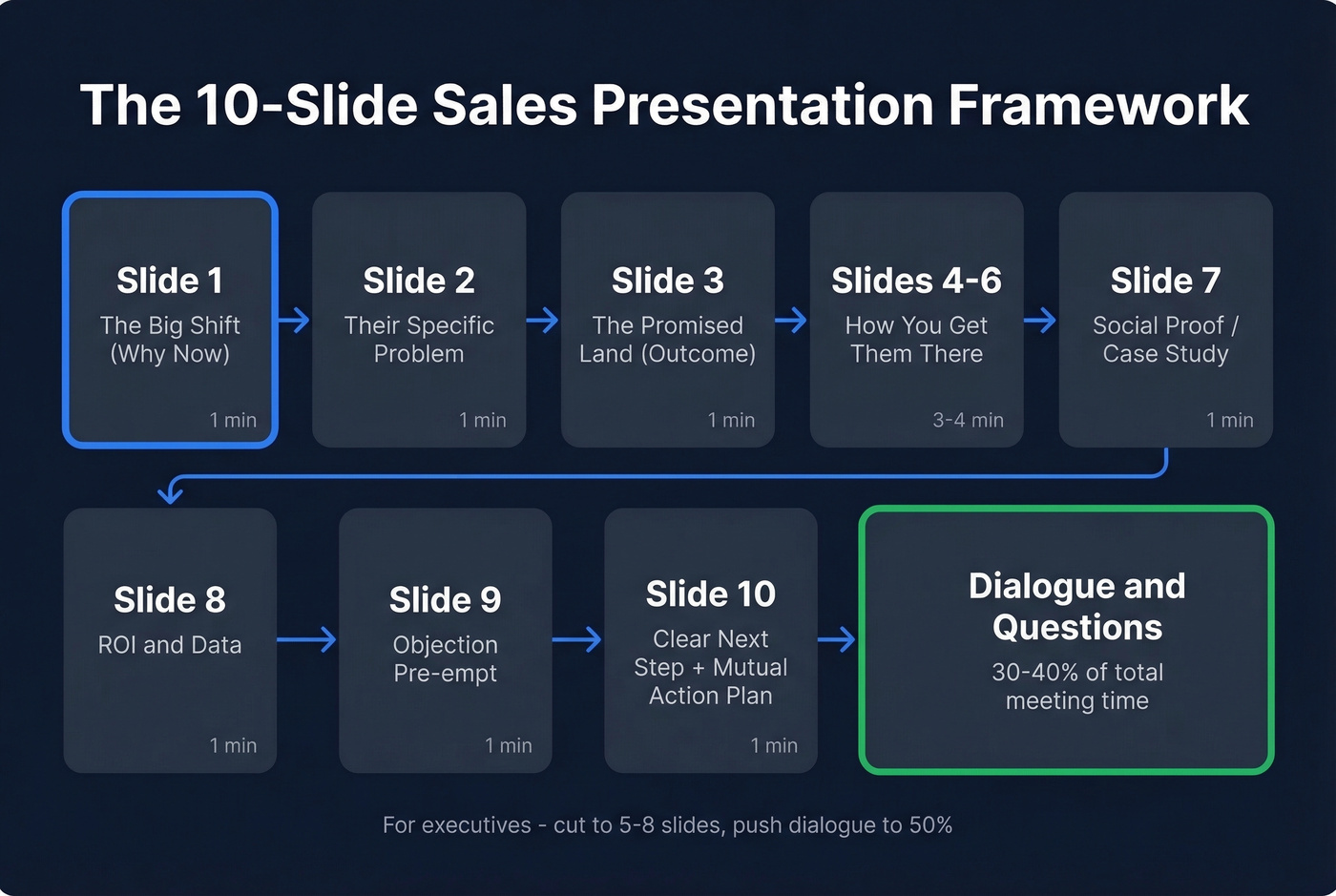
Here's a tighter framework, loosely based on Andy Raskin's narrative arc: lead with the shift, not with your logo. (If you want more frameworks like this, see sales deck storytelling.)
| Slide | Purpose | Time |
|---|---|---|
| 1 | The big shift (why now) | 1 min |
| 2 | Their problem (specific) | 1 min |
| 3 | The promised land (outcome) | 1 min |
| 4-6 | How you get them there | 3-4 min |
| 7 | Social proof / case study | 1 min |
| 8 | ROI / data | 1 min |
| 9 | Objection pre-empt | 1 min |
| 10 | Clear next step + MAP | 1 min |
| - | Dialogue + questions | 30-40% |
One contrarian take we stand behind: lead with the solution in the first two minutes. The old "build suspense for 15 minutes" approach doesn't work when your buyer already knows what you sell. Name the outcome early, then earn the right to go deeper with proof and specifics.
For executive audiences, cut this to 5-8 slides and push dialogue time to around 50%. Executives don't want a tour of your product - they want to know the business impact in five minutes and spend the rest pressure-testing your assumptions. (If you're standardizing this across the org, align it with your sales enablement motion.)

Mapping the full buying committee is what separates closed deals from stalled ones. Prospeo gives you 300M+ profiles with 30+ filters - job title, department, seniority - so you present to every stakeholder who matters, not just the champion.
Stop pitching the wrong person. Build your full DMU in minutes.
Nail Your Introduction
92% of B2B buyers prefer digital engagement, and only 15-25% want to interact with reps in person at all. Design for screens first, not conference rooms.
Don't open with the deck. Build rapport, ask one or two operational questions, and confirm the agenda. A strong sales presentation introduction tells the buyer you've done your homework and you respect their time. Salesforce's own guidance says to start with dialogue, not slides - and they're right. The deck is a prop for the conversation, not the conversation itself. (Need better questions? Use a discovery questions bank.)
Ask a question every 3-4 minutes. A presentation that runs wall-to-wall is a monologue. Ask any rep on r/sales and they'll tell you the same thing: the deck isn't the problem, it's the conversation around it. A slightly imperfect deck with real dialogue outperforms a beautiful monologue every time.
Send the agenda beforehand. This sounds basic, but it's the single highest-leverage virtual selling habit. It sets expectations, surfaces last-minute stakeholder additions, and gives you an excuse to confirm attendees. (Pair it with a repeatable discovery call script so reps don’t wing it.)
Do a tech check. Screen share, audio, camera. Two minutes of prep prevents five minutes of fumbling.
Use visuals, not text walls. Visuals are processed 60,000x faster than text. Aim for roughly 15 words or fewer per slide - if your slide is packed with paragraphs, you've written a document, not a presentation.
Record with permission. The champion who attended will need to sell internally. A recording is the best leave-behind you can give them.
Handling Objections Mid-Presentation
The difference between a rep who handles objections and one who gets derailed is usually one word. Swap "but" for "and." (For more ways to reduce pushback, see reduce sales objection rate.)
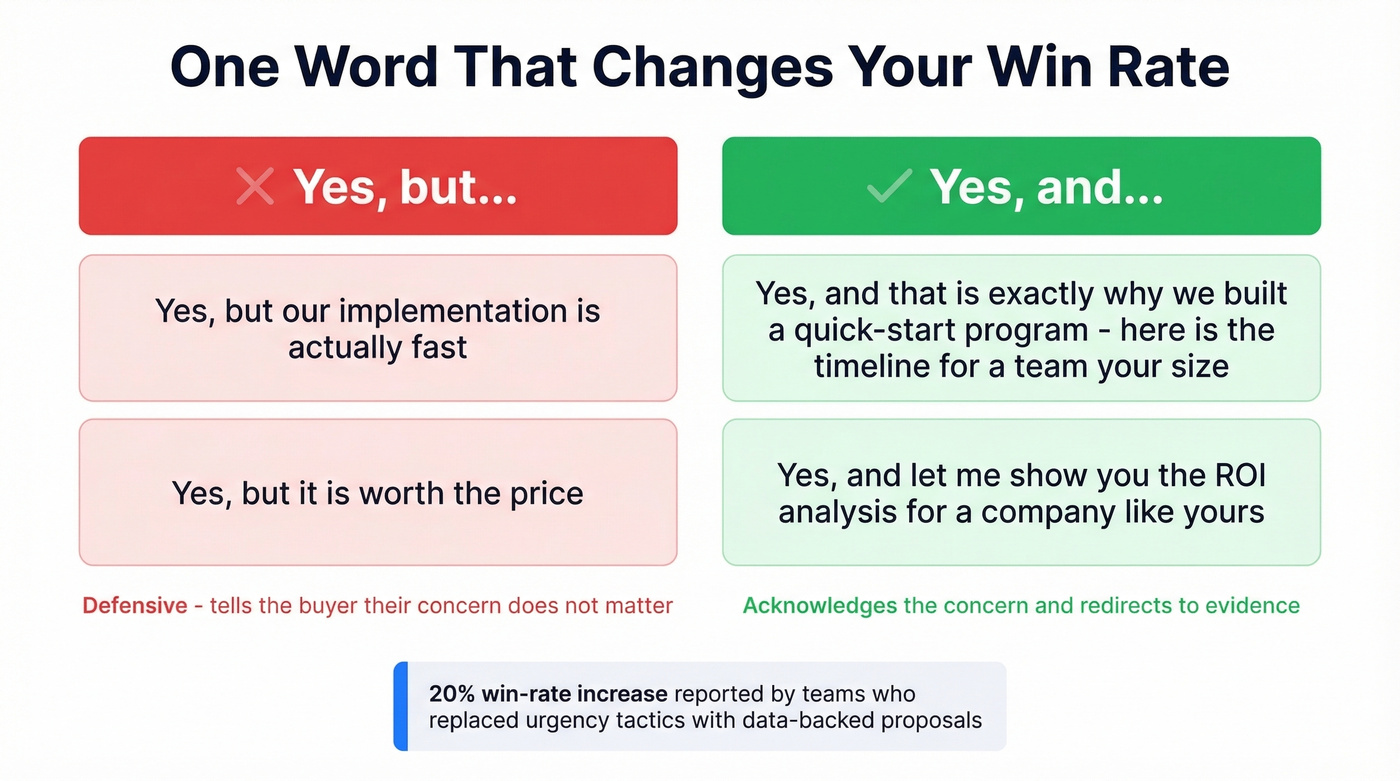
Instead of "Yes, but our implementation is actually fast," try "Yes, and that's exactly why we built a quick-start program - here's the timeline for a team your size."
Instead of "Yes, but it's worth the price," try "Yes, and let me show you the ROI analysis for a company like yours."
"Yes, but" is defensive. It tells the buyer their concern doesn't matter. "Yes, and" acknowledges the concern and redirects to evidence. One team reported a 20% win-rate increase over two quarters by replacing urgency CTAs with data-backed proposals and tailored value maps. Multi-stakeholder buying committees see right through gimmicks like "only a few spots left."
Hot take: If your deal size is under five figures, you probably don't need a 30-minute presentation at all. A five-minute Loom video with a clear next step will outperform a live meeting that three people had to reschedule twice. Save the live presentation for deals where the buying committee is large enough to justify the coordination cost. (If you’re doing this at scale, build a repeatable Loom video workflow.)
The 24-Hour Follow-Up Plan
"I'll follow up" isn't a plan - it's a vague promise that lets the deal drift into the void.
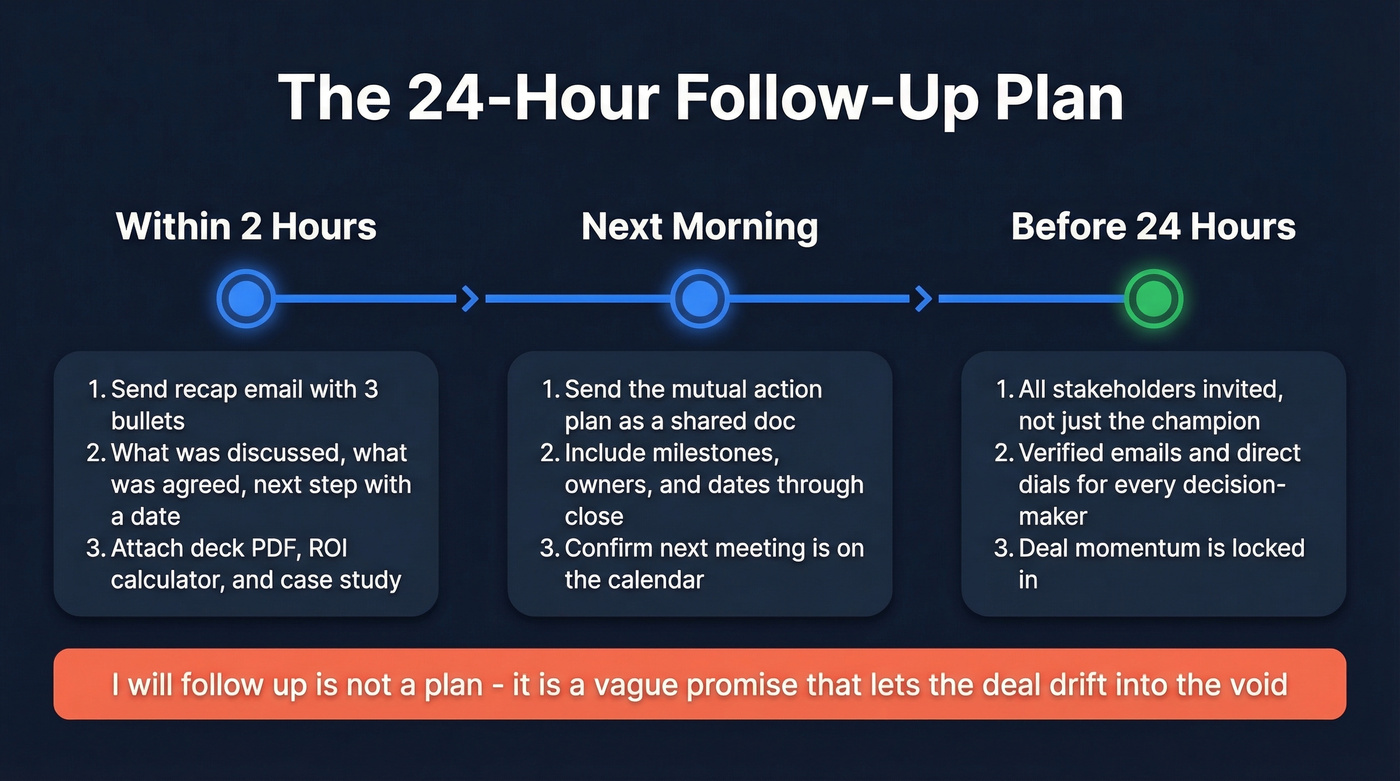
Same day, within 2 hours: Send a recap email with three bullets covering what was discussed, what was agreed, and the next step with a specific date. Attach the asset pack: deck PDF, ROI calculator, relevant case study.
Next morning: Send the mutual action plan - a shared doc with milestones, owners, and dates from now through close. Confirm the next meeting is on the calendar with all stakeholders invited.
In our experience, the champion who attends rarely has budget authority. Make sure your recap actually reaches every decision-maker, not just the one who showed up. Prospeo's CRM enrichment returns 50+ data points per contact at a 92% API match rate, with data refreshed every 7 days - so you're sending follow-ups to verified emails and direct dials, not bouncing off stale records. (If you need copy you can paste, use these sales follow-up templates.)
AI Tools to Build Your Deck Faster
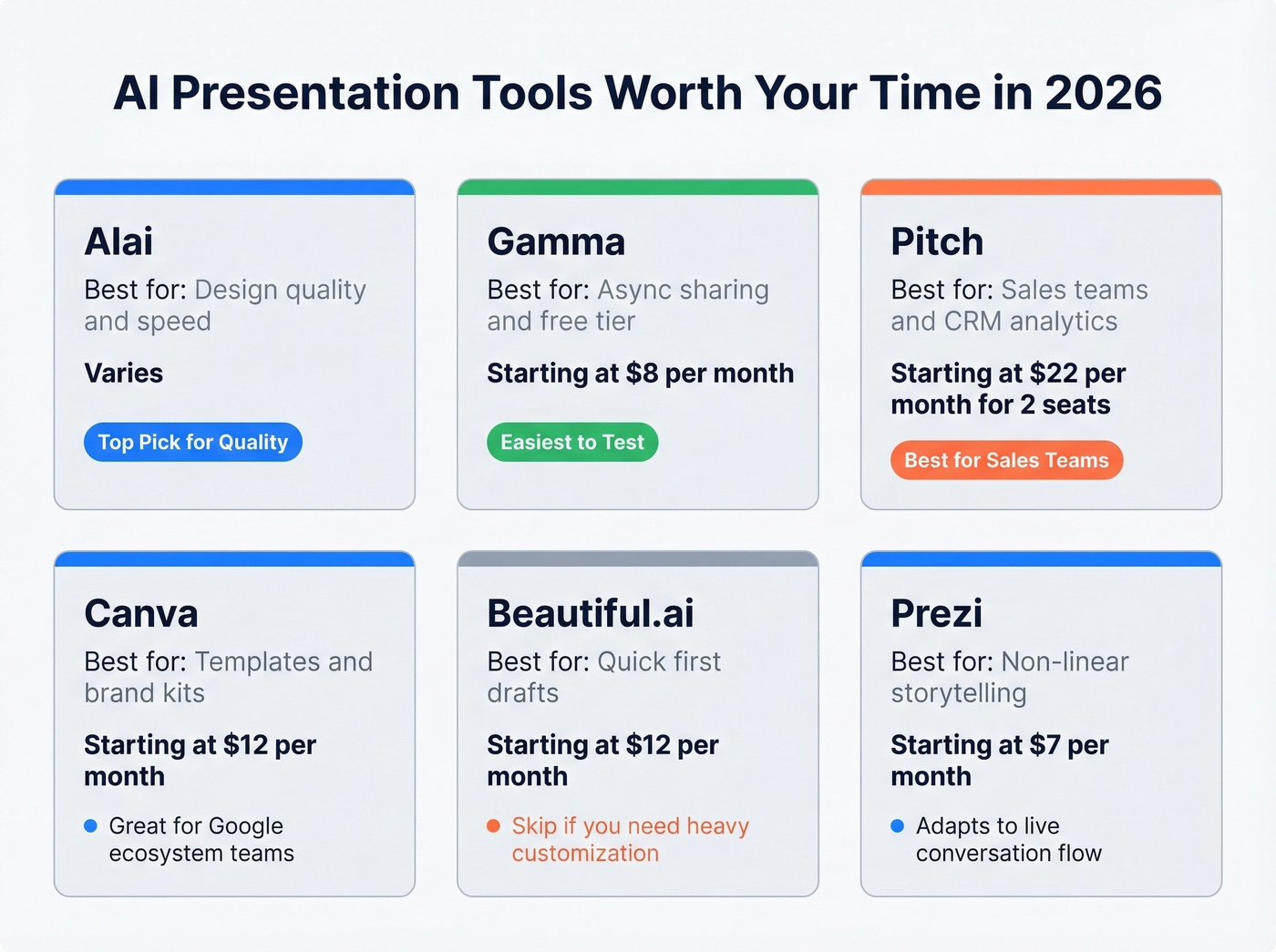
A Redditor on r/powerpoint tested every major AI presentation tool with the same prompt. Here's what's worth your time if you're hunting for fresh sales presentation ideas beyond standard slide decks:
| Tool | Best For | Starting Price |
|---|---|---|
| Alai | Design quality + speed | Varies |
| Gamma | Async sharing + free tier | $8/mo |
| Pitch | Sales teams + CRM analytics | $22/mo (2 seats) |
| Canva | Templates + brand kits | $12/mo |
| Beautiful.ai | Quick first drafts | $12/mo |
| Prezi | Non-linear storytelling | $7/mo |
Alai stood out for design quality and cross-slide context. Gamma's generous free plan makes it the easiest to test. Pitch is the pick for sales teams that want engagement analytics and CRM integration baked in. Tools like Prezi let you build non-linear narratives that adapt to the conversation in real time - useful when your buyer wants to skip ahead or drill into a specific section.
Skip Beautiful.ai if you need heavy customization; it's fast but opinionated about layout. For teams already deep in the Google ecosystem, Canva or Gamma will feel more natural than a standalone tool.
Your 24-hour follow-up plan falls apart when emails bounce and phone numbers are dead. Prospeo's CRM enrichment returns 50+ data points per contact at a 92% match rate, refreshed every 7 days - so your recap lands with every decision-maker, not just the one who showed up.
Send follow-ups that actually arrive. 98% email accuracy, $0.01 per lead.
FAQ
How long should a sales presentation be?
Aim for 10-15 slides in a standard meeting, or 5-8 when presenting to executives. Reserve 30-40% of meeting time for dialogue and questions. A presentation that fills every minute is a monologue, not a conversation - and monologues don't close deals.
How do I make a virtual presentation engaging?
Send an agenda beforehand, do a tech check, use visuals instead of text-heavy slides, and ask a question every 3-4 minutes. Design for screens first, since the vast majority of B2B buyers now prefer digital engagement. Record the session with permission so your champion can share it internally.
What makes a great sales presentation speech?
The best sales presentation speech opens with a relevant market shift, names the buyer's specific problem, and presents a clear path to the outcome they care about. Practice the first two minutes until they feel effortless - that opening determines whether the room leans in or checks out.
How do I get the right stakeholders into the meeting?
Map the decision-making unit before you book the call - identify the economic buyer, champion, and technical evaluator. Use a data platform to find verified emails and direct dials for each stakeholder, so you can invite them directly instead of hoping your contact forwards the invite. Teams using verified contact data report bounce rates under 4%.