

5 Sales Proposal Follow-Up Emails That Don't Sound Desperate
You spent two hours tailoring a proposal for a prospect who seemed excited on the call. It's been three days. Your inbox is empty.
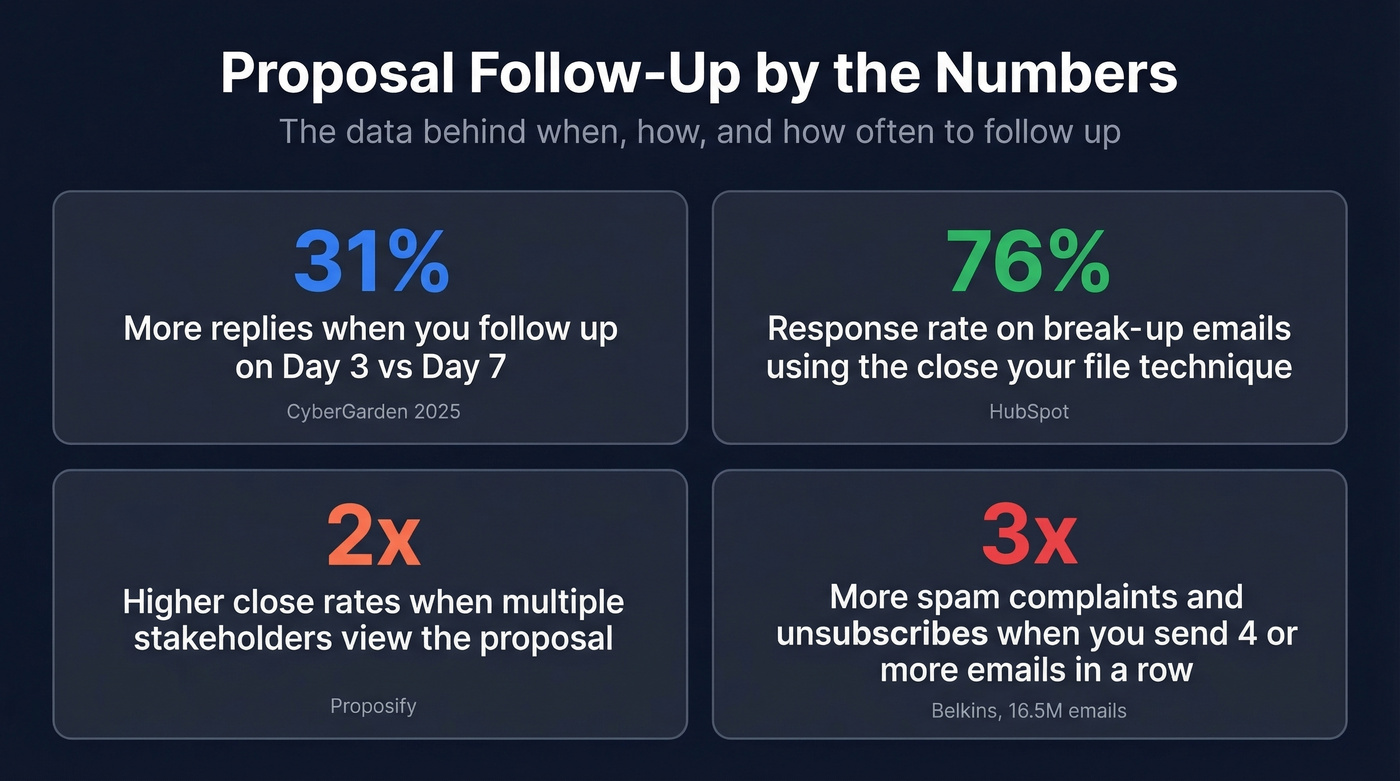
Here's the thing: 90% of B2B buyers research extensively before engaging with a vendor, and even when 61% start with a preferred option, nearly half are still open to switching. That silence isn't rejection - it's evaluation. Your sales proposal follow-up email needs to help the process along, not interrupt it.
What You Need (Quick Version)
- Day 3, not day 1. First follow-up 48-72 hours after the proposal. Reference a specific section.
- Never say "just checking in." Use a logistics frame or send a case study instead. (More options: just checking in.)
- Don't run endless threads. Belkins' analysis of 16.5M cold emails shows 4+ emails in a sequence more than triples unsubscribe and spam complaint rates. (If you need a system, see sequence management.)
- Verify the email first. A bounced follow-up is worse than no follow-up. (Related: email verification.)
Set Expectations Before You Send
The best proposal follow-up starts before you hit send on the proposal itself. When you're wrapping the call, plant the seed: "I'll send this over today. Once you've had a chance to review - probably by Thursday - I'll check in to see if anything needs adjusting."
That one sentence gives the prospect a timeline so your follow-up feels expected, not intrusive. It frames you as someone managing a process, not chasing a deal. A simple way to do it is a logistics-based line like: "I'm trying to finalize my schedule for next week - does Thursday or Friday work to review this together?" (More examples: email wording to schedule a meeting.)
If your proposal tool tracks opens and section views, use that data to time your follow-up. A prospect who's viewed your pricing page three times is ready for a different conversation than one who hasn't opened the doc. (Related: email tracking pixel.)

A perfectly crafted proposal follow-up means nothing if it bounces. Prospeo verifies emails with 98% accuracy and refreshes data every 7 days - so you'll know if your contact changed roles before your sequence even starts.
Stop wasting follow-ups on dead inboxes. Verify first.
5 Templates That Actually Get Replies
Most follow-up advice is written for cold outreach. A proposal follow-up is fundamentally different - you've already had a conversation, they've seen pricing, and there's a specific document to reference. Nearly 70% of buyers say personalization influences whether they engage with content. In our experience, the value-add template (Template 2) outperforms every other option. If you only send one follow-up after a proposal, make it that one. (For more variations, see these sales follow-up templates.)
Template 1: The 48-Hour Check-In
Subject: Quick question on the [timeline/pricing/ROI section]
Hi [Name],
Wanted to flag one thing in the proposal - the [specific section, e.g., "Q3 rollout timeline on page 4"] assumes your team can start onboarding by [date]. If that's tight, I can adjust.
Any initial reactions so far?
Why it works: Referencing a specific section proves you built this for them. It gives them something concrete to respond to instead of a vague "thoughts?"
Template 2: The Value-Add Follow-Up
Subject: [Case study/data point] that's relevant to your [initiative]
Hi [Name],
While you're reviewing the proposal, thought this might be useful - [Company X] had a similar [challenge] and saw [specific result] after [timeframe]. Attached the case study.
Happy to walk through how that maps to your situation.
Why it works: You're giving the prospect ammunition to sell internally, not asking them to do something for you. That distinction matters more than any subject line trick.
Template 3: The Multi-Stakeholder Nudge
Subject: Should I loop anyone else in?
Hi [Name],
Totally understand these decisions involve more than one person. Is there anyone else on your team who'd want to review the proposal - finance, IT, legal? Happy to send them a copy or jump on a quick call to answer their questions directly.
Why it works: Proposify found that close rates double when more than one stakeholder views a proposal. This email acknowledges the internal buying process instead of pretending your contact decides alone. (Related: team selling.)
Template 4: The New Information Follow-Up
Subject: Heads up - [price change / new feature / deadline]
Hi [Name],
Quick update: [specific new information - e.g., "our Q2 pricing locks in at current rates through Friday" or "we just shipped the Salesforce integration your team asked about"]. Wanted to make sure you had this before finalizing.
Want me to update the proposal?
Why it works: New information creates a legitimate reason to re-engage - urgency without the manufactured pressure of "this offer expires soon!!!"
Template 5: The Break-Up Email
Subject: Should I close your file?
Hi [Name],
I haven't heard back, so I'm guessing the timing isn't right. I'll close out your file on my end - but if things change, I'm an email away.
No hard feelings either way.
Why it works: This is Bryan Kreuzberger's "permission to close your file" technique. HubSpot's write-up of the template cites a 76% response rate. Loss aversion kicks in - people don't like having options taken away, even options they're ignoring.
The Right Follow-Up Cadence
Don't wing the timing. 75% of online buyers expect 2-4 follow-ups before deciding, so you're not being pushy - you're meeting expectations. A day-3 follow-up yields roughly a 31% increase in replies compared to waiting a full week. (More timing guidance: When Should You Follow Up on an Email?.)
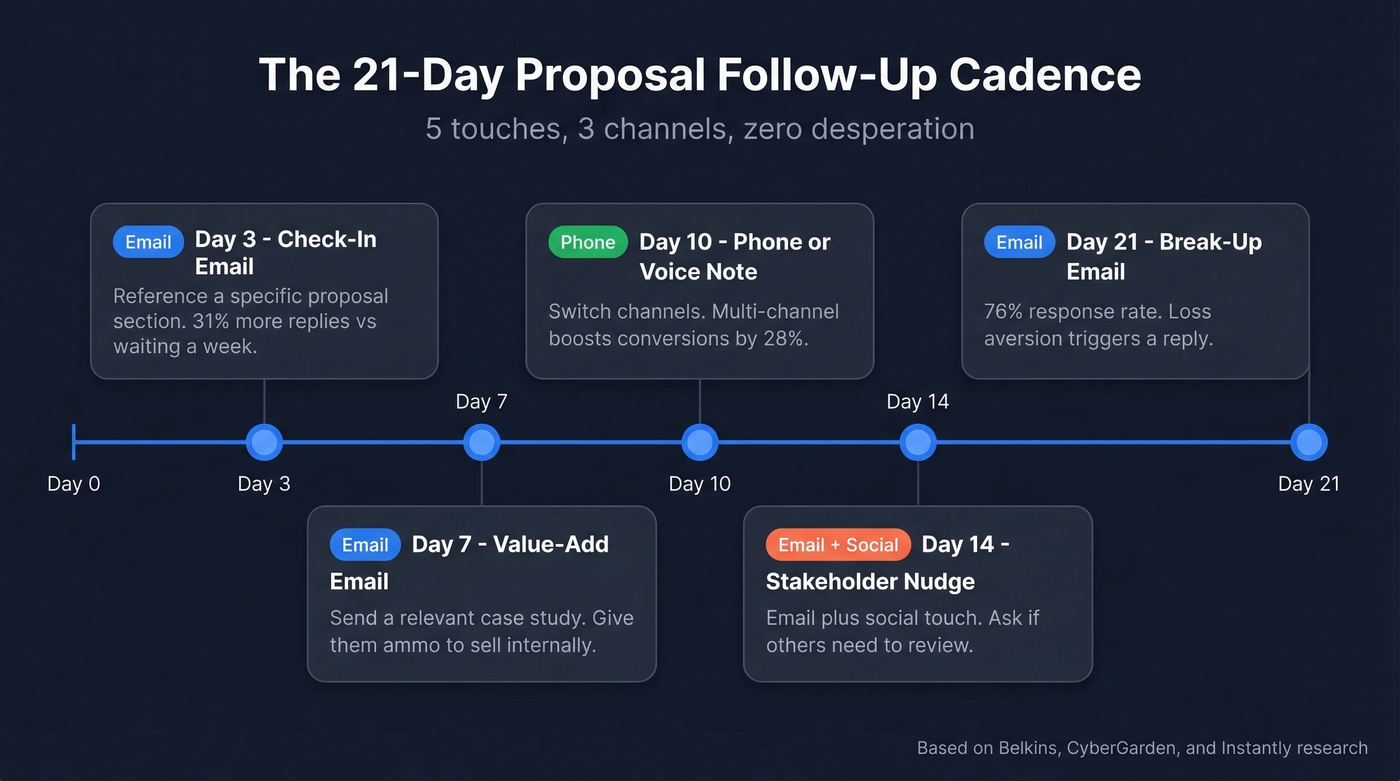
| Day | Action | Channel |
|---|---|---|
| 3 | Check-in (Template 1) | |
| 7 | Value-add (Template 2) | |
| 10 | Quick call or voice note | Phone |
| 14 | Stakeholder nudge (Template 3) | Email + social |
| 21 | Break-up (Template 5) |
Multi-channel follow-up improves conversion rates by ~28% over email-only sequences. After two unanswered emails, switch to phone or social. Don't just keep emailing into the void.
One caveat: if you're selling into enterprise (1,000+ employees), Belkins' dataset shows these companies punish persistence harder. Keep the sequence tighter and make each touch count. And before starting any sequence, make sure your contact data is current - Prospeo can verify emails in seconds with 98% accuracy so you're not wasting touches on a bounced address. (Related: email deliverability.)
Mistakes That Kill Your Follow-Up
"Just checking in" with no value. Replace it with a case study, a new data point, or a logistics question. Every empty check-in trains your prospect to ignore you.
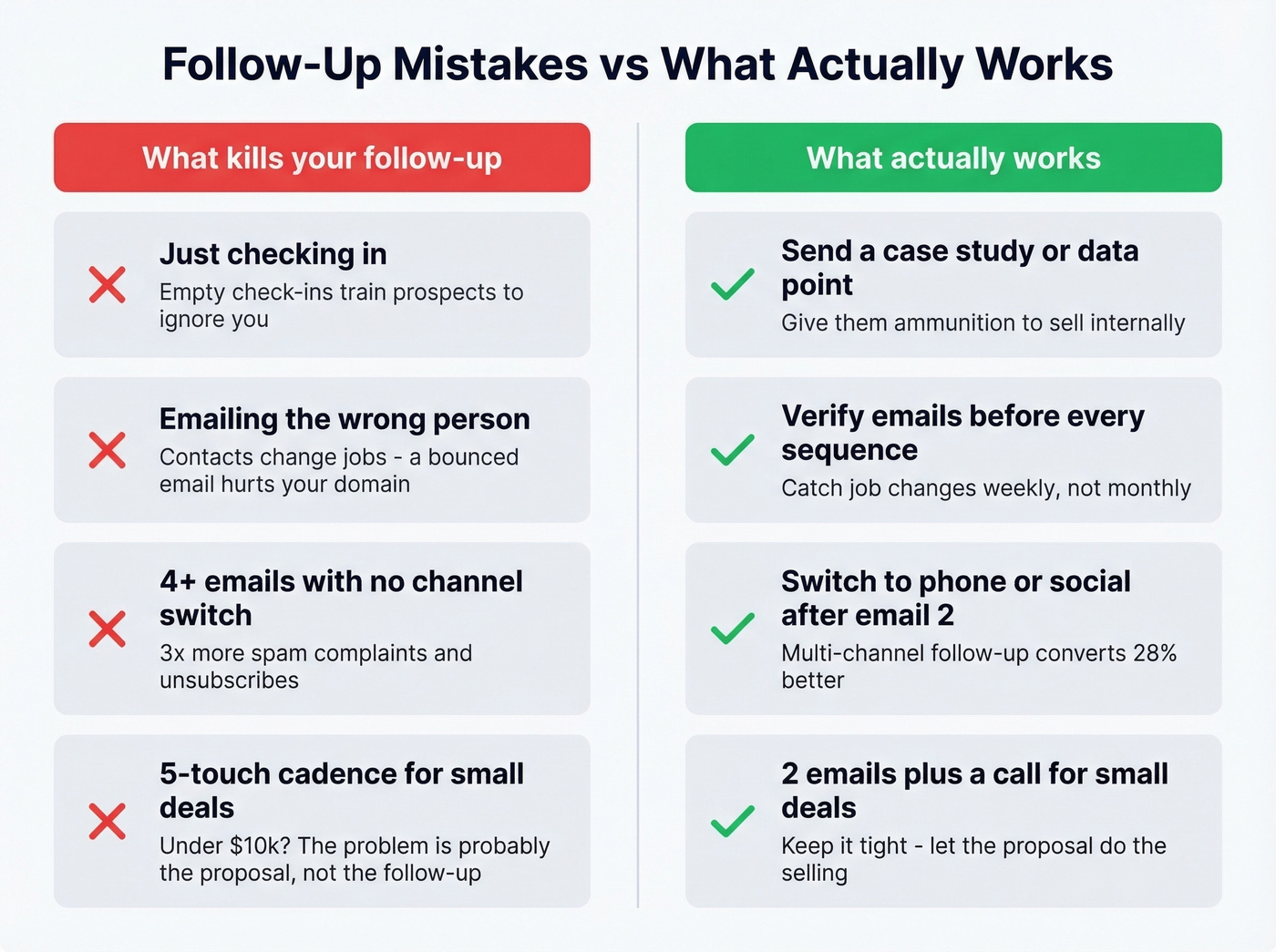
Following up with the wrong person. We've seen entire sequences wasted because the contact moved to a new company. Contacts change roles constantly - run your proposal contacts through email verification before launching your sequence. Prospeo refreshes its data every 7 days versus the 6-week industry average, so you'll catch job changes before they cost you a deal.
A bounced follow-up doesn't just fail. It damages your domain reputation. (More: email bounce rate.)
Sending 4+ emails without switching channels. The data is clear: four or more emails in a sequence more than triples unsubscribe and spam complaint rates. After two emails with no reply, pick up the phone or engage on social.
Hot take: If your average deal size is under $10k, you probably don't need a five-touch cadence at all. Two emails and a phone call. The proposal should do most of the selling - if it doesn't, the problem isn't your follow-up. Skip the elaborate sequence and fix the proposal instead.
Following up with the wrong person kills more deals than bad timing. Prospeo's 300M+ profile database catches job changes weekly, and email verification at $0.01 per address means protecting your domain reputation costs almost nothing.
One bounced follow-up damages your domain. Don't risk it.
FAQ
How long should I wait before following up on a proposal?
Wait 2-3 business days. Day 3 is the sweet spot - it gives your prospect time to review without letting the conversation go cold. Setting a review date on the original call makes your follow-up feel expected rather than pushy.
How many follow-ups should I send after a proposal?
Most buyers expect 2-4 follow-ups before deciding. Avoid long email-only threads - Belkins' 16.5M-email analysis shows 4+ emails more than triples unsubscribe and spam complaint rates. Mix in a phone call or social touch after email two.
What should a proposal follow-up template include?
Every template should reference a specific section of the proposal, include a clear call to action, and offer something of value - whether that's a case study, a scheduling link, or new information relevant to the deal.
How do I make sure my follow-up actually reaches the prospect?
Verify the email address before sending. A tool like Prospeo checks addresses with 98% accuracy on a 7-day refresh cycle, so you're not following up with someone who left the company months ago. The free tier covers 75 verifications per month.