

Sales Psychology: What Actually Works (and What Backfires)
You sent 500 cold emails last quarter. You got 3 replies. One was an out-of-office, one was "please remove me," and the third ghosted after the discovery call. The average conversion rate across industries sits at 2.9% - and that's for qualified leads, not closed deals. In 2026, 84% of reps missed quota. Something's broken, and it isn't just your subject lines.
The gap isn't effort. It's understanding how people actually make decisions - and applying that understanding at every stage of the sales process, not just the close.
Here's the short version: master loss framing (rewrite every value prop as loss-avoidance), add one identity-priming question to every discovery call, and verify your prospect data before applying any of this. Behavioral science doesn't work on bounced emails. The rest of this guide shows you how, stage by stage, with the data to back it up.
What Is Sales Psychology?
Sales psychology is the application of behavioral science - cognitive biases, decision heuristics, emotional triggers - to how you sell. It's the study of why people say yes, why they stall, and why they ghost you after a great demo.
Here's the thing: most content on this topic recites Robert Cialdini's six principles of influence, drops a Kahneman reference, and calls it a day. A 2026 systematic review by Gupta, Kapoor, and Verma in Frontiers in Neuroergonomics mapped neuromarketing research across consumer buying stages, confirming that the science goes far deeper than "reciprocity and scarcity." Yet most sales guides haven't caught up. They give you a vocabulary lesson when you need a playbook.
You don't need 12 psychological tricks. You need 3 principles applied consistently, at the right moments, with data clean enough to actually reach your prospects.
The Foundation: Cialdini's Six
You should know these cold:
| Principle | Definition | Sales Application |
|---|---|---|
| Reciprocity | People return favors | Give value first - audits, insights, intros |
| Social Proof | People follow the crowd | Case studies, logos, "500+ teams use this" |
| Scarcity | Rare things feel valuable | Real deadline-driven offers, limited slots |
| Authority | People defer to experts | Data-backed claims, credentials, research |
| Liking | People buy from people they like | Personalization, mirroring, shared context |
| Commitment | Small yeses lead to big yeses | Free trial, then pilot, then contract |
Good. Now let's talk about the principles that actually change your win rate.
Loss Aversion and Prospect Theory
Daniel Kahneman and Amos Tversky's prospect theory is the single most useful framework for sales messaging. The core insight: losses feel roughly twice as intense as equivalent gains. "You'll save $50K" is nice. "You're losing $50K every quarter you delay" hits different.
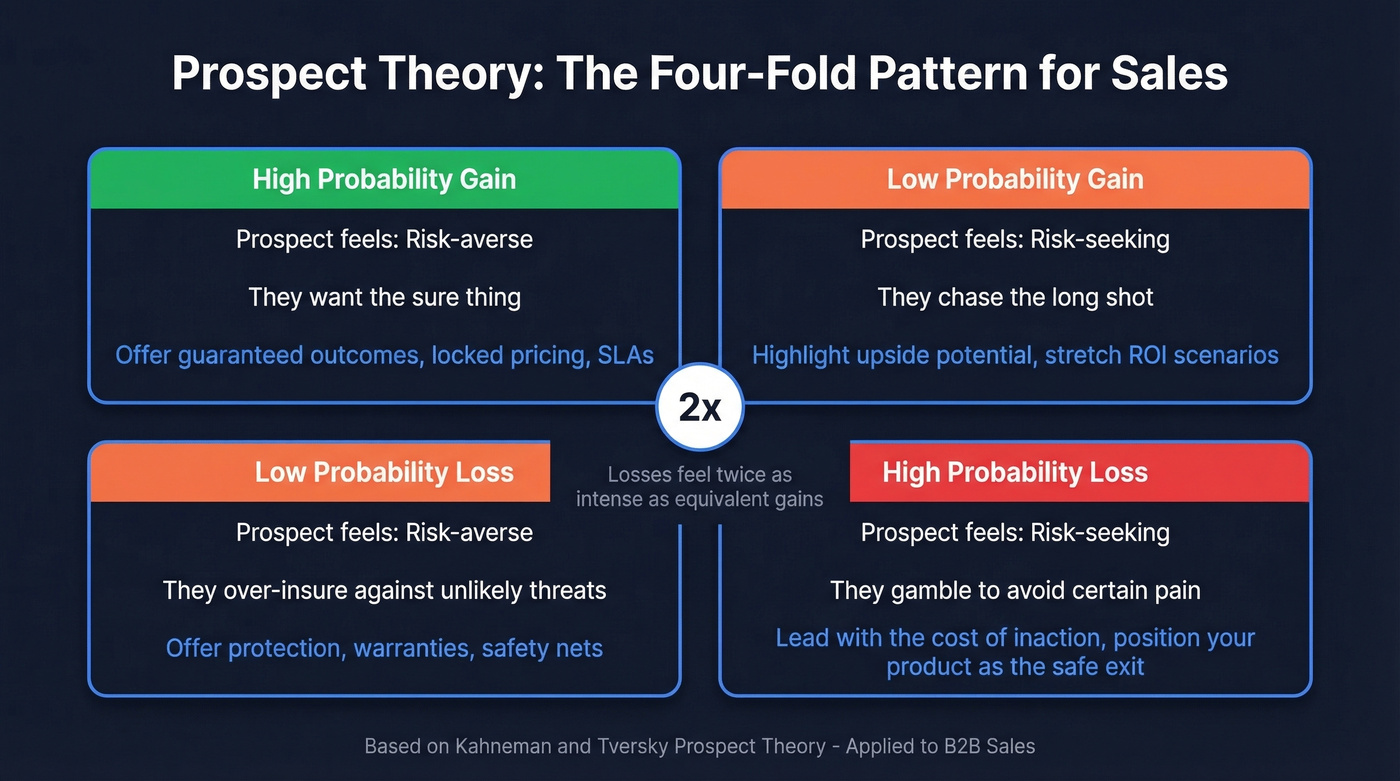
But it goes deeper than a rewrite trick. The four-fold pattern changes how you frame every deal depending on where the prospect sits emotionally. When prospects face high-probability gains, they become risk-averse - they want the sure thing. When they face high-probability losses, they become risk-seeking - they'll gamble to avoid the pain. Your demo shouldn't lead with upside. It should lead with what they're losing right now, then position your product as the safe path out.
Anchoring
The first number a prospect hears becomes the anchor for every subsequent evaluation. Show your premium tier ($80K/year), and your mid-tier ($35K/year) feels reasonable. Start with the mid-tier, and it feels expensive in isolation. Always anchor high, then let the real number feel like relief. I'll cover the specific application in the Demo section below - this section is the why, that one is the how.
Decoy Effect and Choice Overload
Three pricing tiers exist for a reason, and it isn't flexibility. The decoy effect means a strategically inferior option makes the target option look better by comparison. Classic example: a $49 basic plan, a $79 pro plan, and a $99 enterprise plan where enterprise only adds one marginal feature over pro. Pro suddenly looks like the obvious choice.
Overdo it - five tiers, twelve add-ons - and you trigger choice overload. More options can lead to fewer purchases. When buyers feel overwhelmed, they default to "no."
Pre-Suasion: Before the Pitch
Cialdini's follow-up to Influence introduced pre-suasion - the idea that what happens before your pitch matters more than the pitch itself. The data backs this up in ways that feel almost unfair.
An A/B test on a sofa e-commerce site changed only the background image. When visitors saw clouds, they gravitated toward softer, more comfortable cushions. When they saw pennies, they prioritized cheaper options. Same products. Same prices. Different priming - different buying behavior. Participants denied being influenced when told about the experiment.
Now here's where it gets practical for sales calls. Researchers asked people to complete a marketing survey. Compliance rate: 29%. But when they first asked "Do you consider yourself a helpful person?" compliance jumped to 77%. That's identity priming - the person affirms a self-concept, then acts consistently with it. Apply this to your discovery calls:
- "Are you the kind of leader who moves fast when the data's clear?"
- "Would you say your team prioritizes precision over volume?"
- "Do you consider yourself someone who evaluates tools rigorously before committing?"
Each question primes an identity. The prospect then behaves consistently with it throughout the conversation. It's not manipulation - you're helping them act on what they already believe. Daniel Pink explores this dynamic in To Sell Is Human: the best sellers don't push. They create conditions where buying feels like the natural next step.

Loss aversion, anchoring, pre-suasion - none of it matters if your emails never reach the inbox. Prospeo delivers 98% email accuracy on a 7-day refresh cycle, so every carefully framed message actually lands.
Stop losing deals to bad data before your psychology even kicks in.
Stage-by-Stage Playbook
Prospecting
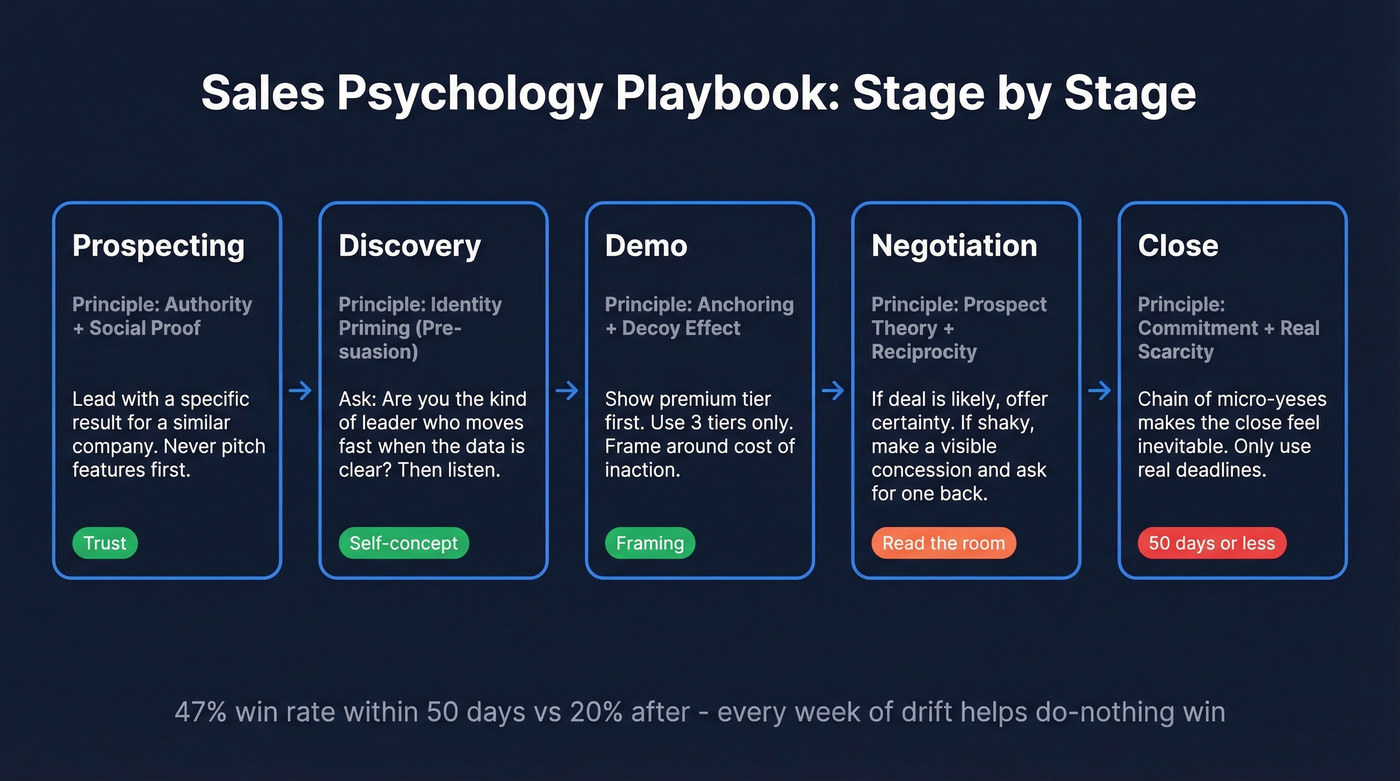
Authority and social proof do the heavy lifting in cold outreach. Your first email needs to answer one question: "Why should I trust this stranger?" Lead with a specific result ("We helped [similar company] cut churn by 23%"), not a feature list. 80% of B2B interactions now happen in digital channels, which means your email is your first impression - there's no handshake to fall back on.
None of this matters if your email bounces. We've seen teams invest weeks crafting loss-framed sequences only to discover 30% of their list was dead addresses. Tools like Prospeo, with 98% email accuracy and a 7-day data refresh cycle, exist to solve exactly this problem - the free tier gives you 75 verified emails per month, enough to test whether your new messaging actually lands. If you're rebuilding your outbound motion, start with sales prospecting techniques that match your market and volume.

Discovery
This is where identity priming earns its keep. Open with one of those "Are you the kind of..." questions, then shut up. Adam Grant's research is widely cited for showing ambiverts outperform strong extroverts because they balance talking and listening. Aim to listen more than you talk. Ask the priming question, let the prospect talk themselves into the problem, and listen for the loss they're already feeling so you can reflect it back. If you want a tighter structure, use a discovery call script and swap in your priming question at the top.
Demo and Presentation
Anchor the price before you show a single feature. Set the frame around the cost of inaction - what happens if they do nothing for another quarter? Now your solution feels like a bargain in context.
Structure your packaging to use the decoy effect: three tiers, with the middle tier as your target. Keep it clean. Choice overload kills deals faster than a bad demo. For a repeatable flow, keep a product demo checklist next to your deck.
Negotiation
Picture this: you're three calls deep, the champion loves you, and the CFO just asked for a 20% discount.
Prospect theory's four-fold pattern tells you exactly how to read the room. When the deal is likely to close, the prospect becomes risk-averse - they want certainty. Offer it: locked pricing, guaranteed onboarding timeline, SLA commitments. When the deal is shaky, they become risk-seeking. That's when you deploy reciprocity. Make a visible concession ("I'll waive the setup fee") and ask for one in return ("Can we get the contract signed by Friday?"). If you want to go deeper on pricing frames, see anchor in negotiation.
Close
Real scarcity works. Manufactured scarcity destroys trust.
"We have three onboarding slots left this quarter because our implementation team is booked" is real. "This price expires in 24 hours" on an enterprise deal is insulting - and your prospect knows it.
Lean on commitment and consistency instead. The prospect has already said yes to a trial, yes to a pilot, yes to an internal presentation. The close is the next logical step in a chain of micro-commitments they've already made. Timing matters more than most reps realize. Opportunities closed within 50 days have a 47% win rate. After that threshold, win rates collapse to around 20%. Every week you let a deal drift is a week "do nothing" starts winning. If your deals stall late, map your process against these steps to close a sale.
B2B vs. B2C: Context Changes Everything
In B2C, you're often dealing with a single decision-maker acting on emotion in the moment - scarcity and social proof hit harder and faster. In B2B, those same triggers need to survive a committee review.
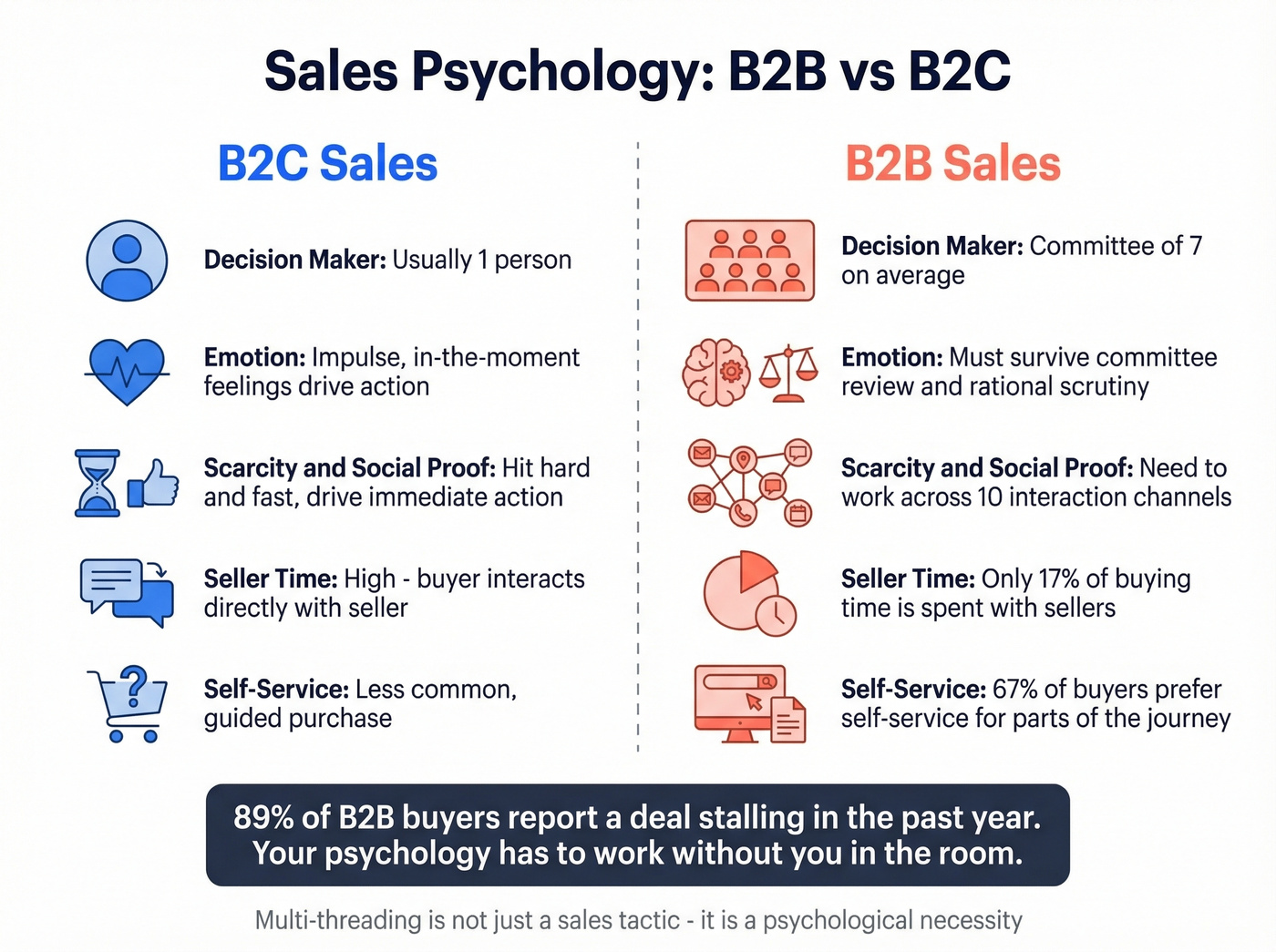
B2B buyers spend only 17% of their buying time actually meeting with sellers. They use an average of 10 interaction channels. A buying committee of seven people means your loss framing needs to work in an email, a Zoom call, and a self-serve product page - because different stakeholders on the same deal will encounter your message in different formats. And 67% of B2B customers now prefer self-service for parts of their buying journey, which means your persuasion framework has to work without you in the room. This is also why B2B sales teams obsess over multi-threading and enablement assets.
That's why 89% of B2B buyers report a deal stalling in the past year. It's not that the psychology failed - it's that it only reached two of the seven decision-makers. Multi-threading isn't just a sales tactic. It's a psychological necessity. If you're diagnosing why deals slip, start with the most common sales pipeline challenges.
When Psychology Backfires
We've watched reps blow six-figure deals by applying these principles carelessly. Sales psychology backfires more often than it works when you treat it like a bag of tricks instead of a framework. Here are the anti-patterns that kill deals:
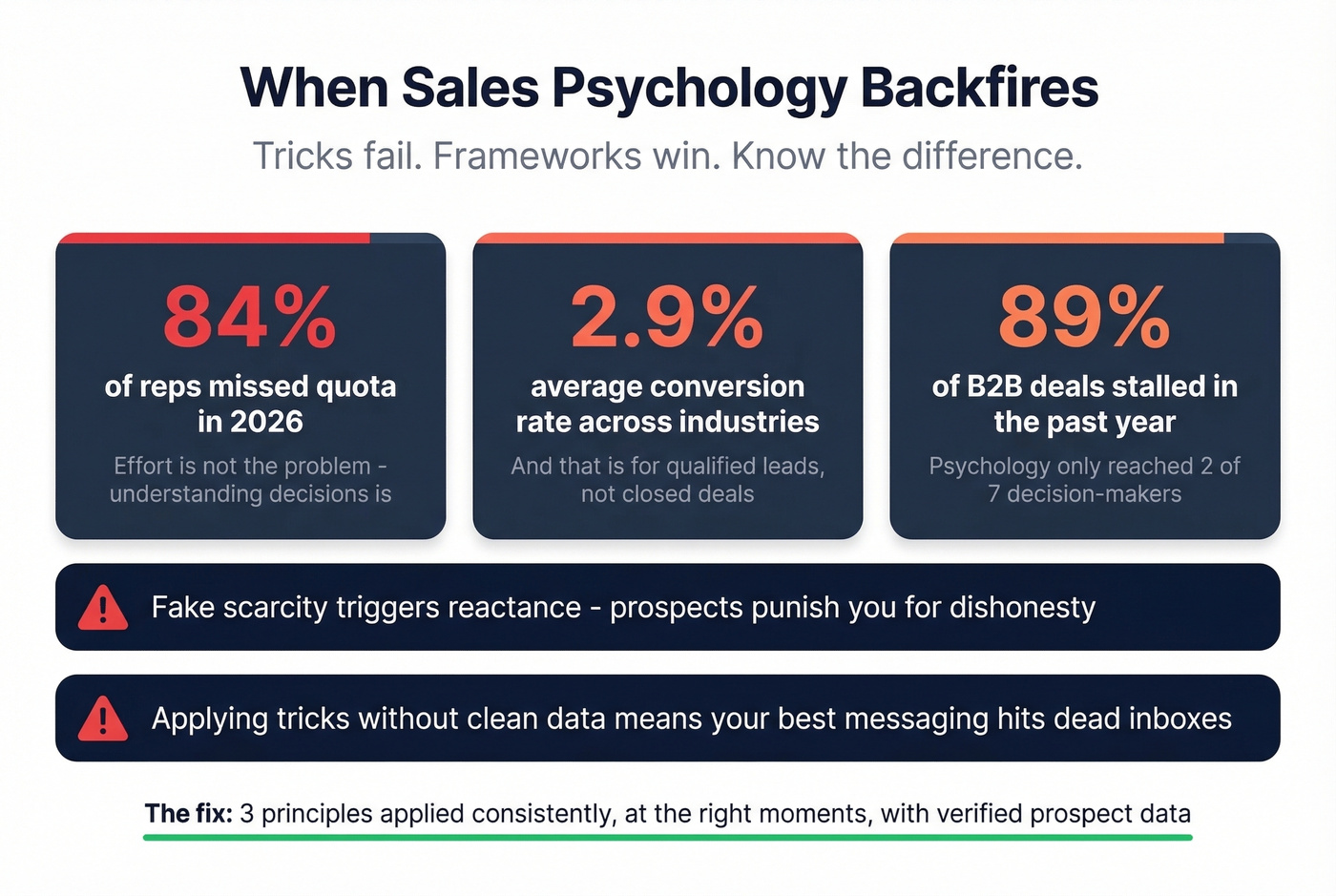
Fake scarcity triggers reactance. When prospects sense manufactured urgency, they don't just ignore it - they actively resist. Reactance theory explains why: people push back when they feel their autonomy is threatened.
Over-talking threatens autonomy. Talking too much in a discovery call signals that you care more about your pitch than their problem. The prospect feels steamrolled, not persuaded.
Jargon creates cognitive strain. Every unfamiliar term increases cognitive load. When the brain works harder to process language, it has less capacity to evaluate your actual value proposition. Simplify ruthlessly.
Arguing activates ego defense. The moment you tell a prospect they're wrong, they stop evaluating your product and start defending their position. Acknowledge first, reframe second.
Deferring too much kills authority. As one practitioner put it bluntly: believing the client knows more than you is a fatal mistake. You're the expert. If you don't project authority, no amount of social proof will compensate.
The common thread? Each anti-pattern violates a core psychological need - autonomy, competence, or relatedness. Ethical persuasion serves those needs. Manipulative tactics threaten them. If you want a clearer line between influence and coercion, use a simple ethics in sales checklist.
Let's be honest about something: most teams don't have a sales psychology problem. They have a data quality problem dressed up as a psychology problem. You can master every principle in this article, but if your emails bounce and your contact data is stale, you're applying behavioral science to an empty room. Fix the foundation first. The psychology compounds on top of it. Start by tracking your email bounce rate and cleaning lists before you scale.
Monday Morning Action Plan
Audit your data. Upload your prospect list and see how many addresses are actually valid. You can't apply psychology to a bounced email.
Rewrite one email sequence using loss framing. Take your best-performing template. Replace every "you'll gain" with "you're losing." Test it against the original for two weeks. If you need a baseline to rewrite, pull from these cold email follow-up templates.
Add one identity-priming question to your discovery script. "Are you the kind of leader who acts fast when the data supports it?" Then listen.
Remove one instance of fake scarcity from your funnel. Find the "limited time offer" that isn't actually limited. Kill it. Replace it with a real deadline or drop the urgency entirely.
You just learned how identity priming lifts response rates from 29% to 77%. Now imagine pairing that with verified direct contacts for every prospect. Prospeo's 300M+ profiles and 30+ filters let you reach the right decision-makers - so your behavioral science actually has someone to persuade.
Apply the playbook to prospects who actually exist in your pipeline.
FAQ
Is using psychology in sales manipulative?
Ethical sales psychology helps buyers make better decisions faster by reducing cognitive load and surfacing relevant information. It crosses into manipulation when you fabricate scarcity, misrepresent facts, or exploit emotional vulnerability. The line is simple: does the tactic serve the buyer's interest or only yours?
What's the highest-leverage technique to start with?
Loss framing delivers the fastest results. Rewrite your top-performing email so every benefit is stated as a cost of inaction - "you're losing $50K/quarter" instead of "you'll save $50K." Teams that run this A/B test typically see 15-30% higher reply rates within two weeks.
What tools help apply sales psychology?
The foundation is accurate prospect data - behavioral science doesn't work on bounced emails. From there, conversation intelligence platforms track talk-to-listen ratios and flag priming opportunities in live calls. Layer in intent data to time outreach when prospects are already researching solutions.
How does sales psychology differ in B2B vs. B2C?
B2B buying committees average seven people across 10 interaction channels, so your loss framing and social proof must survive asynchronous review - not just land in a live conversation. B2C decisions are faster and more emotionally driven, making scarcity and impulse triggers more effective in the moment.