

Sales Rebuttals That Actually Work (According to 300M+ Analyzed Calls)
It's 2:15 PM on a Tuesday. You're 47 dials into a cold call block, and the VP of Marketing you've been chasing for three weeks finally picks up. She says "not interested" before you finish your first sentence.
What comes out of your mouth in the next four seconds determines whether this becomes a pipeline opportunity or a wasted dial.
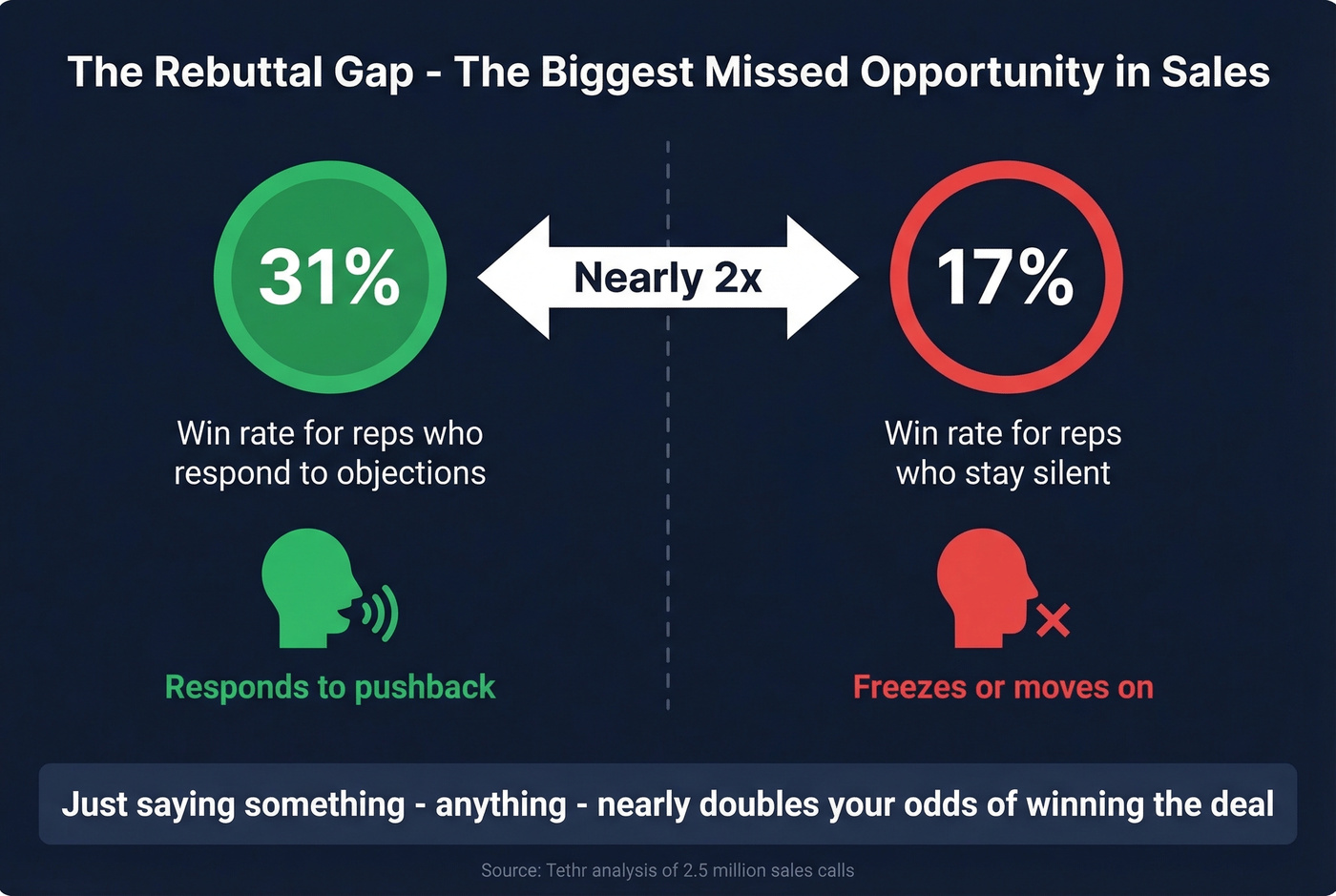
That four-second window is where sales rebuttals separate closers from dialers. 81% of revenue leaders say their deals are more complex than ever, and yet Tethr's analysis of 2.5 million calls found a 17-point gap between how often objections appear and how often reps actually respond to them. Most rebuttal guides hand you 25 scripts and zero data on which ones work. We've pulled the numbers that matter and built this around what actually moves win rates.
The Cheat Sheet
Before you read another word:
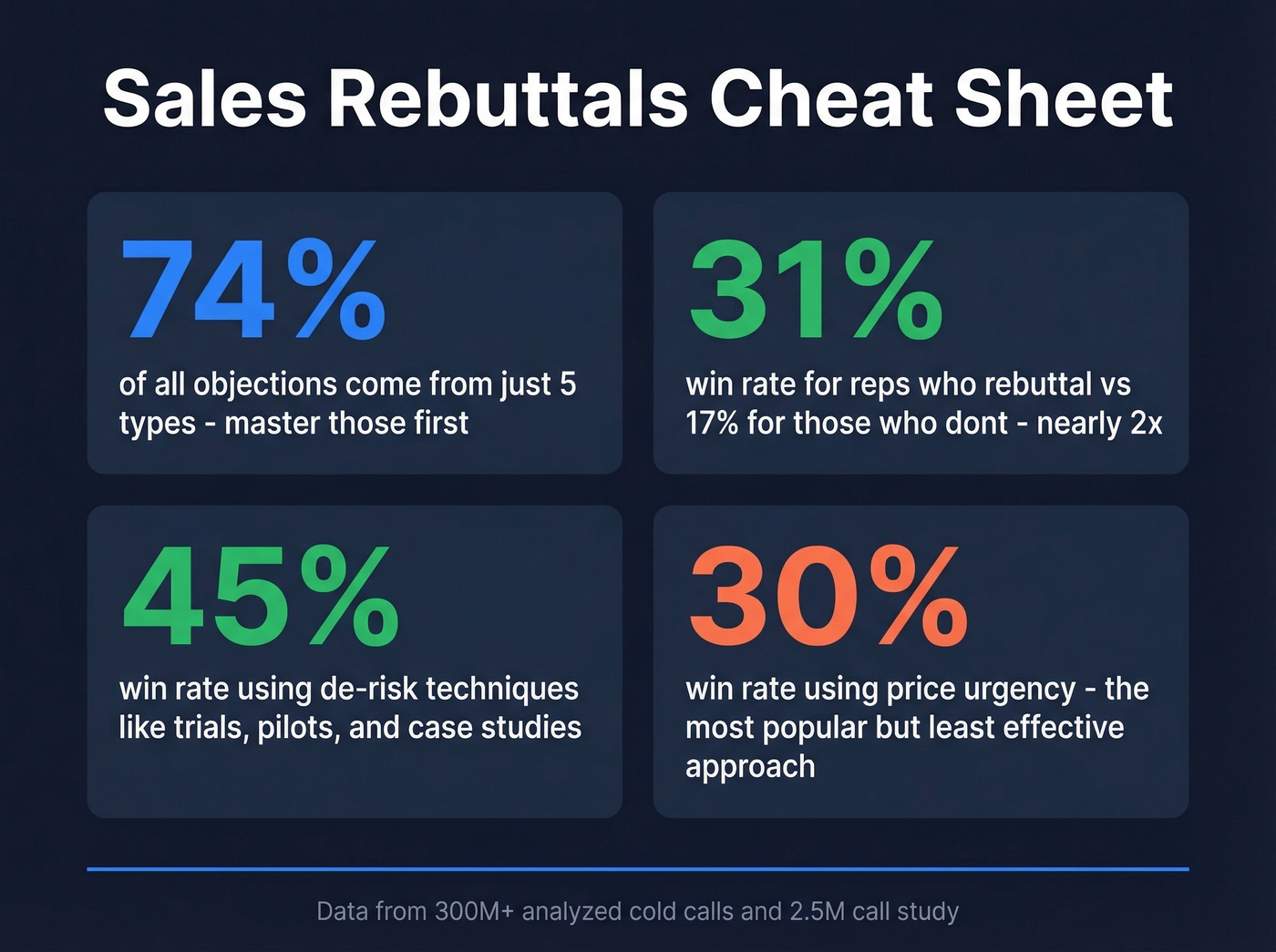
- The top 5 objections cover 74% of all sales conversations. Master those first.
- Reps who rebuttal at all win 31% of deals vs. 17% for reps who don't. Nearly double.
- De-risk techniques like trials, pilots, and case studies average a 45% win rate. Price-driven urgency averages 30%.
- You need 5 great responses, not 25.
Why Reps Freeze on Objections
A sales rebuttal is your response to a prospect's pushback - the thing you say or type after they resist. But knowing the definition doesn't explain why so many reps go silent when it counts.
The answer is psychology, and it cuts both ways. Your prospect is running on three cognitive biases, and understanding them turns a scripted response into a strategic one.
Loss aversion drives price objections. Prospects feel the pain of spending $40,000 more intensely than the pleasure of gaining $120,000 in pipeline. That's why "it'll pay for itself" rarely lands - you're speaking to the wrong part of their brain.
Status quo bias powers the "we're happy with our current vendor" objection. Switching costs feel enormous even when they aren't, because the familiar feels safe. Your job isn't to trash their current tool. It's to make the gap between where they are and where they could be feel concrete and specific.
The ambiguity effect creates "I need to think about it." When prospects face too much uncertainty, they default to inaction. De-risking the decision - free trials, pilot programs, money-back guarantees - directly counters this bias, which is exactly why de-risk techniques outperform every other approach in the data.
The 3 Objection Types
Gong analyzed 300M+ cold calls and found that every objection falls into one of three buckets. This taxonomy matters because each type requires a fundamentally different rebuttal approach.
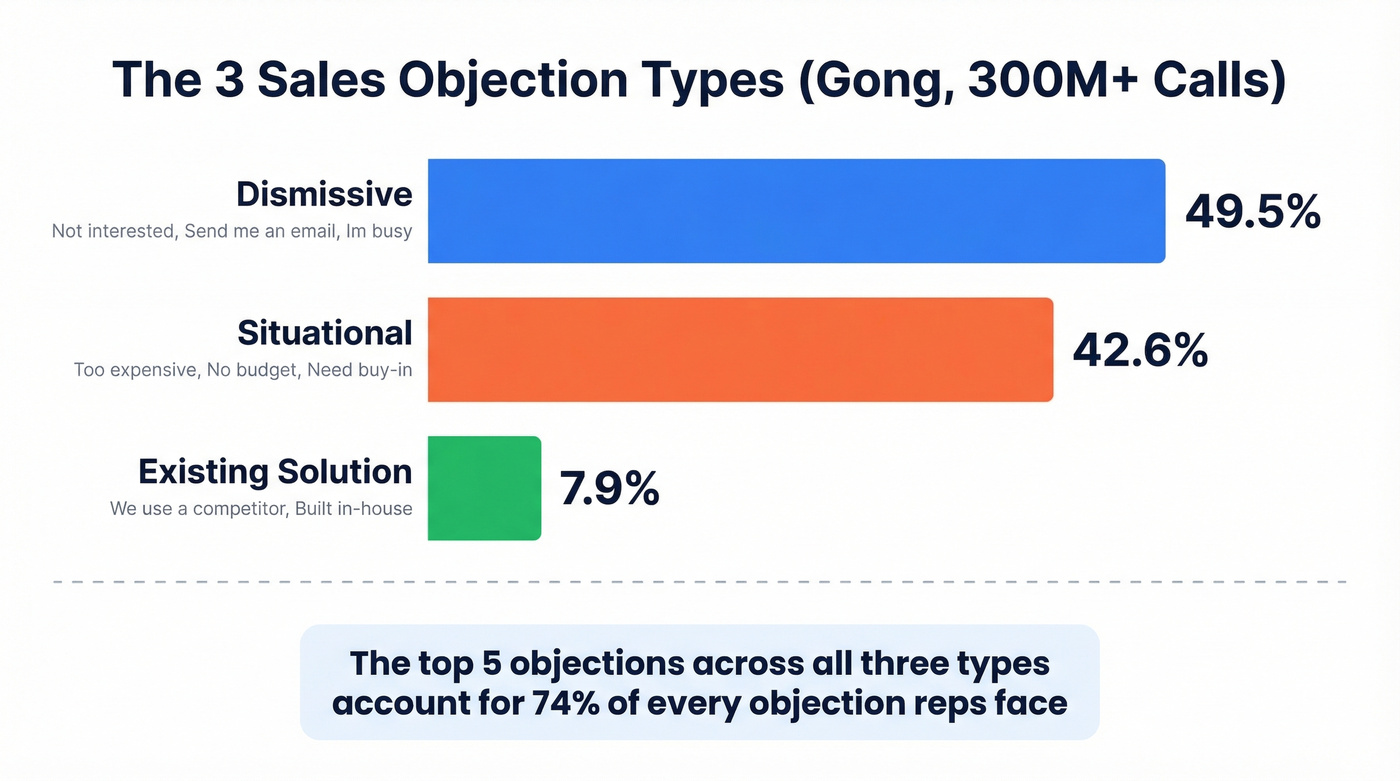
| Type | Frequency | Examples | What's Really Happening |
|---|---|---|---|
| Dismissive | 49.5% | "Not interested," "Send me an email," "I'm busy" | Prospect wants you gone |
| Situational | 42.6% | "Too expensive," "No budget," "Need buy-in" | Real constraint, real conversation |
| Existing solution | 7.9% | "We use [competitor]," "Built in-house" | Status quo bias in action |
The top 5 objections across all three types account for 74% of every objection reps encounter. You don't need a 50-page playbook - you need surgical precision on the handful that actually show up.
Which Rebuttal Strategies Win Deals
Not all objection responses are created equal. Tethr's study of 2.5 million calls broke down win rates by rebuttal strategy, and the results should change how you train your team.
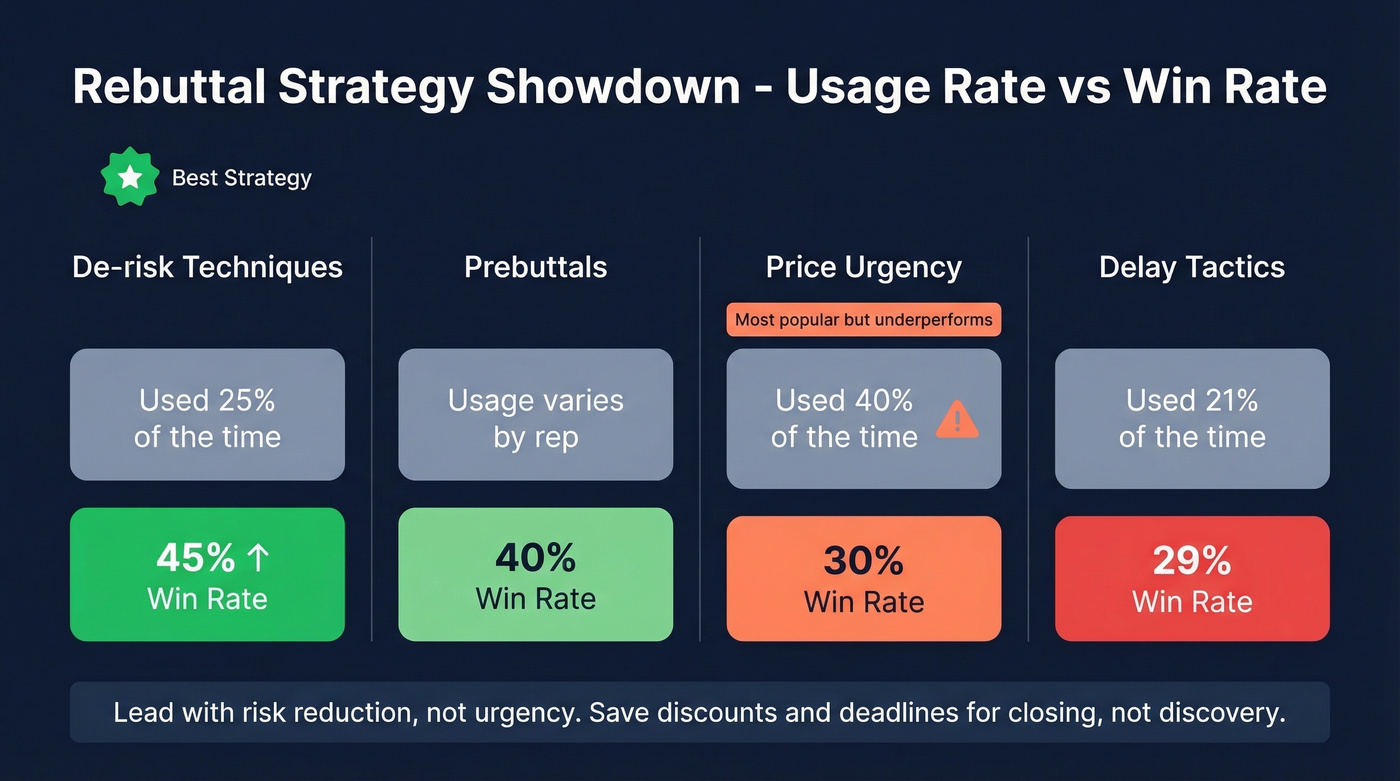
| Rebuttal Type | Usage Rate | Avg Win Rate |
|---|---|---|
| De-risk techniques | 25% | 45% |
| Prebuttals | Varies | 40% |
| Price urgency drivers | 40% | 30% |
| Delay tactics | 21% | 29% |
Here's the thing: the most popular rebuttal type - price urgency - is one of the least effective. Reps default to "this price expires Friday" because it feels proactive. But de-risk techniques win at 45% because they directly address the ambiguity that's actually stalling the deal.
Prebuttals deserve special attention. These are responses deployed before the prospect even raises an objection, and they correlate with a 40% win rate. If you know price is going to come up, address it in your pitch before they have to ask. It signals confidence and removes friction.
The baseline recommendation: lead with risk reduction, not urgency. Save discounts and deadlines for closing, not discovery.

The best sales rebuttal in the world won't save you if your email bounces or your call goes to a dead line. Prospeo delivers 98% email accuracy and 125M+ verified mobile numbers with a 30% pickup rate - so your rebuttals actually reach decision-makers.
Stop perfecting scripts for prospects you'll never reach.
Best Sales Rebuttals for Every Objection
Let's get specific. Below are scripts organized by Gong's three-bucket taxonomy, with phone and email versions for each. Every rebuttal here uses de-risk or exploratory techniques - the approaches that actually move win rates.
Dismissive Objections (49.5%)
These are the "get off my phone" objections. The prospect hasn't engaged with your value prop at all - they're rejecting the interruption, not the offer.
"Not interested."
Phone: "Totally fair - you don't have enough context to be interested yet. Can I take 20 seconds to tell you why I called, and you can tell me if it's worth a longer conversation?"
Email: "No worries - I probably didn't give you enough context. [One sentence of specific value prop]. Worth a 10-minute call, or should I check back next quarter?"
"I'm busy - call me back."
The consensus on r/sales is that most reps fumble this by just saying "Sure, when works?" and getting ghosted. A practitioner-tested line that works: "I know I caught you cold - can I level with you briefly to see if it even makes sense to follow up in the first place?" This earns you 20 seconds without being pushy. It works because it gives the prospect an out while framing your ask as respectful of their time.
"Send me an email."
Phone: "Happy to - what specifically should I cover so it's actually useful and doesn't just end up buried?" This forces them to engage with your topic for 10 seconds, which often opens the real conversation. (If you need options, steal from these follow-up templates.)
"Is this a cold call?"
Phone: "It is. I'm calling because [one specific, researched reason]. Does that land, or am I off base?" Honesty disarms. Defensiveness confirms their suspicion that you're wasting their time.
"How'd you get my number?"
Phone: "Your contact info is in our business database - I reached out because [specific reason]. Should I not have this number?" (If this comes up a lot, your sales prospecting techniques and data hygiene need a tune-up.)
Situational Objections (42.6%)
These are real conversations. The prospect has a genuine constraint - budget, timing, authority. Your job is to explore, not overcome.
"Too expensive."
Phone: "That's fair. Can I ask - too expensive compared to what? Your current solution, your budget for this quarter, or the ROI you'd need to justify it?" This unpacks the objection into something you can actually address. Price objections are almost never about the number - they're about perceived value relative to something else. (This is also where anchor in negotiation matters.)
Email: "Totally understand. Most of our customers felt the same way before seeing the ROI numbers. [Customer name] saw [specific result] in [timeframe]. Want me to walk you through their math?"
"No budget right now."
Phone: "Makes sense. If budget weren't a factor, is this something you'd want to solve? ... Great. Let's map out what a pilot would look like so you can build the case for next quarter's budget." (A lightweight sales POC can make this easy to justify.)
"I need to think about it."
This is the ambiguity effect in action. The prospect doesn't need to think - they need more certainty.
Phone: "Of course. What specifically are you weighing? I might be able to get you the info that makes the decision easier." Then shut up. The silence after this question is where deals are won.
"Need internal buy-in."
Phone: "Who else needs to weigh in? I can put together a one-pager that addresses their specific concerns - what would they care about most?" This turns the objection into a coaching opportunity. You're helping your champion sell internally, and that's where multi-threaded deals get unstuck. (If you want a structure, borrow from MEDDIC sales qualification.)
Existing Solution Objections (7.9%)
Only 7.9% of objections, but they're where reps make the biggest mistake: criticizing the prospect's current solution. Gong's guidance is to avoid that reflex and use an "agree, trap question, sell the test drive" approach.
"We already use [competitor]."
Phone: "Good - that means you already see the value in solving this problem. Out of curiosity, if you could change one thing about how [competitor] works for you, what would it be?" You're not attacking their choice. You're surfacing the gap they already know exists.
"We built it in-house."
Phone: "That's impressive - most teams don't invest that heavily. What's the maintenance burden look like? I ask because a lot of our customers started in-house and eventually realized the engineering hours were costing more than a purpose-built solution."
"We're stuck in a contract."
Phone: "When does it renew? Let's set up a pilot 60 days before so you have real comparison data when the decision comes up. No pressure before then."
Email: "Totally get it. When's your renewal? Happy to run a side-by-side comparison beforehand so you have data, not just a pitch."
3 Frameworks Worth Memorizing
Scripts handle specific objections. Frameworks are what you fall back on when you hear something you haven't rehearsed.
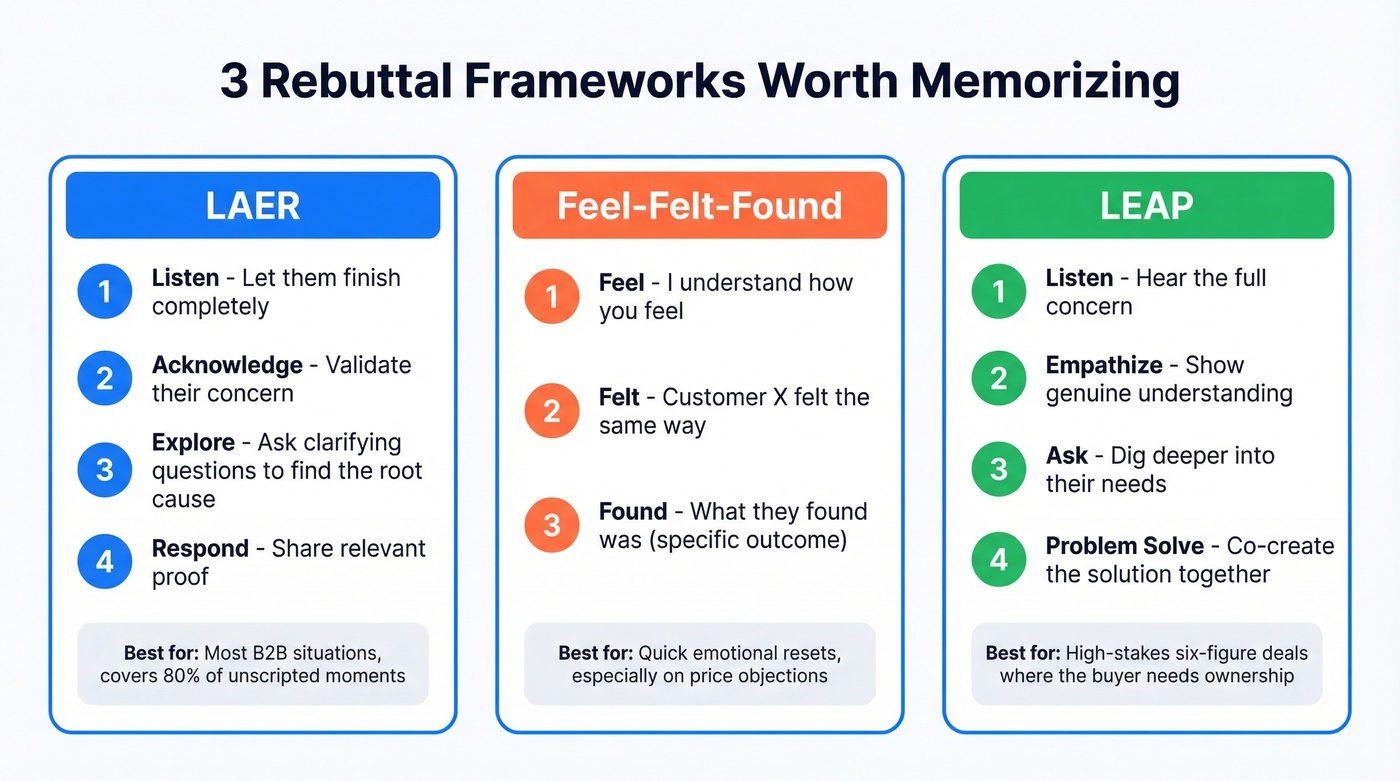
LAER (Listen, Acknowledge, Explore, Respond) is the most versatile for B2B. Let the prospect finish, validate their concern, ask a clarifying question to find the root cause, then respond with relevant proof. In our experience, this one covers about 80% of situations where a rep doesn't have a rehearsed script ready.
Feel-Felt-Found is best for quick emotional resets, especially on price. "I understand how you feel - [customer name] felt the same way. What they found was [specific outcome]." Simple, empathetic, and effective because social proof reduces perceived risk.
LEAP (Listen, Empathize, Ask, Problem Solve) is the consultative version for high-stakes deals. Instead of responding with a pitch, you co-create the solution with the prospect. Best when you're selling six-figure contracts where the buyer needs to feel ownership of the decision. (This pairs well with strong discovery questions.)
5 Mistakes That Kill Rebuttals
- Not rebutting at all. The 17-point gap between objection frequency and rebuttal frequency is the biggest missed opportunity in sales. Reps who respond win at 31%. Reps who don't win at 17%. Just saying something doubles your odds.
Criticizing the prospect's current solution. The moment you say "well, [competitor] doesn't do X," the prospect stops listening and starts defending.
Offering discounts too early. Discounting before you've established value trains the prospect to negotiate harder. De-risk first. Discount last. (If you need a guardrail, set a walk away point.)
Arguing instead of asking questions. As Outreach puts it: "Spend less time trying to 'overcome' objections and more time trying to understand them."
Using the same script across phone, email, and DM. A phone rebuttal needs to be 1-2 sentences. An email rebuttal gets 3-6 lines. A DM is one tight paragraph plus a question. Same message, different packaging. (For email structure, use these email subject line examples.)
How to Train Your Team
Picture your SDR manager pulling up a call recording from yesterday's session. She pauses it right at the "too expensive" objection and asks the room: "How would you respond here?" That pause-and-discuss format is one of the most effective training drills we've seen for building rebuttal muscle.
Build your weekly rhythm around these exercises:
- Rapid-fire drill (5-10 min warm-up): Manager fires objections, reps respond immediately. No thinking time. This builds muscle memory so responses sound natural, not rehearsed.
- Structured roleplay: One person plays prospect, one plays rep. Debrief what worked and what didn't.
- Call review pauses: Pull real recordings, pause at objections, discuss as a team.
- AI roleplay tools: Platforms like Awarathon and Second Nature let reps practice against AI prospects with instant feedback on tone and phrasing. Good for ramp, not a replacement for live practice.
- Living objection playbook: Document every objection verbatim, what it really means, qualifying questions, recommended response, and proof points. Update it monthly. Skip this if your team is under five reps - a shared doc works fine until you hit scale. (If you're formalizing enablement, see sales training tips.)
The Objection You're Creating
Here's a question most sales leaders never ask: how many of your objections are self-inflicted?
The best rebuttal is the one you never have to make. Fix your data first, then worry about your scripts. (Start with data enrichment services if your CRM is stale.)
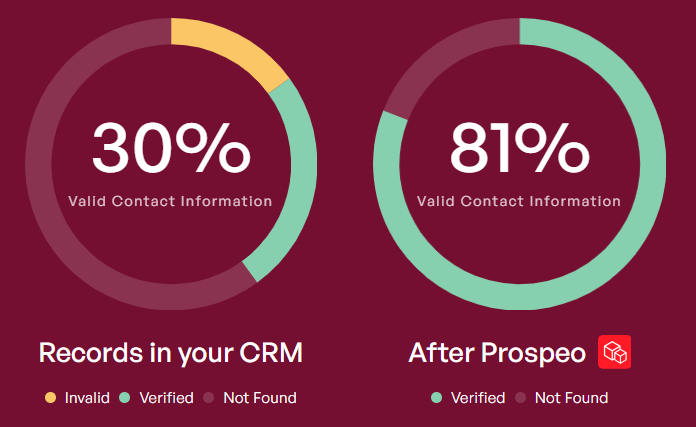
De-risk techniques win 45% of deals because they remove uncertainty. Remove your own uncertainty first: Prospeo's 7-day data refresh means you're never calling with stale info. At $0.01 per email, bad data is no longer an excuse for missed pipeline.
Reach the right buyers before your rebuttals even matter.
FAQ
What's the difference between a rebuttal and an objection?
An objection is the prospect's concern or pushback. A rebuttal is your strategic response. Tethr's data shows reps who deliver rebuttals win 31% of deals versus 17% for reps who let objections go unanswered - nearly double the win rate just for responding.
How many sales rebuttals should a rep memorize?
Five. Gong's analysis of 300M+ cold calls shows the top 5 objections cover 74% of all conversations. Master those five cold before expanding your playbook. Depth beats breadth - reps with deep fluency on core objections outperform those with shallow knowledge of 25.
Do de-risk techniques really outperform discounts?
Yes. De-risk approaches like free trials, pilots, and ROI case studies average a 45% win rate versus 30% for price urgency tactics like deadline-driven discounts. They work because they reduce the ambiguity stalling the decision rather than just pressuring the prospect.
Can bad prospect data cause more objections?
Absolutely. Calling the wrong person or using outdated contact info generates dismissive objections like "How'd you get my number?" that no script can fix. Teams using verified data with weekly refresh cycles report dramatic drops in bounce rates and corresponding jumps in real conversations - which is exactly why we built Prospeo the way we did.