

Sales Reps: The Data-Backed Guide to the Role, the Pay, and the Reality
It's 8:47 AM on a Tuesday. You've got 73 accounts in your pipeline, a CRM that needs updating from yesterday's calls, and a quota number that feels like it was set by someone who's never dialed a phone. Your manager wants a forecast by noon. Your first prospect just ghosted the demo. Welcome to life as one of America's 1.6 million sales reps.
The quick numbers: BLS median pay sits at $74,100 for wholesale and manufacturing reps, while Glassdoor's 135,000 salary submissions put median total comp at $125K with a most likely range of $96K-$166K. There are 142,100 openings per year in wholesale and manufacturing alone. And the thesis that runs through everything below is simple - sales in 2026 isn't a people game, it's a data game. The reps who win have the best contact data, not just the best pitch.
What Is a Sales Representative?
A sales representative identifies potential buyers, builds relationships, and converts interest into revenue. The BLS breaks the duties into a longer list: prospecting from directories and trade shows, contacting new and existing customers, running needs discovery, explaining product features, answering objections, negotiating terms, preparing contracts, and handling post-sale follow-up.
The biggest structural distinction is inside vs. outside sales. Inside reps work remotely through phones, video calls, and email sequences. Outside reps travel to client sites, attend trade shows, and close deals face-to-face. B2B reps typically sell higher-ticket products with longer cycles, while B2C reps sell higher volume at lower price points. Both require the same core skill: getting someone who doesn't know you to trust you enough to buy.
What Sales Reps Actually Do All Day
The job description says "build relationships and close deals." The reality is more granular and more exhausting.
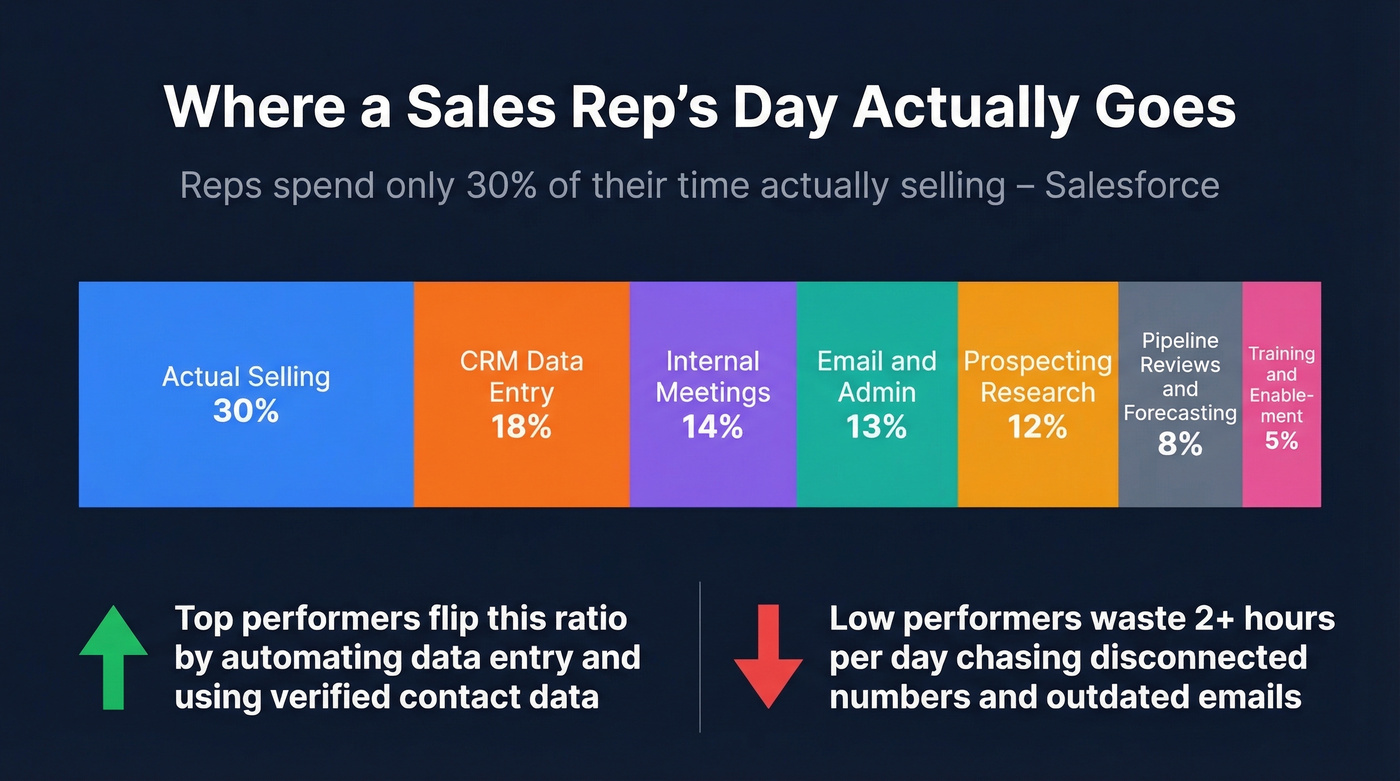
An SDR's day starts with a call block - 50 to 80 dials before lunch, plus 100+ personalized emails. That's not a stretch target; that's the baseline at most B2B SaaS companies. Between call blocks, you're qualifying leads using frameworks like BANT or MEDDIC, logging every touchpoint in Salesforce, and prepping for afternoon demos.
AEs have a different rhythm. Mornings are pipeline reviews and deal strategy. Afternoons are demos and negotiation calls. Fridays are forecast updates and the weekly "why isn't this deal closing?" conversation with your manager.
The part nobody puts in the job posting? The emotional weight. A thread on r/sales captures it well - reps describe the daily grind as constant rejection, fielding client complaints about things outside their control, and the low-grade anxiety of watching your number every single day. The best advice from that community: "Fail to prepare, prepare to fail." Reps who front-load their research and data quality spend less time chasing dead leads and more time in actual conversations.
Salesforce reports that reps spend only about 30% of their time actually selling. The rest goes to admin, data entry, and internal meetings. That ratio is the single biggest productivity problem in sales - and it's why the tool stack matters so much.
Types and Role Hierarchy
About 60% of companies use "SDR" and "BDR" interchangeably. Don't read too much into the title - read the job description. The roles themselves are genuinely different, and the comp ranges reflect it.
| Role | Focus | Typical OTE | Key Metric |
|---|---|---|---|
| SDR | Inbound qualification | $60K-$85K | Meetings booked |
| BDR | Outbound prospecting | $60K-$90K | Pipeline created |
| AE | Demos + closing | $160K-$220K | Revenue closed |
| Enterprise AE | Large accounts | $200K-$300K+ | Deal size + cycle |
| AM | Expansion + retention | $90K-$130K | Net revenue retention |
| SE | Technical pre-sales | $120K-$180K | Win rate support |
| CSM | Post-sale success | $90K-$130K | Churn + NPS |
| Channel Sales | Partner-driven | $120K-$200K | Partner revenue |
There's also a growing trend toward less "salesy" titles. Companies are experimenting with names like "Revenue Development Rep" and "Pipeline Strategist" to boost cold outreach reply rates. "Business Development Representative" triggers spam filters in people's brains.
Entry-Level Prospecting Roles
SDRs handle inbound leads - responding quickly, qualifying fit, and booking meetings for AEs. BDRs do the outbound version: cold calls, cold emails, building pipeline from scratch. Both roles are the proving ground. You'll learn CRM hygiene, objection handling, and how to take rejection without letting it ruin your afternoon. OTE ranges from $55K to $90K depending on market and company stage.
Closing Roles
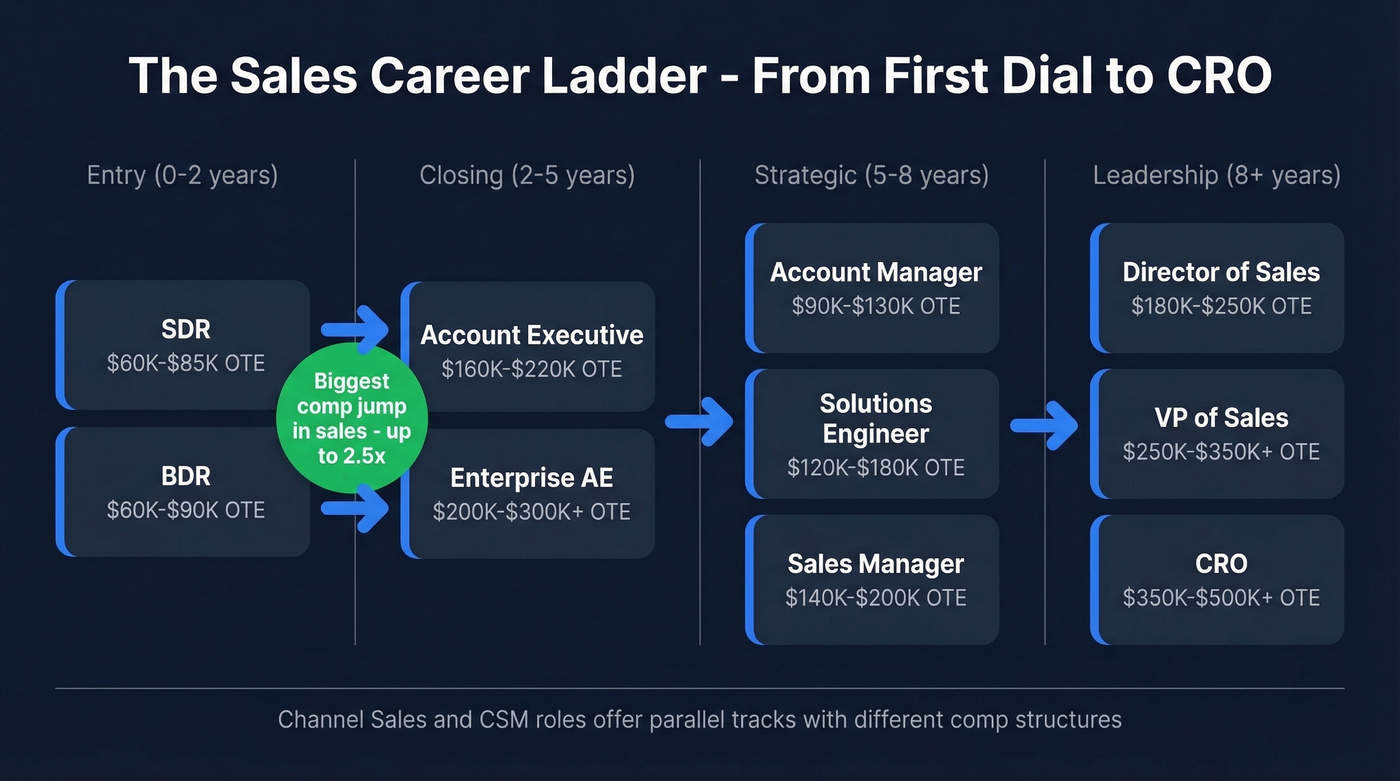
AEs own the deal from first demo to signed contract. They're quota-carrying, which means their comp is directly tied to revenue. Enterprise AEs handle longer cycles of 6-12 months with bigger deal sizes. The comp jump from SDR to AE is significant - $160K-$220K OTE is standard for mid-market AEs in SaaS. We've seen this promotion window make or break careers; it's the single most important inflection point in a sales career.
Strategic and Post-Sale Roles
Account Managers focus on expansion revenue and retention within existing accounts. Solutions Engineers provide technical depth during the sales process - they're the ones running the deep-dive product demos. CSMs own the post-sale relationship, driving adoption and renewals. These roles carry higher base-to-variable ratios, which means more predictable income but lower upside.
Salary and Compensation
Let's talk money.
Base vs. Total Compensation
The BLS median for wholesale and manufacturing reps is $74,100 per year. Non-technical products drop to $66,780. Technical and scientific products jump to $100,070. But those numbers don't capture the full picture for B2B SaaS and tech sales, where variable comp changes everything.
Glassdoor's data across 135,000 salary submissions puts median total pay at $125K, with a most likely range of $96K-$166K. Base pay runs $59K-$97K, with additional pay from commission, bonuses, and accelerators adding $37K-$69K on top.
Pay by Role Type
| Role | Base Range | OTE Range |
|---|---|---|
| SDR | $45K-$60K | $60K-$85K |
| BDR | $45K-$65K | $60K-$90K |
| AE | $80K-$110K | $160K-$220K |
| SE | $90K-$130K | $120K-$180K |
| CSM | $70K-$100K | $90K-$130K |
The SDR-to-AE promotion is the single biggest comp jump in most sales careers. Going from $75K OTE to $180K OTE in 12-18 months is realistic at a well-run SaaS company. That's the carrot that keeps SDRs dialing.
Highest-Paying Industries
| Industry | Median Total Pay |
|---|---|
| Pharma & Biotech | $151,843 |
| Construction & Maintenance | $148,458 |
| Aerospace & Defense | $134,780 |
| Information Technology | $125,822 |
| Energy & Utilities | $122,516 |
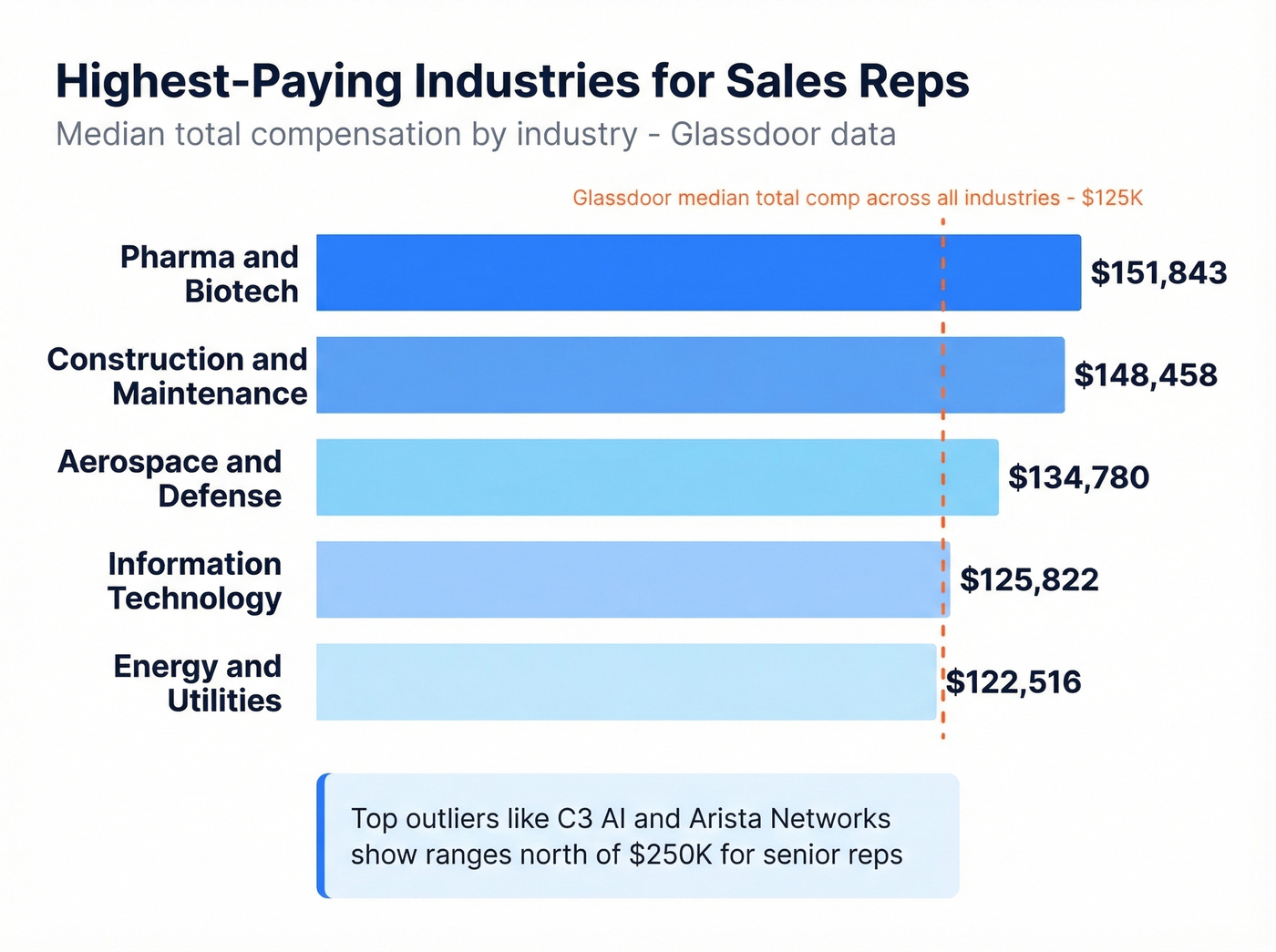
At the top end, companies like C3 AI and Arista Networks show Glassdoor ranges north of $250K for senior reps. Those are outliers, but they illustrate the ceiling.

Reps only spend 30% of their time selling. The rest? Chasing bad data and updating CRMs. Prospeo gives sales reps 98% accurate emails and 125M+ verified mobile numbers - so every dial and every send actually reaches a real buyer.
Stop chasing dead leads. Start hitting quota.
What Makes a Great Sales Rep
SalesFuel's research identifies 10 traits that predict sales success: grit, confidence, self-motivation, problem-solving, time management, optimism, initiative, curiosity, adaptability, and coachability. The 11th trait, added for the AI era, is knowing how to use technology as a force multiplier - not just clicking through tools, but thinking critically about which ones actually amplify your output.
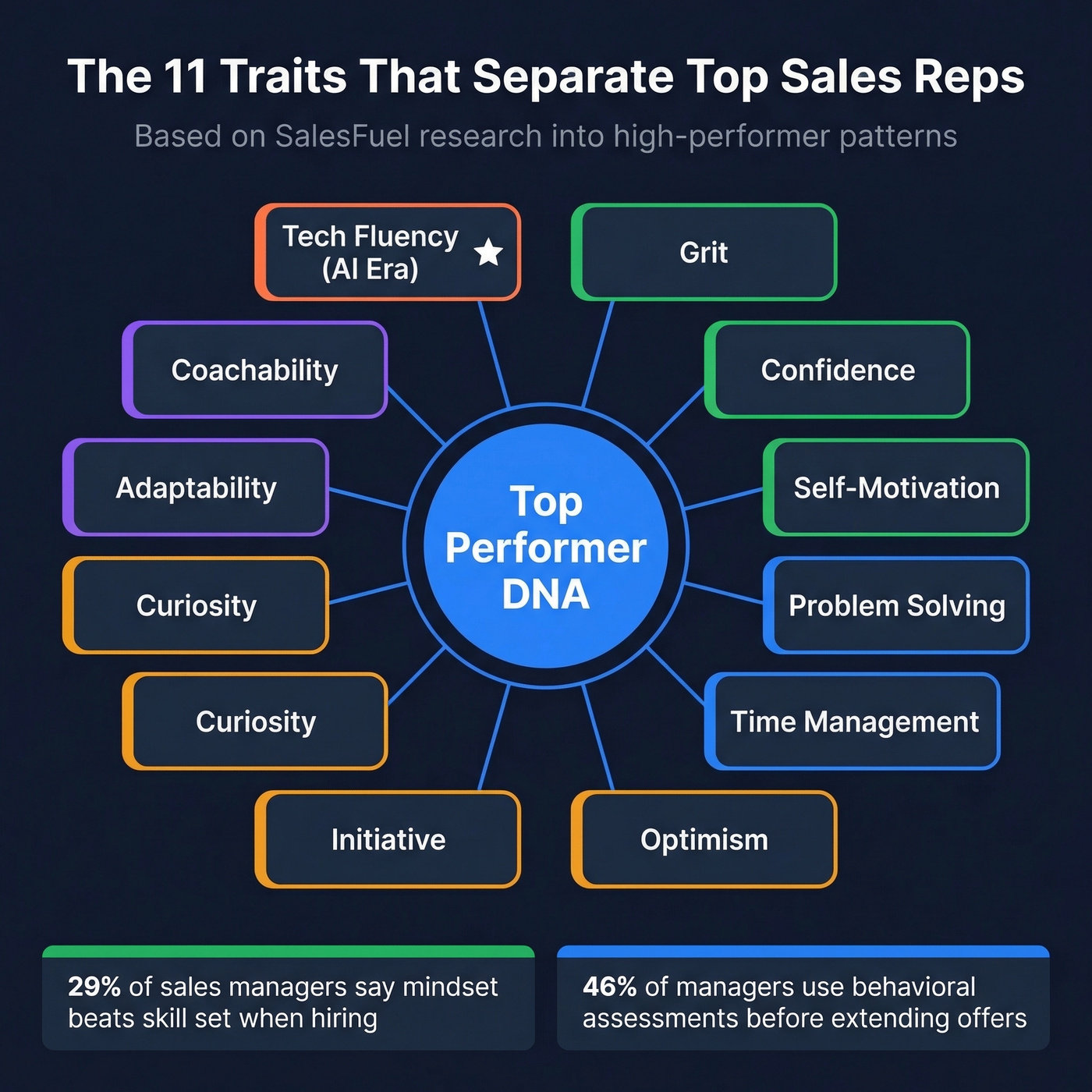
Here's what's interesting: 29% of sales managers say mindset and motivation outweigh skill set when hiring. Yet 46% use behavioral assessments before extending offers. Managers who rated their teams poorly were 20% less likely to have used pre-hire assessments, which suggests the assessment step actually works. If you're naturally competitive and comfortable with ambiguity, the role fits. If you need predictable daily structure and guaranteed outcomes, it doesn't.
Your data skills matter as much as your people skills now. Reaching the right person is the first thing that matters - and that means verifying contact data before every call block, not just trusting whatever's been sitting in your CRM for months. You can have world-class empathy, but if you're dialing a number that's been disconnected since last quarter, none of it counts.
Tools Sales Reps Use in 2026
The average rep uses 6+ tools daily. The global sales tech market is projected to hit $104.5B by 2030, growing at 16.3% CAGR. Here's what actually matters in the stack.
Sales Tech Stack Overview
| Category | What It Does | Top Tools | Typical Cost |
|---|---|---|---|
| CRM | Pipeline + deal tracking | Salesforce, HubSpot | $0-$300/user/mo |
| Data Enrichment | Verified contacts + intent | Prospeo, ZoomInfo, Apollo | $0-$5K+/mo |
| Sales Engagement | Multi-channel sequences | Outreach, Salesloft | $100-$130/user/mo |
| Conversation Intelligence | Call recording + coaching | Gong, Chorus | $100-$150/user/mo |
| Forecasting | Revenue prediction | Clari, BoostUp | $100-$150/user/mo |
| Contract Management | Proposals + e-signatures | PandaDoc, DocuSign | $25-$65/user/mo |
| Calendar / Scheduling | Meeting booking | Calendly, Chili Piper | $0-$30/user/mo |
| Content Management | Sales collateral sharing | Highspot, Seismic | $30-$60/user/mo |
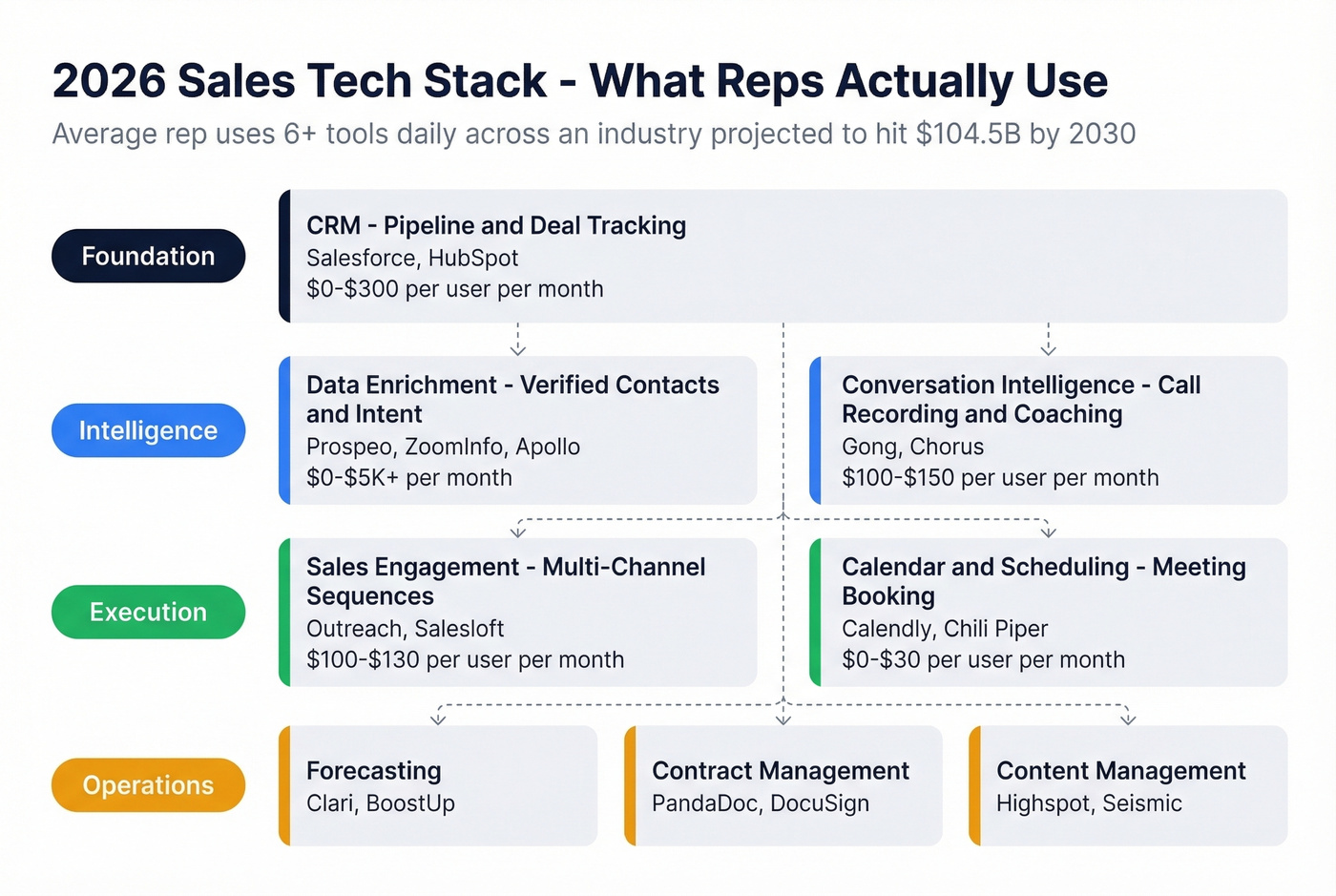
CRM
Salesforce is the default for mid-market and enterprise teams. It's powerful, customizable, and expensive - expect $75-$300 per user per month depending on the edition. HubSpot is the go-to for SMBs and startups, with a genuinely useful free tier that scales into paid plans from $20/mo per seat. Every other tool in your stack feeds into or pulls from your CRM, so get this choice right first. (If you want a quick comparison set, see examples of a CRM.)
Data Enrichment and Email Finding
This is where pipeline quality lives or dies. We've tested dozens of data providers over the years, and the pattern is always the same: accuracy and freshness determine whether your reps spend their mornings in conversations or leaving voicemails at disconnected numbers.
Prospeo covers 300M+ professional profiles with 143M+ verified emails and 125M+ verified mobile numbers. The 98% email accuracy rate matters because bad emails don't just bounce - they damage your domain reputation and tank deliverability for every future campaign (see email deliverability). Data refreshes every 7 days, compared to the 6-week industry average. The platform starts free at 75 verified emails per month plus 100 Chrome extension credits, with paid plans from ~$39/mo. No contracts, no sales calls required.
Apollo is the budget-friendly option with 275M+ contacts and a solid free tier. Paid plans start around $49/user/month. It's best for teams that want prospecting and sequencing in one tool, though email accuracy runs lower than dedicated verification platforms. ZoomInfo is the enterprise standard - deep US database, intent data, and workflow tools - but a 10-seat contract can run $30K-$60K per year, which prices out most startups and agencies.
Engagement, Forecasting, and Call Intelligence
Outreach is the market leader for multi-step sequences across email, phone, and social. It's powerful but complex - expect $100-$130 per user per month and a real implementation lift (see implementing a sales engagement platform). Salesloft is the main alternative with a slightly simpler UX and similar pricing.
Gong records and analyzes sales calls, surfacing patterns in what top performers do differently. It's become essential for coaching and deal inspection. Clari handles revenue forecasting and reports a 12x improvement in forecast accuracy within the first year for its users. Both tools run $100-$150 per user per month for mid-market teams.
KPIs: What Success Looks Like
Here's the uncomfortable truth: up to 70% of B2B reps missed quota in 2024. The industry-wide lead-to-customer conversion rate sits at just 2-5%.
The metrics that matter break into two categories. Activity metrics - calls per day, emails sent, meetings booked per week - measure effort. Outcome metrics - pipeline created, win rate, average deal size, quota attainment - measure results. The gap between the two is almost always data quality.
If your reps are making 70 calls a day and connecting on 3 of them, the problem isn't effort. It's the list. Bad data kills morale faster than a tough quarter. We've seen teams triple their connect rates just by switching to a verified data source, and that's what turns activity metrics into pipeline (more benchmarks: sales conversion rate).
Here's the thing: if your average deal size is under $15K, you probably don't need a $60K/year data platform. A self-serve tool with verified emails and a free tier will outperform an enterprise suite you're only using at 20% capacity. And if your company blames reps for missing quota instead of examining data quality and territory design, the problem isn't the reps.
The SDR doing 80 dials before lunch needs numbers that connect. Prospeo's verified mobiles hit a 30% pickup rate - nearly 3x the industry average. At $0.01 per email, even entry-level reps get enterprise-grade data without the enterprise budget.
Triple your connect rate without tripling your dials.
Career Path and Getting Started
The standard ladder looks like this:
SDR (0-18 months) → AE (1-3 years) → Enterprise AE (2-4 years) → Sales Manager → VP of Sales → CRO
The BLS says a high school diploma is often sufficient for non-technical roles, while a bachelor's is typically expected for technical and scientific products. In practice, most SaaS companies care more about your track record than your transcript. Certifications like the CPSP or CSE can help, but hiring managers care more about quota attainment history than credentials.
The best entry path? SDR at a mid-market SaaS company with a real enablement program. You'll learn the full sales motion, get reps on the phones fast, and have a clear promotion path to AE within 12-18 months. In our experience, the companies with the best SDR-to-AE pipelines invest in data quality and coaching equally - one without the other doesn't work. If you're starting from scratch, build a plan around a 30-60-90 day plan and a repeatable cold calling system.
When evaluating a job, check four things: room for growth (is there a defined promotion path?), enablement resources like onboarding and mentoring, compensation model clarity including base vs. commission split and accelerators, and industry fit - do you care about what you're selling? Skip any company that won't tell you the OTE structure before the second interview. Comp transparency is a signal of how the organization treats its team. Opacity is a red flag. (If you want the math, start with OTE in sales.)
The Future of the Role
The full-cycle AE is dying. Here's what's replacing it - and two other shifts that matter.
The great unbundling. The full-cycle AE who prospects, demos, negotiates, and closes is becoming a relic. Specialized teams consistently outperform generalists, and the math backs it up: a full-cycle rep might make 20 prospecting calls, run 3 demos, and close 1 deal per week, while a specialized SDR-to-AE handoff model produces 100 calls, 10 qualified meetings, and 2-3 closed deals in the same timeframe. Specialization wins.
Remote and hybrid dominance. 70%+ of sales roles now offer remote or hybrid options. Inside sales was already trending remote pre-pandemic; that shift is permanent. The tools exist, the talent pool is global, and companies mandating five days in-office for phone-based roles are losing candidates to competitors who don't.
AI as a core competency. AI isn't replacing sales reps - the BLS projects 1.8 million sales openings per year through 2034, mostly from replacement needs. But AI is amplifying the best performers and exposing the worst ones. Reps who use AI for research, personalization, and call prep are outproducing those who don't by a widening margin. The skill isn't "using ChatGPT." It's knowing which data to feed it and which outputs to trust (see data-driven selling).
FAQ
Is sales a good career in 2026?
Yes, if you pick the right company. Total comp ranges from $96K to $166K for mid-career reps, with 142,100 annual openings in wholesale and manufacturing alone. The honest caveat: 70% of B2B reps missed quota recently. The upside is real, but only at organizations that invest in enablement, data quality, and realistic territory design.
Do you need a degree to become a sales representative?
Not always. A high school diploma is sufficient for non-technical products, while a bachelor's is typical for technical and scientific sales. Many SaaS companies hire based on mindset over credentials - 29% of sales managers explicitly prioritize motivation and attitude over formal qualifications.
What's the difference between an SDR and an AE?
SDRs prospect and qualify leads; AEs demo and close deals. SDR OTE runs $60K-$85K, while AE OTE ranges from $160K-$220K. The promotion typically takes 12-18 months of consistent quota attainment and is the biggest single comp jump in most sales careers.
What tools do sales reps need most?
Three essentials: a CRM like Salesforce or HubSpot, a data enrichment platform with verified emails and mobile numbers, and a sequencing tool like Outreach or Salesloft. Data quality is the foundation - every metric downstream, from connect rate to closed revenue, depends on reaching the right person with accurate contact information.