

SaaS Sales in 2026: The Data-Backed Guide for Reps and Leaders
Only 41% of software reps hit quota as of early 2025 - and nothing in the macro environment suggests a dramatic rebound. Meanwhile, the global SaaS market is projected to grow from $317B to $1.2 trillion by 2032 at an 18.4% CAGR. The opportunity is enormous. The playbook most teams are running is broken.
The r/sales subreddit captures the mood well. Reps describe 2024 as one of the worst AE job markets in memory, enterprise sellers say cold calling feels harder than 2019/2020, and multiple threads speculate that something "fundamental is broken" in how we sell software subscriptions. They're half right - the fundamentals haven't changed, but the execution bar has gone through the roof.
This isn't a "What is SaaS sales?" explainer. It's the benchmarks, salary data, AI adoption stats, and tech stack guidance that actually help you sell - or lead a team that sells - right now.
The Short Version
- The quota crisis is real, but the market is growing. Adapt your motion to longer cycles and bigger buying committees. Don't panic - adjust.
- Fix your data before your copy. If your bounce rate is above 5%, no amount of subject-line testing will save you. Data quality is the #1 outbound lever. (If you want the benchmarks and fixes, see our guide to email bounce rate.)
- Multi-thread every deal over $25k. Closed-won deals have 2x as many buyer contacts as lost deals. Above $50k, multi-threading boosts win rates by 130%.
- AI isn't optional anymore. Sellers using AI tools are 3.7x more likely to hit quota. If you're not using AI for research, personalization, or sequencing, you're competing with one hand tied behind your back.
What Is SaaS Sales?
SaaS sales is the process of selling cloud-based subscription software to businesses. Sounds simple, but the subscription model changes everything about how you sell.
Traditional software was a one-time purchase. You closed the deal, collected a check, and moved on. Recurring revenue flips that - the post-sale experience matters as much as the close, and churn kills growth faster than slow pipeline does. This makes selling software subscriptions fundamentally relationship-driven in a way that perpetual-license deals never were.
The other shift: buyers are more informed than ever. 67% of the buyer journey is completed before a prospect ever talks to a rep. They've read the G2 reviews, watched the demo video, and compared your pricing page to three competitors. By the time they book a call, they're evaluating - not discovering. Your job isn't just to sell. It's to help 25 stakeholders across procurement, IT, and the business unit reach consensus before budget season ends.
SaaS Sales Models Explained
The model you run depends almost entirely on your ACV and buyer complexity.
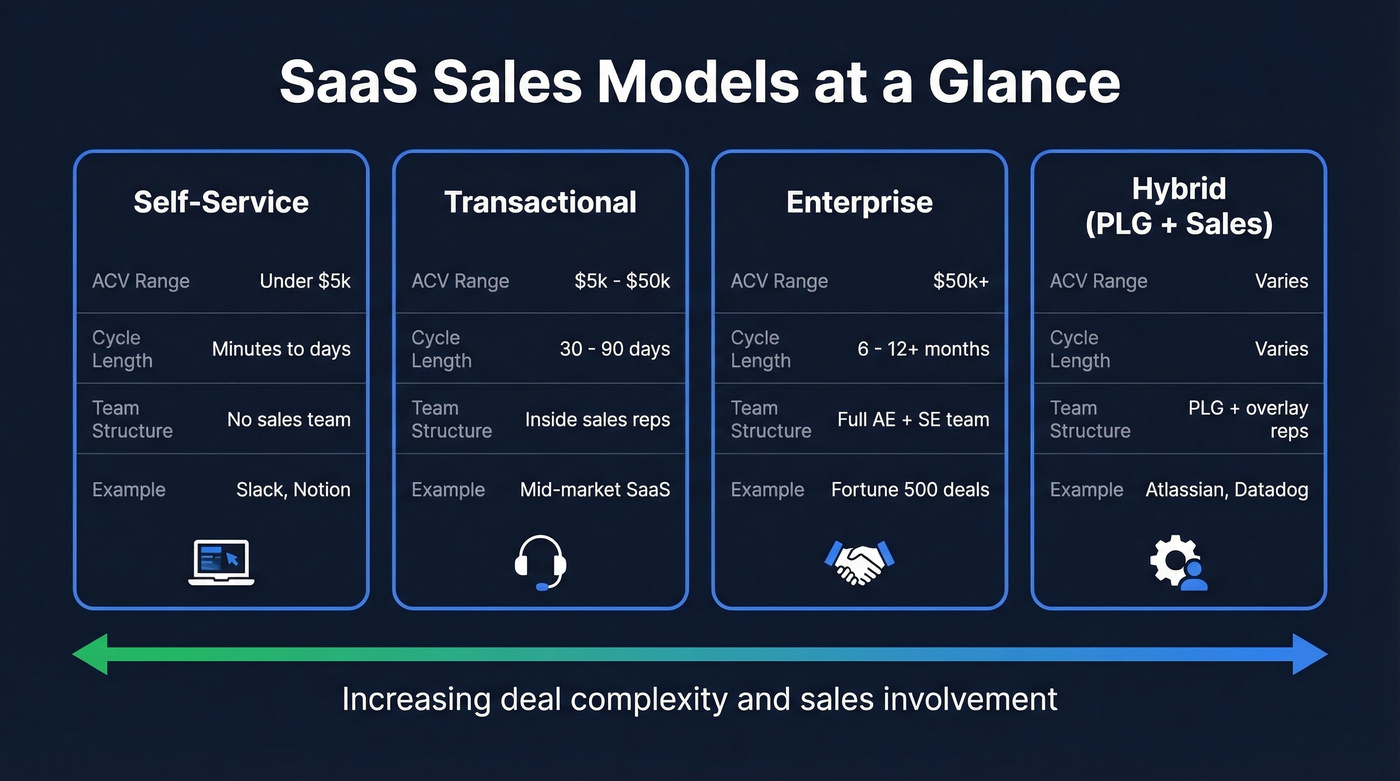
| Model | ACV Range | Cycle Length | Team Structure |
|---|---|---|---|
| Self-Service | <$5k | Minutes-days | No sales team |
| Transactional | $5k-$50k | 30-90 days | Inside sales |
| Enterprise | $50k+ | 6-12+ months | Full AE + SE team |
| Hybrid (PLG+SLG) | Varies | Varies | PLG + overlay reps |
Self-Service
Product-led growth in its purest form. The product sells itself through free trials, freemium tiers, and in-app upgrade prompts - think Slack, Notion, or Calendly. No sales team required for sub-$5k deals; marketing and product drive conversion. This is where many software companies start before layering on a sales motion.
Transactional
The bread-and-butter inside sales motion. Deals range from $5k to $50k, close in 30-90 days, and involve one to three stakeholders. Reps run demos, handle objections, and push deals through a relatively straightforward procurement process. Most mid-market companies live here.
Enterprise
Forrester's 2026 research shows that AI-related purchases can double the buying group size due to added scrutiny around security, governance, and integration risk. That's the reality of enterprise deals right now: cycles above $50k involve 6-12+ months, dedicated account executives paired with solutions engineers, and buying committees that have ballooned to roughly 25 stakeholders. You're not selling to a VP - you're selling to procurement, legal, IT security, and sometimes the board. (If you're selling six-figure deals, this pairs well with our guide to enterprise B2B sales.)
Hybrid (PLG + Sales-Led)
Here's the thing: PLG isn't replacing sales teams. It's replacing bad sales teams. The hybrid model uses product-led acquisition to generate bottom-up demand, then layers a sales team on top for expansion and upmarket deals. Sales and CS teams drive 58% of upsells, while product-driven upsells account for just 10%. The product gets users in the door. Humans close the bigger checks.
Key Benchmarks for 2026
Quota, Win Rates & Cycle Length
The quota picture is grim. Different surveys paint slightly different pictures, but the direction is consistent: only 16% hit quota in 2023, and by 2024, up to 70% of reps missed their number entirely. The 41% figure from RepVue in early 2025 suggests a partial recovery, but we're still far from the 2021 highs.
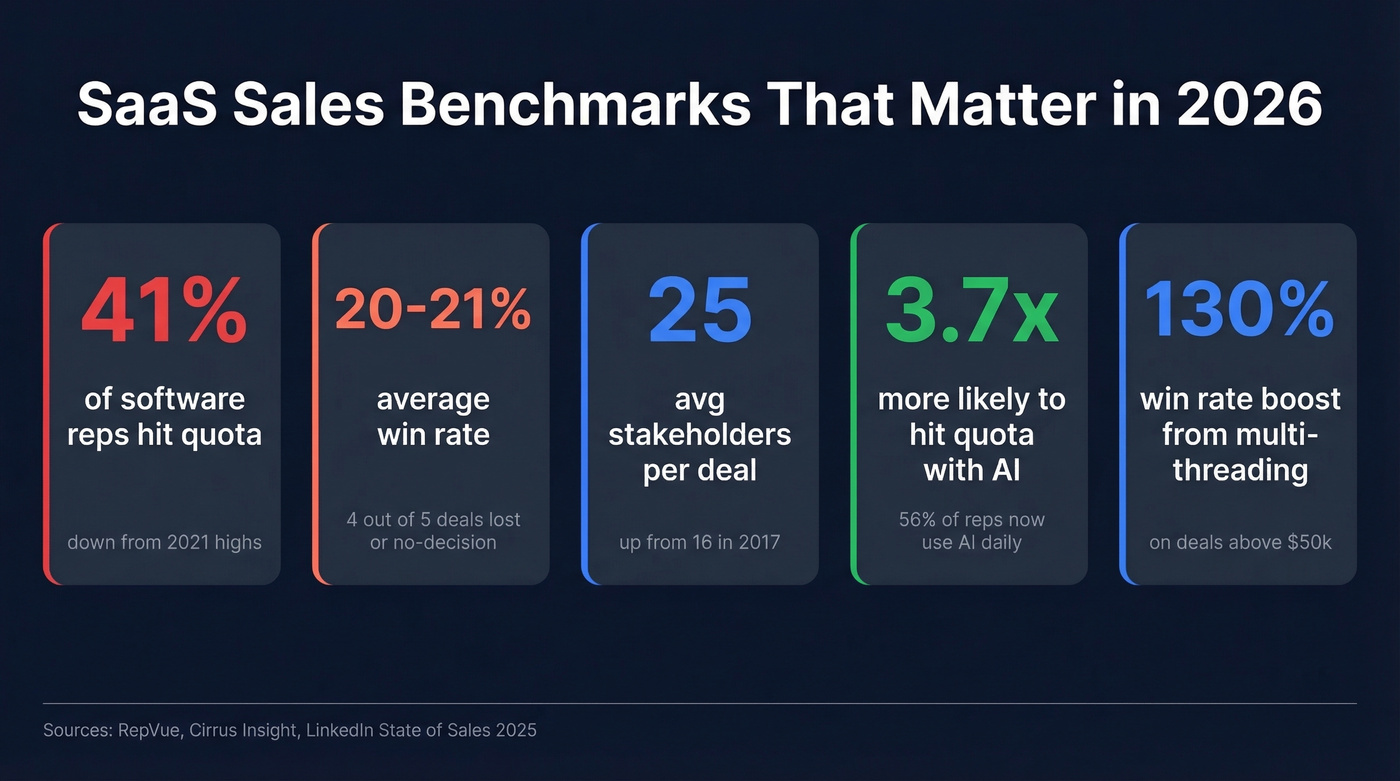
Win rates sit at 20-21% across the board. Four out of five deals end in a loss or no-decision. Top performers push above 30%, but that's the exception, not the norm.
Cycle lengths depend entirely on deal size - the "84-day average" cited in some guides is misleading without ACV segmentation:
| Segment | ACV | Typical Cycle |
|---|---|---|
| SMB | $5k-$15k | 30-90 days |
| Mid-Market | $15k-$50k | 60-180 days |
| Enterprise | $50k+ | 6-12+ months |
Buying committees have expanded to roughly 25 stakeholders, up from 16 in 2017. Every additional stakeholder adds friction, extends timelines, and increases the odds of a no-decision outcome. Multi-threading isn't a nice-to-have. It's survival. (For a deeper playbook, see account-based selling.)
Outbound Performance
Cold email reply rates in 2026 average 3.43%. Top quartile teams hit 5.5%. Elite performers - the ones with dialed-in targeting, clean data, and strong copy - reach 10.7%+. If you're below 3%, the problem almost certainly isn't your copy. It's your data. (If you need a system, start with these sales prospecting techniques.)
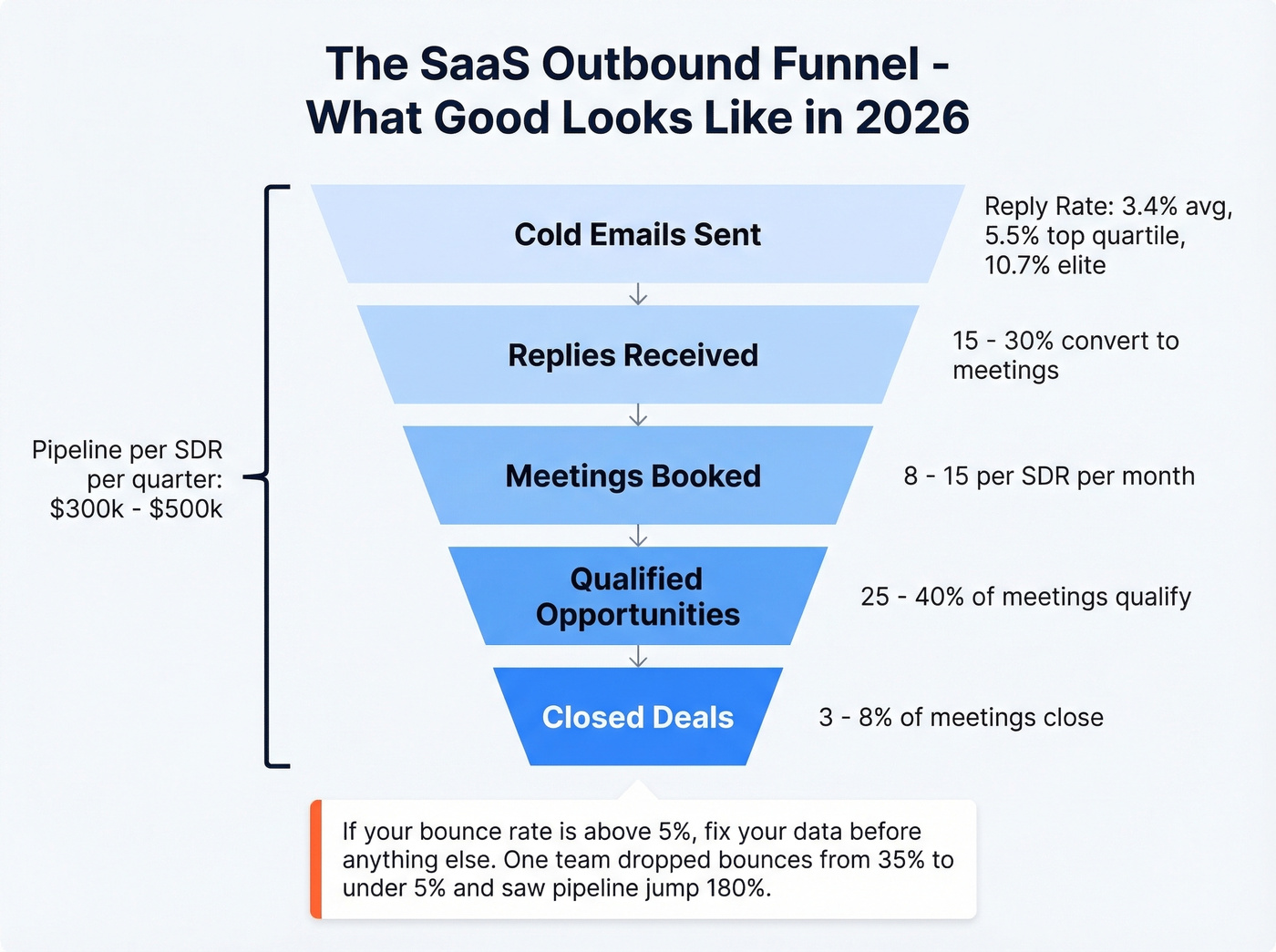
A healthy outbound funnel converts at these rates:
- Reply to meeting booked: 15-30%
- Meeting to qualified opportunity: 25-40%
- Meeting to closed deal: 3-8%
- Pipeline per SDR per quarter: $300k-$500k
- Meetings per SDR per month: 8-15
Bounced emails don't just waste sequences - they destroy domain reputation. Gmail and Yahoo's 2024 authentication requirements, plus Microsoft Outlook's May 2025 sender rules, mean deliverability is harder to maintain than ever. We've seen this firsthand: one team went from a 35-40% bounce rate to under 5% after switching data providers, and AE-sourced pipeline jumped 180%. That wasn't a copy problem or a strategy problem. It was a data problem. (If you're troubleshooting, use this email deliverability guide and these email reputation tools.)

You just read it: teams that fix their data see bounce rates drop from 35% to under 5% and pipeline jump 180%. Prospeo delivers 98% email accuracy with a 7-day refresh cycle - not the 6-week industry average that leaves you emailing dead inboxes. At $0.01 per email, cleaning up your outbound costs less than one lost deal.
Stop losing deals to bad data. Start every sequence with verified contacts.
AI and Efficiency in B2B Software Selling
AI adoption among sales reps rose from 24% in 2023 to 43% in 2024. LinkedIn's 2025 data shows 56% of sales pros now use AI daily, and those users are 2x as likely to exceed targets. The gap between adopters and holdouts is widening fast. (If you're building your workflow, start with generative AI sales tools.)
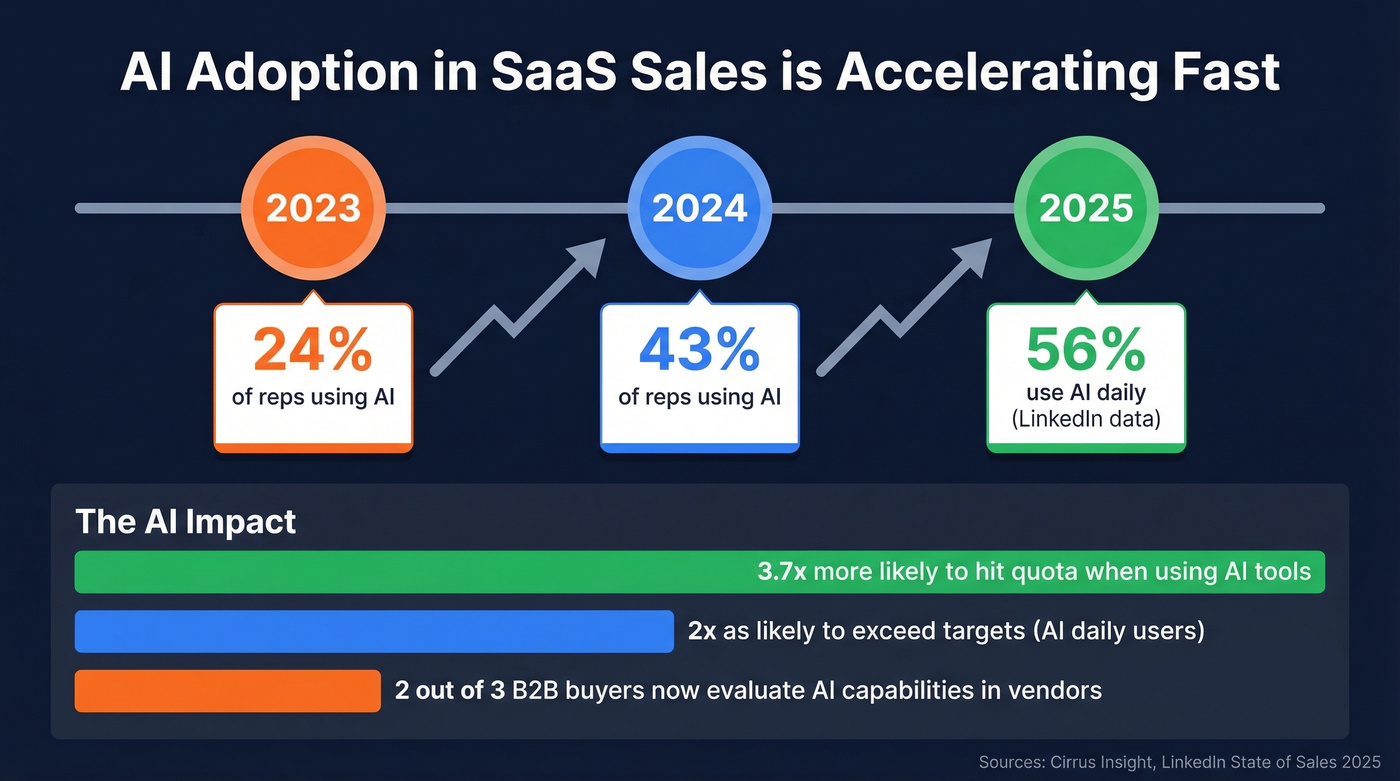
The quota impact is the most compelling stat: sellers partnering with AI tools are 3.7x more likely to meet quota. That's not marginal. That's a different career trajectory.
Two out of three B2B software buyers now consider AI capabilities when selecting a vendor, and 88% of power users say they'd pay a premium for AI features. When buyers do choose a vendor, the top decision factors are security/compliance (17%), pricing (17%), and vendor responsiveness (15%) - not feature lists. If you're selling subscription software, your buyers expect you to be using the same technology they're evaluating.
Multi-threading deserves special attention here. Closed-won deals have roughly 2x as many buyer contacts as lost deals, and for deals above $50k, multi-threading boosts win rates by 130%. AI tools make multi-threading practical at scale - mapping org charts, identifying champions, and surfacing the right contacts across a buying committee of 25 people. We've seen teams go from single-threaded enterprise deals to 5-7 contacts per opportunity just by layering AI research into their pre-call workflow.
Let's be honest about stack bloat, though: if your average deal is under $15k, you probably don't need a $40k/year data platform or a six-tool tech stack. A CRM, a sequencer, and accurate contact data will outperform a bloated stack that your reps spend half their day navigating instead of selling. (For a tighter setup, see our picks for the best SDR tools.)
The SaaS Sales Tech Stack
90% of sales orgs plan to consolidate their tech stack. That tells you everything about the current state of tooling - most teams are drowning in software they bought but don't use. Reps spend only 28-30% of their time actually selling; the rest goes to CRM updates, internal meetings, and admin. Every tool you add that doesn't directly increase selling time makes the problem worse.
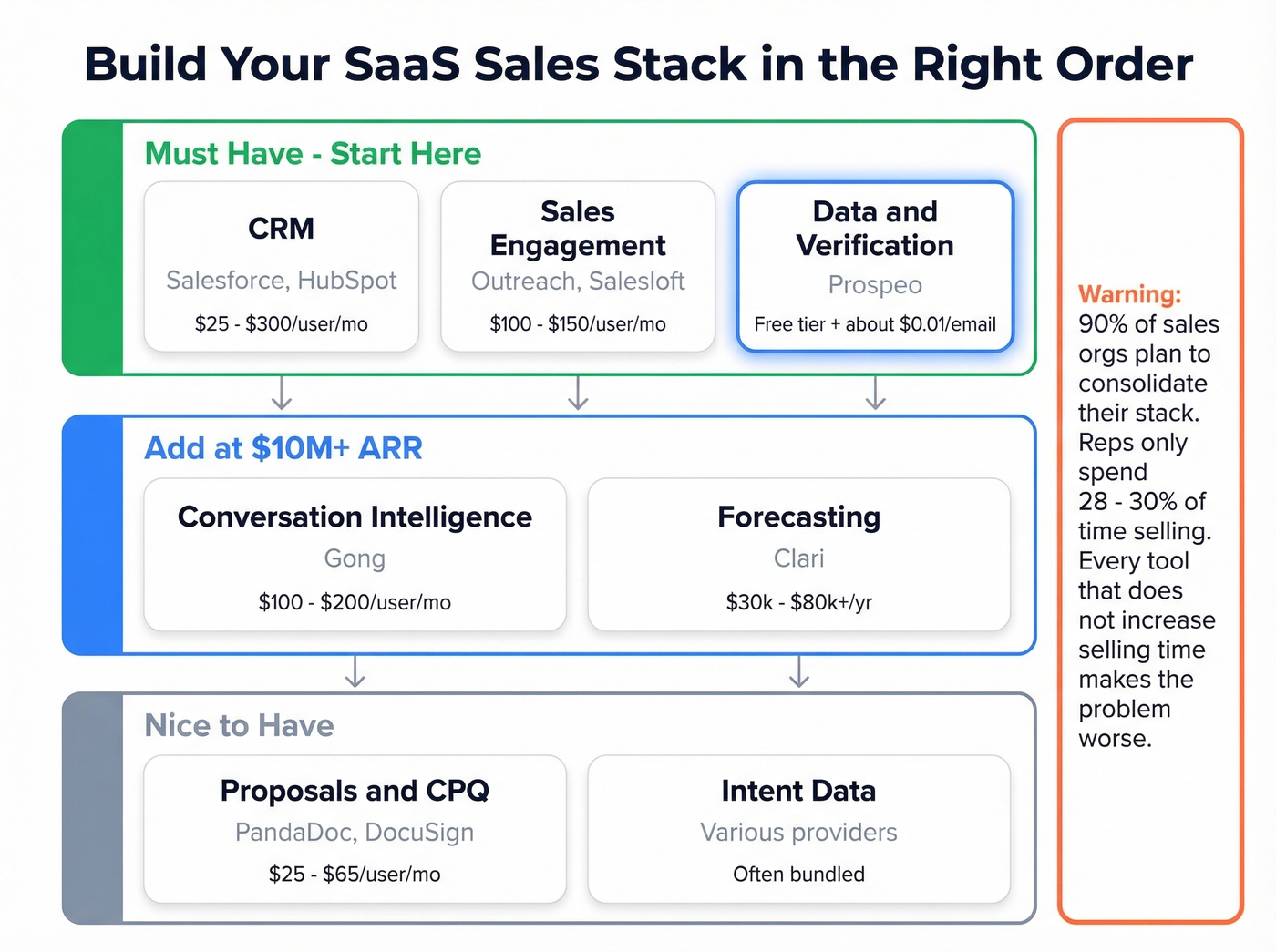
Start with three things: a CRM, a sales engagement platform, and a data provider with real-time verification. Everything else is optional until you're past $10M ARR. (If you're evaluating vendors, compare data enrichment services and B2B company data.)
| Category | Tools | Price Range |
|---|---|---|
| CRM | Salesforce, HubSpot | $25-$300/user/mo |
| Engagement | Outreach, Salesloft | $100-$150/user/mo |
| Data & Verification | Prospeo | Free tier + ~$0.01/email |
| Data & Verification | ZoomInfo | $15k-$40k+/yr |
| Data & Verification | Cognism | $1k-$3k/mo |
| Conversation Intel | Gong | $100-$200/user/mo |
| Forecasting | Clari | ~$30k-$80k+/yr |
| Proposals/CPQ | PandaDoc, DocuSign | $25-$65/user/mo |
The data and verification layer is where we've seen the most wasted spend. A 10-seat ZoomInfo contract with intent data and mobile numbers can run $40-60k/year. That's real money for a Series A company - and half the team probably only uses the search bar.

Prospeo covers 300M+ professional profiles, 143M+ verified emails, and 125M+ verified mobile numbers, all on a 7-day data refresh cycle versus the six-week industry average. It runs at 98% verified email accuracy, integrates natively with Salesforce, HubSpot, Outreach, Salesloft, Smartlead, Instantly, Lemlist, Clay, Zapier, Make, and n8n, and starts free with 75 verified emails per month. One customer, Meritt, tripled pipeline from $100K to $300K per week after switching, with bounce rates dropping from 35% to under 4%. (If you're comparing options, see best sales prospecting databases.)
Skip tools that require annual contracts and a sales call just to see pricing. If you can't self-serve into a product and test it against your own data within 30 minutes, that's a red flag - especially for teams under 20 reps.
Multi-threading 25-stakeholder deals means you need direct dials, not gatekeepers. Prospeo gives you 125M+ verified mobile numbers with a 30% pickup rate - nearly 3x the industry average. Layer in buyer intent data across 15,000 topics to know which accounts are actively evaluating SaaS solutions right now.
Reach the full buying committee, not just the one contact who ghosted you.
SaaS Sales Salaries in 2026
Compensation varies dramatically by role and segment. Here are the current ranges:
| Role | Base Salary | OTE |
|---|---|---|
| SDR | $55k-$75k | $70k-$95k |
| Mid-Market AE | $75k-$100k | $140k-$180k |
| Enterprise AE | $100k-$140k | $180k-$250k+ |
| Sales Manager | $110k-$140k | $160k-$200k+ |
| Sales Director | $140k-$180k | $200k-$250k+ |
| VP Sales | $180k-$220k | $250k-$350k+ |
Mid-market AE roles typically run a 50/50 base-variable split. Enterprise AEs sometimes skew 60/40 base-heavy, especially at later-stage companies where deal cycles are long and variable comp takes quarters to materialize. (For comp math and benchmarks, see OTE in sales.)
The fastest path into SaaS sales is still SDR to AE. Skip the sales bootcamp grifters charging $5k for a Loom library. Get an SDR seat, learn discovery and objection handling on real calls, and promote within 12-18 months. Focus on companies with a clear promotion path and documented criteria - ask in the interview how many SDRs promoted to AE in the last 12 months. If they can't give you a number, that tells you everything.
Where the Industry Is Heading
The enterprise motion is shifting from persuasion-heavy to validation-heavy. Only 31% of prioritized AI use cases reach full production - buyers want proof, not promises.
Three growth concentrations are emerging. AI-native SaaS is attracting the most buyer attention and VC dollars. Vertical SaaS - purpose-built for healthcare, construction, or legal - continues to carve out defensible niches. And security/compliance SaaS is booming as every organization grapples with Zero Trust, data privacy, and regulatory expansion.
The teams that win in 2026 aren't the ones with the best pitch decks. They're the ones with the cleanest data and the most threads in every deal. McKinsey estimates AI could deliver $2.6T-$4.4T in annual value across marketing and sales. That value flows to teams with tight data, smart AI workflows, and relentless multi-threading - not teams still running 2021 playbooks with stale contact lists. Platforms that combine data enrichment, sequencing, and verification into a single workflow will keep replacing fragmented stacks. (If you're operationalizing this, see data-driven selling.)
FAQ
Is SaaS sales still a good career in 2026?
Yes - the market is growing to $1.2T by 2032, and companies will always need people who can navigate complex B2B deals. The easy-money ZIRP era is over, but reps who adapt to longer cycles, bigger buying committees, and AI-assisted workflows will out-earn most white-collar roles.
How long is the average SaaS sales cycle?
SMB deals ($5k-$15k) close in 30-90 days, mid-market ($15k-$50k) takes 60-180 days, and enterprise ($50k+) runs 6-12+ months. The "84-day average" you'll see elsewhere is misleading without ACV segmentation - always benchmark against your own deal size.
What tools do SaaS sales teams actually need?
Start with a CRM, a sales engagement platform, and a data provider with real-time verification. Everything else is optional until you're past $10M ARR. The right tools should increase the percentage of time reps spend selling, not add to their admin burden.
What's a good cold email reply rate?
The 2026 average is 3.43%, top quartile teams hit 5.5%, and elite performers reach 10.7%+. If you're below 3%, focus on data quality and deliverability before optimizing subject lines or copy.
How much do SaaS sales reps make?
SDRs earn $70k-$95k OTE, mid-market AEs hit $140k-$180k, and enterprise AEs reach $180k-$250k+. Most AE roles use a 50/50 base-variable split, though enterprise positions sometimes skew 60/40 base-heavy.