

Sales Script Templates: Copy-Paste Scripts for Every Scenario in 2026
It's 9:02 AM. You dial the first number on your list. Disconnected. Second number - straight to voicemail. Third - wrong person, wrong company. By the time you actually reach a live prospect, your energy's shot and your opener sounds like you're reading a cereal box.
Close founder Steli Efron hit the same wall when he launched ElasticSales. His fix: a single sales script template that landed 7 paying customers in 14 days. Scripts don't make you robotic - they free you to actually listen.
And here's the stat that should kill any remaining hesitation: 49% of buyers actually prefer a cold call over other outreach methods. The phone isn't dead. Bad phone calls are dead.
What You Need (Quick Version)
If you need one sales call script today, use the permission-based cold call opener below. If your connect rate is below 5%, the problem isn't your script - it's your data (jump to "Why Scripts Fail Before You Dial"). And if you sell in a specific vertical, skip the generic talk tracks and go straight to the industry scripts.
2026 Cold Calling Benchmarks
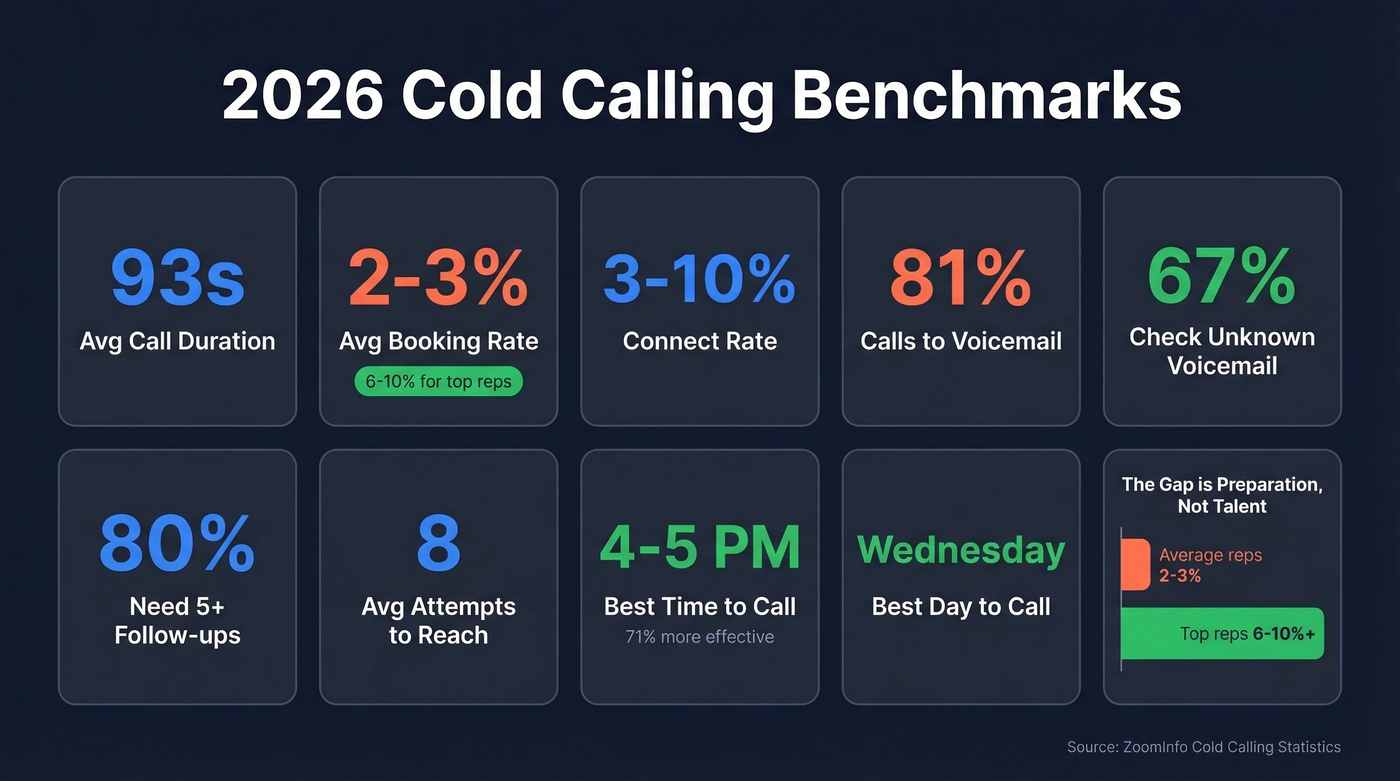
Before you touch a script, know what "good" looks like. All benchmarks below come from ZoomInfo's cold calling statistics unless otherwise noted.
| Metric | Number |
|---|---|
| Avg. call duration | 93 seconds |
| Booking rate (avg.) | 2-3% |
| Booking rate (top reps) | 6-10%+ |
| Connect rate | 3-10% |
| Calls to voicemail | 81% |
| Check voicemail (unknown) | 67% |
| Sales needing 5+ follow-ups | 80% |
| Avg. attempts to reach a prospect | 8 |
| Best time to call | 4-5 PM (71% more effective) |
| Best day | Wednesday |
The gap between 2-3% average and 6-10% for top performers isn't talent. It's preparation, targeting, and persistence.
Core Cold Call and Follow-Up Scripts
Cold Call (Permission-Based Opener)
This is the opener that shows up again and again in practitioner scripts because it acknowledges the interruption instead of pretending the call was expected.
The Script:
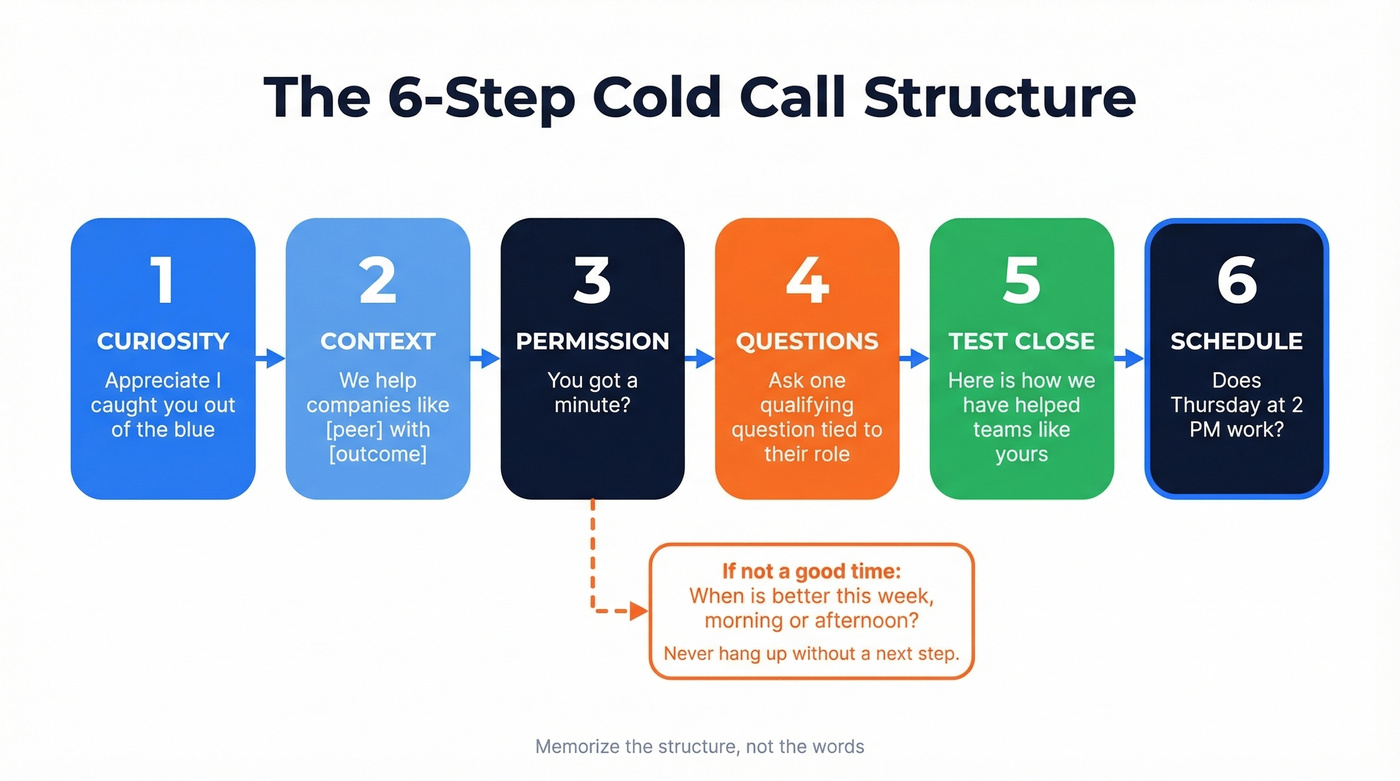
"Hi [First Name], appreciate I caught you out of the blue here - you got a minute?"
[If yes]: "Great. We do [your coolest feature] for other companies in your space like [biggest competitor/peer company]. The reason I'm calling is [one-sentence pain point you solve]."
"Quick question - [qualifying question tied to their role]?"
[Listen. Respond. Then]: "The purpose of my call today was actually to set aside a half hour later this week to walk through how we've helped teams like yours. Does [time] on [day] work?"
"Appreciate I caught you out of the blue" disarms the prospect. It's honest. Close's data shows that "Is it a bad time?" outperforms "Is now a good time?" because it gives the prospect permission to be candid - and candid prospects stay on the line longer.
The six-step structure is what matters: curiosity, context, permission, questions, test close, schedule. Memorize the structure, not the words. Every great call script is just a variation of this skeleton.
If you want more talk tracks you can adapt fast, start with these talk tracks.
If they say "not a good time": Ask, "No problem - when's better this week, morning or afternoon?" Don't hang up without a next step.
Follow-Up Call
80% of sales require 5+ follow-up calls, and it takes an average of 8 attempts to reach a prospect. Most reps quit after two. That's where deals die.
If you left a voicemail previously:
"Hi [First Name], it's [Your Name] from [Company] - I left you a voicemail on [day]. Wanted to quickly follow up because [reference specific trigger: they opened your email, visited your pricing page, etc.]. Do you have 30 seconds?"
If email-only so far:
"Hi [First Name], I sent you an email about [topic] on [day]. Figured a quick call might be easier than another email in your inbox. Got a minute?"
Prioritize calling people who've opened your emails two or more times. A top-voted post on r/sales shared this cadence: four calls spread across a two-week sequence paired with four emails. The people who engage with your emails but don't reply are your warmest call targets. Having a reliable follow-up template ensures you never fumble these high-intent conversations.
For more plug-and-play sequences, use these sales follow-up templates.
Voicemail Scripts
81% of calls from unknown numbers go to voicemail. But 67% of people check voicemail from unknown numbers - so a good voicemail isn't wasted effort.
Cold voicemail:
"Hi [First Name], it's [Your Name] from [Company]. I'm calling because we've helped companies like [peer company] with [one specific outcome]. I'll send you a quick email with details - look for it from [your email]. Talk soon."
Follow-up voicemail:
"Hi [First Name], [Your Name] again from [Company]. Following up on the email I sent [day]. I'll try you again on [specific day] - or feel free to grab time on my calendar. I'll drop the link in a follow-up email. Thanks."
Keep both under 20 seconds. Name a specific follow-up day - it creates a micro-commitment in the prospect's mind.
If voicemail is killing your day, build a repeatable cold calling system instead of winging it.
Gatekeeper Navigation
"Hi, it's [Your Name] from [Company]. Is [First Name] available?"
Confident and brief. Don't over-explain. The gatekeeper's job is to filter; your job is to sound like someone who belongs on the call.
If they push back ("What's this regarding?"):
"I'm following up on an email I sent - they'll know what it's regarding."
If they push harder ("They're not available"):
"No worries. When's the best time to catch them? I want to make sure I'm not interrupting their day."
Here's the thing: Friday afternoons are gold for reaching VPs and C-suite directly. Gatekeepers leave early. Decision-makers are still at their desks winding down the week.
Objection Handling (BANT Framework)
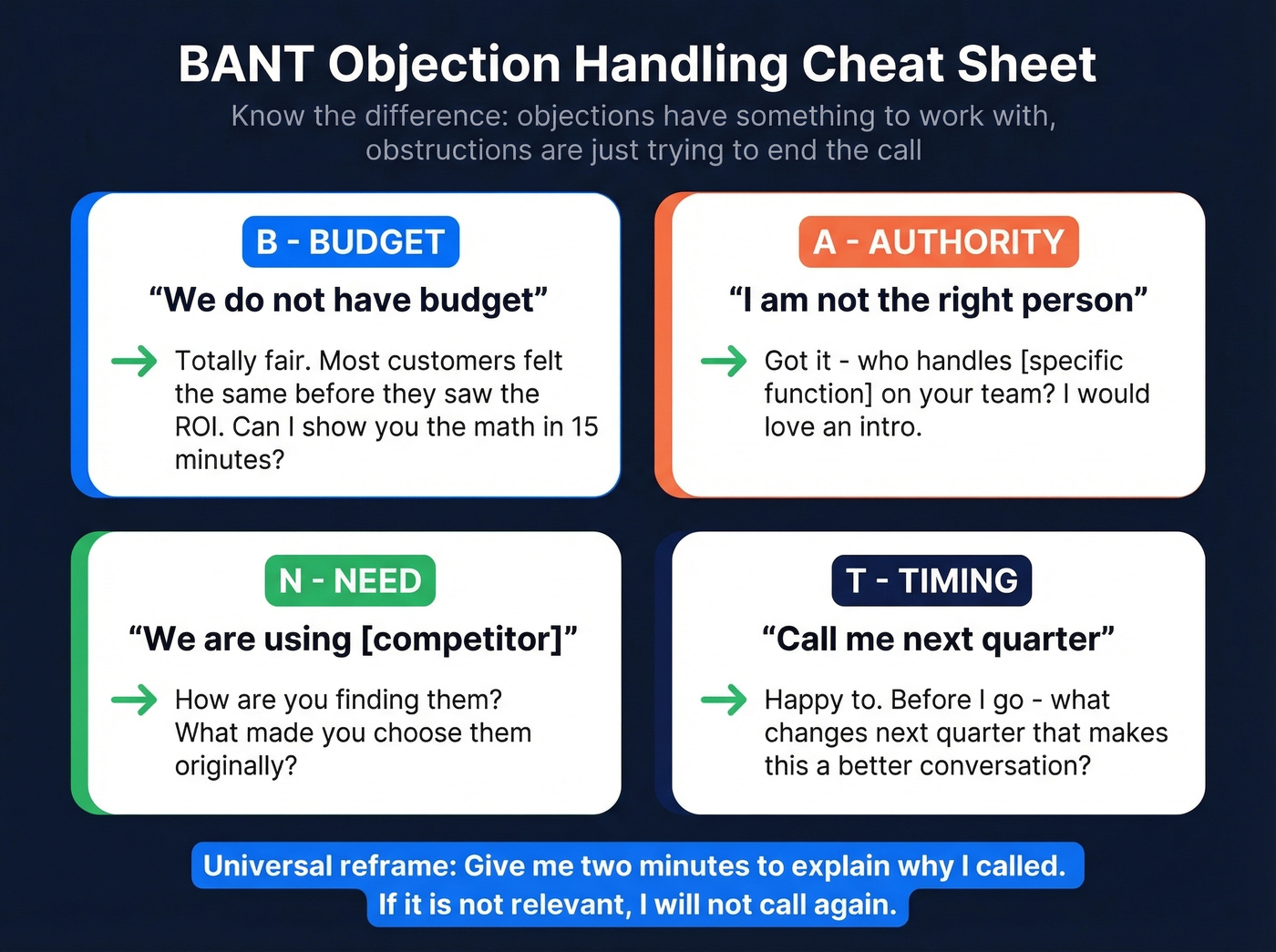
First, distinguish objections from obstructions. "I don't have time" is an obstruction - they're trying to end the call, not raise a concern. "We already use a competitor" is an objection - there's something to work with.
| Category | Objection | Rebuttal |
|---|---|---|
| Budget | "We don't have budget" | "Totally fair. Most of our customers felt the same before they saw the ROI. Can I show you the math in 15 minutes?" |
| Authority | "I'm not the right person" | "Got it - who handles [specific function] on your team? I'd love an intro." |
| Need | "We're using [competitor]" | "How are you finding them? What made you choose them originally?" |
| Timing | "Call me next quarter" | "Happy to. Before I go - what changes next quarter that makes this a better conversation?" |
The "give me two minutes" reframe works across all categories: "Give me two minutes to explain why I called. If it's not relevant, I won't call again." Low-risk for the prospect, and it buys you enough time to deliver one sharp value statement.
If you want a deeper playbook for pushback, see cold call rejection.
Breakup and Referral Scripts
Breakup (re-engagement):
"Hi [First Name], I've reached out a few times and haven't heard back - totally understand you're busy. I wanted to share one last thing: [specific insight, case study, or data point relevant to their role]. If the timing isn't right, no hard feelings. But if [pain point] is on your radar, I'd love 15 minutes. Either way, I won't keep filling your inbox."
Frame the breakup as a final value drop, not a guilt trip.
Referral ask:
"[First Name], you mentioned this isn't a priority right now - totally respect that. Is there anyone on your team or in your network who's dealing with [specific problem]? I'd be happy to share what we've learned with them."
If you're pairing calls with email, these sales prospecting techniques will help you stack touches without spamming.

Your script won't matter if 35% of your calls hit disconnected numbers. Prospeo's 125M+ verified mobiles have a 30% pickup rate - that's 3x the industry average. Stop burning your best opener on wrong numbers.
Pair your best script with numbers that actually connect.
Industry-Specific Phone Scripts
SaaS
"Hi [First Name], appreciate the minute. We've helped companies like [peer company] cut [specific metric - e.g., onboarding time] by 37%. I know [pain point] is a common challenge for [their role] - do you have 30 seconds to talk about how we're solving it?"
Follow with qualifying questions: "What tools are you using for [function] today?" and "What's the biggest bottleneck your team hits with [process]?" Cognism's internal data shows 5,265 of 9,247 cold calls resulted in meaningful conversations - the difference was leading with a specific, quantified outcome rather than a generic pitch.
If you're selling software, this SaaS sales guide will help you tailor discovery and close.
Insurance
69% of buyers have accepted a cold call in the past 12 months - insurance prospects are more receptive than you'd think. Lead with the emotional hook, then pivot to savings.
| Scenario | Script |
|---|---|
| Opener | "Hi [First Name], quick question - if you had to file a claim tomorrow, do you feel confident you'd be fully covered?" |
| Value prop | "We've helped families in [area] save over $100/year on premiums with better coverage. I can put together a free custom quote - no obligation. Worth 10 minutes?" |
| "Happy with my provider" | "That's great. Most of our customers were too - until they saw the coverage gaps. Mind if I run a quick comparison?" |
| "Can't afford it" | "That's exactly why I called. We specialize in finding savings you didn't know existed." |
Recruiting
This one needs no preamble. Two lines, delivered with confidence:
"Hi [First Name], you're probably not actively looking - and that's exactly why I'm calling. I've got a [role type] at [company/industry] that's worth hearing about. Got two minutes?"
Passive-candidate language flatters the prospect. You're not calling because they're desperate - you're calling because they're good. That framing alone gets you past the first 15 seconds.
Financial Services
Financial services prospects are hyper-skeptical of cold calls. The wall goes up the second they hear "financial." So don't lead with finance - lead with generosity.
"Hi [First Name], I'm not selling anything today. I work with [type of client] in [area] and wanted to see if you'd be open to a quick 15-minute conversation to share a strategy or two that's been working well for people in a similar situation."
The "not selling anything today" framing works because it's true - you're offering insight first. The sale comes later.
How Methodologies Shape Your Script
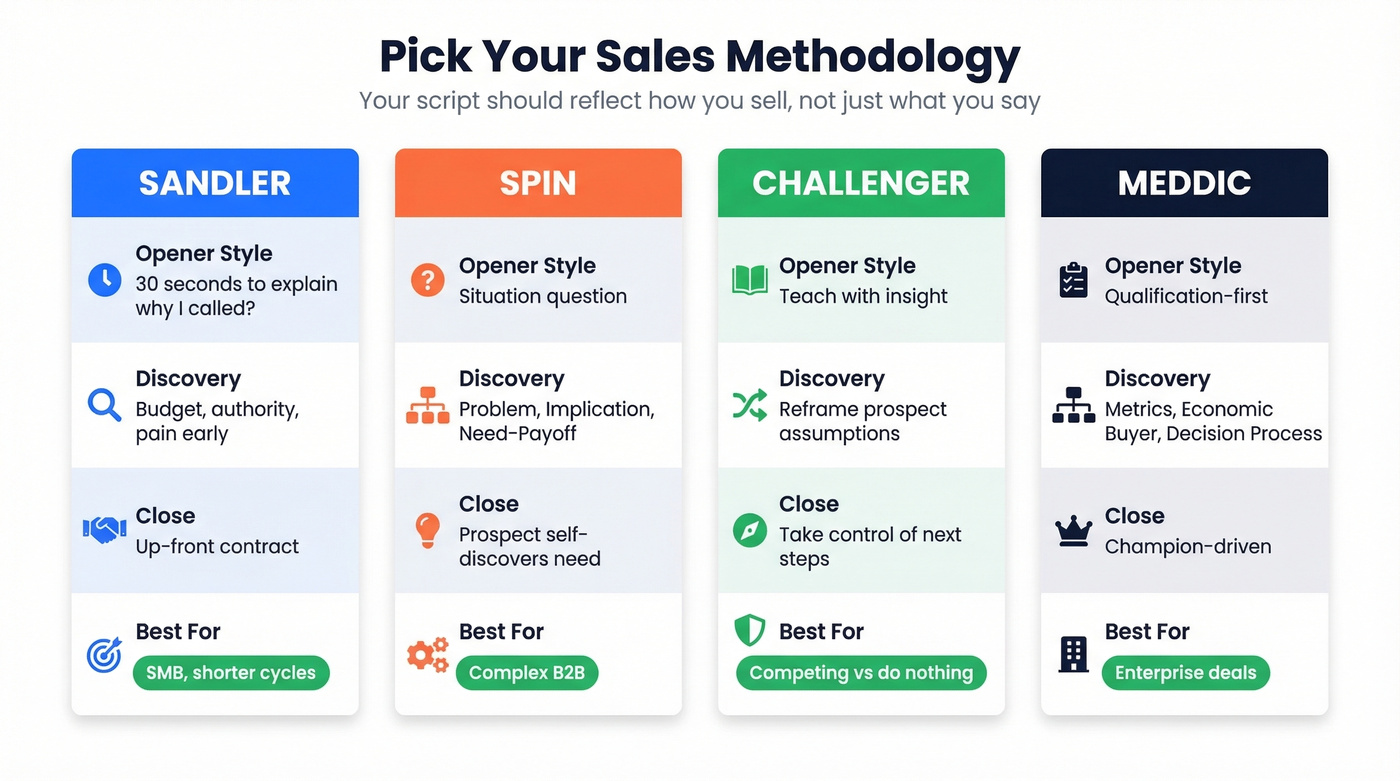
A sales process is a map - it tells you what to do and when. A methodology is driving instructions - it tells you how. Your outbound script should reflect a methodology, not just a sequence of steps.
| Methodology | Opener Style | Discovery Approach | Close Technique | Best For |
|---|---|---|---|---|
| Sandler | No-pressure ("30 seconds to explain why I called?") | Budget/authority/pain early | Up-front contract | SMB, shorter cycles |
| SPIN | Situation question | Problem, Implication, Need-Payoff | Prospect self-discovers need | Complex B2B |
| Challenger | Teach with insight | Reframe prospect's assumptions | Take control of next steps | Competing vs. "do nothing" |
| MEDDIC | Qualification-first | Metrics, Economic Buyer, Decision Process | Champion-driven | Enterprise deals |
Korn Ferry research found that teams with 75%+ methodology adoption see +21% quota attainment, +15% win rates, and +6% revenue lift. The key word is adoption - not just training, but reps actually using the framework on every call.
Sandler's no-pressure opener - "Can I take 30 seconds to tell you why I called? Then you can decide if we keep chatting" - is the most plug-and-play for SMB teams. SPIN requires stronger discovery chops but pays off in complex B2B where the prospect needs to feel the pain before they'll move. Challenger works best when your biggest competitor is inertia. And if you're selling six-figure enterprise deals, MEDDIC isn't optional - it's table stakes.
If you're building a repeatable outbound motion, this sales process optimization guide will help you standardize what works.
One trend we've been watching in 2026: AI coaching tools like Dialpad can surface real-time prompts during calls based on what the prospect says. They won't replace your methodology, but they'll tell you when you're talking too much and not asking enough questions.
If you're evaluating call coaching stacks, start with these Dialpad alternatives.
Why Scripts Fail Before You Dial
Look, most teams should stop optimizing their script and start optimizing their list. If your deal size is under $50K and you're spending hours perfecting word choices, you're solving the wrong problem.
The math doesn't lie. With a 3-10% connect rate and 81% of calls hitting voicemail, the majority of your calling block is wasted on wrong numbers, outdated contacts, and people who left the company six months ago. Cognism's internal team hits a 6.7% success rate - nearly 3x the 2.3% average - and they attribute it to quality data paired with precise targeting, not a magic script.
The highest-ROI improvement most teams can make is cleaning their contact data before they ever pick up the phone. We've seen this firsthand with Prospeo's 125M+ verified mobile numbers - teams like Meritt tripled their pipeline from $100K to $300K per week after switching, and their bounce rate dropped from 35% to under 4%. When your data's clean, your scripts actually get heard.
If you're fixing list quality, start with data enrichment services to keep records current.
The article says it takes 8 attempts to reach a prospect. With bad data, half those attempts are wasted on wrong contacts. Prospeo refreshes every 7 days - not 6 weeks - so your call list stays current and your connect rate stays high.
Stop dialing dead leads. Start every call with data you trust.
Five Script Mistakes That Kill Calls
One HubSpot contributor tracked 11,519 cold calls, booked 335 meetings, and closed $287K. Here's what he learned not to do:
Pitching before earning attention. Your first 15 seconds should create curiosity, not deliver a product demo. Lead with relevance, not features.
Over-scripting and under-listening. If you're reading, you're not hearing. The best reps internalize the structure and improvise the words.
Opening with rapport instead of relevance. "How's your Tuesday going?" wastes the prospect's time. They know you're selling. Respect that.
Not A/B testing openers. Run two openers for a week. Track which one gets more conversations past 30 seconds. Iterate.
Treating "no" as final. A "no" is feedback. Ask why. Adjust. Call back in 30 days with a different angle. 80% of sales need five or more touches - one rejection means nothing.
Skip the mistake of trying to fix all five at once. Pick the one that describes your last bad call and fix that first.
If you're ramping new reps, this 30-60-90 day plan for sales reps helps turn scripts into habits.
FAQ
How long should a cold call script be?
Successful cold calls average 93 seconds. Your script should deliver your opener, one value statement, and a meeting ask in under two minutes. Read it aloud - if it takes longer than 90 seconds at conversational pace, cut it down.
Should I read my script word for word?
No. Scripts are conversation guides, not teleprompter text. Internalize the structure - opener, context, permission, questions, close - then speak naturally. In our experience, reps who read verbatim consistently underperform those who use frameworks flexibly.
How do I sound natural on a cold call?
Practice the script 10+ times before going live. Slow down, smile - it genuinely changes your vocal tone. Record yourself and listen back. The goal is to know your talk track well enough that you never need to look at it.
What tools help improve cold call results?
Prospeo for verified contact data - 98% email accuracy and a 30% mobile pickup rate mean your calls actually connect. Gong or Dialpad for conversation intelligence to see what's working on live calls. And a CRM like HubSpot or Close for tracking outcomes and iterating on scripts over time.
Now stop reading about scripts and go make 20 calls.