

The Sales Skills That Actually Matter in 2026
84% of sales reps missed quota last year. Not because they lacked hustle or didn't know their product - but because they were grinding on the wrong sales skills with the wrong data. Meanwhile, 73% of sellers rate themselves strong at detecting deal risks, yet 56% of managers say their reps miss critical risks that stall revenue. That's not a training problem. It's a self-awareness problem.
The gap between how sellers perceive their abilities and how those abilities actually perform in pipeline is the single biggest drag on quota attainment right now. What follows is built from a 1,004-person study on top performers, competency frameworks used by enterprise sales orgs, and real benchmarks by role level - organized into something you can act on this quarter.
Quick version: You don't need 30 skills. A global study of 1,004 sellers and sales managers shows clear separators between top performers and everyone else - and you can boil the most actionable ones down to five: consultative selling, active listening, prospecting discipline, coachability, and business acumen. Top performers are 88% more likely to excel at consultative selling, and sellers with effective coaching and training are 63% more likely to be top performers.
What Separates Top Performers
The RAIN Group study of 1,004 sellers and sales managers is the most useful dataset we've found on this question. It identifies the biggest behavioral gaps between top performers and everyone else. The differences aren't subtle.
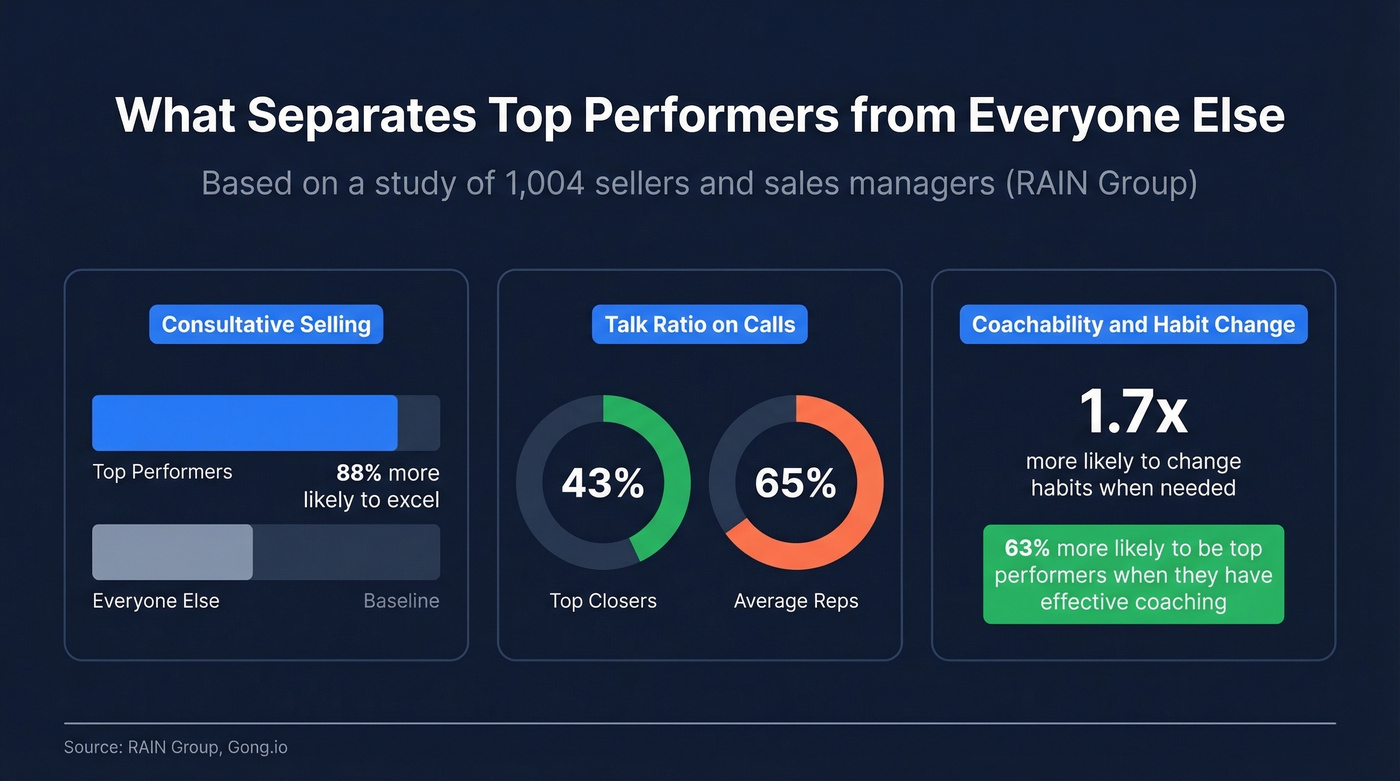
Top performers are 88% more likely to excel at advanced consultative selling - the ability to diagnose a buyer's situation, connect it to business outcomes, and shape a solution collaboratively. That's the single biggest separator. Not closing technique. Not objection handling. Consultative selling.
They're also 1.7x more likely to change habits when needed. That's coachability in action - the willingness to hear feedback, adjust, and iterate. Sellers who have an effective manager, regular coaching rhythm, and quality training are 63% more likely to land in the top performer category.

Then there's the talk-ratio benchmark. Gong's data shows top-closing B2B reps talk 43% of the time on calls. Average performers? 65%. That's a fundamentally different approach to discovery.
None of these separators are exotic. Consultative selling, listening, coachability, habit change, account growth - anyone can learn them with deliberate practice. The difference is that top performers execute them consistently while everyone else treats them as things they already know.
Five Core Competencies
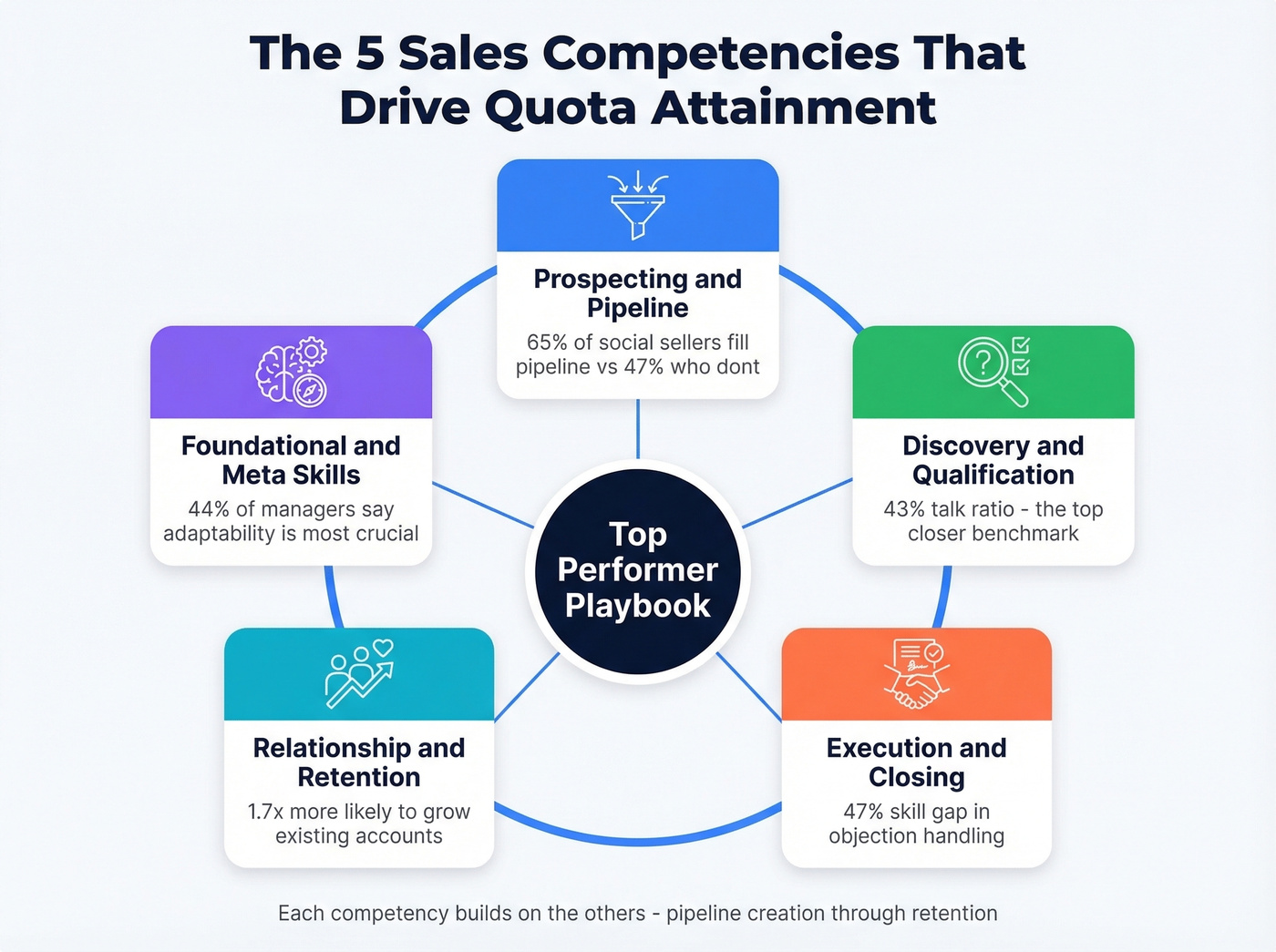
Five categories map to how selling actually works, from pipeline creation through retention. Each includes benchmarks and the anti-patterns that kill deals.
Prospecting and Pipeline
Every other skill is irrelevant if your pipeline is empty.
65% of reps who use social selling fill their pipeline, compared to 47% who don't. Multi-channel outreach consistently outperforms single-channel approaches. And Gartner predicts that 30% of sales professionals will develop considerable deficiencies in social selling as they over-rely on automation - meaning reps who still prospect with intent will have an even bigger edge.
Here's the thing: the anti-pattern that destroys prospecting ROI before it starts isn't laziness. It's bad data. If you're prospecting with unverified emails and stale contact info, you're burning your sender domain. We've seen teams running sequences where 30-35% of emails bounce, tanking deliverability for the entire org. One customer, Meritt, went from a 35% bounce rate to under 4% after switching to Prospeo, and their connect rate tripled. Their pipeline jumped from $100K to $300K per week. No $30K data contract needed - the free tier lets you start immediately.


Prospecting discipline is the #1 skill on this list - but it falls apart when your data is wrong. Prospeo delivers 98% email accuracy across 300M+ profiles, refreshed every 7 days. Teams using Prospeo book 26% more meetings than ZoomInfo users.
Sharpen your best sales skill with data that actually connects.
Discovery and Qualification
Discovery is where deals are won or lost - usually before the buyer even realizes it. The skill here isn't asking questions. It's asking the right questions, in the right order, and then actually listening to the answers.
That Gong benchmark bears repeating: 43% talk ratio for top closers versus 65% for average reps. If you're talking more than your prospect on a discovery call, you're presenting, not discovering.
Strong discovery questions follow a pattern. Start broad ("Walk me through how your team handles X today"), then probe specifics ("What happens when that breaks down?"), then quantify ("What does that cost you per quarter?"). The anti-pattern is leading with features. "We have AI-powered analytics" means nothing until you've established that the buyer has an analytics problem worth solving.
Business acumen matters here too - and it's one of the most important competencies at every level. Top performers understand their buyer's industry, competitive landscape, and financial pressures well enough to ask questions that surprise and impress. That doesn't come from training decks. It comes from reading earnings calls, industry reports, and actually caring about your buyer's business. This kind of commercial literacy separates reps who ask generic questions from those who earn executive-level credibility.
If you want a tighter framework for this stage, use a structured set of discovery questions and a consistent sales qualification method.
Execution and Closing
Objection handling has the largest skill gap in the RAIN Group data - 47%. Discovery and questioning comes in at 42%, and time management at 37%.
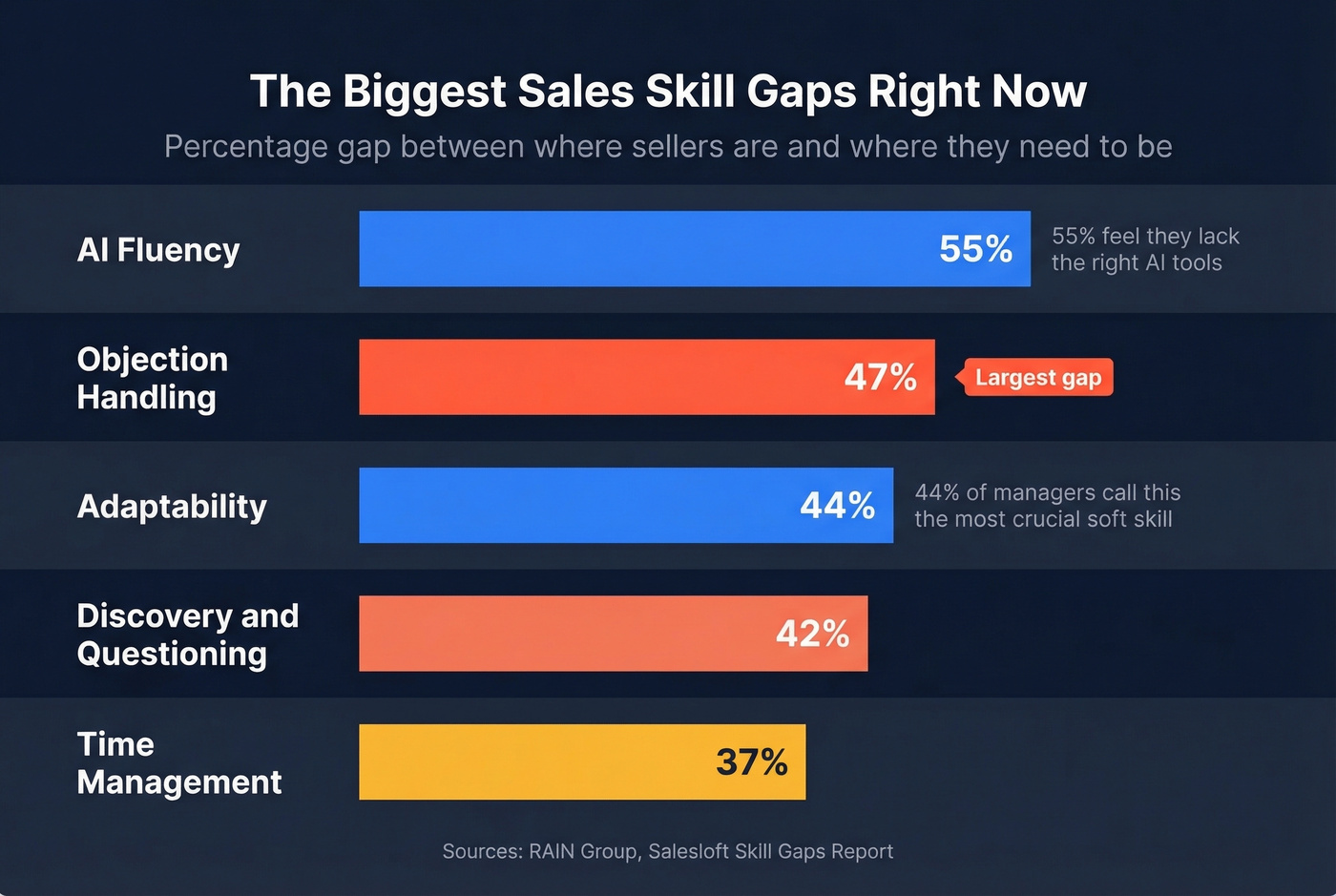
Nearly half of sellers can't effectively handle pushback. Let that sit for a second.
Strong execution requires three things. Presentation abilities that connect features to the specific outcomes uncovered in discovery. Objection handling that validates the concern before reframing it - "I hear you on price; let's look at what the current problem is costing you per quarter and see if the math works." And negotiation discipline that protects value instead of giving everything away to close the deal.
If you want a repeatable structure here, map your process to clear steps to close a sale and use an anchor in negotiation to protect value.
The anti-pattern is overpromising. Reps who stretch the truth about capabilities or timelines to close a deal create churn, not revenue. Every CS team knows which reps oversell - and it shows up in retention metrics within six months.
Relationship and Retention
Top performers are 1.7x more likely to excel at growing existing accounts. That's not a soft skill - it's a revenue skill.
Account expansion, cross-sell, and renewal are where compounding growth happens, and they require a different muscle than net-new acquisition. Sales pros spend only about a third of their time actually selling - the rest goes to admin, internal meetings, and CRM updates. The reps who protect their selling time and maintain consistent follow-up cadences with existing accounts outperform those who chase new logos exclusively.
If you're building a system for this, start with sales follow-up templates and a consistent sales meeting follow-up email workflow.
As deal sizes grow, relationship building at the stakeholder level matters more. An AE managing a six-figure renewal needs to be multi-threaded across the buying committee - not dependent on a single champion who might leave. The skill is mapping influence, building trust with multiple contacts, and creating enough value that renewal is a formality rather than a negotiation.
Foundational and Meta Skills
These are the abilities that amplify everything else: sales communication, time management, adaptability, coachability, and increasingly, AI fluency.
44% of managers say adaptability is the most crucial soft skill for sales success. Time management carries a 37% skill gap, which makes sense when 40% of sellers frequently deviate from the sales process and only 20% of managers believe deals follow a repeatable process.
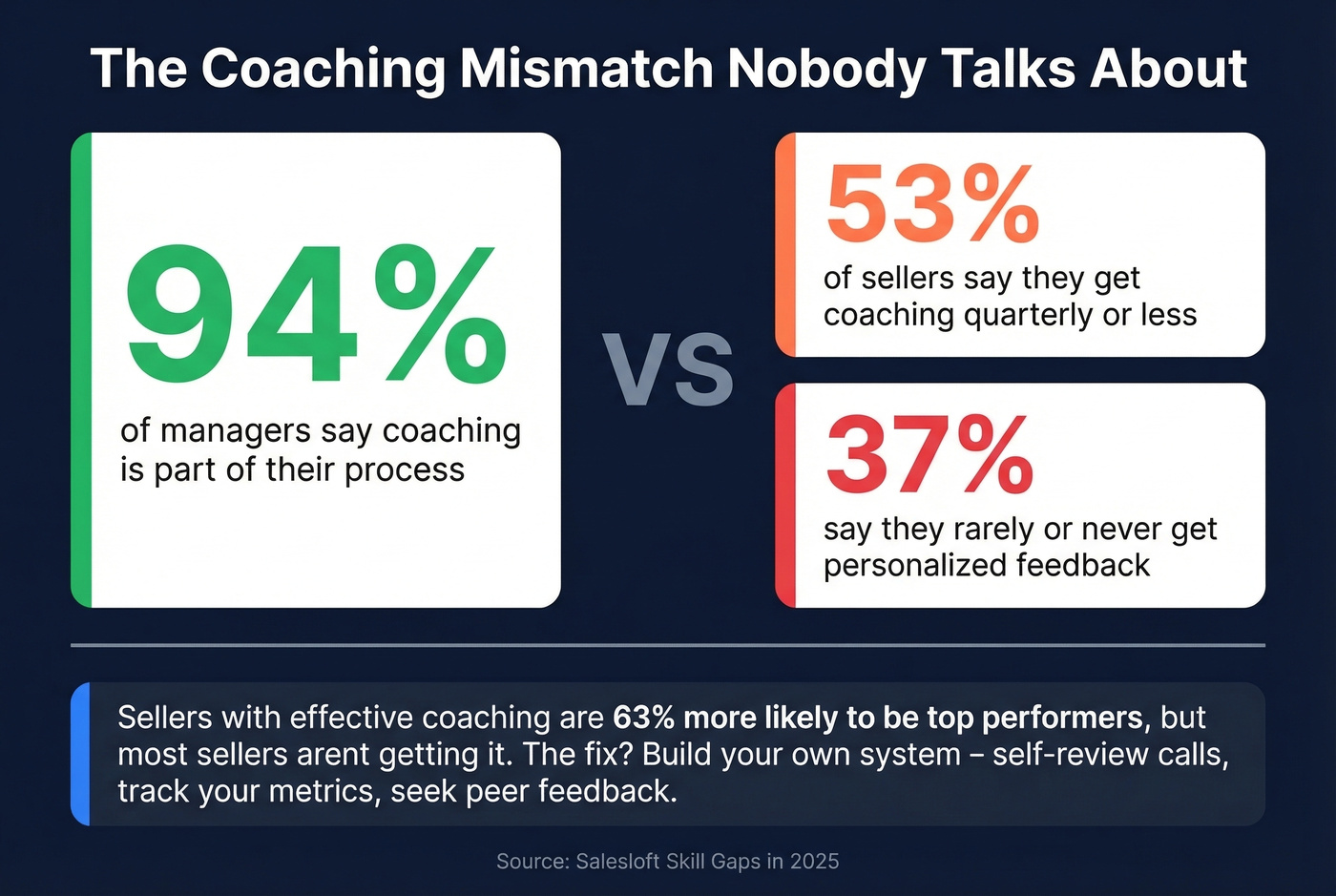
Then there's the coaching mismatch - and honestly, it's one of the most frustrating dynamics in sales today. 94% of managers say coaching is part of their process. But 53% of sellers say they receive coaching quarterly or less, and 37% say they rarely or never get personalized feedback. That's not a minor gap. It's a structural failure.
Coachability still matters even without a coach. Sellers who self-review call recordings, track their own metrics, and actively seek feedback from peers are building the same muscle. The 63% top-performer correlation with effective coaching doesn't require a manager - it requires a system.
AI fluency is the newest addition to the technical toolkit. Only 6% of sellers use AI for task prioritization. 55% feel they lack the right AI toolset. The skill isn't "using ChatGPT" - it's knowing how to prompt effectively, QA AI outputs before they reach a buyer, and automate repetitive workflows so you can spend more time on the human parts of selling. (If you're operationalizing this, a practical starting point is AI sales follow-up.)
Sales Skills by Role Level
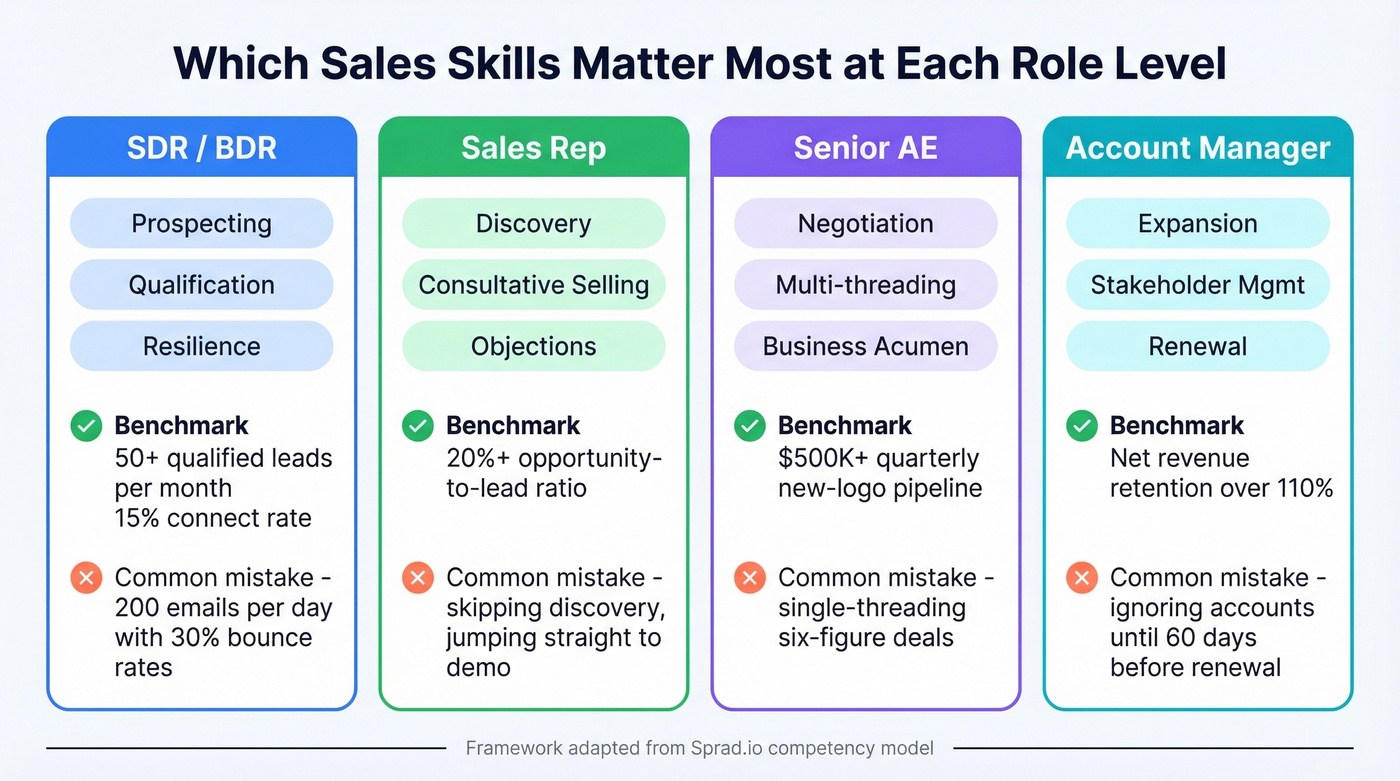
Not every competency matters equally at every level. An SDR perfecting negotiation technique is optimizing the wrong thing. An AM who can't prospect isn't necessarily failing - they need different muscles. The benchmarks below draw from the Sprad.io competency framework.
| Role | Top 3 Skills | Key Benchmark | Common Mistake |
|---|---|---|---|
| SDR/BDR | Prospecting, qualification, resilience | 50+ qualified leads/mo, 15% connect rate | 200 emails/day with 30% bounce rates |
| Sales Rep | Discovery, consultative selling, objections | 20%+ opportunity-to-lead ratio | Skipping discovery, jumping to demo |
| Senior AE | Negotiation, multi-threading, acumen | $500K+ quarterly new-logo pipeline | Single-threading six-figure deals |
| Account Manager | Expansion, stakeholder mgmt, renewal | Net revenue retention >110% | Ignoring accounts until 60 days before renewal |
SDRs should obsess over prospecting mechanics and qualification frameworks. Connect rate and qualified lead volume are the metrics that matter - not closed revenue. Building resilience to rejection is genuinely important at this level because the volume of "no" is highest (and it helps to train resilience in sales like a system, not a mood).
For sales reps, the shift is toward discovery depth and consultative selling. The 20%+ opportunity-to-lead ratio is a useful gut check - if fewer than one in five leads become real opportunities, the qualification or discovery process is broken somewhere.
Senior AEs live and die by deal complexity. Multi-threading, negotiation discipline, and genuine business acumen separate the reps closing six-figure deals from those stuck at mid-market. These advanced competencies take years to develop but drive outsized revenue impact.
Account managers need expansion abilities above all else. The best AMs don't just retain - they grow. Identifying upsell triggers and running renewal conversations that feel like strategy sessions rather than contract negotiations are the core competencies here.
You just read that reps spend only a third of their time selling. Bad contact data makes that worse - reps waste hours chasing bounced emails and dead numbers. Prospeo gives you 125M+ verified mobiles with a 30% pickup rate and enrichment that returns 50+ data points per contact.
Spend your selling time actually selling. Start at $0.01 per email.
Skills vs. Traits
Before getting into assessment, it's worth distinguishing skills from traits. Skills are learnable behaviors - discovery technique, objection handling, CRM management. Traits are innate tendencies - curiosity, competitiveness, empathy. You can train skills; you hire for traits. The best development plans focus on skills while acknowledging which traits accelerate learning.
How to Assess Your Level
The Alexander Group's competency model gives you a clean framework: Competencies, then Skills, then Observable Behaviors. That hierarchy forces you to move from abstract ("I'm good at discovery") to concrete ("I consistently uncover budget, timeline, and decision process within the first call").
Three proficiency levels work for most roles:
- Threshold: Can perform with guidance. Follows scripts and frameworks. Needs coaching on edge cases.
- Fully Functional: Executes independently and consistently. Adapts approach based on buyer signals. Hits benchmarks reliably.
- Expert: Teaches others. Innovates on methodology. Handles complex, high-stakes situations with confidence.
The honest self-assessment isn't "how do I feel about this skill" - it's "what does my data say?" Pull your call recordings and check your talk ratio. Look at your CRM conversion rates by stage. Review your email reply rates and bounce rates. Compare your pipeline velocity to team averages. Update quarterly - skills atrophy when you stop practicing them.
How to Actually Improve
Reading about selling doesn't build competence. Practice does. The soft skills every salesperson needs - listening, empathy, adaptability - are built through repetition, not theory. Here are three drills that work, adapted from Highspot's role-play framework:
Discovery probe drill. Pair up with a colleague. One plays a prospect who gives vague answers ("We're looking to improve efficiency"). The seller probes three levels deep without leading the witness. "Efficiency in what area?" leads to "Our onboarding process," which leads to "What's happening in onboarding that's creating friction?" and finally "New hires take 90 days to ramp." Now you have something to work with.
Elevator pitch drill. 60 seconds. No jargon. Explain what your company does and why it matters to a specific persona. Record yourself. If you want examples to model, borrow from these sample elevator pitches.
Objection handling drill. The classic: "It's too expensive." Don't argue price. Validate, then explore. "I hear you - let's make sure the investment makes sense. What's the current cost of the problem we discussed?" Practice until the response is instinctive, not scripted.
AI role-play tools are gaining traction as a legitimate training channel. They solve the scalability problem - you can run 20 objection-handling reps in an hour without burning out a colleague. The training ROI data supports investment: 353% ROI on structured sales training, 19% increase in win rates, and structured onboarding retains 50% more new hires while reducing ramp time up to 34%.
For the 53% of sellers who don't get regular coaching, self-coaching is the workaround. Review one call recording per week. Score yourself on talk ratio, question quality, and next-step clarity. Track improvement over 30 days. It's not as good as having a great manager, but it's infinitely better than waiting for feedback that never comes.
AI as a Selling Competency
Only 6% of sellers use AI for task prioritization. Let that sink in. 81% of sales teams are using AI in some capacity, but almost nobody is using it for the thing that matters most - deciding what to work on next.
The gap isn't access. It's fluency.
AI fluency in 2026 means four things: prompting well enough to get useful outputs, QA'ing those outputs before they reach a buyer, automating repetitive workflows, and interpreting intent data and buying signals to prioritize accounts. A neuroscience study by Dr. Carmen Simon found that AI-coached sellers remembered 50% more information after 48 hours than those who received human feedback alone. Human coaching, meanwhile, increased motivation and emotional engagement. The takeaway isn't "replace managers with AI" - it's "let AI coach the deal, let your manager coach the rep."
SaaStr predicts AI will join every sales call within 12-18 months as an active assistant, and that up to 50% of routine, transactional deals under $10K will be AI-handled. The competencies needed in this new world are judgment, relationship building, complex negotiation, and creative problem-solving. 43% of sellers currently prioritize based on personal judgment rather than buyer signals. That number needs to drop.
Let's be honest about what this means for career planning. If your average contract value is small and your sales cycle is under two weeks, AI will handle most of your selling within 18 months. The reps who survive aren't the ones fighting that shift - they're the ones moving upmarket into deals that require human judgment. The sales training market is projected to hit ~$19B by 2032, and a massive chunk of that growth is AI-enabled coaching tools. Learning to use them isn't optional anymore.
FAQ
What are the most important sales skills in 2026?
Consultative selling, active listening, prospecting discipline, coachability, and business acumen - these five create the widest performance gap. Top performers are 88% more likely to excel at consultative selling, and sellers with effective coaching are 63% more likely to reach top-performer status.
How do I improve my sales skills fast?
Record calls and review your talk-to-listen ratio weekly - target 43% talking. Run AI role-plays for objection handling. Get coaching, even self-directed, because sellers with regular coaching are 63% more likely to be top performers. Focus on one skill at a time for 30 days before moving to the next.
What sales skills should I put on my resume?
Lead with consultative selling, pipeline generation, CRM fluency, and negotiation - then quantify results. "Generated $500K quarterly pipeline" beats "strong communication skills" every time. Include specific tools like Salesforce, Gong, or Prospeo. Highlight both hard abilities like forecasting and soft competencies like stakeholder management.
What's the difference between hard and soft sales skills?
Hard skills are measurable - CRM management, data analysis, pipeline forecasting. Soft skills are behavioral - active listening, adaptability, empathy, coachability. Top performers excel at both, but behavioral competencies take longer to develop because they require changing ingrained habits rather than learning a new tool.
How is AI changing the skills reps need?
AI handles research, call prep, and routine follow-up - freeing reps for complex discovery and negotiation. Only 6% use AI for task prioritization today, revealing a massive fluency gap. Developing AI fluency - prompting, QA, workflow automation, and signal interpretation - is now essential alongside traditional selling abilities.