

Sales Subject Lines for Emails: What Actually Works (and What Every Guide Gets Wrong)
A rep on r/Entrepreneur shared their cold email rebuild: 200 emails sent, 47 bounced, 30 hit spam. The subject line was fine. Everything underneath it was broken. After 62 days of fixing infrastructure, list quality, and send cadence, reply rates doubled from 3% to 6% - and the subject lines barely changed.
That's the dirty secret most "best subject lines" articles skip. Your subject line matters, but it's the last mile, not the first. Here's what 5.5M cold emails actually tell us about what works - plus the infrastructure fix that makes any subject line perform better.
Three Rules From 5.5M Emails
Belkins analyzed 5.5M cold emails sent across all of 2024. Three patterns stood out:
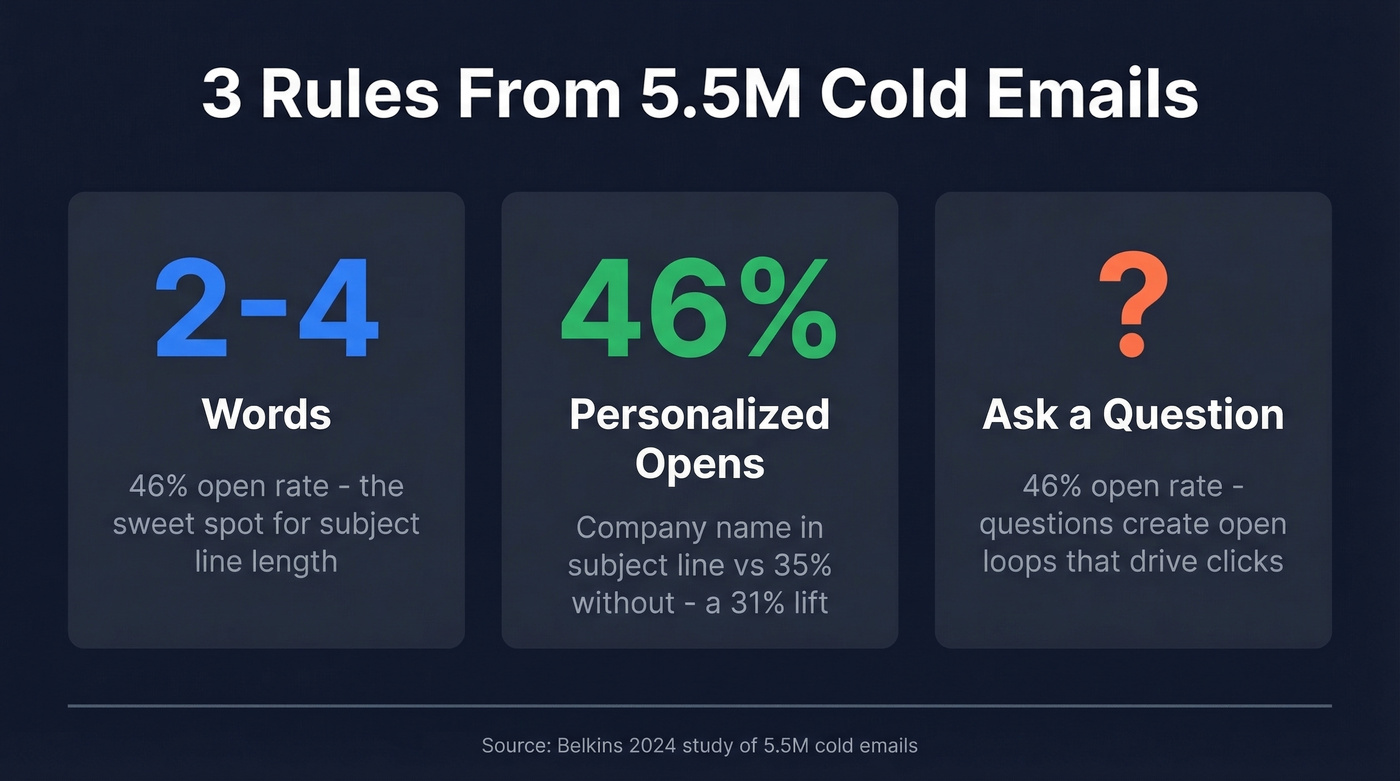
- Keep it to 2-4 words. Subject lines of 2-4 words hit a 46% open rate - the best-performing length bracket.
- Personalize with the company name. Personalized subject lines averaged 46% opens vs. 35% without. That's a 31% lift.
- Phrase it as a question. Question-format subject lines matched that 46% open rate, outperforming every other format tested.
And the contrarian insight: if your open rate sits below 15%, stop rewriting subject lines. The problem is your list quality and deliverability.
What the Data Actually Shows
The 5.5M-email dataset is the most useful cold email study published in the last two years. It's vendor data, sure, but the sample size and explicit timeframe make it far more credible than the recycled "best practices" lists you've already seen.
For context, Mailchimp's benchmark across billions of marketing emails shows a 35.63% all-user average open rate. Business and finance emails average 31.35%. Cold email personalization at 46% doesn't just beat generic cold email - it beats most marketing email. That should reframe how you think about subject line optimization.
Personalization Isn't Optional
Personalized subject lines hit 46% opens. Non-personalized ones landed at 35%. Reply rates jumped from 3% to 7%. Those numbers settle the debate.
Here's the kicker: a Yes Lifecycle Marketing study of 7B emails found that 97.7% of emails used zero subject-line personalization. The bar is on the floor. Just dropping a company name into your subject line puts you ahead of nearly everyone in the inbox.
Shorter Beats Longer
The length curve from the dataset is clean. Two to four words: 46% opens. One word: 38%. Seven words: ~39%. Nine words: ~35%. Ten words: 34%.
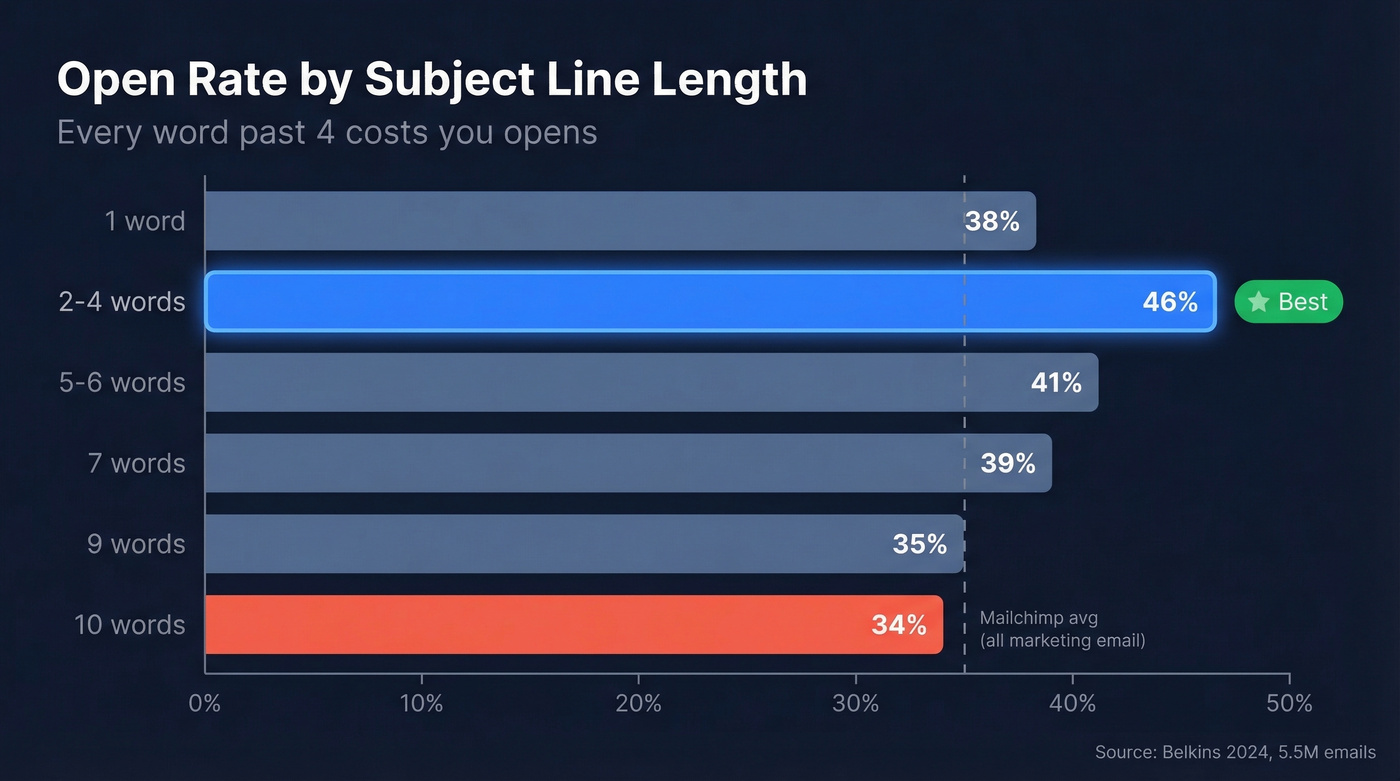
Every word you add past four costs you opens.
Twilio SendGrid's Cyber Week data confirms this - the average subject line ran 6 words, but the best performers were 2-4 words. Not surprising when you consider that most of your audience reads email on mobile, where truncation starts at 33 characters.
Questions Outperform Statements
Question-format subject lines averaged 46% opens - tied for the highest of any format tested. The r/Entrepreneur practitioner backed this up: "Quick question" pulled 39% opens, while "Partnership opportunity" limped in below 19%.
Questions work because they create an open loop. The reader's brain wants to close it. A full 33% of recipients decide to open based on the subject line alone, according to Instantly's research - and a question gives them a reason to click.
Casing and Numbers
ALL CAPS subject lines hit 30% opens vs. 25% for sentence case - but the spam risk isn't worth the 5-point lift. Numbers in subject lines performed marginally worse (27% vs. 28% without). Neither trick moves the needle enough to bother with.
The 33-Character Rule
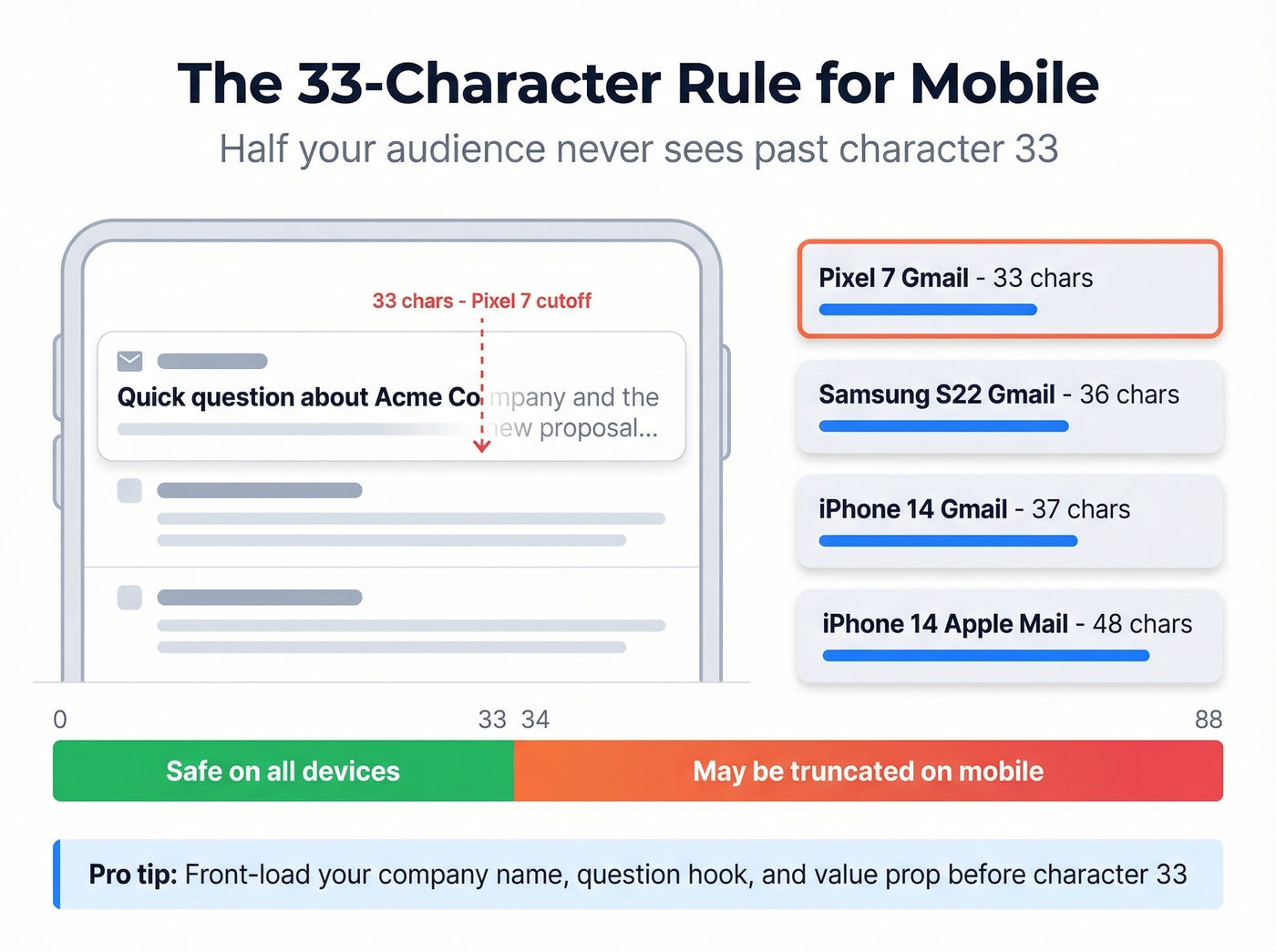
Most of your prospects read email on their phones. Mobile clients are ruthless with truncation. EmailToolTester measured exact character limits across devices:
| Device / Client | Subject Line Limit | Preheader Limit |
|---|---|---|
| Pixel 7 (Gmail) | 33 chars | 37 chars |
| Samsung S22 (Gmail) | 36 chars | 40 chars |
| iPhone 14 (Gmail) | 37 chars | 39 chars |
| iPhone 14 (Apple Mail) | 48 chars | 99 chars |
| Gmail Desktop (~1400px) | ~88 chars | - |
| Outlook Desktop | ~51 chars | - |
If you want full visibility across every major device, 33 characters is your ceiling. That's roughly 5-6 short words. Front-load the key information - your company name personalization, the question hook, the value prop - because everything after character 33 might not exist for half your audience.
Don't forget the preheader. At 37 characters safe on mobile, it's essentially a second subject line. Use it to complete the thought your subject line starts. If you want a deeper playbook, pair this with preview text A/B testing.

The data is clear: personalized subject lines hit 46% opens. But personalization only works when your emails actually land. Prospeo's 5-step verification delivers 98% email accuracy on a 7-day refresh cycle - so every perfectly crafted subject line reaches a real inbox, not a bounce log.
Stop perfecting subject lines for emails that never arrive.
Fix Deliverability Before Writing
The r/Entrepreneur practitioner who doubled their reply rate didn't do it with better subject lines. They did it with better infrastructure. If you need a full checklist, start with an email deliverability guide and work outward.
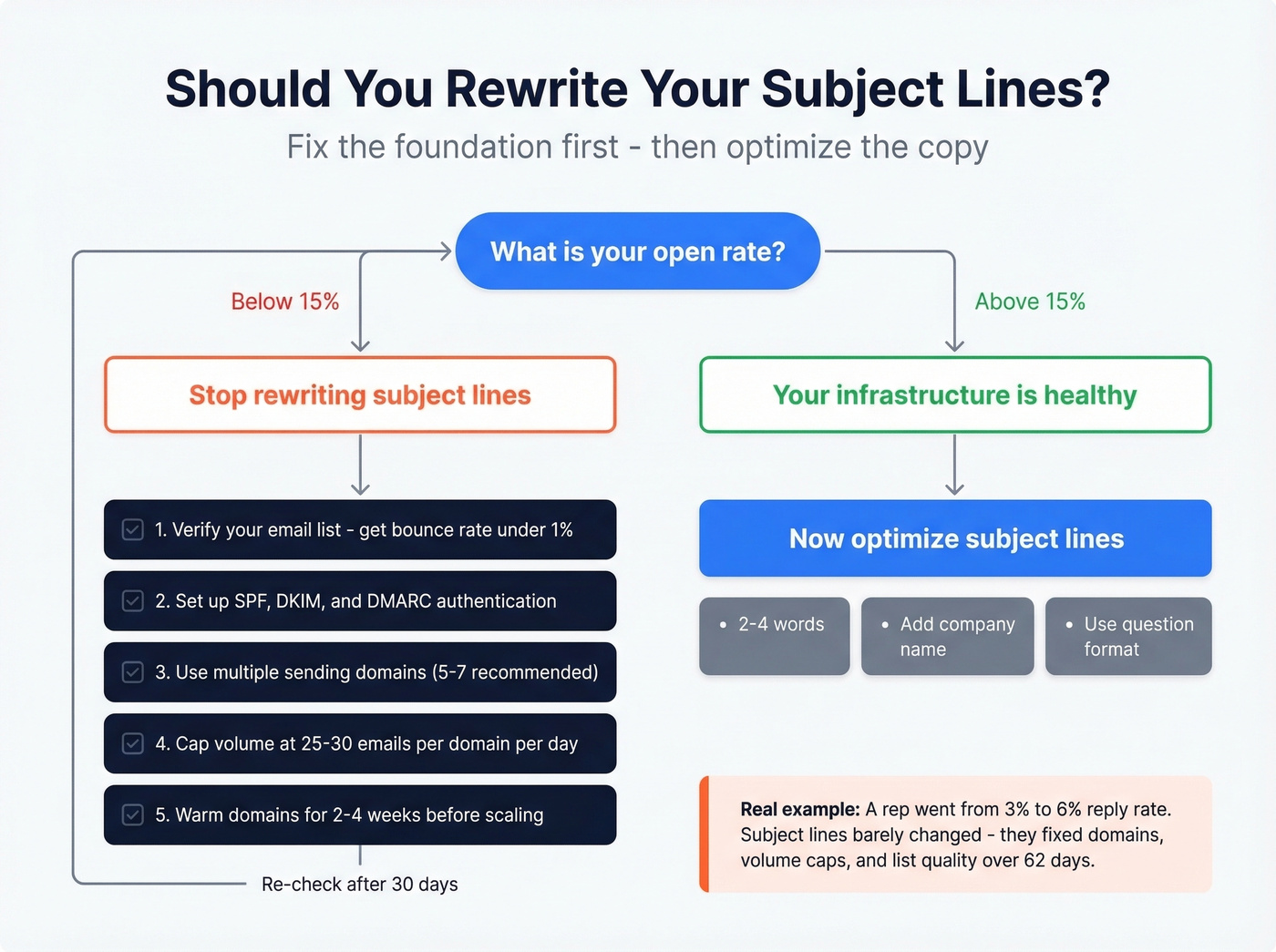
Their bounce rate was 11%. They were sending from 3 domains with no volume caps. After expanding to 7 domains, capping at 26 emails per day per domain, setting up SPF/DKIM/DMARC authentication, and manually verifying their list, bounce rate dropped below 2%. The whole stack cost ~$420/month and produced 16 qualified leads monthly.
Here's the thing: if your bounce rate is above 1%, fix deliverability first. Subject line tweaks won't matter. Mailbox providers see bounces as a reputation signal - too many and your emails land in spam regardless of what the subject line says. (If you want the numbers and fixes, see email bounce rate benchmarks.)

This is where list verification becomes the fastest fix. Prospeo runs a 5-step verification process with catch-all handling, spam-trap removal, and honeypot filtering - delivering 98% email accuracy on a 7-day data refresh cycle. Real results: Meritt cut their bounce rate from 35% to under 4%, and Stack Optimize maintains 94%+ deliverability across all client campaigns with zero domain flags. If you're troubleshooting reputation, use email reputation tools to spot issues early.
50+ Subject Lines Sales Teams Use
Every example below follows the data: short, personalized where possible, and structured as questions or curiosity hooks. Swap in your prospect's company name, a relevant metric, or a trigger event. For more patterns, pull from these email subject line examples.
We've tested dozens of these patterns across client campaigns. A mediocre subject line sent from a healthy domain will outperform a brilliant one sent from a flagged domain - every single time. Spend your time on list quality and domain health first, then optimize the copy. (If you're building full sequences, use a B2B cold email sequence framework.)
Cold Outreach (First Touch)
These lean into the question format (46% opens) and company-name personalization (31% lift):
- Quick question about {{Company}}
- {{Company}}'s Q3 pipeline?
- Saw {{Company}}'s news
- Question on {{department}} hiring
- {{Company}} + {{Your Company}}?
- Noticed {{specific trigger}}
- Idea for {{Company}}'s {{goal}}
- Wrong approach at {{Company}}?
- {{Mutual connection}} suggested this
- Who handles {{function}} at {{Company}}?
The "Quick question" pattern pulled 39% opens in practitioner testing. "Partnership opportunity" pulled under 19%. The difference is specificity and curiosity vs. generic pitch signaling.
For B2B SaaS, ROI framing tends to perform best ("{{Company}}'s pipeline?"), while financial services and healthcare often require compliance-safe language. Adjust the templates, but keep the structure. If you want to tighten the body copy to match, use an email copywriting checklist.
Follow-Up Subject Lines
Follow-ups should be shorter than your first touch. In our experience, the ones that reference a specific detail from the prior exchange consistently outperform generic "just checking in" framing.
- Following up - {{specific detail}}
- The {{metric}} I mentioned
- Forgot to mention this
- One more thought on {{topic}}
- Did the timing work?
- {{Company}} update worth seeing
- Still relevant?
If you need full follow-up sequences, these sales follow-up templates are a good starting point.
Breakup Emails
"Should I close your file?" is the single best breakup subject line we've seen. It triggers loss aversion - a principle Chris Voss popularized in sales negotiation. The prospect feels they're losing an opportunity, not being pitched one. That shift paradoxically makes them more likely to respond.
- Should I close your file?
- Not a fit?
- Am I off base here?
- Last note from me
- Worth one more look?
- Bad timing or wrong person?
Meeting Requests
Skip "let's chat." A specific time reference or mutual connection outperforms vague framing by a wide margin:
- 15 min this week?
- {{Day}} at {{time}} work?
- {{Mutual connection}} said to reach out
- Quick call re: {{topic}}?
- 10 min to show you {{specific thing}}
Re-Engagement (Dormant Leads)
Trigger-based subject lines work best here - reference something that changed since your last conversation:
- Congrats on the raise, {{First Name}}
- Saw {{Company}} is hiring {{role}}
- Things changed since we talked
- {{Industry trend}} - relevant to {{Company}}?
- {{Company}} came up in a conversation
Before vs. After Rewrites
Notice the pattern across every category: high-performing subject lines are 2-4 words and either ask a question or reference something specific to the prospect.
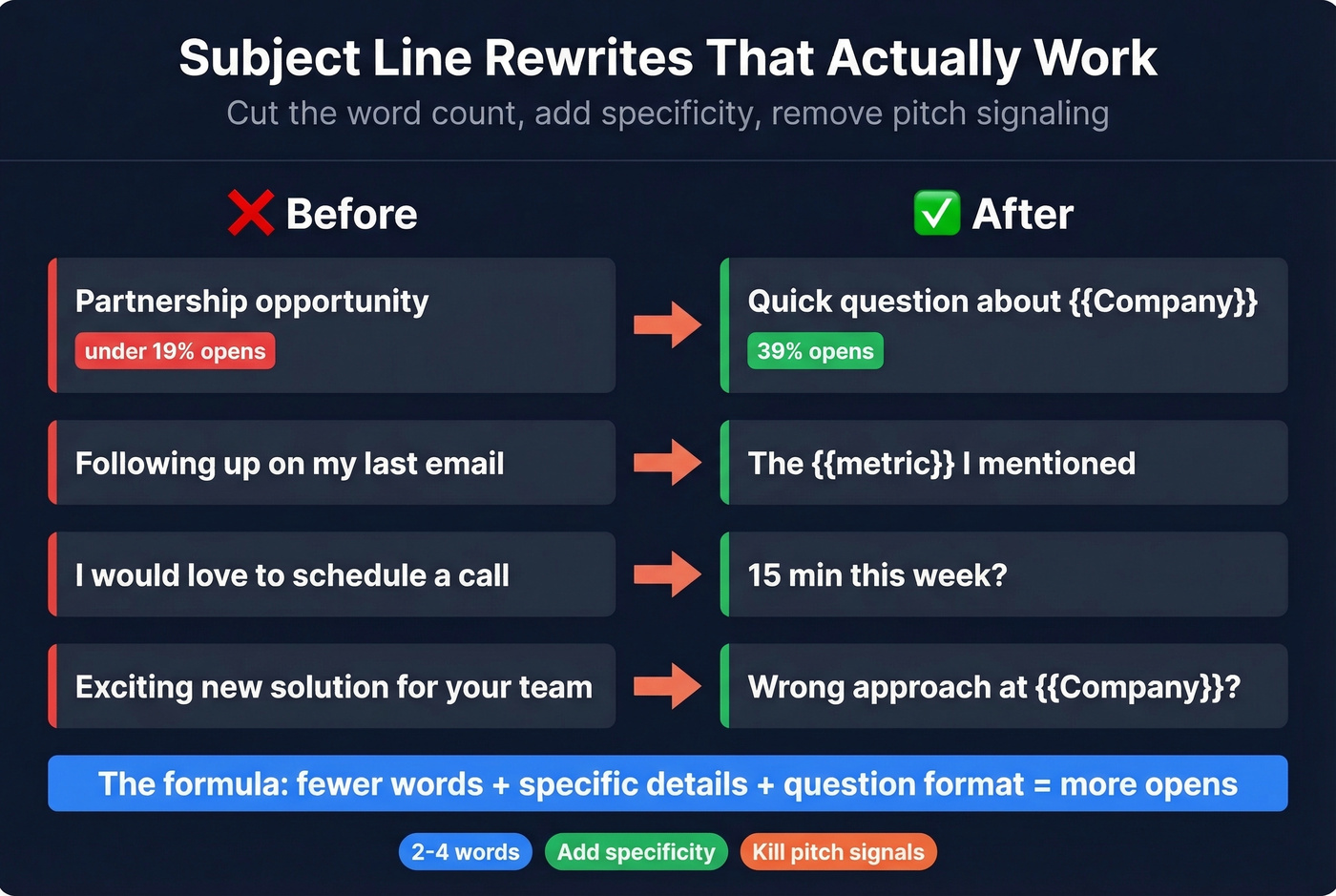
- ❌ "Partnership opportunity" (<19% opens) → ✅ "Quick question about {{Company}}" (39% opens)
- ❌ "Following up on my last email" → ✅ "The {{metric}} I mentioned"
- ❌ "I'd love to schedule a call" → ✅ "15 min this week?"
- ❌ "Exciting new solution for your team" → ✅ "Wrong approach at {{Company}}?"
Every rewrite follows the same formula: cut the word count, add specificity, remove pitch signaling.
Compliance Mistakes That Cost $53K
CAN-SPAM penalties run up to $53,000 per email. That's not a typo. Jumpstart Technologies settled a $900K FTC claim for disguised emails. Experian Consumer Services faced a $650K fine for deceptive "important account info" subject lines that were actually product promotions. Under GDPR, fines reach EUR 20M or 4% of global revenue.
A classic compliance risk: using "RE:" or "FW:" in subject lines when there's no prior conversation. It's a misleading-header pattern that can get you flagged by both regulators and mailbox providers. Don't do it.
"Spam Trigger Words" Are Mostly Myth
Every cold email guide includes a list of "spam trigger words" to avoid. Modern spam filters don't work that way. They use machine learning models that evaluate patterns, not individual words.
The risk isn't saying "free" in a subject line. The risk is saying "free" from a new domain with no authentication, no engagement history, and promotional formatting. Flagged terms can increase filtering probability by 20%+ - but only when combined with other risk signals: new sender domain, hype language, no SPF/DKIM, low engagement, image-heavy emails with no plain-text version. Fix the pattern, and you can use whatever words you want. If you want to sanity-check content risk, run an email spam checker.
How to A/B Test Subject Lines
Most teams "test" subject lines by trying two versions on a 50-person list and declaring a winner. That's not testing - that's guessing with extra steps.
Here's the framework from Instantly that actually produces reliable results:
- Minimum 250 contacts per variant. Push to 500+ for real statistical confidence.
- Isolate one variable. Change the subject line and nothing else - not the send time, not the body, not the sender name.
- Optimize for positive reply rate, not opens. Clickbait subject lines spike opens but tank replies and sender reputation.
- Set your benchmarks. On a warmed list, target 40-60% open rate and 5%+ positive reply rate. Bounce rate should stay at or below 1%.
- If open rate is below 15%, stop testing subject lines. Check inbox placement first.
Let's be honest about timing, too. Instantly's data shows Monday has the highest open rates (22%), while Wednesday peaks for replies. In our experience, sending Tuesday through Thursday, 8-11 AM in the recipient's timezone, consistently outperforms other windows - and the r/Entrepreneur practitioner saw a 16% open improvement after fixing send timing alone. For a deeper breakdown, see the best time to send cold emails data.
That r/Entrepreneur rep cut bounces from 11% to under 2% and doubled reply rates - without changing subject lines. Prospeo users like Meritt went from 35% bounce to under 4%, tripling pipeline to $300K/week. At $0.01 per verified email, clean data costs less than one wasted send day.
Fix deliverability first. Optimize subject lines second.
FAQ
How long should a sales email subject line be?
Two to four words performs best, hitting 46% open rates in the 5.5M-email study. Keep subject lines under 33 characters for full mobile visibility across all major devices. Front-load the most important word - everything past character 33 gets cut on Android Gmail clients.
Do personalized subject lines actually work?
Decisively. Personalized subject lines average 46% opens vs. 35% without, per the 5.5M-email dataset. Reply rates jump from 3% to 7%. Company name personalization outperforms first name in cold outreach because it signals relevance without implying a false relationship.
Should I use emojis in sales subject lines?
In B2B cold email, skip them. Emojis reduce perceived professionalism and contribute to spam filtering when combined with promotional language or poor sender reputation. For outreach to decision-makers, plain text wins.
How do I know if my subject line is the problem vs. deliverability?
If open rates sit below 15%, the issue is almost certainly deliverability. Check SPF/DKIM/DMARC authentication, bounce rates, and sender reputation first. Fix the foundation before you optimize the copy - a clean list and authenticated domain will do more for your open rate than any subject line rewrite.
Can AI write better sales subject lines than humans?
There's no widely cited large-scale 2026 dataset proving AI-generated subject lines beat humans when you control for personalization and testing discipline. AI is useful for generating variants quickly - draft 10 options in seconds, then A/B test the best two. The testing matters more than the drafting tool.