

Sales Team Productivity: What's Broken and How to Fix It
Seventeen percent of reps generate 81% of revenue. That's not a productivity problem - it's a systems failure dressed up as individual performance. The average rep spends 28% of their week actually selling, and the other 72% disappears into CRM updates, internal meetings, and switching between ten different apps that were supposed to make them faster.
Most sales team productivity problems trace to three root causes: bad data, too many tools, and not enough coaching. Fix those before buying anything new.
The Benchmarks That Matter
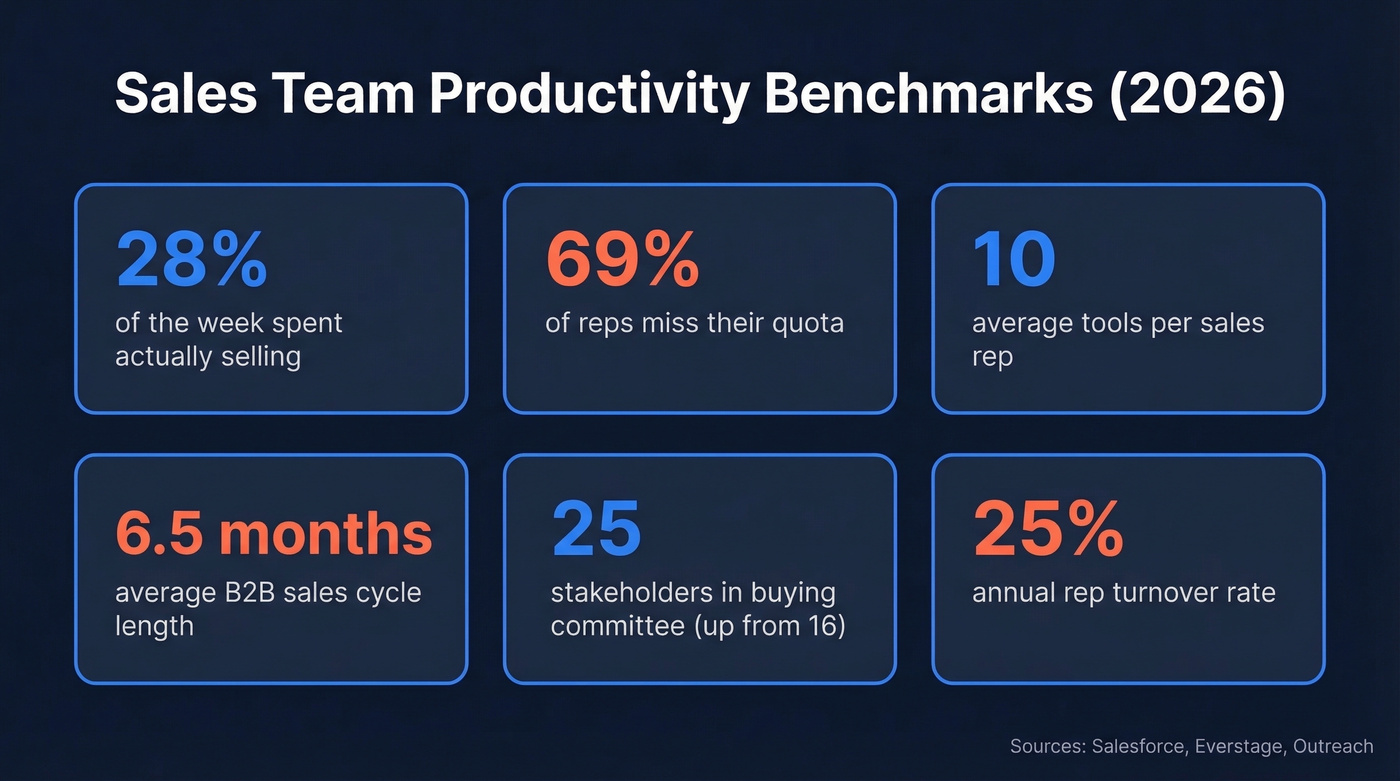
| Metric | Number |
|---|---|
| Reps hitting quota | 43.5% |
| Reps falling short of quota | 69% |
| Time spent selling | 28% of week |
| Time on CRM updates/admin | 18% of week |
| Avg tools per rep | 10 |
| Avg B2B sales cycle | 6.5 months |
| Buying committee size | 25 (up from 16 in 2017) |
| Win rate after 50 days | Drops from 47% to ~20% |
| Annual rep turnover | 25% |
Why Reps Are Struggling
It's not laziness. Sixty-six percent of reps feel overwhelmed by their tools, and the selling environment has shifted under their feet:
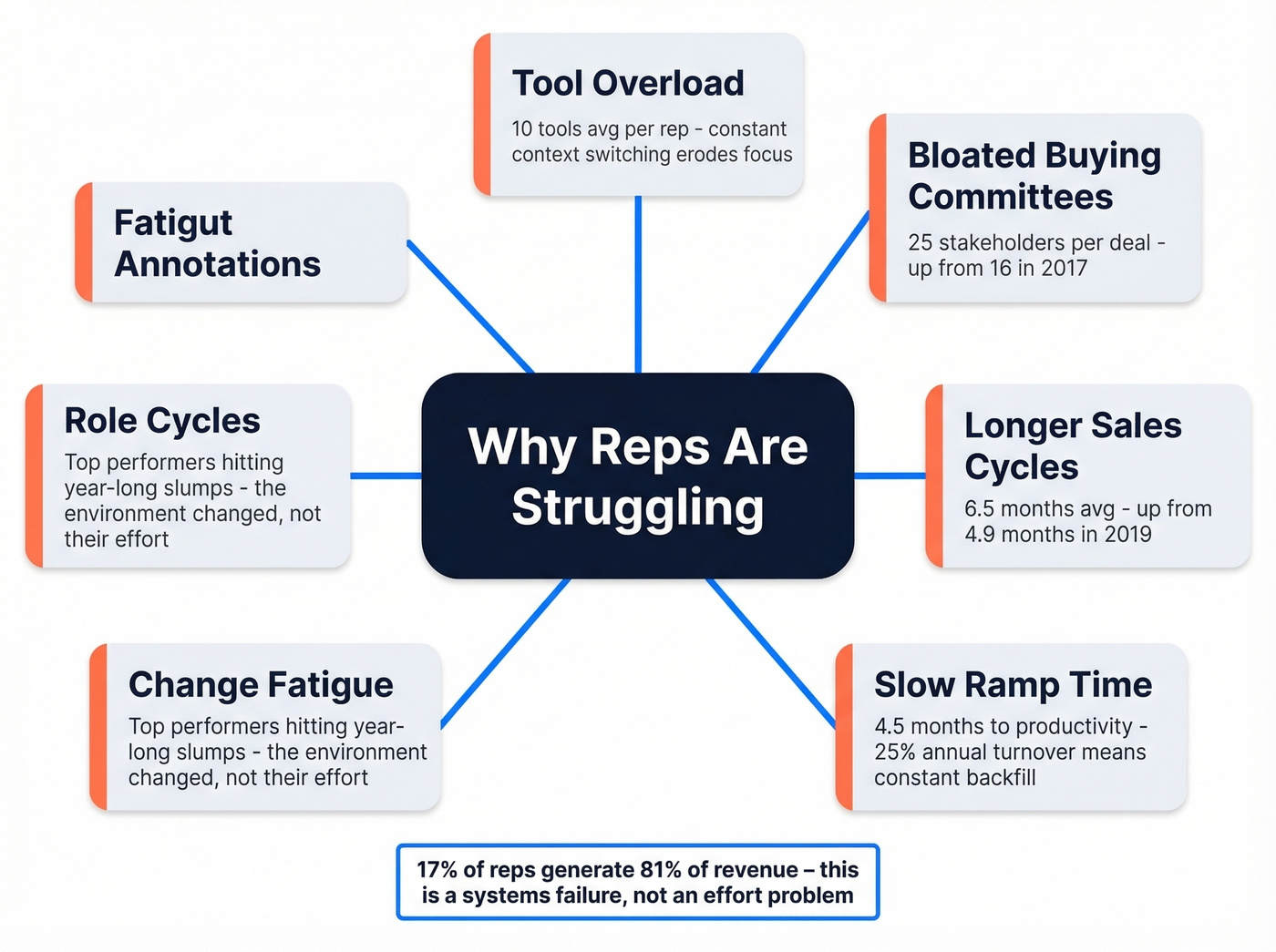
- Tool overload. Ten tools average per rep. Each one adds context-switching cost that erodes focus.
- Bloated buying committees. From 16 stakeholders to 25. Every deal now requires team selling and multi-threaded engagement most reps weren't trained for.
- Longer cycles. 4.9 months in 2019 has become 6.5 months in 2026. Deals stall, pipeline rots.
- Slow ramp. New reps take 4.5 months to hit productivity. With 25% annual turnover, you're constantly backfilling.
- Change fatigue. On r/sales, former top performers describe year-long quota slumps despite maintaining activity discipline - the environment changed, not their effort.
Here's the thing: if 17% of your reps generate 81% of revenue, the problem isn't individual effort. It's the system those reps operate inside. Adding more tools is the opposite of a productivity strategy. Skip the shiny new platform and start by subtracting complexity.

Snyk's 50 AEs were losing 4-6 hours per week to bad contact data. After switching to Prospeo, bounce rates dropped from 35-40% to under 5% and AE-sourced pipeline jumped 180%. No new tools. No new headcount. Just 98% verified emails at $0.01 each.
Stop bleeding rep hours to bounced emails. Start with 75 free verified contacts.
Seven Fixes That Actually Work
1. Consolidate Your Tech Stack
Ninety-four percent of sales orgs plan to consolidate their tools. A Forrester TEI study modeled $1.3M in cost savings from consolidation alone, plus a 40% increase in selling activity without adding headcount. We've watched teams that consolidate fastest see results within one quarter - sometimes sooner. Ten tools is indefensible. Audit what reps actually touch daily and kill everything else.
If you're evaluating what stays vs. goes, start with your SDR tools and engagement layer first.
2. Fix Your Data First
This is the invisible productivity killer. Snyk had 50 AEs prospecting 4-6 hours per week with bounce rates running 35-40%. After switching to Prospeo for verified contact data, bounces dropped under 5% and AE-sourced pipeline jumped 180%. No new tools. No new headcount. Just clean data.
Before you invest in AI coaching or a new engagement platform, audit your data. If your contacts bounce, nothing downstream works. Clean data is the single fastest way to increase rep output without changing anything else in the workflow.
If you're not sure where to start, use a simple email bounce rate audit and then move into data enrichment services.
3. Coach, Don't Just Measure
Only 26% of reps get weekly 1:1 coaching. That's a failure.
The most common manager anti-pattern we see is prioritizing activity metrics over outcomes. Your reps don't need more KPI screenshots - they need someone who watches their calls and tells them what to fix. A manager who reviews five calls per week and gives specific feedback will outperform a dashboard with 40 widgets every single time.
If you want a systems-first approach here, build it into your sales leadership cadence.
4. Use AI Strategically
Look - AI efforts stall when teams try to automate fragmented, broken workflows instead of fixing the system first. Automating a bad process faster just produces bad outcomes faster.
That said, Bain points to 30%+ improvement in win rates in early AI successes, and 45% of teams already run a hybrid AI-SDR model. The key is starting with one high-impact use case - lead qualification or call summarization - and expanding only after it proves out. Don't try to "AI everything" in Q1.
If you're building this out, anchor it to generative AI sales tools that plug into your existing workflow.
5. Kill Slow Follow-Up
Deals closed within 50 days hit a 47% win rate. After that threshold, win rates crater to around 20%. Implement a sales SLA: no same-day follow-up, the deal gets reassigned. Harsh? The data doesn't care about feelings.
If you need something reps will actually use, steal from these sales follow-up templates.
6. Build a Real Onboarding Playbook
GreyScout cut ramp time from 8-10 weeks to 4 weeks by ensuring new reps started with verified contacts instead of stale lists. We've seen this pattern repeatedly - pair new hires with veterans for the first 30 days, give them clean data and a working sequence, and have a manager review their first 20 calls. Ramp time is a systems output, not an individual one.
If you're scaling your team, onboarding speed is the first bottleneck to remove.
A lightweight way to standardize ramp is a 30-60-90 day plan for sales reps.
7. Align Sales and Marketing
A Forbes/Brainshark study found that 72% of companies exceeding plan by 25%+ had a dedicated enablement role - and the gap has only widened since. If your marketing team produces content that sales never uses, you don't have a content problem. You have an alignment problem.
True revenue team productivity requires both sides working from the same pipeline data and shared definitions of a qualified lead. Fix the handoff before you produce another case study nobody reads.
If you’re formalizing this, start with marketing enablement.
The Three-Layer Stack
Your team needs fewer tools, cleaner data, and a manager who coaches. That's it. Here's what the stack should look like:
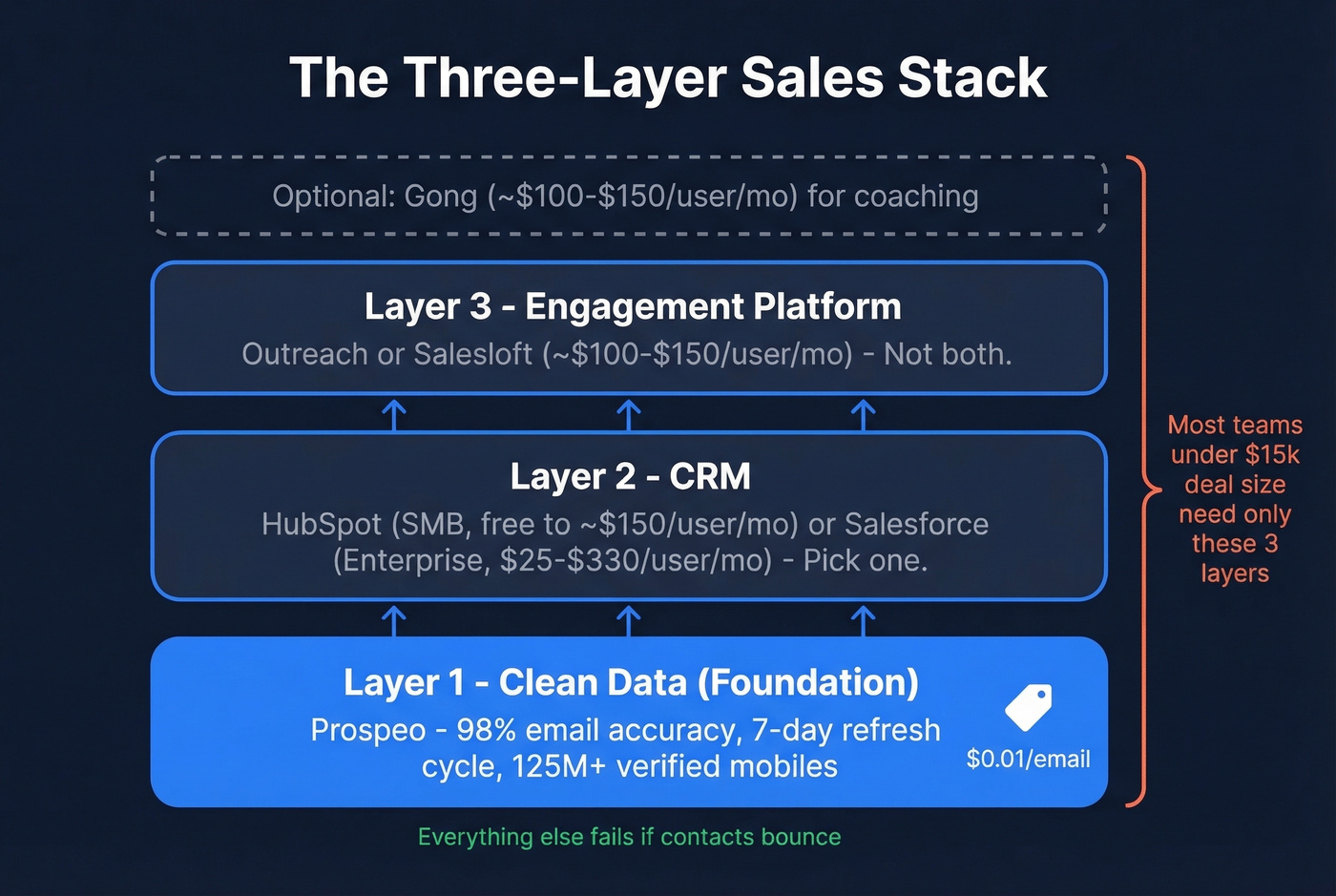
Layer 1 - Clean data. Prospeo gives you 98% email accuracy, a 7-day data refresh cycle, and 125M+ verified mobile numbers. Free tier starts at 75 verified emails/month, paid plans run roughly $0.01/email with no contracts. This is the foundation - everything else fails if your contacts bounce.
Layer 2 - CRM. HubSpot for SMB (free to ~$150/user/month) or Salesforce for enterprise ($25-$330/user/month). Pick one. (If you need examples to compare quickly, see examples of a CRM.)
Layer 3 - One engagement platform. Outreach or Salesloft at roughly $100-$150/user/month. Not both.
Optional: Gong at roughly $100-$150/user/month if you're serious about coaching. Everything else is optional until these three layers work.
Let's be honest: most teams with deal sizes under $15k don't need more than these three layers. I've watched orgs spend $200k+ on sales tech while ignoring data quality, then wonder why pipeline is flat.
Metrics That Track Real Performance
| Metric | What It Tells You |
|---|---|
| Revenue per rep | Overall productivity |
| Quota attainment % | Team health vs. targets |
| Selling time % | How much time goes to actual selling |
| Win rate | Conversion effectiveness |
| Avg sales cycle | Deal velocity trend |
| Pipeline velocity | Opps x win rate x deal size / cycle length |
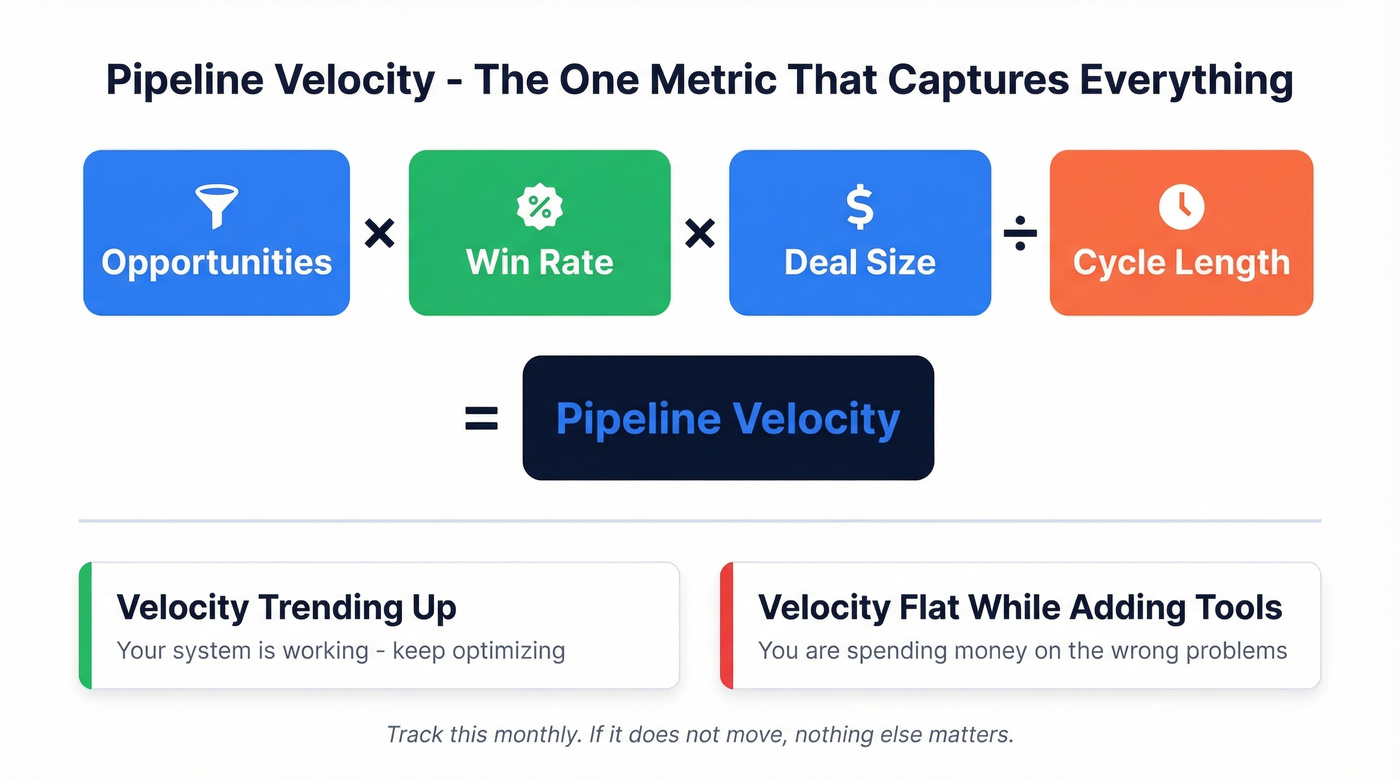
Pipeline velocity is the one metric that captures everything. If it's trending up, your system is working. If it's flat while you're adding tools, you're spending money on the wrong problems.
To go deeper, track pipeline health alongside velocity so you can see why it’s moving.
The three-layer stack starts with data quality. Prospeo refreshes 300M+ profiles every 7 days - 6x faster than the industry average. 125M+ verified mobiles with a 30% pickup rate. Your reps actually connect with buyers instead of voicemails and dead emails.
Consolidate your stack where it matters most - start with the data layer.
FAQ
What percentage of their week do sales reps actually spend selling?
About 28%, according to Salesforce's State of Sales research. The rest goes to CRM updates (18%), internal meetings, and switching between an average of ten different tools. Cutting just two redundant tools can reclaim 3-5 hours per rep per week.
What's a good quota attainment rate?
Industry average sits at roughly 43-45% in 2026. If your team is above 60%, you're significantly outperforming most B2B organizations. Below 35% signals a systemic issue - usually bad targeting or stale data - not an effort gap.
How do you improve sales team productivity during a downturn?
Tighten your ICP, clean your contact data so reps stop wasting hours on dead leads, and shift coaching toward deal progression rather than raw activity volume. Teams that protect pipeline quality over quantity come out of downturns faster - adding more dials to bad numbers only accelerates burnout.
How does data quality affect rep efficiency?
If 30-40% of your emails bounce, reps waste hours on dead contacts daily. Snyk saw AE-sourced pipeline jump 180% after fixing bounce rates alone - no new tools, no new headcount. Cleaning your data is the highest-ROI move most teams haven't made yet.
How can complex-sale industries shorten ramp time?
When buying committees run 25+ stakeholders deep, reps need verified contacts for every decision-maker - not just the initial champion. GreyScout cut ramp from 8-10 weeks to 4 weeks by pairing new hires with clean, verified data and a structured onboarding playbook from day one.