

Sales Theory: The Complete Guide for 2026
64% of sellers missed their most recent quota last year. Not because they lacked hustle - most reps work plenty hard. They missed because they're running discovery calls, demos, and negotiations without a structured theory for why buyers actually say yes. That gap is expensive: organizations with a formal enablement strategy achieve 49% higher win rates on forecasted deals. Theory isn't academic fluff. It's the difference between winging it and winning consistently.
What You Need (Quick Version)
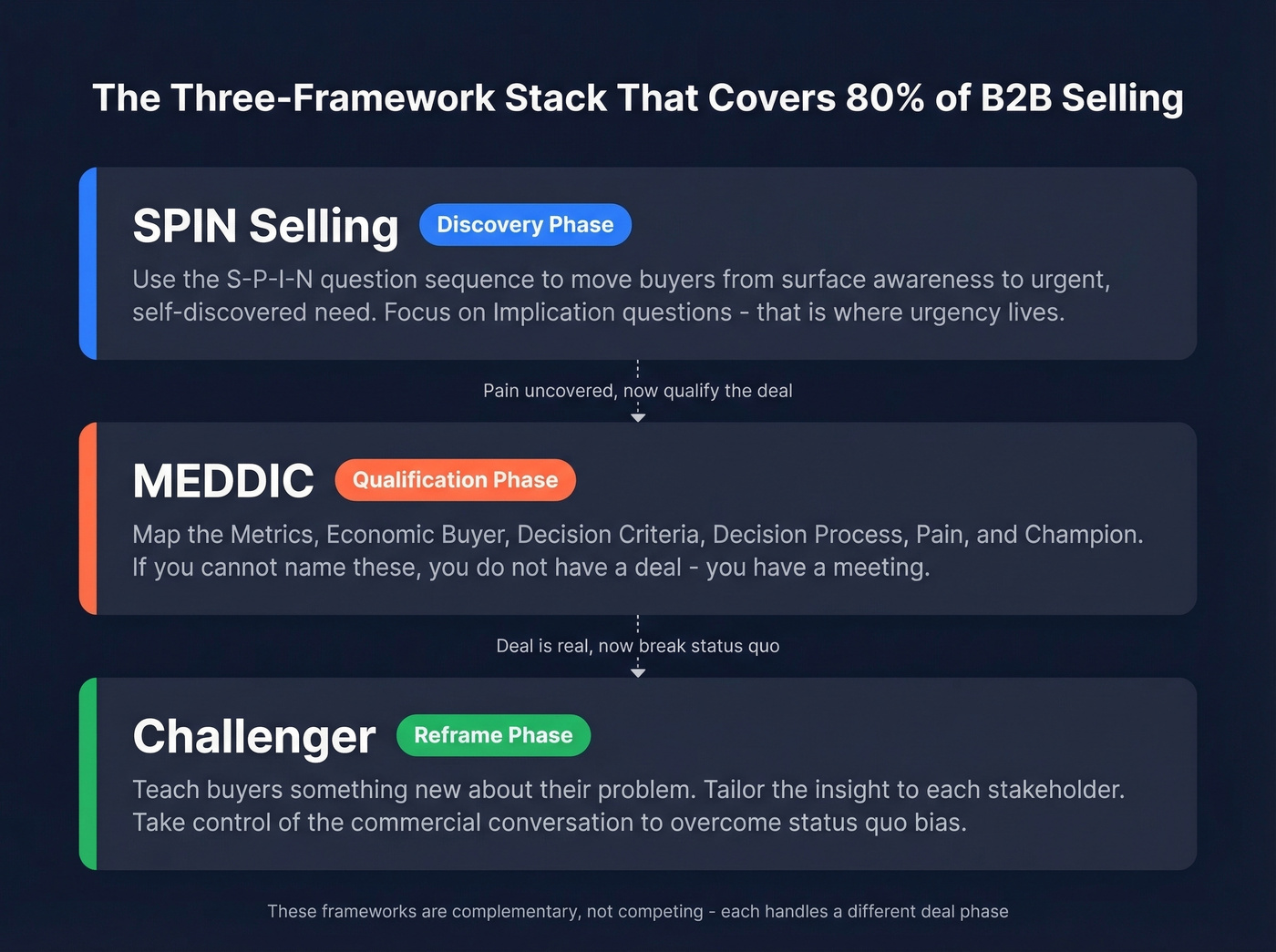
If you're building a methodology from scratch, start with SPIN for discovery, MEDDIC for qualification, and Challenger's reframe sequence for overcoming status quo bias. That covers 80% of what you need. Everything else is refinement - and none of it works without accurate prospect data feeding the right conversations to the right people.
What Sales Theory Actually Is
The most common definition treats it as a set of personality traits that make someone good at selling. That's wrong. Personality helps, but it's not theory - it's temperament.
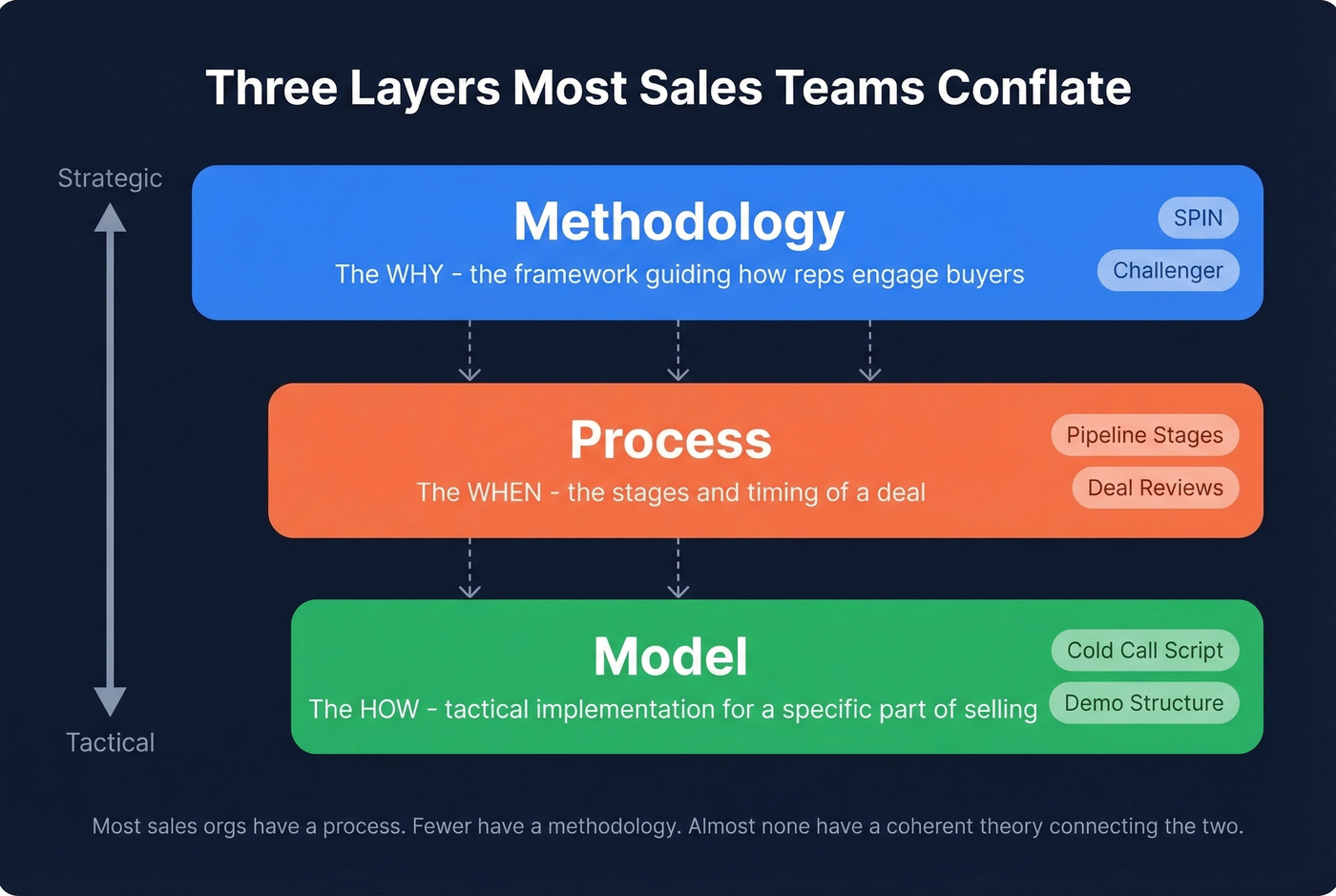
Sales theory is the body of research and frameworks explaining why buyers buy and how sellers can systematically influence that decision. It's a scientific approach - replacing gut instinct with repeatable, evidence-backed methods. It sits above tactics. HubSpot draws a useful distinction between three layers most people conflate: a methodology is the framework guiding how reps engage buyers (SPIN, Challenger), a process is the when - the stages and timing of a deal, and a model is the tactical implementation for a specific part of selling, like a cold call script or demo structure.
Most sales orgs have a process. Fewer have a methodology. Almost none have a coherent theory connecting the two. That gap matters because 50-90% of the B2B buying journey is completed before a buyer ever talks to a rep, and 61% of sellers say admin tasks and inefficient processes slow them down. By the time you get the meeting, the buyer already has a mental model of their problem and possible solutions. Your theoretical grounding determines whether you reinforce their existing frame or reshape it.
A 60-Year Timeline
Modern selling frameworks didn't start with a book. They started with Xerox.
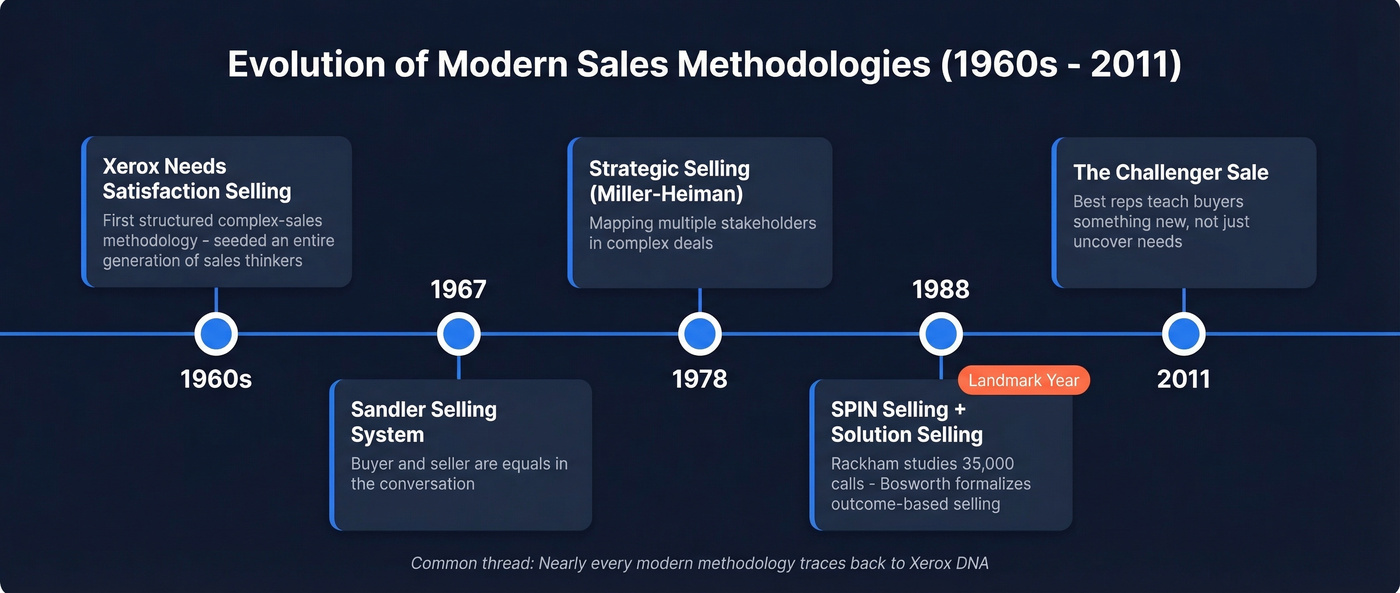
- 1960s - Xerox invests heavily in "Needs Satisfaction Selling," later packaged as Professional Selling Skills. This is the first structured complex-sales methodology, seeding an entire generation of sales thinkers.
- 1967 - David Sandler creates the Sandler Selling System, built on the idea that buyer and seller are equals in the conversation.
- 1978 - Robert Miller and Stephen Heiman publish Strategic Selling, introducing the concept of mapping multiple stakeholders in complex deals.
- 1988 - Two landmark frameworks arrive in the same year. Neil Rackham publishes SPIN Selling, backed by 35,000 sales calls. Mike Bosworth formalizes Solution Selling at SPI.
- 2011 - Matthew Dixon and Brent Adamson publish The Challenger Sale, arguing that the best reps teach buyers something new rather than simply uncovering needs.
Here's the thread connecting all of it: multiple founders - Bosworth, Rackham, Sappington - had Xerox connections. The DNA of that 1960s Needs Satisfaction approach runs through nearly every modern methodology. Each generation refined the model, but the core question stayed the same: how do you move a buyer from status quo to action?
These older techniques need adapting for modern selling environments where buyers arrive pre-educated and buying committees are larger. The frameworks endure, but the application has to evolve.
The Major Sales Frameworks
SPIN Selling
Neil Rackham's team studied 35,000+ sales calls across 20+ countries over 12 years. The result is one of the most rigorously researched frameworks ever published - and one of the earliest examples of sales science applied to real-world selling. SPIN stands for Situation, Problem, Implication, Need-payoff: a questioning sequence designed to move buyers from surface-level awareness to urgent, self-discovered need.
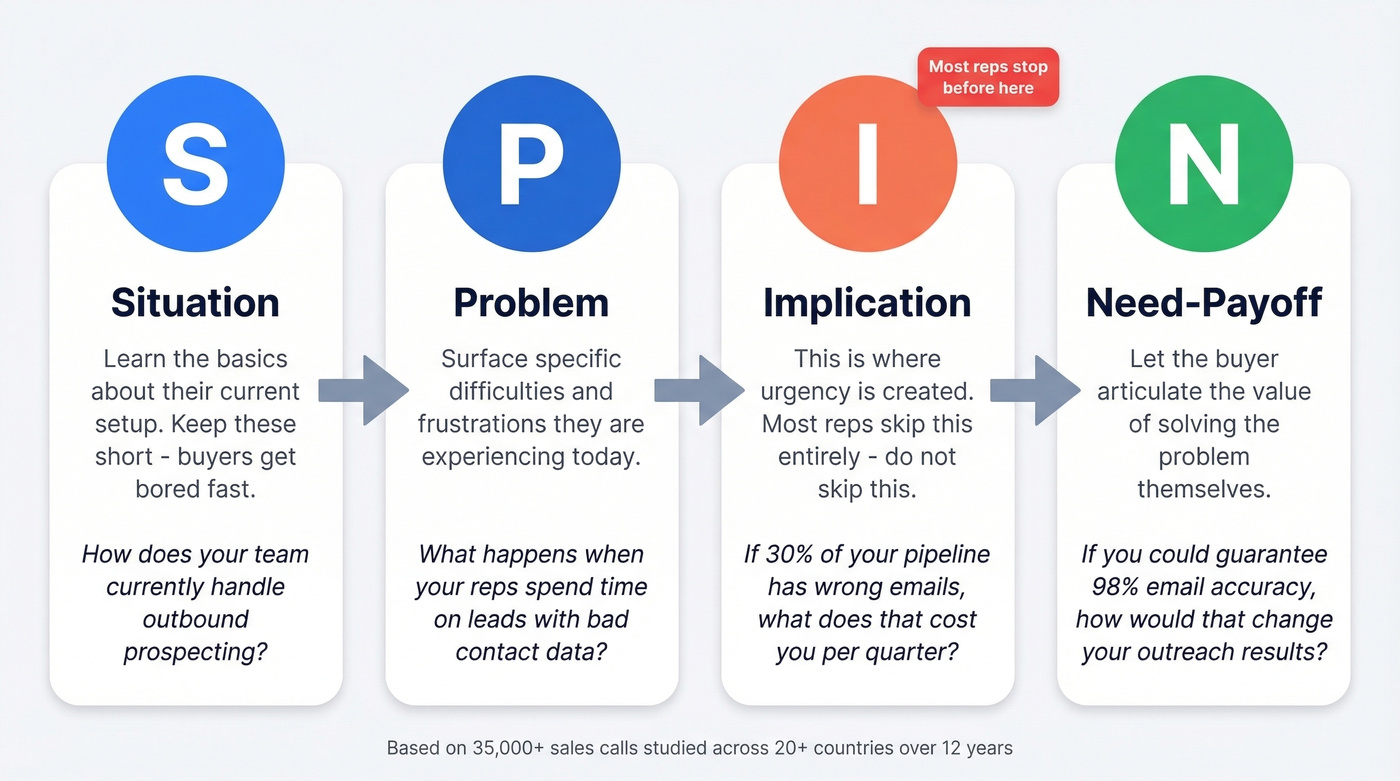
Rackham's research found that a strong questioning strategy increases closure rates by roughly 20%. But here's where theory meets reality: most reps overuse Situation questions and skip Implication questions entirely. You've been on that discovery call - three questions about the prospect's tech stack, two about team size, and the prospect is checking email because you haven't said anything they don't already know.
On r/sales, SPIN is consistently praised as one of the most practical frameworks available. The critique isn't that SPIN is outdated. It's that reps read the book, ask better Situation questions, and never graduate to the Implication questions that actually create urgency.
Use this if you're building discovery skills from scratch or selling mid-market deals where the buyer doesn't yet feel the pain acutely enough to act. (If you want a tighter question bank, start with these discovery questions.)
Skip this if you need a qualification framework. SPIN tells you how to ask, not whether the deal is real.
The Challenger Sale
Dixon and Adamson's CEB research studied 6,000+ reps and found that the highest performers weren't relationship builders - they were "challengers" who teach buyers something new, tailor the message to stakeholder priorities, and take control of the commercial conversation.
The results can be dramatic. Xerox reported a 17% increase in sales and $65M in contract value after implementing Challenger. But we've seen the other side too: a VP of Sales announces Challenger adoption at the annual kickoff, sends everyone through a two-day workshop, and six months later nothing has changed. Practitioners flag Challenger as hard to implement because it requires organizational alignment on your value proposition, your commercial insights, and your "why change" narrative. Without that infrastructure, individual reps can't execute the teach-tailor-take control mechanic.
Let's be honest: Challenger is the best framework for mid-market-and-up deals where the buyer thinks they don't need to change. It's also the most over-adopted framework in B2B - half the companies that "implement" it just send reps to a workshop and call it done. If your leadership won't invest in building the commercial teaching content and coaching infrastructure, pick SPIN and save yourself the frustration. (For a practical way to operationalize this in enterprise, see enterprise B2B sales.)
MEDDIC / MEDDPICC
MEDDIC is the qualification framework that separates pipeline from wish lists. Metrics, Economic Buyer, Decision Criteria, Decision Process, Identify Pain, Champion - and in the expanded MEDDPICC version, Paper Process and Competition.
The consensus on r/sales is that MEDDIC/MEDDICC is one of the best methods for exposing what's actually missing in a deal. If you can't name the champion, the economic buyer, and the decision criteria, you don't have a pipeline - you have a list of people who took your meeting. MEDDIC forces that honesty early, before you've invested three months in a deal that was never going to close. (If you want to implement it cleanly, use these MEDDIC discovery questions.)
Skip this for short-cycle deals with one decision-maker. For enterprise qualification with multiple stakeholders and long cycles, it's the standard. (This is also where MEDDIC sales qualification helps teams stay consistent.)
Sandler Selling System
David Sandler built this in 1967 on a radical premise for the era: the buyer and seller are equals. The Sandler Selling System submarine metaphor - moving through compartments sequentially, never going backward - gives reps a structured way to qualify and advance without reverting to pitch mode. It's particularly strong for reps who struggle with being too accommodating or too aggressive.
Solution Selling
Mike Bosworth formalized this at SPI in 1988, drawing on his Xerox background. The mechanic is straightforward: diagnose pain, create a vision of a better future, then map your capabilities to that vision. You're selling outcomes, not features. Solution Selling was revolutionary in the late '80s and still underpins how most consultative sellers think, even if they've never read the book. It's been largely absorbed into newer frameworks like Challenger and Gap Selling.
Other Frameworks Worth Knowing
AIDA - Attention, Interest, Desire, Action - is the classical model most marketers learn first. It's useful for structuring outbound sequences and landing pages, but it assumes a linear buyer journey that rarely holds in complex B2B deals with multiple stakeholders entering at different stages. (If you want the modern version, see the AIDA sales funnel.) BANT is IBM's lead qualification shorthand. Fine for inbound triage, fundamentally seller-centric, and a relic for enterprise sales. NEAT Selling modernizes BANT by emphasizing buyer psychology and earning the right to ask qualifying questions. Gap Selling focuses on the distance between a buyer's current state and desired future state - the bigger the gap, the more urgency. SNAP Selling targets overwhelmed buyers with a keep-it-Simple, be iNvaluable, always Align, raise Priorities approach. Conceptual Selling from Miller-Heiman treats every interaction as a chance to understand the buyer's concept of what they're trying to achieve, not just their stated requirements.

SPIN, Challenger, and MEDDIC all assume one thing: you're talking to the right person. 50-90% of the buying journey happens before you get the meeting - so when you finally do, bad contact data kills the deal before your framework kicks in. Prospeo's 300M+ profiles with 98% email accuracy and 30+ filters (buyer intent, job changes, technographics) ensure your methodology lands on real decision-makers, not dead inboxes.
Stop perfecting your discovery questions for prospects you can't reach.
How to Choose the Right Framework
The framework that works depends on what you're selling, to whom, and how long the deal takes.
| Framework | Best For | Deal Size | Cycle Length | Research Basis | Key Mechanic |
|---|---|---|---|---|---|
| MEDDIC | Enterprise qualification | >$100K | 6-18 months | Practitioner-proven | Stakeholder mapping |
| SPIN | Consultative discovery | $25K-$100K | 3-6 months | 35K calls, 12 years | Question sequence |
| Challenger | Reframing status quo | $25K-$100K+ | 3-12 months | 6K reps (CEB) | Teach-tailor-control |
| Sandler | Equal-footing selling | $10K-$100K | 1-6 months | Decades of practice | Submarine sequence |
| BANT | Inbound triage | <$25K | <3 months | IBM standard | Quick qualification |
You don't need to pick just one. The three-framework stack we recommend - SPIN for discovery, MEDDIC for qualification, Challenger's reframe for overcoming inertia - covers the vast majority of B2B selling scenarios. Each handles a different phase of the deal. They're complementary, not competing. (If you're building the top of funnel too, pair this with proven sales prospecting techniques.)
The Psychology Behind Buyer Decisions
Every framework above is built on psychological principles, whether the authors name them or not. Understanding the cognitive biases, emotional triggers, and decision patterns that drive buyer behavior makes you better at adapting any methodology to novel situations - and it's what separates reps who can only follow a script from reps who can read a room.
Cialdini's 7 Principles
Robert Cialdini's influence framework gives you seven levers. Most sales content only lists six - the seventh, Unity, came from his 2016 book Pre-Suasion and is arguably the most powerful for B2B.
Reciprocity means giving value before asking for anything, like sharing a relevant benchmark before requesting a meeting. Commitment and consistency builds small yeses toward larger ones - a 15-minute discovery call before a full demo. Social proof references similar companies who've solved the same problem. Authority leads with credentials, case studies, and data rather than your title. Liking acknowledges that people buy from people they genuinely connect with; mirroring and shared context matter. Scarcity works when it's real, like limited implementation slots this quarter, but fake scarcity destroys trust fast. Unity creates shared identity - "we're both operators trying to solve this" - a bond that transcends the buyer-seller dynamic.
Why "No Decision" Kills More Deals Than Competitors Do
Behavioral economics explains the single biggest deal-killer in B2B: the status quo. Decision science tells us that buyers don't evaluate options rationally - they filter every choice through cognitive biases that heavily favor inaction. Loss aversion, a core finding of Kahneman and Tversky's Prospect Theory, means losses are felt roughly 2x as strongly as equivalent gains. For a buyer, the risk of switching and failing outweighs the benefit of improving and succeeding, even when the math clearly favors change.
Anchoring matters here: the first number or frame in a negotiation biases everything that follows. Anchor on the cost of inaction, not your price. (If you want to go deeper, use this guide on anchor in negotiation.) Status quo bias compounds loss aversion - buyers default to "do nothing" because it feels safer, even when it's objectively worse. The decoy effect works in pricing too: a strategically placed third option makes the target tier feel like the obvious choice, which is why three-tier pricing pages convert better than two-tier ones. Confirmation bias means buyers actively seek information that validates their existing beliefs - if they've already decided the status quo is fine, they'll filter your pitch through that lens.
Gartner/CEB research shows personal value can be twice as important as business value in B2B decisions. The buyer's career risk matters more than the ROI spreadsheet. This connects to Maslow's hierarchy: enterprise buyers operate at the esteem and self-actualization level, where career advancement and recognition drive decisions more than basic needs.
Challenger's 5-step reframe sequence is the best practical application of these principles: Warm and Reframe, Rational Drowning, Emotional Impact, New Way, Your Solution. The pivotal question in any stalled deal: "What happens if nothing changes in the next six months?"
"Do nothing" wins by default. Great sellers make "do nothing" look dangerous.
Common Mistakes When Applying Frameworks
Knowing the frameworks isn't enough. Here's where teams go wrong.
Overusing scarcity and urgency in B2B SaaS. "Only a few spots left" works for a webinar signup. In a six-figure enterprise deal, it reads as gimmicky and damages trust. One team we tracked increased their win rate by 20% over two quarters simply by replacing urgency-based CTAs with data-backed proposals and tailored value maps.
Pitching before diagnosing. SPIN exists because this problem is universal. If you're presenting your solution before you've uncovered the buyer's Implication-level pain, you're guessing - and the buyer knows it.
Talking more than listening. NetSuite's research on common sales failures puts this at the top. The best discovery calls have the rep listening more than they talk. Way more.
Ignoring the decision-making unit. You've built rapport with your champion, but you've never spoken to the economic buyer or mapped the decision criteria. MEDDIC catches this. Most reps don't use MEDDIC.
Using frameworks without the data to support them. MEDDIC requires identifying the economic buyer - which is useless if your email bounces. SPIN questions only work if you're talking to someone with actual authority. If your bounce rate is above 5%, your methodology isn't the problem. Your data is. (Start by fixing your email bounce rate.)
Building a Repeatable Sales Engine
The science behind successful selling isn't a single framework - it's the disciplined combination of research-backed methodology, behavioral psychology, and clean data. Here's how we've seen teams turn theory into a repeatable engine:
Measure what matters. Track framework adherence - are reps asking Implication questions? - alongside lagging indicators like quota attainment. You can't improve what you don't observe.
Coach to the methodology, not just the number. Managers who review call recordings for SPIN question quality or Challenger reframe execution build teams that compound skill over time. A two-day workshop isn't coaching. Weekly deal reviews with framework-specific feedback is. (If you're formalizing this, use a 30-60-90 day plan for sales reps.)
Feed the system with accurate data. Every methodology assumes you're reaching the right person. Verified contact data is the foundation layer - without it, even the best-trained reps are shouting into a void. Prospeo's 98% email accuracy and 7-day data refresh cycle means your carefully crafted SPIN sequence actually reaches the person who can say yes, not a dead inbox. (If you're evaluating vendors, compare data enrichment services.)
From Theory to Execution
Every methodology in this article assumes one thing: you're reaching the right person with accurate contact information. That assumption breaks constantly.
MEDDIC says identify the economic buyer. SPIN says ask Implication questions to someone with authority. Challenger says teach the buyer something new. None of that matters if your email bounces or your phone number connects to someone who left the company eight months ago. Meritt, an outbound agency, saw their pipeline triple from $100K to $300K per week after switching to Prospeo - their bounce rate dropped from 35% to under 4%. The methodology didn't change. The data did.
Sales theory gives you the playbook. Accurate data gives you the field to run it on.
MEDDIC says identify the Economic Buyer and Champion. Challenger says tailor your insight to each stakeholder. Neither works if your data is stale. Prospeo refreshes every 7 days - not the 6-week industry average - so you're mapping buying committees with current titles, verified emails, and direct dials. At $0.01 per email, your qualification framework finally has the fuel it needs.
Great sales theory deserves data that keeps up with your deals.
FAQ
What's the best sales theory for beginners?
SPIN Selling is the strongest starting point. It's backed by 35,000 calls across 20+ countries and teaches the discovery skill that underpins every other framework. Master the questioning sequence first, then layer on MEDDIC for qualification and Challenger for reframing as you advance into larger deals.
Is SPIN Selling still relevant in 2026?
Yes - practitioners on r/sales consistently rank it among the most practical frameworks available. The questioning sequence works across Zoom, phone, and email. Buyer psychology hasn't changed since 1988, and structured discovery still outperforms unstructured conversations by roughly 20% in close rates.
How do I implement a methodology without it falling apart?
Three things matter more than which framework you pick: ongoing manager coaching beyond a two-day workshop, accurate prospect data so frameworks reach the right people, and measuring framework adherence alongside outcomes. Most implementations fail because companies treat adoption as a training event rather than an ongoing discipline.
What's the difference between a sales methodology and a sales process?
A methodology is the structured how - the repeatable approach reps follow to engage buyers. A process is the when - the stages and timing from prospecting through close. Theory sits above both, explaining the psychological and behavioral principles that make methodologies work. Most teams have a process but lack a methodology, which is why deals stall in the middle of the funnel.
Does a research-backed approach actually improve results?
The data is clear. Rackham's SPIN research showed a roughly 20% lift in close rates from structured questioning alone. Xerox saw $65M in new contract value after implementing Challenger. Teams that ground their selling in evidence-based frameworks consistently outperform teams relying on intuition and personality - and the gap widens as deal complexity increases.