

Sales Titles Hierarchy: Every Role From SDR to CRO
About 13% of all full-time U.S. jobs are in sales. That's millions of people navigating a hierarchy where the titles sound similar, the pay varies wildly, and nobody agrees on what "BDR" actually means. Most guides give you a glossary - a list of acronyms with one-sentence definitions. No salaries, no org charts, no career-path guidance.
This one's different.
The Quick Version
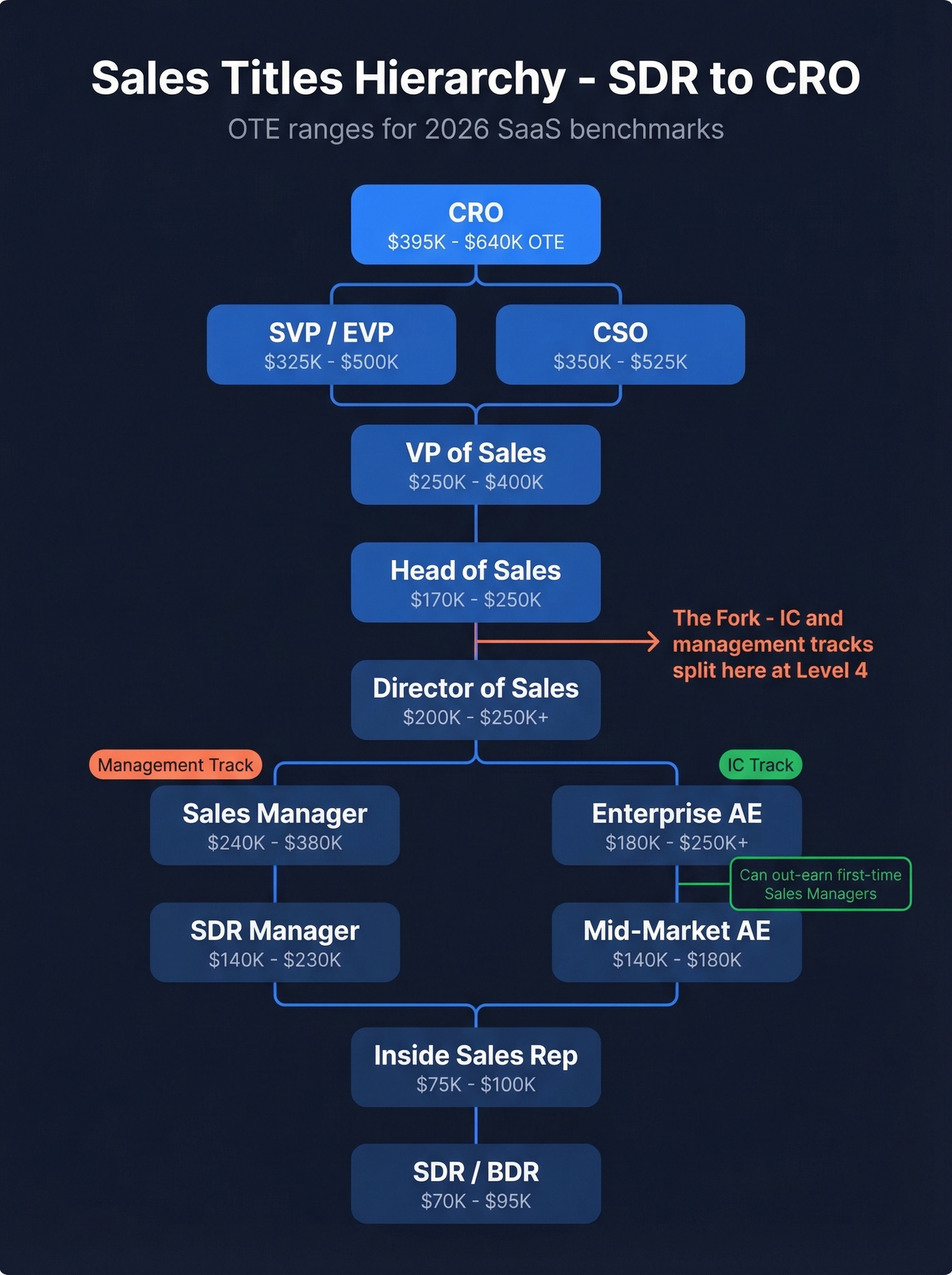
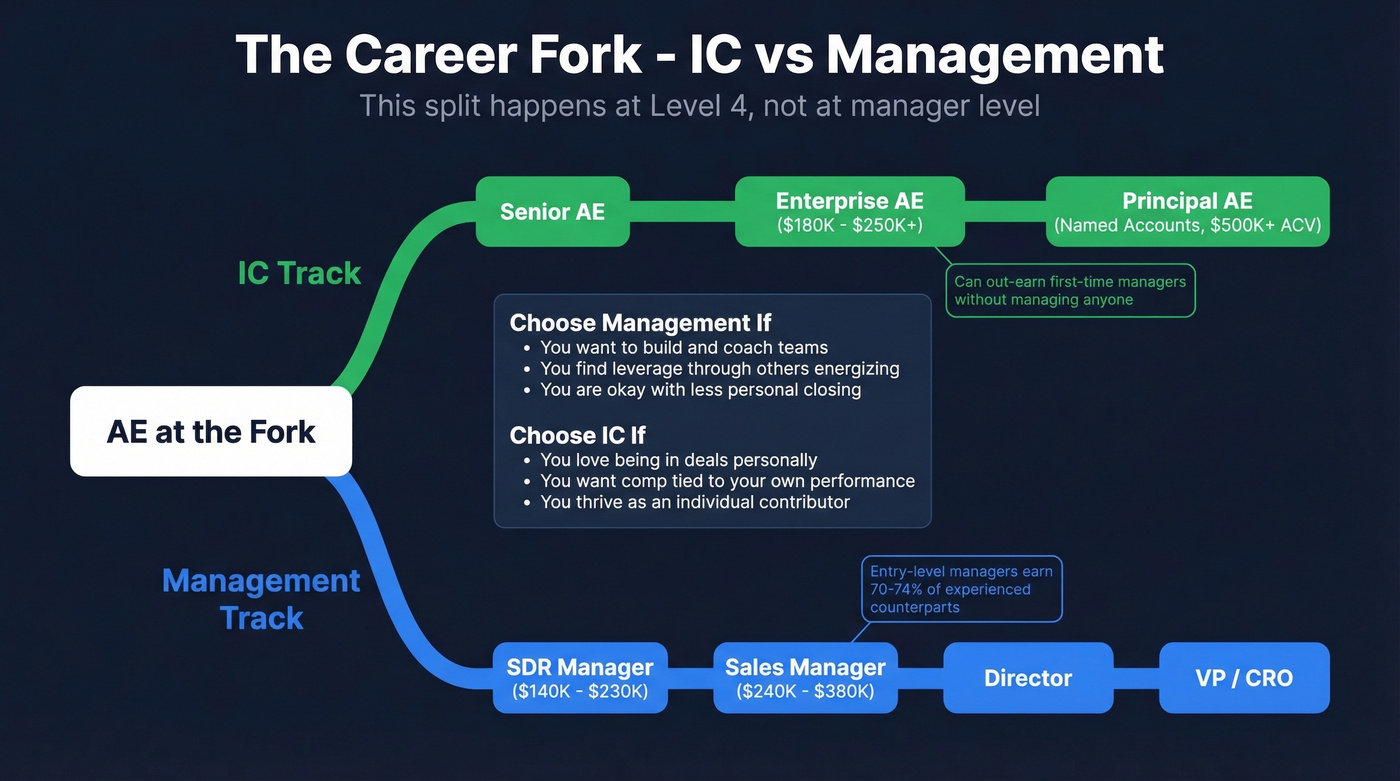
The standard sales ladder runs: SDR/BDR → AE → Sales Manager → Director → VP → CRO. OTE spans from ~$70K at entry to $640K at the CRO level. Two things most people get wrong: first, the IC track and management track fork at the AE level, not at manager. Second, an Enterprise AE at $180K-$250K+ can out-earn a first-time Sales Manager. Don't chase a management title for status - chase it because you want to build teams.
The Full Sales Job Titles Hierarchy
Every role in one reference table. The IC-to-management fork happens at Level 4.
| Level | Title | Track | Typical OTE |
|---|---|---|---|
| 1 | SDR / BDR | IC | $70K-$95K |
| 2 | Inside Sales Rep | IC | $75K-$100K |
| 3 | Mid-Market AE | IC | $140K-$180K |
| 4 | Enterprise AE | IC | $180K-$250K+ |
| 4 | SDR Manager | Mgmt | $140K-$230K |
| 5 | Sales Manager | Mgmt | $240K-$300K (0-2 yrs) / $270K-$380K (3-5 yrs) |
| 5 | Regional Sales Mgr | Mgmt | $120K-$170K |
| 6 | Director of Sales | Mgmt | $200K-$250K+ |
| 7 | Head of Sales | Exec | $170K-$250K |
| 8 | VP of Sales | Exec | $250K-$400K |
| 9 | SVP / EVP | Exec | $325K-$500K |
| 9 | CSO | Exec | $350K-$525K |
| 10 | CRO | Exec | $395K-$640K |
Notice the wide OTE bands at the management level. A Sales Manager with 3-5 years of experience can earn $270K-$380K - nearly double the entry-level range. Experience and company stage matter more than the title itself.
Sub-Levels Within Each Tier
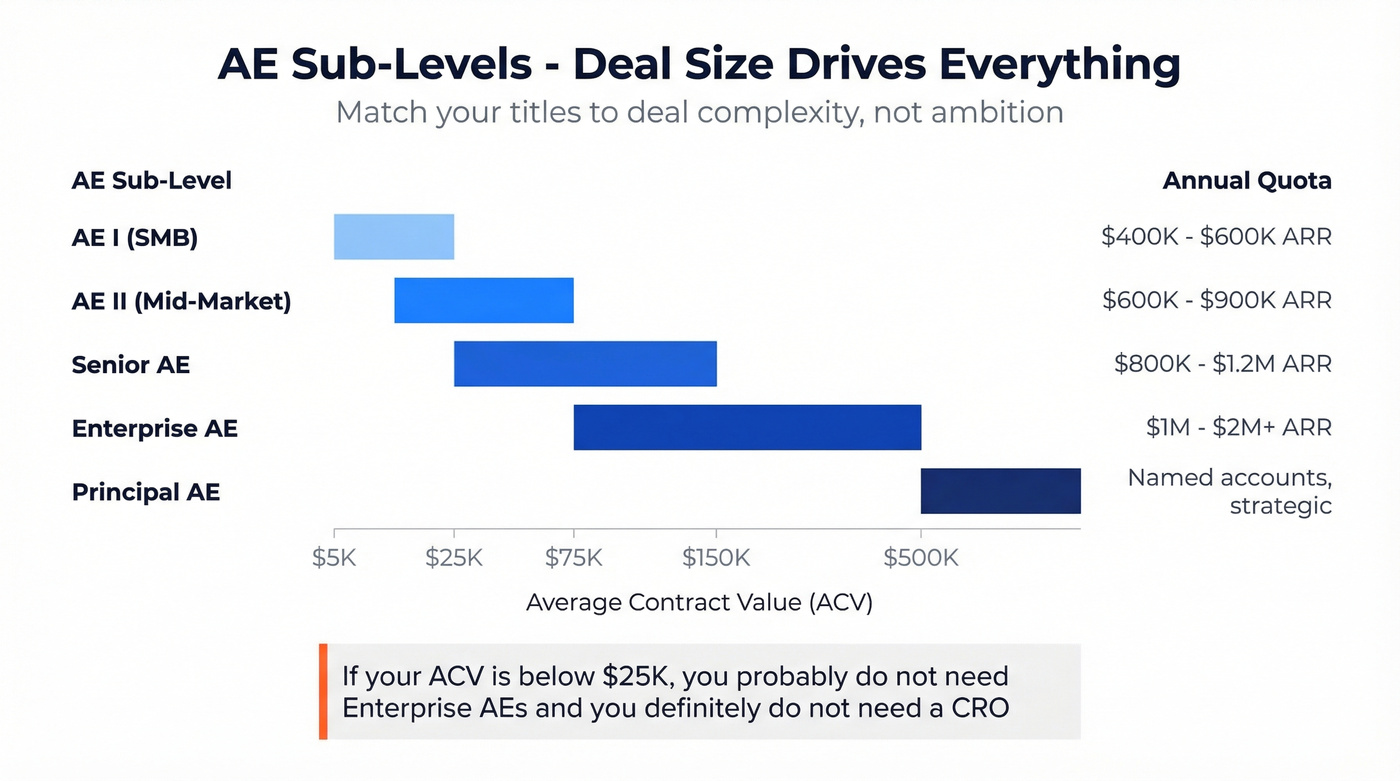
The table above shows the broad titles, but most mature SaaS orgs run sub-levels within them. This granularity actually determines your comp and quota.
| Sub-Level | Typical Deal Size | Quota Range |
|---|---|---|
| SDR I | Any (ramp period) | 8-12 meetings/mo |
| SDR II | Any (full quota) | 15-20 meetings/mo |
| AE I (SMB) | $5K-$25K ACV | $400K-$600K ARR |
| AE II (Mid-Market) | $25K-$75K ACV | $600K-$900K ARR |
| Senior AE | $50K-$150K ACV | $800K-$1.2M ARR |
| Enterprise AE | $100K-$500K+ ACV | $1M-$2M+ ARR |
| Principal AE | $500K+ ACV | Named accounts, strategic |
If your average contract value sits below $25K, you probably don't need Enterprise AEs - and you definitely don't need a CRO. Match your titles to your deal complexity, not your ambition.
Entry-Level Roles
SDR vs BDR - The Real Difference
In theory, SDRs handle inbound lead qualification - converting MQLs to SQLs, running discovery calls, booking meetings - while BDRs focus on outbound prospecting through cold outreach, research, and ABM support. In practice, only ~25% of companies maintain a strict split. Some flip the definitions entirely. Focus on the job description, not the letters.
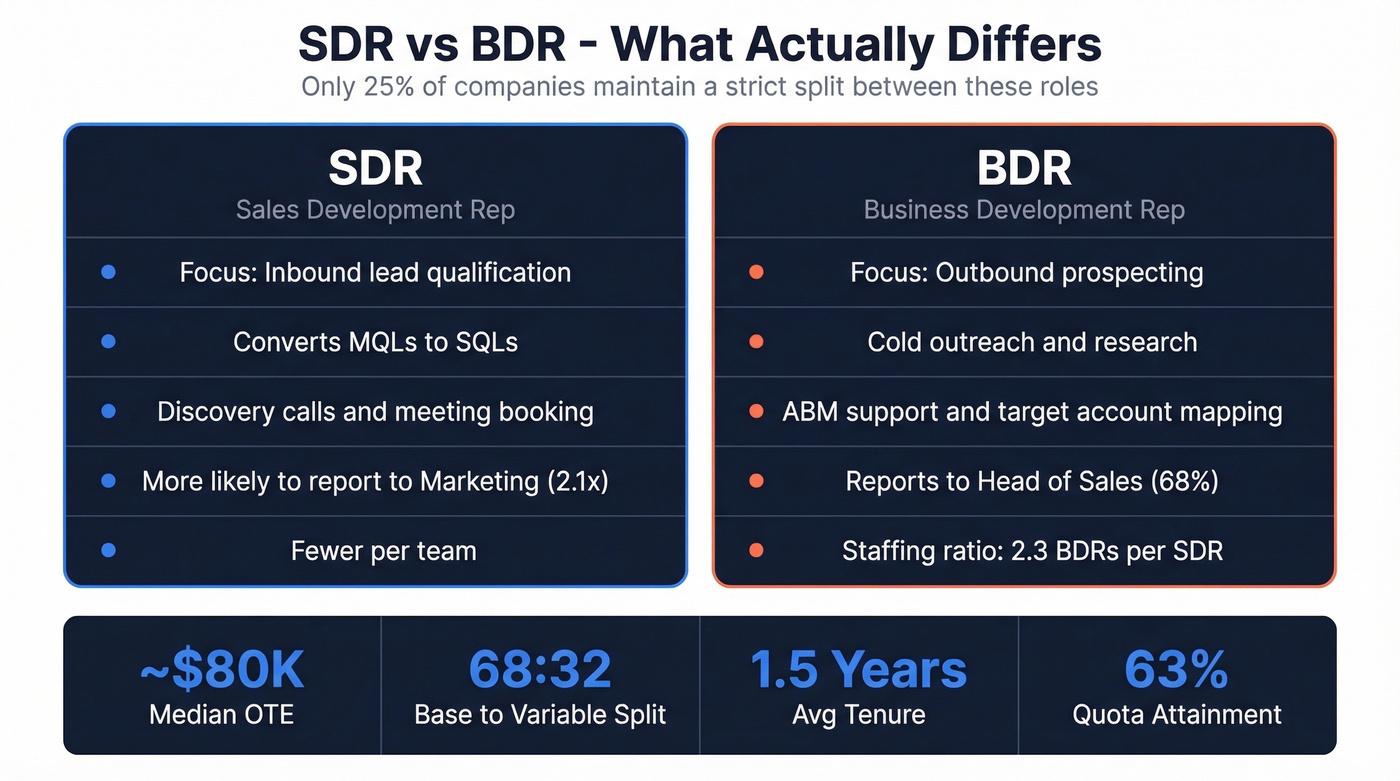
The reporting structure tells you more than the title. 68% of SDR teams report to the head of sales, but inbound-focused SDR teams are 2.1x more likely to report to marketing. Staffing ratios run about 2.3 BDRs per SDR, and the median SDR/BDR-to-AE ratio is 1:2.6.
Median OTE: $80K (range $70K-$95K). The typical base-to-variable split is 68:32 - roughly $54K base with $26K in variable comp tied to meetings booked or pipeline generated. Average tenure is just 1.5 years, ramp time runs about 3.2 months, and ~63% of SDRs attain quota. Experience required at hire has dropped to about 1 year, down from 2.5 years in 2010. Companies are hiring greener reps and investing in faster onboarding instead.
Inside Sales Rep vs Outside Sales Rep
Not every org uses the SDR-to-AE handoff model. Inside Sales Reps run the full cycle - prospecting through close - remotely. It's a leaner structure that works well for transactional or mid-market deals where a dedicated closer isn't necessary.
Outside Sales Reps cover geographic territories with in-person meetings, higher travel budgets, and typically larger deal sizes. The "inside vs outside" distinction is fading as remote selling becomes the default, but field sales still dominates in medical devices, manufacturing, and enterprise infrastructure.
Mid-Level Roles
Account Executive
The AE is the closer. After the SDR handoff, the AE runs demos, manages the sales cycle, negotiates, and signs deals. Mid-market AEs typically earn $140K-$180K OTE with a 50/50 base-variable split and 10-15% commission on closed deals. Enterprise AEs push $180K-$250K+ OTE, with base salaries of $100K-$140K.
An Enterprise AE closing seven-figure deals can out-earn most first-line managers without managing a single person. That's the fork we'll cover in detail below.
Account Manager, CSM, and Sales Engineer
Account Managers own renewals, upsells, and expansion within existing accounts. Customer Success Managers overlap but lean toward post-sale relationship management - onboarding, adoption, health scores. CSMs often report to a VP of Customer Success or the CRO rather than the VP of Sales. The distinction matters because AMs carry revenue targets; CSMs may or may not.
Sales Engineers bridge product and prospect. They handle technical demos, proof-of-concept builds, and objection handling on the technical side. Picture the person in the room who can answer "but will it integrate with our legacy ERP?" without flinching. Most have 5+ years of experience plus a technical background, and they don't follow the traditional SDR-to-AE path. They're IC roles, but they're critical in complex B2B sales where the buyer needs to see the product work before signing.
Sales Ops, RevOps, and Enablement
These three functions sit alongside the quota-carrying hierarchy, not inside it. They don't close deals - they make closers more effective.
| Function | Focus | Day-to-Day Examples |
|---|---|---|
| Sales Ops | CRM, reporting, process | Pipeline hygiene, territory assignments, comp plan admin |
| Sales Enablement | Training, content, coaching | Onboarding programs, call coaching, competitive battle cards |
| RevOps | Cross-functional alignment | Unifying marketing ops, sales ops, and CS ops under one data layer |
RevOps emerged because pipeline leaks happen at handoff points between departments, not within them. At startups, one person wears all three hats. By the time you're past $20M ARR, these are distinct teams.
If you're building this function, start with sales operations metrics and a clear RevOps Manager scope before you hire.
Management Roles
SDR Manager
Here's a compression trend that should worry you: newer SDR Managers earn 70-74% of what experienced counterparts make, and the gap is narrowing. OTE runs $140K-$200K with 0-2 years of management experience, climbing to $170K-$230K at the 3-5 year mark.
In our experience, the best SDR Managers never fully stop prospecting. Many still carry a small personal book - especially at smaller companies - while handling onboarding, coaching, and pipeline reviews. It's one of the hardest roles in sales because you're responsible for the output of the least experienced people on the team.
Sales Manager and Regional Sales Manager
Sales Manager OTE ranges from $240K-$300K at the 0-2 year mark to $270K-$380K with 3-5 years of experience. That spread is driven by company stage, team size, and whether the role includes a personal quota. Some sources peg entry-level Sales Manager OTE lower ($160K-$200K), typically at smaller companies or outside major SaaS hubs - the ranges above reflect tech-focused benchmarks.
Regional Sales Managers - who own geographic territories - earn $120K-$170K OTE, which feels low relative to the travel and coordination involved.
One 2026 trend worth watching: geographic pay standardization. Remote work has largely eliminated regional pay premiums for sales leadership roles. A Sales Manager in Austin earns roughly what one in San Francisco does now.
Director of Sales
Directors earn $140K-$180K base with OTE of $200K-$250K+. This role bridges execution and strategy - you're managing managers, owning a number, and reporting to the VP. It's the last rung before the executive layer, and honestly, it's where many strong operators stall out. The jump from Director to VP requires a shift from "how do we hit this quarter's number" to "how do we build a scalable revenue engine that works without me in every deal."
If you're making that jump, study sales leadership and tighten your sales forecasting solutions process early.

Whether you're an SDR booking 15-20 meetings a month or an Enterprise AE closing seven-figure deals, your pipeline starts with reaching the right people. Prospeo gives you 300M+ profiles with 98% email accuracy and 125M+ verified mobile numbers - so every role in your sales hierarchy hits quota faster.
SDRs using Prospeo book 35% more meetings than Apollo users.
Executive Roles
Head of Sales
If you're under $5M ARR, you probably don't need a VP of Sales. You need a Head of Sales - someone who carries a personal quota, builds the initial playbook, and hires the first two or three reps. OTE runs $170K-$250K with equity of 0.25%-1.0% at early-stage companies.
This person is a seller-builder, not a process optimizer. Hiring a VP too early is one of the most expensive mistakes startups make - they'll build process before you have a repeatable motion to process-ify.
VP, SVP, CSO, and CRO
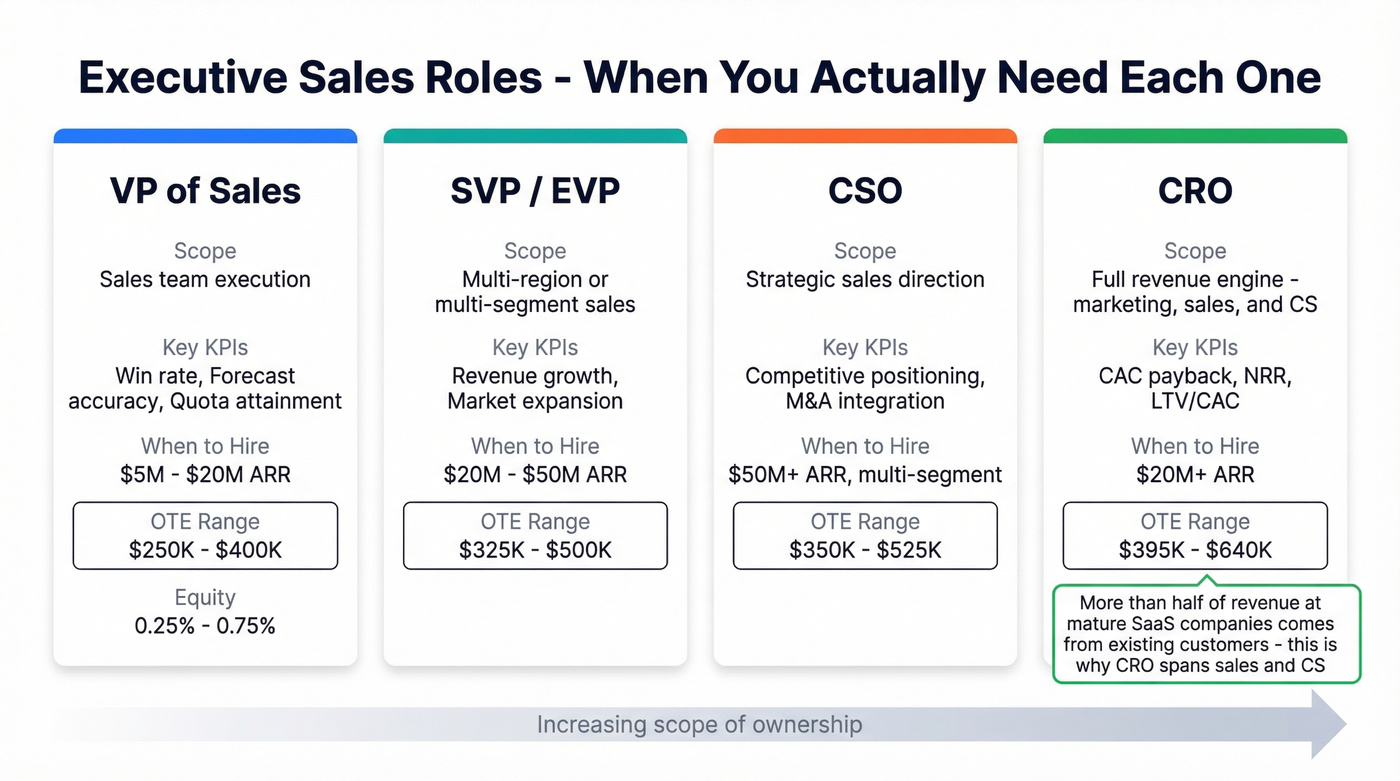
This is where titles get genuinely confusing. Let's break it down.
| Title | Scope | Key KPIs | When to Hire |
|---|---|---|---|
| VP Sales | Sales team execution | Win rate, forecast, quota | $5M-$20M ARR |
| CSO | Strategic sales direction | Competitive shifts, M&A | $50M+ ARR, multi-segment |
| CRO | Full revenue engine | CAC payback, NRR, LTV/CAC | $20M+ ARR |
A VP of Sales owns the sales team. A CRO owns the revenue engine - marketing, sales, and customer success aligned under one number. At many mature SaaS companies, more than half of revenue comes from existing customers, which is exactly why the CRO role spans sales and CS. A CSO is rarer, typically found in larger organizations navigating post-M&A integration or new market entry.
VP OTE runs $250K-$400K with equity of 0.25%-0.75% at venture-backed companies. SVP/EVP pushes $325K-$500K. CSO hits $350K-$525K. CRO at a late-stage company commands $395K-$640K; at Seed/Series A companies, expect $275K-$385K OTE with heavier equity. Emerging variants include Chief Commercial Officer and Chief Growth Officer - CRO-adjacent titles with slightly different emphasis.
IC vs Management - The Fork
Here's a real scenario from r/sales: a sole AE at a bootstrapped startup earning $70K base plus 14% commission (tracking $145K/year) was asked to become a player-coach - 70-80% AE work, 20-30% team management - while hiring the first SDR. The negotiation? Bump base to $85K-$90K, drop commission to ~12%, add a ~2% override on SDR-sourced deals.
That's the player-coach trap. You give up earning potential on your own deals in exchange for a management title and a small override.
| IC Track (Enterprise AE) | Management Track (Sales Manager) | |
|---|---|---|
| Pros | Higher ceiling on personal earnings; no HR headaches; deep deal expertise; career portability | Leverage through team output; broader strategic exposure; path to VP/CRO; builds leadership resume |
| Cons | Income tied to your own quota; limited org influence; career ceiling without exec pivot | Lower personal comp ceiling early on; success depends on others; emotional labor of coaching |
We've seen this play out dozens of times: an Enterprise AE at $180K-$250K+ OTE out-earns a first-time Sales Manager without managing anyone. Don't chase a management title for status. Chase it because you genuinely want to build and coach teams.
The cost of getting this wrong is real on both sides. An empty AE seat costs roughly $200K in lost revenue over 60 days. Promoting your best closer into management - where they're mediocre - hurts twice.
To avoid the trap, build a repeatable 30-60-90 day plan and standardize your sales process optimization before you add layers.
Title Inflation Is Real
A Pearl Meyer survey of 400+ organizations found that 54% use titles to attract talent - up 35% from 2018. And 15% of candidates accepted lower pay in exchange for a bigger title.
Here's the thing: title inflation is a tax on candidates. You take "Senior Director of Strategic Revenue" and realize six months in that you're managing three SDRs with no budget. Worse, creative titles hurt your searchability when you're back on the market. Recruiters search for "VP of Sales," not "Head of Revenue Acceleration." Keep your titles clean and standard.
AI is reshaping the bottom of the ladder, too. SDR roles are already being augmented by AI-powered sequencing and lead scoring, and new titles like "AI Sales Strategist" and "Revenue Intelligence Analyst" are appearing in job postings. The SDR role won't disappear, but the reps who survive will spend less time on manual research and more time on high-judgment activities like discovery calls and objection handling.
If you're modernizing the SDR motion, start with sales prospecting techniques and a practical AI cold email outreach workflow.
Other Titles You'll Encounter
The hierarchy above covers the core ladder, but you'll run into several adjacent titles depending on the org. Channel Sales Managers own partner and reseller relationships - they don't sell directly but enable others to sell your product. Territory Managers are Regional Sales Managers with a more granular geographic or vertical focus. Partner/Alliance Managers handle strategic partnerships, co-selling motions, and ecosystem development. Solutions Consultants are Sales Engineers by another name, common in consulting-heavy orgs.
None of these sit neatly on the SDR-to-CRO ladder, but they're legitimate career paths with comp that often mirrors their closest hierarchy equivalent. Skip these if you're early in your career and focused on the core IC or management track - they're easier to move into laterally once you've built a foundation.
How the Org Chart Changes as You Scale
| Stage | Structure | Key Roles |
|---|---|---|
| Startup (<$5M ARR) | Flat | Founder/Head of Sales → 2-3 full-cycle AEs |
| Scale-up ($5M-$20M) | Layered | VP Sales → SDR Mgr + AE Mgr → SDRs + AEs + CSMs; Sales Ops added |
| Enterprise ($20M+) | Matrixed | CRO → VP Sales + VP CS + VP Mktg → Directors → Managers → ICs; RevOps + Enablement |
The startup stage is simple: the founder or Head of Sales closes deals and hires a handful of AEs who run full-cycle. No SDRs, no managers, no ops.
At the scale-up stage, you specialize. SDRs feed AEs. Managers coach both. Sales Ops keeps the CRM from becoming a dumpster fire. This is also where data quality becomes a team-wide bottleneck - reps waste hours researching contacts instead of selling, and bad emails torch your domain reputation. Tools like Prospeo help here by returning 50+ data points per contact with a 7-day refresh cycle, so reps at every level spend time in conversations rather than spreadsheets.
If you're fixing that bottleneck, prioritize data enrichment services and a clean lead enrichment workflow.
At enterprise scale, the CRO sits atop a matrixed org with dedicated VPs for sales, CS, and marketing. RevOps and Enablement become standalone functions. Pod structures emerge - segmented by deal size, vertical, or geography. Understanding the role structure at each stage helps you hire the right people at the right time instead of over-building your org chart before you need to.
2026 Salary Benchmarks by Level
All figures represent OTE ranges for SaaS companies based on widely used 2026 benchmarks. Base-to-variable splits vary by role and company.
| Level | Role | Base Range | OTE Range |
|---|---|---|---|
| 1 | SDR / BDR | $55K-$75K | $70K-$95K |
| 2 | Inside Sales Rep | $60K-$80K | $75K-$100K |
| 3 | Mid-Market AE | $75K-$100K | $140K-$180K |
| 4 | Enterprise AE | $100K-$140K | $180K-$250K+ |
| 4 | SDR Manager | $100K-$190K | $140K-$230K |
| 5 | Sales Manager | $120K-$160K (0-2 yrs) / $140K-$200K (3-5 yrs) | $240K-$300K (0-2 yrs) / $270K-$380K (3-5 yrs) |
| 5 | Regional Sales Mgr | $94K-$130K | $120K-$170K |
| 6 | Director of Sales | $140K-$180K | $200K-$250K+ |
| 7 | Head of Sales | $130K-$180K | $170K-$250K |
| 8 | VP of Sales | $175K-$275K | $250K-$400K |
| 9 | SVP / EVP | $220K-$350K | $325K-$500K |
| 9 | CSO | $230K-$375K | $350K-$525K |
| 10 | CRO (Late-Stage) | $263K-$425K | $395K-$640K |
| 10 | CRO (Seed/A) | $193K-$257K | $275K-$385K |
Scaling from SDR Manager to VP of Sales means proving your team can generate pipeline. With 30+ filters - buyer intent, job changes, headcount growth, technographics - Prospeo lets sales leaders build targeted lists in minutes, not hours. CRM enrichment returns 50+ data points per contact at a 92% match rate.
Stop paying $1/lead for stale data when $0.01 gets you fresher contacts.
FAQ
What's the standard sales titles hierarchy?
The standard ladder runs ten levels: SDR/BDR → Inside Sales Rep → Mid-Market AE → Enterprise AE → SDR Manager/Sales Manager → Director of Sales → Head of Sales → VP of Sales → SVP/CSO → CRO. The IC and management tracks fork at Level 4, and most companies add sub-levels like AE I, AE II, and Senior AE within the broader tiers.
What's the difference between SDR and BDR?
SDR typically handles inbound lead qualification while BDR focuses on outbound prospecting. Only ~25% of companies maintain a strict split - most blend the roles or flip the definitions entirely. Focus on the job description and daily activities, not the three-letter acronym.
What does a CRO do vs a VP of Sales?
A VP of Sales owns the sales team's quota execution and is measured on win rate, forecast accuracy, and bookings. A CRO owns the full revenue engine - marketing, sales, and customer success - and is measured on cross-functional metrics like NRR, CAC payback, and LTV/CAC. Most companies don't need a CRO until $20M+ ARR.
What's the highest-paying sales title?
CRO at a late-stage company, with OTE ranging from $395K to $640K. But an Enterprise AE at $180K-$250K+ OTE can out-earn most first-time Sales Managers without managing anyone - the IC track pays better than many people realize.