

Salutary Data vs Apollo.io: Honest Comparison (2026)
Comparing Salutary Data vs Apollo.io is like comparing a flour mill to a bakery. One sells raw ingredients in bulk. The other runs the whole storefront - prospecting, sequencing, dialing, the works. They're both "B2B data," but they serve fundamentally different buyers at fundamentally different price points.
If you're trying to decide between them, there's a good chance neither is actually what you need.
30-Second Verdict
Salutary Data is a wholesale data infrastructure provider - bulk feeds, enrichment APIs, and curated U.S. contacts starting at $5,000. No outreach tools. It was acquired by Intentsify on February 5, 2026, which expands its identity resolution and intent capabilities.
Apollo.io is a self-serve sales engagement platform - prospecting, sequences, a dialer, and a Chrome extension starting free. The catch: practitioners on r/coldemail consistently report 32-38% bounce rates on Apollo lists, which is enough to torch your sender reputation in a week.
Salutary Data: Wholesale Data Infrastructure
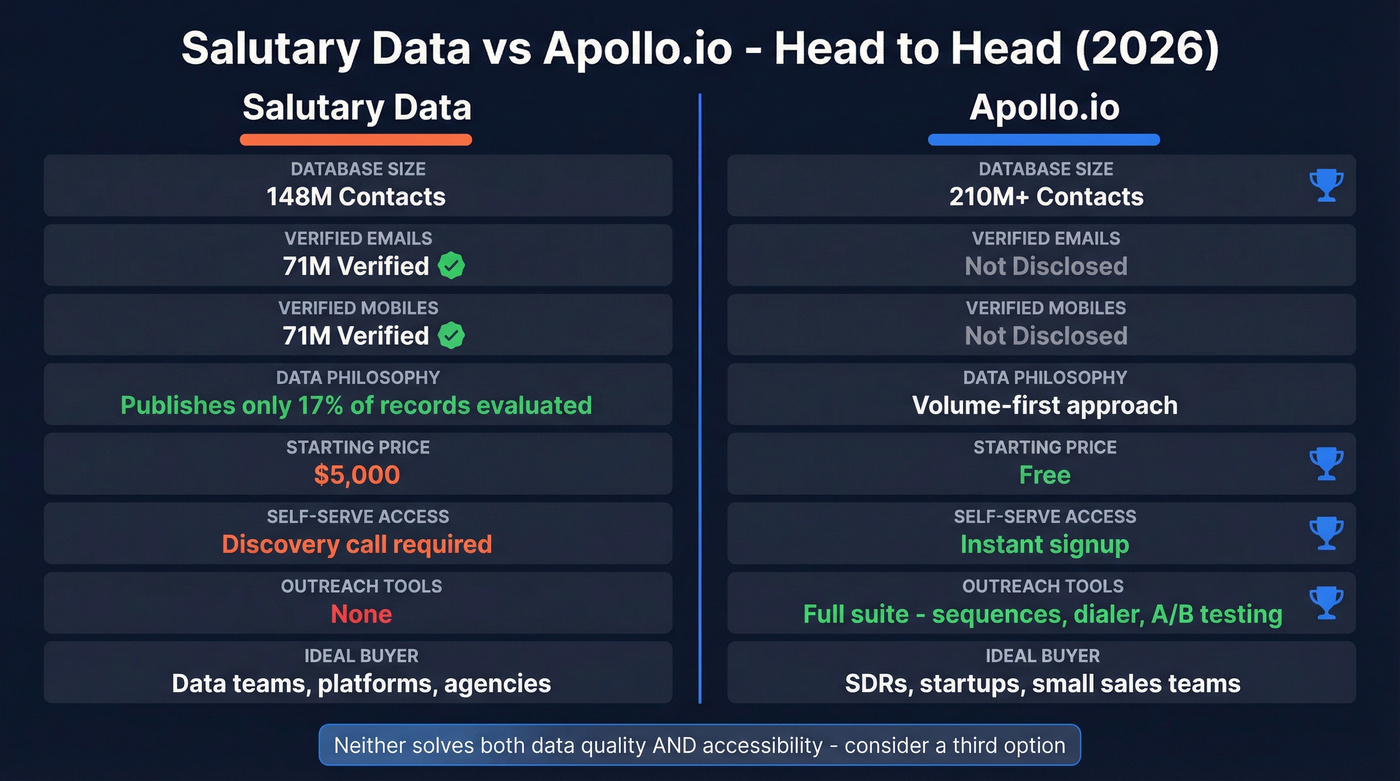
Salutary Data is a boutique U.S. contact provider with a curation-first philosophy. The database covers 148M unique contacts, 71M validated work emails, and 71M validated mobile phones, with a 65% mobile fill rate and 99% title fill rate. Those numbers look modest next to the biggest volume-first databases, but that's the point - Salutary evaluates a much larger pool of records and publishes only 17%.
Pricing starts at $5,000 across five models: flat-fee subscriptions, usage-based credits, success-based billing, pilot programs, and one-off deliveries. This isn't an instant-checkout, swipe-your-card product. Onboarding typically starts with a discovery call (see a discovery call script), though Salutary does offer a web UI for ad-hoc search with download credits plus an API suite for enrichment and append. The API handles up to 10,000 records per bulk call.
If you're an SDR looking to send 200 cold emails tomorrow, this tool wasn't built for you.
Apollo.io: Where Credits Get Expensive
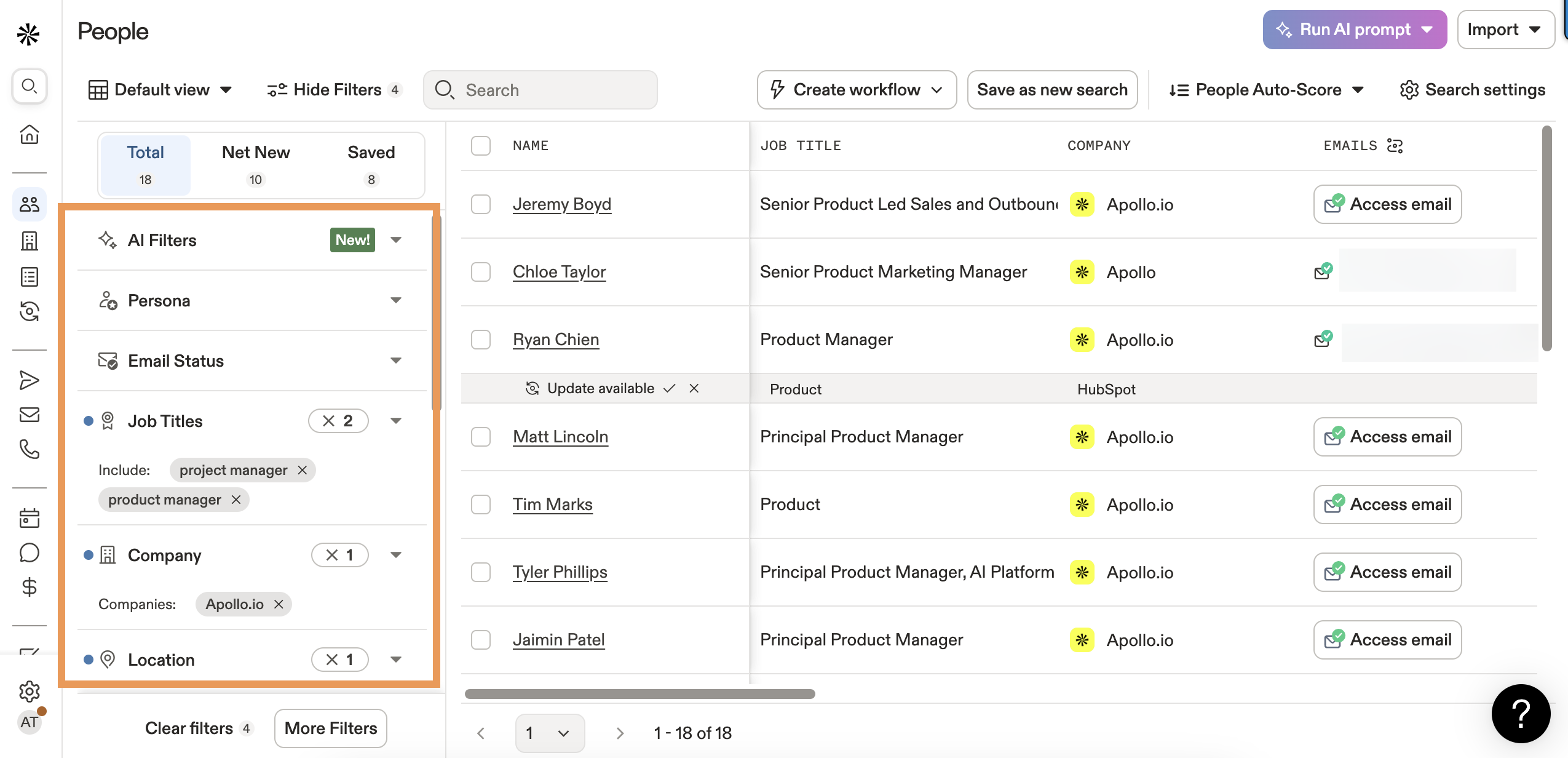
Apollo bundles a contact database, email sequences, a dialer, a Chrome extension, and CRM-style workflows into one platform - starting free. That accessibility made it the default for startups and small teams. But the credit system is where the real cost hides.
Credits expire monthly. Phone numbers cost 8x more than email credits. Overages run $0.20 per credit with a 250-credit minimum. Paid plans bill $49/user/month (Basic), $79 (Professional), and $119 (Organization) annually, with the Organization tier requiring a 3-seat minimum - that's $4,284/year just to walk in the door. We've watched teams budget $5,000/year for Apollo and end up at $8,000-$10,000 once overages and seat upgrades kick in.
The engagement suite - sequences, A/B testing, call recording, meeting scheduling - is genuinely useful (more on sequence management). But for any team sending more than 500 emails a month, running Apollo without a verification layer is reckless (see email deliverability).

Apollo users report 32-38% bounce rates. Salutary Data charges $5K to walk in the door. Prospeo delivers 98% email accuracy across 300M+ profiles at $0.01/email - with data refreshed every 7 days, not every 6 weeks.
Stop choosing between data quality and accessibility. Get both.
Head-to-Head Feature Comparison
| Dimension | Salutary Data | Apollo.io | Winner |
|---|---|---|---|
| Database size | 148M contacts | 210M+ contacts | Apollo (volume) |
| Verified emails | 71M | Not disclosed | Salutary |
| Verified mobiles | 71M | Not disclosed | Salutary |
| Data approach | 17% publish rate | Volume-first database | Salutary (precision) |
| Starting price | $5,000 | Free | Apollo |
| Self-serve | Discovery-call onboarding; web UI + API | Yes | Apollo |
| API access | Yes (10K bulk) | Tier-gated | Salutary (flexibility) |
| Outreach tools | None | Full suite | Apollo |
| Compliance | U.S.-focused | GDPR/CCPA | Apollo (scope) |
| Ideal buyer | Data teams, platforms | SDRs, small teams | Depends on role |
Data Quality: The Real Difference
Here's the thing about Apollo's "Verified" badge: it doesn't mean what most people think.
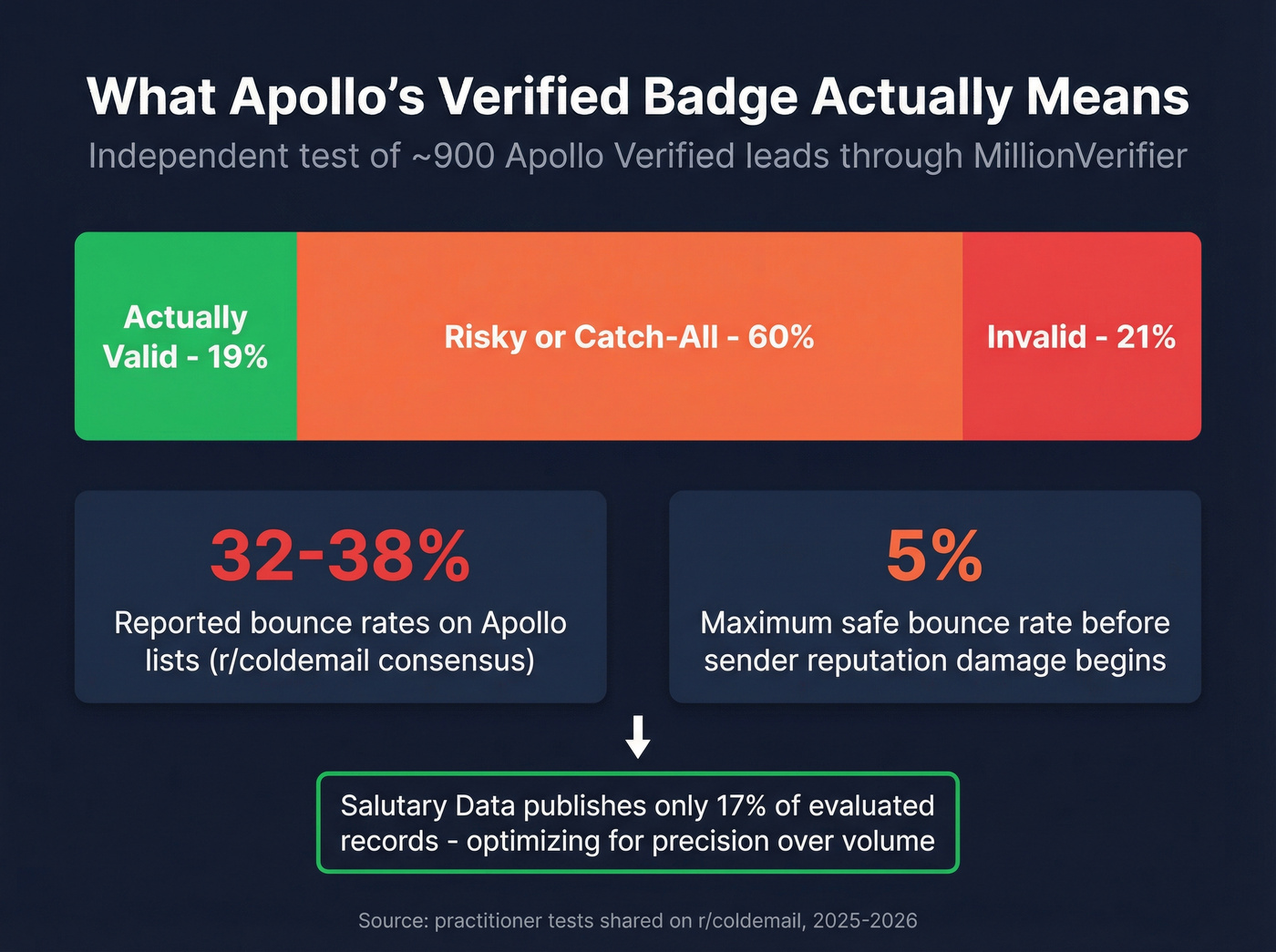
One practitioner exported roughly 900 Apollo "Verified" leads and ran them through MillionVerifier. Only 19% came back valid, with 60% flagged as risky or catch-all. That's not a verification system - that's a label. The broader consensus across r/coldemail puts Apollo baseline bounce rates at 32-38%, and anything above 5% starts damaging your sender reputation fast (see email bounce rate benchmarks and how to improve sender reputation).
Salutary Data takes the opposite approach. By publishing only 17% of evaluated records, they optimize for precision over volume. Their G2 rating sits at 5.0/5, with verified buyers calling the data "consistently clean and highly reliable." You won't find much Salutary Data discussion on Reddit - consistent with its wholesale positioning where end users rarely touch it directly.
Who Should Pick Which?
Salutary Data makes sense for data teams, platforms, and agencies buying bulk feeds or enrichment APIs. You need curated U.S. contact infrastructure, have $5K+ budget, and don't need outreach tools baked in (compare options in data enrichment services).
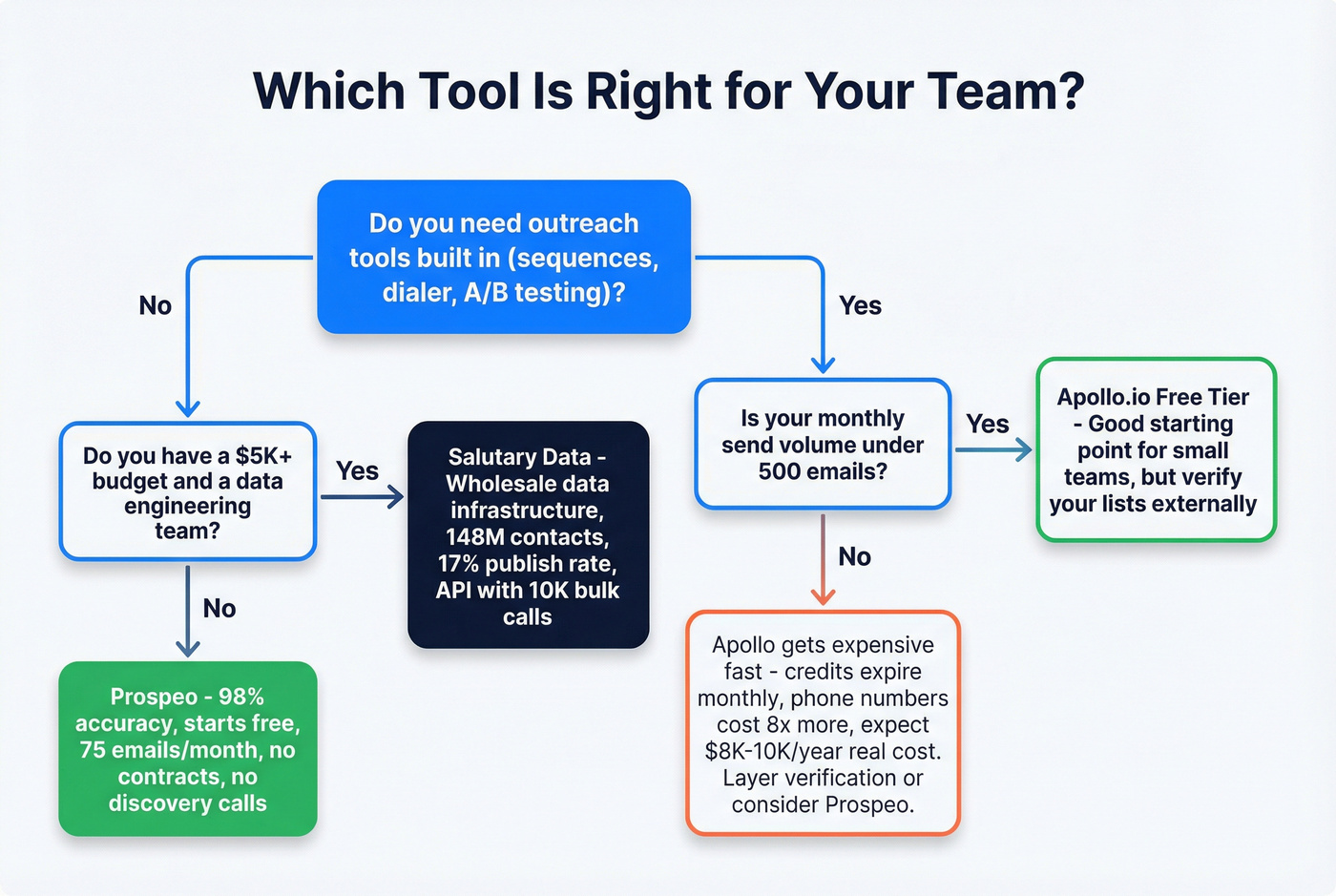
Apollo makes sense for individual reps or small teams that need prospecting, sequencing, and a dialer in one platform - especially if budget is tight and you need to start free today. Just plan to layer verification on top, because the native data won't protect your domain.
Let's be honest: most teams comparing these two actually need neither. Salutary is overkill infrastructure for anyone without a data engineering team. Apollo's all-in-one convenience masks a data quality problem that costs more in burned domains than you'll ever save on subscription fees. If your average deal size is under $15K, you're better off with a dedicated data provider paired with a standalone sequencer like Instantly or Lemlist (see cold email marketing for stack + benchmarks).
A Stronger Third Option
One sales team we spoke with was running Apollo and hitting a 35% bounce rate. Within weeks of switching to Prospeo, that number dropped below 4% - and their pipeline tripled from $100K to $300K per week. That's not an edge case. It's what happens when verification actually works (see how to check if an email exists).
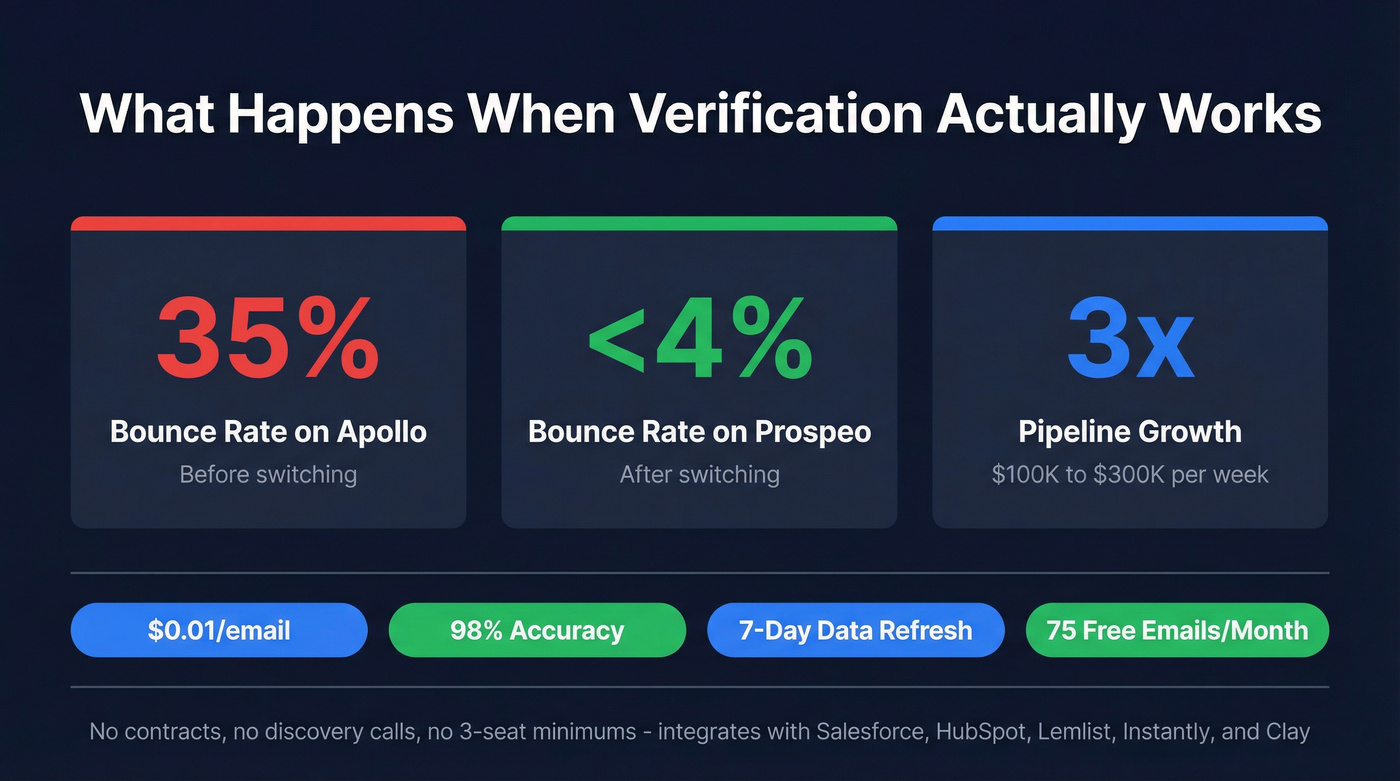
Prospeo starts free with 75 emails and 100 Chrome extension credits per month. Paid plans run about $0.01 per email. No contracts, no discovery calls, no 3-seat minimums. It integrates natively with Salesforce, HubSpot, Lemlist, Instantly, and Clay. With 30+ search filters - buyer intent powered by Bombora, technographics, job changes, headcount growth - you get the targeting depth of enterprise tools at a fraction of the cost (see sales prospecting techniques).
For teams weighing Salutary Data vs Apollo.io, it's the middle ground that doesn't force you to choose between data quality and accessibility.

One team switched from Apollo's 35% bounce rate to Prospeo and tripled pipeline to $300K/week. With 30+ filters, Bombora intent data, and native integrations with Instantly and Lemlist - no discovery calls or 3-seat minimums required.
75 free emails per month. No contracts. No sales calls. Just verified data.
FAQ
Is Salutary Data a direct Apollo.io competitor?
No. Salutary sells wholesale data infrastructure starting at $5,000 with discovery-call onboarding. Apollo is a self-serve sales engagement platform with a free tier. They target different buyers at entirely different price points - data engineering teams vs. individual SDRs.
Why are Apollo.io bounce rates so high?
Apollo's "Verified" label doesn't guarantee deliverability. Independent tests show only 19% pass third-party validation, with 32-38% bounce rates reported across r/coldemail. Always layer real verification on top of Apollo exports before sending anything.
What's a good alternative if neither tool fits?
Prospeo offers 300M+ profiles with 98% email accuracy, a free tier of 75 emails per month, and no contracts. It bridges Apollo's self-serve accessibility with data quality that actually protects your domain - and its 7-day refresh cycle keeps records current while most competitors update every 4-6 weeks.
Did Salutary Data get acquired?
Yes. Intentsify acquired Salutary Data on February 5, 2026, expanding its identity resolution and intent data capabilities. Existing Salutary customers retain access, but the product roadmap now falls under Intentsify's direction.