

12 Sample Emails Requesting Availability for a Meeting in 2026
The average cold email reply rate sits around 5.8%. That means roughly 94 out of 100 meeting requests vanish into the void. Worse, 35% of meetings are considered total time-wasters by the people who attend them. The problem isn't that people hate meetings - it's that most meeting request emails give them zero reason to say yes.
Every template below is built on data from 16.5M cold emails and real practitioner feedback. Grab the one that fits your scenario, swap in your details, and send it.
What Separates Good Meeting Requests From Inbox Trash
A study of 16.5M cold emails found that emails between 6 and 8 sentences hit a 6.9% reply rate - the sweet spot. Go longer and you lose people. Go shorter and you don't give them enough context to commit.
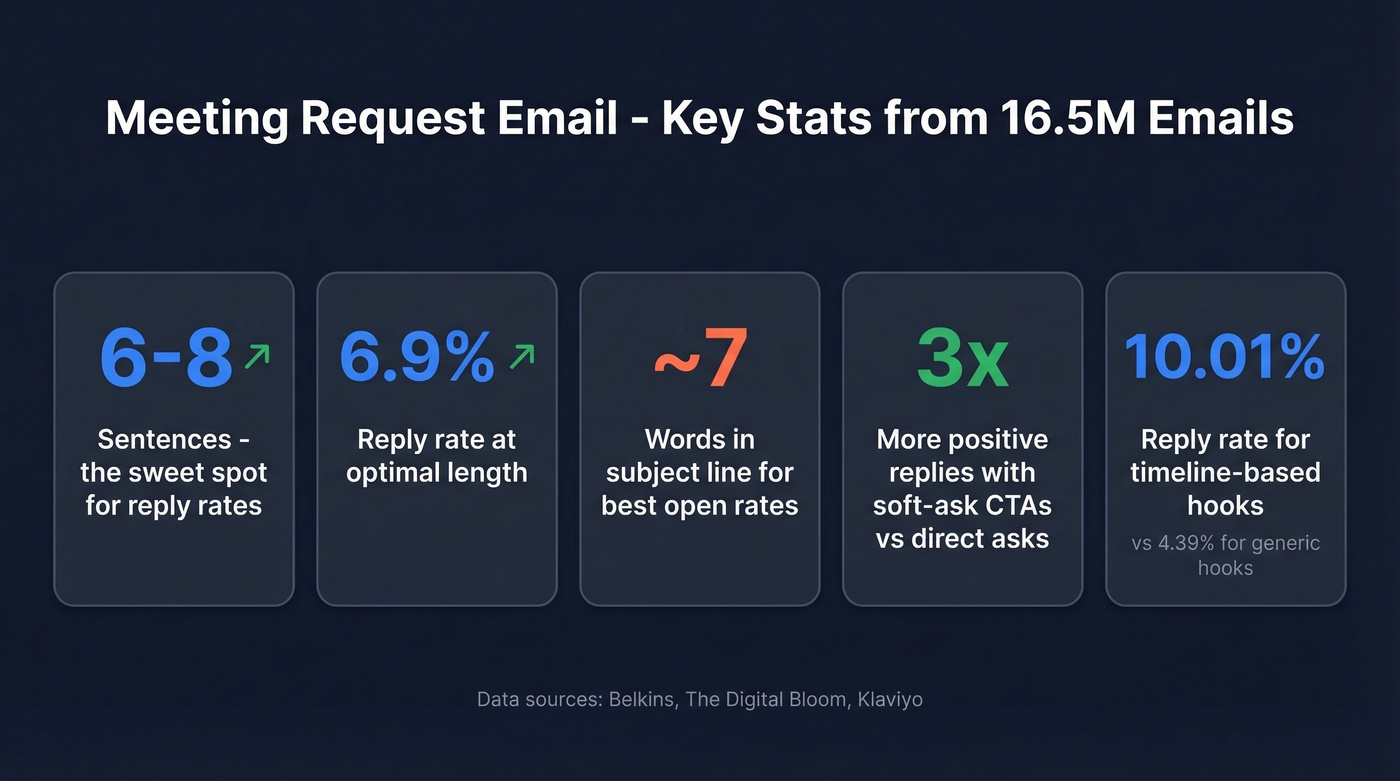
Subject lines averaging ~7 words drive the strongest open rates, and timeline-based hooks - framing around a deadline or window - pull a 10.01% reply rate versus 4.39% for generic problem hooks. One more finding that changed how we write cold outreach: soft-ask CTAs, where you offer a resource or insight before requesting a meeting, pull roughly 3x the positive reply rate of direct meeting asks.
Here's the thing: most people skip the checklist and wonder why nobody responds. Don't be that person.
- Specific reason to meet - frame it around their outcome, not your pitch
- 2-3 concrete time options - never "let me know your availability"
- Stated duration - "15 minutes" removes the fear of a 60-minute trap
- Subject line: 7 words or fewer, timeline-based when possible
- Total length: 6-8 sentences max
If you want more examples beyond meeting requests, pull from these email subject lines and adapt them to your context.
12 Templates for Every Scenario
Most templates below follow the rules: 8 sentences or fewer, 2-3 specific time slots, and a subject line included. The structure stays the same whether you're writing to a colleague or a cold prospect.
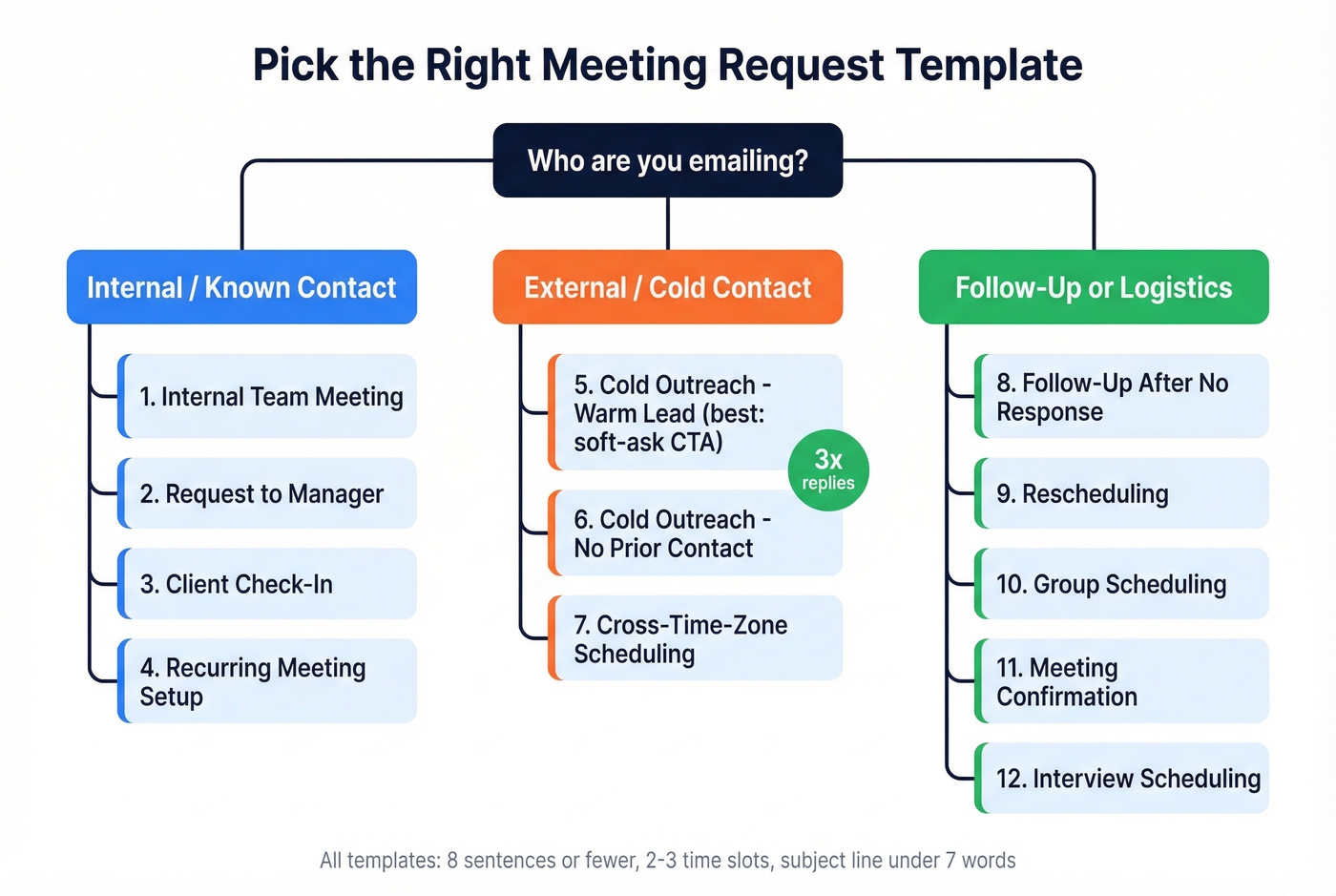
Internal Team Meeting
Subject: Q3 planning sync - 30 min this week
Hi team, I'd like to get us aligned on Q3 priorities before the month closes out. I'm proposing a 30-minute sync to review pipeline targets and resource allocation. Would any of these work? Tuesday, July 8 at 10:00 AM, Wednesday, July 9 at 2:00 PM, or Thursday, July 10 at 11:00 AM. I'll send an agenda by Monday.
If you’re building a repeatable process around these meetings, it helps to standardize your sales activities so the agenda stays consistent.
Request to a Manager or Executive
Subject: 15 min - budget approval for new tooling
Hi [Name], I'd like to walk you through a quick business case for the enrichment tool we've been evaluating. It'll take 15 minutes and I'll have the ROI numbers ready. Could we do Monday, July 7 at 9:00 AM, Tuesday at 3:00 PM, or Wednesday at 10:00 AM?
Client Check-In
Subject: Quick check-in on [project name]
Hi [Name], it's been a few weeks since our last sync and I want to make sure everything's tracking. I've got updates on deliverables and one question about timeline. Could we grab 20 minutes? I'm open Thursday, July 10 at 1:00 PM, Friday at 10:00 AM, or Monday, July 14 at 11:00 AM.
If you need a stronger post-call workflow, use a dedicated sales meeting follow-up email to recap next steps and keep momentum.
Cold Outreach - Warm Lead
This one uses the soft-ask approach that outperforms direct meeting requests by 3x. Instead of asking for a call upfront, lead with something useful.
Subject: Following up on [event/content/trigger]
Hi [Name], I noticed you [downloaded our guide / attended the webinar / visited our pricing page] last week. Companies in [their industry] are typically leaving 15-20% of qualified pipeline untouched - we put together a short breakdown of how three similar teams closed that gap in one quarter. Want me to send it over? If it's relevant, we can jump on a 15-minute call to walk through it.
Why this works: The recipient gets value before committing to a meeting. In our experience, this "resource-first" framing drives about 3x more positive replies than asking for a meeting in the first email.
For more ways to structure outreach that earns replies, borrow patterns from emails that get responses.
Cold Outreach - No Prior Contact
Subject: Quick question about [their specific challenge]
Hi [Name], I've been looking at how [their company] handles [specific process] and noticed a pattern we see a lot in [industry]. We helped three similar teams solve it - happy to share the breakdown if useful. No pitch, just context. Would a 10-minute call work? Tuesday, July 8 at 10:00 AM, Thursday at 1:00 PM, or Friday at 9:00 AM ET.
Before sending cold outreach, verify the address with a tool like Prospeo's email finder - a perfectly written email that bounces helps nobody. If you’re troubleshooting deliverability, start with this email deliverability guide.
Cross-Time-Zone Scheduling
Subject: Sync on [topic] - finding a time across zones
Hi [Name], I'd love to align on [topic] this week. Since we're in different time zones, here are options in both: Tuesday, July 8 at 2:00 PM ET / 7:00 PM GMT, Wednesday at 10:00 AM ET / 3:00 PM GMT, or Thursday at 9:00 AM ET / 2:00 PM GMT. Should take about 20 minutes.
Interview Scheduling
Subject: Interview for [role] - next steps
Hi [Name], thanks for your interest in the [role] position. We'd like to schedule a 45-minute interview with [interviewer name and title]. Could any of these work? Monday, July 7 at 11:00 AM, Wednesday, July 9 at 2:00 PM, or Friday, July 11 at 10:00 AM. I'll send a calendar invite with a video link once you confirm.
Follow-Up After No Response
Subject: Re: [original subject line]
Hi [Name], I sent a note last week about [topic] and wanted to follow up. I know inboxes get buried. If the timing's better now, I'm available Wednesday, July 9 at 1:00 PM, Thursday at 10:00 AM, or Friday at 3:00 PM. If this isn't a priority, no worries - just let me know and I won't follow up again.
Wait 2-3 business days before sending this. Anything sooner and you look desperate. I've seen it kill deals that were otherwise warm. If you want more follow-up options, use these sales follow-up templates.
Rescheduling an Existing Meeting
| Original detail | What to include |
|---|---|
| Day/time being moved | Reference it explicitly |
| Reason | One sentence, no over-explaining |
| New options | 2-3 slots, same duration |
Subject: Need to reschedule our [day] meeting
Hi [Name], something came up and I need to move our [original day] meeting. Apologies for the shift. Could we do Thursday, July 10 at 11:00 AM, Friday at 2:00 PM, or Monday, July 14 at 9:00 AM instead? Same agenda, same duration.
Group / Multi-Attendee Scheduling
Subject: Aligning [team/group] on [topic] - 30 min
Hi all, I'd like to get [names or team] together for a 30-minute discussion on [topic]. Please reply with any that work: Tuesday, July 8 at 10:00 AM, Wednesday, July 9 at 3:00 PM, or Thursday, July 10 at 1:00 PM. I'll go with the slot that works for most people and send a recap to anyone who can't make it.
Meeting Confirmation
Subject: Confirmed: [topic] - [day] at [time]
Hi [Name], confirming our meeting on Wednesday, July 9 at 2:00 PM ET. We'll cover [agenda item 1] and [agenda item 2] - should take about 20 minutes. Here's the video link: [link]. See you then.
Recurring Meeting Setup
Subject: Setting up a recurring [weekly/biweekly] sync
Hi [Name], I'd like to set up a recurring check-in so we stay aligned on [project/topic]. I'm thinking 20 minutes, same slot each week. Would Tuesdays at 10:00 AM, Wednesdays at 2:00 PM, or Thursdays at 11:00 AM work as a standing time?
If you’re running recurring outbound motions, tighten your sequence management so follow-ups don’t sprawl.
Scheduling Links vs. Suggested Times
A bare Calendly link is the laziest thing you can put in a meeting request email. A Chili Piper A/B test found that emails with suggested times booked 13x more meetings than emails with only a calendar link. The link-only version converted at just 1.9%.
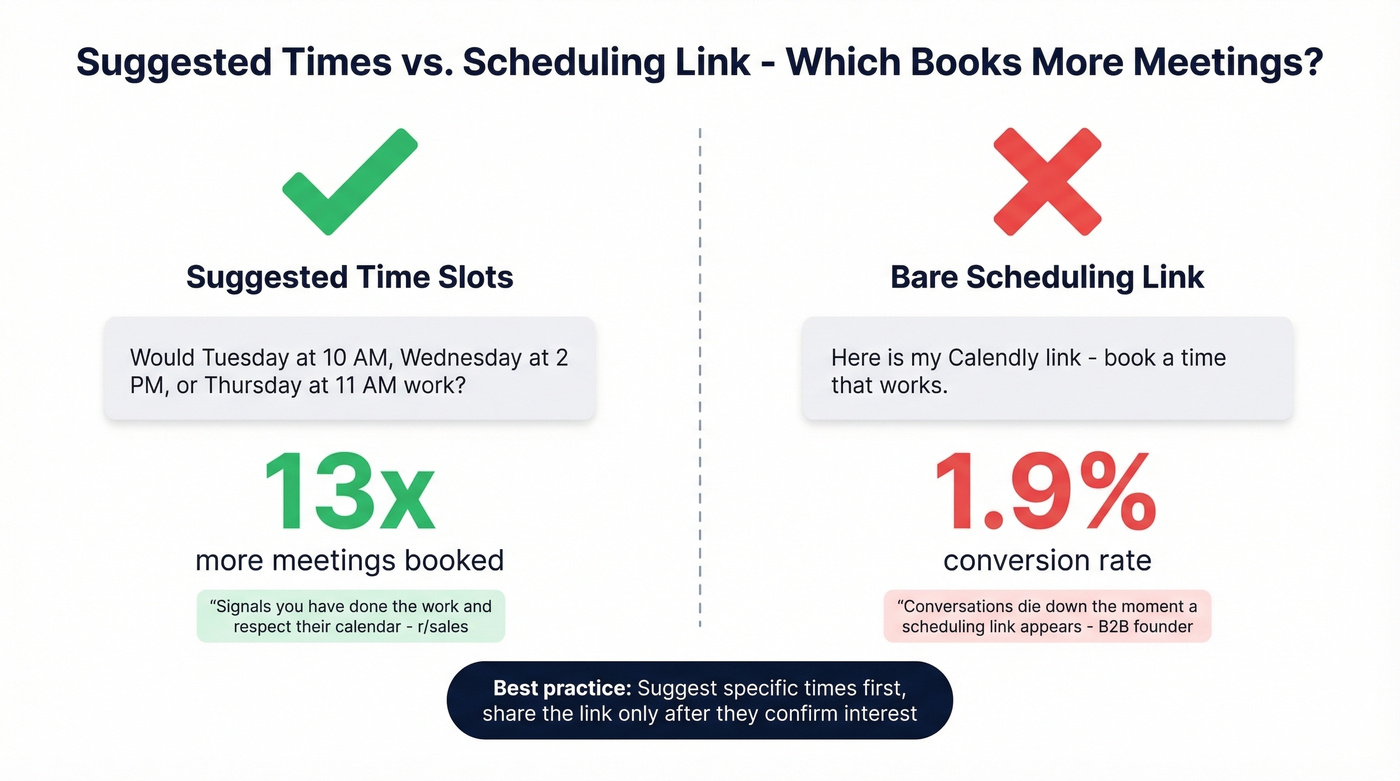
The consensus on r/sales backs this up. One B2B founder reported that conversations "die down" the moment a scheduling link appears - zero meetings booked through Calendly links versus multiple successes with manual time slots. Another sales operator put it bluntly: proposing specific times signals you've done the work and respect the other person's calendar.
Suggest specific times first. Share the link only after the prospect confirms interest.
If you’re automating parts of this workflow, use a system designed for automated cold email scheduling without sacrificing personalization.

A perfect meeting request email means nothing if it bounces. Prospeo's email finder delivers 98% accuracy across 143M+ verified addresses - so your carefully crafted templates actually land in the right inbox.
Stop writing great emails to dead addresses. Find verified contacts first.
Best Time to Send Your Meeting Request
Timing isn't everything, but it's not nothing either.
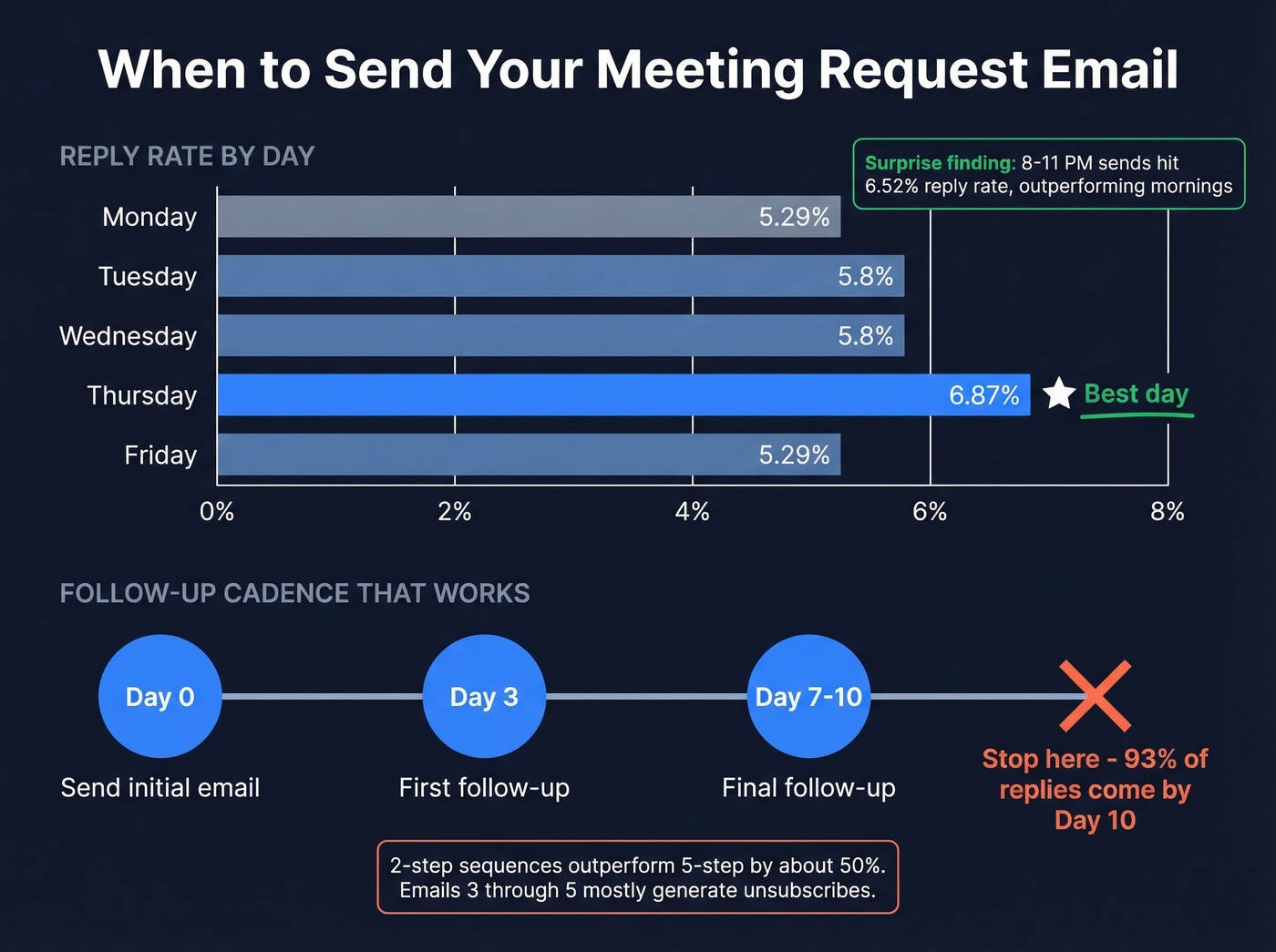
Best day: Thursday pulls a 6.87% reply rate versus Monday's 5.29%. Thursday evening sends are underrated - most salespeople refuse to believe it, but the data is clear. The 8-11 PM window outperforms mornings at 6.52%. For a deeper breakdown, see our guide on the best time to send cold emails.
Follow-up cadence: The 3-7-14 pattern captures 93% of replies that will ever come by Day 10. Operator data across 500k emails shows 2-step sequences outperform 5-step by ~50%. Emails 3 through 5 mostly generate unsubscribes, not meetings.
Let's be honest: if you're sending more than 2 follow-ups on a meeting request, you've already lost. The data proves it, and your gut knows it too. Move on.
Scheduling Across Time Zones
60% of email misunderstandings in global teams come from tone interpretation, not language barriers. Swap idioms for clarity - "Let's touch base" becomes "Let's schedule a check-in." Always include explicit time zone formatting: "Tuesday, July 8 at 2:00 PM ET / 7:00 PM GMT." When in doubt, err on formality. A slightly formal availability request reads as respectful everywhere, while a casual one can land wrong in cultures you don't know well.
Verify Before You Send
The best meeting request email in the world is worthless if it bounces. We've seen teams burn through weeks of outreach only to discover half their list was dead addresses. Prospeo checks emails in real time with 98% accuracy across 300M+ professional profiles, and the free tier gives you 75 verifications per month - enough to validate a weekly outreach list without spending anything. If you’re monitoring list quality, track your email bounce rate and fix issues before scaling.

Cold outreach reply rates sit at 5.8%. You can't afford to waste a single send on a bad address. Prospeo verifies emails through a 5-step process with spam-trap removal - at roughly $0.01 per email, no contracts required.
Every bounced meeting request is a lost deal. Verify addresses before you hit send.
FAQ
How many times should you follow up on a meeting request?
Once or twice. Operator data across 500k emails shows 2-step sequences outperform longer ones by ~50%. Follow up after 3 business days, then again after 7. By Day 10, 93% of replies that will ever come have already arrived.
Should you include a Calendly link in a meeting request?
Not upfront. A/B testing shows emails with suggested times book 13x more meetings than emails with only a calendar link. Propose 2-3 specific slots first. Share the scheduling link only after the recipient confirms interest.
How do you ask for availability without sounding demanding?
Lead with context, not a request. Explain why the meeting matters to the recipient, suggest 2-3 specific time slots, and include a low-pressure out like "If none of these work, happy to adjust." Framing the meeting around the recipient's goals will always outperform leading with your agenda.
How do you make sure your meeting request reaches the right inbox?
Use an email verification tool before sending. High bounce rates damage your domain reputation, which tanks deliverability for every future email - not just meeting requests. This matters most when you're contacting someone for the first time and don't have a prior thread to fall back on.