

Sample Follow-Up Emails That Actually Get Replies - Templates + the Strategy Behind Them
Most follow-up emails fail before they're even opened. You copy a template, swap the name, hit send, hear nothing. The template wasn't the problem. Everything around it was.
Here's the short version:
- Keep it short. Under 80 words. The best-performing campaigns all stay there.
- Send 2-3 follow-ups, typically 2-4 days apart. Never open with "just checking in."
- Verify your list first. Bounce rates above 2% will hurt deliverability and domain reputation fast. No template survives bad data.
Templates are maybe 20% of the equation. The other 80% is deliverability, list quality, timing, and length. Let's get into the data, then the templates, then the part nobody talks about.
The 97% Problem
The average cold email reply rate is 3.43%. For every 100 emails you send, roughly 97 people ignore you. The top 10% of senders hit 10.7%+, which sounds better until you realize that's still 89 people not responding.
One marketer on r/b2bmarketing put it bluntly: even with best practices, response rates sit around 2-3%, and the question becomes what you do with the 97% who don't respond. The answer isn't a better template - it's a better system.
What the Data Says About Follow-Up Emails
Follow-ups aren't optional. They're where nearly half your replies come from - 42% by one benchmark.
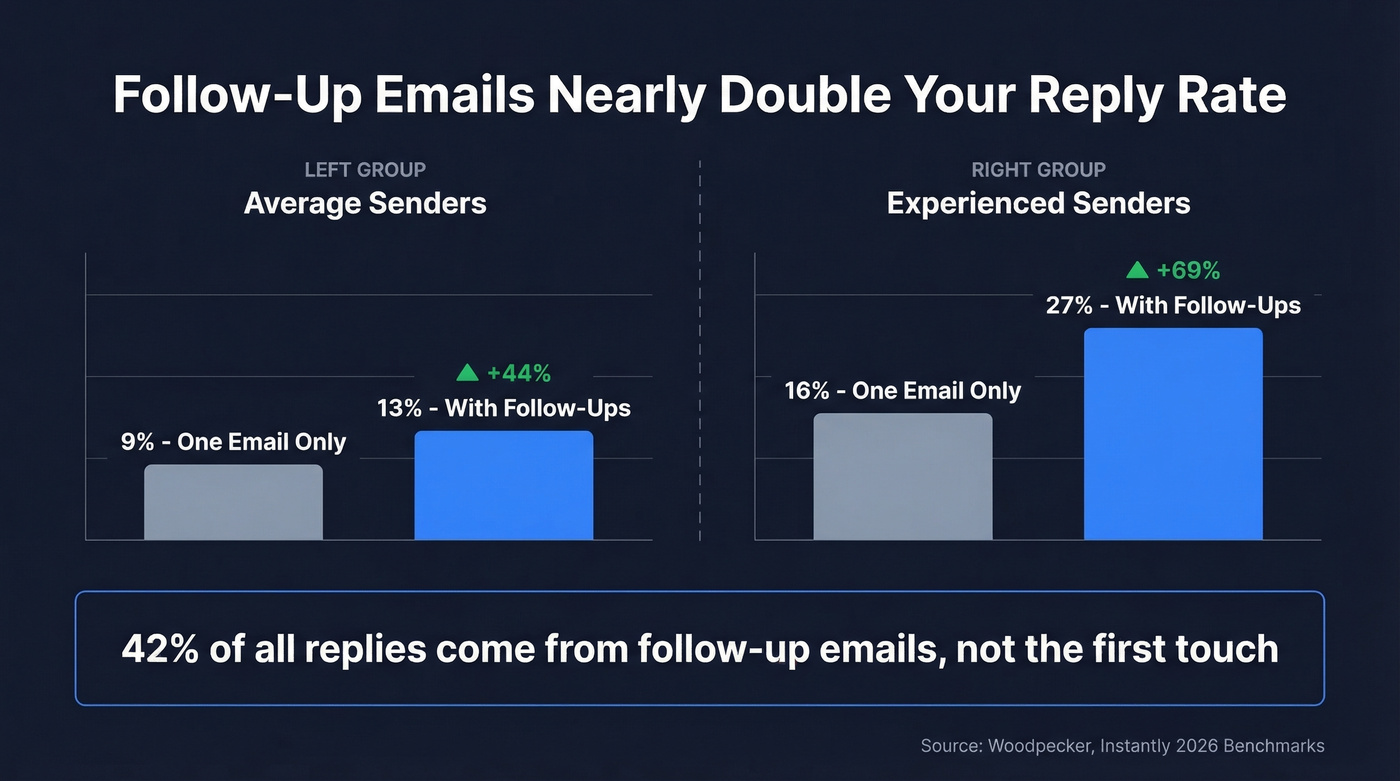
Woodpecker's data shows one-email campaigns average about 9% reply rates. Add at least one follow-up and that jumps to 13%. For experienced senders, the gap is even wider: 16% with one email vs. 27% with follow-ups. That's not marginal. It's nearly double.
How many touchpoints? Benchmark data suggests 4-7 for full sequences, but Woodpecker finds most of the lift comes from the first 2-3 follow-ups. Plan for 2-4 follow-ups (4-7 total touches) with 3-4 day spacing. Don't expect much after that unless each touch adds genuinely new value.
There's a psychology angle here too: the Zeigarnik Effect says unfinished tasks stay top of mind, which helps explain why a conversation can feel "open" until someone closes it. Your first email opens a loop. Follow-ups keep it open.
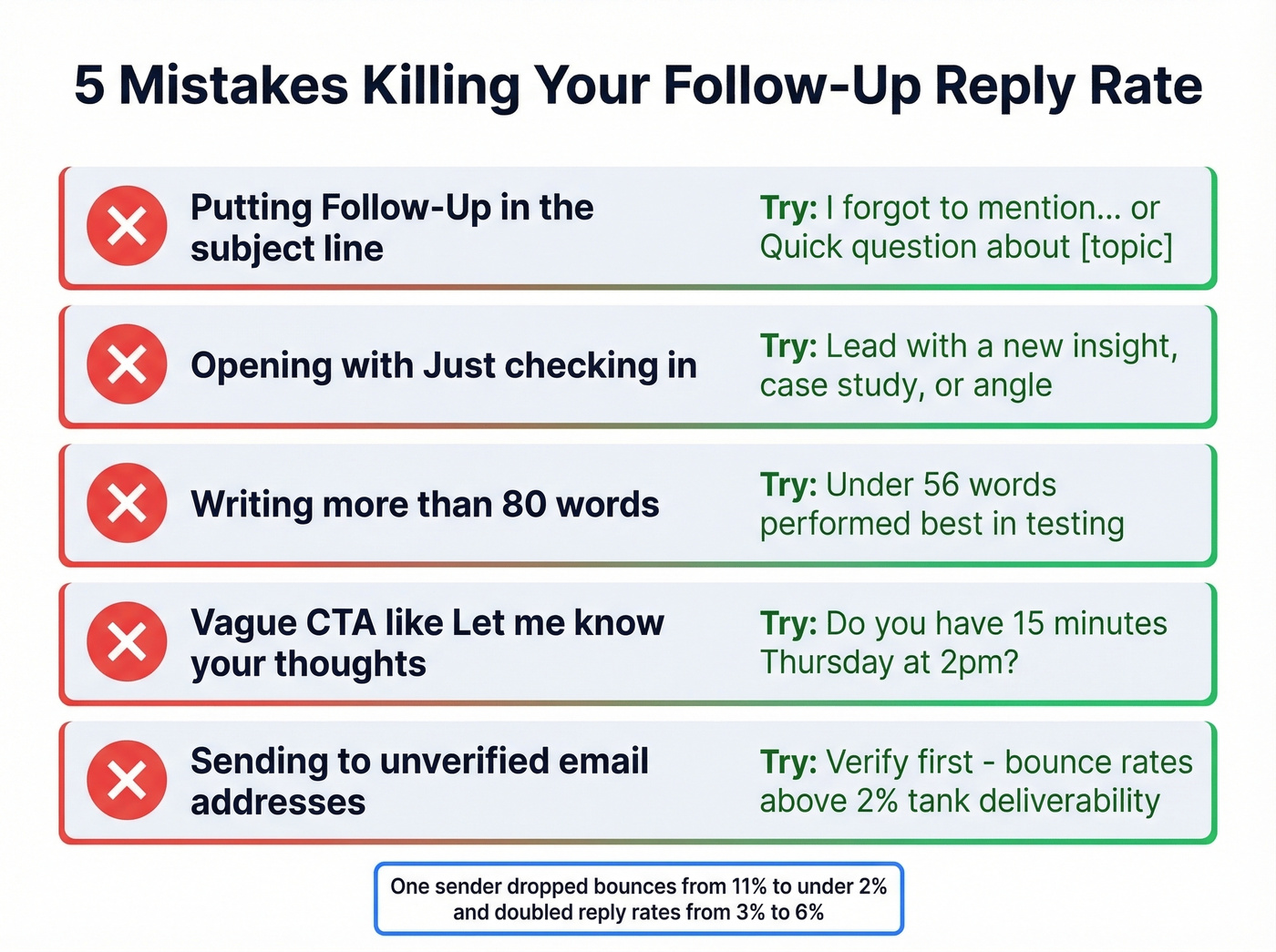
Five Mistakes Killing Your Reply Rate
1. Putting "Follow-Up" in the Subject Line
NetHunt's research flags this as one of the most common mistakes. Writing "Follow-Up" in your subject line tells the recipient you have nothing new to say. Try "I forgot to mention..." or "Quick question about [specific topic]" instead.
2. Opening with "Just Checking In"
"Just checking in," "circling back," "touching base" - these phrases signal you don't have a reason to email. Every follow-up needs to deliver something: a new insight, a relevant case study, a different angle. As GMass's guide puts it, each touchpoint should address a different objection rather than bumping the same empty message.
Before: "Just checking in to see if you had a chance to review my last email."
After: "Saw [Company] just opened a new office in Austin - we helped a similar team cut onboarding time by 40% during their expansion."
3. Writing Too Much
Shorter emails win. Benchmark data shows the best-performing campaigns use emails under 80 words. One practitioner on r/Entrepreneur cut their email length from 141 words to under 56 and saw reply rates climb. Your follow-up isn't a pitch deck - it's a conversation starter.
4. No Clear CTA
"Let me know your thoughts" isn't a call to action. It's a shrug. "Do you have 15 minutes Thursday at 2pm?" gives the recipient something concrete to respond to. One question, one ask, one action. (If you want more examples, see our guide to Email Call to Action.)
5. Sending to Unverified Addresses
Here's the thing - this is the mistake that quietly kills everything else. That same Reddit practitioner reported bounce rates of 11% before they fixed their list hygiene. After verification, bounces dropped below 2%, and reply rates doubled from 3% to 6%.
If your bounce rate is above 2%, deliverability starts sliding fast. Spam filters notice. Inbox placement drops. Your perfectly crafted follow-up lands in a folder nobody checks. (More on benchmarks and fixes in our Email Bounce Rate guide.)

The article says it clearly: bounce rates above 2% destroy deliverability and kill your follow-up sequence before it starts. Prospeo's 5-step email verification delivers 98% accuracy - so your carefully crafted follow-ups actually reach real inboxes. At $0.01 per email, cleaning your list costs less than one bounced opportunity.
Stop writing perfect follow-ups to addresses that don't exist.
Subject Lines That Get Opens
47% of recipients decide whether to open an email based on the subject line alone, and 69% report emails as spam based on the subject line. That makes it the single highest-leverage element of your follow-up. For more ideas, browse these email subject line examples.
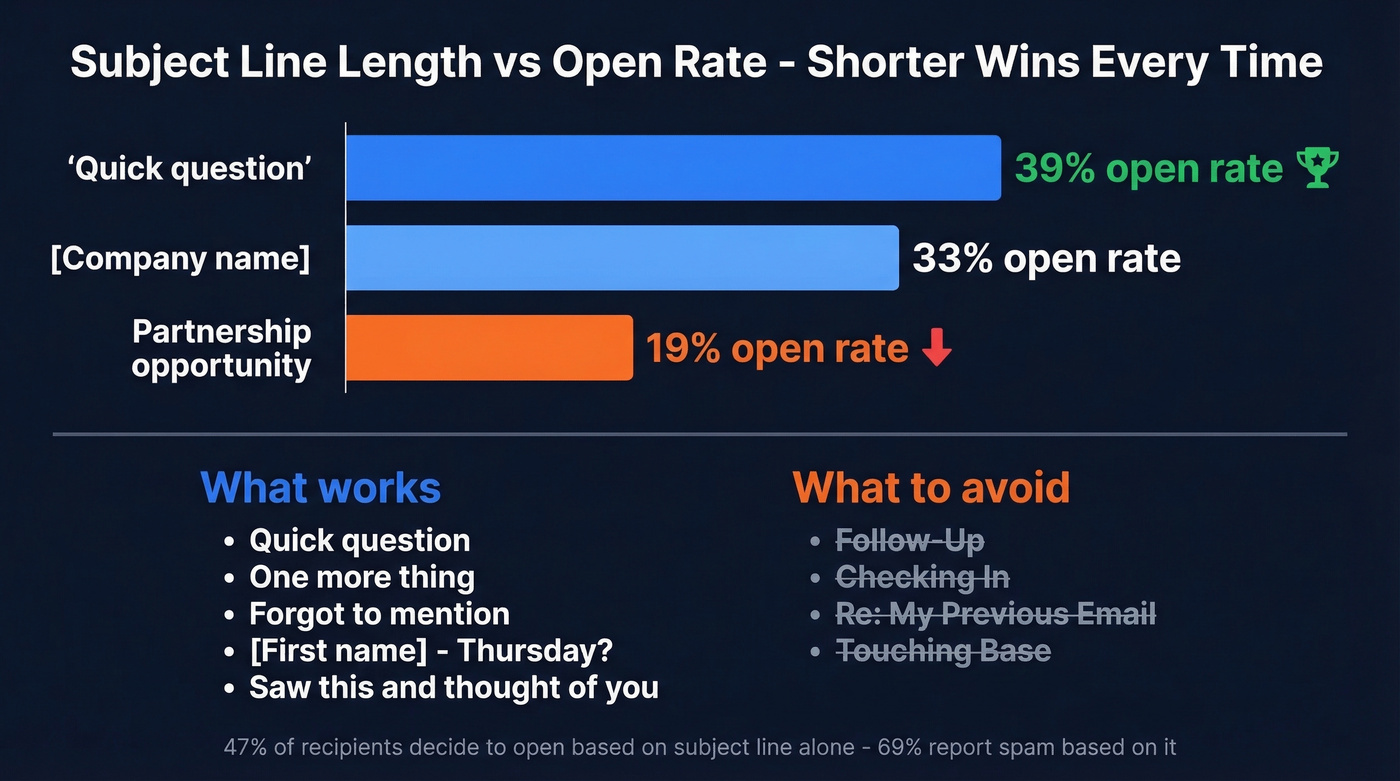
Keep subject lines to 2-4 words. The Reddit case study found "Quick question" pulled 39% open rates, a company-name subject line hit 33%, and "Partnership opportunity" scraped below 19%. Shorter, curiosity-driven lines win consistently. (If you want the data-backed rules, see Subject Lines That Get Opened.)
A few that work for follow-ups:
- "Quick question"
- "One more thing"
- "Forgot to mention"
- "[First name] - Thursday?"
- "Saw this and thought of you"
Never put the word "follow-up" in the subject. It's the email equivalent of saying "this is an ad."
15 Follow-Up Email Templates That Work
Most templates below stay under 80 words. Each includes a subject line, body, and timing context. Use any of these as a starting point, then customize for your prospect's situation. (If you want a broader set, see our Cold Email Follow-Up Templates.)
After No Response
Gentle Nudge (Day 3)
Subject: Quick question
Body: Hi [Name], I sent a note a few days ago about [specific topic]. Totally understand if the timing's off - but if [pain point] is still on your radar, I'd love to share how we helped [similar company] solve it in [timeframe]. Worth a quick chat this week?
Send 3 days after initial email. References the original without repeating it, adds a proof point.
New Value Angle (Day 7)
Subject: Thought you'd want to see this
Body: Hi [Name], since my last note, [relevant industry news/stat] caught my eye. It's directly related to [their challenge]. Happy to walk through how it applies to [Company] - would 15 minutes on [specific day] work?
Send 7 days after initial email. Leads with new information, not a reminder.
Break-Up Email (Day 14)
Subject: Should I close your file?
Body: Hi [Name], I've reached out a couple of times about [topic] and haven't heard back - no hard feelings. If this isn't a priority right now, I'll stop reaching out. But if anything changes, I'm here.
The break-up email is often one of the highest-reply touches because it closes the loop and makes it easy to say "not now." Skip this if you've only sent one prior email - it'll feel premature and weird.
After a Meeting or Demo
Same-Day Recap
Subject: Next steps from today
Body: Hi [Name], great conversation today. To recap: [one key takeaway]. Next step is [specific action] by [date]. I'll send over [resource/proposal] by EOD tomorrow. Anything I missed?
Send within 2 hours of the call. Anchors the next step while the conversation's fresh.
One-Week Check-In
Subject: [Specific thing they mentioned]
Body: Hi [Name], last week you mentioned [specific challenge]. I put together [resource/idea] that addresses exactly that. Take a look when you get a chance - happy to discuss on [day].
Send 5-7 days post-meeting. Proves you listened by referencing something specific.
After Sending a Proposal
2-3 Day Follow-Up
Subject: One question about the proposal
Body: Hi [Name], quick question - did the [specific section] of the proposal make sense? That's usually where questions come up. Happy to hop on a quick call to walk through it.
Send 2-3 days after. Asks about a specific section, not "did you see it?"
One-Week Urgency
Subject: Timing on [project name]
Body: Hi [Name], I know [project/initiative] has a [deadline/quarter target]. If we kick off by [date], we can have [deliverable] ready in time. Want to finalize this week?
Send 7 days after proposal. Ties urgency to their timeline, not yours.
After a Job Interview
Same-Day Thank You
Subject: Loved the [specific topic] conversation
Body: Hi [Name], thanks for the conversation today. The part about [specific project or challenge] really resonated - it's exactly the kind of [work/problem] I'm excited to dig into. Looking forward to next steps.
Send within 4 hours. Specificity proves engagement beyond a generic thank-you.
A Real Follow-Up That Worked
A practitioner on r/sales shared this message that consistently books meetings:
Subject: Trying to lock in next week
Body: Hi [Name], I'm finalizing my schedule for next week - wanted to know if [specific day/time] works for you? If not, happy to adjust. Just need to know by [day] so I can plan around it.
It works because it creates a soft deadline without pressure. The "finalizing my schedule" framing makes the ask feel logistical, not salesy.
Networking and Events
Post-Event Connection
Subject: Good meeting you at [event]
Body: Hi [Name], enjoyed our chat at [event] about [topic]. You mentioned [specific thing] - I actually wrote about that recently. Want to grab coffee next week and continue the conversation?
Send within 24 hours. The specific callback separates you from every other "nice to meet you" email.
The Objection-Shift: Before and After
Most people send the same pitch twice. Here's how to shift the angle instead:
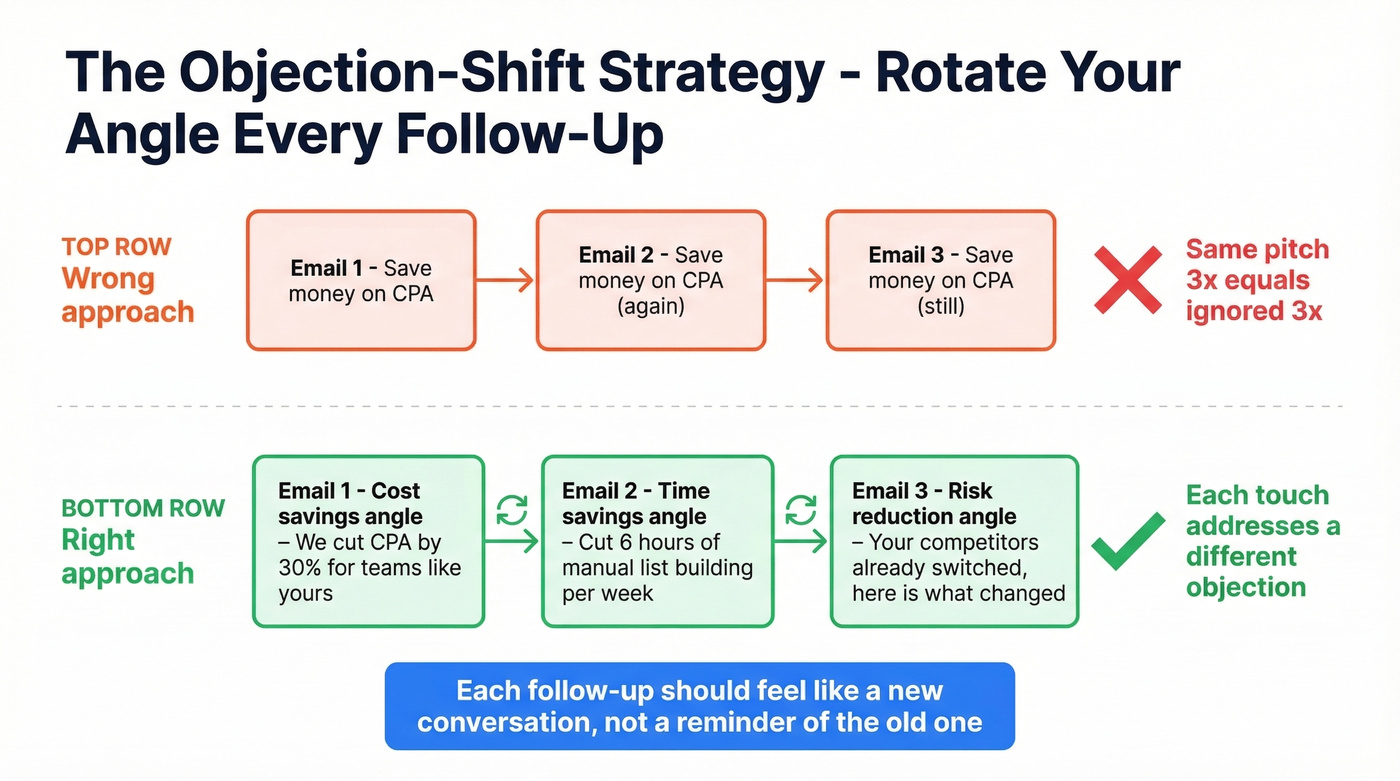
Bad second email (same pitch): "Just wanted to follow up on my email about reducing your CPA..."
Good second email (new angle): "Hi [Name], I realize my last email focused on cost savings. But talking to teams like yours, the bigger win is usually time savings - cutting 6 hours of manual list-building per week. Worth revisiting?"
Each follow-up should address a different potential objection. If email one was about cost, email two is about time. Email three is about risk. We've found this rotation approach works far better than hammering the same value prop three times in a row. (More on building sequences in our B2B Cold Email Sequence guide.)
Invoice / Payment Reminder
Friendly First Reminder
Subject: Invoice #[number] - quick reminder
Body: Hi [Name], just a heads-up that invoice #[number] for [amount] was due on [date]. If it's already been processed, ignore this! Otherwise, here's the [payment link]. Let me know if you have any questions.
Send 1-3 days after due date. Assumes good intent, makes payment easy.
The Follow-Up Cadence
| Day | Action | What Changes | Example Subject |
|---|---|---|---|
| 0 | Initial email | - | "Quick question" |
| 3 | Follow-up #1 | Add social proof | "Saw this, thought of you" |
| 7 | Follow-up #2 | New angle/objection | "Different take on [topic]" |
| 14 | Break-up email | Close the loop | "Should I close your file?" |
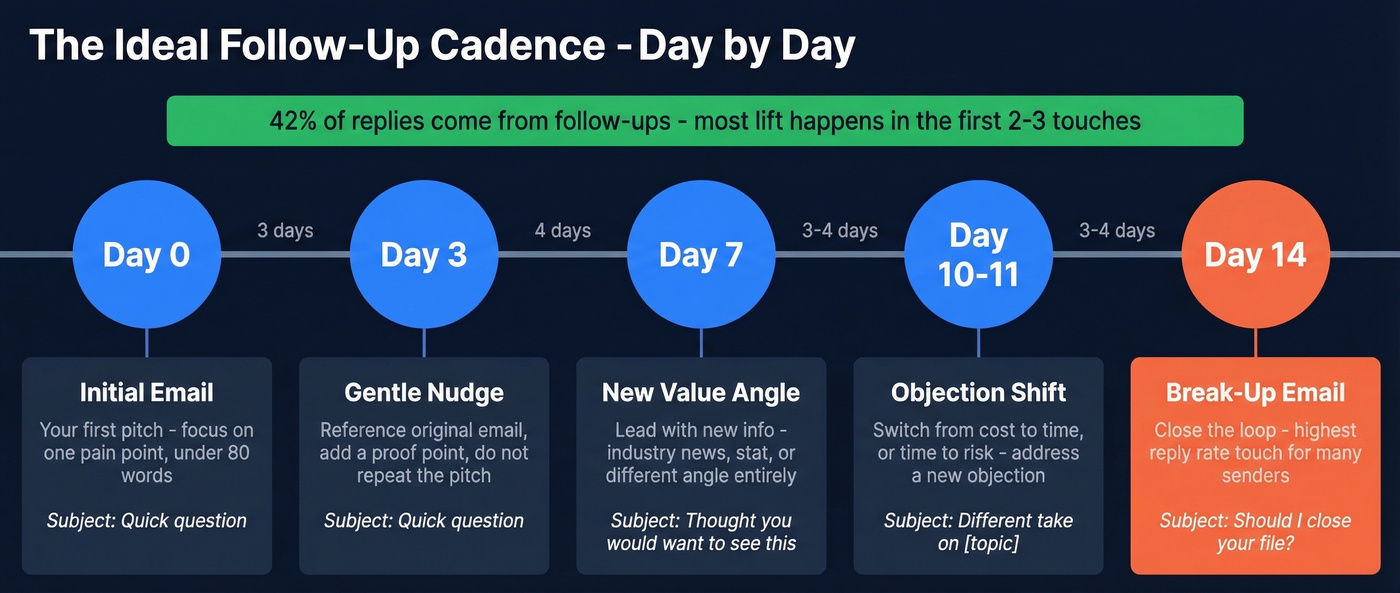
Send Tuesday through Thursday, 8-11 AM in the recipient's timezone - that window pulled 16% higher open rates in the Reddit case study, and Wednesday performs highest across broader benchmarks. (For a deeper breakdown, see Best Time to Send Cold Emails.)
After 3-4 follow-ups with zero engagement, stop. You're not persistent at that point; you're spam.
Let's be honest: if your deal size is under $10k, you probably don't need a 7-touchpoint sequence. Three follow-ups with tight copy will outperform a bloated sequence every time. The teams we've seen obsess over sequence length are usually avoiding the harder work of fixing their targeting and list quality. (If you need a system for that, start with Sales Prospecting Techniques.)
When NOT to follow up: If they explicitly said no, if they unsubscribed, or if the role is clearly wrong for your offer. Persistence is a virtue. Ignoring a "no" is not.
One note on industry norms: B2B SaaS buyers expect follow-ups. Recruiting and consulting prospects often have shorter patience. Adjust your cadence accordingly.
Before You Hit Send
The best follow-up sequence in the world fails if your emails don't reach the inbox. We've seen teams obsess over template wording while running a 12% bounce rate - it's like perfecting your free throw form while playing on a court with no hoops. (If you need the fundamentals, read our Email Deliverability Guide.)
One practitioner on r/Entrepreneur documented this exactly. Their reply rate cratered from 8% to 3% over 18 months. The fix wasn't better copy - it was infrastructure. They scaled from 3 domains to 7, capped sends at 26 per day per domain, and got their bounce rate from 11% to under 2%. Reply rates doubled from 3% to 6% in 62 days. Their total stack cost was about $420/month, generating 16 qualified leads - roughly $26 per lead.
Verify your list. Non-negotiable. Prospeo runs every address through a 5-step verification process - catch-all handling, spam-trap removal, honeypot filtering - with 98% accuracy and a 7-day refresh cycle. The free tier gives you 75 verifications per month to test it. (If you're comparing tools, see Bouncer Alternatives.)
Send plain text. HTML templates with logos and buttons scream "marketing email." Plain text feels like a real person wrote it.
Reply in the same thread. Don't start a new email for each follow-up. Replying in-thread keeps context visible and signals to email providers that this is a conversation, not a blast.
Follow-ups double reply rates - but only when they land. Prospeo refreshes 300M+ contacts every 7 days, not the 6-week industry average. That means the prospect list you build today is still accurate when your third follow-up goes out next week. No stale data, no bounces, no domain damage.
Build a follow-up sequence on data that's never more than 7 days old.
FAQ
How long should I wait before sending a follow-up email?
Three to four days after your initial email is the sweet spot. Following up sooner feels pushy; waiting longer than a week risks losing momentum. Start with the "Gentle Nudge" template above and adjust timing to match your sales cycle length.
How many follow-up emails should I send?
Two to three follow-ups capture most of the reply-rate lift. Woodpecker's data shows replies nearly double with follow-ups, but returns diminish sharply after the third touch. Beyond that, you need genuinely new value at each step.
What's a good follow-up email reply rate?
The average cold email reply rate is 3.43%. Top-quartile senders hit 5.5%+, and the top 10% exceed 10.7%. If you're above 5%, you're outperforming most outbound teams. Below 3%, audit your list quality and deliverability first - the problem is almost never the copy.
How do I stop follow-up emails from landing in spam?
Verify every address before sending. Cap daily volume at 25-30 per domain, use plain text formatting, warm up new domains for two weeks minimum, and always reply in the existing thread rather than starting a new one.
Should I reply in the same thread or start a new email?
Always reply in the same thread. It preserves context for the recipient and signals to inbox providers that this is a genuine conversation, not a mass blast - which directly improves deliverability and open rates.