

Sample Outreach Email Templates (and the System That Makes Them Work)
You sent 500 outreach emails last month and got 3 replies. Two were "please remove me from your list."
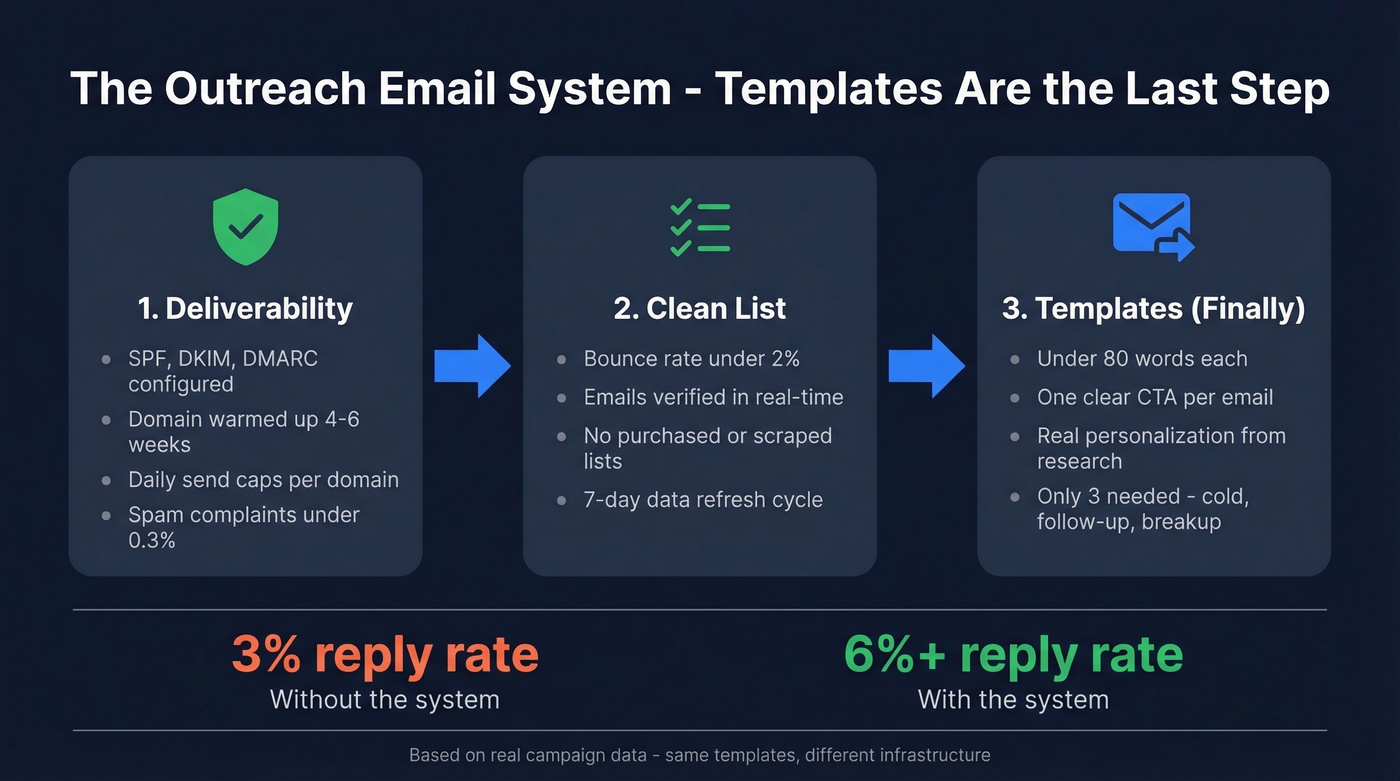
Here's the thing: the problem isn't your templates. It's everything underneath them. You don't need another sample outreach email copied from a blog post. You need 3 good templates, a clean list, and a deliverability setup that actually reaches the inbox. We've watched teams obsess over subject line A/B tests while Gmail quietly routes every message they send to spam - and that's the kind of misplaced effort that kills campaigns before they start.
What You Need Before the Templates
- Deliverability comes first. SPF, DKIM, DMARC, domain warm-up, daily send caps. If your emails hit spam, the best template in the world won't save you. (If you need a deeper walkthrough, start with our email deliverability guide.)
- Your list has to be clean. Bounce rate must stay under 2%. Every bounced email damages your sender reputation and every future email you send.
- Three strong templates beat fifty generic ones. A cold open, a follow-up, and a breakup - personalized with real prospect data, kept under 80 words each. One practitioner cut email length from 141 words to under 56 and watched reply rates jump from 3% to 6%. That's the whole system.
2026 Outreach Email Benchmarks
The average cold email reply rate in 2026 is 3.43%. Top-quartile campaigns hit 5.5%+. Elite performers - teams with dialed-in infrastructure, tight lists, and real personalization - exceed 10%.
| Metric | Average | Elite |
|---|---|---|
| Open rate | 30-45% | 60%+ |
| Reply rate | 1.5-3% | 5%+ |
| Bounce rate | 3-5% | <1% |
These benchmarks are diagnostic. If your open rates are below 30%, that's a deliverability or sender reputation problem, not a subject line problem. Don't waste time A/B testing subject lines when Gmail is routing you to spam.

A Mailshake reviews benchmark roundup references a separate analysis of 1.37M cold emails showing just a 2.09% average reply rate. Methodology varies, but the pattern holds: most teams underperform because of infrastructure, not creativity.
Deliverability Checklist Before Sending
Google and Yahoo's bulk sender rules aren't suggestions anymore. They're enforced.
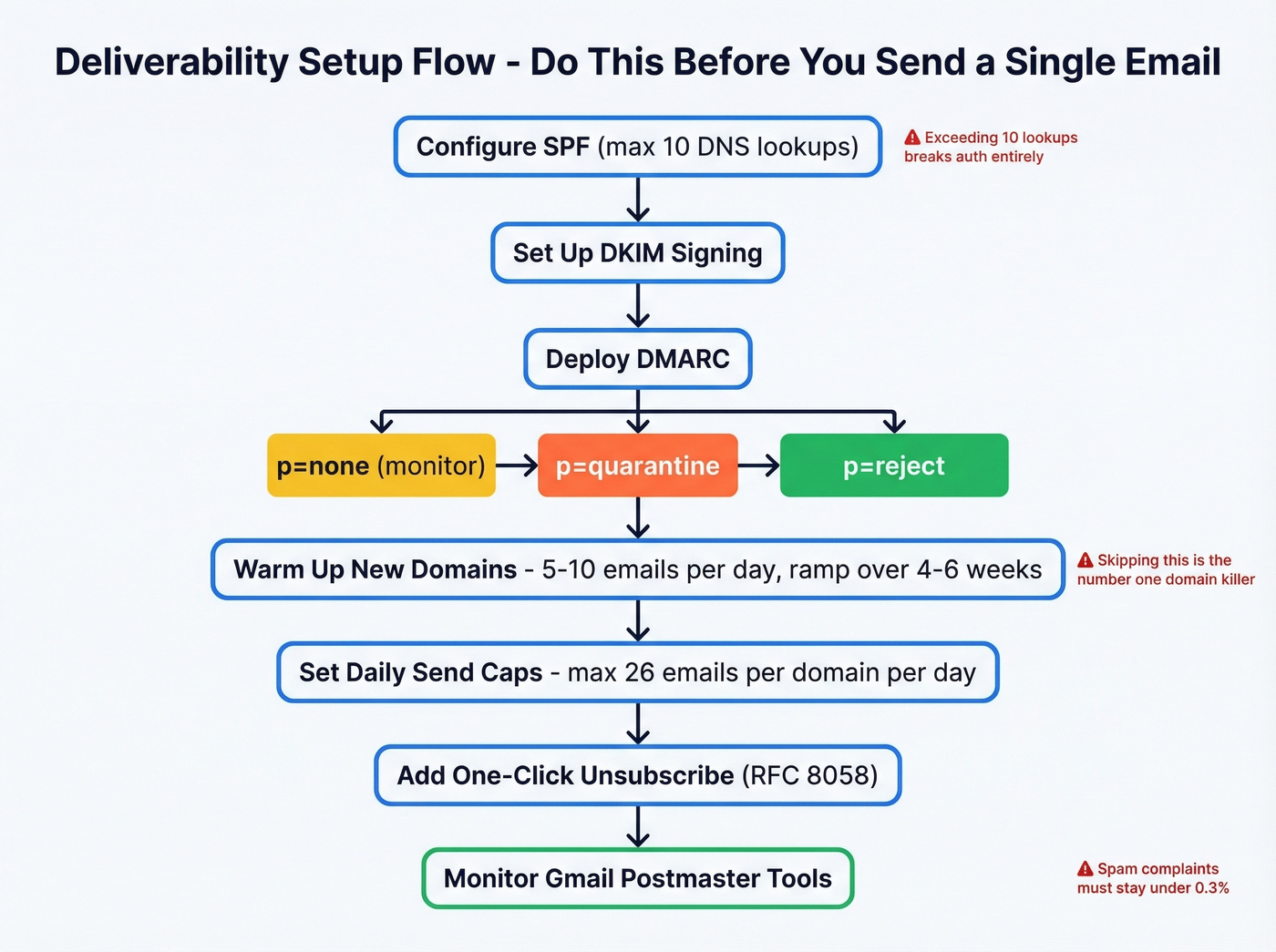
- SPF, DKIM, and DMARC - all three, configured correctly. SPF has a 10 DNS lookup limit; exceed it and your authentication breaks entirely. Start DMARC at
p=none, move top=quarantine, thenp=reject. (More detail: DMARC alignment and SPF record examples.) - Spam complaints under 0.3% That's Gmail's Postmaster Tools threshold. Cross it and you're throttled.
- Bounce rate under 2%. Non-negotiable. Every bounce above this erodes sender reputation. (See: email bounce rate.)
- Warm up new domains at 5-10 emails per day, ramping over 4-6 weeks. (If you want options, compare unlimited email warmup tools.)
- One-click unsubscribe in every email (RFC 8058 compliance).
- GDPR compliance for B2B outreach - legitimate interest basis, clear opt-out, and data processing transparency.
A practitioner on r/Entrepreneur rebuilt their infrastructure from the ground up: went from 3 domains to 7, capped each at 26 emails/day, and dropped their bounce rate from 11% to under 2%. Reply rate doubled from 3% to 6%. Total stack cost: ~$420/month generating 16 qualified leads. The templates didn't change. The system did.
Fix Your List Before Your Copy
Your bounce rate is 11% and you don't even know it. Meanwhile, Gmail is quietly routing everything you send to spam.
That same campaign is worth studying closely. The single biggest factor in doubling their reply rate wasn't copy, timing, or subject lines - it was ditching purchased lists and manually verifying every contact. Bounce rate went from 11% to under 2%, and everything else improved as a result. We've seen this pattern repeat across dozens of campaigns we've analyzed: list quality is the multiplier that makes or breaks everything downstream.

Templates are useless if emails bounce. Prospeo verifies emails in real-time with 98% accuracy on a 7-day refresh cycle - not the 6-week industry average that lets data rot between campaigns. The free tier covers 75 emails plus 100 Chrome extension credits per month, enough to validate your first campaign list before you burn a domain. (If you're comparing tools, start with AI email checker or Bouncer alternatives.)

That practitioner who cut bounce rates from 11% to under 2%? They did it by verifying every contact. Prospeo does that automatically - 98% email accuracy on a 7-day refresh cycle, so your list never goes stale between campaigns. The free tier gives you 75 verified emails per month to test before you commit a single domain.
Stop burning domains on bad data. Verify your list first.
Subject Lines That Get Opens
A Belkins study of 5.5M emails found personalized subject lines hit a 46% open rate versus 35% without personalization. The reply rate gap is even more striking: 7% with personalization versus 3% without. Questions performed best. Ideal length? Two to four words.
If you want more patterns to test, pull from these cold email subject line examples (and broader email subject line examples).
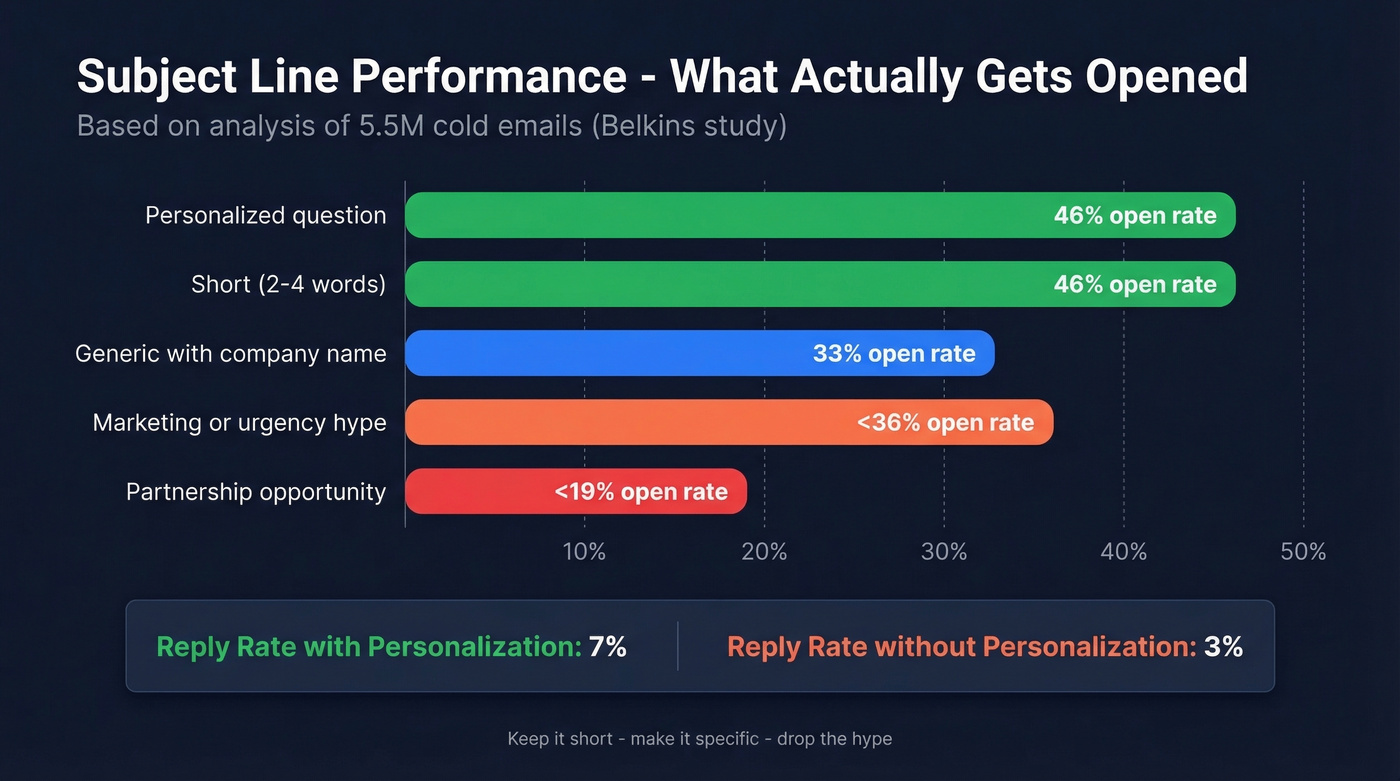
| Subject Style | Open Rate |
|---|---|
| Personalized question | ~46% |
| Short (2-4 words) | ~46% |
| Company name included | ~33% |
| Marketing/urgency hype | <36% |
| "Partnership opportunity" | <19% |
Keep it short. Make it specific. Drop the hype.
10 Outreach Email Examples That Convert
Every template below follows the same rules: under 80 words, one clear CTA, and a reason the prospect should care. These are frameworks - adapt the specifics to your ICP. (If you want a full sequence, see our B2B cold email sequence guide.)
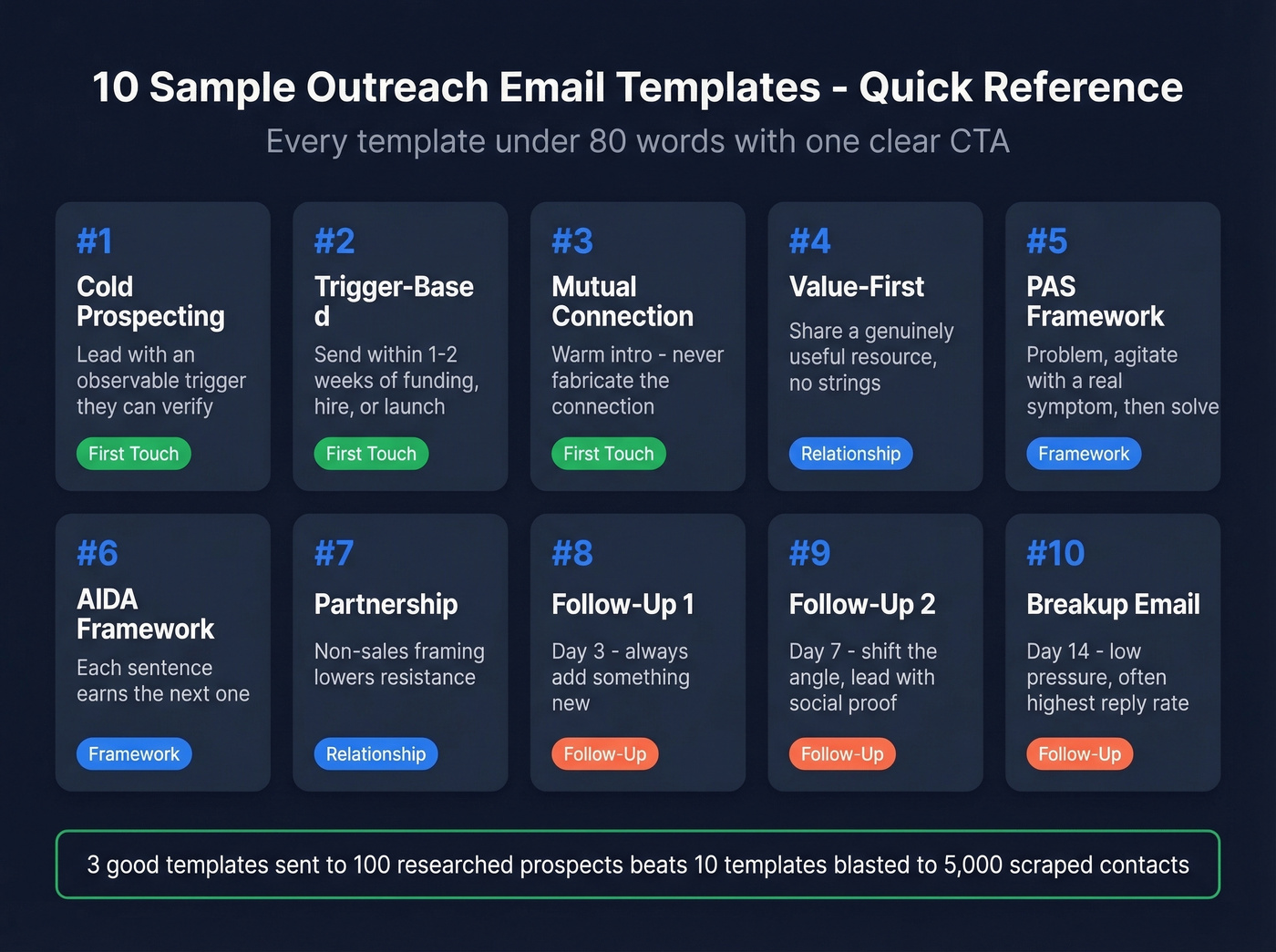
Let's be honest: most teams would get better results sending 3 of these templates to 100 well-researched prospects than blasting all 10 to 5,000 scraped contacts. Volume is a crutch for bad targeting.
1. Cold Prospecting (First Touch)
Subject: Quick question about {{department}}
Hi {{firstName}},
Noticed {{company}} is scaling the {{department}} team. When teams grow that fast, {{specific pain point}} usually becomes the bottleneck.
We help {{similar companies}} solve that - typically seeing {{specific result}} within 60 days.
Worth a 15-minute call this week?
The key is the observable trigger in the opening line. When the first sentence is real, the rest of the email gets read. This sample outreach email works because it leads with something the prospect can verify - not a generic compliment.
2. Trigger-Based (Funding / Hire / Launch)
Subject: Congrats on the Series B
Hi {{firstName}},
Saw {{company}} just closed a {{funding round}}. Congrats - that's a big milestone.
Teams at this stage usually need to {{common post-funding challenge}}. We helped {{similar company}} do exactly that, cutting {{metric}} by {{percentage}}.
Happy to share what worked if you've got 15 minutes.
Send within 1-2 weeks of the trigger event. Timeliness creates relevance - the prospect knows you're paying attention, not blasting a list.
3. Mutual Connection / Referral
Subject: {{mutual connection}} suggested I reach out
Hi {{firstName}},
{{Mutual connection}} mentioned you're working on {{initiative}} and thought we should connect.
We've been helping teams like {{similar company}} with {{specific outcome}}.
Would you be open to a quick call?
Warm intros convert better than cold outreach. Don't fabricate the connection - prospects check.
4. Value-First (Resource Share)
Skip this template if you don't have a genuinely useful asset to share. A thinly disguised pitch dressed up as a "resource" will backfire every time.
Subject: Thought this might help
Hi {{firstName}},
Put together a {{resource type}} on {{topic relevant to their role}}. It covers {{specific insight}} that's been useful for {{persona}} teams.
Here's the link: {{URL}}
No strings attached - just thought it'd be relevant given {{company}}'s focus on {{initiative}}.
Leading with value instead of an ask builds goodwill. The CTA is implicit.
5. PAS Framework (Problem-Agitate-Solve)
This framework mirrors how people process buying decisions: name the pain, make it real, offer the fix.
Subject: {{pain point}} at {{company}}?
Hi {{firstName}},
Most {{persona}} teams at {{company stage}} struggle with {{pain point}}. It usually shows up as {{symptom}} - and it gets worse as you scale.
We built {{product/feature}} specifically for this. {{Similar company}} cut their {{metric}} by {{percentage}} in {{timeframe}}.
Worth exploring?
The agitation sentence is where most people go wrong. Don't invent pain - describe a symptom they'll recognize immediately.
6. AIDA Framework
Subject: {{company}} + {{your company}}
Hi {{firstName}},
{{Attention-grabbing stat or observation about their industry}}.
{{Company}} is in a unique position to {{opportunity}} - especially given {{specific company detail}}.
We've helped {{similar companies}} capture that opportunity, averaging {{result}}.
Can I send over a 2-minute breakdown of how?
Each sentence earns the next. If your attention-grabber is weak, the rest collapses.
7. Partnership / Collaboration
Subject: Idea for {{company}} + {{your company}}
Hi {{firstName}},
Been following {{company}}'s work on {{initiative}}. We're doing something complementary with {{your focus area}}.
Thinking there's a natural overlap - specifically around {{shared audience or goal}}.
Would love to explore what a collaboration looks like. Open to a quick chat?
Non-sales framing lowers resistance. Decision-makers respond to partnership language differently than vendor pitches.
8. Follow-Up #1 (Day 3)
Subject: Re: {{original subject}}
Hi {{firstName}},
Wanted to bump this up - also wanted to share that {{new piece of value: stat, case study, or insight}} that's relevant to {{their initiative}}.
Still happy to chat if the timing works.
Never send a follow-up that just says "checking in." Every touch needs to add something new.
9. Follow-Up #2 (Day 7)
Subject: {{social proof angle}}
Hi {{firstName}},
{{Similar company in their space}} just {{achieved result}} using our approach to {{problem}}.
Thought it'd resonate given {{company}}'s focus on {{initiative}}.
Shift the angle completely. Lead with social proof instead of repeating your original pitch. A new angle signals you're not auto-following up - you're thinking about their situation.
10. Breakup Email (Day 14)
Subject: Should I close the loop?
Hi {{firstName}},
I've reached out a couple of times about {{topic}}. Totally understand if the timing isn't right.
If {{pain point}} becomes a priority down the road, I'm here. Otherwise, I'll stop filling your inbox.
Breakup emails often get the highest reply rates in a sequence because they remove the obligation to respond. Low pressure, respectful, surprisingly effective.
Follow-Up Sequence and Timing
58% of all replies come from the first email. That means 42% come from follow-ups - stopping after one email leaves nearly half your replies on the table.
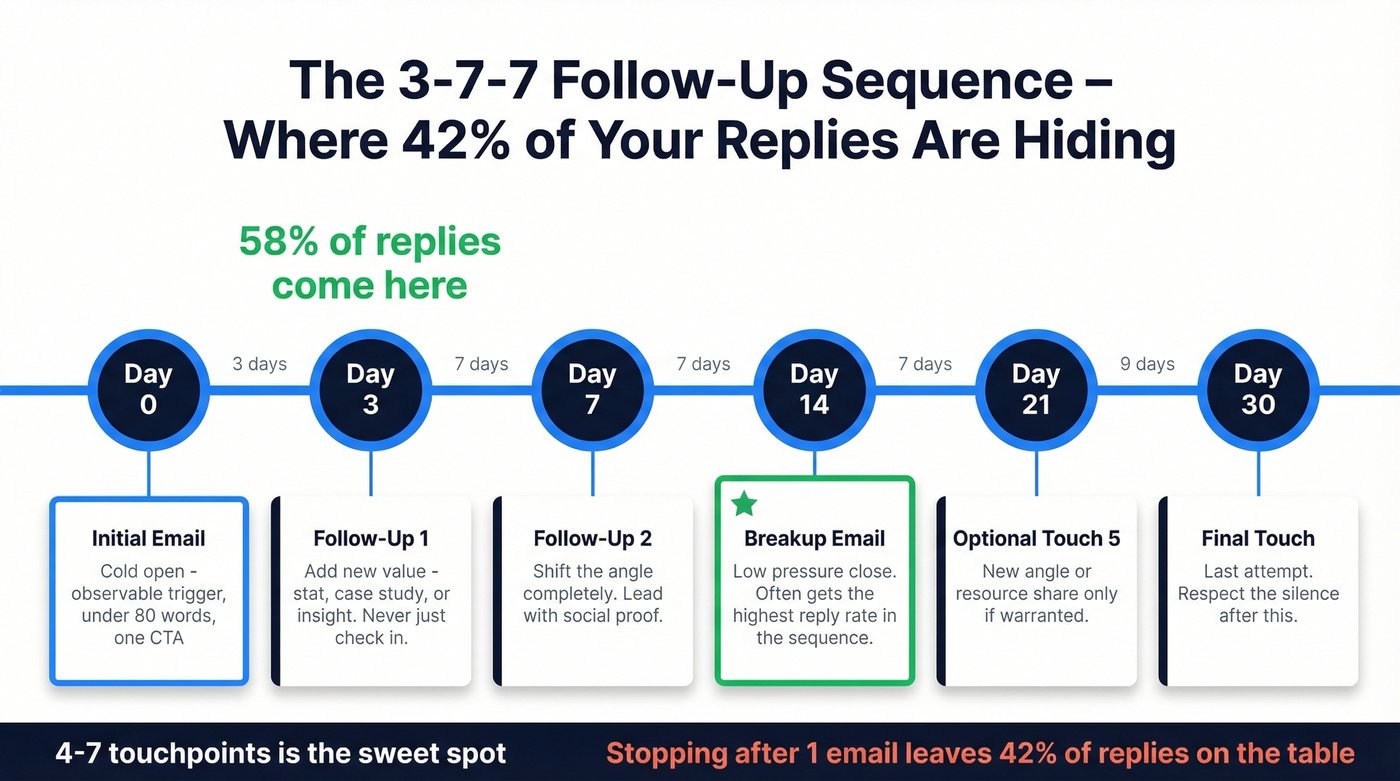
The 3-7-7 rule gives you a clean cadence: follow up 3 days after your initial email, then every 7 days. Full sequence: Day 0, Day 3, Day 7, Day 14, Day 21, Day 30. The sweet spot is 4-7 touchpoints. Campaigns with 2-3 follow-ups boost reply rates by 40-80% compared to single-email sends. Send Tuesday through Thursday, 9-11 AM in the recipient's timezone - Wednesday is the highest-performing day in 2026 benchmark data. And every follow-up needs to earn its spot. "Just checking in" is a waste of an email. (More data here: best time to send cold emails.)
Personalization That Moves the Needle
Most teams are stuck at level one - inserting {{firstName}} and calling it done.
The real progression runs deeper. Role and KPI-based personalization ties your message to what their job actually measures. Trigger-based outreach connects to funding rounds, new hires, or product launches. Company-level insight draws from their tech stack and growth trajectory. And intent signals like pricing page visits or competitor comparisons tell you who's actively shopping for a solution right now. (If you want a system, see personalized outreach.)
"Decorative personalization" - generic compliments, vague references to their work - actually reduces trust. One practitioner on r/automation used Make.com and OpenAI to scrape prospect bios, generate three tailored automation ideas per contact, and insert them as template variables. Response rate went from 2% to 8%, processing 1,000 personalized messages in about 30 minutes. We've seen similar results when teams invest in research infrastructure over copy tweaks. The best outreach emails we've analyzed all share one trait: the personalization references something the prospect did, not just who they are.
At the high end, Siege Media ran a campaign that hit 81% opens and 13% reply rate - proof that deep personalization at scale works. It just requires better data inputs than a first name and company.
Mistakes That Kill Reply Rates
Over-automation without real personalization. If every email reads like a mail merge, prospects can tell. Automation should scale your research, not replace it.
Poor mobile formatting. Tiny text, broken layouts, and walls of copy kill engagement before the prospect reads a word. Preview every email on a phone screen before it goes out.
Sending too frequently. Email fatigue triggers unsubscribes and spam flags. Respect the cadence - 3-7 day spacing, not daily blasts.
Zero segmentation. Blasting your entire list with the same message is the fastest way to tank reply rates. Segment by role, company stage, and pain point at minimum. I've watched teams triple their reply rates just by splitting one list into three segments with slightly different opening lines. (For a practical approach, use intent based segmentation.)
Every sample outreach email on this page needs one thing to work: a real person reading it. Prospeo's 300M+ profiles with 30+ filters - including job changes, funding events, and hiring signals - let you find the exact prospects who match your triggers. At $0.01 per email, building a verified list of 500 contacts costs less than your morning coffee run.
Find the trigger-ready prospects these templates were built for.
FAQ
What's a good reply rate for outreach emails?
The 2026 average is 3.43%. Top-quartile campaigns hit 5.5%+, and elite performers exceed 10%. If you're consistently above 3%, your deliverability and list quality are solid - optimize copy and personalization from there.
How many follow-ups should I send?
Three to four follow-ups using the 3-7-7 cadence: first follow-up after 3 days, then every 7 days. Campaigns with 2-3 follow-ups boost reply rates 40-80% compared to single sends.
How long should a cold outreach email be?
Under 80 words. Top-performing campaigns consistently stay below that threshold. Shorter emails force you to lead with value and respect the prospect's time - both of which drive higher reply rates.
What's the best day to send cold emails?
Tuesday through Thursday, 9-11 AM in the recipient's timezone. Wednesday is the top-performing day in 2026 benchmark data. Avoid Mondays (inbox overload) and Fridays (early checkout).
How do I build a verified list for outreach campaigns?
Start with a verification tool that catches invalid addresses before they bounce - keeping your rate under 2% protects sender reputation while you test your first campaign. Pair verification with bounce rate monitoring and you'll know within days whether your list is clean enough to scale.