Stop Motivating Your SDRs. Fix What's Demotivating Them.
It's 2pm on a Thursday. Your SDR just finished a 47-call block. Most went to voicemail. Three people said "call back next quarter." One hung up mid-sentence. Now multiply that by every weekday since January.
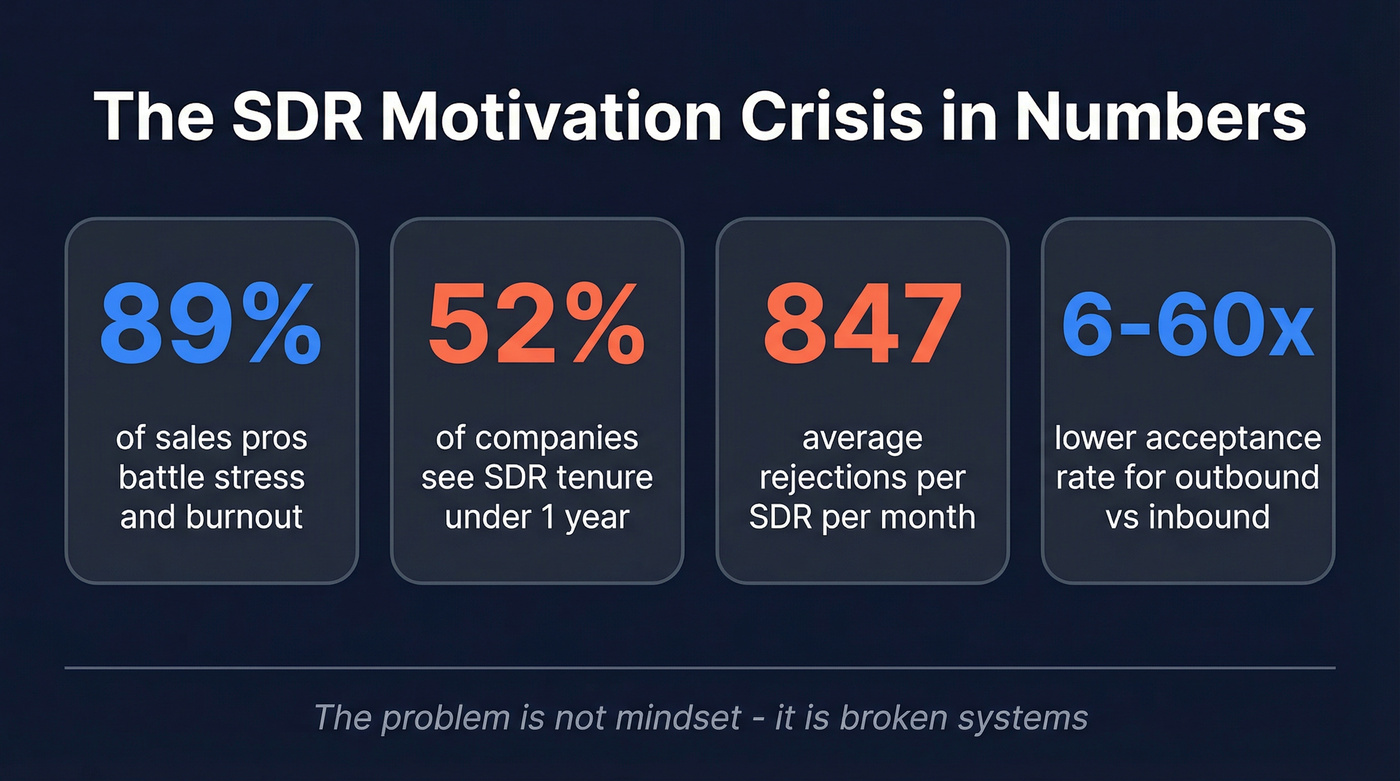
89% of sales professionals battle stress and burnout. 52% of companies report average SDR tenure under one year. And yet most managers respond to flagging energy with pizza parties and Spotify playlists. SDR motivation doesn't fail because reps lack grit - it fails because the machine they're working inside is broken. If you're wondering how to keep reps engaged, the answer starts with fixing systems, not attitudes.
The Real Motivation Problem Isn't Mindset
Here's a pattern we see constantly: an SDR sends 200+ emails a day, works 600-700 accounts a month, and still misses quota. The instinct is to question their effort. The real answer, almost every time, is that the system is broken.
Chili Piper documented a similar pattern. Their team was grinding at full capacity, but tenured reps had access to better accounts while newer SDRs churned through low-conversion territory. The problem wasn't hustle - it was inequitable pipeline quality creating slower ramp, higher frustration, and wasted effort on accounts that were never going to convert. After rebalancing, their outbound team ended at 118% of their closed-won goal - not by working harder, but by fixing account allocation.
The average SDR faces roughly 847 rejections per month. Outbound acceptance rates run 6-60x lower than inbound demo requests. Stack systemic disadvantages on top of that baseline rejection volume and motivation doesn't erode - it collapses. No amount of gamification fixes a rigged game.
Fix the Foundation First
Before you touch leaderboards, spiffs, or coaching cadences, audit three things.
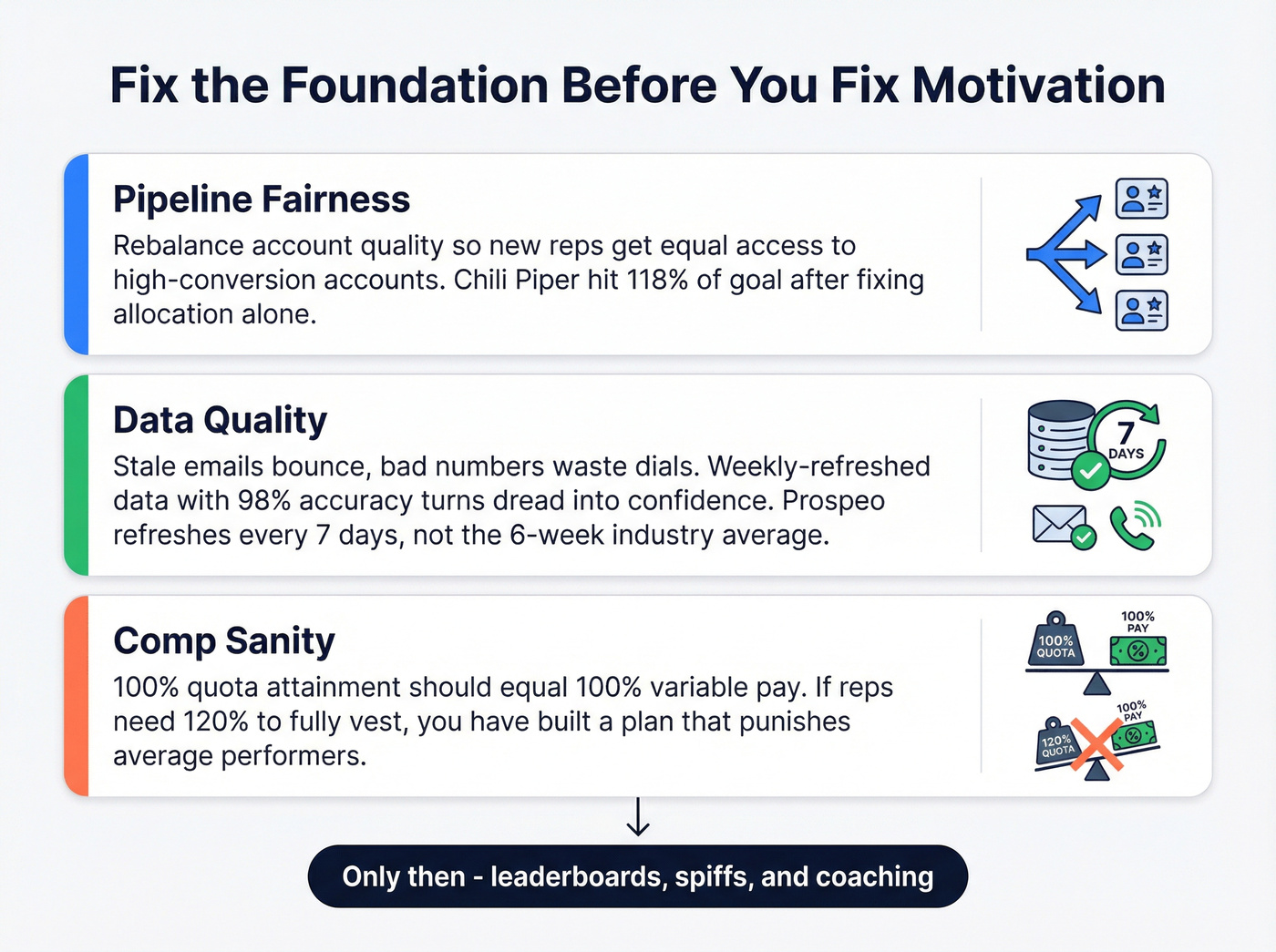
Pipeline fairness. Are new reps getting the same quality accounts as tenured ones? Chili Piper rebalanced their pipelines so all SDRs accessed higher-quality accounts, and the result was reduced ramp time, better efficiency, and improved outcomes without increasing anyone's workload. If your top performer's territory is three times richer than your newest hire's, you don't have a motivation problem. You have an allocation problem.
Data quality. Your SDR just spent 90 minutes on a call block where a big chunk of the numbers were disconnected. That's not a motivation problem - it's a data quality problem. Stale emails bounce, bad numbers waste dial time, and every dead-end compounds into frustration that looks like disengagement. We've watched teams go from demoralized to energized just by swapping their data provider. Prospeo delivers 98% email accuracy and 125M+ verified mobiles with a 30% pickup rate, refreshed every 7 days - not the 6-week industry average. When reps trust their data, they stop dreading the phone and start actually selling.

Comp sanity. If your OTE is $70k but the variable component requires 120% quota attainment to fully vest, you've built a plan that punishes average performers. SDRs talk. Make sure a rep hitting 100% of quota earns 100% of their variable - that's the bare minimum for trust.
Build Visible Progress Systems
Single-outcome leaderboards - "most meetings booked this month" - actively demotivate 80% of your team. The top two reps love them. Everyone else checks out by week two.
Teams with high visibility into performance metrics are 21% more productive. But visibility only works when you're tracking the right things. Run multiple leaderboards: calls made, meetings booked, pipeline created, follow-up cadence consistency. This lets mid-pack reps win somewhere, which keeps them engaged instead of demoralized.
Social comparison alone increases effort by roughly 12%, even without material rewards. That's a free boost - but only if the comparison feels fair. The moment you introduce scarcity mechanics like "bottom performer loses their territory," you've crossed from motivation into anxiety. Recognition should pull people forward, not push them away from a cliff.

You just read it: bad data compounds into burnout. Prospeo delivers 98% email accuracy and 125M+ verified mobiles refreshed every 7 days - so your SDRs spend call blocks actually reaching prospects, not listening to disconnected number tones.
Stop demotivating your team with dead-end dials.
SDR Incentives That Actually Work
Use non-cash incentives. Cash bonuses sound great until tax withholding takes a big bite and the rep gets a smaller check than expected. XANT found that a straight cash-per-appointment incentive lifted bookings just 3.4%. But when they added a top-performer prize, the team booked 19% of the month's total appointments in a single day. Novelty and competition outperform dollars almost every time.
Skip pure individual rewards. They over-reward your top rep - who'd perform anyway - and ignore everyone else. Mix three categories: individual achievement, team-based goals, and personal improvement metrics. A rep who went from 8 meetings to 14 deserves recognition even if someone else booked 20.
What actually lands: KPI bingo, experience prizes like concert tickets or a nice dinner, extra PTO, professional development budgets. The common thread is that these feel like rewards, not taxable income.
Coach Weekly, Promote on a Timeline
Two coaching sessions per week is the minimum cadence that moves the needle. Not pipeline reviews - actual skill coaching. Call teardowns, objection handling practice, email copy feedback. We've seen teams where "coaching" means a weekly forecast call. That's not coaching. That's reporting.
Ask any SDR what kills their drive and you'll hear the same three things: bad data, no career path, and managers who confuse pipeline reviews with development. Let's be honest - engagement and career growth are inseparable. Reps who can see their future stay longer and perform better.
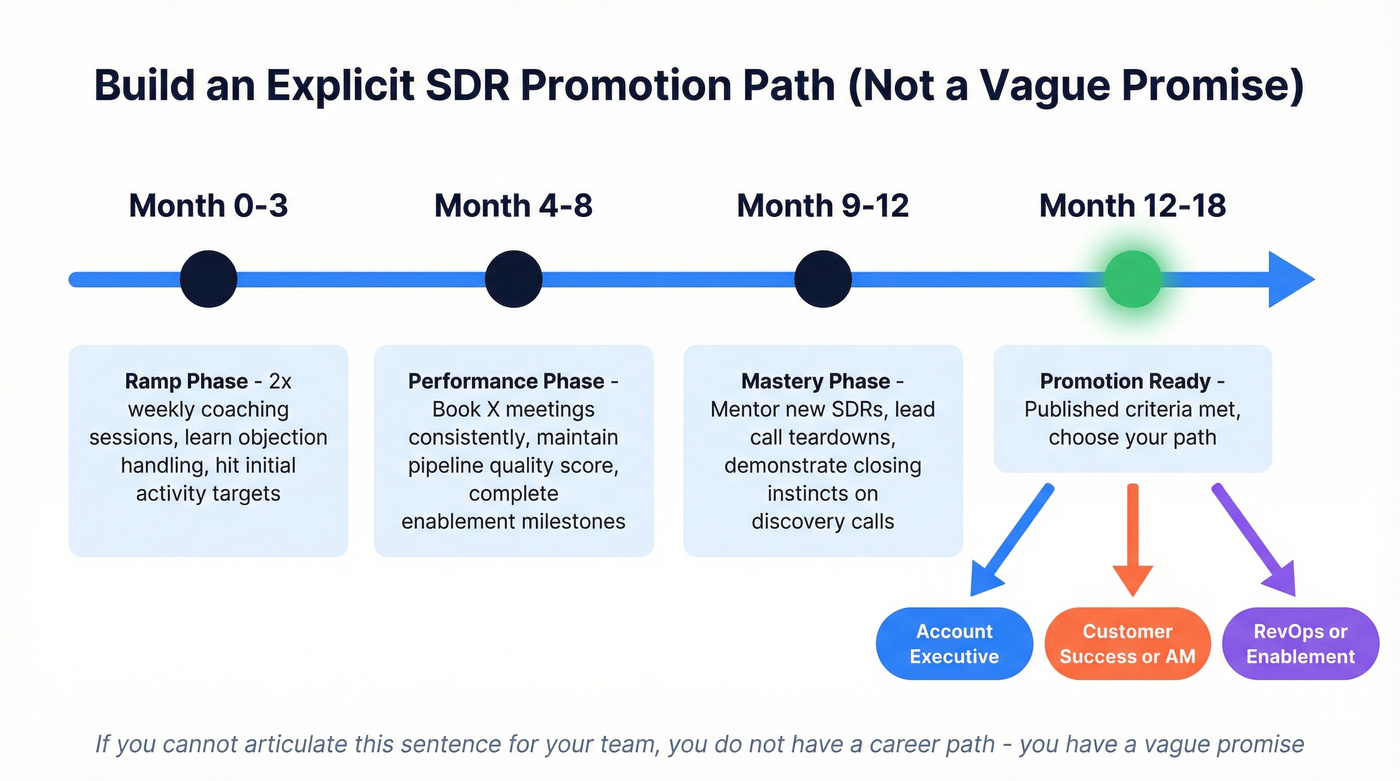
Here's the thing about the 52% tenure stat: most SDRs don't leave because the job is hard. They leave because they can't see what's next. Temporal discounting is real - a promotion "sometime next year" feels abstract and worthless compared to today's rejection. Publish explicit promotion criteria. "Book X meetings over Y months, maintain Z pipeline quality, complete these enablement milestones, and you'll be promoted to AE within 12-18 months." If you can't articulate that sentence for your team, you don't have a career path - you have a vague promise. And map multiple exits: AE, Account Management, Customer Success, RevOps. Not every SDR wants to carry a closing quota.
The Manager Checklist
- Pipeline fairness: Audit account quality distribution monthly. New reps get equal access to high-conversion accounts.
- Data quality: Arm your team with verified emails and direct dials. Weekly-refreshed data eliminates the invisible waste that compounds into burnout.
- Multiple leaderboards: Track calls, meetings, pipeline, and follow-up cadence - not just one outcome metric.
- Non-cash incentives: Mix individual, team, and improvement-based rewards. Experiences over cash.
- 2x/week coaching: Real skill development, not forecast reviews (use a cold call coaching framework).
- Explicit promotion path: Published criteria, 12-18 month timeline, multiple next-step roles (see SDR job meaning for role + career-path context).
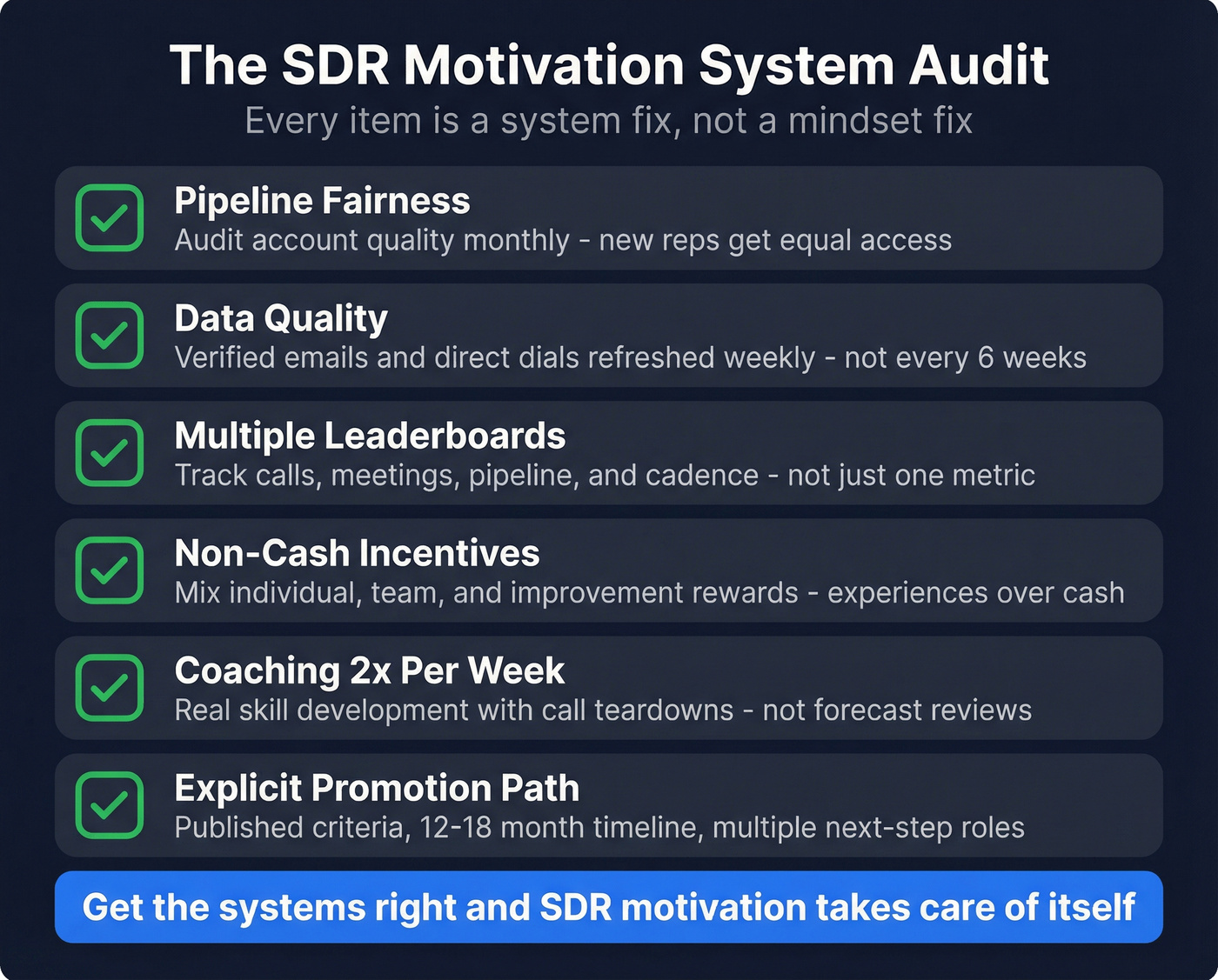
Every item on this list is a system fix, not a mindset fix. Get the systems right, and SDR motivation takes care of itself.
Every bounced email and disconnected number chips away at your SDRs' drive. Prospeo's 30% mobile pickup rate means reps connect with real buyers 3x more often than with legacy providers - turning rejection-heavy days into pipeline-building ones.
Give your reps data worth dialing at $0.01 per verified email.