

SDR Productivity: Benchmarks, Fixes & Tools (2026)
Your SDR manager just showed you the dashboard. Activity is up - more dials, more emails, more "touches" logged. But meetings booked? Flat. Pipeline? Shrinking. The average SDR team hits just 43% quota attainment, and 83.4% of reps miss quota month-over-month. That's not a coaching problem. That's a systems problem.
Most SDR productivity issues trace back to data quality, speed-to-lead, and territory math - not effort. Fix those three before you touch cadences or coaching scripts.
What SDR Productivity Actually Measures
SDR productivity is output per rep, not activity volume. The core formula: meetings booked / active SDRs. Dials, emails sent, talk time - that's input. Tracking the right metrics is what separates teams that improve from teams that just feel busy.
The Bridge Group's 2025 report across 351 B2B companies shows an average SDR-to-AE ratio of 1:2.4, with ramp time at 3.0 months - the lowest since 2010. If your reps aren't productive after three months, the problem is structural.
2026 SDR Benchmarks
These numbers come from research covering 16.5M cold emails and 204K+ cold calls, plus Bridge Group data.
| Metric | Average | Good | Top Performer |
|---|---|---|---|
| Cold email reply | 5.8% | 7-8% | 10%+ |
| Cold call success | 2.3% | 4-5% | 6.7%+ |
| Meetings/month | 15 | 18-20 | 25+ |
| Show rate | 80% | 85% | 90%+ |
| Meeting to opp | ~50% | 55-60% | 65%+ |
| Quota attainment | 56-60% | 70% | 80%+ |
Cold email reply rates have dropped from 6.8% in 2023 to 5.8% today - a 15% decline in three years. If your sequences haven't changed since then, they're underperforming by default.
Here's what's counterintuitive: most teams respond to that decline by adding more steps to their cadences. The data says the opposite works. Single-email sequences pull an 8.4% reply rate. Contacting just 1-2 people per company yields 7.8%. Shorter and tighter beats longer and louder every time.
The SDR Time Allocation Audit
Your SDRs aren't lazy - they're drowning. Salesforce's State of Sales data shows reps spend 60% of their time on non-selling tasks. Here's where those hours actually go:
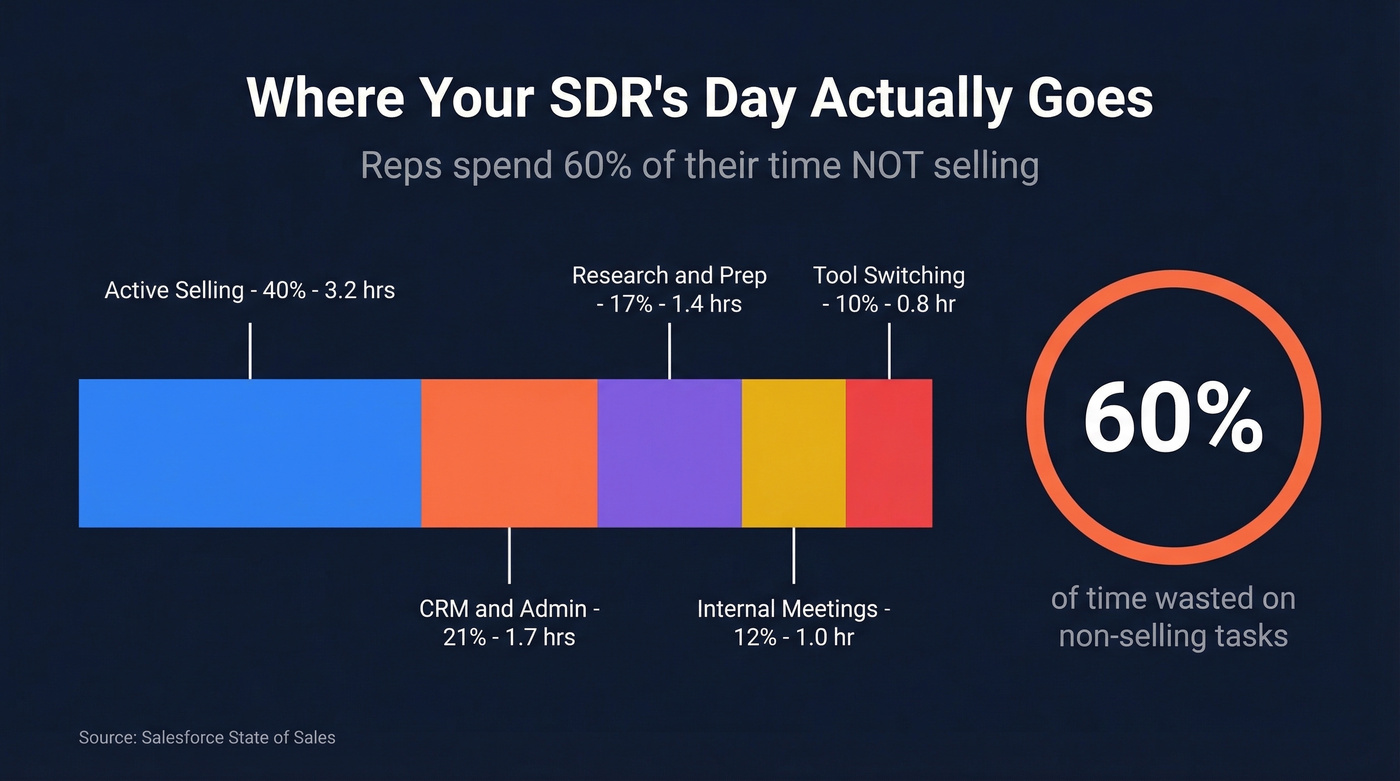
| Activity | % of Day | Hours |
|---|---|---|
| Active selling | 40% | 3.2 hrs |
| CRM / admin | 21% | 1.7 hrs |
| Research / prep | 17% | 1.4 hrs |
| Internal meetings | 12% | 1.0 hr |
| Tool switching | 10% | 0.8 hr |
The typical SDR uses 7+ tools daily, and every switch costs focus. We've audited dozens of SDR stacks, and the pattern is always the same: too many tools, not enough integration, reps alt-tabbing their way through the day instead of actually selling. That 60% problem isn't about discipline. It's about infrastructure.
The 5 SDR Productivity Killers
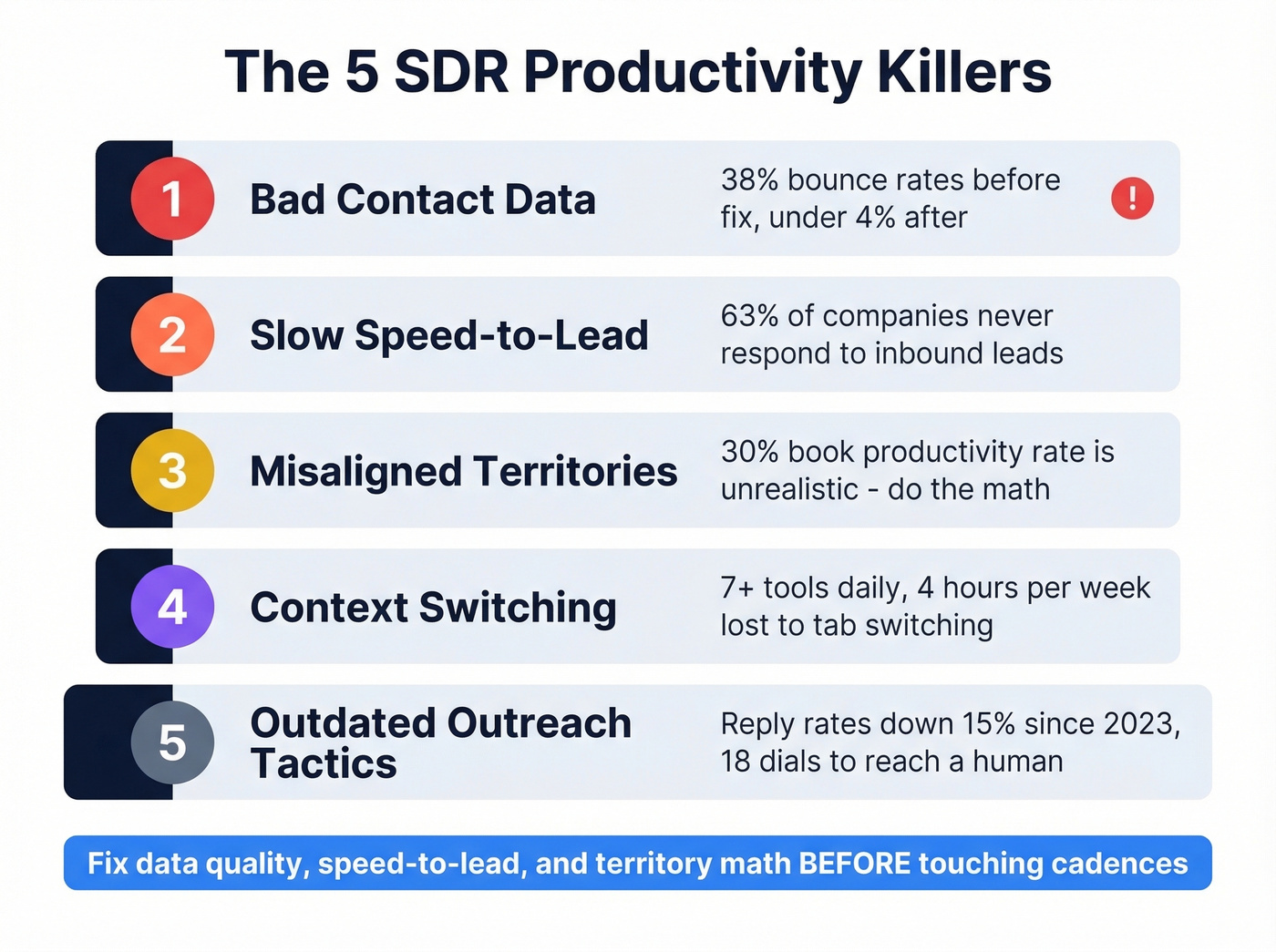
1. Bad Contact Data
SDRs spend 17% of their day on research and prep - largely because their data is stale. When a huge chunk of your phone numbers are wrong, no dialer will save you.
GreyScout experienced this firsthand. After switching to verified data through Prospeo, they cut rep ramp time from 8-10 weeks to 4 weeks and dropped bounce rates from 38% to under 4%. Pipeline jumped 140%. The lesson: teams invest in sequencing tools and coaching while their foundation - the contact data - is rotten.

2. Slow Speed-to-Lead
This one is brutal. 63% of companies never respond to inbound leads at all. Among those that do, average response time exceeds 29 hours. Responding within one minute delivers a 391% higher conversion rate, and 78% of buyers purchase from the first company to respond.
Within five minutes? That's a 9x conversion lift versus thirty minutes. Every minute you wait, you're handing pipeline to a competitor who picked up the phone faster.
3. Misaligned Territories
If the math requires your SDR to convert accounts at an unrealistic rate just to hit quota, that's a territory problem, not a rep problem. Quick test: if your rep has 200 accounts and needs 30 meetings per quarter, that's a 15% book productivity rate - achievable. Give them 100 accounts with the same target? That's 30%. Unrealistic.
Let's be honest - we've seen managers blame reps for "not hustling" when the territory math was broken from day one.
4. Context Switching
Seven-plus tools, 0.8 hours per day lost to switching between them. That's roughly 4 hours per week spent clicking between tabs instead of talking to prospects. Every tool you add needs to justify the cognitive tax it imposes. When reps constantly bounce between research, dialing, emailing, and CRM updates, deep focus becomes impossible. The consensus on r/sales is pretty clear: tool sprawl kills more pipeline than bad messaging does.
5. Outdated Outreach Tactics
Reply rates are down 15% since 2023. It takes 18 dials on average to reach a human, and 93% of conversations happen by the third call attempt. If your team is still running the same 7-step cadence from three years ago, they're fighting with a dull blade.

Bad data is the #1 SDR productivity killer. GreyScout cut ramp time in half and boosted pipeline 140% after switching to Prospeo's verified contacts. With 98% email accuracy, a 7-day refresh cycle, and 125M+ verified mobiles, your reps stop researching and start selling.
Give your SDRs data that actually connects them to buyers.
How to Improve SDR Efficiency
Fix your data first. This is the single highest-return move you can make. Snyk's 50-person AE team was running 35-40% bounce rates. After switching to verified data, bounces dropped under 5%, pipeline jumped 180%, and they generated 200+ new opportunities per month. Clean data doesn't just help SDRs - it lifts the entire revenue org. (If you want a deeper breakdown, start with email bounce rates and email deliverability.)
Set a speed-to-lead SLA. Five minutes max for inbound. No exceptions. InsideSales data shows a 9x conversion lift when you respond within five minutes versus thirty. Route leads automatically, alert reps in real time, measure compliance weekly. (This pairs well with a simple lead status model so nothing gets stuck.)
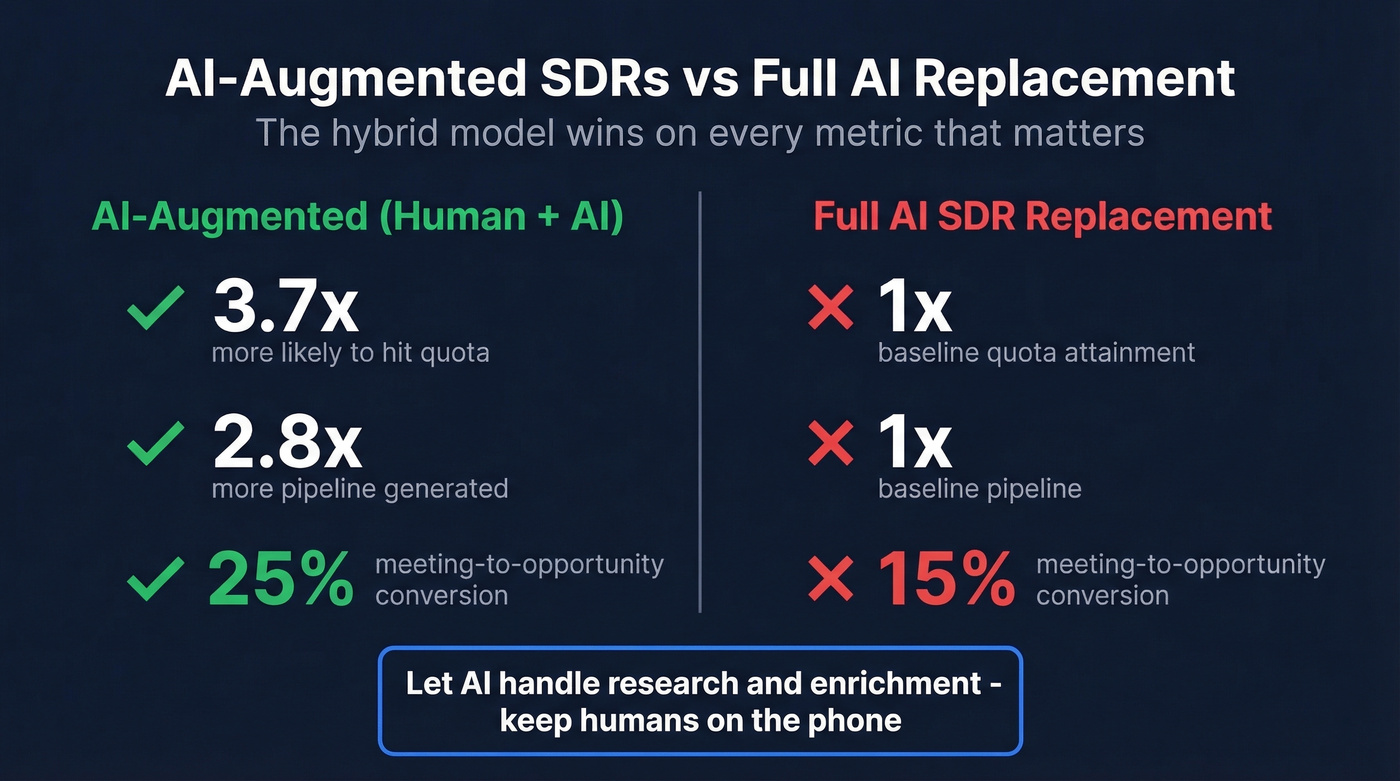
Use AI for prep, humans for conversations. Sellers using AI are 3.7x more likely to hit quota, and AI-augmented teams generate 2.8x more pipeline than full-replacement AI SDR setups. The quality gap is real: AI SDRs convert meetings to opportunities at 15% versus 25% for humans. Let AI handle research, personalization drafts, and data enrichment. Keep humans on the phone. For more, see generative AI sales tools and AI cold email outreach.
Time Management Tips That Work
Beyond fixing infrastructure, here are rep-level habits grounded in the data:
- Time-block prospecting in 90-minute sprints. Multitasking kills workflow efficiency. Batch calls together, batch emails together - never alternate between them. (More ideas: sales prospecting techniques.)
- Front-load high-intent activities. Call inbound leads and warm accounts first thing. Protect peak energy hours for the highest-conversion tasks.
- Cap internal meetings at 3 hours per week. The audit shows reps lose a full hour daily to internal syncs. Cut the standing meetings that don't directly improve pipeline.
- Automate CRM logging. If your reps are manually entering call notes and email activity, you're burning 1.7 hours per day on admin that tools can handle.
Skip the "productivity hack" advice you see on social media about waking up at 5 AM or journaling your way to quota. The real gains come from eliminating the structural drag on your reps' time, not adding morning routines.
The Minimal SDR Tech Stack
You need 3-4 tools that talk to each other, not 7+ that don't. We've tested dozens of stacks - the lean ones consistently outperform.
| Category | Tools | Approx. Cost |
|---|---|---|
| CRM | HubSpot, Salesforce | Free - ~$200/user/mo |
| Sequencing | Outreach, Instantly | ~$30-150/user/mo |
| Prospecting data | Prospeo, Apollo, ZoomInfo | ~$0.01/email - $15-40K/yr |
| Calling | Orum, Aircall | Custom - ~$40-70/user/mo |
If you're rebuilding your stack, start with a shortlist of SDR tools and make sure your sequencing supports clean sequence management.
For prospecting data, Prospeo delivers 98% email accuracy, 125M+ verified mobiles, and a 7-day refresh cycle across 300M+ profiles - at roughly $0.01 per email with a free tier and no contracts. Apollo runs $49-99/user/month for mid-market teams. ZoomInfo typically lands in the $15-40K/year range depending on seats and modules.
Snyk's 50 AEs went from 35-40% bounce rates to under 5% - and generated 200+ new opportunities per month. The difference wasn't coaching or cadences. It was switching to Prospeo's 300M+ verified profiles with 30+ filters for intent, technographics, and job changes.
Stop burning SDR hours on stale data at $0.01 per verified email.
Quick SDR ROI Math
The formula: (Revenue from SDR-generated opps - Total SDR costs) / Total SDR costs x 100. A fully loaded SDR costs roughly $139K/year. At 15 meetings/month, a 50% opportunity rate, $50K ACV, and 20% close rate, that's $75K/month in closed revenue per SDR - a 5.5x return.
If you want to pressure-test the assumptions, compare against your sales conversion rate and track pipeline health weekly.
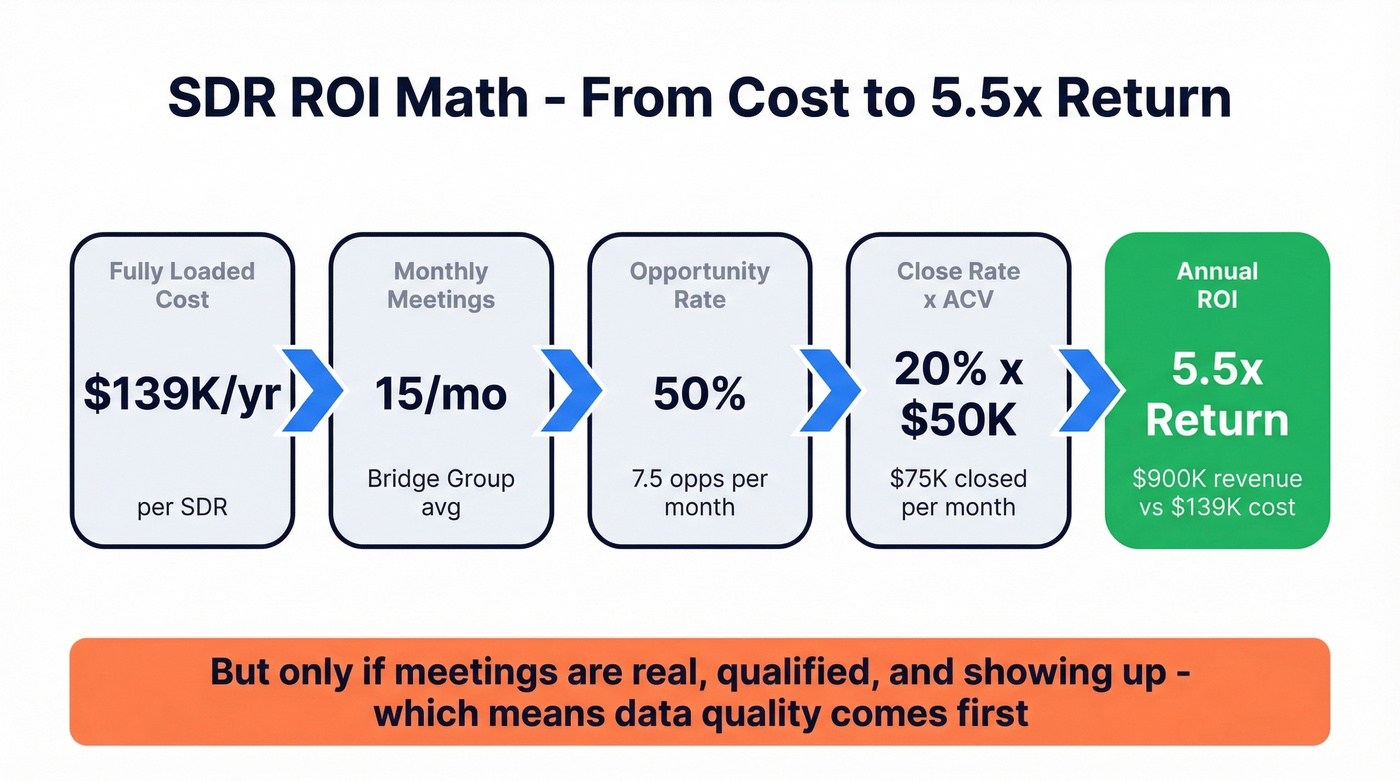
But only if those meetings are real, qualified, and showing up. Which brings us back to data quality.
FAQ
What's a good number of meetings per SDR per month?
The Bridge Group average across 351 companies is 15/month. Good teams hit 18-20, and top performers book 25+. Inbound-heavy teams skew higher on volume but should weight show rate and meeting-to-opportunity conversion more heavily.
How much selling time should SDRs get per day?
The benchmark is 40%, or about 3.2 hours. Top teams push past 50% by automating research and streamlining CRM entry. If your reps are below 35%, audit the tool stack before blaming effort - it's almost always a systems issue.
Are AI SDRs replacing human reps?
Not yet. AI SDRs convert meetings to opportunities at 15% versus 25% for humans. The winning model is hybrid: AI handles research and initial outreach, humans run conversations. Teams using this approach see 2.8x more pipeline than those going all-in on automation.
What's the single biggest drag on SDR productivity?
Bad contact data. Reps burn 17% of their day on research because existing records are stale. Meritt saw this directly - after switching to weekly-refreshed, verified data, their pipeline tripled from $100K to $300K per week and bounce rates dropped from 35% to under 4%.