

SDR vs BDR: What's Actually Different (and Does It Matter)?
You accepted an SDR offer last month. Your college roommate just signed a BDR offer at a competitor. You're both cold calling the same personas, running the same sequences, booking the same meetings - and now you're wondering what the actual difference is. Even sales orgs can't agree on the definitions. Some say SDRs handle outbound. Others say that's the BDR's job. The confusion isn't your fault - it's the industry's.
The Short Answer
Most companies use SDR to mean inbound and BDR to mean outbound, but plenty of orgs swap the titles entirely. Understanding the meaning at any given company requires asking about the actual sales motion, not the label on your business card. Median OTE runs $85K for SDRs and $83K for BDRs - a rounding error. If you're choosing between two offers, pick the one with a clearer promotion path at that specific company, not the one with the "better" title.
Inbound vs Outbound: The Real Dividing Line
An SDR (Sales Development Representative) typically works inbound leads - people who've already raised their hand through a demo request, content download, or webinar signup. The job is speed-to-lead: qualify fast, book the meeting, hand off to an AE.
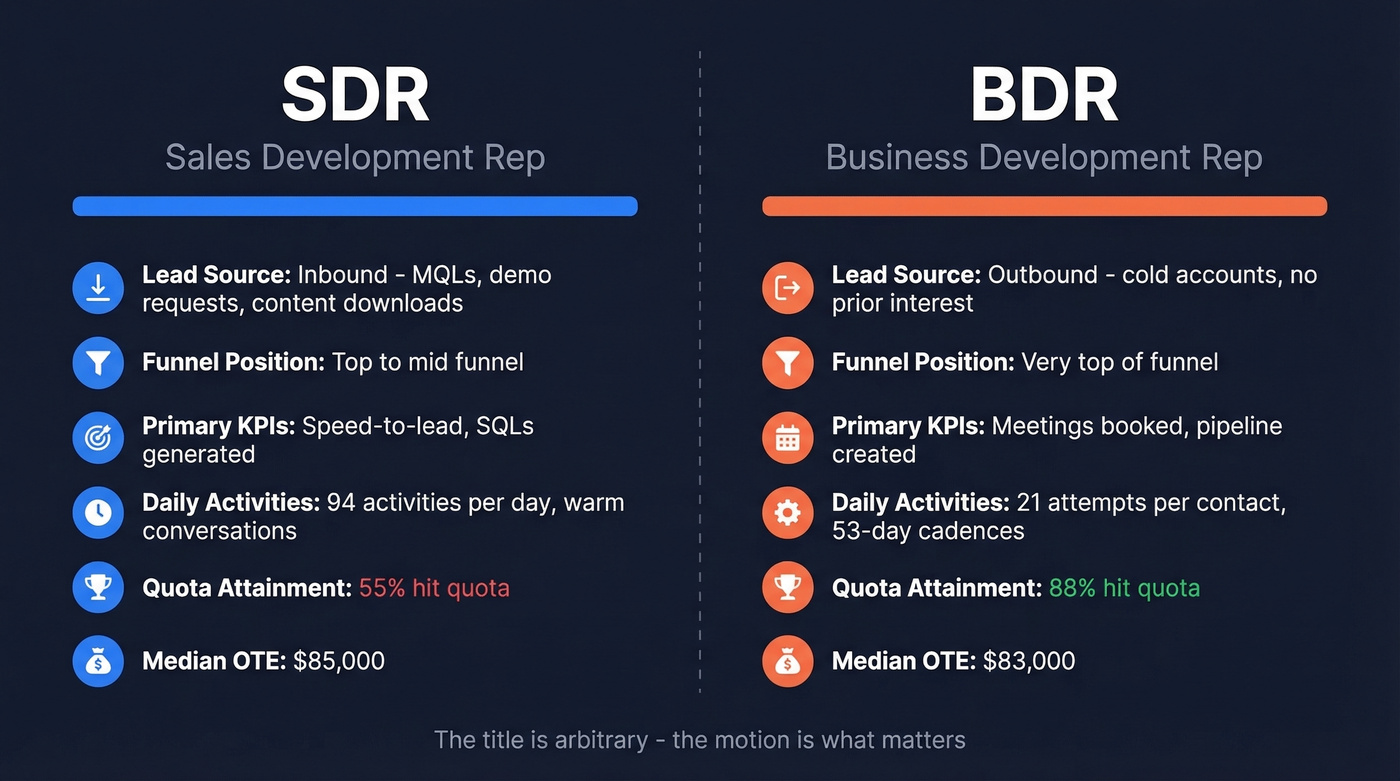
A BDR (Business Development Representative) creates pipeline from scratch. Cold outreach into accounts that haven't expressed interest yet. It's harder, longer-cycle work that requires more research and persistence.
Stop debating titles. Start debating inbound vs outbound.
That said, many companies blur or completely swap these definitions. Salesforce calls their outbound reps BDRs. HubSpot uses SDR for both motions. Some startups just call everyone "Sales Development" and move on. The consensus on r/sales is pretty clear: the title is arbitrary, the motion is what matters. So what do SDR and BDR mean in practice? It depends entirely on the org chart you're looking at.
Beyond the standard inbound/outbound split, some orgs divide responsibilities by deal size, account tier, or new-logo vs expansion. The labels change, but the underlying question stays the same: who generates demand, and who converts it?
| Dimension | SDR | BDR |
|---|---|---|
| Lead source | Inbound (MQLs) | Outbound (cold) |
| Funnel position | Top-to-mid | Very top |
| Primary KPIs | Speed-to-lead, SQLs | Meetings booked, pipeline created |
| Typical reporting | 60% report to Sales | 80% report to Sales |
| Key tools | CRM, engagement, call recording | Data providers, engagement, CRM |
| Career path | AE in 12-18 months | AE in 12-18 months (stronger closing skills) |
What Each Role Looks Like Daily
A Day as an SDR
The average SDR runs 94.4 activities per day - 35.9 calls, 32.6 emails, 15.3 voicemails, and about 7 social touches. That volume produces roughly 4.4 quality conversations per day, down 45% since 2014. Buyers are harder to reach, and they're pickier about who gets their time.
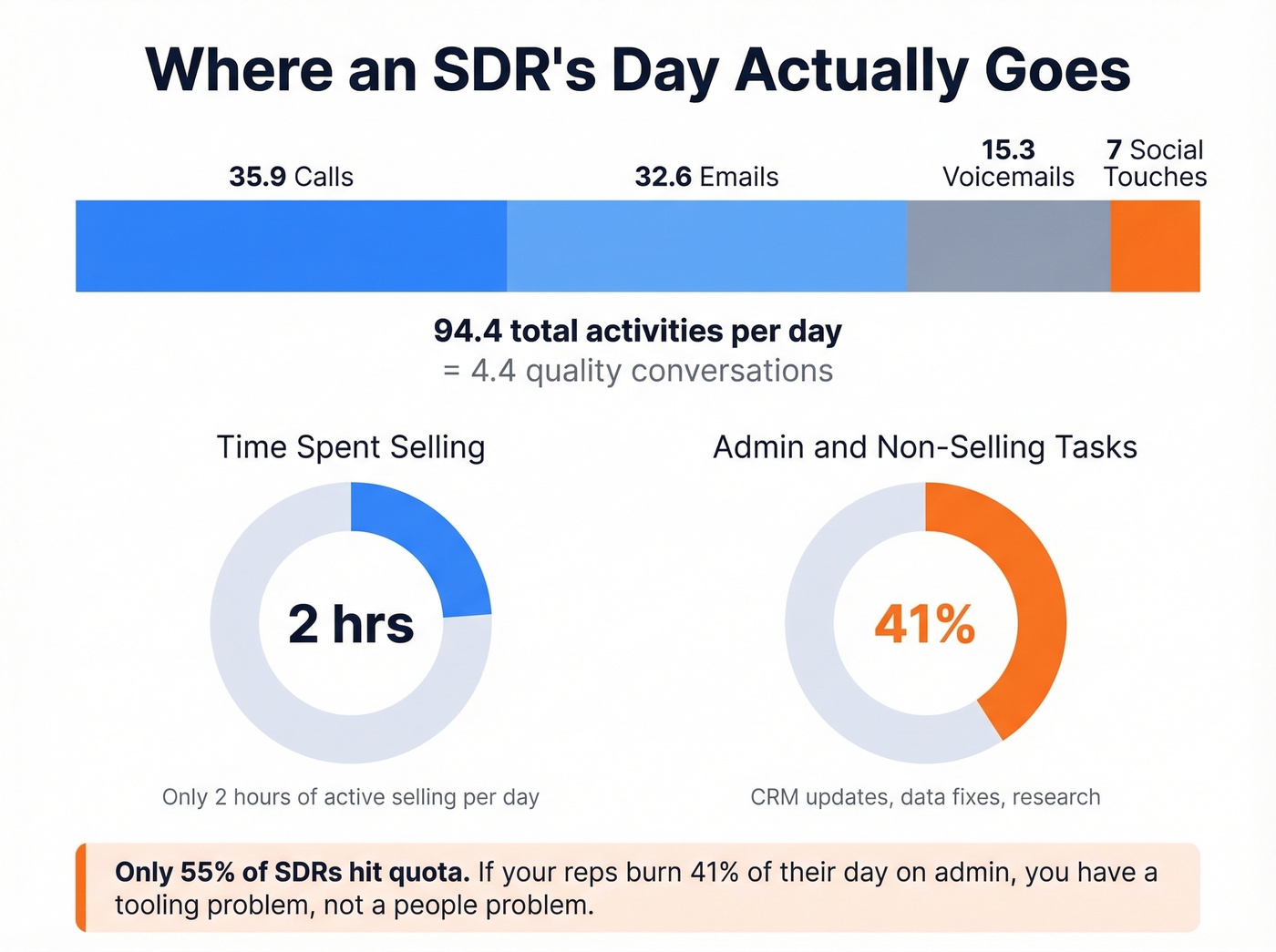
The output? About 15 meetings per month for a median performer, generating roughly $3M in pipeline per year. But here's the number that should frustrate every sales leader: SDRs spend just 2 hours per day actively selling. Admin tasks eat 41% of the day - logging activities, updating CRM fields, researching accounts, fixing bad data. Only 55% of SDRs hit quota. If your reps are burning 41% of their day on admin, you don't have a people problem. You have a tooling problem.
A Day as a BDR
BDR work is slower and more deliberate. The 6sense BDR Benchmark shows reps now average 21 attempts per contact (up from 17), spread across a 53-day cadence before giving up on a prospect. That's nearly two months of touches per person.
Multithreading is the norm - 90% of BDRs engage multiple contacts per account, averaging 9 individuals per deal versus 6.4 last year. The job isn't "send emails and hope." It's strategic account penetration. When the meeting finally lands, 74% of BDRs hand off as an Opportunity rather than a raw lead, which means they're doing real qualification work before the AE ever gets involved.
Here's the stat that surprised us most: BDRs hit 88% of quota on average, compared to just 55% for SDRs. The reps doing the harder work actually perform closer to target. BDRs with proper enablement support hit 95% of quota versus 80% for unsupported reps - a gap that makes the case for investing in tools and training before hiring more headcount.
Salary and Compensation in 2026
Pay Benchmarks
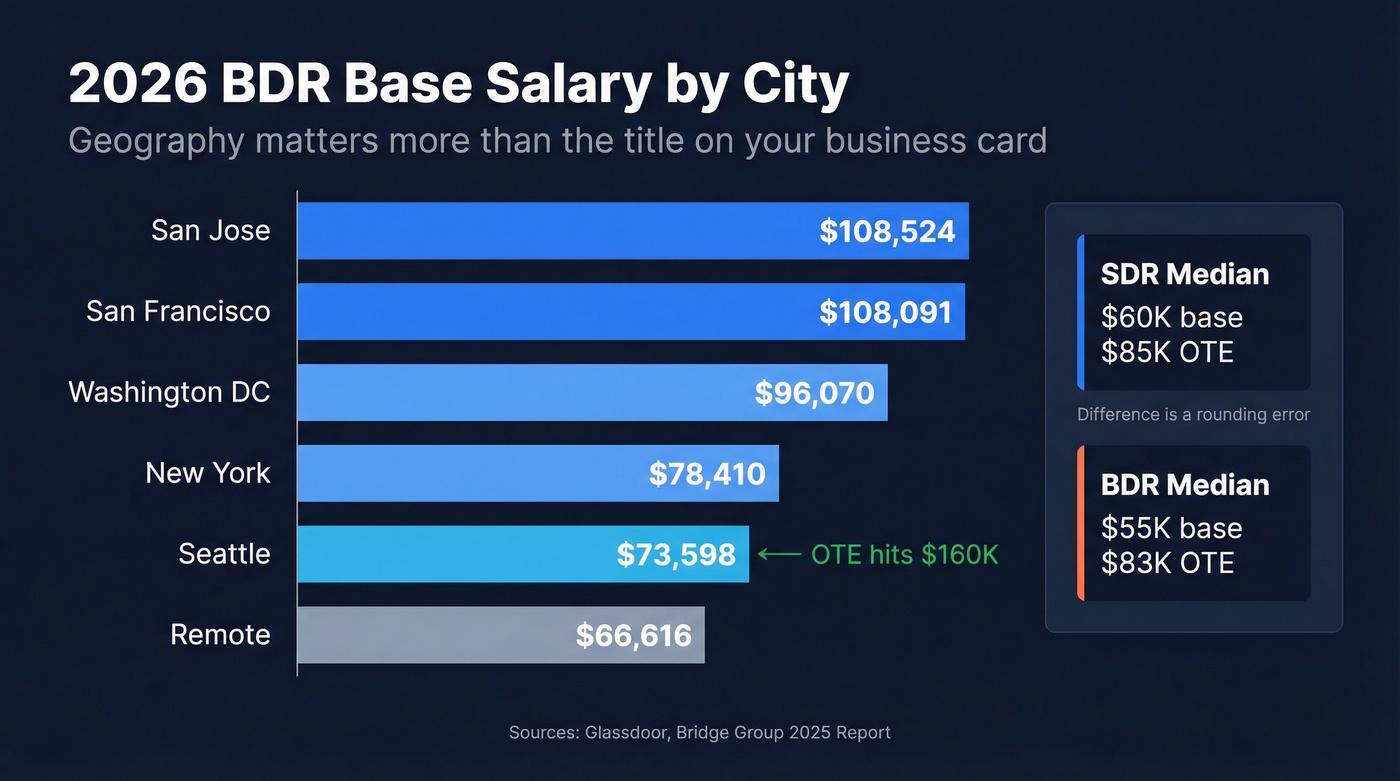
The pay gap between SDRs and BDRs is negligible. Median SDR base sits at $60,000 with an OTE of $85,000. BDRs come in at $55,000 base and $83,000 OTE. The real comp differences come from geography, company stage, and quota structure - not the title. The motion you run matters far more than the acronym on your profile. (If you want to sanity-check offers, start with OTE math.)
Pay mix shifts with seniority. Entry-level reps in their first year typically see a 70/30 base-to-variable split with $70-75K OTE. Mid-level reps with 1-3 years move to a 65/35 split and $80-90K OTE. Senior reps at 3-5+ years land at 60/40 with $90-100K+ OTE.
Geography matters more than most people realize:
| City | BDR Base | Notes |
|---|---|---|
| New York | $78,410 | Total comp ~$99K |
| San Jose | $108,524 | Highest base nationally |
| San Francisco | $108,091 | Near-identical to SJ |
| Seattle | $73,598 | OTE hits $160,149 |
| Washington DC | $96,070 | Strong gov-tech market |
| Remote | $66,616 |
For UK-based reps, expect SDR base salaries of £30-45K with OTE of £45-70K depending on whether you're in London or regional. In EU markets, OTE commonly ranges €50-80K for mid-level reps.
How Commission Plans Work
The standard split for pipeline-generation roles is 70-80% fixed and 20-30% variable. Go above 30% variable and you introduce instability that drives turnover in a role that already has retention challenges.
What KPIs actually drive commission? A Tribes survey of startup comp plans found deals signed (39%), meetings booked (33%), and turnover generated (33%) as the top three. Only 11% of plans compensate on leads sent to AEs - you want to incentivize outcomes, not handoffs.
The healthy quota-to-OTE ratio falls between 4:1 and 6:1. Anything above 6:1 and the math stops working for the rep. If your ratio is 7:1 or 8:1, that's not a hiring problem - it's a leadership problem.

SDRs spend just 2 hours a day selling because bad data eats the rest. Prospeo gives your reps 98% verified emails and 125M+ direct dials - so they stop fixing contact records and start booking meetings. At $0.01 per email, arming your entire SDR/BDR team costs less than one missed quota month.
Stop losing pipeline to bad data. Start your free account in 30 seconds.
Tools SDRs and BDRs Actually Use
The Bridge Group's 2025 report breaks down tech adoption by motion, and the differences are telling. Sales engagement platforms run at 72% adoption for inbound teams, 84% for allbound, and 77% for outbound. Sales Navigator shows an even sharper split: 56% of inbound-only teams use it versus 88% of allbound and 81% of outbound teams. Contact data tools follow a similar pattern - 56% inbound versus 82% allbound and 74% outbound. Call recording flips the other way: 89% adoption for inbound (where calls are warm) versus 66% for outbound.
The standard stack is a CRM like Salesforce or HubSpot, a sales engagement platform like Outreach or Salesloft, a contact data source, and call recording for coaching. But the category most teams underinvest in is contact data quality. Bad data wastes 27% of a seller's time and costs businesses $9.7M per year on average. When your reps are only selling 2 hours a day, every bounced email and wrong number compounds the problem.

Data quality is the real productivity lever. In our experience, the difference between a 79% accurate email list and a 98% accurate one isn't 19 percentage points - it's the difference between burning your domain reputation and actually booking meetings. Prospeo's 7-day refresh cycle keeps records current while most providers update every 6 weeks, and that freshness gap matters when SDRs are burning through 94 activities a day. (If you're auditing your stack, compare your data enrichment and email deliverability setup too.)
BDRs average 21 attempts across 9 contacts per account. Every touch with a wrong email or dead number burns cadence time and kills momentum. Prospeo's 7-day data refresh and 30% mobile pickup rate mean your outbound reps actually reach the buyers they're researching - not bounce notices.
Give your BDRs the direct dials that competitors can't find.
Should You Hire an SDR or BDR First?
Hire an SDR first if you've got strong inbound demand - demo requests piling up, MQLs going stale, AEs doing their own qualification. The SDR's job is to convert that existing interest into pipeline faster than your AEs can alone.
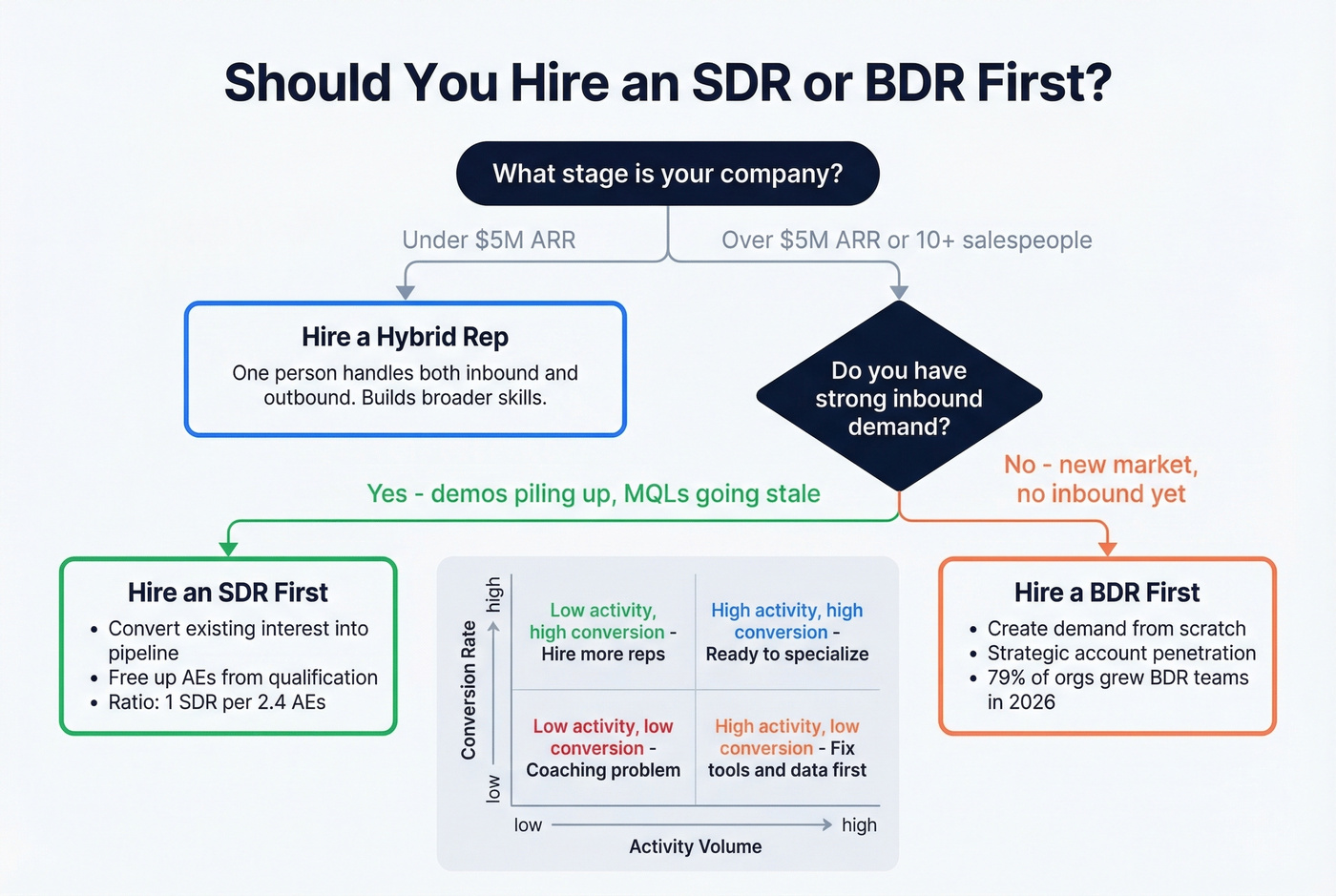
Hire a BDR first if you're entering a new market, launching a new product, or don't have meaningful inbound volume yet. BDRs create demand. They don't wait for it.
Under ~$5M ARR, combine both motions into a single hybrid role. Most early-stage teams can't justify the specialization, and one person handling both inbound and outbound builds broader skills anyway. Once you hit 10+ salespeople, specialize. The Bridge Group data shows a consistent SDR-to-AE ratio of 1:2.4, which has held steady since 2018. The market is expanding too - 79% of orgs grew or maintained their BDR team size in 2026.
Let's break down a quick diagnostic we've found useful. Plot your team on two axes: activity volume (high/low) and conversion rate (high/low). High activity but low conversion means your data or messaging is broken - fix the tools before adding headcount. Low activity but high conversion means you need more reps. Low on both? That's a coaching problem. High on both? You're ready to specialize and scale. (If you're rebuilding outbound from scratch, start with proven sales prospecting techniques and a clean lead generation workflow.)
On reporting lines: Bridge Group data shows 60% of Sales Development groups report to Sales, and the 6sense benchmark puts that at 80% for BDRs specifically. The exception is inbound-heavy, high-velocity models where speed-to-lead is everything - those teams sometimes sit under Marketing.
Career Paths After SDR or BDR
The most common path is SDR/BDR to Account Executive, typically within 12-18 months. Top performers make the jump in 10-12 months. AE OTE at the mid-market level runs $120-180K - a meaningful step up from the $83-85K range.
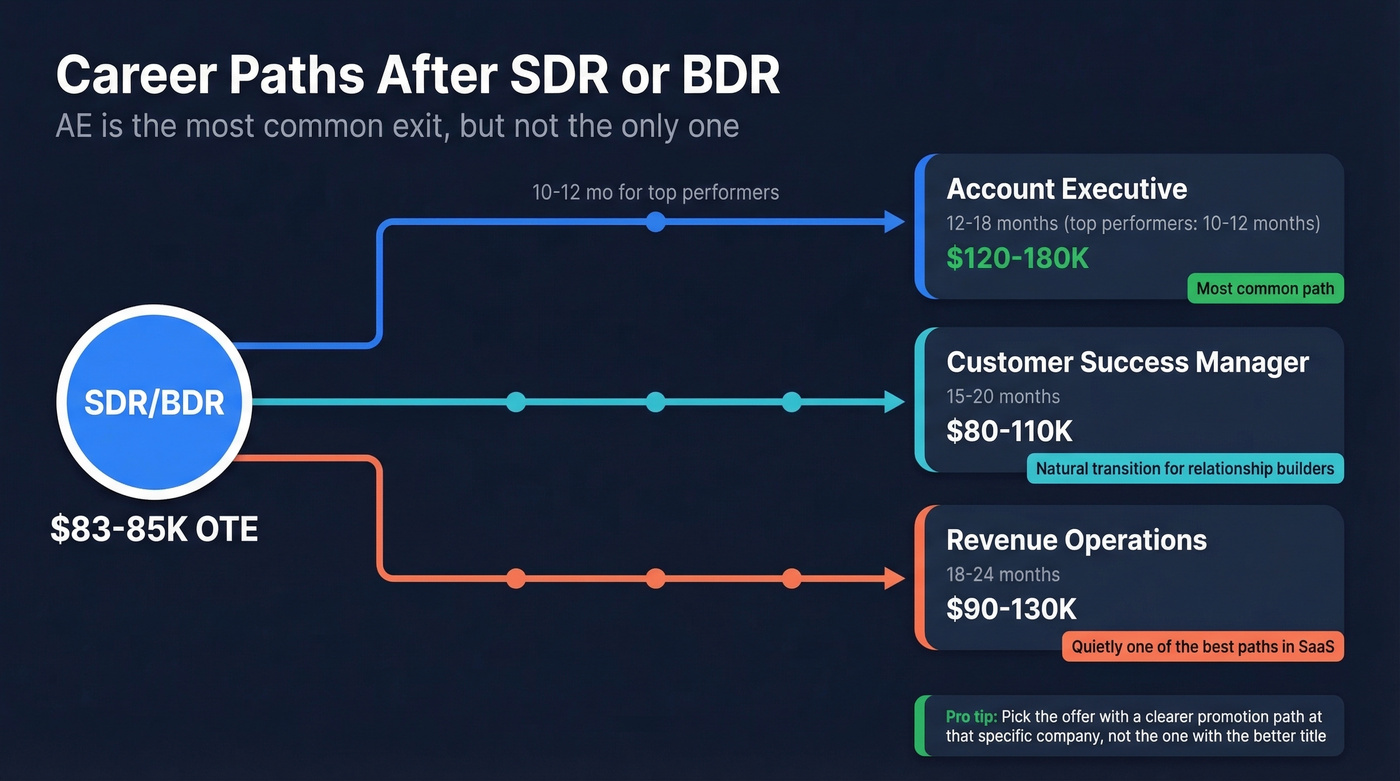
But AE isn't the only exit. SDR to Customer Success Manager is a natural transition at the 15-20 month mark, with total comp in the $80-110K range. For the analytically minded, SDR to RevOps typically takes 18-24 months and pays $90-130K. RevOps is quietly one of the best career paths in SaaS right now - high demand, strong comp, and you don't have to carry a quota. Regardless of whether you started as a BDR or SDR, the promotion trajectory looks remarkably similar. (If you're aiming for ops, the RevOps Manager track is a good reference point.)
Average SDR tenure sits at 1.9 years, with a ramp time of just 3 months - the lowest since 2010. But promotion timelines have stretched 28% post-pandemic, from 12 months to 15-16 months on average. If you're in the role, build your case with 90%+ quota attainment for two straight quarters before pushing for promotion.
AI SDRs: Real but Overhyped
60% of BDRs already use AI tools, and the Bridge Group notes this is the first year AI SDRs appear in their data. The performance deltas are striking in narrow areas - AI handles technical questions immediately 87% of the time versus 15% for humans, and time to technical qualification drops from 8.3 days to 2.1 days. Automated teams are 14.5% more productive and make 23% more calls per day, with automation saving roughly 12 hours per week per rep.
But AI SDRs aren't set-and-forget. They require daily training and QA. They're excellent at research, initial qualification, and handling routine questions at scale. They're terrible at reading political dynamics inside an account, building genuine rapport, and knowing when to push versus when to back off.
The role isn't disappearing - it's splitting into "AI-managed volume" and "human-led strategic accounts." Our take: if your average deal size is under $10K, an AI SDR paired with clean data will outperform a junior human rep within 18 months. Above that threshold, humans win for the foreseeable future. The deals are too complex and the relationships too nuanced for AI to navigate alone. (If you're testing automation, start with AI sales follow-up workflows before replacing the whole motion.)
FAQ
What's the difference between SDR and BDR?
It comes down to sales motion - inbound vs outbound - not seniority. SDRs typically qualify inbound leads; BDRs prospect cold accounts. Many companies swap or merge the titles, so always check the specific org's definition before assuming one outranks the other.
Can one person do both roles?
Yes, especially at companies under $50M ARR. Most early-stage teams combine both motions into a single hybrid role regardless of title. Specialization makes sense once you have 10+ salespeople and enough volume to justify it.
Which role pays more?
They're nearly identical. Median SDR OTE is $85K versus $83K for BDRs. The real comp difference comes from company stage, geography, and quota structure - not the title itself.
Is SDR a good first sales job?
Yes - average ramp time is 3 months, tenure is 1.9 years, and clear promotion paths lead to AE roles at $120-180K OTE within 12-18 months. It's the standard on-ramp into B2B tech sales. Skip it if you're targeting enterprise sales from day one - some companies hire directly into BDR roles for strategic accounts, which gives you a faster path to complex deal experience.
What tools help SDRs and BDRs book more meetings?
The core stack is a CRM, a sales engagement platform, call recording, and a contact data provider. Data quality is the biggest lever most teams underinvest in - bad emails and wrong numbers waste hours every week that reps can't get back.