

Self Confidence in Sales Is a System, Not a Feeling - Here's How to Build It
Your emails bounced. Three straight dials went to voicemail. The prospect who seemed warm last week ghosted. And your manager's advice? "Just be more confident." That's like telling someone who's drowning to just breathe. Meanwhile, there's a rep on Reddit asking whether getting nervous introducing numbers means they'll never be good at sales.
Self confidence in sales isn't something you're born with. It's something you build - by reducing what can go wrong: proven openers, clean contact data, coaching with real feedback loops, and measuring confidence on a regular cadence.
Why Sales Confidence Is a Revenue Problem
This isn't soft-skills fluff. A study of 2.5 million recorded sales conversations found that 40-60% of deals end in "no decision." Buyers express intent, consume your time, then freeze. That freeze is partly a confidence problem on both sides of the table - the buyer doesn't trust the rep enough to commit, and the rep doesn't trust themselves enough to push through the discomfort.
Speed matters too. Outreach's benchmarks show deals closed within 50 days hit a 47% win rate, versus roughly 20% after that window. Hesitation kills deals. Confident reps move faster because they trust their process, their data, and their talk track - and that speed compounds across every stage of the pipeline.
What Confident Reps Actually Say
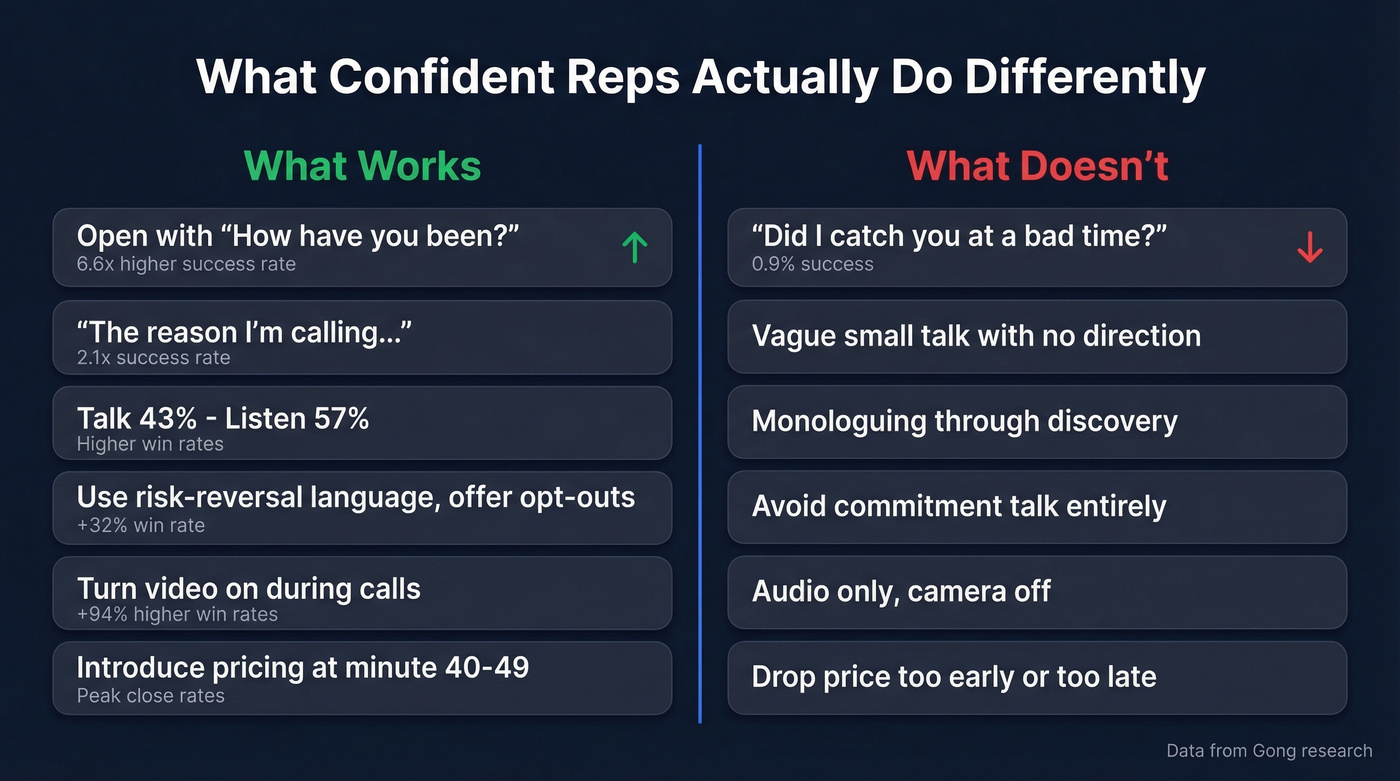
Gong analyzed cold calls at scale and found specific language patterns that separate winners from everyone else. We've pulled the highlights into one table because the contrasts are striking:
| Behavior | What works | What doesn't | Impact |
|---|---|---|---|
| Cold call opener | "How have you been?" | "Did I catch you at a bad time?" | 6.6x higher than baseline (>10% success on first cold call); "bad time" sits around 0.9% |
| State reason for call | Lead with "the reason I'm calling..." | Vague small talk | 2.1x success rate |
| Talk-to-listen ratio (discovery) | 43:57 (seller:buyer) | Monologuing | Higher win rates |
| Risk-reversal language | Opt-outs, SLAs | Avoiding commitment talk | +32% win rate |
| Video on | Seller video on during calls | Audio only | 94% higher win rates |
| Pricing timing | Minute 40-49, 3-4 mentions | Too early or too late | Peak close rates |
The 43:57 ratio is worth memorizing. Top reps talk less than half the time on discovery calls. They ask, listen, and let the buyer articulate their own pain. That's not passivity - it's controlled confidence. (If you want a tighter structure, use a discovery questions framework.)
When pricing comes up, the best reps don't flinch. They introduce it around minute 40-49, after value is established, and they use risk-reversal language that gives buyers an out. Counterintuitively, offering an exit increases close rates by 32%. And turning your video on? It's one of the easiest conviction signals you can send. Buyers read your certainty through your face.

Confident reps don't flinch on calls - but confidence starts before the dial. When your emails bounce and numbers are dead, self-doubt creeps in fast. Prospeo's 98% email accuracy and 125M+ verified mobiles mean your first 10 touches actually land.
Stop blaming your mindset when it's your data that's broken.
The Confidence Killers Nobody Talks About
Imposter Syndrome
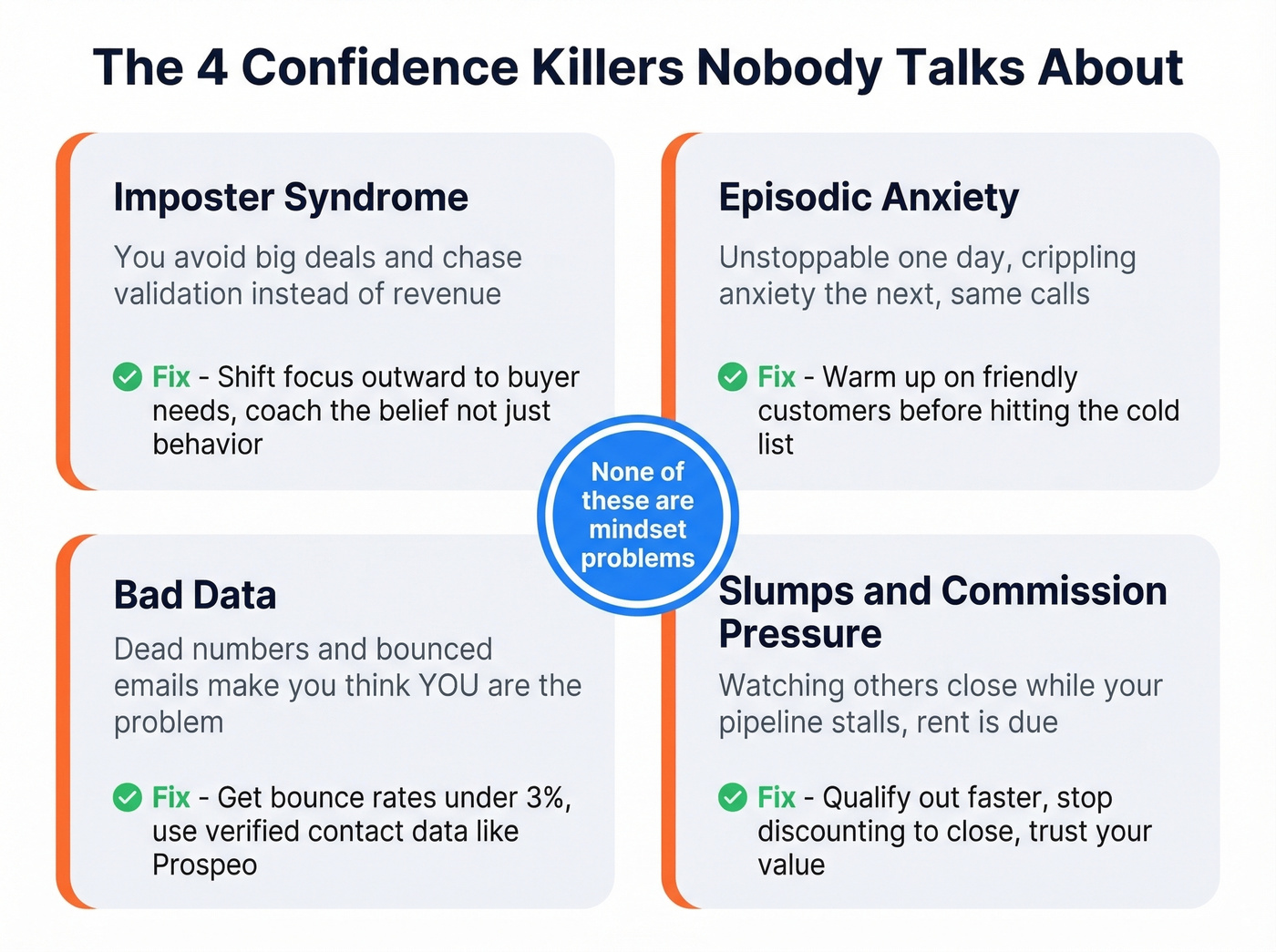
Sandler's framework nails this. Imposter syndrome makes reps avoid big opportunities, chase validation instead of real deals, and hesitate on tough questions. The fix isn't a pep talk. It's shifting focus outward to the buyer's needs, upgrading self-talk with truth-based statements, and coaching the belief - not just the behavior. A rep who's been told "you belong in this room" once will forget it by Tuesday. A rep who's closed three enterprise deals in the last month doesn't need to be told.
Episodic Anxiety
A five-year sales vet on r/sales described feeling "unstoppable" some days and "crippling anxiety" on others - before the same cold calls they've made thousands of times. One of the best workarounds we've seen: warm up by dropping in on a current customer or warm lead before you hit the cold list. It resets your nervous system. You go from "I hope someone picks up" to "I just had a great conversation five minutes ago." (This is basically warm calling in practice.)
Bad Data Erodes Belief
Here's the thing: when your first 10 dials hit dead numbers and your emails bounce, you don't think "my data provider is bad." You think "I'm bad at this." That failure loop is insidious. It's not a mindset problem - it's an infrastructure problem. If you're seeing consistent bounces, start with email bounce rate benchmarks and fixes.
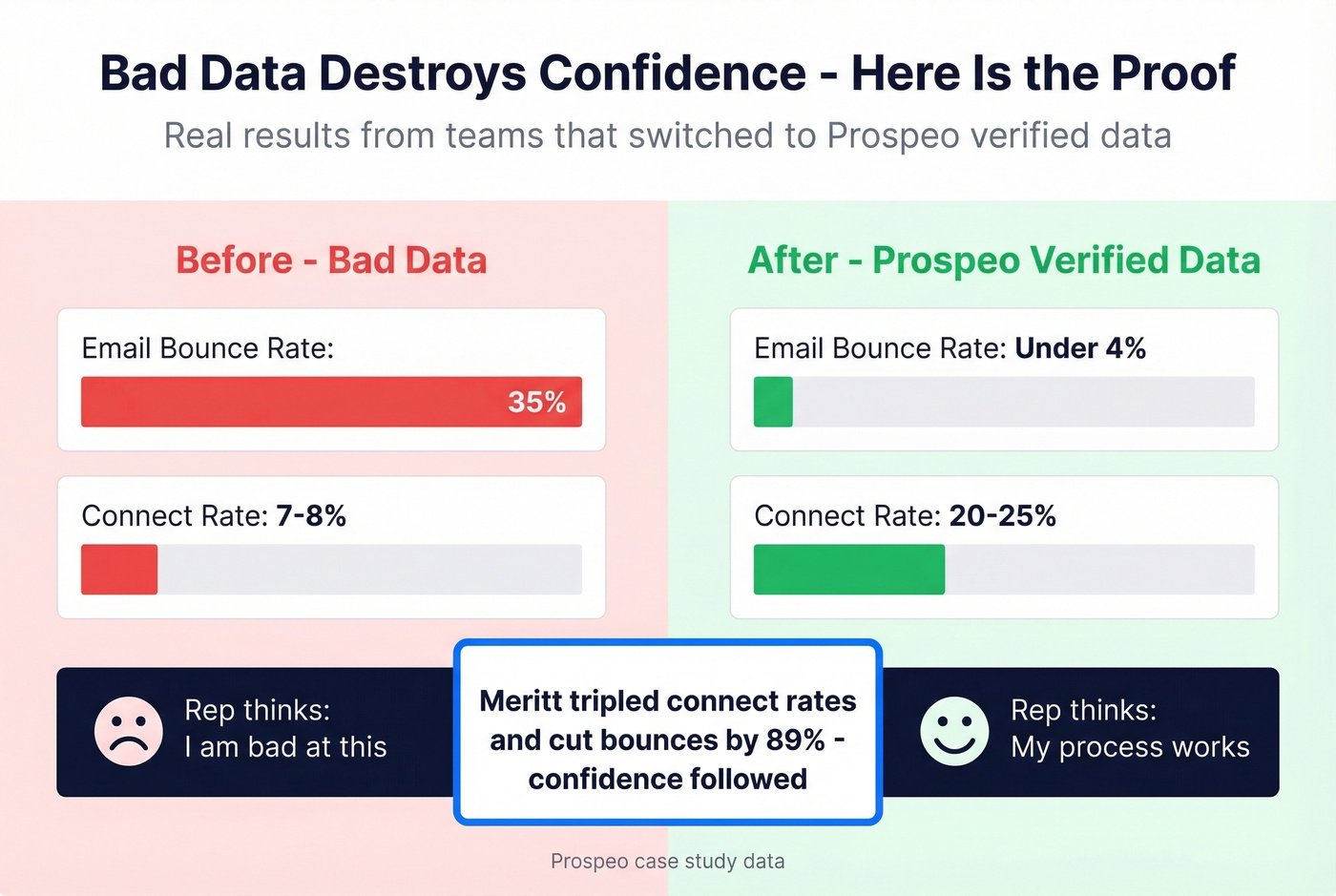
We've seen this play out with teams that switch to Prospeo. Meritt's bounce rate dropped from 35% to under 4%, and their connect rates tripled to 20-25%. When your first 10 dials actually connect, confidence takes care of itself.
Slumps and Commission Pressure
One rep on r/sales described the spiral: cancelled appointments, watching other reps close while you're stuck, and a slump that threatens your rent. Social comparison makes it worse. Confident reps break slumps by qualifying out faster - a low average deal size is often a conviction problem, not a pipeline problem. If you're discounting to close, you don't trust your value prop. Fix that first. (For a practical reset, build resilience in sales like a system.)
How to Build It (The System)
Get Coached With Data
Teams receiving consistent sales coaching see 16.7% higher revenue growth. 75% of coached reps hit quota, and 76% say coaching helps them avoid second-guessing. If your org doesn't have a coaching cadence, you're leaving revenue on the table.
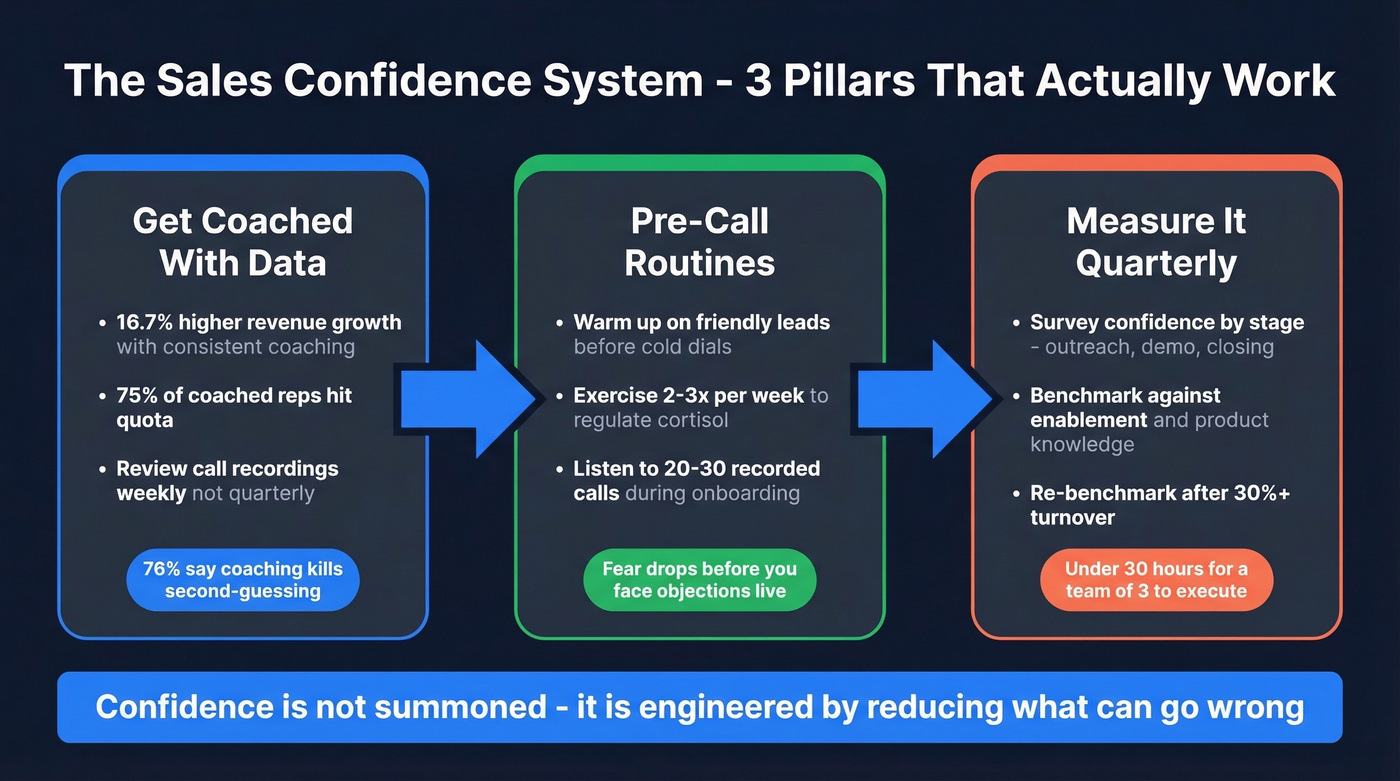
Let's be honest - most "coaching" in sales orgs is a manager listening to one call per quarter and saying "nice job" or "you talked too much." Real coaching means reviewing call recordings weekly, tracking specific metrics like talk-to-listen ratio, and giving feedback tied to outcomes. The data is clear: reps who get this don't just feel more confident, they close more. (If you're formalizing this, sales performance management helps.)
Pre-Call Routines That Work
Three things that actually move the needle for reps we've worked with:
- Warm-up touches before cold outreach. Call a friendly customer or follow up on a warm lead. Get a win in your ear before you dial strangers.
- Physical exercise as anxiety regulation. One Reddit rep swears by BJJ 2-3 times a week. Others run. The mechanism matters less than the consistency - your body processes cortisol through movement, and that carries into your calls.
- Call recording exposure during onboarding. New reps who listen to 20-30 recorded calls hear every objection before they face it live. Fear drops. Assurance rises. Skip this if your onboarding is already longer than 6 weeks - in that case, front-load recordings in week one and cut something else. (Pair this with a solid 30-60-90 day plan for sales reps.)
Measure It Quarterly
The GTM Alliance framework recommends a sales confidence survey - measuring confidence by stage (outreach, demo, closing), benchmarked against enablement satisfaction and product knowledge. A team of three can execute the full survey, analysis, and action plan in under 30 hours. If you've had more than 30% turnover since the last survey, re-benchmark immediately.
This is the part most orgs skip. They'll invest in tools, training, even offsite retreats, but they won't measure whether any of it actually moved the needle on rep confidence. Without measurement, you're guessing. (If you need a broader view, track sales operations metrics alongside confidence.)
The Contrarian Truth
Most sales confidence advice is backwards. Managers invest in mindset workshops and motivational speakers when they should be auditing their data quality and coaching cadence. Confidence doesn't come from affirmations. It comes from reducing the number of things that can go wrong.
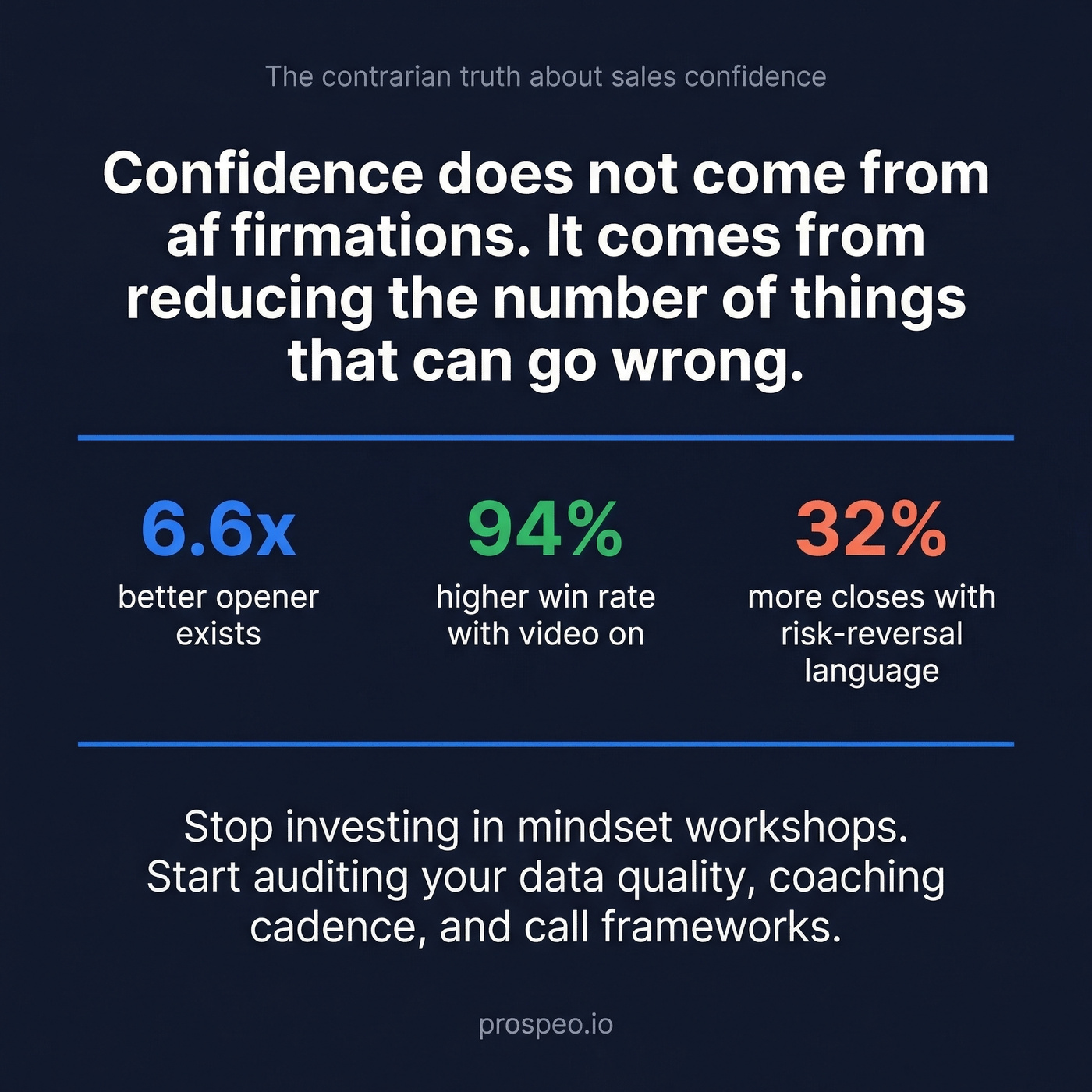
When your opener works 6.6x better than the alternative, when your data connects on the first dial, when you've heard the objection 30 times before - self confidence in sales isn't something you summon. It's already there. Stop trying to feel confident. Start building the system that makes it inevitable. (If you want to tighten the whole motion, start with sales prospecting techniques.)
Meritt cut their bounce rate from 35% to under 4% and tripled connect rates to 20-25% after switching to Prospeo. That's not a confidence hack - it's infrastructure. When reps know their data connects, hesitation disappears and pipeline follows.
Build sales confidence on data that actually works - starting at $0.01 per email.
FAQ
Can you build sales confidence without being naturally outgoing?
Yes. Reps who follow proven frameworks like Gong's 43:57 talk-to-listen ratio consistently outperform "naturally confident" reps who wing it. Structure beats personality every time.
How long does it take to build confidence as a new rep?
New reps with weekly coaching and exposure to 20-30 call recordings typically see measurable gains within 30-60 days. Ramp time drops further when contact data is reliable - GreyScout cut rep ramp from 8-10 weeks to 4 after switching to verified data with consistent connect rates.
Does bad contact data really affect a rep's confidence?
Absolutely. When emails bounce and numbers are dead, reps internalize those failures as personal shortcomings rather than a data quality issue. Fixing deliverability - targeting under 3% bounce rates - removes the most common trigger for self-doubt on outbound teams.