

How to Write a Self Introduction Email to New Clients (Templates for 2026)
You just closed a new client. The contract's signed, the handshake's done, and now you're staring at a blank compose window trying not to sound like a corporate chatbot. Here's the thing: most "introduction email" guides are actually cold outreach guides wearing a different hat. Introducing yourself after someone has already chosen to work with you is a completely different exercise - the sale is over, and the relationship is just starting.
Why Your First Email Matters More Than You Think
Your intro email lands during a window of maximum attention. Welcome emails generate 86% higher open rates, and the average email open rate across industries sits at 43.46% based on 2026 data from 3.6 million campaigns. That first message is the highest-attention email you'll ever send this person.
Waste it on a generic "looking forward to working together" and you've burned your best shot at setting the tone for everything that follows.
What to Include (and What to Skip)
Your intro email isn't a LinkedIn bio. Clients don't care where you went to school or how many years you've been in the industry. The consensus on r/CustomerSuccess is blunt: skip the peacocking. They care about three things - what you'll do for them, how to reach you, and what happens next.
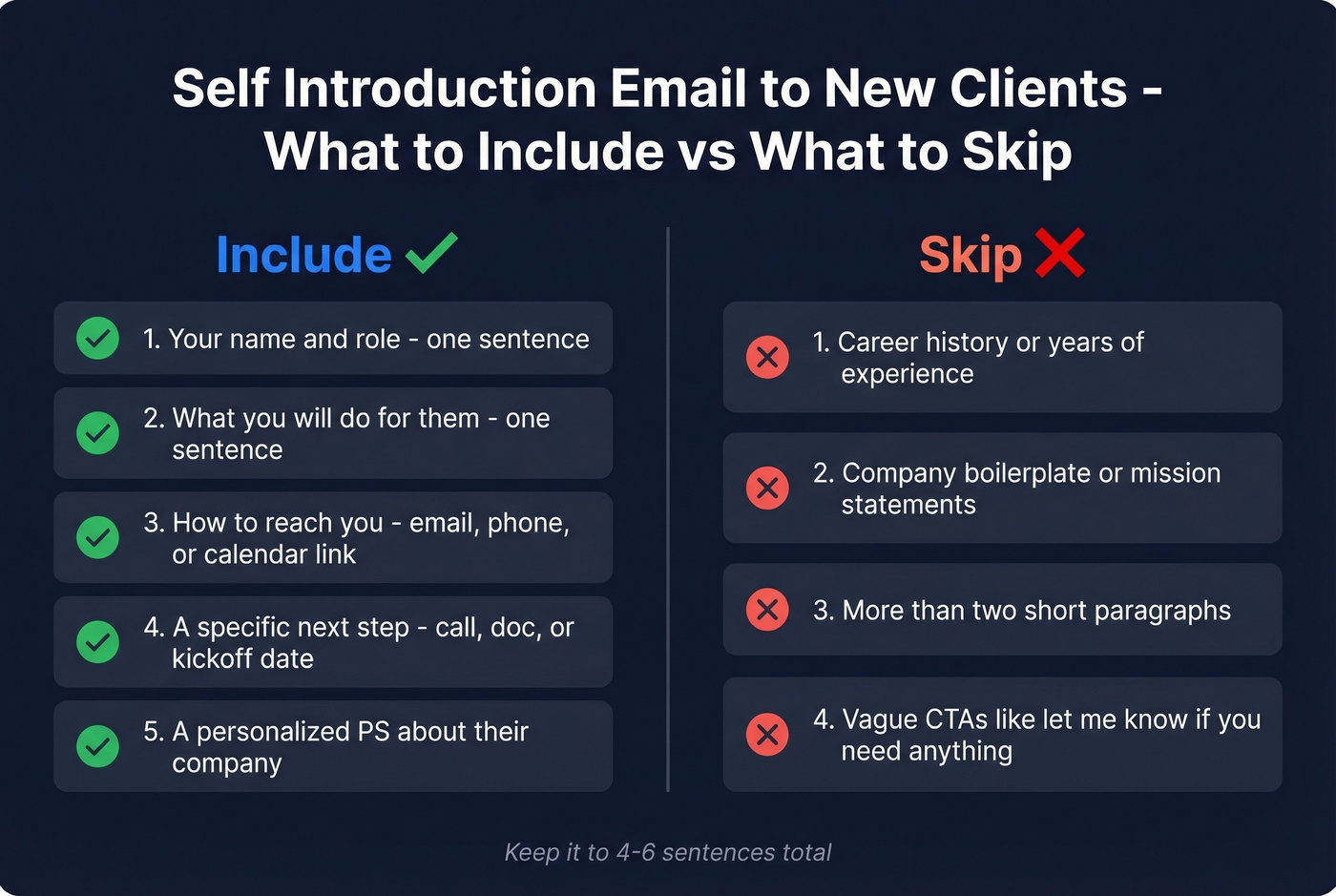
We've found the best intro emails run 4-6 sentences. Not every intro needs a meeting request; sometimes a low-effort CTA like "reply with your preferred time" does more than pushing a calendar invite. (If you need stronger CTAs, see email call to action examples.)
Tone calibration matters. Match the client's energy. If your sales conversations were casual, don't suddenly switch to corporate-speak. If the client's a Fortune 500 legal team, skip the exclamation points. The intro email should feel like a continuation of the relationship, not a reset.
Include:
- Your name and role - one sentence
- What you'll do for them - one sentence
- How to reach you (email, phone, or calendar link)
- A specific next step: a call, onboarding doc, or kickoff date
- A personalized PS referencing something specific about their company
Skip:
- Career history or years of experience
- Company boilerplate or mission statements
- More than two short paragraphs
- Vague CTAs like "let me know if you need anything"
Subject line examples: "Your new account manager - [Your Name]," "Welcome to [Company] - next steps inside," "[Referrer Name] suggested we connect," or "Kickoff details for [Project Name]." For more options, pull from these email subject line examples.
Templates for Every Scenario
Use the sample that best matches your situation, then customize it with your details.
Post-Sale Welcome
Subject: Welcome to [Company] - here's what happens next
Hi [Client Name],
Excited to officially welcome you to [Company]. I'm [Your Name], your [title] and primary point of contact going forward.
This week, expect:
- Dashboard access (login credentials incoming)
- Our getting-started guide: [link]
- Support channels: [email] or [phone] anytime
I've blocked time for a 30-minute kickoff on [date/time]. If that doesn't work, grab a slot here: [calendar link].
Looking forward to it, [Your Name]
PS - Congrats on [specific milestone or recent news]. Exciting stuff.
Account Manager / CSM Handoff
Keep this ultra-short. A clean handoff reassures clients that nothing will fall through the cracks. (If you want more variations, use these handoff email templates.)
Subject: Your new point of contact at [Company]
Hi [Client Name],
I'm [Your Name], your new [title] at [Company]. I'm your advocate on the inside for anything you need, from day-to-day questions to renewals.
I'd love 15 minutes to introduce myself and hear what's working (and what isn't). Grab a time here: [calendar link].
Best, [Your Name]
PS - Saw [something specific from their website or recent news]. Would love to hear more about that.
Referral / Warm Introduction
This follows a four-part connector framework: open, praise the client, state your value, direct them to connect. If you need more formats, here are more connection email examples.
Subject: Connecting you with [Your Name] at [Company]
Hi [Client Name],
[Referrer Name] here. I wanted to introduce you to [Your Name] at [Company] - they specialize in [one sentence on value]. Given what you're building at [Client Company], I think this could be a great fit.
[Your Name], [Client Name] has been doing impressive work on [specific detail]. I'll let you two take it from here.
Best, [Referrer Name]
Agency or Service Provider Kickoff
Subject: [Project Name] kickoff - your team and timeline
Hi [Client Name],
We're excited to get started on [project]. I'm [Your Name], your lead on this account. You'll also be working with [Team Member] on [their role].
First milestone is [deliverable] by [date], with weekly check-ins on [proposed day/time]. Project brief lives here: [link to shared workspace].
Let me know if the timing works or if you'd like to adjust.
Best, [Your Name]
Follow-Up to a No-Reply
Send this when your intro went unanswered after 3-5 business days. Three sentences max - lower the effort of the CTA. If you want more options, use these sales follow-up templates.
Subject: Re: [Original subject line]
Hi [Client Name],
Just floating this back up - I sent an intro last [day] and want to make sure it didn't get buried. Could you reply with a preferred time for a quick intro call, or just confirm you received this?
Thanks, [Your Name]

Your intro email is the highest-attention message you'll ever send a new client. A bounce turns that first impression into a dead end. Prospeo verifies emails in real time with 98% accuracy - catching invalid addresses, spam traps, and catch-all domains before they torpedo your sender reputation.
Verify your client's email before you write a single word.
When to Send
Send your introduction the same day the deal closes or the same day you're assigned the account. Waiting even a couple of days lets momentum die. A Moosend analysis of 10 billion emails found Thursday drives the highest open rates, with Tuesday close behind, and Brevo's data narrows the window further: 10 AM and 3-4 PM in the recipient's time zone are the open-rate peaks. (More timing data here: best time to send cold emails.)
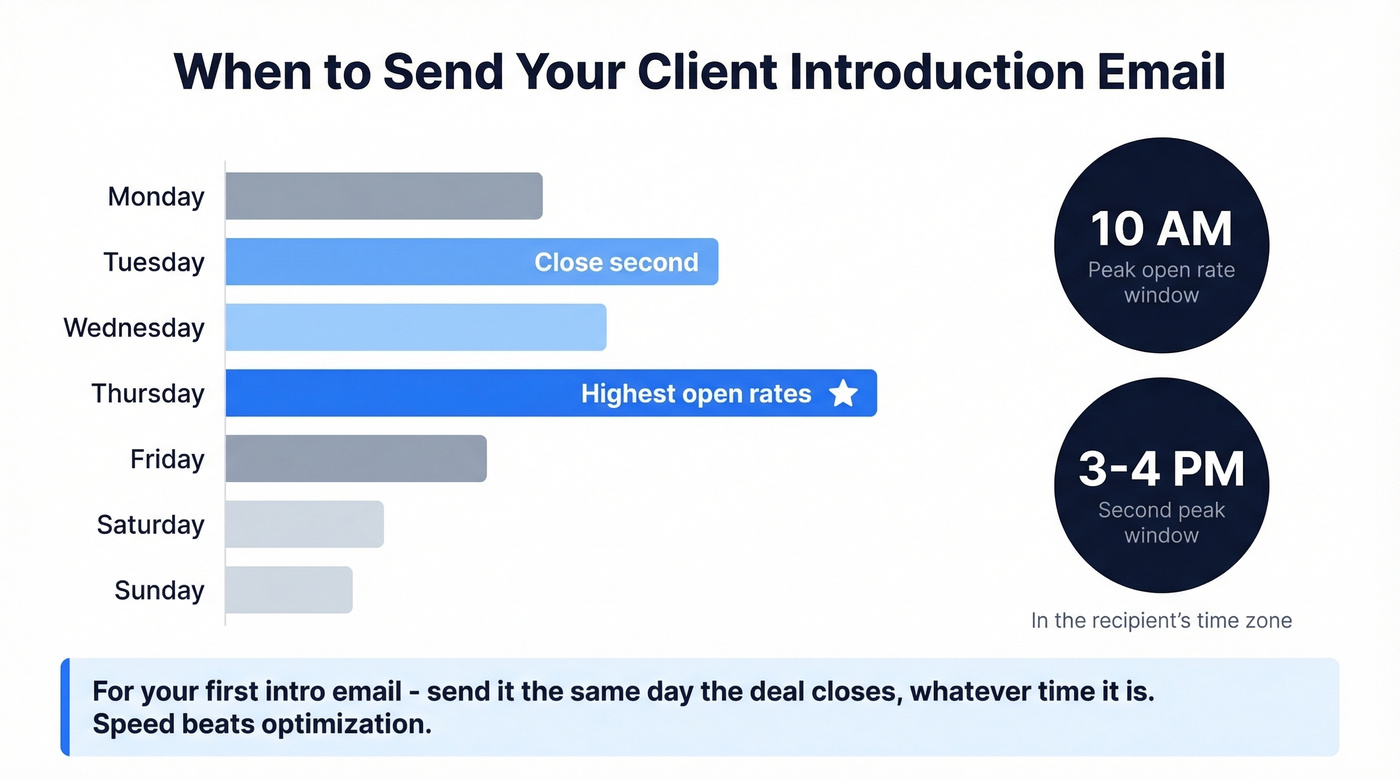
For follow-ups, stick to Tuesday through Thursday, mid-morning. But for that first intro? Send it the same day, whatever time it is. Speed beats optimization.
Mistakes That Kill the Relationship
Sending to a dead address. CRM data decays constantly - people change roles, companies switch domains. We've seen bounced intro emails tank a client relationship before it even starts. Run the address through a verification tool before hitting send. Prospeo checks emails in real time with 98% accuracy and catches invalid addresses, spam traps, and catch-all domains before they damage your sender reputation, with a free tier covering 75 verifications per month. If you want the deeper mechanics, start with email bounce rate and this email deliverability guide.

Reply All with internal commentary. You draft a reply-all, get distracted, and accidentally send "this client is going to be high-maintenance" to the entire thread. It happens more than anyone admits.
Adding a new stakeholder to a long thread. Every prior message in that chain is now visible to someone who wasn't part of the conversation. Start a fresh thread instead.
No clear next step. If your intro email ends with "looking forward to working together" and nothing else, the relationship stalls. Always include a specific action - a date, a link, a question that demands a reply. (More on writing emails that convert: email copywriting.)
Let's be honest about the biggest intro email mistake: it's not bad writing. It's sending to the wrong person. If your champion left the company between contract signing and onboarding, your beautifully crafted self introduction email to new clients lands in an abandoned inbox. Verify the contact before you verify the copy.
What Comes After the Intro
Your intro email isn't a one-and-done. The best onboarding sequences run 3-5 emails over one to two weeks, and they follow a rhythm that keeps the client engaged without overwhelming them:
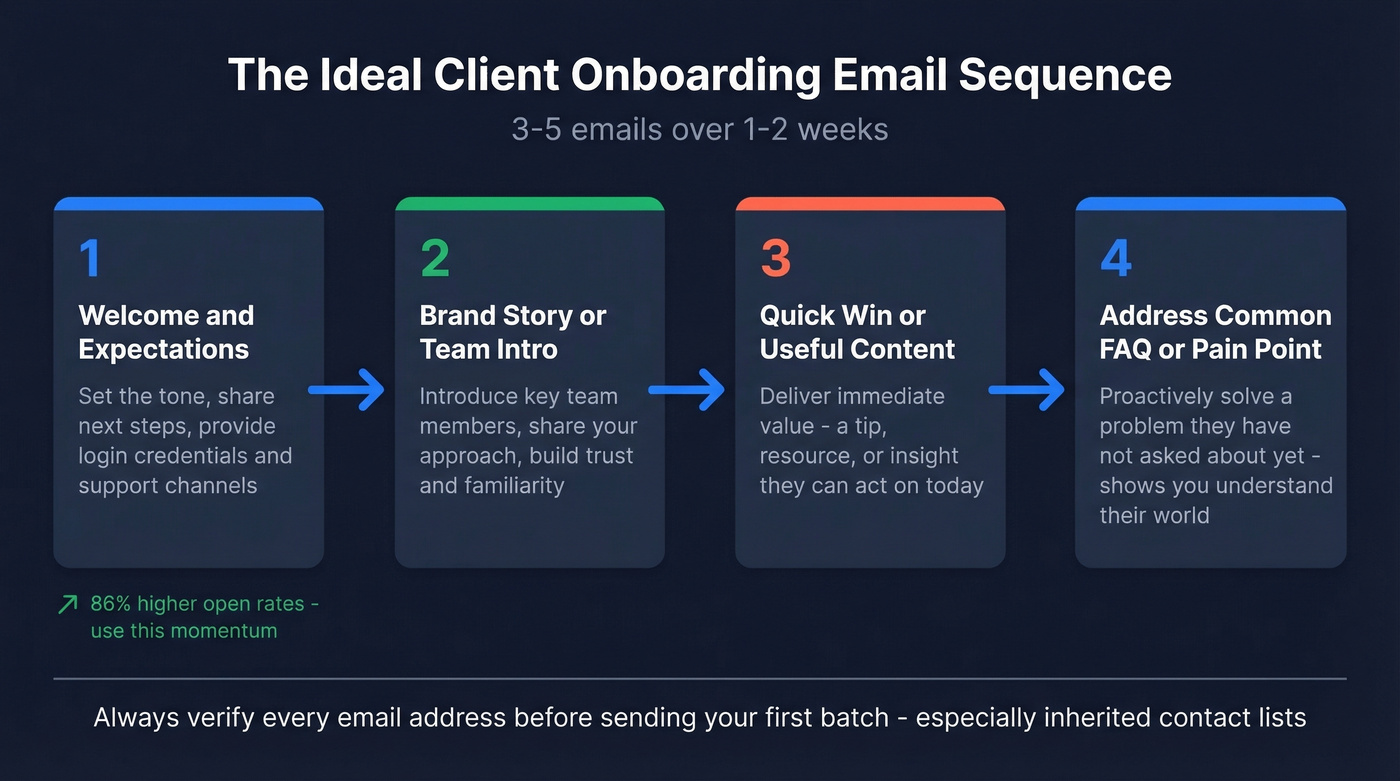
- Welcome and expectations
- Your brand story or team intro
- A quick win or engaging piece of content
- Address a common FAQ or pain point
That first email carries 86% higher open rates, so use the momentum to build a cadence, not just check a box. If you inherited a list of client contacts from a departing colleague, verify every address before sending - upload a CSV to a bulk verification tool and separate invalid from valid addresses before your first batch goes out. HubSpot's onboarding guide has a solid breakdown of sequencing if you want to go deeper. If you're rebuilding contact records at the same time, consider data enrichment services to fill gaps fast.
The biggest intro email mistake isn't bad copy - it's sending to someone who left the company. Prospeo's data refreshes every 7 days (not the 6-week industry average), so you always have the current contact for your new client's team. Find verified emails and direct dials for every stakeholder in one click.
Stop introducing yourself to people who already left.
FAQ
How long should an introduction email to a client be?
Four to six sentences. State your name, your role, what you'll do for them, and a specific next step. Save the detail for the kickoff call - anything over two short paragraphs gets skimmed.
What subject line works best?
Specific, short subject lines like "Your new account manager - [Your Name]" or "Welcome to [Company] - next steps inside" outperform generic ones. Avoid single-word subjects like "Introduction" - they get buried under dozens of similar emails.
Should I follow up if I don't get a reply?
Yes. Wait 3-5 business days, then send a two-sentence follow-up referencing your original email. "Just confirming you received this" works better than re-pitching a meeting. If the second email bounces, the address is probably invalid.
How do I introduce myself when taking over an account?
Lead with your role and availability, not your resume. Acknowledge the transition, explain what stays the same, and offer a 15-minute call to align on priorities. Four sentences is plenty for a handoff email.
How can I make sure my intro email doesn't bounce?
CRM contact data decays fast. Run the email address through a verification tool before sending - a bounced intro email damages credibility before the relationship even starts. Catch-all domain verification and spam-trap removal are the two features that matter most.