

How to Sell Remotely in 2026: The Practitioner's Playbook
You built a list of 35 phone numbers from local businesses. It took you an hour. You burned through every single one by 10:47 AM - and now you're staring at a blank screen wondering what to do until lunch. That's not a selling problem. That's a lead sourcing problem, and it's the #1 reason selling remotely feels harder than it should be.
What You Need (Quick Version)
Three things move the needle when you're selling remotely. First, a scalable lead engine - not manual list building that caps out at 35 contacts per session. Second, a multichannel cadence you run daily across email, phone, and social. Third, contact data accurate enough that you aren't wasting limited selling hours on bounced emails and disconnected numbers.
Does Remote Selling Actually Work?
70-80% of B2B buyers now prefer virtual interaction over face-to-face, according to McKinsey's widely cited research. About 40% of deals over $500K close without a single in-person meeting. U.S. B2B sales hit $15.12 trillion in 2025, and total growth was 0.4% - while digital commerce keeps expanding at a much faster pace.
The close-rate gap is real but narrow. Across 939 B2B companies tracked in Q1-Q3 2025, remote close rates averaged 28% versus 32% for in-person. Four points. Teams using demo videos in their virtual selling process hit a 35% close rate, beating the in-person average outright.
Remote selling isn't a compromise. It's the default mode for most B2B transactions now, and the question isn't whether it works - it's whether your process can handle 25 stakeholders and a six-month-plus buying cycle.
The Economics of Remote Sales
The cost math alone makes the case:
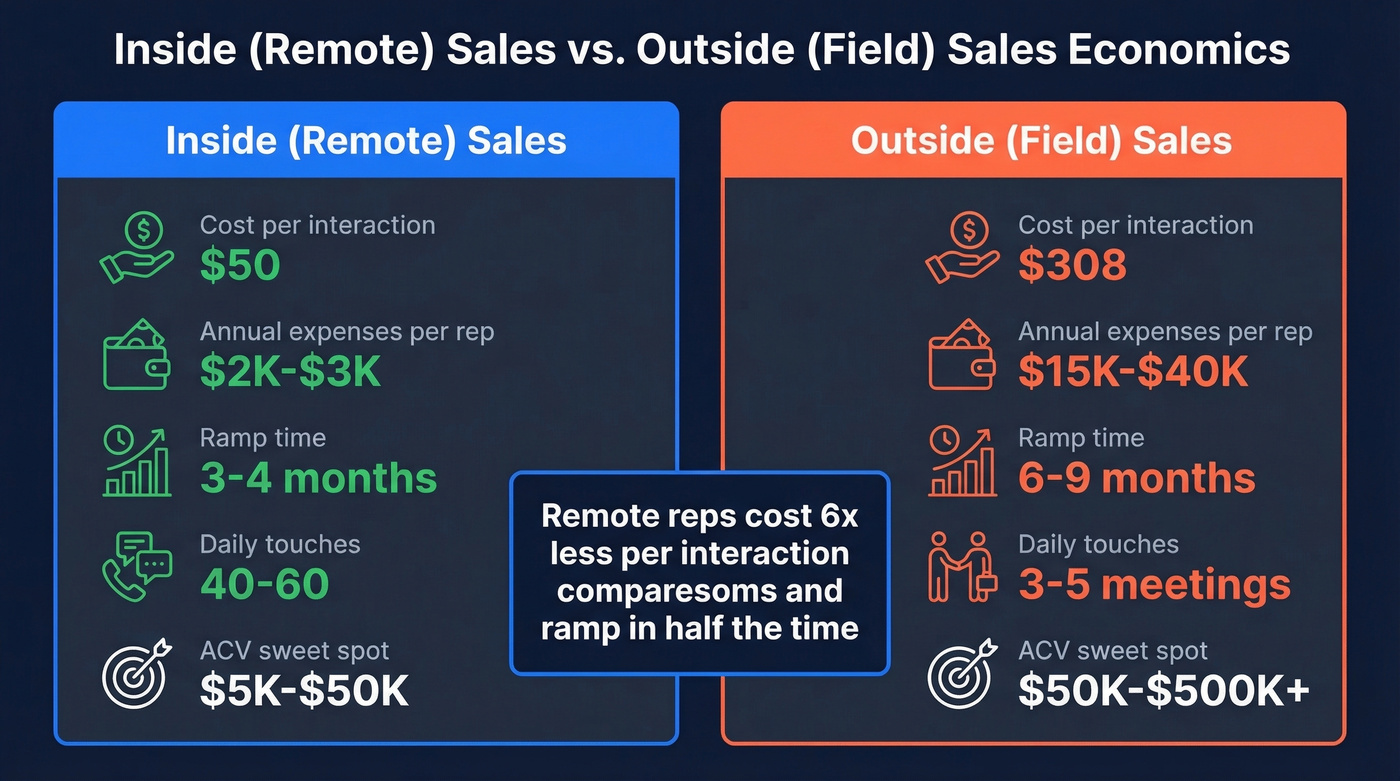
| Metric | Inside (Remote) | Outside (Field) |
|---|---|---|
| Cost per interaction | ~$50 | ~$308 |
| Annual expenses/rep | $2K-$3K | $15K-$40K |
| Ramp time | 3-4 months | 6-9 months |
| Daily touches | 40-60 | 3-5 meetings |
| Typical ACV sweet spot | $5K-$50K | $50K-$500K+ |
A remote rep costs roughly one-sixth per interaction and ramps in half the time. That's not marginal - it's structural. The daily touch volume is where the real advantage shows up: forty to sixty touches per day means a remote rep covers more ground in a week than a field rep covers in a month. When your pipeline depends on volume and velocity, selling from anywhere wins on pure math.
How Buyers Changed (Your 2022 Playbook Is Dead)
Your buyers aren't waiting for you to educate them. 83% now define their requirements before they ever talk to a seller. 94% use LLMs during their research process. They're showing up to your discovery call already knowing what they want - and often knowing your pricing, your competitors, and your G2 reviews better than your newest rep does.
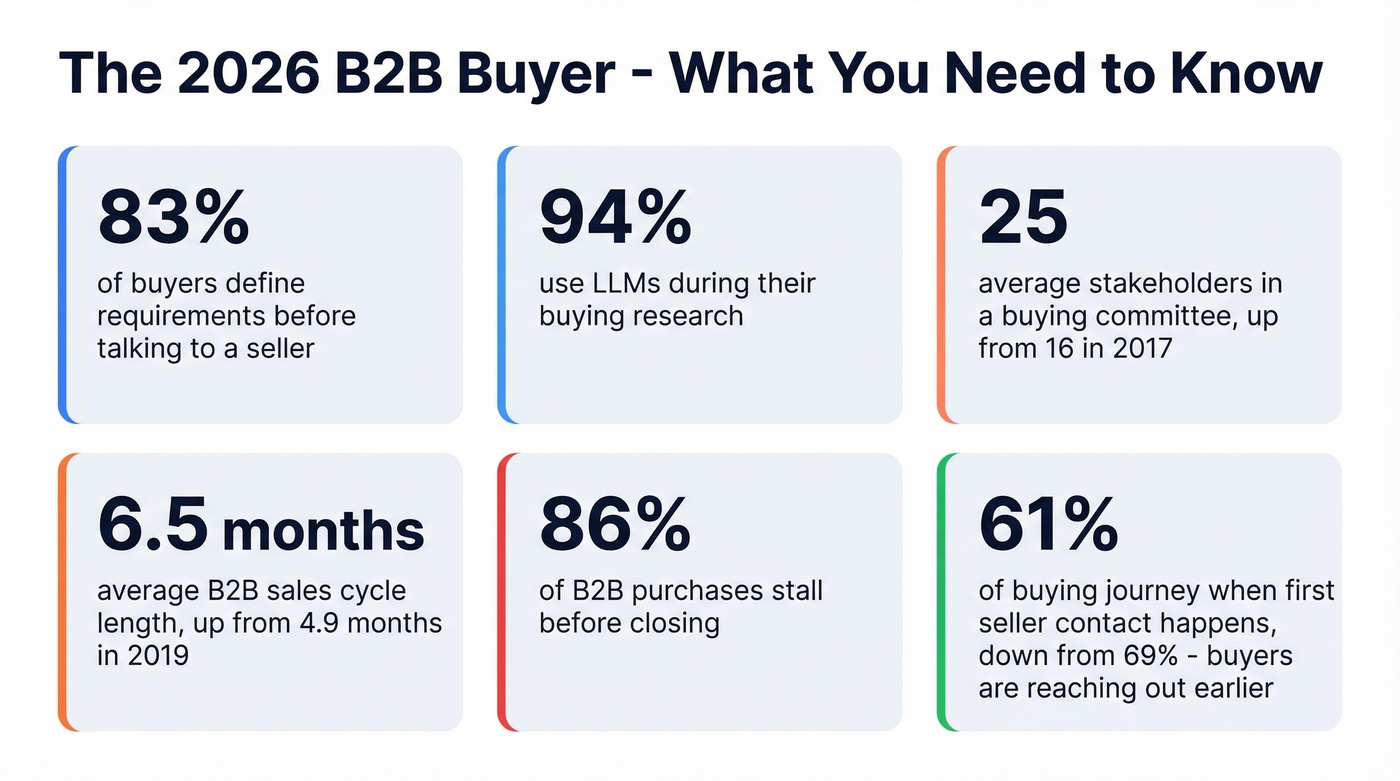
Buying committees have ballooned to an average of 25 stakeholders, up from 16 in 2017. Average B2B sales cycles stretched to 6.5 months in 2023, up from 4.9 months in 2019, and they haven't gotten shorter since. No wonder 86% of B2B purchases stall and 81% of buyers end up dissatisfied with the provider they chose.
Here's the thing: economic pressure is actually pulling buyers toward sellers earlier. 6Sense's 2025 data shows first contact moved from 69% of the buying journey to 61% - roughly six to seven weeks earlier than in 2024. 49% of buyers say their buying cycles shortened, and 62% say economic pressures pushed them to engage sellers sooner. Buyers want help navigating complexity. They just don't want a pitch.
If your remote selling approach still leads with a product demo instead of helping a committee build consensus, you're losing deals you should be winning.
Hot take: If your average contract value is under $25K, you probably don't need field sales at all. The four-point close-rate gap evaporates when you factor in the 6x cost difference per interaction. Put that travel budget into better data and a second SDR.

You can't do 40-60 daily touches when you're manually scraping 35 numbers an hour. Prospeo's 300M+ database with 30+ filters - buyer intent, technographics, funding, headcount growth - builds targeted lists in minutes. 98% email accuracy and 7-day refresh means every touch counts.
Replace your lead sourcing bottleneck with a system that scales to 60 touches a day.
The Remote Selling Playbook
Lead Sourcing - The Real Bottleneck
Every remote seller hits the same wall. You can only manually build so many lists. That Reddit poster on r/InsuranceAgent who burned through 30-35 numbers in under an hour? That's the failure mode. Activity without a scalable lead engine is just busy work.
The fix is a data platform that lets you build targeted lists in minutes, not hours. Prospeo's B2B database covers 300M+ professional profiles with 30+ search filters - buyer intent, technographics, job changes, headcount growth, funding signals. You're not guessing who to call. You're filtering by who's actually in-market, at companies that match your ICP, in roles that have buying authority. The 98% email accuracy and 7-day data refresh cycle mean that when you're doing 40-60 touches a day, you aren't burning time on dead-end contacts.

We've seen the results firsthand. GreyScout doubled their sales team from 2 to 5 reps, cut bounce rates from 38% to under 4%, and grew pipeline 140% - with new reps ramping in 4 weeks instead of 8-10. Founder Led Sales cut list-building from 15 hours a week to 2-3 hours and landed 5 paid sponsors at $3,500/month within six months.
Outreach Cadence Template
Single-channel outreach is dead. Multichannel sequences outperform single-channel by 2x or more, with one dataset showing a 287% increase when combining email, phone, and social.
If you want more options beyond email + phone + social, pull ideas from these sales prospecting techniques and build them into your weekly rhythm.
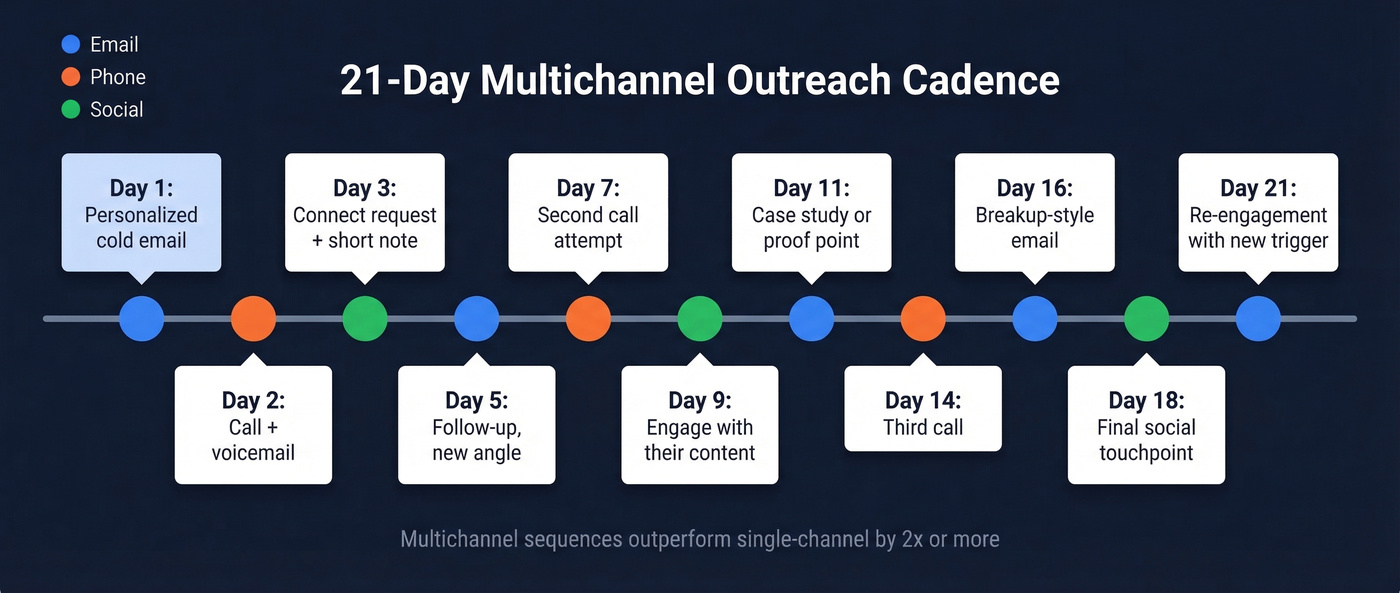
| Day | Channel | Action |
|---|---|---|
| 1 | Personalized cold email, problem-focused | |
| 2 | Phone | Call + voicemail |
| 3 | Social | Connect request + short note |
| 5 | Follow-up, new angle | |
| 7 | Phone | Second call attempt |
| 9 | Social | Engage with their content |
| 11 | Case study or proof point | |
| 14 | Phone | Third call |
| 16 | Breakup-style email | |
| 18 | Social | Final touchpoint |
| 21 | Re-engagement with a new trigger |
For higher-value targets, extend to 15-20 touches over four weeks. We've tested cadences from 8 to 25 touches - 15-20 is the sweet spot for most B2B deals under $100K. The key is mixing channels. A prospect who ignores five emails will sometimes pick up the phone on day 14. Run the cadence every day, not when you feel like it.
Discovery and Demo Calls
Since 83% of buyers have already defined their requirements, treat discovery as confirmation, not education.
If you need a tighter structure, use a discovery questions framework so you’re not winging it on Zoom.
Do:
- Open with "I've done some research - let me confirm what I think I know about your situation"
- Ask about evaluation criteria and who else is involved
- Use demo videos (teams using them hit 35% close rates)
- Set a specific next step before ending every call
Don't:
- Run a 20-minute product tour nobody asked for
- Assume you're talking to the sole decision-maker (25 stakeholders, remember)
- Skip the agenda - virtual meetings without structure lose attention fast
Handling Objections Remotely
You can't see the prospect lean back, cross their arms, or glance at their phone. On a video call, silence feels longer and discomfort is easier to hide. With 86% of B2B purchases stalling, your job isn't just handling objections - it's unstalling deals.
If objections are a recurring pattern, it’s usually a qualification + messaging issue - fix it with a sales communication system, not more pressure.
Three frameworks that work well in our experience:
The "committee question" - "Who else needs to be comfortable with this before you can move forward?" The "risk reversal" - address the fear of choosing wrong, since 81% of buyers regret their choice. And the "micro-commitment" - instead of asking for the deal, ask for the next 15-minute call with their CFO on the line.
Closing and Follow-Up
That 81% buyer dissatisfaction stat is your competitive advantage in follow-up. Most sellers disappear after the proposal. The ones who win keep showing up with value - a relevant case study, a competitive comparison the committee can circulate, a one-pager for the CFO who wasn't on the demo.
If you want plug-and-play language, keep a swipe file of sales follow-up templates so you can move fast without sounding generic.
"I'll send a follow-up" is not a next step. "I'll send the ROI calculator by Thursday and we'll review it together Friday at 2 PM" is. Remote deals die in ambiguity. Kill the ambiguity.
Outreach Benchmarks to Track
Before you decide your cadence isn't working, know what "normal" looks like:
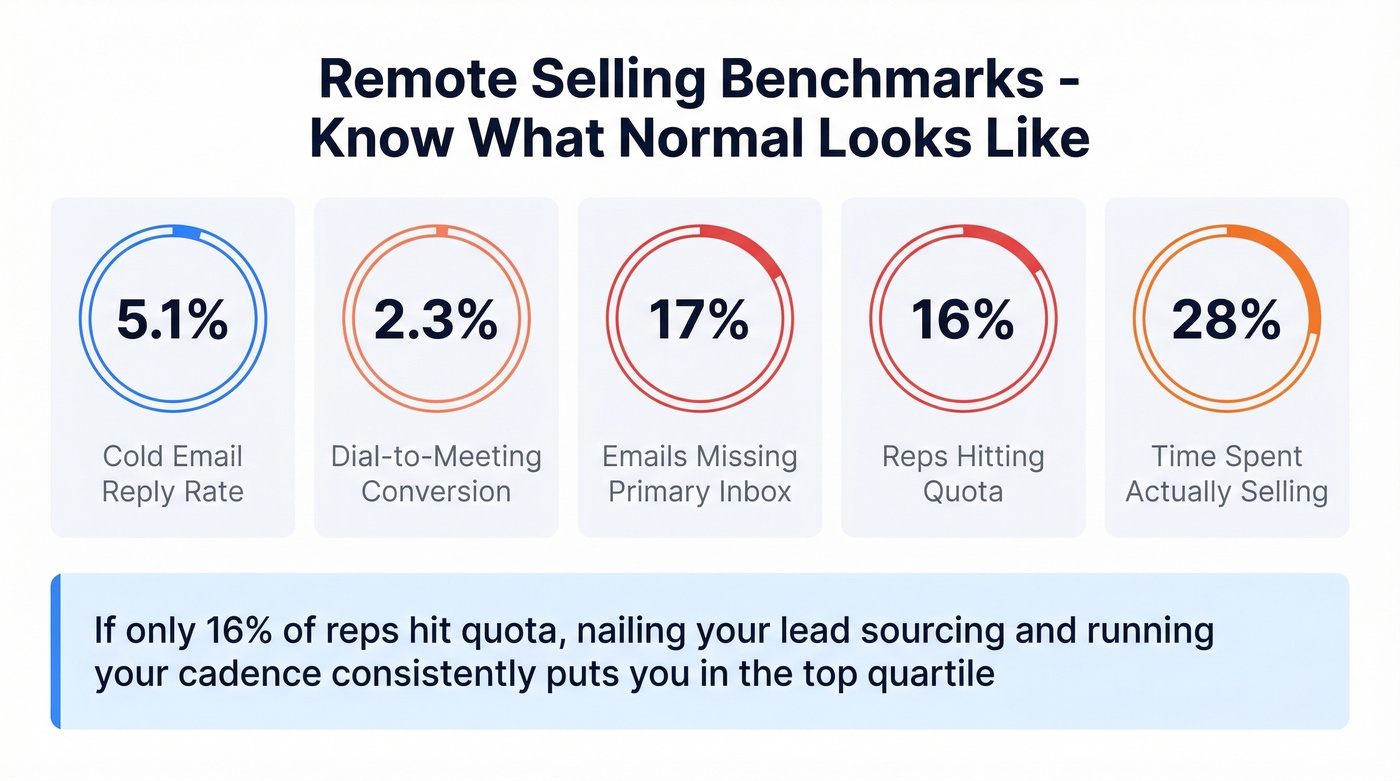
- Cold email reply rate: ~5.1%
- Dial-to-meeting conversion: ~2.3%
- Emails missing primary inbox: ~17%
- Reps hitting quota: only 16%
- Time spent actually selling: 28% of the week
That 17% deliverability loss is a data quality problem. Before you send a single email, verify your list. Prospeo's 5-step verification catches spam traps, honeypots, and catch-all domains - Meritt dropped their bounce rate from 35% to under 4% and tripled their pipeline from $100K to $300K per week after switching.
If you’re diagnosing bounces and inboxing issues, start with these email deliverability fundamentals before you touch your copy.
Real talk: if only 16% of reps hit quota and reps spend just 28% of their week selling, the bar for "high performer" is lower than you think. Nail your lead sourcing, run your cadence consistently, and you're already in the top quartile.
Daily Routine for Remote Sellers
The consistency problem from that Reddit thread is real. Without a commute and an office, it's easy to drift. Protect your prospecting blocks, and your numbers get more predictable fast.
If you’re struggling to stay consistent, treat your day like a 30-60-90 day plan - with targets, not vibes.
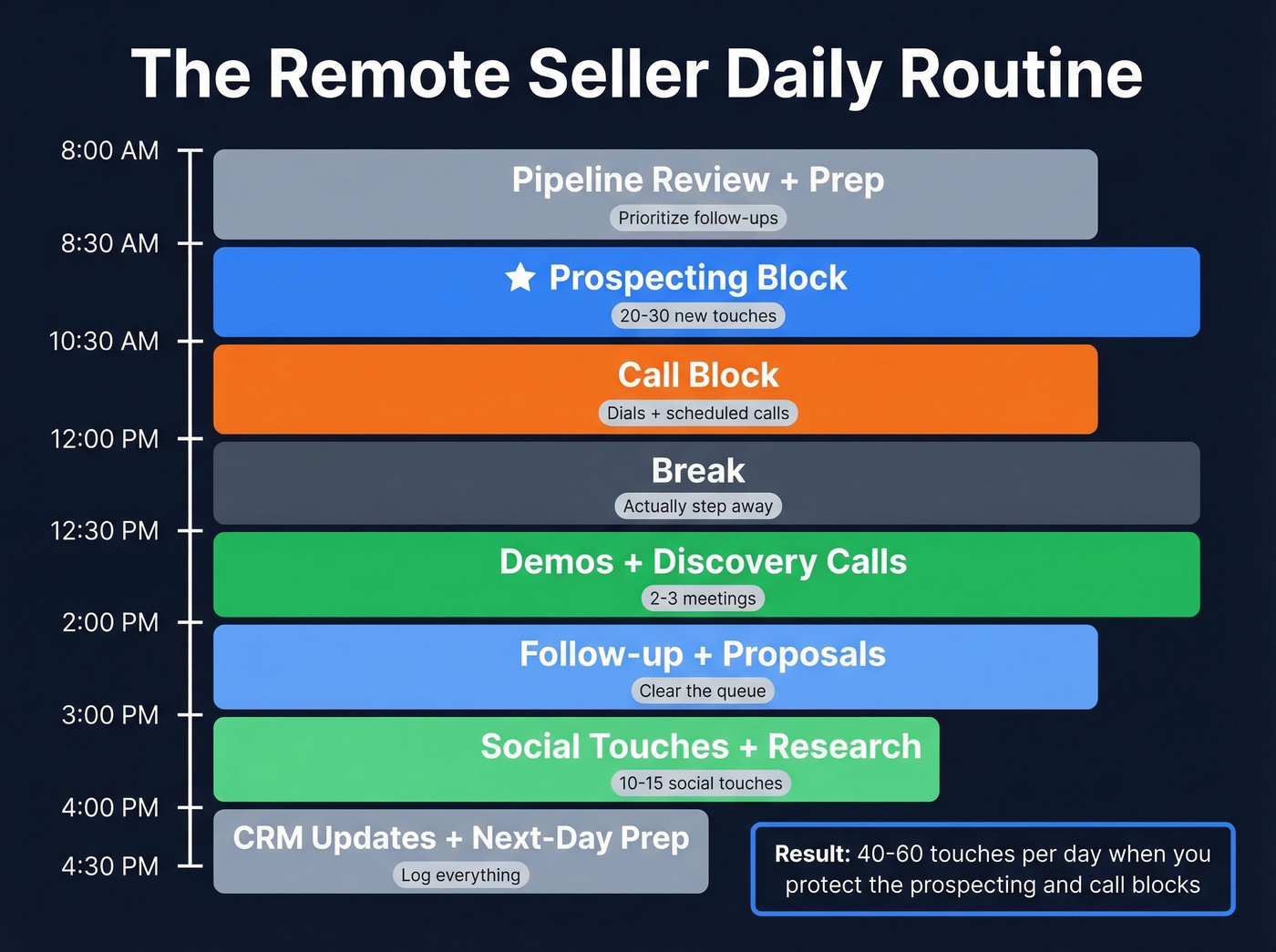
| Time Block | Activity | Target |
|---|---|---|
| 8:00-8:30 | Pipeline review + prep | Prioritize follow-ups |
| 8:30-10:30 | Prospecting block | 20-30 new touches |
| 10:30-12:00 | Call block | Dials + scheduled calls |
| 12:00-12:30 | Break | Actually step away |
| 12:30-2:00 | Demos + discovery calls | 2-3 meetings |
| 2:00-3:00 | Follow-up + proposals | Clear the queue |
| 3:00-4:00 | Social touches + research | 10-15 social touches |
| 4:00-4:30 | CRM updates + next-day prep | Log everything |
That's 40-60 touches per day if you protect the prospecting and call blocks. The reps who struggle remotely aren't lazy - they're letting admin, Slack, and "quick questions" eat their selling hours. Guard the blocks. Invest in the basics too: reliable internet, a decent headset, and a second monitor make a measurable difference when you're on video calls six hours a day.
Remote Selling Tech Stack
You don't need 10 tools. Reps already use an average of 10 sales tools, and most of that complexity slows them down. Start with a CRM, a data platform, and a video tool. Add a sequencer when you're consistently doing 40+ touches a day.
If you’re evaluating options, this list of SDR tools can help you avoid tool sprawl.
| Tool | Category | Starting Price | Free Tier? |
|---|---|---|---|
| HubSpot | CRM | ~$20/user/mo | Yes |
| Salesforce | CRM | ~$25/user/mo | No |
| Zoom | Video Meetings | ~$15/user/mo | Yes (40 min) |
| Salesloft | Sales Engagement | $125-165/user/mo | No |
| Apollo | Data + Sequencing | $49-99/user/mo | Yes |
| Gong | Conversation Intel | ~$100-200/user/mo | No |
| Calendly | Scheduling | ~$10/user/mo | Yes |
One tool worth adding to your workflow: an AI assistant like ChatGPT or Microsoft Copilot for drafting personalized email openers, summarizing call notes, and prepping for discovery calls. Since 94% of your buyers are already using LLMs in their research, you should be using them in your outreach. They're free to around $20/month and pay for themselves in time saved on the first day.
If you’re using AI to write outbound, make sure it’s aligned with AI cold email outreach best practices so you don’t sound like everyone else.
Let's be honest about budget: the stack should cost under $100/month for a solo rep getting started - HubSpot free tier, Zoom free tier, and a paid data platform. Don't let tool overload become the problem it's supposed to solve.
Multichannel cadences only work when your data works. GreyScout cut bounce rates from 38% to under 4% and grew pipeline 140%. At $0.01 per email, you spend less on a week of verified contacts than one field rep spends on lunch.
Fix the data and the cadence fixes itself - 75 free emails to prove it.
FAQ
Is selling remotely as effective as in-person?
Close rates average 28% remote versus 32% in-person across 939 B2B companies. Teams using demo videos push that to 35%, beating in-person outright. About 40% of deals over $500K now close without a single face-to-face meeting - the cost and velocity advantages tip the scales for most deal sizes.
What's the biggest mistake remote sellers make?
Treating lead sourcing as a one-time task instead of a continuous engine. Manual list building caps out at 30-35 contacts per session. Without a scalable data source refreshed on a weekly cycle, you'll burn through your pipeline faster than you can rebuild it.
How many touches does it take to book a remote meeting?
Plan for 15-20 touches across email, phone, and social over 3-4 weeks. Multichannel sequences outperform single-channel by 2x or more. At a 2.3% dial-to-meeting rate, volume and persistence matter more than any single clever email.
What tools do I need to start selling remotely?
Three essentials: a free CRM like HubSpot, a data platform for verified contacts, and a video tool like Zoom. Add a sequencer once you're consistently doing 40+ daily touches. Skip anything that doesn't directly help you reach more prospects or close more deals - complexity kills consistency.