

Selling to C-Level Executives: The Practitioner's Field Guide for 2026
You open with "Tell me about your biggest challenges," and the CFO checks her phone. The meeting's over before it started.
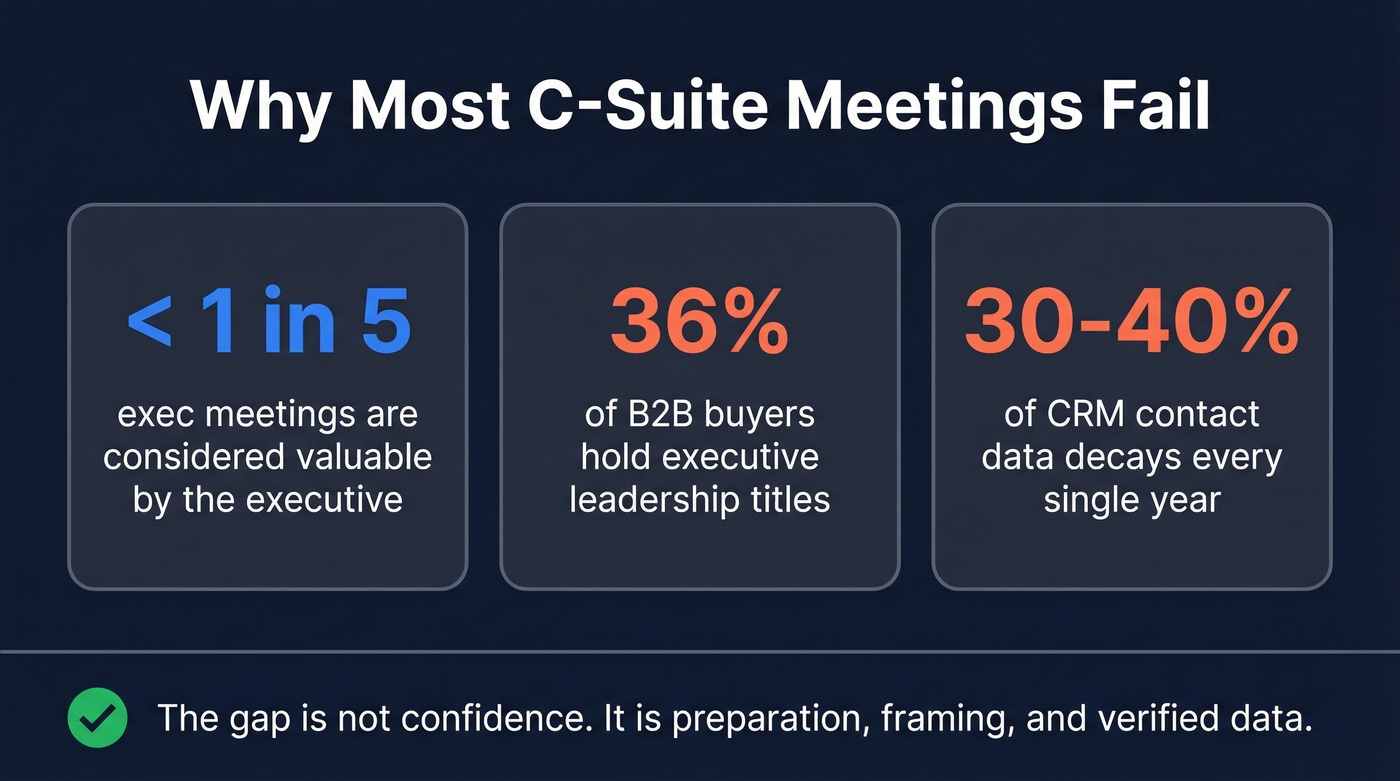
Executives don't have time to educate you on their problems - they expect you to walk in already knowing. Fewer than one in five exec meetings are considered valuable by the person sitting across the table. With 36% of B2B buyers holding executive leadership titles, selling to C-level decision-makers isn't a niche skill anymore. It's the core of enterprise selling. The gap isn't confidence. It's preparation, framing, and data.
Three Things That Move the Needle
- Verified direct contact data. Your prep is wasted if the number is dead. (If you're auditing your stack, start with data enrichment services.)
- A loss-aversion-framed point of view. Don't pitch upside - frame the cost of inaction. Executives respond to risk faster than opportunity. This is loss-aversion framing in practice.
- A specific CTA that tests commitment. "Can you share this with your VP of Ops by Thursday?" beats "Let's circle back" every time.
Getting Past Gatekeepers to Reach the C-Suite
Here's the invisible bottleneck: 30-40% of the contact data in your CRM decays every year. You can nail the talk track, research the 10-K, and build a killer one-pager - none of it matters if you're calling a disconnected line. 43% of executives say they already spend too much time on email, so every touchpoint has to count.
The gatekeeper problem is actually a data problem.
Call before 8 AM or after 5:30 PM - assistants keep regular hours, executives don't. Use first names ("Is Sarah available?" sounds like an existing relationship). Or skip the switchboard entirely with a verified mobile number. We've seen teams go from single-digit connect rates to 20-25% just by switching from stale data to fresh direct dials using Prospeo's 125M+ verified mobiles, which refresh every 7 days. That's the difference between a dead line and a live conversation. (If you're rebuilding your outbound motion, pair this with a tighter cold calling system.)

You just read how research separates reps from top performers. Prospeo gives you the intel to show up like a board member - 30+ filters including buyer intent, technographics, headcount growth, and funding data across 300M+ profiles. Layer in job change signals to catch new executives before competitors do.
Research like a board member. Prospect like one too.
Research Like a Board Member
Reps research companies. Top performers research like they're preparing for a board meeting. SBI's RAMP framework - Research, Access, Meet, Propose - is a useful mental model, but the real differentiator is source quality.
Go beyond the "About Us" page. Earnings calls and investor presentations reveal what executives are actually worried about. The risk factors section of 10-K filings is a goldmine for loss-aversion framing. Job postings tell you where they're investing - if they're hiring 15 SDRs, they're scaling outbound; if they're hiring a new CRO, priorities are shifting. Even technographic signals and headcount growth data can tell you whether a company is in build mode or belt-tightening mode, which completely changes how you frame the conversation. (This is where firmographic and technographic data pays for itself.)
Before every meeting, run SBI's meeting purpose test: "As a result of this meeting, the executive will ___?" If you can't finish that sentence with something specific, you're not ready.
Every 'circling back' email to a dead address kills your deal momentum. Prospeo's 98% email accuracy and 125M+ verified mobile numbers refresh every 7 days - so when you follow up with that CFO, you reach a live person, not a disconnected line. Teams using fresh direct dials see connect rates jump to 20-25%.
Your follow-up only works if the number is live.
Messaging That Lands in Two Minutes
Most reps open with upside: "We help companies grow 10x." Executives hear this twelve times a week. It's noise.
The loss-aversion reframe cuts through: "Companies in your space that haven't addressed [specific risk] are losing $X per quarter to [competitor/inaction]." Same value proposition, completely different emotional register. Let's be honest - if your opening sounds like everyone else's, you've already lost. (If you want more patterns like this, steal from these sample elevator pitches.)
Before: "Hi Sarah, I'd love to show you how our platform helps companies like yours increase revenue by 30%."
After: "Sarah, three companies in your space lost their #2 market position last year after delaying [specific initiative]. I have a 4-minute breakdown of what they missed. Worth a look?"
Quick self-edit: check your I/my vs. you/your ratio. It should be roughly 1:2. Keep subject lines to 6-7 words - anything longer gets truncated on mobile, where executives live. (If you need a swipe file, use these email subject line examples.)
Match the Executive's Decision Style
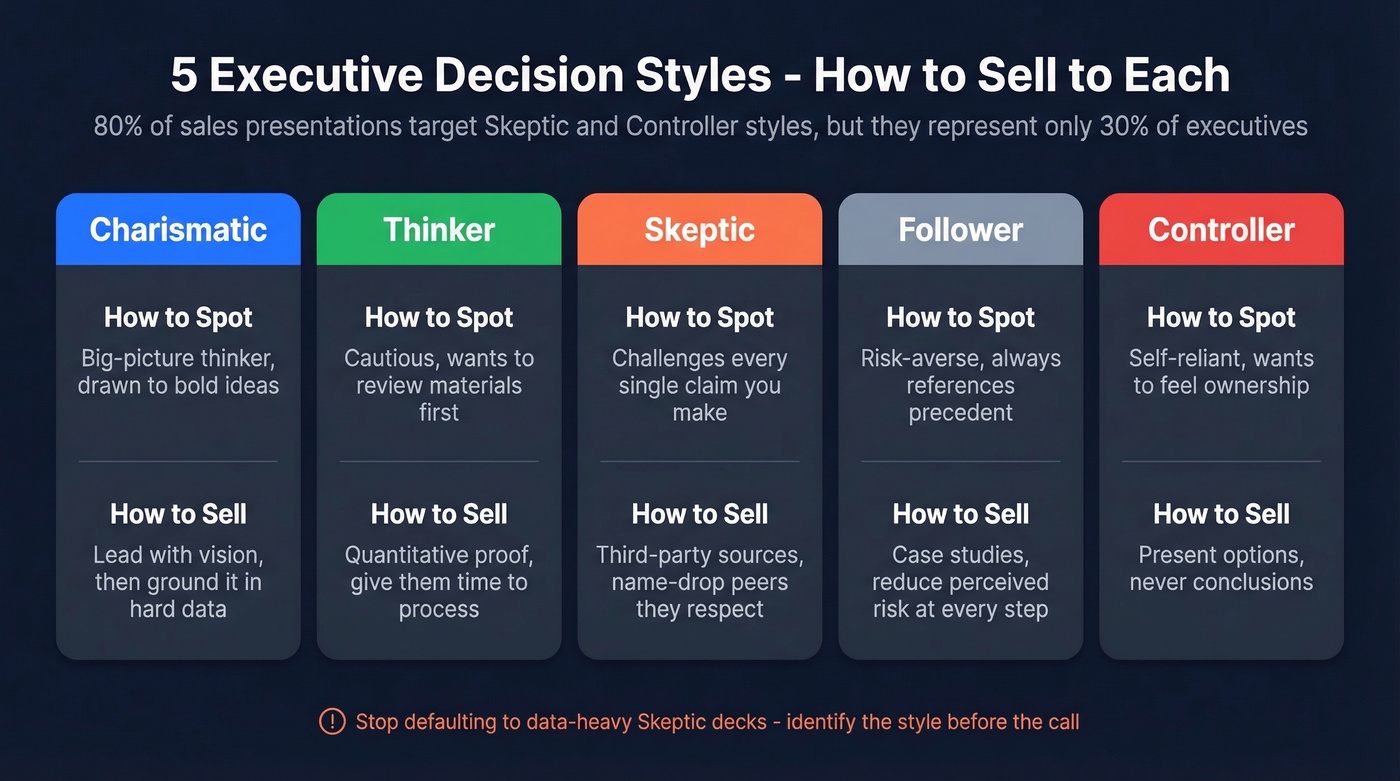
Here's a stat that should change how you prepare. Korn Ferry found that 80% of sales presentations target Skeptic and Controller styles - but those styles represent only about 30% of executives. You're optimizing for the minority.
| Style | How to Spot | How to Sell |
|---|---|---|
| Charismatic | Big-picture, drawn to bold ideas | Lead with vision, ground in data |
| Thinker | Cautious, wants to review materials | Quantitative proof, give time |
| Skeptic | Challenges every claim | Third-party sources, peer names |
| Follower | Risk-averse, references precedent | Case studies, reduce perceived risk |
| Controller | Self-reliant, wants ownership | Present options, not conclusions |
Identify the style before the call. Review their thought leadership, press interviews, and public communication. A Charismatic CEO and a Controller CFO need completely different conversations - even about the same product.
Adjust Your Message by Role
CEO: Market position and growth. They're thinking about competitive moats, category leadership, and board-level narratives. Frame your solution as a strategic lever, not a tool. (This is also classic B2B brand positioning thinking applied to sales.)
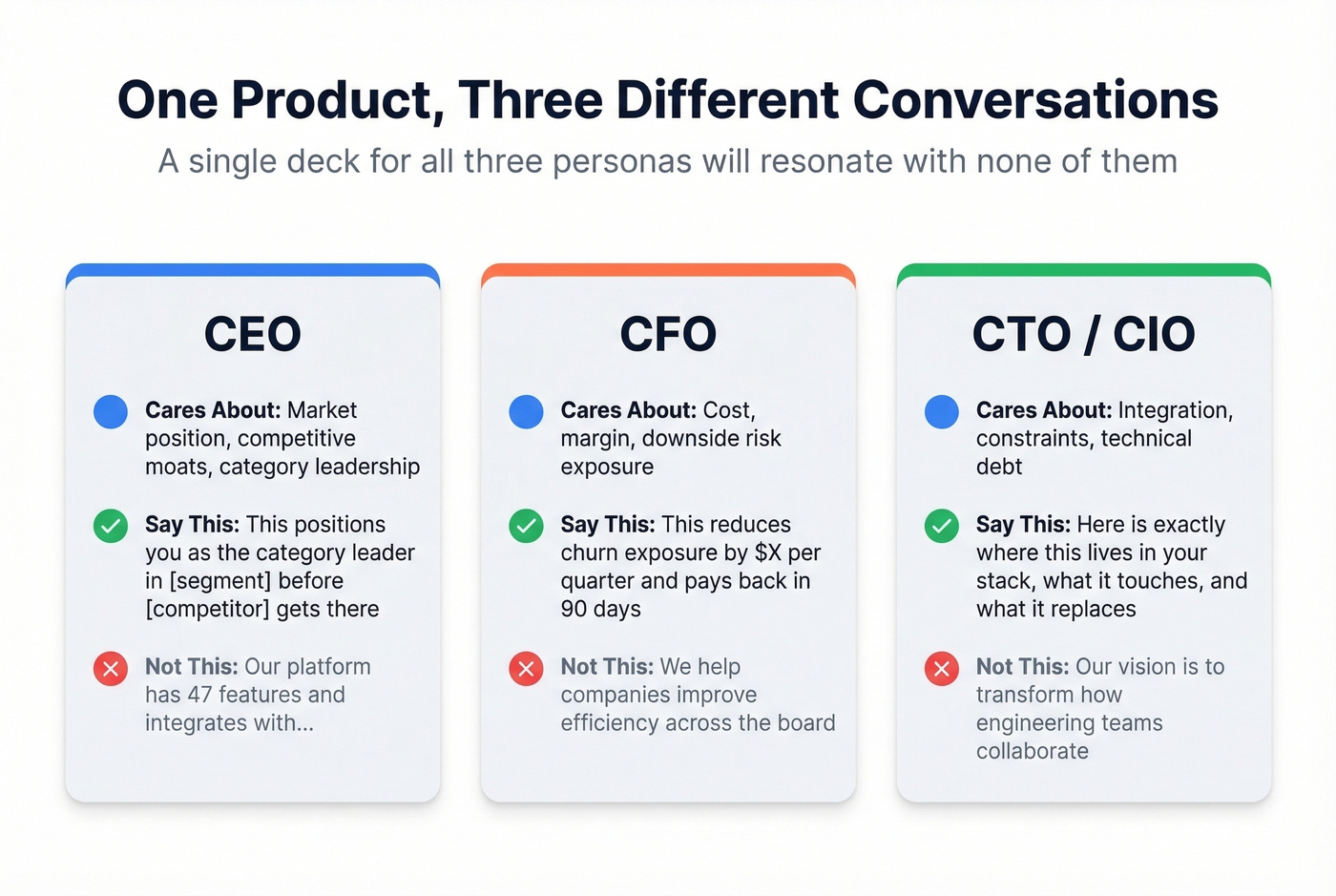
CFO: Cost, margin, and risk. Every dollar you're asking for competes with every other dollar. "This reduces churn exposure by $X/quarter" beats "this improves efficiency." (If you need the math, build it around churn analysis.)
CTO/CIO: Integration, constraints, and technical debt. The practitioner insight from r/b2bmarketing is spot-on: technical buyers react to constraints, not vision. Give them painful clarity on where your product lives in the stack, what it touches, and what it replaces. (More on this split: technical buyer vs economic buyer.)
A single deck that tries to speak to all three personas will resonate with none of them.
Closing Deals After the Meeting
"Just checking in" is the fastest way to lose an executive's attention. Every follow-up needs to deliver something new. (If you want plug-and-play options, start with sales follow-up templates.)
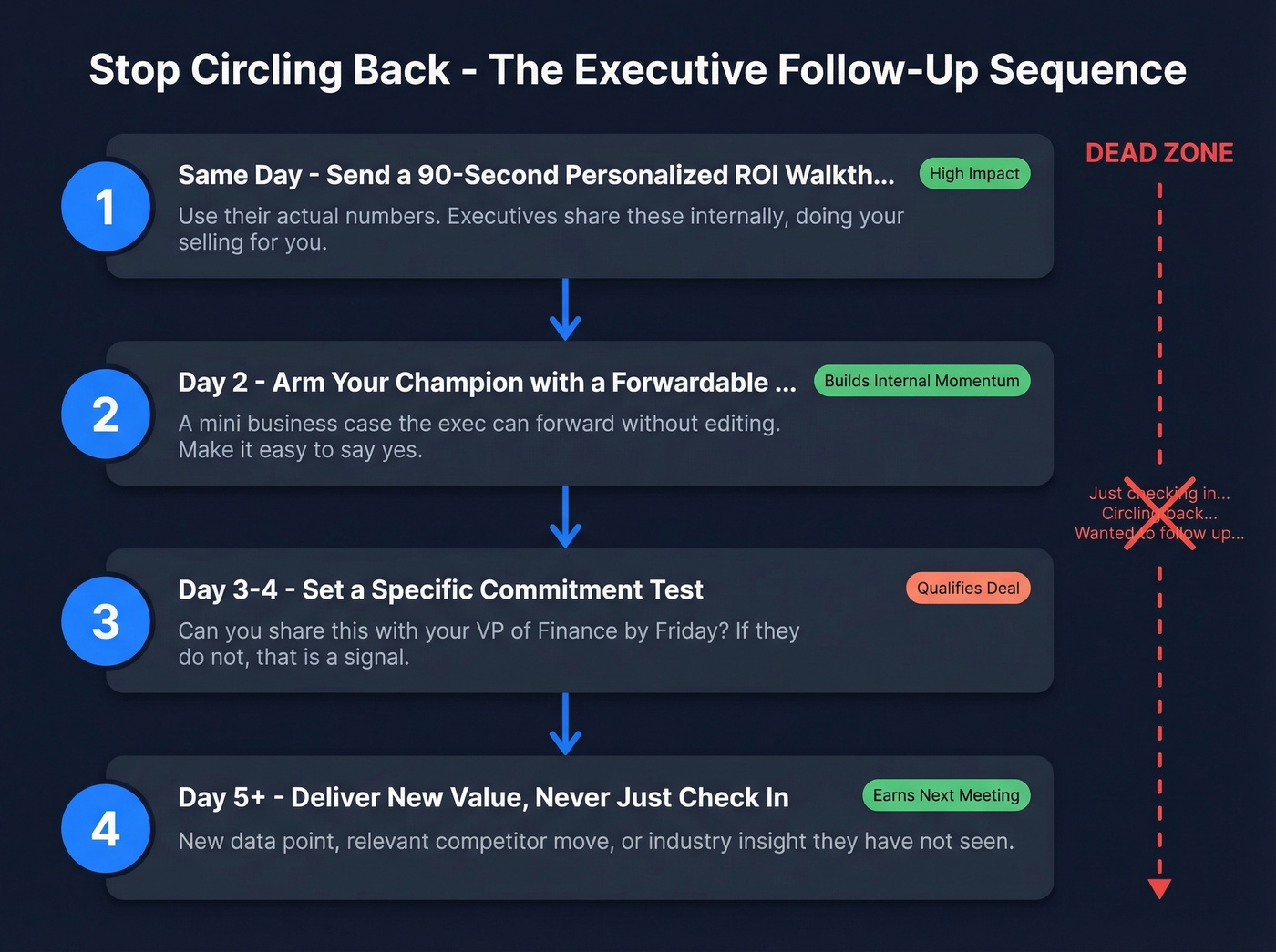
I've watched reps nail a first meeting and then kill the deal with three consecutive "circling back" emails. It's frustrating because the hard part was already done - they had the exec's attention and then squandered it with lazy follow-up. Instead, send a 90-second Loom-style ROI walkthrough personalized to their numbers. Executives share these internally, doing your selling for you. Arm your internal champion with a one-pager or mini business case the exec can forward without editing. And always set a specific commitment: "Can you share this with your VP of Finance by Friday?" If they don't, that's a signal - and it gives you a justified follow-up path.
When the Exec Says "Talk to My VP"
This isn't a rejection. A warm handoff to the right person is one of the best outcomes from a C-suite call. You now have the executive's name as social proof, a specific person to engage, and implicit permission to reference the conversation.
Here's the thing: most reps overvalue the C-suite meeting itself. You don't need 45 minutes with a CEO. You need 3 minutes of their attention, a clear point of view, and a handoff to someone who can evaluate the details. In our experience, the 3-minute rule holds - if you got that, the call worked. Stop chasing hour-long exec meetings and start optimizing for sharp, high-signal touchpoints. The reps who win at this level know that brevity is a feature, not a limitation.
FAQ
How do you get a meeting with a C-level executive?
Lead with a point of view relevant to their strategic priorities - not a generic intro. Use verified direct mobile numbers to bypass gatekeepers, time outreach around trigger events, and keep the ask small: 10 minutes, one topic. Skip the switchboard and go direct whenever possible.
What do C-suite executives care about most?
Making money, saving money, and managing risk - in that order. CEOs focus on market position and competitive moats. CFOs care about margins and downside exposure. CTOs want integration clarity and technical debt reduction. Every message should map to one of these three priorities.
What's the biggest mistake when selling to senior executives?
Opening with your product instead of their problem. The consensus on r/coldemail is right: once a script gets widely copied, it stops working. Structure matters more than templates - make it about them, one clear idea, easy to say yes to. A point of view beats a pitch deck every time.
How does C-suite selling differ from mid-level selling?
Mid-level managers evaluate features and workflows. Executives evaluate strategic impact, risk, and opportunity cost. Every minute of their time must deliver insight they can't get from their own team. Skip the product walkthrough and lead with the business case - that's the fundamental shift.