

SMB Sales: The Complete Playbook for Selling to Small Businesses in 2026
You just lost a deal you should've closed. The owner said "sounds great, let me think about it" three weeks ago and hasn't replied since. Your pipeline is full of these - small business deals that felt warm, then went cold because you ran an enterprise playbook on a buyer who needed a decision in 10 days, not 10 meetings.
SMB sales is a speed game disguised as a relationship game. The companies are smaller, the cycles are shorter, and the margin for wasted effort is razor-thin.
What Is SMB Sales (And Why It's Different)
There are 33.3 million small businesses in the United States - 99.9% of all U.S. businesses. They employ 61.6 million people, nearly 45.9% of the entire workforce. That's the addressable market. It's massive, fragmented, and wildly underserved by most sales orgs.
But 27.1 million of those businesses have zero employees. They're solopreneurs, freelancers, single-location shops. Only about 5.4 million have 1-19 employees, and another ~648,000 have 20-499. The "SMB" label covers everything from a one-person consulting firm to a 200-person regional manufacturer. Treating them the same is the first mistake most teams make, and it's the one that quietly kills pipeline before anyone notices.
So what does SMB stand for in sales? Small and midsize business - but the meaning goes beyond a simple acronym. Selling to SMBs means matching their buying behavior: fewer stakeholders, faster decisions, extreme price sensitivity, and near-zero tolerance for complexity. The buyer is often the owner. They don't have a procurement team. They want to know if your product works, what it costs, and how fast they can get value.
What You Need (Quick Version)
If you take nothing else from this article, take these three levers:
- Tighten your ICP and disqualification rules. Most deals die in qualification, not closing. If you're spending cycles on businesses that can't buy, you're losing deals you never had. (If you need a starting point, use an ICP scoring rubric.)
- Enforce a 24-hour proposal SLA. Proposals sent within 24 hours of a demo close 35% faster. Small business buyers lose urgency fast - every day you wait, the "let me think about it" reflex kicks in.
SMB vs Enterprise - What Changes
The motion isn't just faster. It's structurally different, and understanding how selling to small businesses differs from enterprise helps you avoid applying the wrong playbook to the wrong buyer. (If you're running six-figure motions, see enterprise B2B sales.)
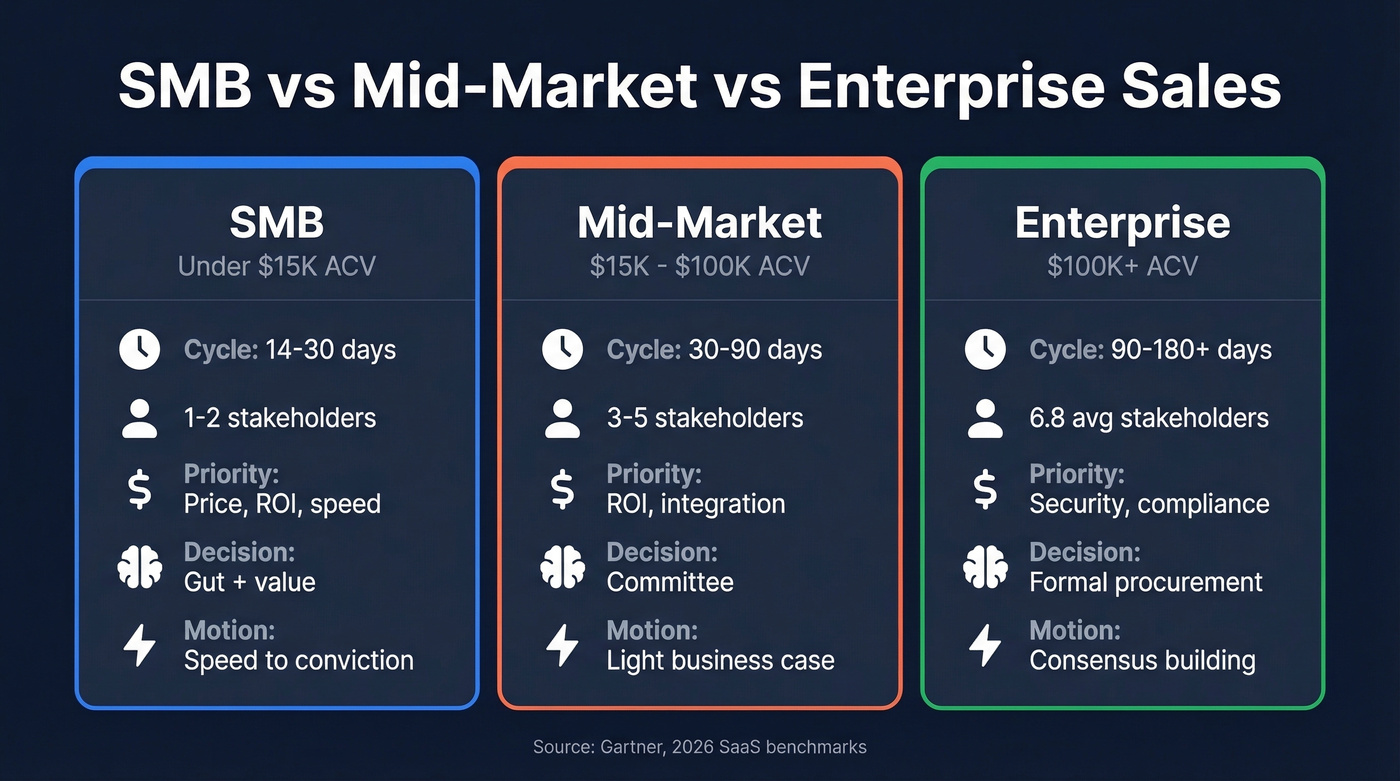
| Dimension | SMB (<$15K ACV) | Mid-Market ($15-100K) | Enterprise ($100K+) |
|---|---|---|---|
| Cycle length | 14-30 days | 30-90 days | 90-180+ days |
| Stakeholders | 1-2 | 3-5 | 6.8 avg (per Gartner) |
| Buyer priority | Price, ROI, speed | ROI, integration | Security, compliance |
| Decision style | Gut + value | Committee | Formal procurement |
Enterprise deals now average 6.8 decision-makers, up from 5.4 in 2020. SMB deals usually involve one person - the owner or a department head who controls budget. Your sales process should be built for speed-to-conviction, not consensus-building. If you're multi-threading across four stakeholders, you're selling to a mid-market company and calling it SMB.
Segment Your Accounts Properly
We've seen teams treat a 5-person agency the same as a 150-person manufacturer and wonder why conversion rates are all over the map. Here's how we break it down.
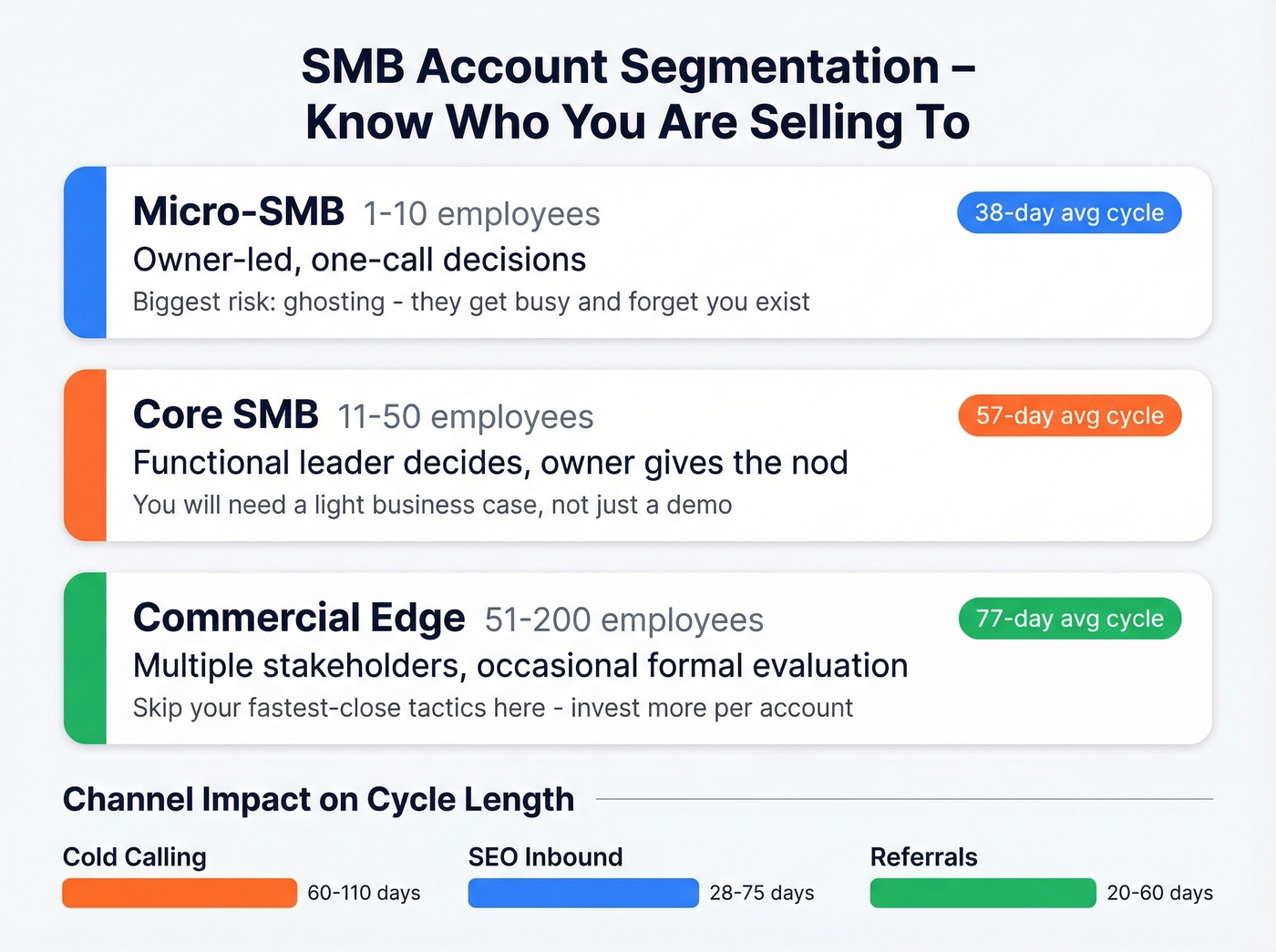
Micro-SMB (1-10 employees): Owner-led. Decisions happen in one conversation. Average cycle is 38 days. The buyer cares about price and time-to-value above everything else. Your biggest risk is ghosting - they get busy running the business and forget about you entirely.
Core SMB (11-50 employees): A functional leader owns the decision but needs a nod from the owner. Cycle averages 57 days. You'll need a light business case, not just a demo.
Commercial edge (51-200 employees): Starting to look like mid-market. Multiple stakeholders, 77-day cycles, and occasionally a formal evaluation process. Skip your fastest-close tactics here - the motion is slower and the deal size justifies more investment per account.
Channel matters too. Cold-calling-sourced deals run 60-110 days. SEO-sourced inbound closes in 28-75 days. Referrals are fastest at 20-60 days.

You just read that stale data kills SMB deals before they start. Prospeo refreshes every 7 days - not 6 weeks - so the owner you're calling is still at that company. With 30+ filters for headcount, funding, and intent, you build micro-SMB and core-SMB lists in minutes at $0.01/email.
Stop burning dials on contacts who left three months ago.
Key Benchmarks for 2026
Based on 2026 SaaS funnel benchmarks, the baseline conversion rates are tighter than most teams expect.
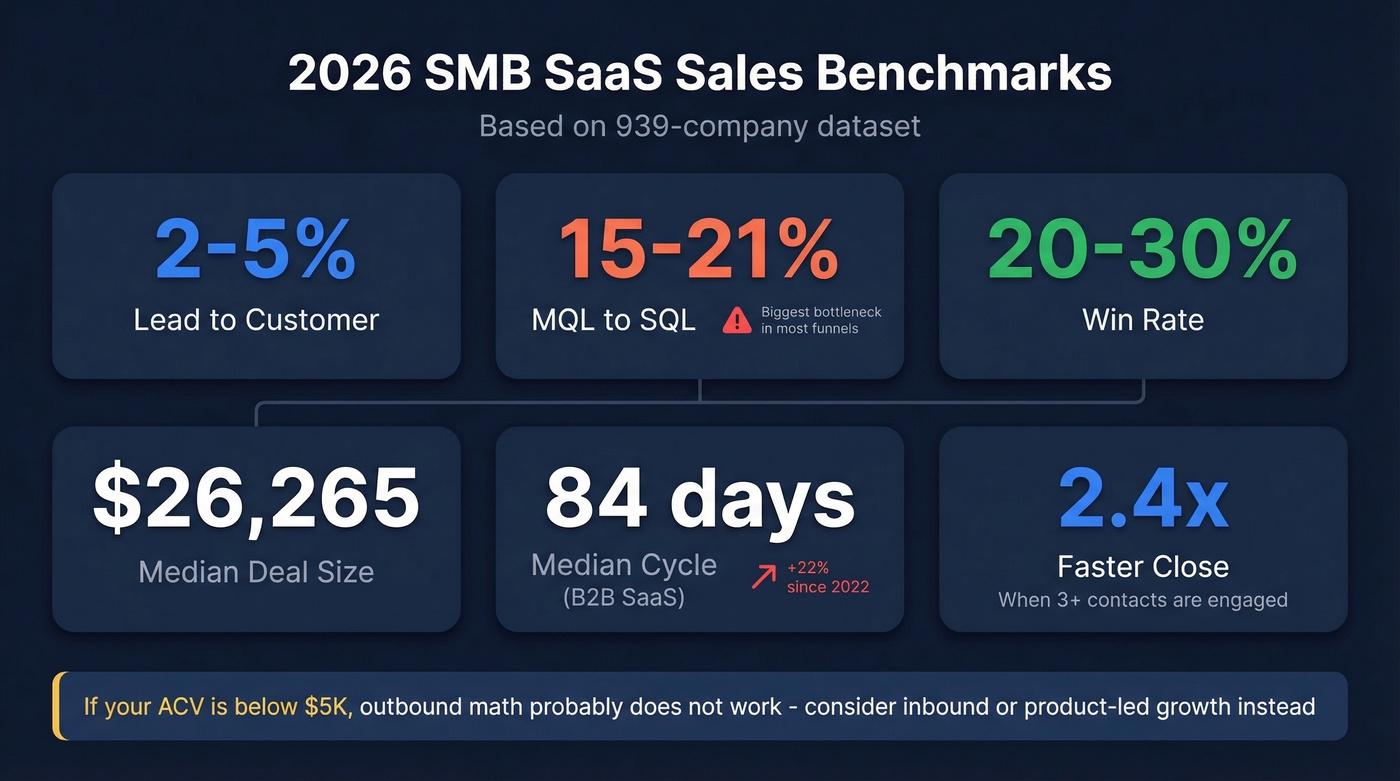
Per a 939-company dataset, deals with 3+ contacts engaged close 2.4x faster. Even in smaller deals, multi-threading the owner plus one other stakeholder dramatically improves your odds. That's the single most actionable insight in this section.
| Metric | Benchmark |
|---|---|
| Lead to Customer | 2-5% |
| MQL to SQL | 15-21% |
| Win rate | 20-30% |
| Median deal size | $26,265 |
| Median cycle (B2B SaaS) | 84 days |
The MQL-to-SQL conversion is the biggest bottleneck in most funnels. If you're converting fewer than 15% of MQLs to qualified opportunities, your problem isn't closing - it's qualification. Fix that before you invest in negotiation training. (To diagnose the leak, use a B2B sales funnel template.) Sales cycles have also lengthened 22% since 2022 across B2B SaaS, so track deal slippage rate as a pipeline health metric.
Here's the thing: if your annual contract value sits below $5K, you probably can't afford a dedicated outbound motion at all. One Reddit seller shared 1,900+ dials producing about $3K total, with ~$2K from cold calls selling a $300/year per-location product plus a $150 setup fee. That's not a skills problem - it's an economics problem. Below a certain deal size, inbound and product-led growth are the only motions that make the math work.
The SMB Sales Process
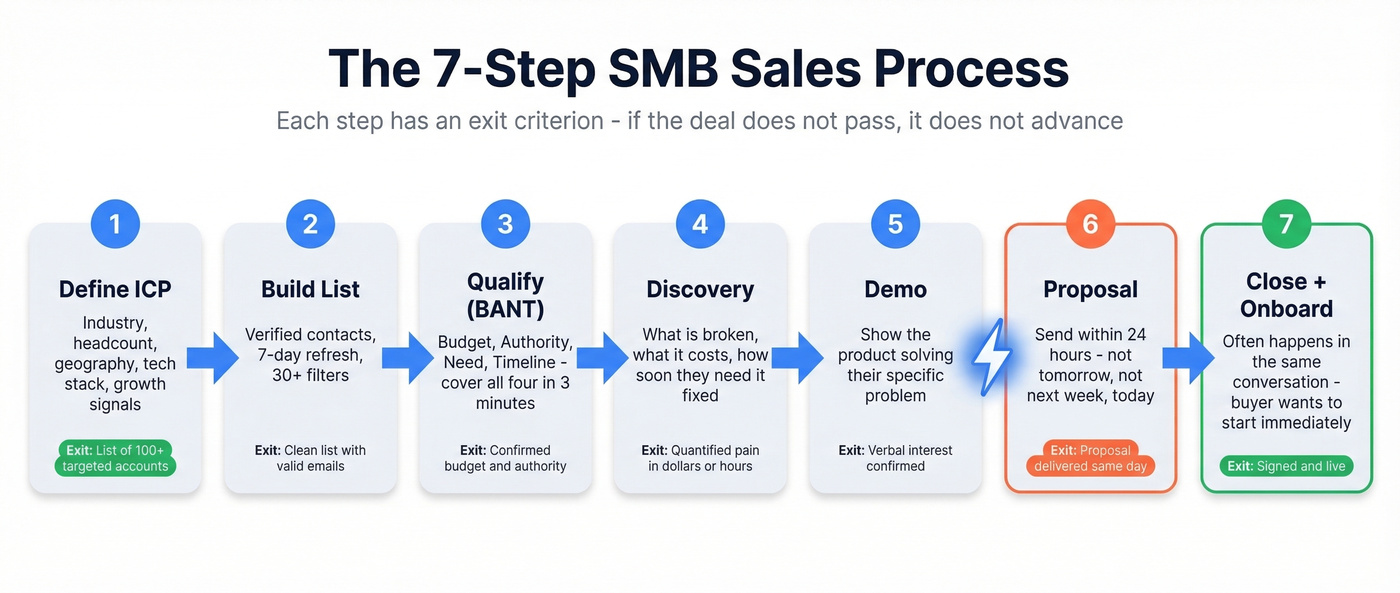
Seven steps. Each one has an exit criterion - if the deal doesn't pass, it doesn't advance.
Prospecting & List Building
Define your ICP. Not "small businesses." Specific. Industry, headcount range, geography, tech stack, growth signals. The tighter your ICP, the fewer wasted conversations. (If you need ideas, borrow from these sales prospecting techniques.)
Build your list. Most outbound math breaks down at this stage. A B2B leads database with company-size filters, headcount growth signals, and real-time verification keeps your list clean. In our experience, the 7-day data refresh cycle matters because SMB contacts change roles fast - stale data means bounced emails and wasted dials. With 30+ search filters including buyer intent, technographics, and funding signals, you can build hyper-targeted lists instead of buying generic databases. This is especially critical when selling to small businesses, where the total addressable accounts are massive but the revenue per deal is small - every wasted touch erodes your margins. (If you're building lists at scale, see Clay list building.)

Qualification & Discovery
Qualify ruthlessly. Does this person have budget, authority, and a problem you solve right now? If any answer is no, disqualify and move on. Pipelines die from bloat, not from lack of leads. (If you want a stricter system than BANT, use MEDDIC sales qualification.)
Run discovery in 10 minutes, not 30. BANT still works - Budget is "can you afford this," Authority is "are you the owner," Need is "what's broken," Timeline is "when do you need this fixed." In this segment, you can cover all four in three minutes. Then go deeper on the pain:
- "What are you using today to handle [problem]?" - this reveals the workaround you're replacing
- "How much time does that cost you per week?" - quantifies pain in their language
- "What would make this a no?" - surfaces objections early instead of letting them kill the deal later
The goal is to understand three things fast: what's broken, what it's costing them, and how soon they need it fixed.
Demo, Objections & Close
Demo and proposal. Show the product solving their specific problem. Then send the proposal within 24 hours. Not tomorrow. Not "early next week." Today. (Use a product demo checklist to keep it tight.)
Handle objections. SMB objections cluster around three themes, and the LAER framework - Listen, Acknowledge, Explore, Respond - prevents reps from jumping to rebuttals before understanding the real concern.
"It's too expensive." Isolate it: "If price wasn't an issue, would this be a good fit?" If yes, you have a packaging problem, not a product problem. Offer a phased rollout or trial to de-risk.
"I don't see the ROI." Translate their pain into dollars. A 10-person landscaping company spending 8 hours a week on manual scheduling at $35/hour is burning $1,120/month. Your $99/month tool sells itself. Small business owners think in hours and dollars, not percentages.
"It looks complicated." This is a fear objection, not a feature objection. Show the simplest path to value: "You'll be live in 15 minutes." If your product genuinely takes weeks to implement, you have a product problem for this segment.
Close and onboard. In SMB sales, these often happen in the same conversation. The buyer wants to know they can start immediately. If your onboarding takes two weeks, you'll lose deals to competitors who offer same-day setup.
Minimum Viable Sales Stack
You don't need 12 tools. You need three categories covered well.
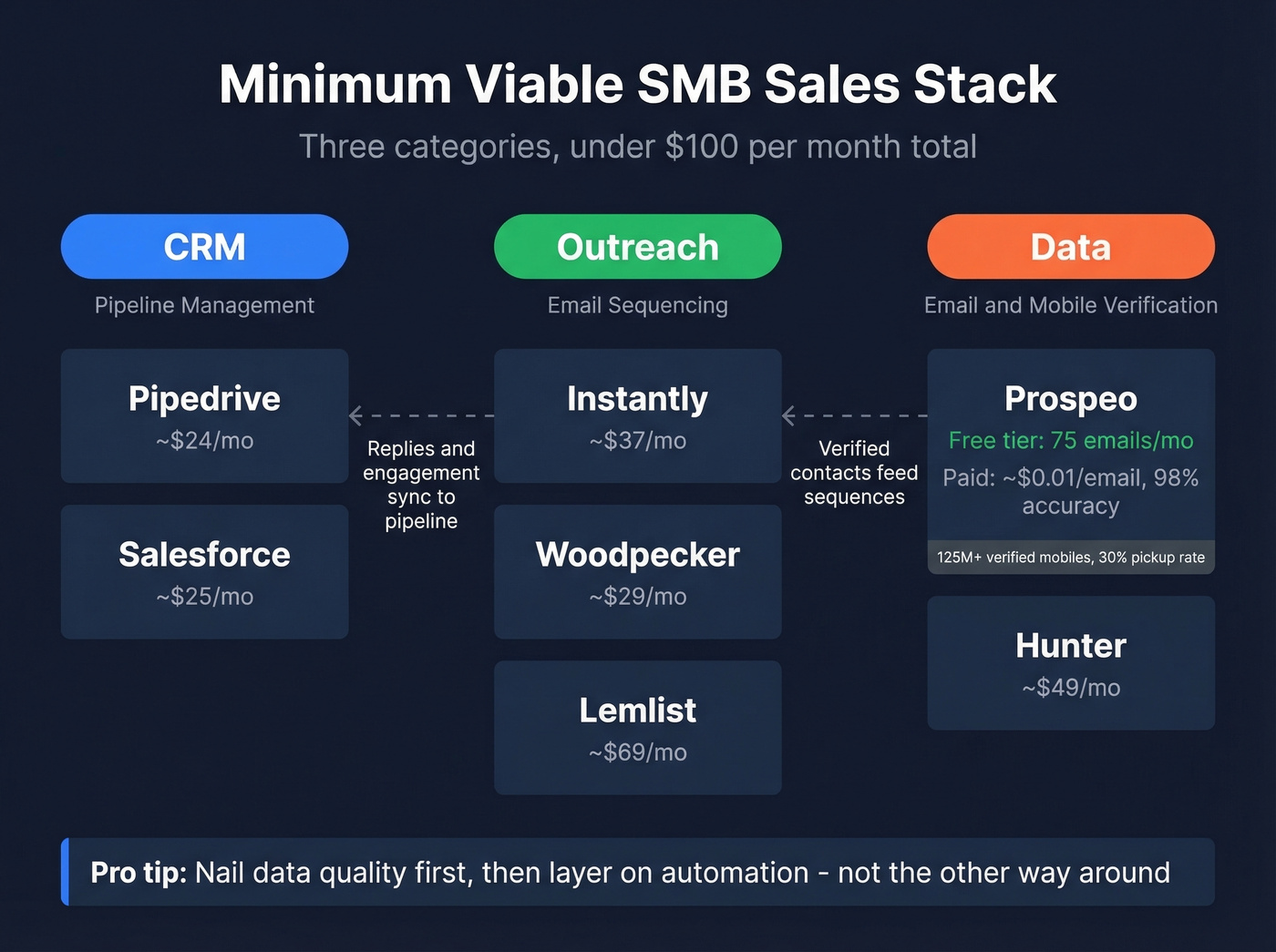
| Category | Tool | Starting Price |
|---|---|---|
| CRM | Pipedrive | ~$24/mo |
| CRM | Salesforce | ~$25/mo |
| Outreach | Instantly | ~$37/mo |
| Outreach | Woodpecker | ~$29/mo |
| Outreach | Lemlist | ~$69/mo |
| Email/Mobile Data | Prospeo | Free (75 emails/mo) |
| Email/Mobile Data | Hunter | ~$49/mo |
Prospeo's free tier gives you 75 verified emails and 100 Chrome extension credits per month - enough to validate your ICP before spending anything. Paid plans run ~$0.01 per email with 98% accuracy, and the platform includes 125M+ verified mobile numbers with a 30% pickup rate. That matters when your buyer is an owner who's more likely to answer a direct dial than read a cold email. (If you're comparing tools, start with Hunter alternatives.)
Pair that with Instantly or Lemlist for sequencing and Pipedrive for pipeline management. That's a complete stack for under $100/month. The consensus on r/sales is that the biggest ROI comes from nailing data quality first, then layering on automation - not the other way around.
Multi-threading even one extra stakeholder closes SMB deals 2.4x faster. Prospeo's 300M+ profiles and 125M+ verified mobiles let you reach the owner and their ops lead - with 98% email accuracy and a 30% mobile pickup rate, so your outreach actually connects.
Find the owner and the second stakeholder in one search.
Mistakes That Kill Deals
Let's be honest: most small business deals don't die in the close. They die from slow follow-up, bad qualification, and enterprise habits that don't translate.
Talking more than listening. SMB buyers decide fast when they feel heard. We've watched reps run 30-minute feature walkthroughs for owners who made up their mind in the first five minutes - they just needed someone to stop talking long enough to say yes.
Failing to disqualify. Every unqualified deal steals time from one that could close. This is the hardest discipline to build, especially when pipeline looks thin.
Using jargon with owner-operators. "Synergistic value proposition" means nothing to someone running a plumbing company. Talk like a human.
Slow follow-up. If you don't follow up within 24 hours, someone else will. Period. (If you need copy, use these sales follow up templates.)
Leading with price instead of value. Anchor on outcome, not cost. When budget is tight, the owner needs to see the return before they'll stomach the spend.
FAQ
How long is a typical SMB sales cycle?
For deals under $15K ACV, expect 14-30 days. Micro-SMBs average 38 days, core SMBs average 57 days. Referral-sourced deals close fastest at 20-60 days, while cold outbound adds significant cycle drag compared to inbound.
What does SMB mean in sales?
SMB stands for small and midsize business - companies typically under 200 employees with annual contract values below $15K. It describes a selling motion built around speed, simplicity, and owner-level decision-making rather than committee-driven procurement.
What's the difference between SMB and mid-market sales?
SMB deals involve 1-2 decision-makers, close in weeks, and hinge on price and immediate ROI. Mid-market involves 3-5 stakeholders, runs 30-90 day cycles, and requires formal business-case evaluation with multiple sign-offs.
What's a good win rate for SMB sales?
The benchmark is 20-30% for B2B SaaS. The biggest leverage point is MQL-to-SQL conversion, which runs just 15-21%. Improving qualification criteria has more pipeline impact than any closing technique.
How do I find verified contacts for small business decision-makers?
Use a B2B data platform with company-size filters and real-time verification. Prospeo's database covers 300M+ profiles with 30+ filters - headcount, industry, intent signals - and refreshes every 7 days. The free tier at 75 emails/month lets you validate your targeting before committing budget.