

How to Generate Software Leads That Actually Convert
Your VP of Sales just told you to generate more software leads. The budget didn't change. The quota did. You're not alone - 84% of sales reps missed quota in 2024, and 67% don't expect to hit it this year either. The problem isn't effort. It's that most B2B lead generation programs are built on bad data, wrong channels, and benchmarks nobody bothered to look up.
Here are the actual numbers: what leads cost by channel, which strategies produce pipeline (not just MQLs), and the lean tool stack that makes it work without a six-figure budget.
The Quick Version
- Know your numbers. SaaS CPL averages $188; software development CPL averages $595. Cold email ($225) and referrals ($25) are the most efficient channels.
- Fix your data first. If 35% of your emails bounce, nothing else works. Use a verified data platform before you spend a dollar on sequences or ads.
- Go multi-channel. Buyers use 10+ channels. Combine cold email, content, and intent signals.
- Measure what matters. Target 25-35% MQL-to-SQL conversion, ~29% close rate, and under 5% email bounce rate.
What Software Leads Actually Cost
Here's what you'll pay per lead by channel, based on Sopro's CPL benchmarks:
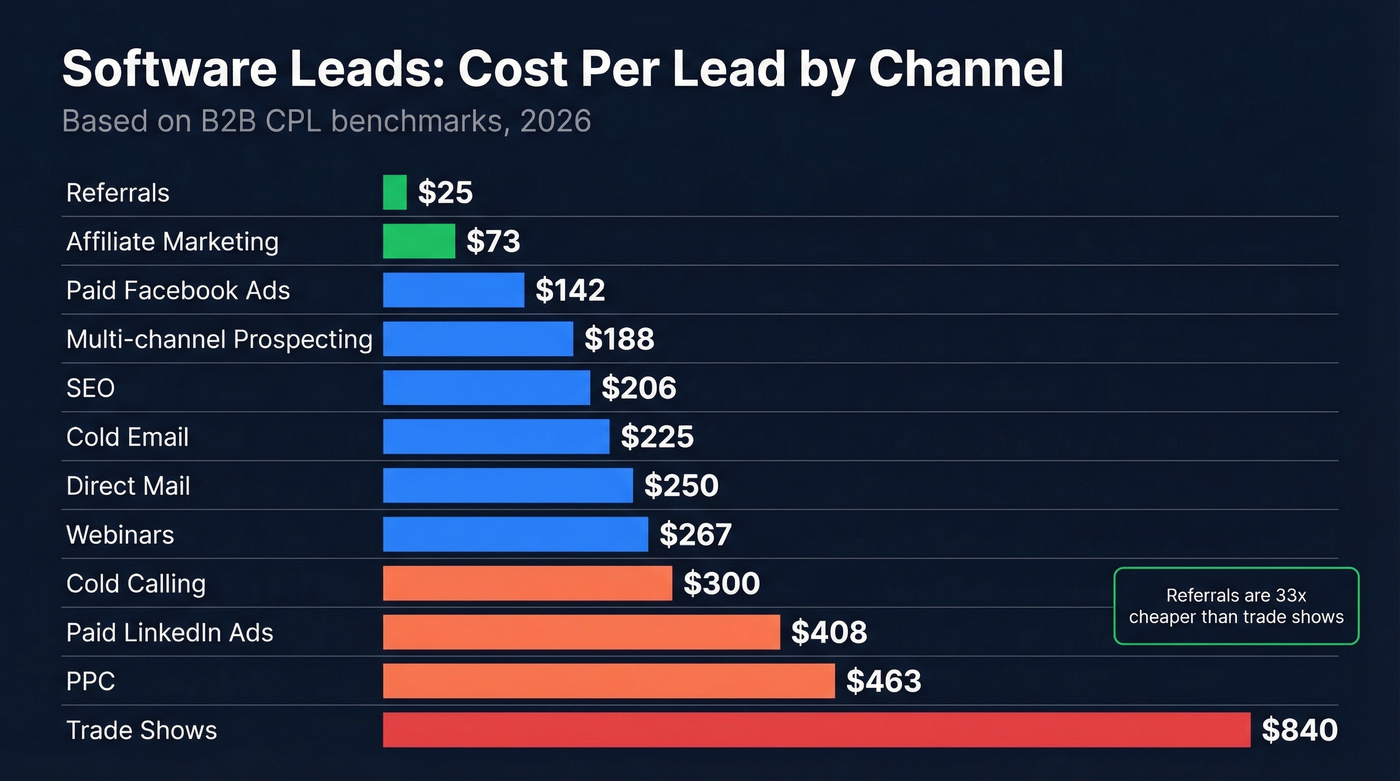
| Channel | Avg CPL |
|---|---|
| Referrals | $25 |
| Affiliate marketing | $73 |
| Paid Facebook ads | $142 |
| Multi-channel prospecting | $188 |
| SEO | $206 |
| Cold email | $225 |
| Direct mail | $250 |
| Webinars | $267 |
| Cold calling | $300 |
| Paid LinkedIn ads | $408 |
| PPC | $463 |
| Trade shows / events | $840 |
Now layer in the industry dimension. B2B SaaS averages $188 per lead. Software development? $595. IT and managed services sits at $501. The spread matters because a SaaS company running PLG motions lives in a completely different cost universe than a custom software shop selling $200K implementations.
If you're spending $840 per lead on events without tracking downstream conversion, you're flying blind. And if you're ignoring referrals at $25 per lead, you're leaving the cheapest pipeline source on the table.
What's Changed for Software Sales in 2026
Gartner projected 80% of B2B sales interactions would happen digitally by 2025 - and the shift has only accelerated. Buyers spend just 17% of their buying time actually meeting suppliers. The rest is independent research and internal alignment.
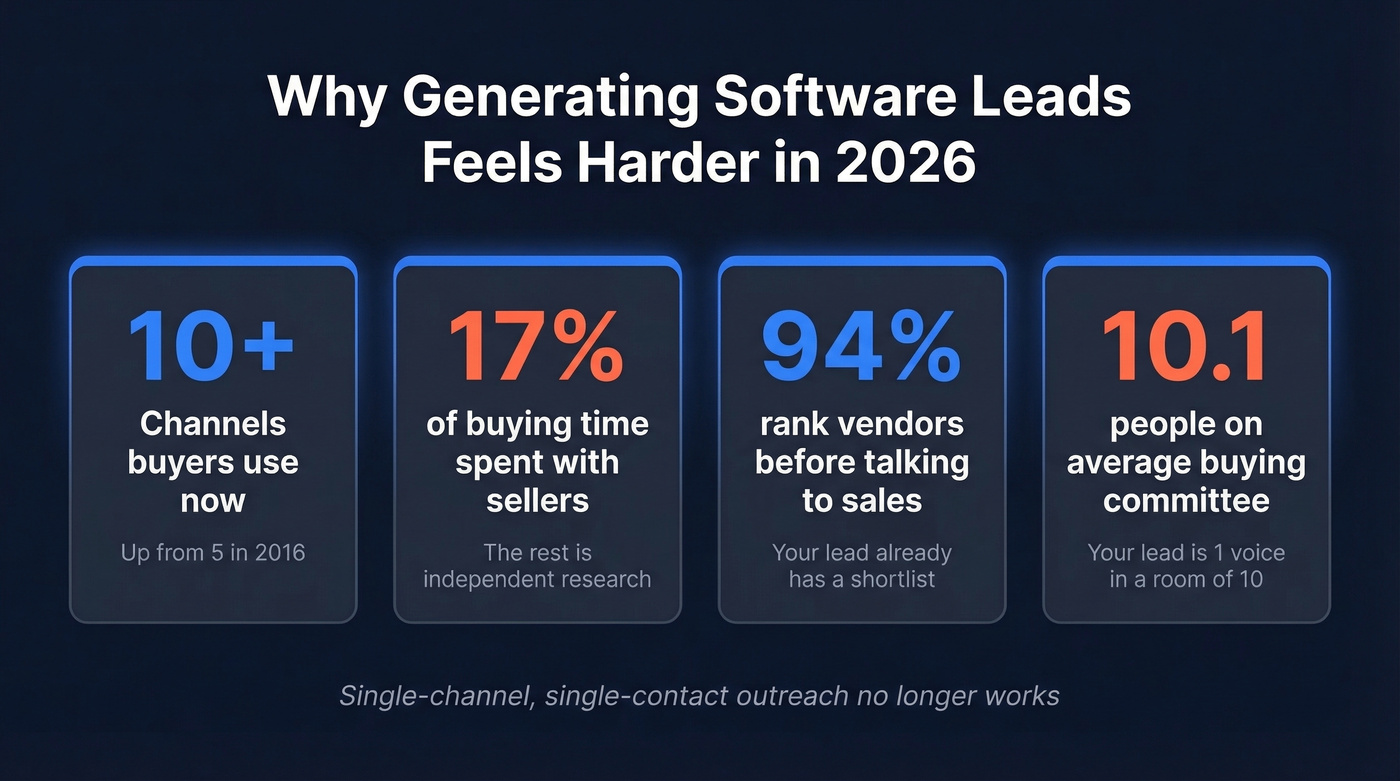
Four stats explain why generating qualified prospects feels harder than it used to. Buyers now use an average of 10 interaction channels, up from 5 in 2016. 94% of buying groups rank their preferred vendors before ever talking to sales. And buying committees have ballooned to 10.1 people on average, meaning your "lead" is really one voice in a room of ten.
Software deals carry extra friction that generic B2B doesn't: long proof-of-concept cycles, technical evaluations that loop in engineering, and low-intent inquiries from people who just want a free trial with no buying authority.
Single-channel, single-contact outreach doesn't work anymore. You need to reach multiple stakeholders across multiple channels, ideally before they've already shortlisted your competitor. Intent-driven buyers convert 3-5x faster than cold lists, which is why intent data has become table stakes for teams selling above $50K ACV. Personalized retargeting can recover up to 40% of lost buyers - another reason single-channel approaches leave money on the table.
Here's the thing: if your average deal size is under $10K, you probably don't need intent data platforms at all. Clean email data and a disciplined 3-step sequence will outperform a $40K Bombora contract every time.
And there's a category most software companies are ignoring entirely - AI visibility. Buyers increasingly discover vendors through LLM-powered answer engines like ChatGPT, Perplexity, and Copilot. If your brand doesn't show up when someone asks "best project management software for mid-market," you're invisible in a channel that's growing faster than organic search. Optimizing for AI-driven discovery is the 2026 equivalent of early SEO.

You just read that 35-40% bounce rates destroy outbound campaigns. Prospeo's 5-step email verification delivers 98% accuracy on 300M+ profiles - the same data that took Snyk from 35% bounce to under 5% and 200+ new opportunities per month. At $0.01 per email, clean software leads cost less than a bad one.
Fix your data before you fix your sequences.
Strategies That Actually Build Pipeline
Inbound: Content, SEO, and Trials
Inbound is the long game, and the math is humbling. Default's benchmark analysis of 100 B2B software websites found that once you cross 25,000 monthly visitors, your visitor-to-demo request rate drops below 1%. That's not a bug - it's the reality of scaling traffic while maintaining intent quality.
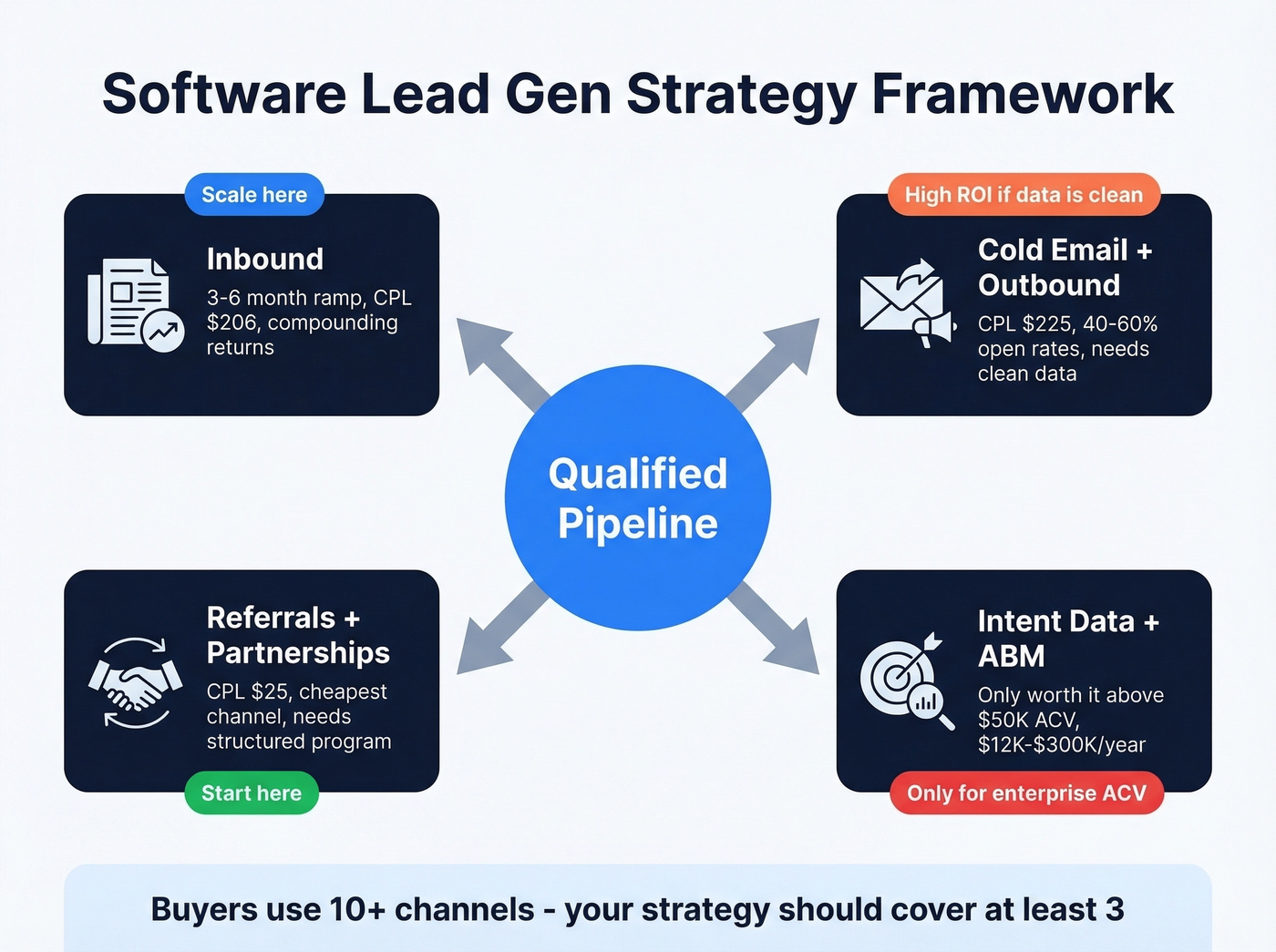
Even at those conversion rates, the numbers work. At 25,000 visitors generating 50 demo bookings per month, a 20% close rate and $15,000 average deal size produces $150,000 in ARR. SEO's CPL of $206 is competitive with most paid channels, and the compounding effect means your cost per lead drops every month as content ages.
The mistake most software companies make is expecting inbound to produce pipeline in month two. Budget 3-6 months before inbound contributes meaningfully. In the meantime, outbound fills the gap.
Cold Email and Outbound
Cold email at $225 CPL is one of the most efficient channels for software companies, but only if your data is clean. We've seen teams report 35-40% bounce rates on their first outbound campaign because they pulled contacts from a stale database. At that point, you're not generating leads - you're burning your domain reputation (and your email deliverability).

Snyk's sales team saw this firsthand: 50 AEs went from 35-40% bounce rates to under 5%, generating 200+ new opportunities per month after switching to verified data.
The benchmarks to aim for: 40-60% open rates on warmed domains, 1-3% reply rates, and 0.5-1.5% meeting conversion. In a 2022 campaign, Cloudreach reps generated 100-150 leads per week using targeted outbound, building $4.9M in pipeline. That's not magic - it's clean data plus disciplined sequencing (see B2B cold email sequence).
Don't sleep on organic outreach as a complement. Connection acceptance rates run 20-35%, with reply rates of 5-15% on personalized messages. It pairs well with cold email for a true multi-channel approach (more sales prospecting techniques).
Intent Data and ABM
91% of B2B marketers now use intent data to prioritize accounts, and 71% of companies run some form of ABM. But only 24% report exceptional ROI. The intent data market hit $4.49B in 2026 - a lot of money chasing a tool where three-quarters of users aren't thrilled with the results.
Bombora runs $12K-$40K/year as a standalone. 6sense can hit $300K+ annually for enterprise deployments. The math only works above $50K ACV. Below that, you're spending more on the signal than the deal is worth.
Referrals and Partnerships
Referrals at $25 CPL are the cheapest lead source by a wide margin.
Most software companies treat referrals as something that "just happens." It doesn't. Build a structured referral program with clear incentives, make it easy for customers to refer with one-click intros instead of lengthy forms, and track referral pipeline the same way you track outbound (use a simple lead status model so nothing gets lost). If you're paying $595 per lead through paid channels while ignoring referrals, you're subsidizing your competitors' retargeting.
Webinars deserve a second look too. At $267 CPL they're mid-range, but the real value is in segmenting registrants by engagement level. Someone who attended live, asked a question, and downloaded the slides is a fundamentally different lead than someone who registered and never showed. Treat them accordingly.
The Tools You Actually Need
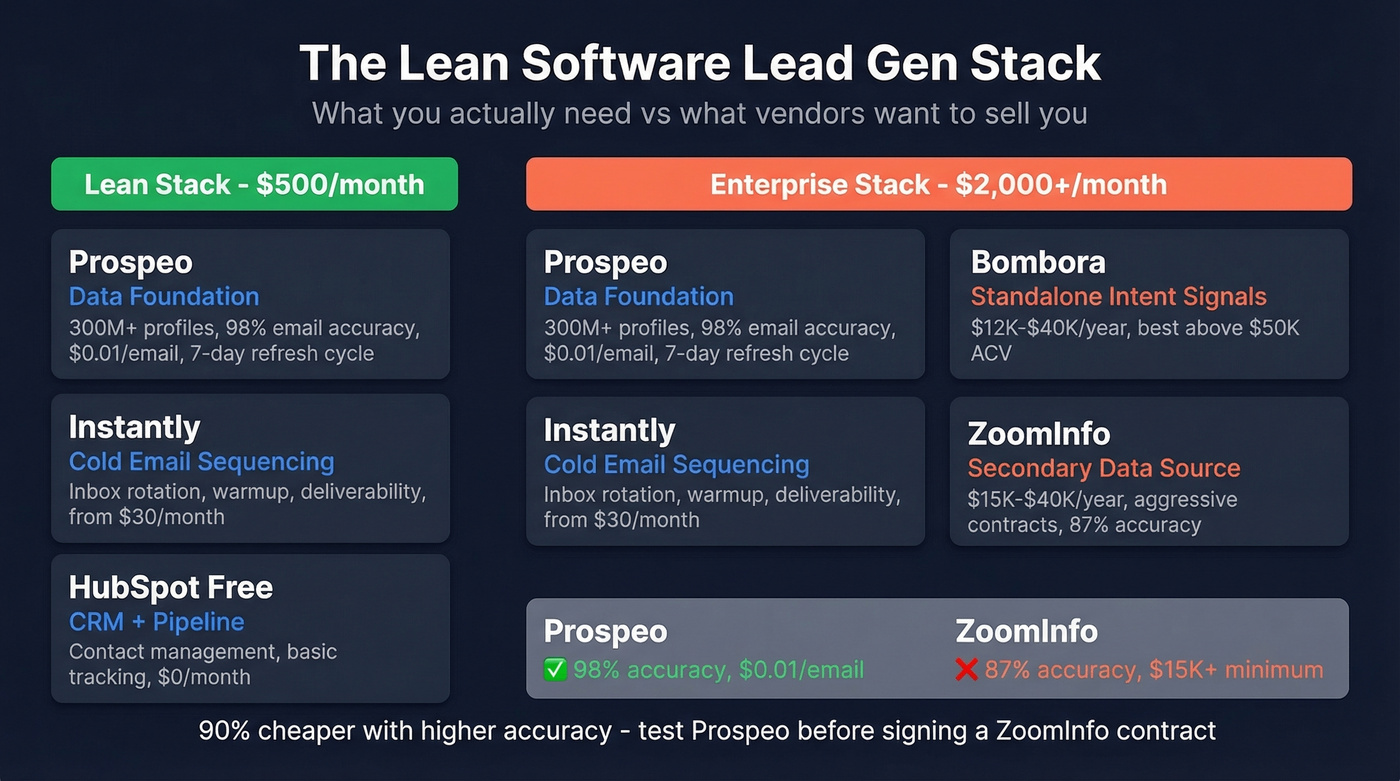
You don't need 12 tools. You need three, maybe four.
Prospeo (Data Foundation)
Prospeo gives you 300M+ professional profiles, 143M+ verified emails, and 125M+ verified mobile numbers on a 7-day refresh cycle versus the 6-week industry average. The 30+ search filters cover buyer intent across 15,000 topics, technographics, job changes, headcount growth, and funding signals.
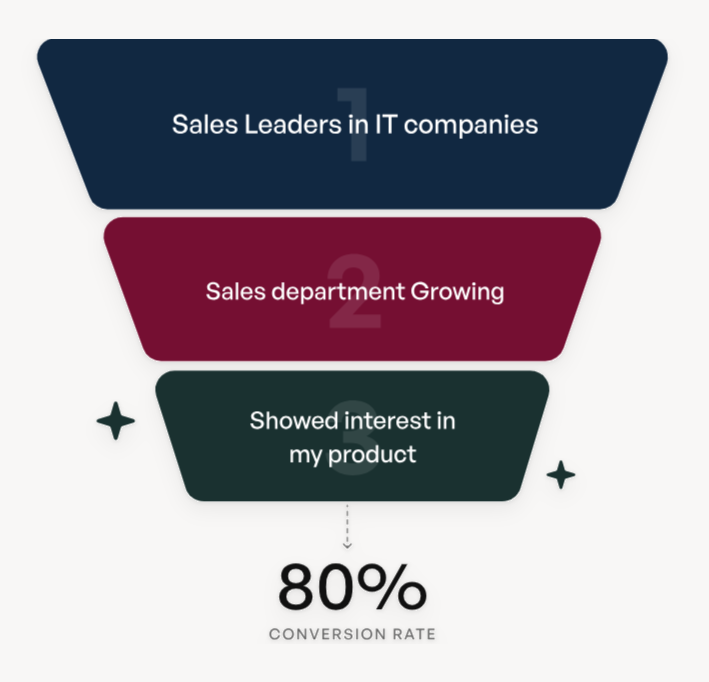
In practice: Meritt tripled their pipeline from $100K to $300K per week after switching, with bounce rates dropping from 35% to under 4%. At ~$0.01 per email with a free tier of 75 emails per month, it's 90% cheaper than ZoomInfo with higher accuracy - 98% vs 87%.
HubSpot (CRM + Automation)
HubSpot's free CRM handles contact management and basic pipeline tracking (more examples of a CRM). Starter plans begin around $20/month; Sales Hub Pro runs $90/seat/month plus a $1,500 onboarding fee, which is worth it once you're past 5 reps.
Instantly (Cold Email Sequencing)
Instantly manages inbox rotation, warmup, and deliverability monitoring. Free accounts include 100 leads, paid plans start around $30/month. It integrates natively with Prospeo, so verified contacts flow directly into sequences without manual exports (see connect outreach tool to CRM).
Apollo and ZoomInfo (Alternatives)
Apollo offers a generous free tier and paid plans from around $49/user/month - solid for US-focused prospecting, though email accuracy runs lower than dedicated verification platforms. ZoomInfo remains the enterprise default at $15-40K/year, but there's no self-serve pricing and the contract locks are aggressive. If you're evaluating ZoomInfo, we'd recommend testing Prospeo first - same data depth at a fraction of the cost (compare best sales prospecting databases).
Lean stack for $500/month: Prospeo + Instantly + HubSpot (free). Covers data, sequencing, and CRM. $2,000+/month: Add Bombora for standalone intent signals and a secondary data source for phone coverage.
Why Most Lead Gen Programs Fail
Five failure modes kill lead generation programs before they produce pipeline.
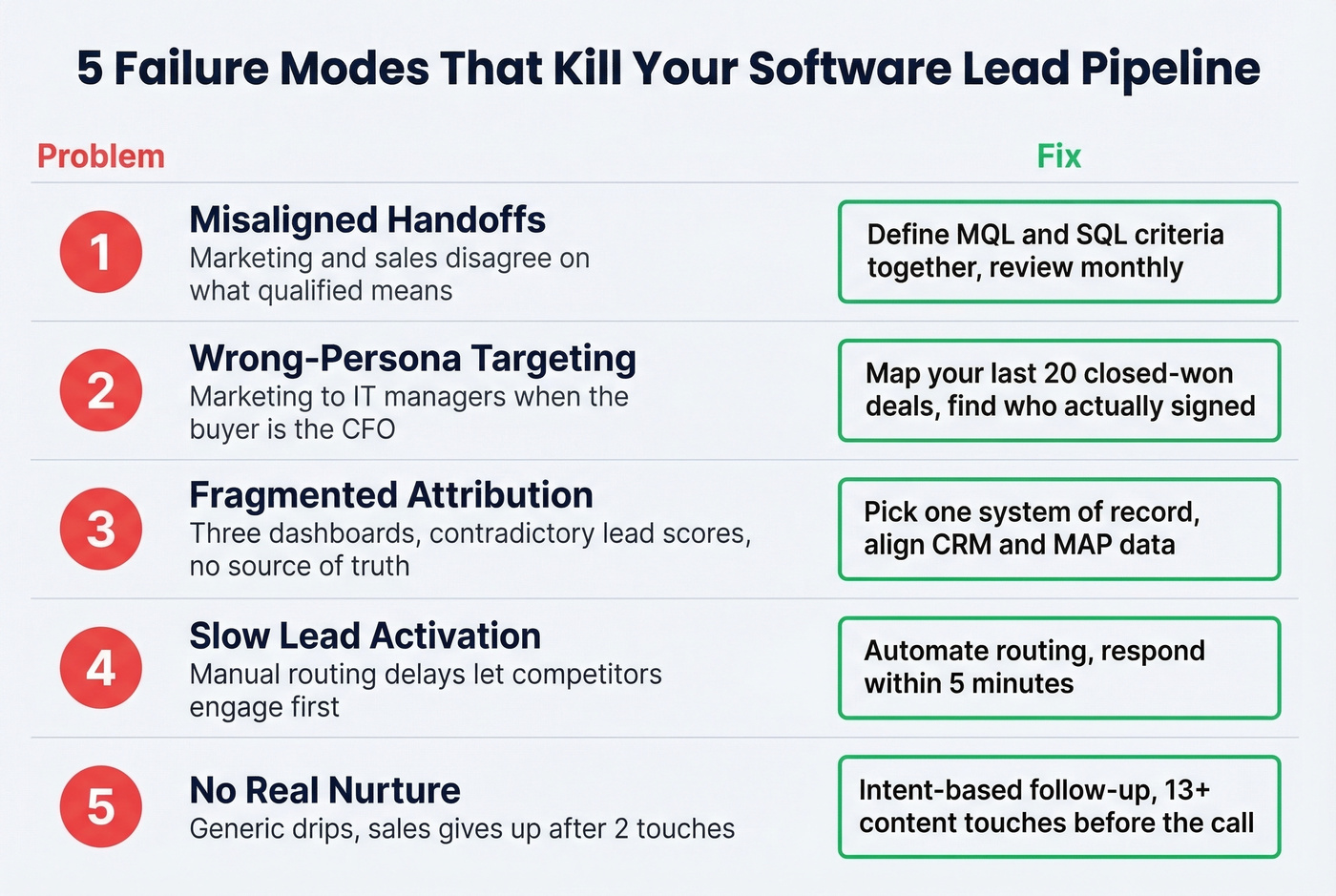
Misaligned handoffs. Marketing and sales don't agree on what "qualified" means. Warning sign: MQL volume is rising but SQL count is falling.
Wrong-persona targeting. Software companies are especially vulnerable - marketing to IT managers when the buyer is actually the CFO. The fix is always the same: map your last 20 closed-won deals and see who actually signed (use an ideal customer profile to keep targeting honest).
Fragmented attribution. CRM, MAP, and intent tools aren't aligned. Three dashboards, contradictory lead scores, no single source of truth. We've watched teams spend entire quarters arguing about which tool's numbers are "right" instead of fixing the disconnect.
Slow lead activation. Manual routing delays mean competitors engage first. In software sales, the first vendor to respond wins a disproportionate share of deals.
No real nurture. Generic drip sequences with no intent-based follow-up. Sales disengages after two touches. The average buyer consumes 13 content pieces before talking to a rep - if your nurture is just noise, they'll consume those 13 pieces from someone else.
Let's be honest: if you can't explain your value in 2-3 sentences and back it up with proof assets like demos, ROI projections, and technical deep dives, scaling spend won't help. Validate your messaging with small batches before pouring money into distribution (tighten your elevator pitch first).
Benchmarks Worth Tracking
Here's the scorecard. If your numbers fall below these ranges, you've got a specific problem to diagnose.
| Metric | Target |
|---|---|
| Email bounce rate | <5% |
| MQA rate (target accounts) | 10-20% |
| MQL to SQL conversion | 25-35% |
| Close rate | ~29% |
| Win rate | ~21% |
| Meetings / 100 surging accounts (30d) | 5-10 |
| Enrichment rate (key fields) | 80%+ |
| Sales cycle | 1-3 months |
The benchmarks from Directive are worth bookmarking. The MQL-to-SQL range of 25-35% is particularly telling - if you're below 25%, your lead definition is too loose. Above 35%, you're probably qualifying too aggressively and leaving pipeline on the table (see average B2B lead conversion rate).
75% of B2B buyers are taking longer to make purchase decisions than they were in 2023. Sales cycles are stretching. The teams that win aren't the ones generating the most software leads - they're the ones converting the right leads faster than their competitors can respond.
Buying committees average 10.1 people, and intent-driven buyers convert 3-5x faster. Prospeo combines 30+ search filters - buyer intent, technographics, headcount growth, funding - with 15,000 Bombora intent topics and 125M+ verified mobile numbers. Reach the full committee across every channel, not just one inbox.
Target software buyers already in-market - before they shortlist your competitor.
FAQ
Should I buy a leads list or build my own?
Build your own. Purchased lists carry bounce rates above 30%, low intent, and serious domain reputation risk. Use a verified data platform to build targeted lists - it's cheaper per contact and the data stays fresh.
How long until I see ROI from lead generation?
Outbound cold email generates meetings within 2-4 weeks with clean data. Inbound takes 3-6 months. Intent-based outbound is fastest - intent-driven buyers convert 3-5x faster because they're already researching your category.
What's the best channel on a limited budget?
Cold email ($225 CPL) and referrals ($25 CPL). Start with 200-500 verified contacts, run a 3-step sequence, and measure reply rates before scaling. If you're spending on events at $840 CPL before maxing out these two channels, you're burning budget in the wrong order.
How do B2B SaaS companies get first customers?
Most founders land first customers through direct outreach and warm introductions, not paid ads. Start with a tight ICP of 50-100 accounts, send personalized cold emails with a clear value prop, and ask every early user for referrals. Solve a painful problem, prove it with one account, then use that proof to open the next ten.