

The Software Sales Process: A Practitioner's Guide With Real Benchmarks
Your software sales process is under pressure. 58% of B2B professionals say their sales cycles got longer this past year, and the average buying committee now runs 6.3 stakeholders deep. If your process hasn't been rebuilt for that reality, you're losing deals to teams that have.
The short version:
- Match your sales cycle to your ACV - 14 days for sub-$2k deals, 3-9 months for $100k+.
- BANT for deals under $25k, MEDDIC for everything above.
- Fix your data before you optimize your pitch - if more than 5% of emails bounce, that's the real bottleneck.
Quick Definitions
A sales process is the stages a deal moves through. A sales methodology is how you execute within those stages - MEDDIC, Challenger, SPIN. A sales cycle is the clock from first meaningful touch to closed-won. Salesforce frames it well (https://www.salesforce.com/sales/process/): process is the "what," methodology is the "how," cycle is the "when."
Which Motion Fits Your Product?
| Motion | ACV Range | Sales Touch | Cycle |
|---|---|---|---|
| Self-serve | < $2k | None/minimal | Days |
| Transactional | $2k-$25k | Light (1-3 calls) | 30-90 days |
| Enterprise | $25k-$500k+ | Heavy (multi-thread) | 90-180 days (up to 18 mo for $500k+) |
| PLG-hybrid | Varies | Product to sales handoff | Varies |
Here's the thing about PLG: over 98% of new users go inactive within two weeks of their first action. That's the activation cliff. PLG doesn't mean "no sales team." It means sales engages based on product telemetry instead of cold outreach.
Top PLG companies reach activation rates of 25-40% with time-to-value under seven days. On the expansion side, sales and success teams drive 58% of upsells while the product alone accounts for just 10%.
Core Stages With Exit Criteria
Most stage breakdowns skip the part that actually matters: when should a deal advance, and when should it die? Here are seven stages clustered by function, each with an explicit gate.
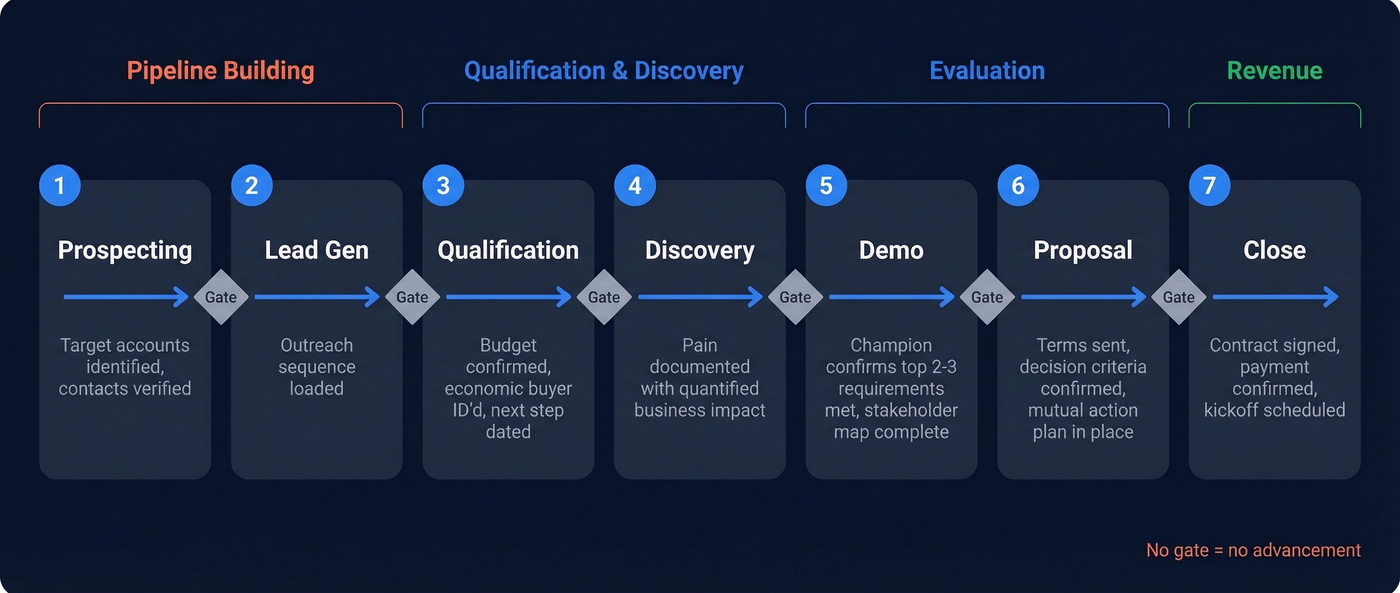
1-2: Prospecting & Lead Generation
The goal isn't volume. It's reaching verified decision-makers who match your ICP before a competitor does. Build your list with verified contact data from a platform like Prospeo, which offers 300M+ professional profiles with 30+ filters including buyer intent, technographics, and job changes - all at 98% email accuracy.
Exit gate: Target accounts identified, contacts verified, initial outreach sequence loaded.

3-4: Qualification & Discovery
Qualification determines whether a prospect can buy. Discovery determines whether they should. These are separate conversations that often happen in the same call.
Qualification gate: Confirmed budget range, identified economic buyer, agreed next step with a date on the calendar. Any of those missing? The deal stays here or gets disqualified.
Discovery gate: Documented pain with quantified business impact. You should be able to articulate the prospect's problem better than they can.
5: Demo & Objection Handling
The demo isn't a product tour - it's a proof session mapped to the pain you uncovered in discovery. Objection handling happens here, not as a separate phase. Strong enterprise reps handle objections by reframing around the quantified pain from discovery, not by feature-dumping.
Demo gate: Champion confirms the solution addresses their top 2-3 requirements. Stakeholder map is complete.
6: Proposal & Negotiation
Proposal gate: Commercial terms sent, decision criteria confirmed, timeline agreed. Mutual action plan in place with the prospect.
7: Close & Post-Sale
Closing is paperwork if you've done the upstream stages right. Post-sale is where revenue compounds or evaporates - and where land-and-expand kicks in.
Close gate: Signed contract, payment terms confirmed, implementation kickoff scheduled.
Post-sale benchmarks: Monthly churn averages 3-7% (https://www.saashero.net/customer-retention/b2b-saas-conversion-benchmarks-journey/) across SaaS. Top performers hold it under 1%. Net revenue retention above 120% is the gold standard.

Your software sales process breaks at Stage 1 if your contact data bounces. Prospeo gives you 300M+ profiles with 98% email accuracy, buyer intent signals, and technographic filters - so reps spend discovery calls selling, not chasing bad numbers.
Fix your prospecting data and every downstream stage converts higher.
Benchmark Your Sales Cycle
We've pulled together the numbers that most guides leave out. Use them to diagnose where your process actually breaks.
Cycle Length by ACV
| ACV Range | Expected Cycle |
|---|---|
| < $2k | ~14 days |
| < $5k | ~30 days |
| < $25k | ~90 days |
| < $100k | 90-180 days |
| > $100k | 3-9 months |
| > $500k | 6-18+ months |
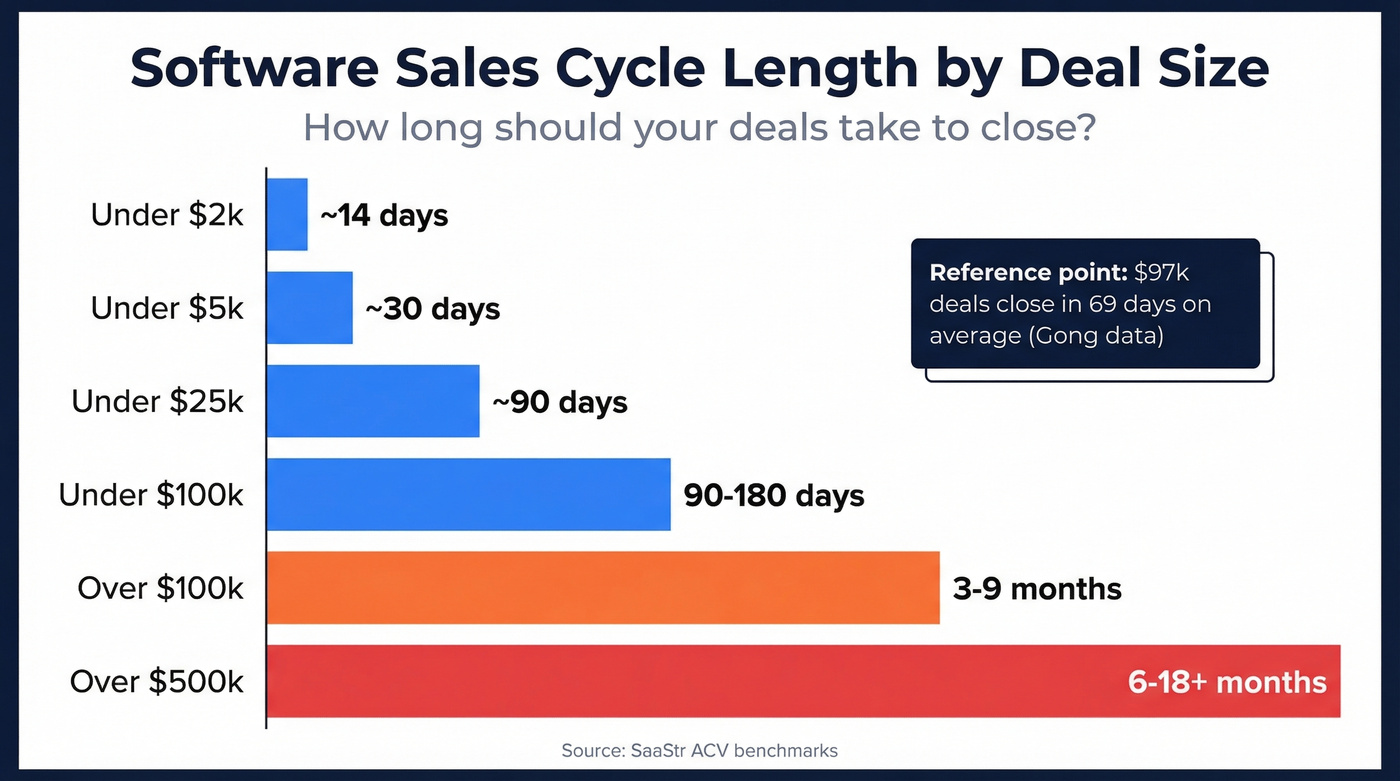
These come from SaaStr's ACV benchmarks. For context, across Gong's customer base, the average deal at $97k closes in 69 days.
Cycle Length by Company Size & Industry
Selling into a 10-person startup is a fundamentally different motion than selling into a 10,000-person enterprise, and the data backs that up in ways that should change how you staff and forecast.
| Segment | Avg. Cycle |
|---|---|
| 1-10 employees | 38 days |
| 101-1,000 employees | 92 days |
| 10,001+ employees | 185 days |
| Software industry | 90 days |
| Healthcare | 125 days |
| Financial services | 110 days |
Channel matters too: referrals close in roughly 20 days versus 60 days for cold outbound. Sales automation shortens cycles by up to 15%, and digital sales rooms cut them by up to 28% (digital sales rooms).
Funnel Conversion Benchmarks
| Stage Transition | Average | Top Performers |
|---|---|---|
| Visitor to Lead | 1.5-2.5% | 8-15% |
| Lead to MQL | 31-39% | 45%+ |
| MQL to SQL | 32-40% | - |
| SQL to Close | 20-25% | 30%+ |
| Trial to Paid | 12-35% | 56%+ |
| Demo to Close | 22-30% | 40%+ |
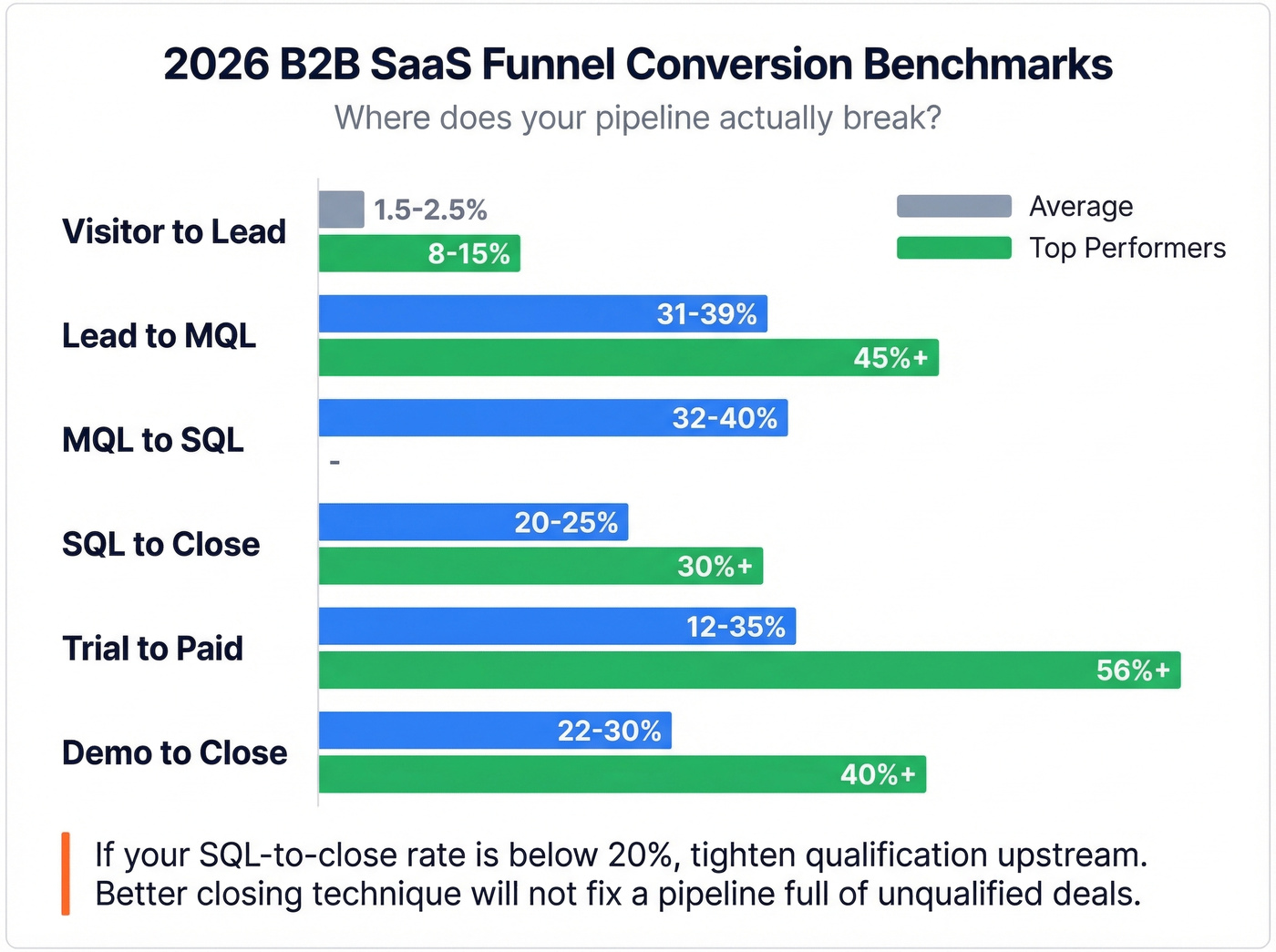
If your SQL-to-close rate sits below 20%, start by tightening qualification and stage entry criteria upstream. Better closing technique won't fix a pipeline full of unqualified deals (see sales pipeline challenges).
Qualification Frameworks
BANT vs. MEDDIC
BANT - Budget, Authority, Need, Timeline - was created by IBM in the 1950s. It's a filter: does this prospect have the money, the power, the pain, and the urgency? For high-volume deals under $25k ACV, BANT works because you need speed over depth.
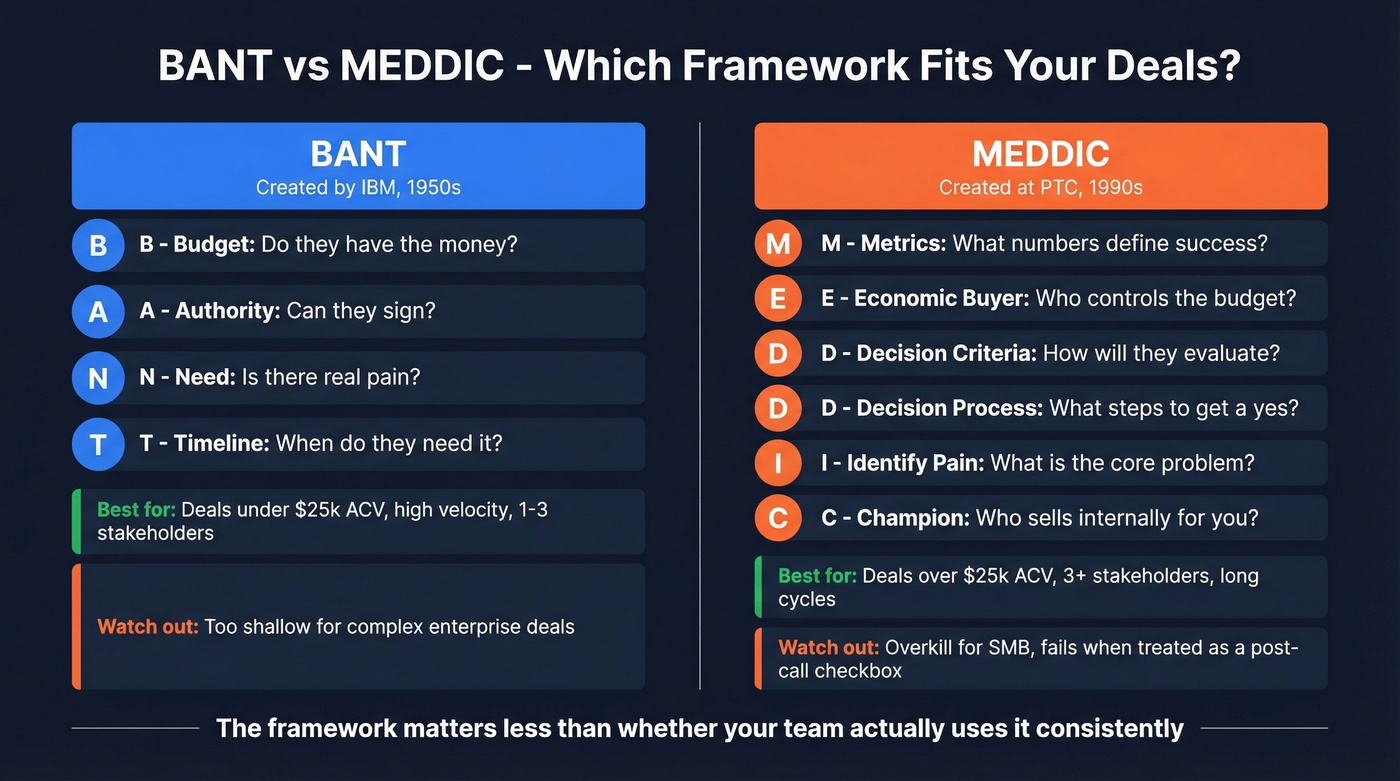
MEDDIC - Metrics, Economic Buyer, Decision Criteria, Decision Process, Identify Pain, Champion - came out of PTC in the 1990s. For deals above $25k with three or more stakeholders, MEDDIC keeps complex deals from stalling in "no decision" purgatory. The consensus on r/sales is that MEDDIC is overkill for SMB deals but indispensable once you're multi-threading into enterprise accounts.
Let's be honest: the framework matters less than whether your team actually uses it consistently. I've seen teams adopt MEDDIC and still lose deals because reps fill in the fields after the call instead of during it. MEDDIC doesn't fail. Reps who treat it as a post-call checkbox fail.
Signal-Based Qualification
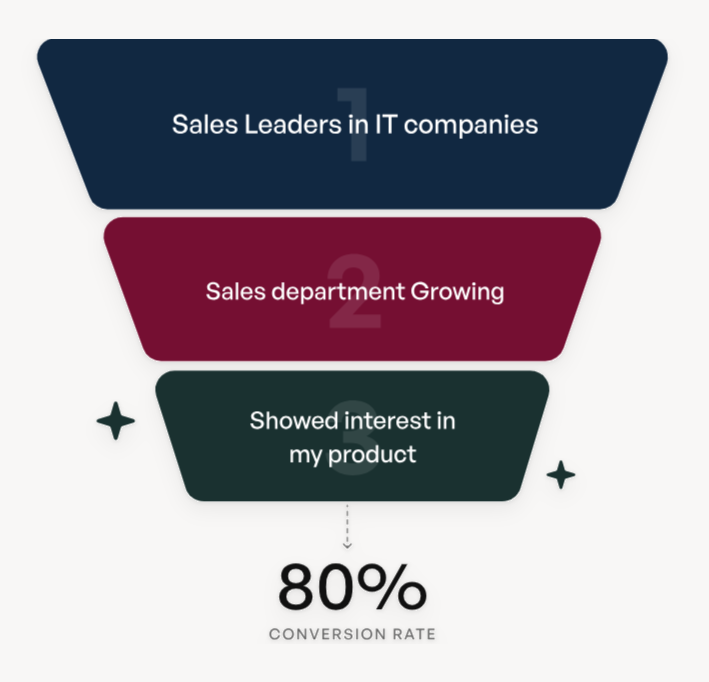
Modern qualification layers signals on top of frameworks. Intent data platforms track thousands of topics, letting you prioritize prospects actively researching your category - not just those who fit your ICP on paper. Combine that with product usage telemetry and engagement scoring, and you're qualifying based on behavior, not demographics (lead scoring).
If your deal sizes sit below $15k, you probably don't need a six-figure data platform. A self-serve tool with accurate emails and intent signals will outperform an enterprise suite your team barely logs into. Skip the bloated contracts and start with something you'll actually use.
Mistakes That Kill Software Deals
Pitching before diagnosing. Sending a pitch deck five minutes into a discovery call is the fastest way to lose a prospect's attention. HubSpot's research confirms it: premature pitching leads to disengagement because you haven't earned the right to prescribe.
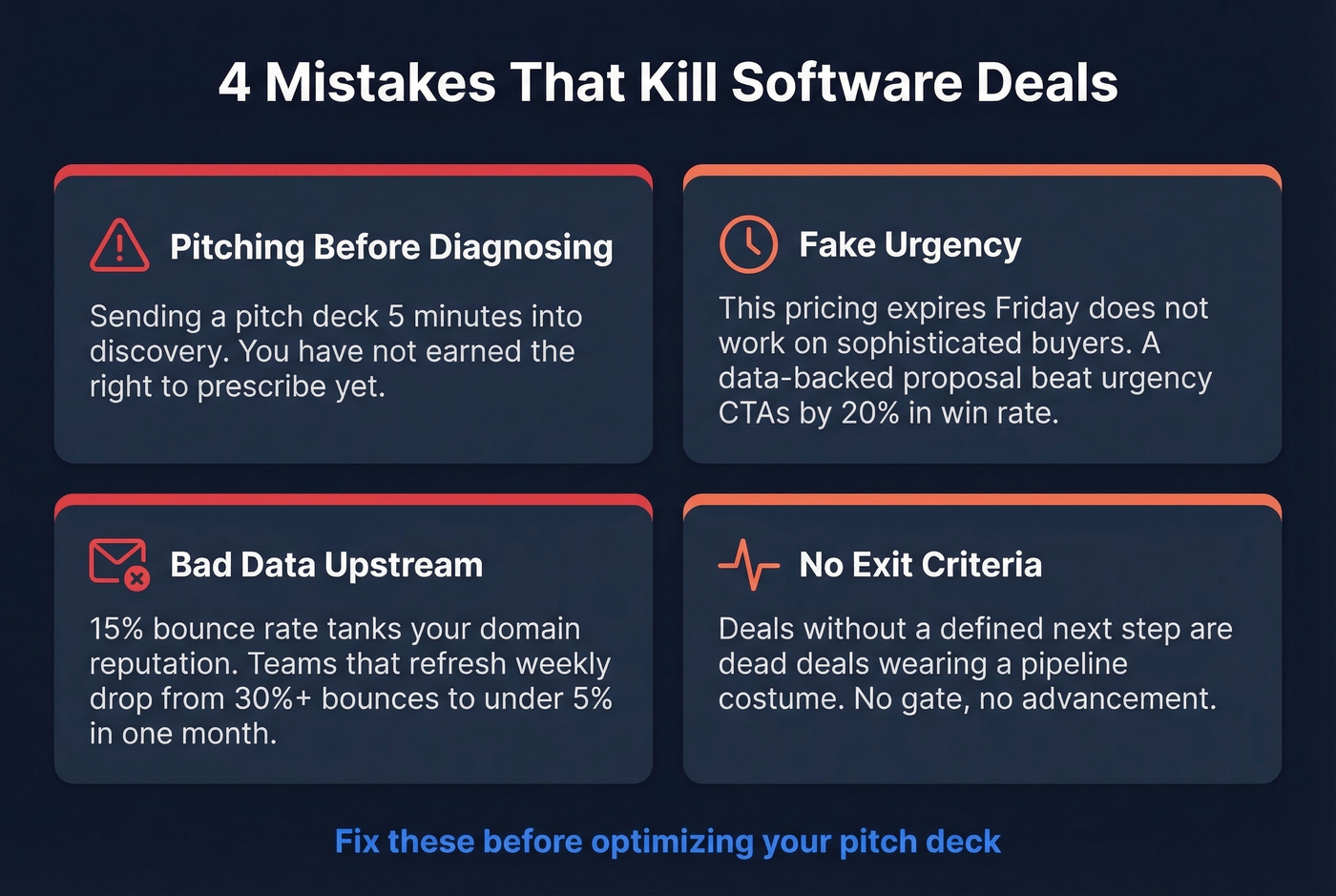
Fake urgency. "This pricing expires Friday" doesn't work on sophisticated buyers. One Head of Sales we spoke with replaced urgency CTAs with data-backed proposals and saw a 20% win-rate lift over two quarters. If your deal needs artificial pressure to close, it wasn't qualified properly (use a clear walk away point).
Bad data upstream. If 15% of your emails bounce, your domain reputation tanks and every subsequent campaign underperforms. Verify before you send. In our experience, teams that switch to a weekly data refresh cycle see bounce rates drop from 30%+ to under 5% within the first month. That's the difference between a clean inbox and a blacklisted domain (email bounce rates).
No exit criteria. Deals without a defined next step are dead deals wearing a pipeline costume. Every stage needs a gate. No gate, no advancement.
Data Quality Is the Foundation
Every stage of your software sales process breaks if reps are working off stale contacts and bounced emails. You can nail every exit criterion and every qualification framework - and still lose if your data is garbage. We've watched teams obsess over closing scripts while 20% of their outbound never reaches a real inbox. Fix the foundation first (start with email deliverability).
If more than 5% of your emails bounce, no qualification framework saves your pipeline. Prospeo's 7-day data refresh and 5-step verification keep bounce rates under 4% - the same benchmark top-performing software sales teams hit in the data above.
Stop losing deals to stale data. Verify your contacts at $0.01 each.
FAQ
How long is a typical software sales cycle?
Sub-$5k ACV deals close in roughly 30 days, while the $25k-$100k range takes 90-180 days. Above $500k, expect 6-18+ months. Company size matters just as much: selling into a 10-person startup averages 38 days versus 185 days for 10,000+ employee enterprises.
What's the difference between a sales process and a methodology?
A sales process defines the stages a deal moves through - prospecting, qualification, demo, close. A methodology defines how you execute within those stages. Build the process first, then layer in methodology.
What qualification framework should SaaS teams use?
BANT for high-volume deals under $25k where speed matters. MEDDIC for enterprise deals with multiple stakeholders and longer cycles. Modern teams layer in signal-based qualification using intent data and product usage to prioritize outreach.
What's a good demo-to-close conversion rate?
The average runs 22-30% in B2B SaaS. Top performers hit 40%+. Below 20%, focus on qualification upstream - tighter stage entry criteria beat better closing technique every time.
How do I fix high email bounce rates in outbound?
Keep bounce rates under 5% by verifying every contact before outreach. A 5-step verification process with catch-all domain handling and spam-trap removal protects sender reputation. Look for providers that refresh data weekly rather than the industry-standard six weeks - stale data is the number one cause of bounced outbound.