

Solution Selling: What It Is, How to Do It, and Why Most Reps Get It Wrong
"What's keeping you up at night regarding your current solution?" The prospect paused for two seconds, then said, "Are you reading from a script?" and hung up. That story - posted by a rep on r/sales after sitting through six hours of consultative selling training - captures the identity crisis at the heart of solution selling in 2026. The methodology isn't broken. The execution is.
The gap between how it's taught and how it's practiced explains why so many reps either dismiss the approach as outdated or butcher it into a robotic interrogation.
The Short Version
Solution selling is a diagnosis-first methodology built for complex B2B deals - the kind where buyers don't fully understand their own problem yet. It works when the prospect's status quo feels uncomfortable but they can't articulate why, or what the fix looks like.
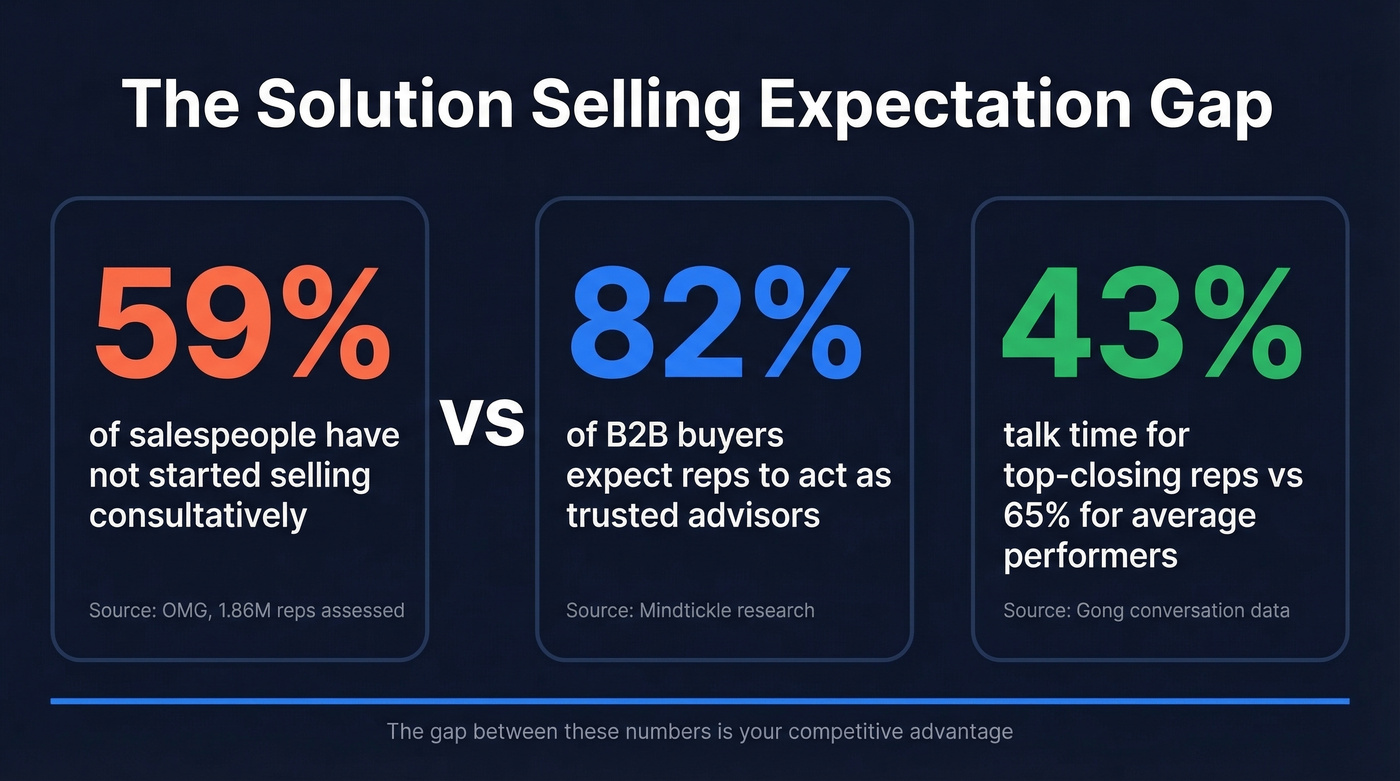
Objective Management Group assessed 1,861,244 salespeople and found 59% haven't even started selling consultatively. Meanwhile, [82% of B2B buyers](https://www.forbes.com/sites/ryanerskine/2017/12/28/how-to-turn-b2b-buyers-into-sales-leads-according-to-data/) expect reps to act as trusted advisors. That's a massive expectation gap - and an opportunity for anyone willing to do the work.
The real first step isn't "understand your product." It's verifying you're talking to the right person with accurate data, then shutting up long enough to hear what actually matters.
What Is Solution Selling?
The methodology traces back to 1975, when Frank Watts developed a sales process he dubbed "solution selling," refined it at Wang Laboratories, and later taught it more broadly. Michael Bosworth formalized and popularized it with his book Solution Selling, published in 1994, building on the approach Watts pioneered in the era of Xerox copiers and enterprise minicomputers.
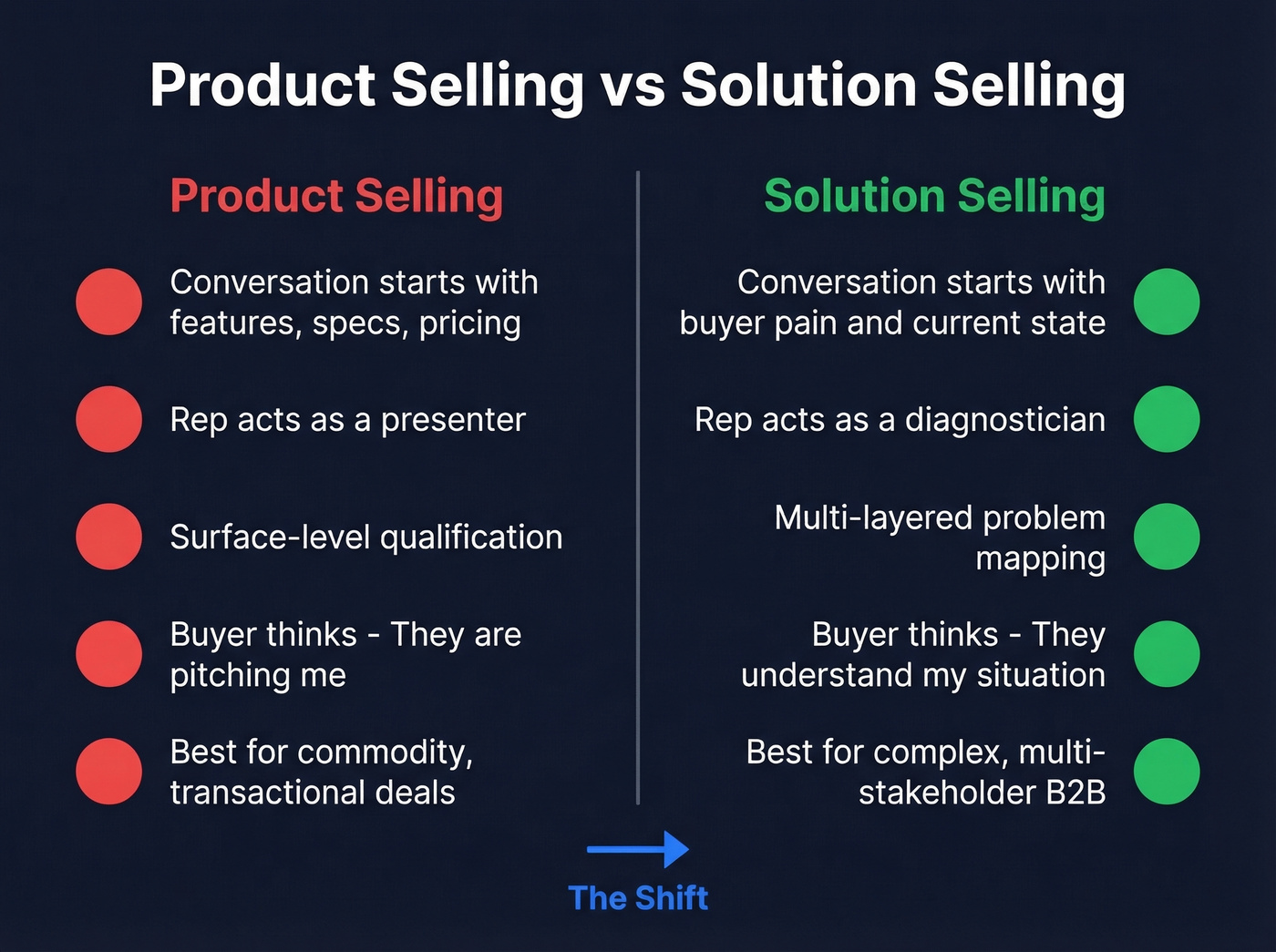
The core idea was radical for its time: stop leading with product features and start leading with the buyer's problem. Instead of demoing a copier's speed and resolution, you'd ask what the prospect's document workflow looked like, where it broke down, and what that cost them. The product only entered the conversation after the pain was clear.
That distinction still matters:
| Product Selling | Solution Selling | |
|---|---|---|
| Conversation starts with | Features, specs, pricing | Buyer's current state and pain |
| Rep's role | Presenter | Diagnostician |
| Discovery depth | Surface-level qualification | Multi-layered problem mapping |
| Buyer perception | "They're pitching me" | "They understand my situation" |
| Best for | Commodity, transactional deals | Complex, multi-stakeholder B2B |
The shift sounds simple. In practice, it requires reps to tolerate ambiguity, resist the urge to pitch early, and actually learn how their buyers' businesses make money. That's why most teams struggle with it - not because the methodology is flawed, but because it demands a fundamentally different skill set than feature-benefit selling.
Six Steps From Expertise to Close
Here's the six-stage solution selling process, with behavioral benchmarks at each step so you know whether you're actually doing it or just going through the motions. When done right, this approach typically improves win rates 5-15% in complex B2B - but only when paired with strong qualification and real ROI modeling.
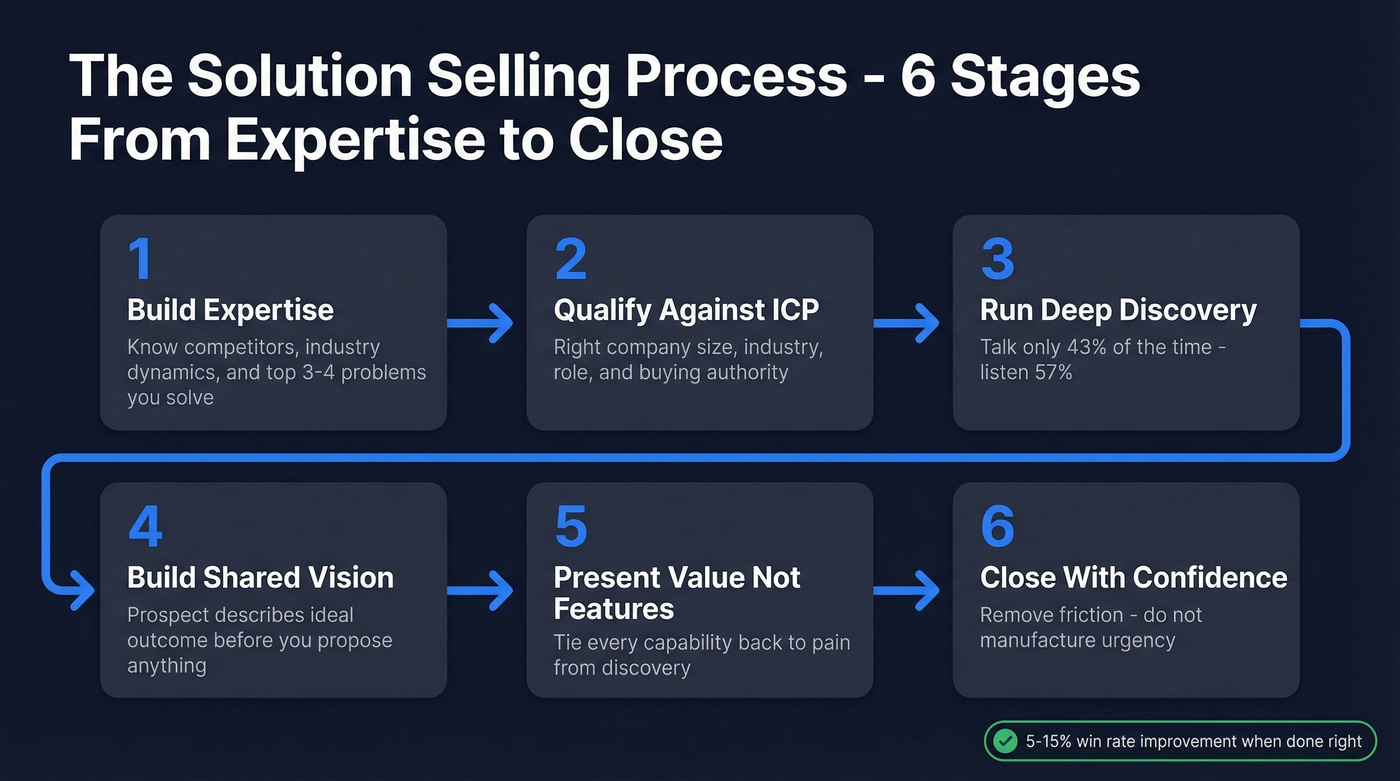
Stage 1: Build product and market expertise. You can't diagnose a problem you don't understand. This means knowing your product cold, yes - but also knowing your competitors' strengths, your buyer's industry dynamics, and the three or four business problems your solution actually solves. Reps who skip this stage default to generic discovery questions because they don't know enough to ask specific ones.
Stage 2: Qualify against your ICP. Not every prospect deserves a discovery call. Before you invest 30 minutes diagnosing someone's pain, confirm they match your ideal customer profile - right company size, right industry, right role, right buying authority. Industry estimates put B2B contact data decay at 35-40% annually, which means the contact you're calling may have left the company three months ago. We'll come back to that.
Stage 3: Run deep discovery. This is the heart of the methodology and where the steps diverge most sharply from traditional pitching. Your job is to understand the prospect's current state, the gap between where they are and where they want to be, and the business impact of that gap. Gong's data shows top-closing B2B reps speak only 43% of the time, compared to 65% for average performers. The 40/60 talk-to-listen ratio isn't a suggestion. It's a performance benchmark. (If you want a tighter structure, use a discovery call framework.)
Stage 4: Build a shared vision. Once you understand the pain, co-create the solution with the buyer. Ask the prospect to describe what the ideal outcome looks like before you propose anything. The prospect should feel like the solution is theirs, not something you're pushing on them. 91% of sellers say they're more successful when solving complex business problems rather than pitching features - and 75% of US consumers base buying decisions on customer experience. The diagnosis is the experience.
Stage 5: Present value, not features. Tie every capability back to the pain you uncovered in discovery. "Our platform reduces invoice processing time by 60%" means nothing without context. "You told me your team spends 12 hours a week on manual invoice reconciliation - here's how that drops to under 5" lands differently. (This is also the core of a value selling framework.)
Stage 6: Close with confidence. If you've done stages 1-5 well, the close is a natural next step, not a pressure tactic. The prospect already sees the gap, understands the cost of inaction, and has co-built the vision. Your job is to remove friction, not manufacture urgency. If you need language by stage, keep a set of closing phrases handy.
A Worked Example
Imagine you sell expense management software to mid-market companies. In Stage 2, you identify a 400-person logistics firm whose CFO just posted about "taming runaway T&E spend." In Stage 3, discovery reveals their finance team manually reconciles 2,000+ expense reports monthly, burning 80 hours and producing a 6% error rate. By Stage 4, the CFO describes her ideal state: automated policy enforcement, real-time visibility, and month-end close cut by three days.
You never mentioned your product's features until Stage 5 - and by then, the CFO was already selling the project internally. That's the methodology working as designed. (If your buyer is finance, this overlaps heavily with how to sell to a CFO.)
Discovery Techniques That Actually Work
The difference between good discovery and bad discovery isn't the questions themselves - it's whether the rep actually listens to the answers and follows the thread. Having a structured framework prevents you from defaulting to "So, tell me about your challenges." Here's a question bank organized by stage, drawn from practitioner discussions and real deal reviews.
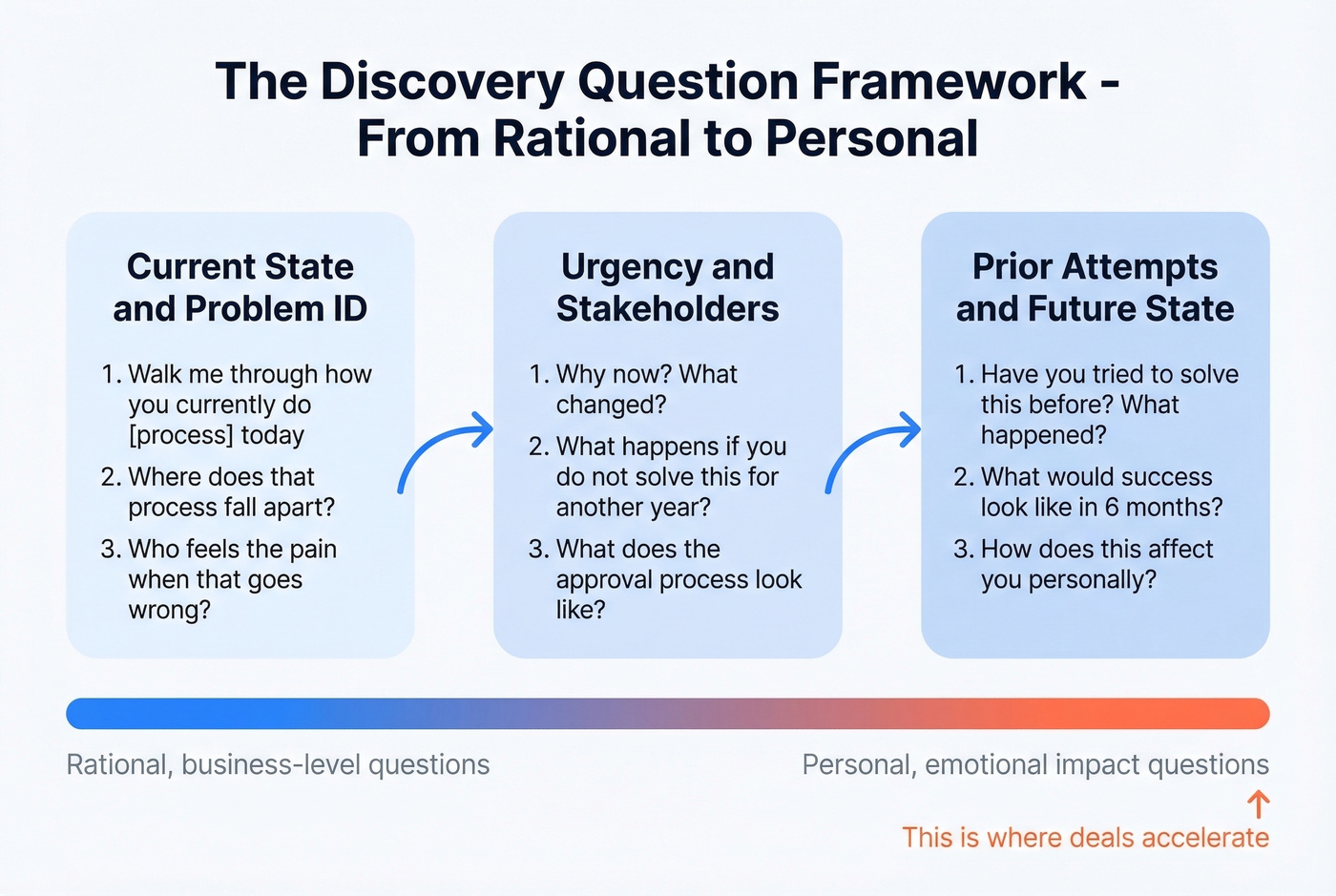
Current State & Problem Identification. Start with "Can you walk me through how you're currently doing [process] today?" and "What does your team's workflow look like from [trigger] to [outcome]?" Then dig into breakdowns: "Where does that process fall apart?" and "Who feels the pain when that goes wrong?" These questions sound basic, but most reps never get past them because they start pitching the moment they hear a problem they can solve. (For more options, pull from open-ended questions.)
Urgency & Stakeholders. "Why now? What changed that made this a priority?" is the single most important question in your toolkit. If the prospect can't answer it, the deal will stall. Follow with "What happens if you don't solve this - could you live with it for another year?" and "If you found the right solution tomorrow, what would the approval process look like?"
Prior Attempts & Future State. "Have you tried to solve this before? What happened?" uncovers hidden objections and political landmines. Close discovery with "What would success look like 6 months from now?" to anchor the conversation in measurable outcomes.
The technique most reps miss is emotional escalation. You start with rational, business-level questions, then gradually move toward impact - "How does that affect your team?" leads to "How does that affect you?" and finally, "How do you feel about that?" The shift from organizational pain to personal pain is where deals accelerate. OMG's assessment data shows this pattern consistently in top performers: they don't just map the business problem, they connect it to the individual's stakes. Mastering these solution selling techniques is what separates reps who run discovery from reps who actually close.
How It Compares to SPIN, Challenger, and MEDDIC
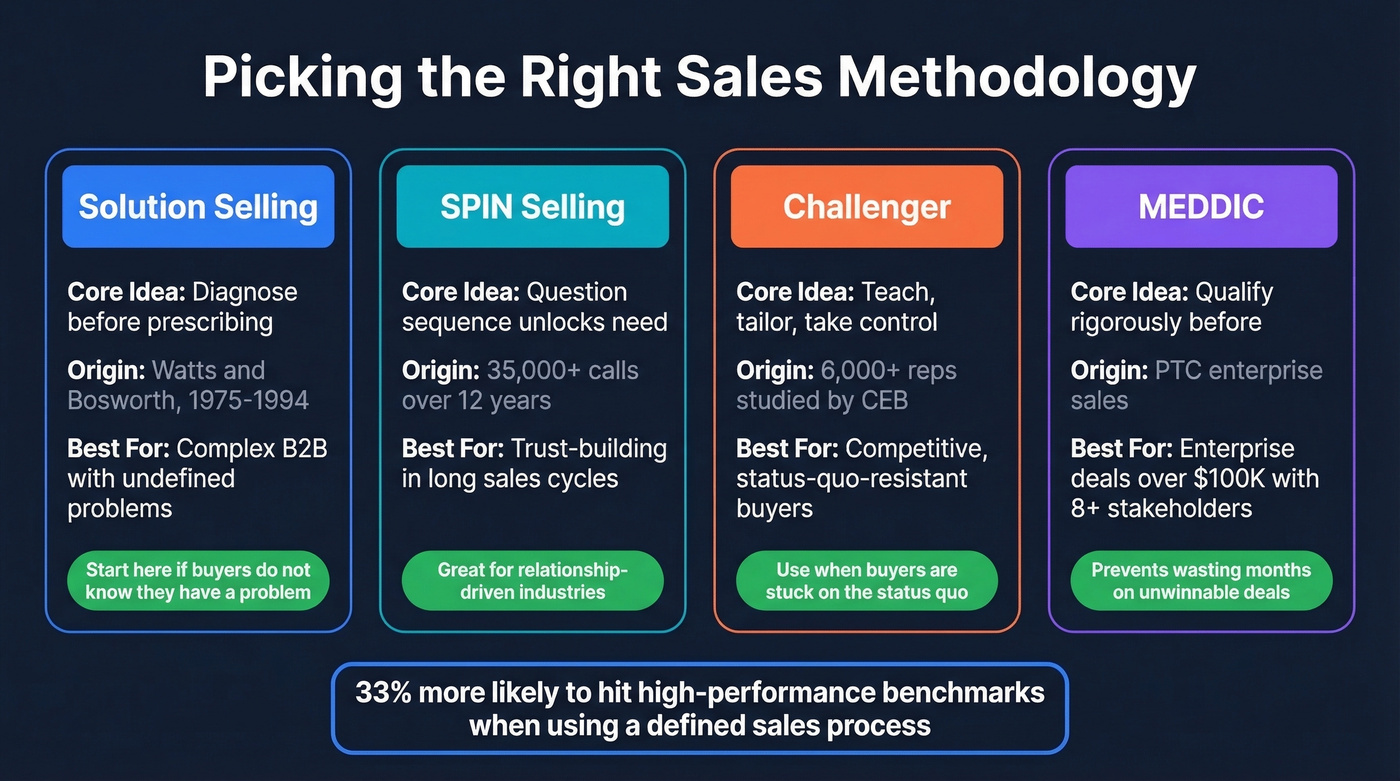
No methodology exists in a vacuum. Most high-performing teams blend elements from multiple frameworks. But understanding the core differences helps you pick the right foundation.
| Solution Selling | SPIN | Challenger | MEDDIC | |
|---|---|---|---|---|
| Core idea | Diagnose before prescribing | Question sequence unlocks need | Teach, tailor, take control | Qualify rigorously before investing |
| Research base | Watts/Bosworth (1975-1994) | 35,000+ calls, 12 years | 6,000+ reps (CEB) | PTC enterprise sales |
| Best for | Complex B2B, undefined problems | Trust-building, long cycles | Competitive, resistant buyers | Enterprise, $100K+ deals |
| Key result | Consultative positioning | Deeper need articulation | Xerox: 17% lift, $65M | Pipeline accuracy |
Sandler's methodology also deserves a mention - its "up-front contract" technique (agreeing on next steps before every meeting) pairs well with the discovery stages and prevents the free-consulting problem we'll cover below. (If you want the full breakdown, see the Sandler sales process.)
The practical guidance: if your buyers don't know they have a problem yet, start with solution selling or SPIN. If they know the problem but are stuck on status quo, Challenger's "teach and provoke" approach works better. For enterprise procurement with 8+ stakeholders and a formal evaluation process, MEDDIC keeps you from wasting months on deals you can't win. (If you're rolling it out, use this guide on how to implement MEDDIC.)
Companies with a defined sales process are 33% more likely to hit high-performance benchmarks. The specific methodology matters less than having a methodology and actually following it.

Stage 2 falls apart when 35-40% of your contact data is decayed. Prospeo refreshes 300M+ profiles every 7 days - not every 6 weeks - so you qualify against real people in real roles with 98% email accuracy.
Stop diagnosing problems with the person who left three months ago.
Is Solution Selling Dead?
The "solution selling is dead" narrative gained traction after Harvard Business Review published a provocative piece in 2012 arguing that buyers had moved past needing a diagnosis. The logic: 57% of the buying journey is completed before a prospect even talks to sales. Consultancy blogs pushed it further, claiming buyers arrive with "90% of their research already done."
The critique has teeth. Buyers are more informed. Showing up with basic discovery questions like "Tell me about your business" signals you haven't done your homework.
Here's the thing, though - OMG's assessment of 1,861,244 salespeople found that 59% haven't even started selling consultatively. 52% aren't following any staged, milestone-based, customer-centric process at all. A decade earlier, only 9% followed such a process - so adoption is improving, but the baseline was catastrophically low.
You can't declare a methodology dead when the majority of sellers have never properly tried it. That's like saying exercise doesn't work because most people quit after two weeks.
Let's be honest about where the line falls: if your average deal size is under $10K and your sales cycle is under two weeks, you probably don't need this approach - a solid product demo and clear pricing will close faster. But for anything above that threshold, the methodology isn't dead. It's under-adopted and frequently butchered. The informed buyer reality means you need to do more research before discovery, not less discovery. Show up knowing the prospect's tech stack, recent funding round, and competitive landscape - then use discovery to uncover the things Google can't tell you: internal politics, emotional stakes, and the real reason they took the call.
Pros and Cons Worth Knowing
Pros: Higher win rates on complex deals, stronger buyer relationships, larger average deal sizes because you're selling to the full scope of the problem, and natural differentiation from competitors who lead with features. Solution sales cycles also tend to produce stickier customers because the buyer feels co-ownership of the decision.
Cons: Longer ramp time for new reps, higher cost per opportunity because deep discovery takes time, risk of the free-consulting trap (giving away your best thinking to unqualified prospects), and poor fit for transactional or commodity sales. It also requires management buy-in - you can't run a consultative process if leadership measures reps on dials per hour.
Mistakes That Kill Deals
Scripted Discovery
The r/sales post we opened with isn't an outlier. When reps memorize question sequences and deliver them in order regardless of context, prospects feel it immediately. Discovery should be a conversation guided by curiosity, not a checklist executed in sequence. If your next question doesn't flow naturally from the prospect's last answer, you're doing it wrong.
The Free Consulting Trap
A rep runs beautiful discovery, maps the prospect's entire problem landscape, co-creates a vision - and then the prospect takes that diagnosis to a cheaper competitor or builds the solution internally. 91% of sellers say they succeed by solving complex problems, but that only pays off when you're solving them for qualified buyers. The fix is qualifying before you invest in deep discovery. Sandler's up-front contract helps here: agree on mutual next steps before you give away your best thinking.
Wrong Talk-to-Listen Ratio
Gong's data is unambiguous. Top closers talk 43% of the time. Average performers talk 65%. If you're doing most of the talking on a discovery call, you're presenting, not diagnosing. Record your next five calls and check the ratio. Most reps are shocked by what they find.
Bad Prospect Data
This is the mistake nobody writes about in methodology guides, but it kills more deals than bad discovery technique. We've seen the pattern play out dozens of times at our own company and across teams we work with: an SDR books 15 discovery calls in a week, six are no-shows because the email bounced or the prospect left the company months ago, and three more are the wrong persona entirely - a marketing coordinator instead of the VP of Marketing. You can't run consultative discovery on a dead email or a disconnected number.
Tools like Prospeo verify emails in real-time at 98% accuracy on a 7-day data refresh cycle, so reps spend time selling instead of chasing ghosts. The methodology only works if the person on the other end of the call is the right person, at the right company, with the right problem. (If you're auditing your list, start with email verification.)
The PPVVC Qualification Framework
Once you've moved past basic discovery, you need a way to score deal quality. The PPVVC framework, rooted in the methodology, gives you a formula: S2 = P2 x V2 x C.
Pain measures how acute the problem is - mild inconvenience or business-critical fire. Power asks whether you're talking to someone who can actually sign the deal or an influencer who'll need to sell internally. Vision captures whether the prospect sees a clear picture of the solution and their role in it. Value is your ability to quantify ROI in terms the economic buyer cares about. And C reflects whether you have Control of the process.
In formal Solution Selling training, PPVVC is commonly framed as Pain, Power, Vision, Value, and Consensus - meaning you have real agreement across the buying group, not just one enthusiastic champion.
The multiplication matters. If any component is zero, the deal score is zero. A prospect with massive pain but no power to buy? Zero. A champion with authority but no clear vision? Also zero.
In practice, the most common missing denominator in lost deals is Vision + Value. Reps establish pain and find power, but never co-create a compelling vision or quantify the business case. When you lose a deal to "no decision," it's almost always a Vision or Value failure - the prospect couldn't justify the change internally because the story wasn't clear enough. (To systematize this, use a deal scoring model.)
Tools That Support the Methodology
A methodology is only as good as the infrastructure supporting it. Here's the minimum viable tech stack for 2026:
CRM: Salesforce (starts around ~$25/user/month, scales up by edition) or HubSpot (free CRM tier) to track deal stages, stakeholder maps, and discovery notes. The CRM matters less than the discipline of using it. (If you need a stage model, start with CRM deal stages.)
Conversation intelligence: Gong typically runs ~$100-200/user/month, often sold annually. It records and analyzes calls so you can catch reps reverting to feature-pitching on live calls. This is where methodology adoption actually gets measured.
Data quality: Neither your CRM nor your conversation intelligence matters if the contact data is wrong. B2B contact data decays 35-40% per year, and a 7-day refresh cycle (versus the 6-week industry average) is the difference between reaching a live prospect and leaving a voicemail for someone who left the company in March.
Training: Richardson, Sandler, or Corporate Visions for formal methodology training (~$2,000-7,000+ per participant). Budget for ongoing coaching, not just a one-time workshop - the OMG data shows adoption takes years, not days.
Solution selling demands you reach decision-makers, not gatekeepers. Prospeo's 125M+ verified mobile numbers deliver a 30% pickup rate - so your deep discovery actually happens with the CFO, not her voicemail.
Find direct dials to the buyers who need your solution.
FAQ
What is solution selling and how does it differ from consultative selling?
Solution selling is a structured methodology with defined stages and frameworks like PPVVC, while consultative selling is the broader philosophy of diagnosing before prescribing. Think of it as one specific implementation of the consultative approach, with more process rigor and formal milestones guiding reps from qualification through close.
When should you NOT use this approach?
Skip it for transactional sales where the buyer already knows what they want and is comparing on price - cycles under two weeks, self-serve PLG motions, and commodity purchases. For deals under $10K with a single decision-maker, a clear demo and transparent pricing will close faster than deep discovery.
How long does team adoption take?
Expect 3-6 months for meaningful behavioral change. OMG's data shows the industry moved from 9% to 48% process adoption over a decade - real transformation is slow. Front-load investment in weekly call coaching and deal reviews rather than a one-time workshop.
Can it work with inbound leads?
Yes - and it's especially valuable there. The 57% buying journey stat means inbound prospects arrive with assumptions and sometimes the wrong self-diagnosis. Your job is to validate their conclusions, challenge where necessary, and uncover the deeper problem they haven't articulated yet.
What tools do I need to get started?
At minimum: a CRM for tracking deal stages, a conversation intelligence tool for coaching, and a verified data source so reps reach the right contacts. Formal methodology training from providers like Richardson or Sandler runs $2,000-7,000+ per rep but pays back in higher win rates within two quarters.