

The Value Selling Framework That Actually Teaches You the Framework
67% of B2B buyers now prefer a rep-free experience. That number - from a Gartner survey of 646 buyers - means your reps don't get many at-bats. When they do land a discovery call or a demo, they'd better show up with something sharper than a feature walkthrough. 45% of those same buyers used AI during their last purchase, so your prospect already knows what your product does before the call starts. The only thing left to sell is the outcome. That's where a value selling framework earns its keep - and where buyers who feel confident in the value are twice as likely to report a high-quality deal.
The Short Version
Value selling is a skill layer, not a standalone methodology. Five steps: discover, gap, hypothesize, validate, realize. Pair it with MEDDIC for qualification and SPIN for discovery - that combination covers most of complex B2B sales.
What Value Selling Actually Is
Here's the simplest definition we've found useful for AE/SE teams: value selling is translating technical capability into business outcomes. You're not selling software. You're selling the delta between where the buyer is today and where they'll be after implementation - expressed in dollars, hours, or risk reduction.
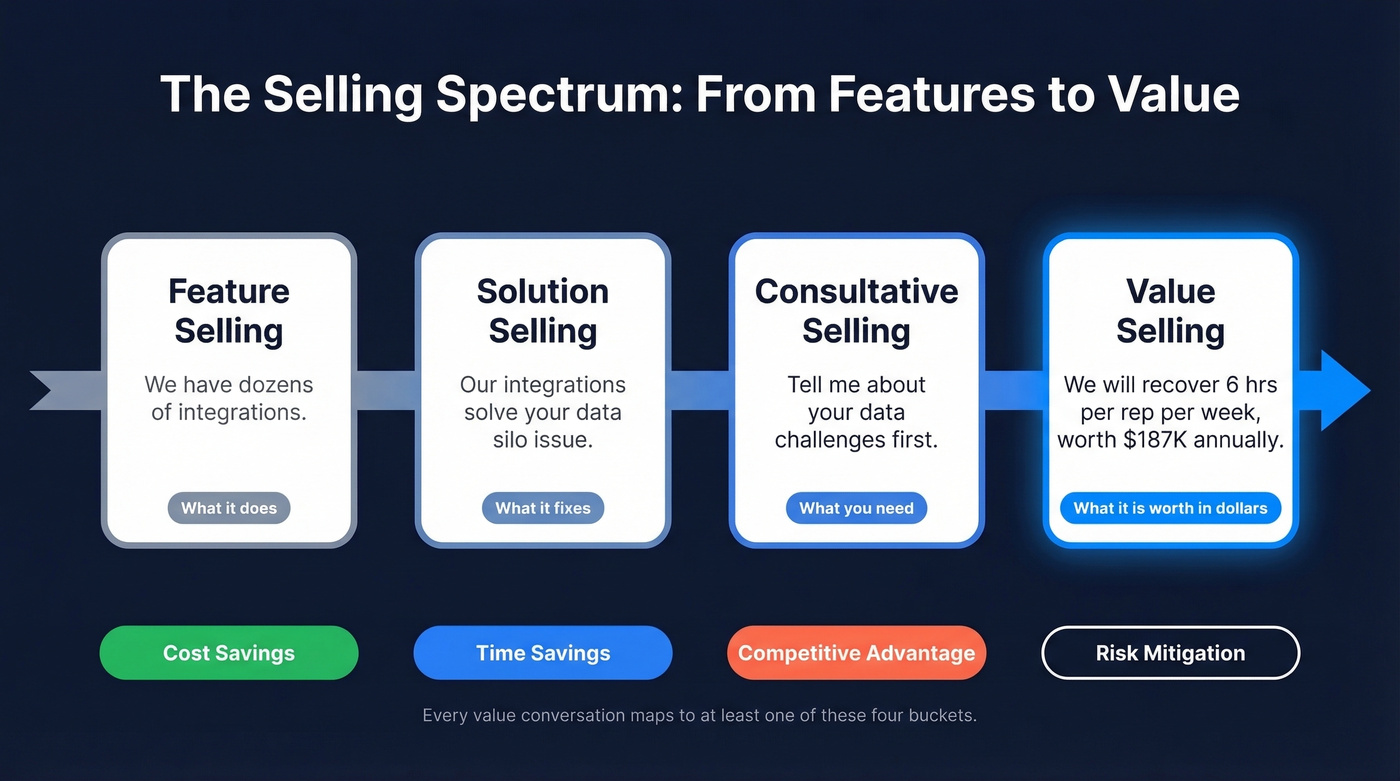
Sounds obvious. But most reps default to one of three adjacent approaches without realizing they're doing something different:
- Feature selling lists what the product does. "We have dozens of integrations."
- Solution selling maps features to problems. "Our integrations solve your data silo issue."
- Consultative selling digs into needs before proposing anything.
Value selling goes one step further than all three. It quantifies the financial impact of solving the problem. Not "we'll improve productivity" - but "we'll recover 6 hours per rep per week, which at your team size equals $187K in annual selling time."
Every value conversation maps to one of four buckets: cost savings, time savings, competitive advantage, and risk mitigation. If your value hypothesis doesn't land in at least one of these, you're still feature selling with extra steps.
The 5-Step Value Selling Framework
Each step has a concrete deliverable - not just a concept.
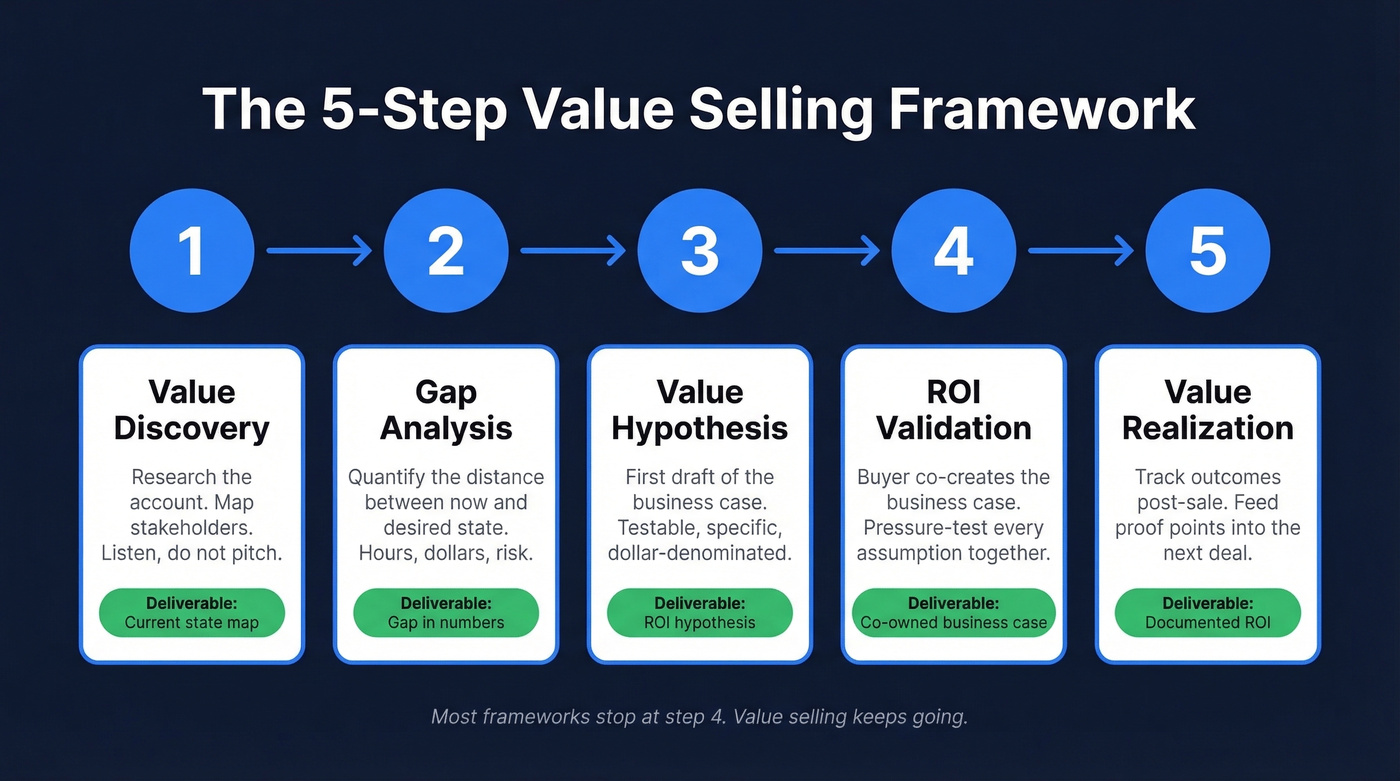
Step 1: Value Discovery
Before you ask a single discovery question, you need to know who you're talking to and what their world looks like. That means researching the account's financials, recent news, tech stack, and org structure. It also means having verified contact info for every stakeholder in the buying committee - not just the person who booked the demo. Prospeo handles this with 98% email accuracy and 125M+ verified mobile numbers, so you can actually reach the CFO, VP of Ops, and anyone else who'll influence the decision. If you can't reach those people, your value story dies with a single champion.
The discovery call itself is about listening, not pitching. You're mapping the buyer's current state: what they spend, how long things take, what breaks, and what keeps the VP up at night. (If you want a tighter structure, use a discovery call script as a baseline.)
Step 2: Gap Analysis
Now you quantify the distance between current state and desired state. This is where most reps get lazy. They hear "we need to be more efficient" and nod along instead of asking "how many hours per week does your team spend on this today?" and "what's the fully loaded cost of that time?"
The gap has to be expressed in numbers. Hours lost, revenue leaked, deals slipped, compliance fines risked. No number, no value story. (This is also where data-driven selling habits pay off.)
Step 3: Value Hypothesis
This is your first draft of the business case - a testable statement that connects your product to the gap. It follows a simple formula: "Based on what you've told me, we believe [product] can [specific outcome], saving/generating [dollar amount] over [time period]."
For example: "Based on your current proposal cycle of 12 hours per proposal across 200 monthly proposals, we believe our platform can reduce creation time to 3 hours - recovering roughly 1,800 hours per month, worth approximately $1.26M annually at your team's fully loaded cost."
The hypothesis isn't a promise. It's a conversation starter that forces the buyer to validate or correct your math.
Step 4: ROI Validation
Here's where the buyer co-creates the business case with you. You present your hypothesis, and together you pressure-test the assumptions. Are the hours accurate? Is the fully loaded cost right? What about the ramp period before full adoption?
A business case the buyer helped build is one they'll defend internally. A business case you handed them on a slide is one that dies in the CFO's inbox.
Step 5: Value Realization
Most frameworks stop at "close the deal." Value selling doesn't. After the contract is signed, you track whether the promised outcomes actually materialize. Did the customer save those 1,800 hours? Did revenue increase?
This isn't customer success theater. Documented value realization feeds your next deal's proof points and protects against churn. It also makes expansion conversations far easier - you're not asking for more budget, you're showing ROI and proposing more of it. (This ties directly into churn analysis and retention work.)
Worked Example: SaaS ROI Math
Let's walk through a real scenario. You sell a sales engagement platform. Your prospect is a mid-market SaaS company with 12 outbound reps.
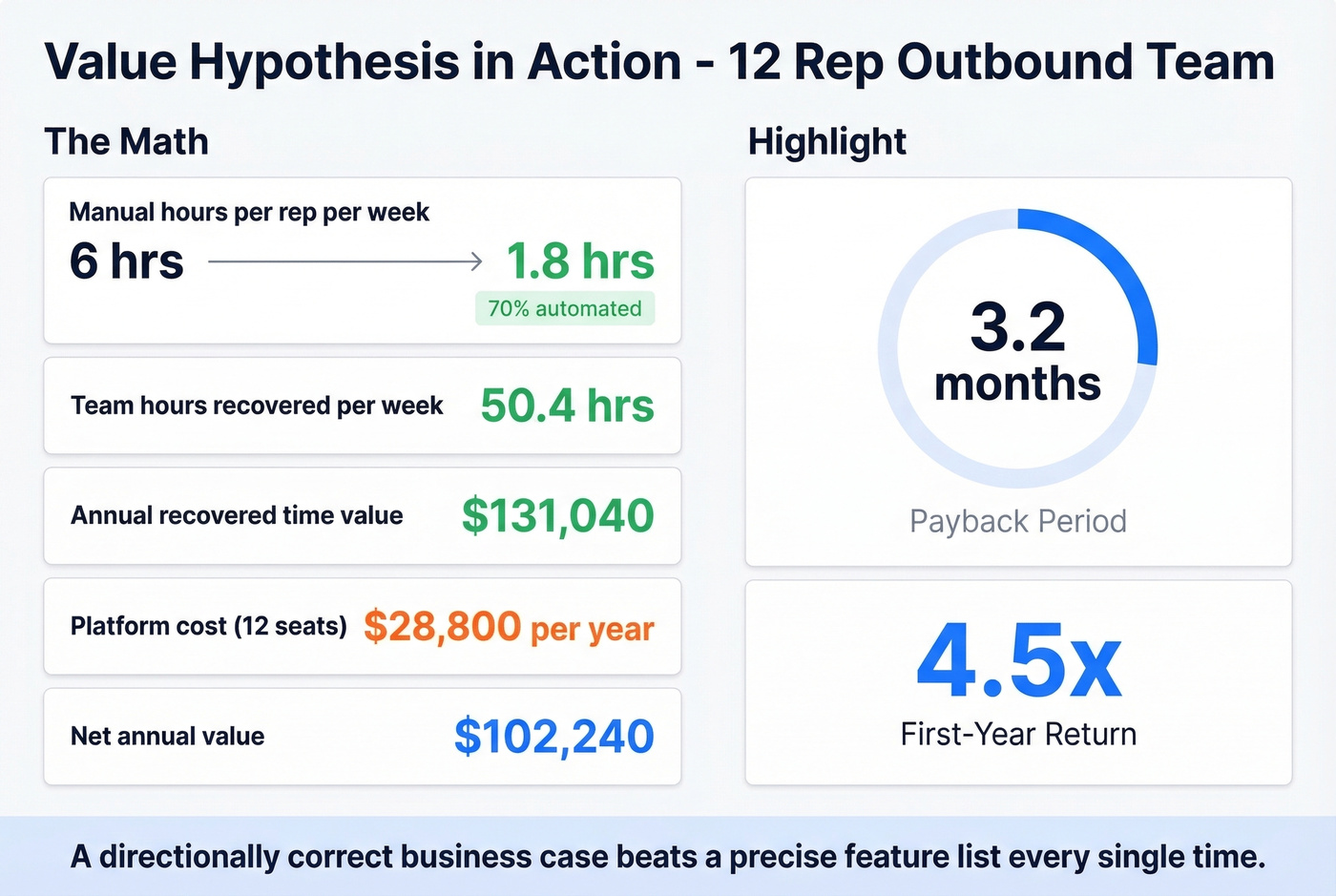
During discovery, you learn each rep spends roughly 6 hours per week on manual tasks: building lists, researching prospects, logging activities, and formatting follow-ups. That's 72 rep-hours per week across the team. At a fully loaded cost of $50/hour, that's $3,600/week or $187,200/year in non-selling time.
Your platform automates about 70% of that manual work:
| Metric | Current State | With Your Platform |
|---|---|---|
| Manual hours/rep/week | 6 hrs | 1.8 hrs |
| Team hours recovered/week | 50.4 hrs | - |
| Annual recovered time value | - | $131,040 |
| Platform cost (12 seats) | - | $28,800/yr |
| Net annual value | - | $102,240 |
| Payback period | - | ~3.2 months |
Your value hypothesis to the VP of Sales: "We can recover 50+ hours of selling time per week across your team, worth roughly $131K annually. At $28,800/year for 12 seats, that's a 3.2-month payback and a 4.5x first-year return."
That's not "we have great automation features." That's a CFO-ready number.
Real deals are messier than this - adoption curves, change management friction, and overlapping tool costs muddy the picture. But even a rough value hypothesis gives you a conversation anchor that feature selling never provides. A directionally correct business case beats a precise feature list every single time.
Discovery Questions That Uncover Value
Gong's data shows that 20 discovery questions is too many. Eight to twelve targeted questions, sequenced properly, beats a checklist every time.
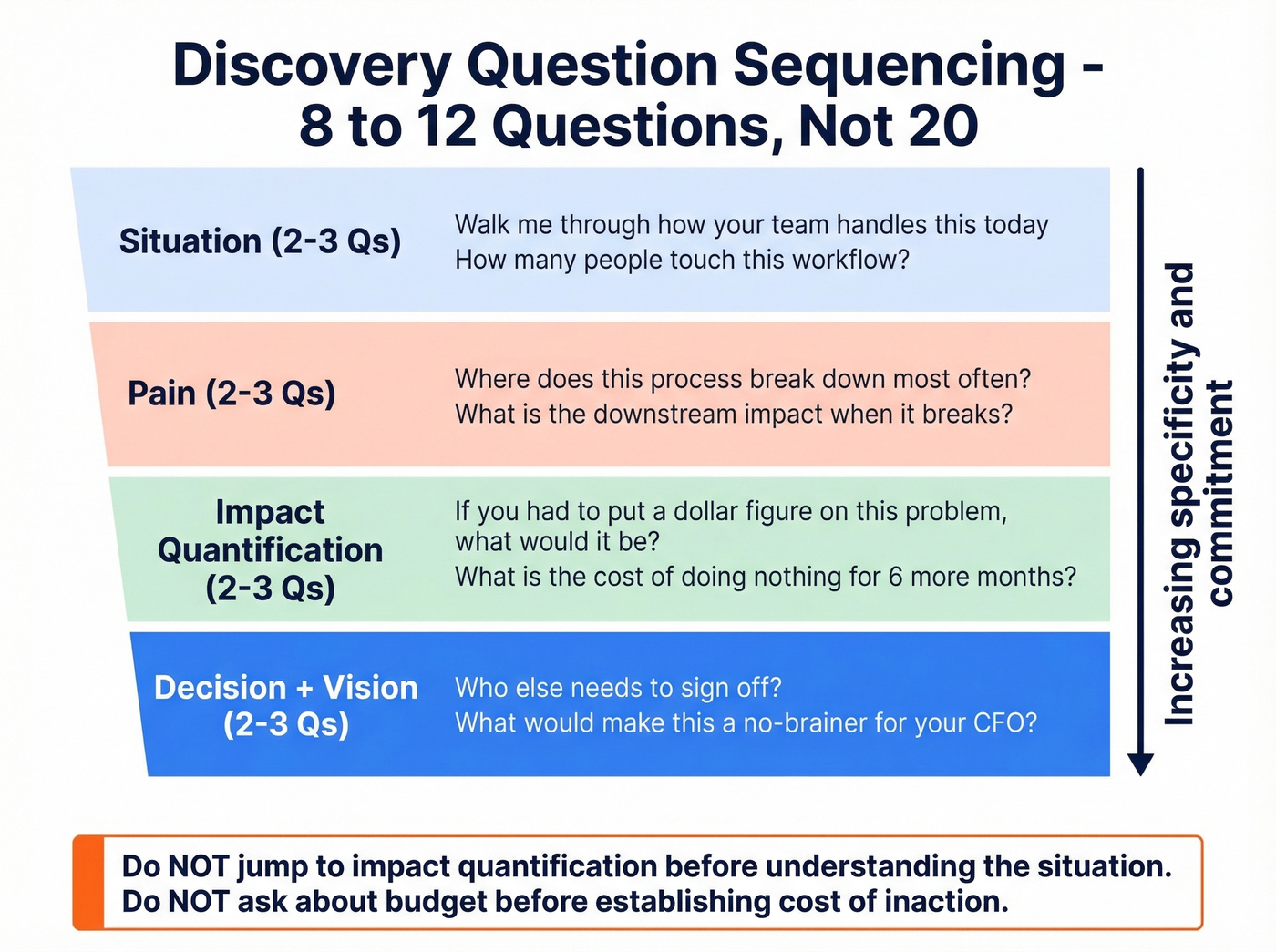
Situation (2-3 questions)
- Walk me through how your team handles [process] today, start to finish.
- How many people touch this workflow, and how much time does each spend?
- What tools are you currently using for this?
Pain (2-3 questions)
- Where does this process break down most often?
- What happens when it breaks - what's the downstream impact?
- How long has this been a problem, and what have you tried?
Impact quantification (2-3 questions)
- If you had to put a dollar figure on this problem - in time, revenue, or missed opportunities - what would it be?
- How does this affect your team's ability to hit quota this quarter?
- What's the cost of doing nothing for another 6 months?
Decision process + vision (2-3 questions)
- Who else needs to sign off on a change like this?
- What does success look like 90 days after implementation?
- What would make this a no-brainer for your CFO?
The key is sequencing. Don't jump to impact quantification before you understand the situation. And don't ask "what's your budget?" before you've established the cost of inaction - that's how you anchor the conversation on value, not price. I've watched reps who quantify impact in the first 10 minutes of discovery close faster and discount less than reps who save it for the proposal.

A value selling framework is only as strong as your access to the buying committee. If your champion is the only person hearing your ROI story, the deal stalls. Prospeo gives you 98% accurate emails and 125M+ verified mobile numbers so you can reach the CFO, VP of Ops, and every decision-maker who needs to see the business case.
Stop letting value stories die with a single champion.
Tailoring Value by Stakeholder
The same product solves different problems for different people in the buying committee.
| Stakeholder | What They Care About | Example Value Statement |
|---|---|---|
| CFO / Finance | Payback period, risk, TCO | "3.2-mo payback, $102K net value, month-to-month contract" |
| VP Sales / RevOps | Pipeline velocity, rep productivity | "Recovers 50+ selling hrs/week - equivalent to hiring 1.2 reps" |
| End User (Rep/IC) | Daily workflow, time saved | "List-building and logging drops from 6 hrs/week to under 2" |
Here's the thing: if you only sell to the end user, you'll get enthusiasm but no budget. If you only sell to the CFO, you'll get budget approval but no adoption. Value selling means multi-threading the right message to the right person. (This is the core of team selling in practice.)
Skip the full five-step framework for deals under $10K. A solid demo and a one-page ROI snapshot will close those. Value selling shines when there are multiple stakeholders, 30+ day cycles, and enough deal size to justify the discovery investment. Don't over-engineer a $5K sale.
When to Go All-In
Three scenarios where value selling is non-negotiable: stalled deals where the buyer has gone dark (go back to the value hypothesis and pressure-test whether the math still holds), competitive displacement where you're ripping out an incumbent (quantify switching costs vs. staying costs), and regulated industries where risk mitigation is the primary value bucket. Compliance fines dwarf your license fee, so lead with that. (A simple competitive intelligence strategy helps you quantify displacement.)
Value Selling vs. SPIN vs. Challenger vs. MEDDIC
As one r/sales thread put it, most methodologies "pretty much sound the same" - they boil down to understanding needs, qualifying properly, and building urgency. There's truth to that. But the differences matter when you're deciding what to train your team on.
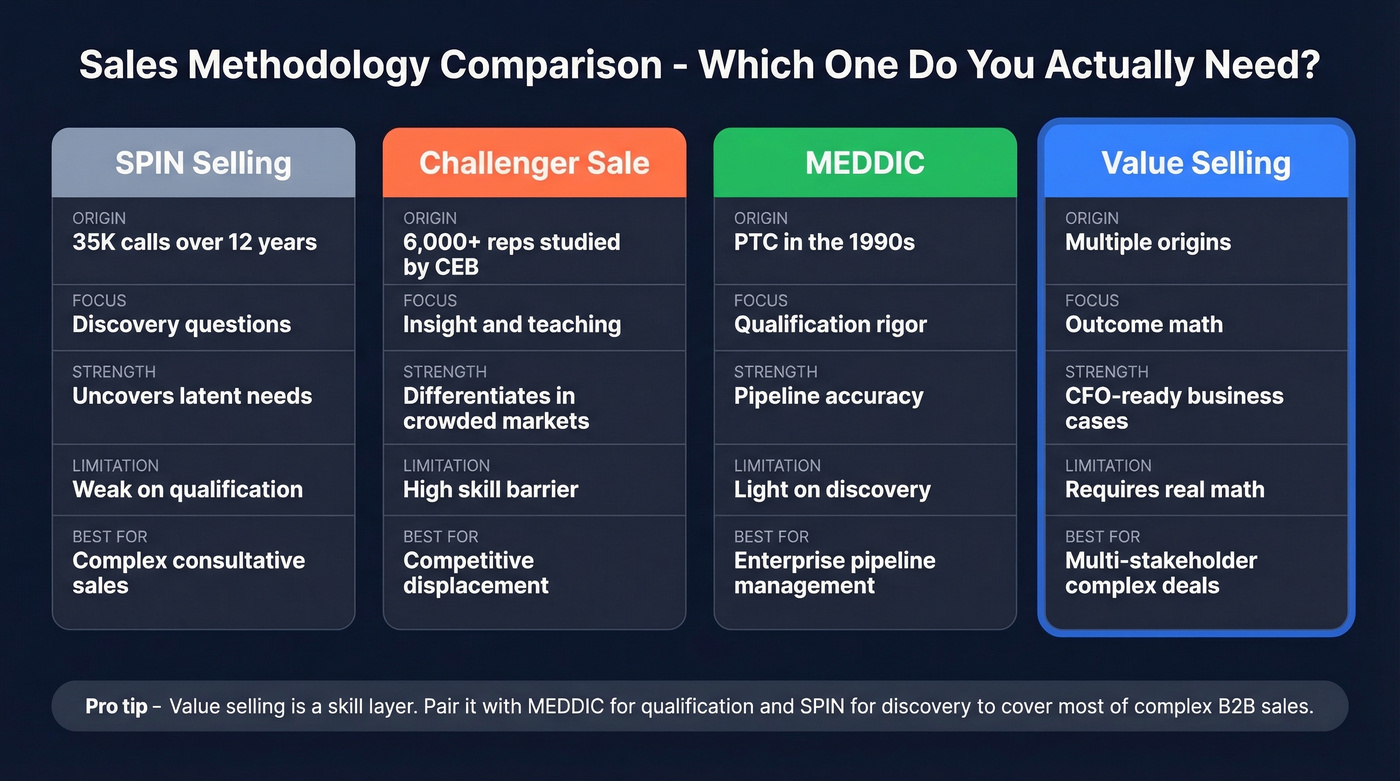
| SPIN | Challenger | MEDDIC | Value Selling | |
|---|---|---|---|---|
| Origin | 35K calls, 12 yrs | 6,000+ reps (CEB) | PTC, 1990s | Multiple origins |
| Focus | Discovery questions | Insight + teaching | Qualification rigor | Outcome math |
| Strength | Uncovers latent needs | Differentiates in crowded markets | Pipeline accuracy | CFO-ready business cases |
| Limitation | Weak on qualification | High skill barrier | Light on discovery | Requires real math |
| Best for | Complex, consultative | Competitive displacement | Enterprise pipeline mgmt | ROI-driven deals |
SPIN Selling was built on 35,000 sales calls across 20+ countries over 12 years - the most research-backed discovery framework in existence. Challenger came from CEB's study of 6,000+ reps and proved that teaching-oriented sellers outperform relationship builders. Xerox generated $65M in contract value after implementing Challenger.
But here's the key insight: value selling isn't a replacement for any of these. It's an overlay. Use SPIN for discovery structure, MEDDIC for qualification discipline, and the value selling framework to build the business case that gets the deal signed. We've seen teams try to pick one methodology and force everything through it - the ones that combine elements consistently outperform. I watched a team layer MEDDIC qualification onto a value-based selling workflow and cut their no-decision rate by a third in one quarter. (If you want a tighter qualification layer, start with MEDDIC sales qualification.)
5 Mistakes That Kill Value Deals
1. Letting the champion build the business case alone. Your internal champion isn't a salesperson. We've watched deals die because the champion was sent into a CFO meeting with a 40-slide deck instead of a one-page business case. Co-create the business case in a working session, then arm the champion with a one-page summary they can actually defend.
2. Speaking in generalities instead of numbers. "We improve productivity" means nothing. "We recover 50 hours of selling time per week across your team, worth $131K annually" means everything. If you can't quantify it, you haven't done enough discovery.
3. Ignoring the real competitor - doing nothing. In most complex B2B deals, your biggest competitor isn't another vendor. It's the spreadsheet, the intern, or the "we'll figure it out next quarter" meeting that ends the evaluation. Quantify the cost of inaction just as rigorously as you quantify the value of your solution. (This is one of the most common sales pipeline challenges behind no-decision.)
4. Assuming you know the value instead of asking. Every account is different. The value hypothesis that worked for your last customer is irrelevant for this one. Discovery isn't optional - it's the foundation.
5. Pitching features when the deal stalls. When a deal goes sideways, the instinct is to demo more features. That's exactly backward. A stalled deal needs a stronger business case, not a longer feature list. Go back to the value hypothesis and pressure-test whether the math still holds.
Does Value Selling Work?
Vendor-reported case studies always carry selection bias - companies don't publish their failures. That said, the ValueSelling Associates case studies include named companies with specific before/after metrics, which is more than most methodology vendors offer.
| Company | Key Metric | Result |
|---|---|---|
| Trend Media | Average contract length | 400% growth |
| Trend Media | Avg deal size | 100% increase |
| Readymode | Win rate on SAOs | 72% |
| Readymode | Annual revenue growth | 40% increase |
| GHD Digital | ARR growth (2 yrs) | 450% increase |
| Weir Group | Sales cycle length | 25% faster |
| Weir Group | Revenue | 21% increase |
The pattern is consistent: this methodology doesn't just increase win rates - it increases deal size and contract length. When you sell on ROI, the conversation shifts from "can we afford this?" to "can we afford not to do this?"
Tools That Support Value Selling
Value selling is a skill, not a software category. But the right tools make each step faster.
CRM: Salesforce (from ~$25/user/mo) or HubSpot (free to ~$150/user/mo) for tracking discovery insights, stakeholder maps, and deal progression. Your value hypothesis should live in the CRM, not in a rep's head. (If you're evaluating options, start with examples of a CRM.)
Conversation intelligence: Gong (~$100-150/user/mo) records and analyzes discovery calls so managers can coach reps on whether they're actually uncovering value or just running through a feature list.
B2B data: Value selling starts with reaching the right person. If your emails bounce or your phone numbers are dead, the best discovery questions in the world won't help. Prospeo gives you verified emails at 98% accuracy and 125M+ verified mobile numbers for stakeholders across the buying committee, refreshed every 7 days. Free tier available - 75 emails/month plus 100 Chrome extension credits/month, no credit card required. (For a broader stack view, see our guide to data enrichment services.)

ROI calculators: Build a simple spreadsheet or use tools like Cuvama or Ecosystems to create interactive value models your buyers can manipulate during the validation step. These platforms typically run $500-2,000+/month depending on team size and complexity.
You just built a CFO-ready ROI calculation. Now you need to actually reach the CFO. Prospeo's 30+ search filters - including buyer intent, job changes, and department headcount - let you identify and contact every stakeholder in the deal. At $0.01 per verified email, building your business case costs less than the coffee you'll buy them.
Get verified contact data for every person who influences the deal.
FAQ
Is value selling the same as consultative selling?
No. Consultative selling focuses on understanding needs through deep questioning. Value selling goes further by quantifying the financial impact in dollars, hours, or risk reduction. Think of consultative selling as the discovery engine and value selling as the math layer on top.
How long does it take to implement a value selling framework?
Individual reps can start using the five-step process immediately. Team-wide adoption with consistent execution typically takes 2-3 months of coaching, deal reviews, and reinforcement through pipeline meetings.
Does value selling work for low-ticket deals?
It's overkill for transactions under ~$5K. The methodology shines in complex B2B sales with multiple stakeholders and 30+ day cycles where the discovery investment pays off in larger deal sizes and fewer no-decisions.
What's the difference between ValueSelling Framework(R) and value selling?
ValueSelling Framework(R) is a branded training program from ValueSelling Associates that includes specific tools like the Qualified Prospect Formula. Value selling is the broader practice - methodology-agnostic - that anyone can learn and apply using the five-step process outlined above.
What tools help with value selling preparation?
A CRM for tracking discovery insights, conversation intelligence like Gong for coaching, and a B2B data platform for finding verified contact info for every stakeholder in the deal. The goal is to map the entire buying committee before the first call so your value story reaches the people who control the budget.