

Speed to Lead AI: How to Respond in Seconds (Not Hours)
A founder on Reddit shared his numbers last year: average lead response time dropped from 3.5 hours to 47 seconds. One agency using his tool booked 4 calls in 48 hours that would've gone cold. Meanwhile, your competitor just texted that inbound lead while your rep was finishing lunch.
Here's the stat that should bother you: 66% of customers say speed is as important as price. Speed to lead AI is the gap between pipeline that converts and pipeline that ghosts you.
What You Need (Quick Version)
Three things make a lead response automation system work:
- Clean contact data. Automating follow-up to disconnected numbers wastes every dollar you spend on speed. Verify before you automate. (If you’re sourcing lists too, start with a B2B database that’s built for accuracy.)
- A channel strategy. For most teams, SMS is the better starting point than voice AI. Pick one, master it, then expand. (If you’re building a broader cadence, use a multichannel sales outreach plan.)
- An automation tool matched to your budget. Apten starts at $49/mo for scrappy teams; Verse.ai starts at $5,000/mo for enterprise-grade managed service.
What Speed to Lead AI Actually Means
The widely cited benchmark - leads contacted within 5 minutes are 21x more likely to convert - traces back to Oldroyd, McElheran, and Elkington's 2011 HBR research on online sales lead response times. That study is 15 years old now, and the bar has moved. In 2026, under 60 seconds is the real benchmark, and AI is the only way to hit it consistently.
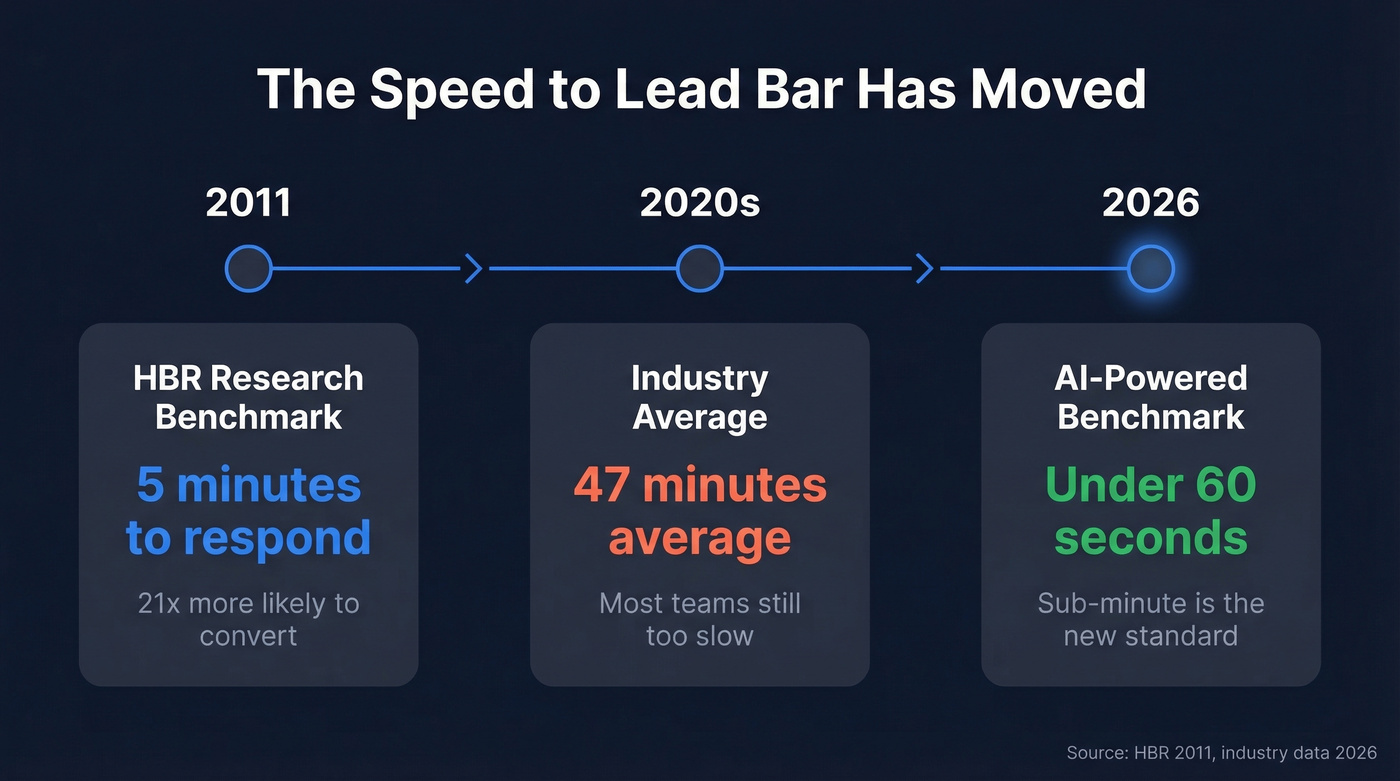
NLP-driven qualification, automated outreach across SMS, voice, and chat, and instant calendar booking have compressed the lead-to-appointment cycle into something that runs while your reps sleep. We've watched teams go from "we'll get back to you within 24 hours" to sub-minute responses without adding headcount. The difference in conversion is staggering. (If you want the bigger picture, this is part of GTM AI in practice.)
Voice AI vs. SMS vs. Chatbots
Most teams default to voice AI because it feels more impressive. SMS is cheaper and scales better for the majority of B2B use cases.
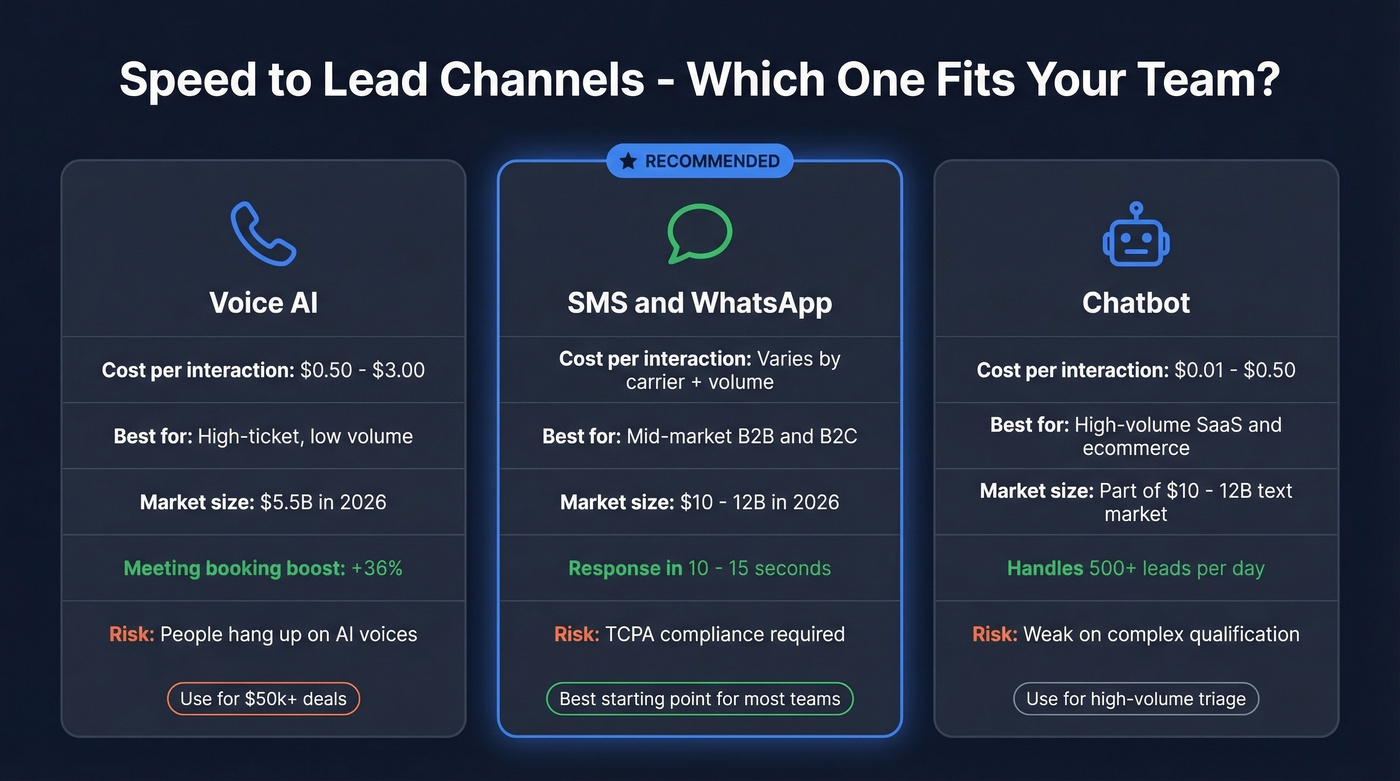
| Channel | Cost/Interaction | Best For | Watch Out |
|---|---|---|---|
| Voice AI | $0.50-$3.00 | High-ticket, low volume | Hang-ups when people detect AI |
| SMS/WhatsApp | Varies by carrier + volume | Mid-market B2B/B2C | TCPA compliance |
| Chatbot | $0.01-$0.50 | High-vol SaaS/ecomm | Weak on complex qualification |
The voice agent market is projected at $5.5B in 2026 with a 35% CAGR, but the text chatbot market is nearly double at $10-12B. The money follows where the scale is.
Voice AI does show +36% meeting booking conversion in high-intent scenarios, and win rates can jump 43%. But there's a real problem: an HVAC business owner on r/AI_Agents asked whether people just hang up when they realize it's not a human. The answer, based on dozens of replies, was a resounding "yes, frequently." (If you’re leaning into calls, tighten your phone sales skills so handoffs don’t fumble.)
Here's our rule of thumb: voice for high-ticket, low-volume deals where a conversation matters. SMS for everything mid-market. Chatbots for high-volume SaaS or ecommerce where you're triaging hundreds of leads per day.

Automating follow-up to disconnected numbers doesn't make you fast - it makes you expensive. Prospeo verifies 300M+ contacts on a 7-day refresh cycle with 98% email accuracy and 125M+ verified mobiles, so your speed-to-lead system actually reaches real buyers.
Stop automating bad data. Clean your list in minutes.
Tools and Pricing Compared
| Tool | Starting Price | Channel | Best For |
|---|---|---|---|
| Prospeo | Free tier; ~$0.01/email verified | Data verification + enrichment | Clean data before automation |
| Apten | $49/mo | SMS + voice | Small teams, budget-conscious |
| SpeedToLead.io | ~$200-500/mo | Chat (GoHighLevel) | GHL users only |
| Retell AI | Usage-based ($0.50-$3/call) | Voice | Technical teams building custom |
| Verse.ai | $5,000/mo | SMS + human hybrid | Enterprise, real estate |
Apten is the obvious starting point for SMBs. It supports automated SMS and voice outreach and integrates with Salesforce and HubSpot, so you can run automated lead follow-up without a developer. Guardrails and auditable logs also make it easier to run compliant outreach at scale. If you're a 5-person sales team, start here. (If you’re evaluating workflow tooling broadly, compare CRM automation software options first.)
Skip SpeedToLead.io unless you're already deep in GoHighLevel. No public pricing means they're optimizing for their sales process, not yours.
Hot take: Most teams selling deals under $15k don't need voice AI at all. A well-timed automated text at 10-15 seconds beats a $3-per-call voice agent that half your leads hang up on. Save the voice budget for deals where a conversation actually moves the needle. (If you do keep calls in the mix, a tight outbound call script helps standardize the human takeover.)
Now, Verse.ai vs. Retell AI is the real fork in the road. Verse.ai has a 4.9/5 on G2, implements in under a month, and gives you a managed SMS-first service with human handoff - genuinely differentiated, but $5,000/mo is overkill for most SMBs. Retell AI is the opposite: usage-based voice agents for technical teams who want to build custom. You'll need engineering resources, but costs stay variable and you won't pay for capacity you don't use.
The Data Problem Nobody Mentions
This is where most speed-to-lead guides fall apart. They obsess over response time and completely ignore what's feeding the system.
A user on r/WholesaleRealestate spent a few thousand dollars on iSpeedToLead leads and reported that "almost every lead was trash" - wrong addresses, disconnected numbers, even a deceased person in the list. Calling dead numbers fast is still calling dead numbers.
Let's be honest: automated lead response without clean data is just fast failure.
Before you automate follow-up, verify your list. Prospeo runs bulk verification with 98% email accuracy and 125M+ verified mobile numbers on a 7-day refresh cycle - the industry average is six weeks, and phone numbers go stale fast. The 5-step verification process includes catch-all handling, spam-trap removal, and honeypot filtering, which is exactly the kind of data hygiene that makes downstream automation actually work. (If you’re comparing vendors, start with the best email verifier tools and the best data enrichment tools for filling gaps.) At roughly $0.01 per email verified, the cost of clean data is negligible compared to burning through bad leads at speed.

Teams using Prospeo cut bounce rates from 35% to under 4% and tripled pipeline - because every automated touchpoint hit a real person. At $0.01 per verified email, clean data costs less than a single wasted voice AI call.
Fast follow-up only works when the number picks up.
Build Your AI Inbound Lead Response System in 5 Steps
1. Verify your contact data. Run your lead list through bulk verification before anything else. Bad data kills every downstream step. We've seen teams cut bounce rates from 35% to under 4% just by adding this single step. (If you need a deeper checklist, use a data validation automation approach.)
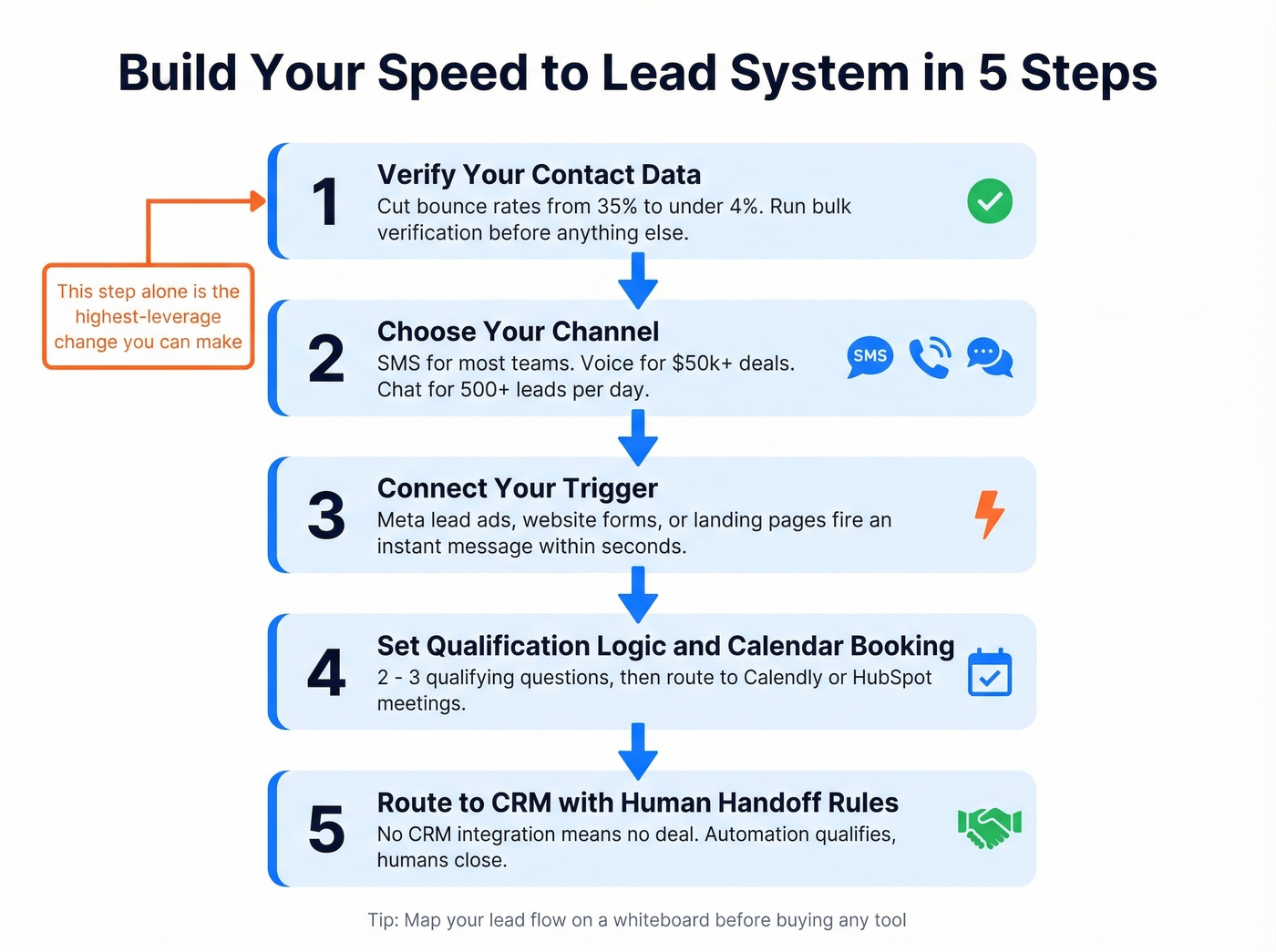
2. Choose your channel. SMS for most teams. Voice if you're selling $50k+ deals. Chat if you're handling 500+ inbound leads per day.
3. Connect your trigger. Meta lead ads, website forms, or landing pages should fire an instant message within seconds of submission. This is where AI inbound lead response truly starts - the moment a prospect raises their hand, your system should already be replying. (If you’re aligning this with your motion, see inbound vs outbound sales strategy.)
4. Set qualification logic and calendar booking. Branching questions filter tire-kickers, then route qualified leads straight to Calendly or HubSpot meetings. Keep the logic simple at first: two or three qualifying questions, then a booking link. You can always add complexity later.
5. Route to CRM with human handoff rules. Tools that don't integrate into CRM workflows create data silos and broken handoffs. This step makes or breaks the system. If your automation tool doesn't natively connect to your CRM, walk away.
Three Mistakes That Kill ROI
Map your lead flow on a whiteboard before you swipe a credit card. Don't buy a $5,000/mo tool before you know your process works. The consensus on r/AskMarketing is blunt - buying tools before fixing process backfires every time. (If you’re diagnosing why leads stall, review common sales pipeline challenges.)
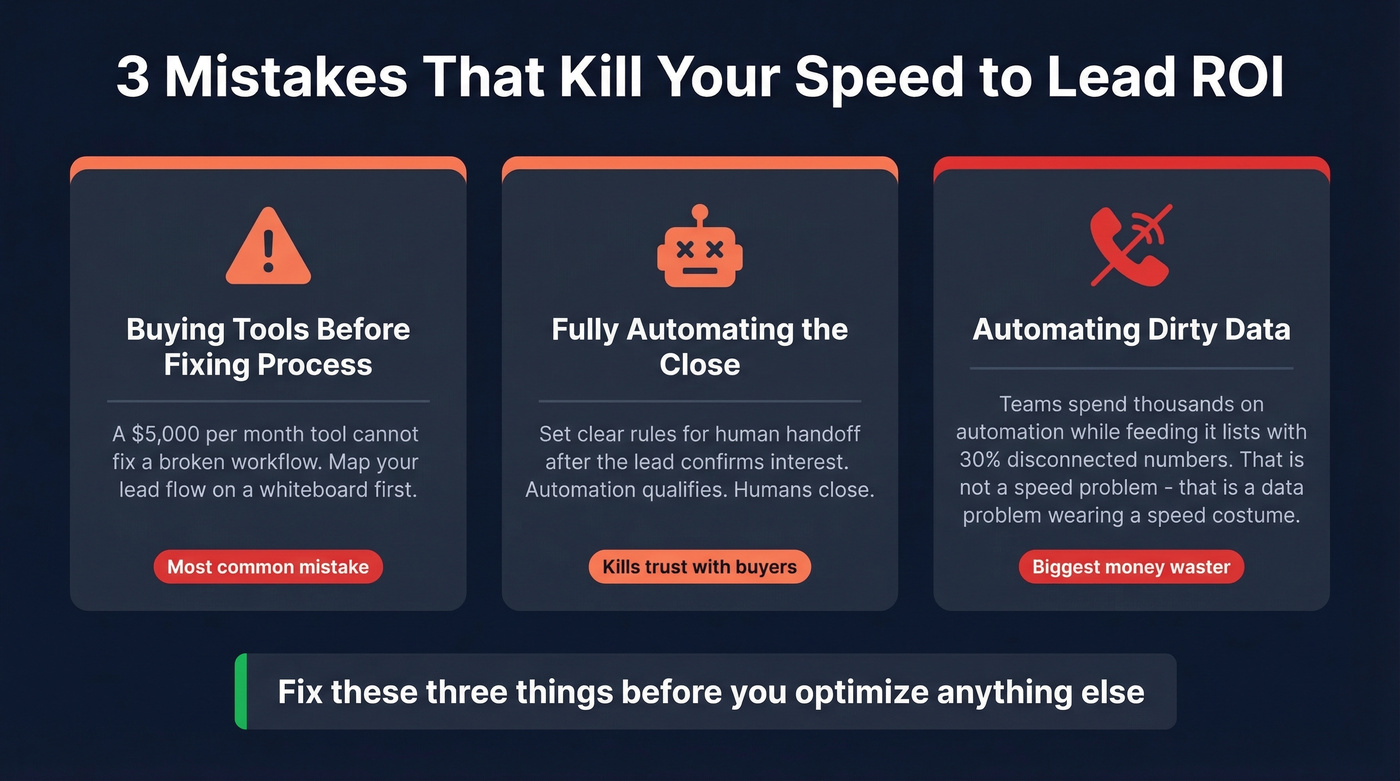
Set clear rules for when a human takes over - typically after the lead confirms interest and books a meeting. Don't fully automate the close. Automation qualifies. Humans close.
Verify your data before you optimize your speed. I've talked to teams who spent thousands on automation while feeding it lists with 30% disconnected numbers. That's not a speed problem. That's a data problem wearing a speed costume.
FAQ
What's a good AI lead response time?
Under 60 seconds. The original HBR research set the bar at 5 minutes, but in 2026 the practical target is seconds - many teams aim for automated SMS in 10-15 seconds. Cutting response time from minutes to under a minute is the single highest-leverage change most sales teams can make.
Does AI-powered lead response work for service businesses?
Yes, but SMS often outperforms voice AI for trades like HVAC and plumbing. The big risk with voice is hang-ups when prospects realize it's not a human - a quick text at 10-15 seconds typically gets 2-3x higher engagement than a robocall.
How much does speed-to-lead automation cost?
Starts around $49/mo with Apten for basic automation, up to $5,000/mo with Verse.ai for a managed AI-plus-human hybrid. Budget $200-500/mo for most SMB setups, plus minimal data verification costs.
How do I make sure my lead data is clean before automating?
Run bulk email and phone verification before connecting any automation. A 5-step verification process with catch-all handling and spam-trap removal is the baseline - anything less and you're feeding garbage into your speed-to-lead system.
The teams winning with speed to lead AI in 2026 aren't just fast. They're fast with clean data. Everything else is noise.